
How Much Does It Cost to Recruit a Caregiver? (2026 Data)
Across 24 caregiver and home health aide campaigns run in 2025 and 2026, the average cost per applicant was $3.47. Individual agencies ranged from $1.22 to roughly $15 depending on market density and service area. For context, replacing a single caregiver who leaves is commonly estimated to cost between $2,600 and $5,000.
See what caregiver hiring costs in your service area →
Why this number is so hard to find
Search for caregiver recruitment costs and you'll run into a problem quickly: the most widely cited figure in home care comes from a myCNAjobs analysis published in 2018, which put average caregiver cost per hire at just over $550. It sits alongside our wider healthcare recruiting figures.
That was a genuinely useful piece of work. It is also eight years old. It predates the pandemic, the wage compression that followed, the collapse and partial recovery of the direct care labor market, and the near-total shift of caregiver job search to mobile.
Everything else available is generic HR content — SHRM's $5,475 national average, healthcare quoted somewhere between $3,000 and $12,000 depending on which calculator you land on. None of it separates a caregiver from a nurse practitioner, and none of it tells you what it costs to generate an application.
So here is current data. Not cost per hire, which bundles recruiter time and onboarding. Cost per applicant — the number you need to build an advertising budget.
What caregiver applicants cost in 2025–2026
From 24 caregiver and home health aide campaigns across our home care and senior living clients, representing 4,562 applications:
| Metric | 2025–2026 caregiver campaigns |
|---|---|
| Average cost per applicant | $3.47 |
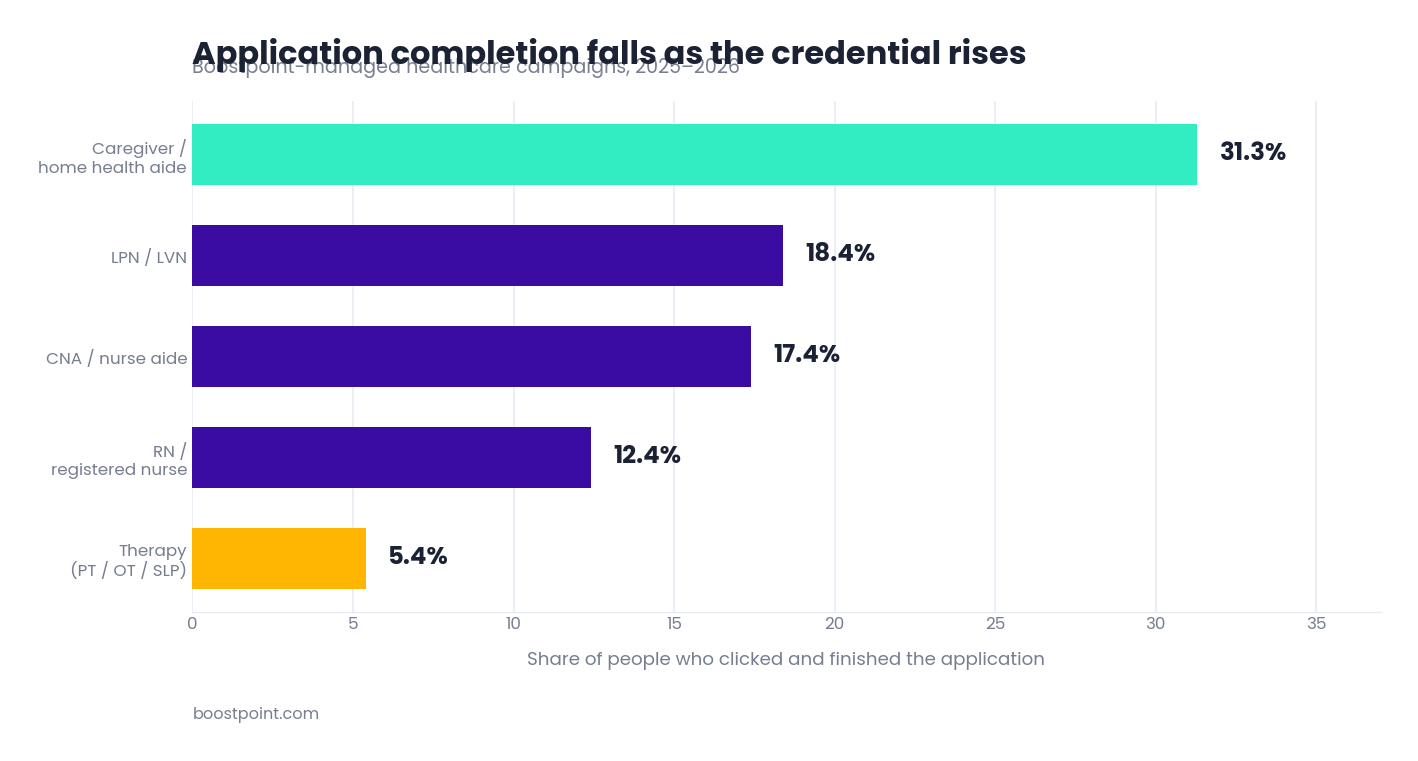
| Application completion rate | 31.3% |
| Applications in sample | 4,562 |
| Campaigns | 24 |
For comparison across the clinical ladder: a CNA applicant cost $6.82, an LPN $12.14, and an RN $15.93. Caregivers are the least expensive clinical-adjacent role to recruit, largely because the eligible population in any market is far larger — most states require training rather than licensure. We break that ladder down in full in what it costs to recruit an RN, LPN or CNA.
Caregiver campaigns also convert better than anything else we run in healthcare. A 31.3% click-to-application rate means roughly one in three people who tap the ad finish the form — more than double what clinical roles achieve, because caregiver applications are short enough to complete on a phone.
How wide the range actually is
Averages hide the thing you most need to know. Across our home care and senior living clients, cost per applicant runs from a little over a dollar in dense suburban service areas to the mid teens in thin rural ones — a six-fold spread on the same channel, run the same way.
None of that is a difference in how well the campaigns were built. It's almost entirely where the agency operates and what it asks for. The next section covers what actually moves your number.
Home care and senior living organizations recruiting with Boostpoint
Three things that move your number
1. How dense your service area is
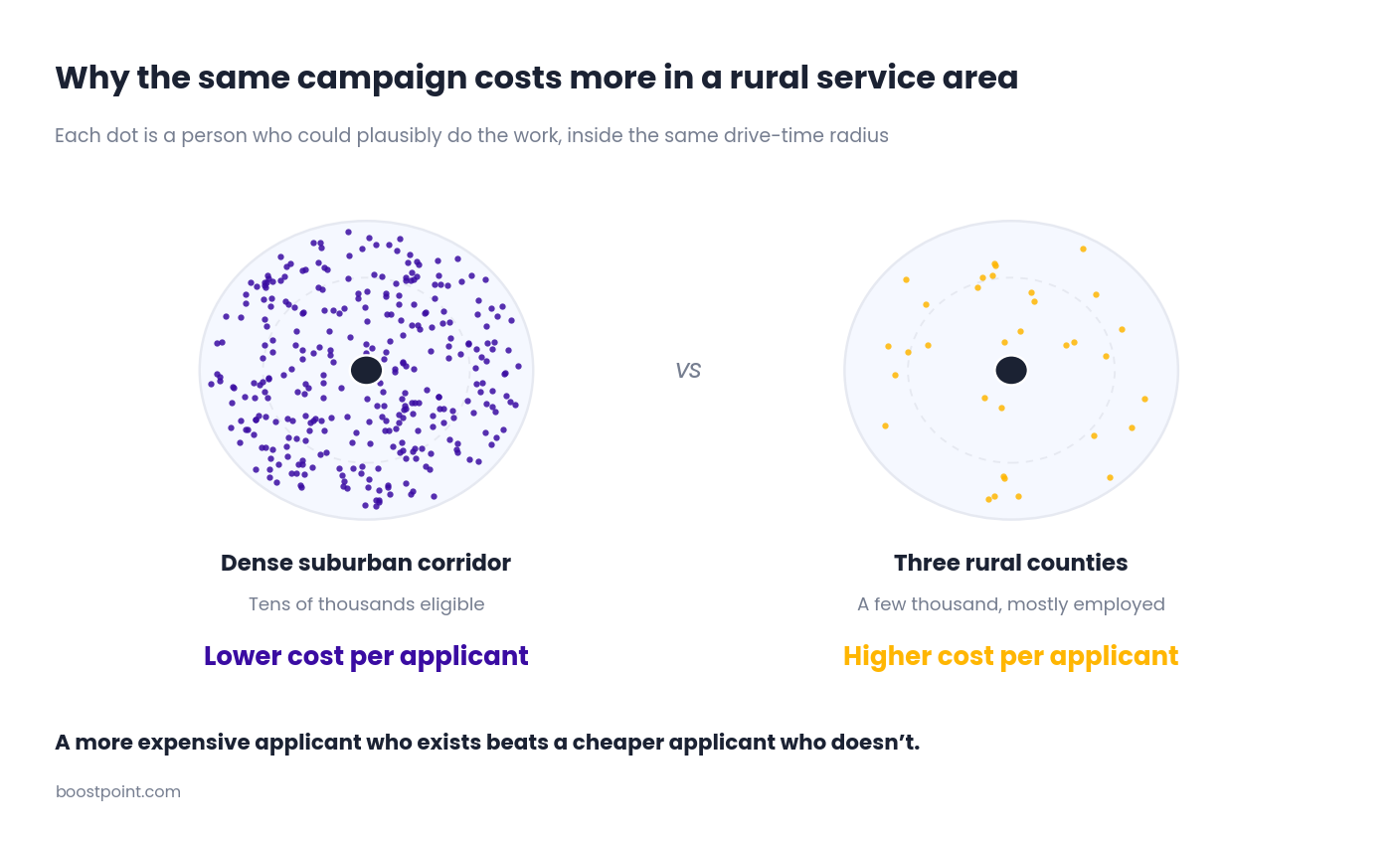
This is the biggest factor by far. An agency covering a dense suburban corridor is advertising into a population of tens of thousands of people who could plausibly do the work. An agency covering three rural counties is advertising into a few thousand, most of whom already have a job.
Rural service areas cost more per applicant. They're also where job boards produce almost nothing, because a job board needs someone to actively search — and in a thin market, there may be nobody searching that week. A $9 applicant who exists is a better outcome than a $0 applicant who doesn't.
2. How tightly you screen
Every knockout question you add filters more applicants out before submission, which raises cost per applicant and lowers the screening load on your scheduler. Requiring reliable transportation, a specific travel radius, weekend availability and two years of experience will produce fewer, better applications at a higher unit cost.
Neither setting is automatically right. An agency with one scheduler and forty open shifts should screen harder. An agency with capacity to train can cast wider. The point is that this is a dial you control, and most agencies don't realize they're holding it.
3. The shift and the schedule
Overnight, weekend and short split shifts are consistently the hardest to fill, because the small group of people actively job hunting self-selects toward convenient schedules. Reaching people who weren't looking is precisely what widens the pool for the shifts that stay open longest.
Put $3.47 next to what turnover costs you
This is the comparison that reframes the budget conversation.
Median caregiver turnover ran about 75% in 2024. Nearly four out of five caregivers who leave do so within their first 100 days. Industry estimates put the cost of a single caregiver departure — recruitment, training, lost productivity, agency coverage — between $2,600 and $5,000.
Your cost to generate a caregiver applicant is $3.47.
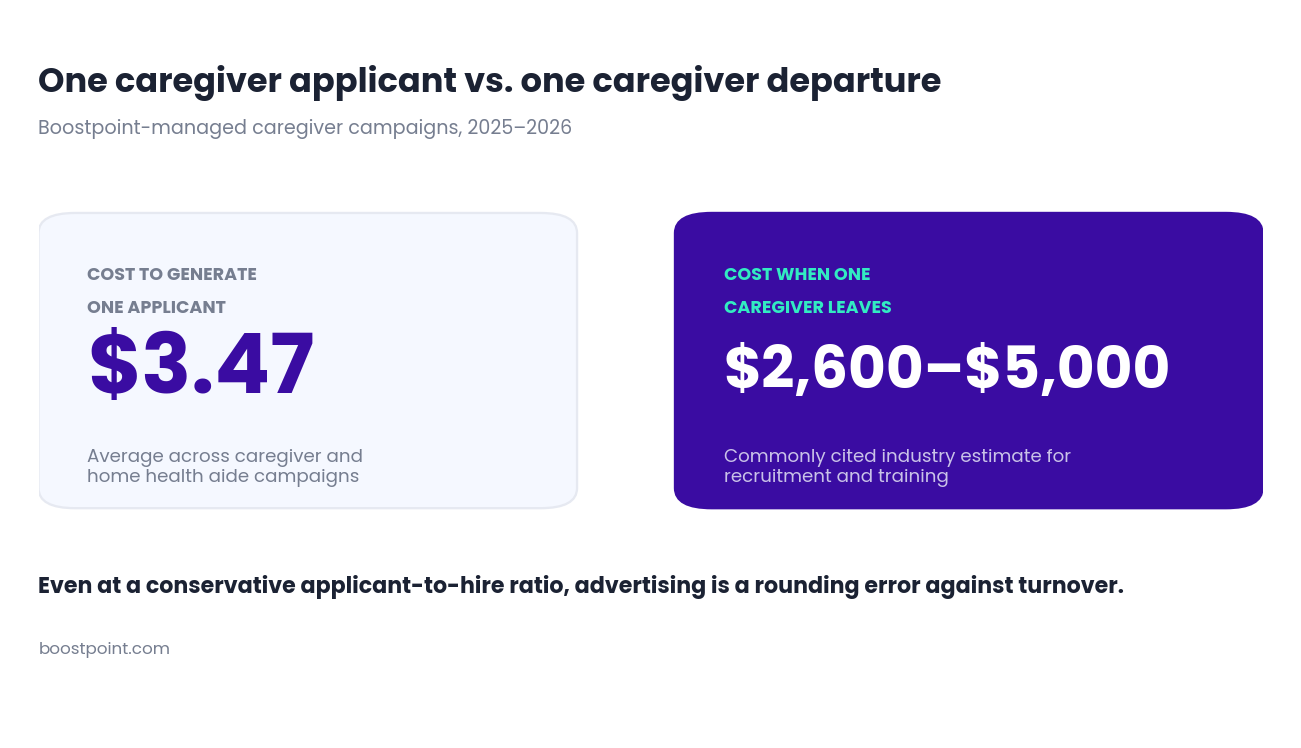
Even at a conservative applicant-to-hire ratio, the advertising cost of replacing a caregiver is a rounding error against the cost of losing one.
For most agencies the binding constraint has never been ad budget. It's whether enough qualified people ever see the role, and how quickly someone follows up when they do.
There's a second implication worth sitting with. If four in five departures happen inside 100 days, and shift or travel mismatch is a leading cause, then screening for shift availability and travel radius at the point of application isn't just a cost lever — it's a retention lever. The cheapest caregiver you hire is the one who stays.
"We're already on Indeed"
Almost every agency owner we talk to says a version of this, usually with a sigh attached.
Most aren't happy with it. They'll tell you applicant quality has slipped, the same names recycle through, ghosting is worse than it used to be, and cost keeps creeping. They stay because it's familiar — the postings are written, the dashboard is known, and switching feels like one more project in a year that's already full.
That's an honest reason to be cautious. It isn't a reason to skip the arithmetic.
Calculate what a qualified caregiver applicant costs you today. Total spend on the channel, divided by applicants who actually met your minimums — not total applications.
Most agencies have never run that number, because job board reporting gives you applications and spend but nothing about quality.
Do it for one month. If it beats $3.47, your channel is working and you've spent twenty minutes confirming it. If it doesn't, you now know the size of the gap.
And to be clear: most of our home care clients still run job boards. The two channels do different work. Boards capture the people already searching. Social reaches the much larger group who aren't — the CNA at the facility across town who'd move for a shorter drive and a dollar more. Where social genuinely displaces spend is staffing agency coverage, which costs multiples of either. For the same comparison across every frontline role, see our frontline hiring benchmarks.
"We don't have photos or videos to run ads with"
The second objection we hear most, and the easiest one to put down.
Agencies assume social recruiting needs a content library — caregiver photos, video of the team, someone to shoot and edit it. Most have a logo, a few stock images from their website build, and no capacity to produce more. It's a reasonable conclusion that you're not ready.
You don't need any of it. The ad creative is built for you from the job description — video and static, written, produced and refreshed before it fatigues. If you have real footage of your caregivers, it helps, and we'll use it. If you don't, the campaign runs anyway and performs.
The same goes for the implementation worry. Nobody has bandwidth to roll out a new platform during a staffing crisis. What's actually required from you is a job description, your pay range and shift, and the ZIP codes you serve. The campaign build, targeting, optimization and reporting happen on our side.
When advertising isn't the answer
- A single opening. The economics favor continuous or seasonal hiring need. For one shift, your referral program is usually cheaper and faster.
- When your rate is below market. If the agency across town pays two dollars more, advertising will surface that faster and more expensively. Fix the offer first — no channel outruns a bad one.
- If nobody can call back the same day. Caregivers apply to several agencies in one sitting and go cold within hours. Without someone working the list, you'll pay for applicants you never reach.
- Specialized clinical roles. Nurse practitioners and specialized therapists are search-firm work. The licensed population is too small for a broad-reach channel.
Frequently asked questions
How much does it cost to recruit a caregiver?
In our 2025–2026 campaigns, caregiver and home health aide applicants averaged $3.47 each across 24 campaigns and 4,562 applications. Individual agencies ranged from $1.22 to about $15 depending on service area density, screening strictness and shift requirements.
Is that cost per hire or cost per applicant?
Cost per applicant — what it costs to generate one completed application. Cost per hire is a much larger number that also includes recruiter time, background checks, training and the cost of the open shift. The most-cited caregiver cost-per-hire figure, just over $550, comes from a 2018 analysis and predates most of what has changed in this labor market.
Why do some agencies pay $1 and others pay $9?
Service area density is the biggest factor. Dense suburban corridors have far more eligible people per square mile than rural counties. Screening strictness and shift requirements are the other two — tighter knockout questions and harder shifts both raise cost per applicant while lowering the screening burden on your scheduler.
Does this work in rural service areas?
Yes, and it's often where the difference versus job boards is largest. Cost per applicant runs higher because the pool is thin, but job boards depend on someone actively searching — and in a rural market, there may be nobody searching this week. A more expensive applicant who exists beats no applicant at all.
How does this compare to what caregiver turnover costs?
A caregiver departure is commonly estimated at $2,600 to $5,000 in recruitment and training. A caregiver applicant costs $3.47. Even at a conservative applicant-to-hire ratio, advertising is a rounding error against turnover — which is why flow and follow-up speed matter more than ad budget for most agencies.
We already use Indeed. Why change?
Most of our home care clients run both. Job boards capture people already searching; social reaches the larger group who aren't. The useful step is calculating your current cost per qualified applicant — most agencies have never done it, because job board reporting shows spend and applications but nothing about quality.
Do we need our own photos or video?
No. Ad creative is produced for you from the job description, including video, and refreshed before it fatigues. Your own footage helps if you have it, but nothing is required to launch.
How much work is this for our team?
You provide a job description, your pay range and shift, and the areas you serve. Campaign build, targeting, optimization and reporting are handled for you. The part that genuinely requires your team is following up with applicants quickly — that's the step no vendor can do for you.
See what caregiver hiring costs in your area
Book a 20-minute call and we'll walk through cost per applicant for your service area, shifts and screening requirements.
Book a Free DemoFigures come from Boostpoint-managed caregiver and home health aide campaigns run between January 2025 and mid-2026, drawn from a wider set of 478 healthcare campaigns across 30 employers representing 24,712 applications. Costs are what advertisers paid, inclusive of campaign management, and cover advertising only — not recruiter time, screening or onboarding. This is a sample of Boostpoint campaigns, not an industry-wide study.
Related: Healthcare Recruiting · What It Costs to Recruit an RN vs LPN vs CNA · Frontline Hiring Benchmarks