
What It Costs to Recruit an RN vs. an LPN vs. a CNA (2026 Data)
Across 478 Boostpoint-managed healthcare recruitment campaigns run in 2025 and 2026, cost per applicant rose steadily with the credential: $3.47 for a caregiver, $6.82 for a CNA, $12.14 for an LPN, $15.93 for an RN, and $40.93 for a licensed therapist. That's a twelve-fold spread — and it means a single blended recruiting budget will always underfund your hardest roles.
Source: 478 Boostpoint-managed healthcare recruitment campaigns across 30 employers, January 2025 through mid-2026, representing 18,553,441 impressions and 24,712 applications on Meta platforms. Boostpoint's canonical 2026 Social Job Advertising Benchmark (891 campaigns, single methodology) reports median cost per applicant of $3.76 for caregivers, $7.72 for CNAs, $12.77 for LPNs and $19.08 for RNs; where this earlier analysis and the benchmark differ, the benchmark figure is canonical.
The number almost nobody publishes
If you search for what it costs to recruit a nurse, you'll find cost-per-hire figures. SHRM puts the average U.S. cost per hire at roughly $5,475 for non-executive roles. Healthcare is commonly quoted somewhere between $3,000 and $12,000 depending on the source, because credentialing, licensing verification and clinical onboarding all add cost. This page is a companion to our wider healthcare recruiting data.
Those numbers are useful for a board deck. They're close to useless for planning a recruitment advertising budget, for two reasons.
First, they blend every role in a health system together — a per-diem CNA and a specialized RN sit inside the same average, and they behave nothing alike. Second, cost per hire bundles advertising with recruiter salaries, background checks, drug screening, orientation and equipment. And it is paid again every time the post reopens, which on the federal numbers is almost always: see the CNA shortage. If you're deciding how much to spend to generate applicants, none of that helps you.
What you actually need is cost per applicant, by role. Here is ours.
Cost per applicant by clinical role
From 478 Boostpoint-managed healthcare campaigns across 30 employers between January 2025 and mid-2026 — 18.5 million impressions and 24,712 applications:
| Role | Cost per applicant | Applications in sample | Campaigns |
|---|---|---|---|
| Caregiver / home health aide | $3.47 | 4,562 | 24 |
| CNA / nurse aide | $6.82 | 506 | 21 |
| LPN / LVN | $12.14 | 1,552 | 34 |
| RN / registered nurse | $15.93 | 2,976 | 123 |
| Therapy (PT / OT / SLP) | $40.93 | 132 | 12 |
Source: 478 Boostpoint-managed healthcare recruitment campaigns across 30 employers, January 2025 through mid-2026, representing 18,553,441 impressions and 24,712 applications on Meta platforms. Boostpoint's canonical 2026 Social Job Advertising Benchmark (891 campaigns, single methodology) reports median cost per applicant of $3.76 for caregivers, $7.72 for CNAs, $12.77 for LPNs and $19.08 for RNs; where this earlier analysis and the benchmark differ, the benchmark figure is canonical.
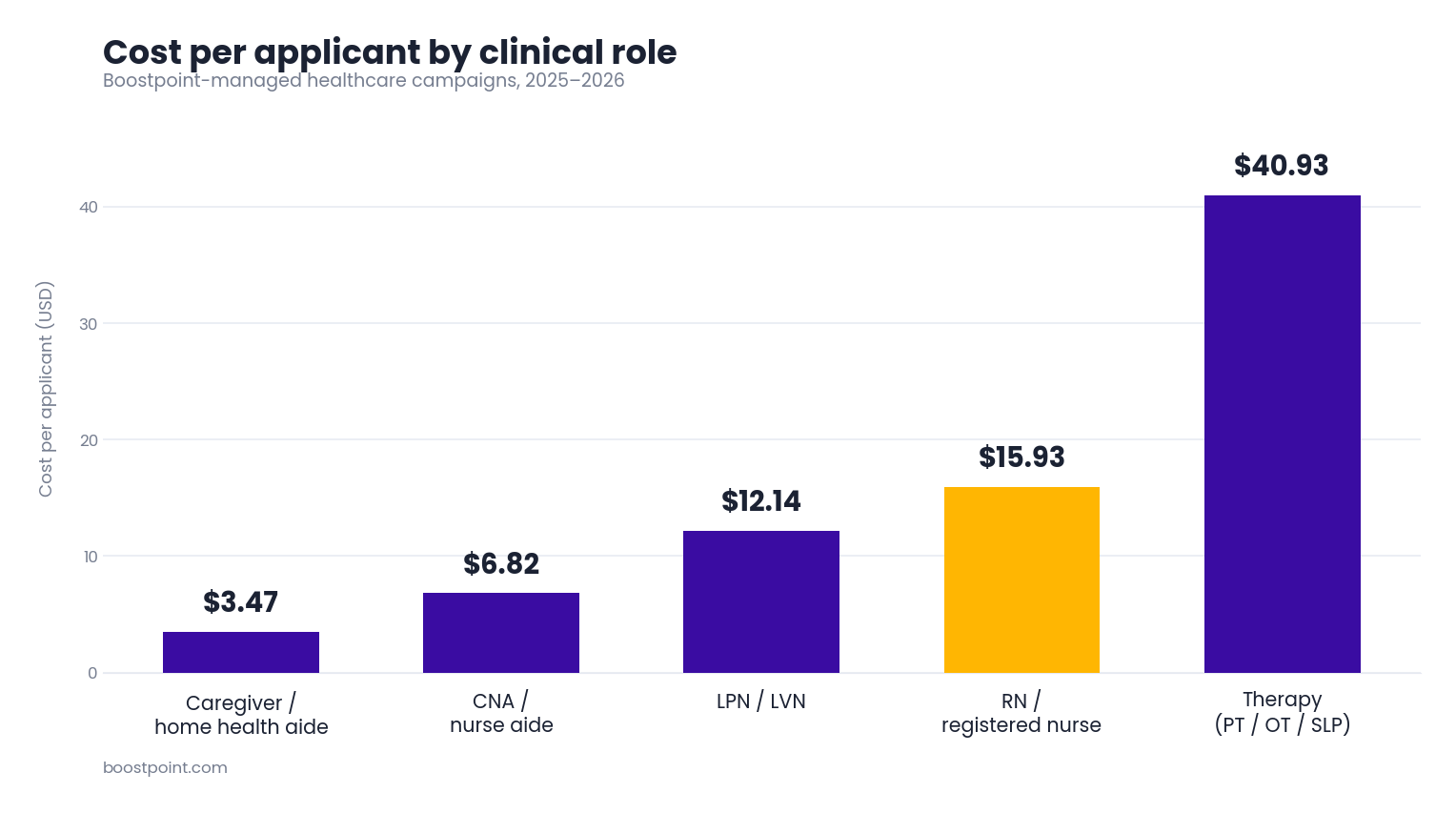
An RN applicant costs about 4.6 times a caregiver applicant. A therapist costs nearly twelve times.
Two caveats before you use these numbers. The CNA and therapy figures rest on smaller samples than the others and should be read as directional. And these are advertising costs only — they don't include recruiter time, credential verification, screening or onboarding. For the role itself, the duties, certification requirements and a posting template are on our CNA job description page. If you are weighing these against an agency, nurse staffing agency costs sets out what a per diem or travel RN bills at.
Why cost climbs with the credential
The instinct is to assume that harder jobs cost more to fill. That's roughly right here, but the actual mechanism is more specific and more useful for planning.
Cost tracks how many people within your radius hold the credential. Not how difficult the work is, and not how much the role pays.
In a metro service area, tens of thousands of people can legally work as a caregiver or home health aide. Several thousand hold an active CNA certificate. Several hundred to a few thousand are licensed RNs, and many of those are already employed by a health system with retention programs. The licensed therapist population is smaller again, often numbering in the dozens for a given specialty and geography.
Every step up that ladder shrinks the pool you're advertising into while the number of employers competing for it stays roughly constant. Cost follows.
The practical implication: when you build a recruitment budget, ask how many people within thirty miles hold the credential — not how senior or demanding the role is. That single question will predict your cost per applicant better than any national benchmark.
The finding we didn't expect: completion rates fall as credentials rise
Cost isn't the only thing that changes along the clinical ladder. So does the share of people who click an ad and actually finish the application.
| Role | Click-to-application rate |
|---|---|
| Caregiver / home health aide | 31.3% |
| LPN / LVN | 18.4% |
| CNA / nurse aide | 17.4% |
| RN / registered nurse | 12.4% |
| Therapy (PT / OT / SLP) | 5.4% |
Source: 478 Boostpoint-managed healthcare recruitment campaigns across 30 employers, January 2025 through mid-2026, representing 18,553,441 impressions and 24,712 applications on Meta platforms. Boostpoint's canonical 2026 Social Job Advertising Benchmark (891 campaigns, single methodology) reports median cost per applicant of $3.76 for caregivers, $7.72 for CNAs, $12.77 for LPNs and $19.08 for RNs; where this earlier analysis and the benchmark differ, the benchmark figure is canonical.
A caregiver applicant is roughly two and a half times as likely to complete an application as an RN, and nearly six times as likely as a therapist.
Some of that is genuine: higher-credentialed candidates are more selective, more likely to be employed, and less likely to move on a whim. But a meaningful share of it is self-inflicted.
Clinical applications are usually longer. They ask for license numbers, certification dates, specialty experience, references and sometimes a resume upload — at the very front of the process, from someone tapping an ad on a phone during a break. Every one of those fields costs completions.
If your RN application takes more than about a minute to finish on a phone, your completion rate is a form problem, not a candidate-quality problem.
Ask the two or three things that genuinely disqualify someone — active license, state, shift availability — and save credential verification for after you've made contact. It's the cheapest improvement available in clinical recruiting and it doesn't require another dollar of budget.
Cost also depends on where the role sits
The same job title behaves differently across care settings. Our campaigns, broken out:
| Setting | Cost per applicant | Applications | Completion rate |
|---|---|---|---|
| Senior living & skilled nursing | $6.11 | 6,781 | 22.1% |
| Home care | $8.40 | 12,941 | 21.6% |
| Hospital & health system | $17.82 | 3,933 | 6.0% |
| Behavioral health & IDD | $51.26 | 640 | 0.9% |
Source: 478 Boostpoint-managed healthcare recruitment campaigns across 30 employers, January 2025 through mid-2026, representing 18,553,441 impressions and 24,712 applications on Meta platforms. Boostpoint's canonical 2026 Social Job Advertising Benchmark (891 campaigns, single methodology) reports median cost per applicant of $3.76 for caregivers, $7.72 for CNAs, $12.77 for LPNs and $19.08 for RNs; where this earlier analysis and the benchmark differ, the benchmark figure is canonical.
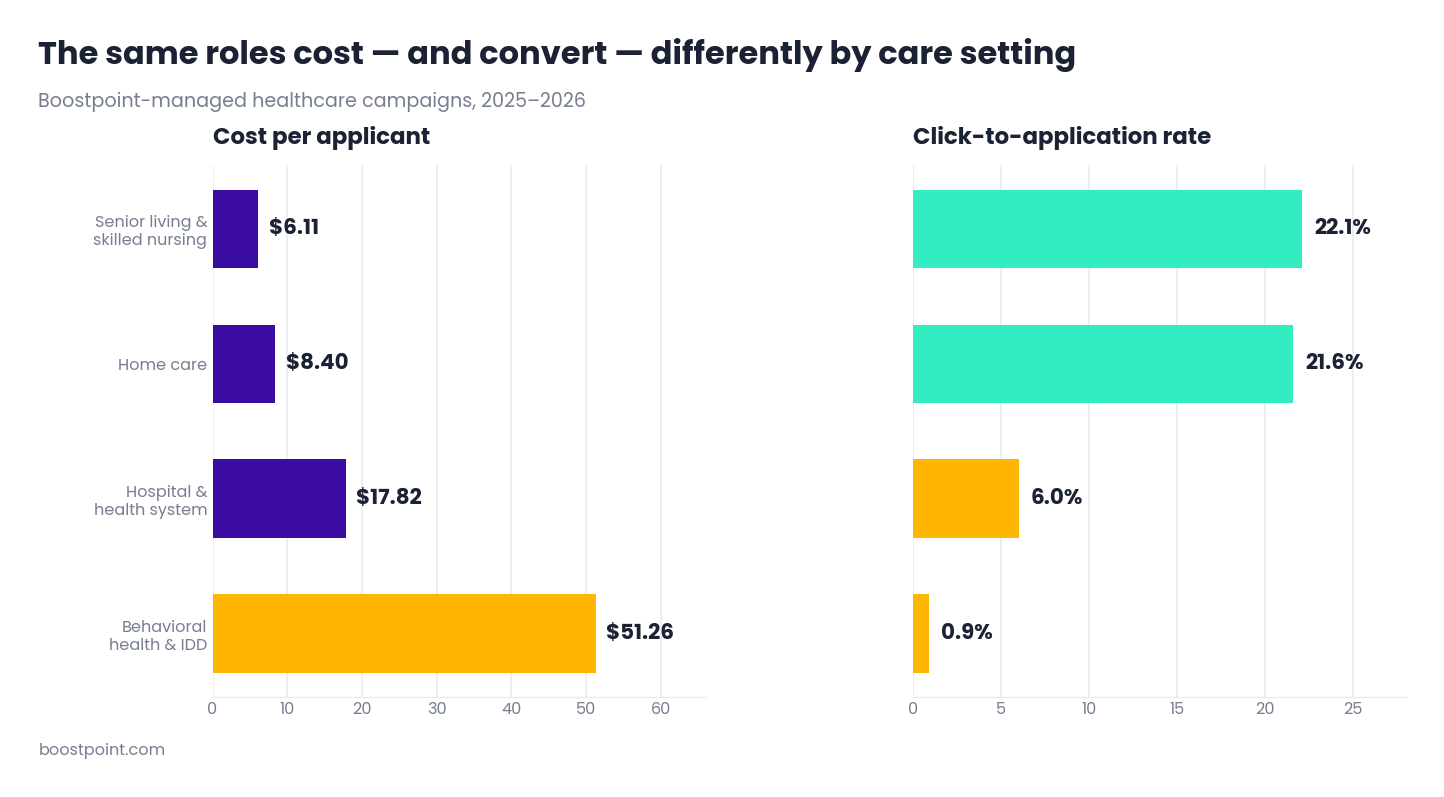
Two things stand out.
Senior living and skilled nursing are cheaper than home care, which inverts what most operators assume. Facility-based roles have a fixed location, predictable shifts and no travel requirement — all of which widen the pool of people who can realistically say yes.
Hospital and health system campaigns convert at 6% against 22% for senior living. That's not candidate quality. Health systems run the longest applications in healthcare, usually routed through an enterprise ATS with account creation before the first question. If you work in hospital TA, that gap is the most valuable number on this page.
What this looks like in practice
The range across our healthcare clients is wide. Home care agencies hiring caregivers inside a defined service area sit at one end. Health systems hiring clinical staff across large multi-state footprints sit at the other.
That gap isn't a difference in execution quality. It's role mix, market density and setting — the same three factors the tables above break down.
Healthcare organizations recruiting with Boostpoint
Which is the point: your number will be determined mostly by what you're hiring and where, not by how well you run ads. Knowing which band you belong in is worth more than any national average — and if you want the picture across every frontline role rather than just clinical ones, our frontline hiring benchmarks cover thirteen roles across six industries.
"We already use Indeed"
This is the most common thing we hear, and it's usually said with a sigh.
Most healthcare recruiters we talk to aren't happy with their job board results. They know applicant quality has slipped, they know the same candidates recycle through, and they know cost has crept up. They keep going because it's the system they know, the postings are already written, and the reporting is familiar.
That's a legitimate reason to be cautious. It isn't a reason not to measure.
The comparison to run is simple: what does a qualified applicant cost you today, by role, on your current channel? Most healthcare teams have never calculated it, because job board reporting shows spend and applications but rarely separates a CNA from an RN, or a qualified applicant from a click.
Run that number for one role. If it beats what's on this page, you've confirmed your channel works and you've lost thirty minutes. If it doesn't, you now know what the gap is worth.
Worth noting: most of our healthcare clients still run job boards. The channels do different jobs — boards capture the people already searching, social reaches the much larger group who aren't. Where social tends to replace spend is agency and travel staffing fees, which cost multiples of either.
"We don't have the photos or videos to make this work"
The second most common objection, and the easiest to resolve.
Agencies and facilities often assume social recruiting requires a content library they don't have — staff photos, facility footage, a videographer, someone to edit it all. Most healthcare organizations have a folder of stock images and a logo, and reasonably conclude they aren't ready.
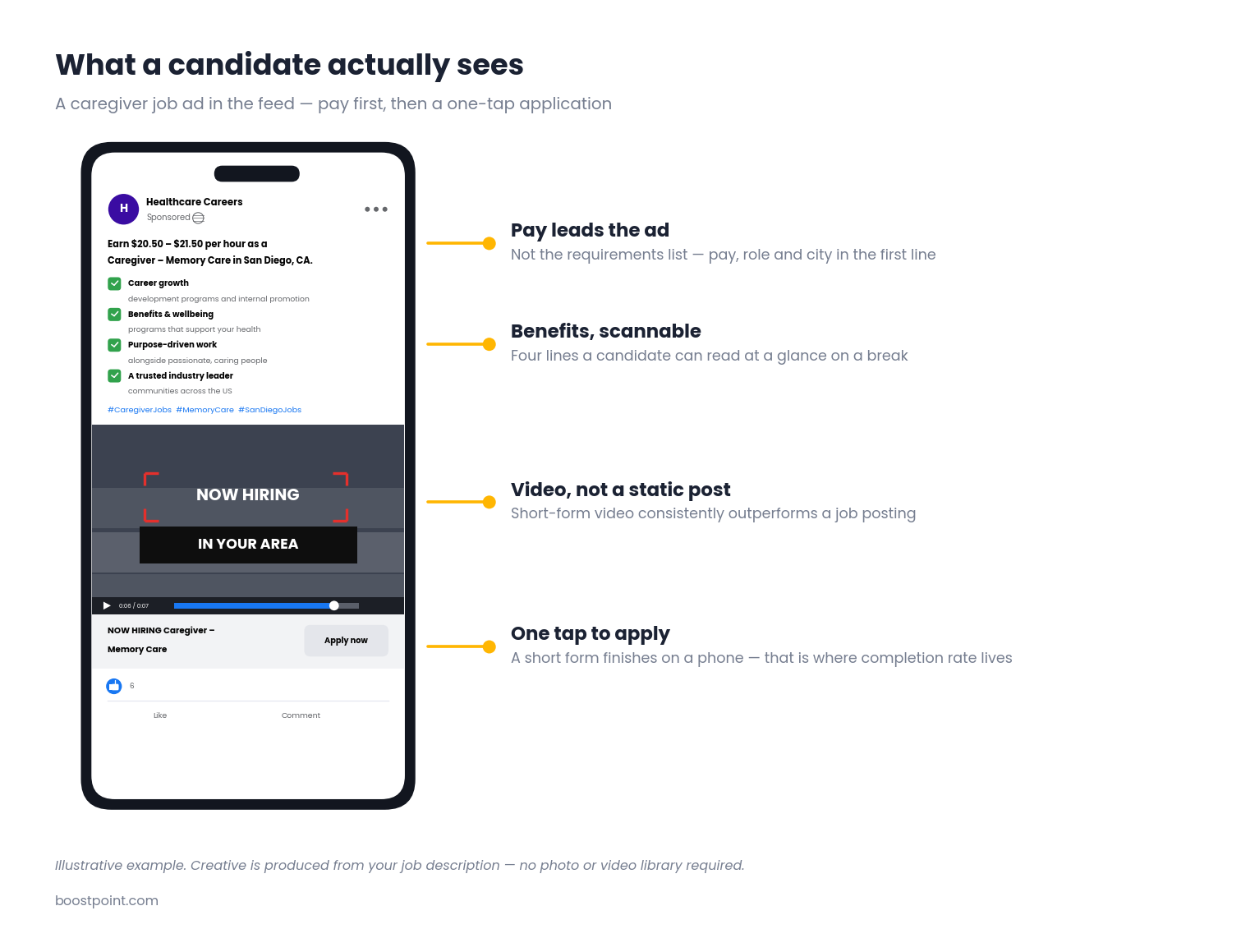
You don't need any of it. Ad creative is built for you from the job description — video and static, written and produced, refreshed before it fatigues. If you have footage or staff photos you're proud of, they help. If you don't, the campaign runs anyway.
The same applies to the implementation concern. Nobody has capacity to roll out another platform in a quarter where you're already short-staffed. The starting requirement is a job description, your pay range and shift, and the markets you're hiring in. Everything else is handled on our side.
When advertising isn't the right answer
- Specialized clinical and leadership roles. Nurse practitioners, specialized therapists, directors of nursing — the licensed population is too small for a broad-reach channel. Our therapy numbers show what happens as the pool narrows. Use a search firm.
- A single opening. The economics favor steady or repeat hiring need. For one role, your referral program is usually cheaper.
- When pay or shift is the real problem. If your rate is below what the facility down the road offers, advertising surfaces that faster and more expensively.
- If nobody can follow up same-day. Applicants arrive in volume and go cold within hours. Without a scheduler working them, you'll pay for candidates you never reach.
RN, LPN and CNA cost per applicant: the latest 12 months
Boostpoint's newest cut of its own campaign data, Boostpoint-managed Meta campaigns from October 2025 through September 2026, puts the median RN applicant at $20.73, the median LPN applicant at $14.95 and the median CNA applicant at $7.55.
| Role | Median cost per applicant | Middle half of campaigns | Clicks that became applicants | Campaigns |
|---|---|---|---|---|
| RN / registered nurse | $20.73 | $13.89–$33.70 | 11.1% | 201 |
| LPN / LVN | $14.95 | $10.89–$30.60 | 19.2% | 57 |
| CNA / nurse aide | $7.55 | $6.42–$11.08 | 17.3% | 18 |
Sample: Boostpoint-managed Meta campaigns, October 2025–September 2026. Cost per applicant is what advertisers paid; it is not cost per hire. The CNA row rests on 18 campaigns, so treat it as directional.
The ladder holds in the newer data: cost still rises with the credential, and RN campaigns still convert the smallest share of clicks of the three. For reference, Boostpoint's 2026 Social Job Advertising Benchmark reports medians of $19.08 for RNs, $12.77 for LPNs and $7.72 for CNAs, and the 2025–2026 table higher on this page comes from a separate, earlier analysis. For CNA hiring specifically, see CNA recruitment.
Where to find LPNs: the settings they work in and the programs that train them
The LPN numbers above sit in the middle of the ladder for a reason: the pool is mid-sized and mostly employed. The BLS Occupational Outlook Handbook counts the largest employers of LPNs and LVNs as nursing and residential care facilities (37%), hospitals (16%), home healthcare services (12%) and physicians' offices (11%). BLS Employment Projections 2025-35 put the occupation at 666,900 jobs in 2025 with about 51,800 openings a year, and the BLS, May 2025 median annual wage was $64,400. That tells you where to look.
- In the facilities you compete with. Most LPNs you could hire are working a shift somewhere else within driving distance. They are not searching, so a job board posting reaches only the few who are. A Facebook and Instagram ad scoped to commuting distance reaches the rest, subject to Meta's special ad category rules (no age, gender or ZIP code targeting, 15-mile minimum radius).
- In the practical nursing programs. BLS notes that LPN certificate and diploma programs are commonly found in community colleges and technical schools and typically take about one year. Graduates still have to pass the licensing exam (the NCLEX-PN) before they can practice, so build the relationship with clinical instructors before graduation, not after.
- On your own CNA roster. A CNA who finishes a practical nursing program is the cheapest LPN you will ever hire. Tuition help and flexible shifts during school are recruiting spend, not just benefits.
- In home health and physician offices. LPNs who left facility work for daytime or one-patient schedules can come back for the right shift. Say the shift plainly in the ad.
If you hire across state lines, check whether the license transfers; our guide to compact nursing states covers multistate licenses. On cost, the LPN / LVN family in Boostpoint's 2026 Social Job Advertising Benchmark had a median of $12.77 per applicant, a middle half of $7.53 to $21.46 and a 21% apply rate.
Frequently asked questions
How much does it cost to recruit an RN?
In our 2025–2026 campaigns, RN applicants cost $15.93 each on average across 123 campaigns and 2,976 applications. That covers advertising only. Total cost per hire — including recruiter time, credentialing and onboarding — runs considerably higher, and is commonly estimated between $3,000 and $12,000 for healthcare roles depending on the source.
What does it cost to recruit a CNA?
CNA and nurse aide applicants averaged $6.82 in our campaigns — roughly double a caregiver and about 43% of an RN. That figure rests on a smaller sample than our caregiver or RN data, so treat it as directional.
Why do therapists cost so much more to recruit?
Because the licensed population in any given market is very small and largely employed. Our therapy campaigns averaged $40.93 per applicant with a 5.4% application completion rate. For specialized therapy roles, a search firm is usually the better tool.
Is cost per applicant the same as cost per hire?
No, and confusing them is the most common budgeting mistake in healthcare recruiting. Cost per applicant is what you pay to generate one application. Cost per hire includes advertising plus recruiter time, screening, credential verification, background checks, onboarding and the cost of the vacancy itself. Advertising is one line inside a much larger number.
Why is our application completion rate so low?
Almost always form length. Our data shows completion falling from 31% for caregiver roles to 12% for RN roles and 5% for therapy — largely because clinical applications front-load license numbers, certification dates and resume uploads. Ask only what genuinely disqualifies someone and verify credentials after contact.
Does this work if we already use Indeed?
Most of our healthcare clients run both. Job boards capture people already searching; social advertising reaches the larger group who aren't looking. The useful exercise is calculating your current cost per qualified applicant by role — most teams have never done it, because job board reporting doesn't separate a CNA from an RN.
Do we need our own photos and videos?
No. Ad creative is produced for you from the job description, including video, and refreshed before it fatigues. Your own footage helps if you have it, but nothing is required to launch.
How long before we see applicants?
Campaigns typically produce applicants within days of launch, though the first two weeks are a learning period while the platform calibrates. Judging performance on fewer than three weeks of data usually leads to the wrong conclusion.
How do you hire LPNs?
Advertise the specific role and shift on its own (not bundled with RN and CNA openings), put the hourly rate and unit or setting in the first line, and ask only the knockouts that matter: an active LPN or LVN license, the state, and which shifts the person can work. Verify the license with the state board after you have spoken, and call applicants the same day. Our LPN job description and LPN interview questions cover the ad and the interview.
Where do you find LPNs to hire?
Mostly in nursing and residential care facilities, which employ 37% of LPNs and LVNs according to the BLS Occupational Outlook Handbook, followed by hospitals, home healthcare and physicians' offices. Reach the employed ones with local social job ads, build ties with community college and technical school practical nursing programs, and support your own CNAs through LPN school.
See what your roles cost to fill
Book a 30-minute call and we'll walk through cost per applicant for the specific roles, shifts and markets you're hiring for.
Book a Free DemoFigures come from 478 Boostpoint-managed healthcare recruitment campaigns across 30 employers, January 2025 through mid-2026, representing 18,553,441 impressions and 24,712 applications on Meta platforms. Costs are what advertisers paid for advertising only. Role-level figures are drawn from campaigns where the role was identifiable; the CNA and therapy samples are smaller and noted as directional. This is a sample of Boostpoint campaigns, not an industry-wide study.
Related: Healthcare Recruiting · How Much Does It Cost to Recruit a Caregiver? · Frontline Hiring Benchmarks