
Nurse Staffing Agency Costs: What the Bill Rate Pays For, and the States That Cap It
A nurse staffing agency bills a per diem RN at a 35–50% markup on the wage (AMN Healthcare), a travel nurse at 40–70% above staff rates (DirectShifts), and a direct hire at 18–25% of first-year salary. Hospitals surveyed by NSI in 2026 reported an average travel nurse fee of $91.23 an hour against $59.46 for a staff RN with benefits. Two states publish legal maximums — Minnesota's 2026 RN cap is $78.51 an hour — and this page shows what is inside the rate, what the contract adds, and the arithmetic of a 78-day vacancy. The direct alternative is recruiting your own nurses: in Boostpoint's 2026 Social Job Advertising Benchmark, the median registered nurse applicant cost $19.08.
A note on who's writing this
Boostpoint is not a nurse staffing agency. We run social media job advertising for healthcare employers, which means we compete with agencies for the same budget, and you should read our framing with that in mind. What we can do that a neutral page usually can't is show our own numbers: the RN row of our 2026 Social Job Advertising Benchmark is on this page, with the methodology at the bottom. Every agency figure here is third-party and attributed, and where a public record exists — a state rate cap, a state labor department report, a public company's filing — we used it in preference to anyone's marketing. This page covers the nursing agency bill only. For the sector-wide comparison of agency fees against advertising, read healthcare staffing costs; for cost per applicant by clinical role, RN vs LPN vs CNA recruiting cost; for the float-pool alternative to per diem, PRN and per diem staffing costs.
Nurse staffing agency rates: the four ways you'll be billed
Nursing agency fees come in four shapes, and the first job is to know which one is on the quote. A per diem agency bills an hourly rate that is the nurse's wage plus a markup. A travel agency bills a weekly rate for a fixed contract, usually 13 weeks at 36 hours. A direct-hire or permanent-placement agency charges a one-time percentage of first-year salary. And nearly every temp arrangement carries a conversion fee if you hire the nurse permanently — except in Illinois, where that fee is now illegal, and in Minnesota, where every administrative charge has to fit inside the state cap.
| Arrangement | Typical charge | How it's billed | Source |
|---|---|---|---|
| Per diem RN | 35–50% markup on the hourly wage | Per hour, per shift, invoiced weekly or bi-weekly | AMN Healthcare |
| Travel nurse | 40–70% above staff nurse rates | Weekly bill rate for a fixed contract, typically 13 weeks × 36 hours | DirectShifts |
| Travel nurse, hospital-reported average | $91.23 per hour · $189,758 per year | What 527 surveyed hospitals said they actually pay, 2026 | NSI Nursing Solutions |
| Direct hire (permanent placement) | 18–25% of first-year salary | One-time fee, due when the nurse starts | AMN Healthcare |
| Conversion (temp to permanent) | Varies by contract; prohibited in Illinois for agreements on or after July 1, 2022 | One-time fee when you hire the agency nurse | Illinois HB 4666 |
On the BLS median RN wage of $97,550 (May 2025), a direct-hire fee runs $17,559 at 18% and $24,387.50 at 25%. On a 13-week travel contract at the NSI hospital average, the bill is 468 hours × $91.23 = $42,695.64; the same 468 hours at $59.46 of loaded staff pay would be $27,827.28, so the premium on one contract is $14,868.36. That premium buys real things — a credentialed nurse who starts Monday, payroll, liability, housing logistics — and the rest of this page is about seeing exactly what.
What is inside a nurse agency bill rate
Most pages stop at "the markup covers overhead." Three public records let you see the actual split. AMN Healthcare, the largest US healthcare staffing company, reported a gross margin of 23.0% in its Nurse and Allied Solutions segment for 2025 on $1,647.3 million of revenue. That means 77 cents of every billed dollar in that segment was cost of revenue — the clinician's pay, benefits, payroll taxes, stipends, and insurance — and 23 cents was left for the agency's own sales, recruiting, operations, and profit. Illinois requires nurse agencies to report what they charge and what they pay; for Cook County, the state's June 2024–May 2025 annual report shows an average RN charge of $110.89 an hour against an average RN wage paid of $78.79, so the wage was 71.05% of the bill and the agency's gross share was $32.10 an hour, a 40.74% markup. And NSI's 2026 hospital survey puts the average travel nurse fee at $91.23 against $59.46 of staff RN pay including 25.8% for benefits — a difference of $31.77 an hour, or $66,081 a year at 2,080 hours.
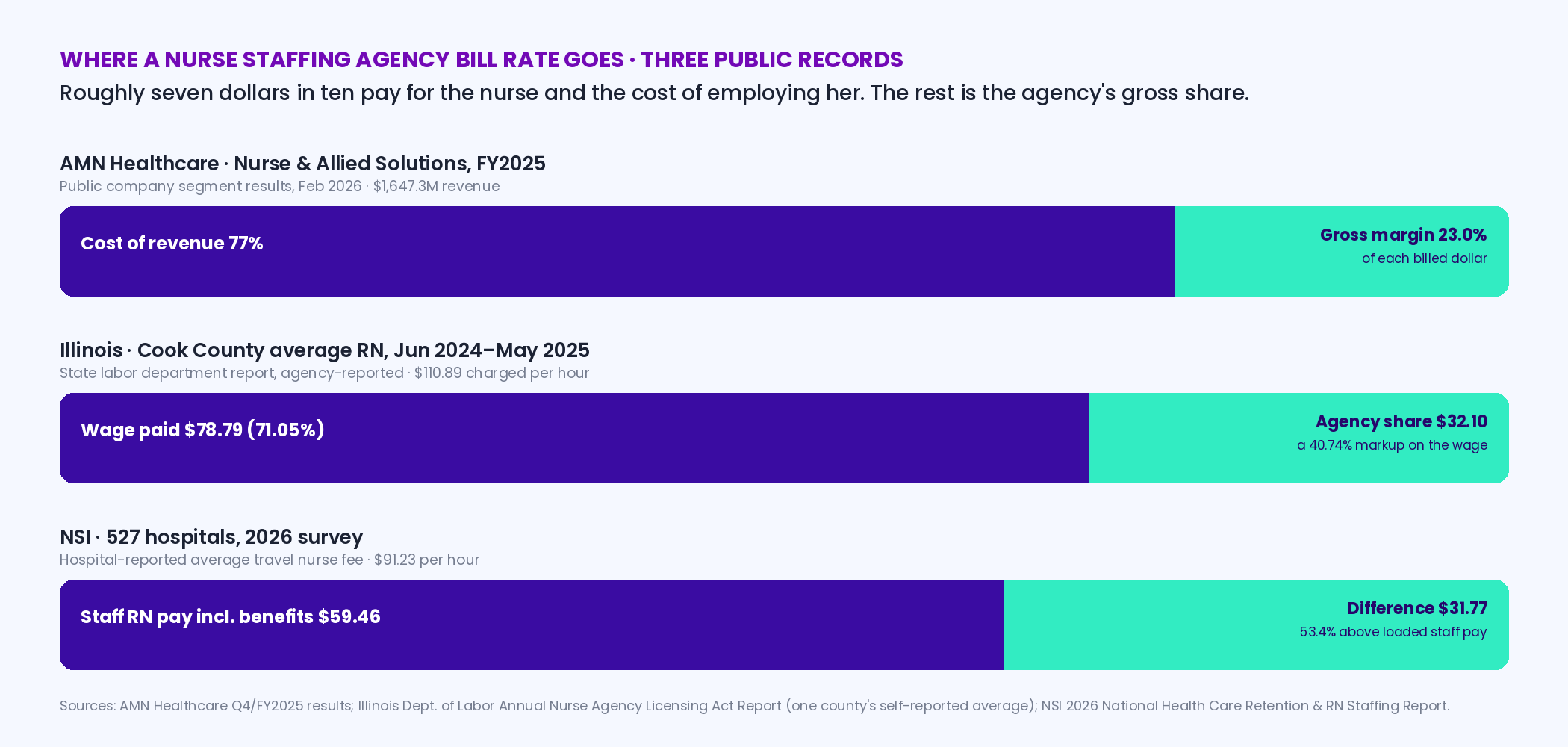
Read those three together and the shape is consistent: roughly seven dollars in ten go to the nurse and the costs of employing her, and the agency's gross share is somewhere between a fifth and a third of the bill depending on how the wage is counted. The Cook County figure is one county's self-reported average and other Illinois counties in the same report swing widely, so treat it as an illustration, not a national rate. The point is that the markup is not mostly margin. It is mostly the cost of carrying a licensed employee you don't have to carry — which is exactly why an agency is worth paying when you need coverage on Monday, and exactly why it gets expensive when Monday turns into a quarter. To put the other side of that trade in dollars — what the shift costs if nobody covers it at all — use the cost of vacancy calculator.
The states that publish a maximum nurse agency rate
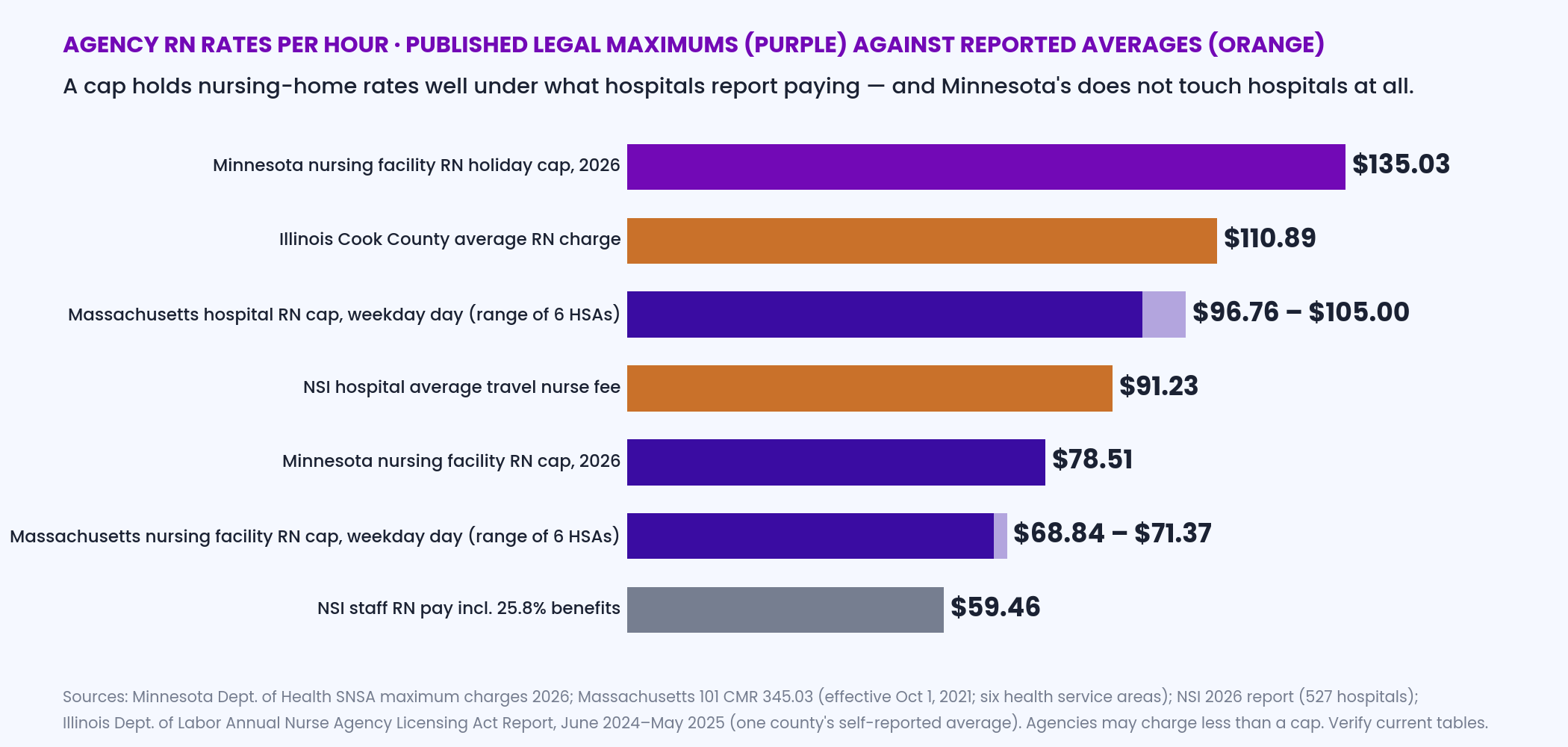
Two states set a legal ceiling on what a nurse staffing agency can bill long-term care facilities, and both publish the numbers. Minnesota's supplemental nursing services agency cap is statewide, set annually by the Department of Health at 150% of the weighted average wage plus a payroll-tax factor under Minn. Stat. 144A.74, and it explicitly includes "all charges for administrative fees, contract fees, or other special charges." Massachusetts sets maximum per-hour prices for temporary nursing services under 101 CMR 345.00 by health service area and shift, with holidays capped at 150% of the maximum and a 19.7% travel-nurse factor above the limits.
| Jurisdiction and setting | RN | LPN | CNA | Source |
|---|---|---|---|---|
| Minnesota nursing facilities — standard, Jan 1–Dec 31, 2026 | $78.51 | $62.97 | $43.83 | MDH SNSA maximum charges; Minn. Stat. 144A.74 |
| Minnesota nursing facilities — holiday, 2026 | $135.03 | $110.82 | $76.26 | MDH SNSA maximum charges |
| Massachusetts nursing facilities — weekday day shift, range across six HSAs | $68.84 – $71.37 | $58.77 – $63.24 | $32.43 – $34.00 | 101 CMR 345.03(2) |
| Massachusetts hospitals — weekday day shift, range across six HSAs | $96.76 – $105.00 | $61.66 – $65.47 | $35.31 – $37.26 | 101 CMR 345.03(3) |
The Massachusetts regulation includes its own worked example for a 12-hour shift: an RN in HSA 1 at a nursing facility from 7 a.m. to 7 p.m. bills eight hours at $71.03 and four at $75.29, so $869.40 ÷ 12 = $72.45 an hour. Run the same arithmetic for Greater Boston (HSA 4) and the day-shift RN ceiling is 8 × $71.37 + 4 × $75.63 = $873.48, or $72.79 an hour; at a Boston hospital it is 8 × $105.00 + 4 × $115.05 = $1,300.20, or $108.35 an hour. Minnesota's flat RN cap makes a 12-hour nursing-home shift $942.12 on a normal day and $1,620.36 on a holiday. Put those ceilings next to the NSI national hospital average of $91.23 and the Cook County average of $110.89 and you can see what a cap does: it holds nursing-home rates well under what hospitals report paying, and it does not touch hospitals at all in Minnesota.
Check the legal maximum for a shift
If you run a facility in Massachusetts or Minnesota, the number below is the most an agency may charge you per hour for that role on that shift, straight from the published tables. Everywhere else, use it as a reference point for what two states decided a fair ceiling looks like.
Nothing is stored or sent — this runs in your browser. Figures are the published maximums; agencies may charge less.
Sources: Minnesota Department of Health, SNSA Maximum Charges for Nursing Facilities effective January 1–December 31, 2026 (RN $78.51, LPN $62.97, CNA $43.83; holiday $135.03, $110.82, $76.26), under Minn. Stat. 144A.74; Massachusetts 101 CMR 345.03(2)–(3), effective October 1, 2021 and still the posted regulation on August 25, 2026, with holidays capped at 150% of the maximum and a 19.7% travel-nurse factor not applied here. Massachusetts 12-hour figures use the regulation's own method: eight hours at the day rate plus four at the next shift's rate, or eight at the night rate plus four at the day rate, weighted. Fixed-term employees are exempt in Massachusetts. Verify the current table before relying on it.
Nursing agency fees the rate sheet doesn't show
The hourly rate is the number you negotiate; the contract terms are where the total moves. Illinois made most of them visible by law. Under HB 4666, for agreements executed on or after July 1, 2022, a nurse agency contract with an Illinois facility must include a schedule of all hourly bill rates per employee category and a full description of administrative charges, agencies may not sign non-competes with nurses or CNAs, and they may not charge liquidated damages, conversion fees, employment fees, buy-out fees, placement fees, or other compensation if you hire the nurse permanently. Agencies also report their average charges and average wages paid to the Department of Labor quarterly, which is where the Cook County figures above come from. Whether or not your state requires it, ask for the same five things in writing:
- The bill-rate schedule by role and shift, with evening, night, weekend, and holiday multipliers stated as numbers, not "premium applies." Massachusetts caps holidays at 150%; Minnesota's 2026 holiday RN rate is $135.03 against $78.51 standard — a 71.99% premium. Your contract's multiplier is whatever it says.
- The conversion fee and its schedule. Many contracts step the fee down with hours worked; some waive it after a threshold. If you are in Illinois it should be zero. If it is a flat percentage of salary with no step-down, that is the term to negotiate first, because it is the one you pay when things go well.
- Overtime and cancellation. Who pays time-and-a-half when a 12-hour shift runs to 13, and how many hours' notice you have to cancel a shift without being billed for it. Two hours and twenty-four hours are both common; the difference on a census that drops is the whole margin.
- Guaranteed hours on travel contracts. A 36-hour guarantee means you pay 36 hours whether or not you use them. Ask whether the guarantee survives a low census, a float to another unit, or a facility-initiated cancellation.
- What is inside the rate. Credentialing, background checks, liability coverage, and housing stipends are either inside the bill rate or invoiced separately. Minnesota's cap forces them inside; elsewhere, an "administrative fee" line can add several dollars an hour to a rate that looked competitive.
When a nurse staffing agency is the right call
Before the case against the bill, the case for it, because it is real. You have a shift going unfilled this week: nothing beats a roster of credentialed nurses who can start tomorrow, and per diem staffing exists for census spikes, leave, and departures. The role is a specialty: an ICU, OR, or cath-lab nurse for one opening is a search an agency runs all day and you run once. Credentialing is your bottleneck: license verification across states, background checks, and health screenings are real work that an agency amortizes across hundreds of placements. Nobody on your team can work applicants: an applicant who waits two days goes cold, and paying an agency to screen is buying a service, not wasting money. And the survey data says hospitals know all of this — NSI found 70.7% of hospitals intend to decrease travel and agency use in 2026, and reports they still reach for it whenever a shortage bites. Wanting to use less agency and being able to are different things, and the gap between them is filled by whether you have a way of producing your own candidates. How to build that for RNs and LPNs is set out in our guide to nurse recruitment.
Where the arithmetic turns: the vacancy that becomes a quarter
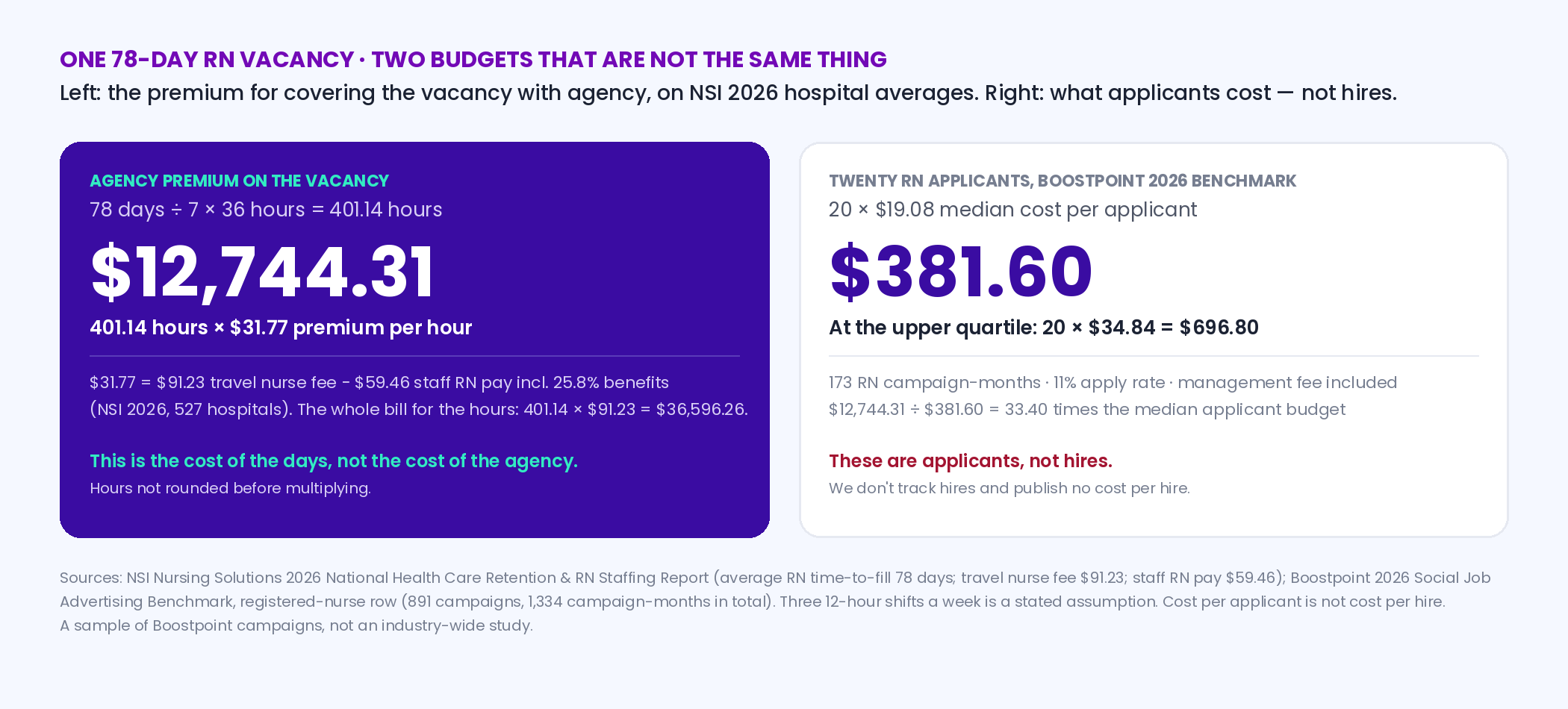
The agency premium is a per-hour number, so the cost of coverage is the premium times the hours, and the hours are set by how long the position stays open. NSI's 2026 report puts the average RN time-to-fill at 78 days, ranging from 56 to 102 by specialty, with an average of 43 unfilled RN FTEs per hospital and an 8.6% vacancy rate. Cover one vacant RN position with agency for those 78 days at 36 hours a week and you buy 78 ÷ 7 × 36 = 401.14 hours; at the NSI difference of $31.77 an hour between the travel fee and loaded staff pay, the premium on that one vacancy is $12,744.31 — before the position is filled, and with the hours not rounded before multiplying. That is the cost of the days, not the cost of the agency. The agency is charging what it charges; the 78 days are yours.
Nothing is stored or sent — this runs in your browser. Defaults are the NSI 2026 hospital averages; replace them with your own rates.
This is the premium above your own loaded cost, not the whole bill — you would have paid the staff wage either way. It excludes the agency's separately invoiced fees, overtime, and any conversion fee. Hours are days ÷ 7 × weekly hours, not rounded before multiplying.
What producing your own RN applicants costs — and what it doesn't buy
The alternative to covering a vacancy is shortening it, and that means a pipeline of your own applicants. Our 2026 benchmark, 173 registered-nurse campaign-months of social media job advertising, shows a median cost per applicant for RNs of $19.08, a middle 50% of $12.76–$34.84, and an 11% apply rate — the lowest apply rate of the nursing roles we track (CNAs convert at 18%, LPNs at 21%), because an RN clicks less readily and completes fewer applications. Twenty RN applicants at the median cost $381.60; at the upper quartile, 20 × $34.84 = $696.80. Those are applicants, not hires, and we don't publish a cost per hire because we don't track hires — how many of twenty RN applicants become one start depends on your screening, your offer, and your unit, and we would be inventing a number if we told you. What we can say is that the applicant budget for a position is a fraction of the agency premium on the same position's vacancy — $12,744.31 is 33.40 times $381.60, which is why the comparison worth running is not "agency versus advertising" but "how many days does each approach take off the 78."
One caution that matters more for nursing than for any other role: in an earlier analysis of 478 healthcare campaigns across 30 employers (campaign-level, a different methodology from the benchmark), hospital application flows completed at 6.0% against 22.1% in senior living and 21.6% in home care, because hospitals mostly route candidates into long ATS applications after the click. If your RN application takes 25 minutes, you will pay for the click and lose the nurse, and the advertising will look expensive for a reason that has nothing to do with the advertising. Fix the form before you fund the campaign. The RN, LPN and CNA cost page goes through what the form does to each role.
Seven dollars in ten of a nurse agency bill pay for the nurse. The premium pays for the days — and the days are the only part of the bill that a facility with its own applicant pipeline gets to shorten.
How to reduce agency nurse spend
The way to reduce agency nurse spend is to shorten the vacancies the agency is covering, and the cheapest input to that is your own applicants: registered nurse campaigns in Boostpoint's 2026 Social Job Advertising Benchmark ran a $19.08 median cost per applicant across 173 campaign-months, less than one hour of the $31.77 hourly travel premium in the NSI survey cited above. That is a one-time cost against a recurring one, and it buys an applicant, not a hire. The comparison by role:
| Role family | Median cost per applicant | Middle 50% of campaigns | Apply rate |
|---|---|---|---|
| Registered nurse | $19.08 | $12.76 – $34.84 | 11% |
| LPN / LVN | $12.77 | $7.53 – $21.46 | 21% |
| CNA / nursing assistant | $7.72 | $6.18 – $12.06 | 18% |
Costs include campaign management and cover advertising only. Cost per applicant is not cost per hire. The steps that turn those applicants into lower agency spend:
- Find the permanent jobs hiding in the agency invoice. A contract that keeps renewing on the same unit is a position, not a gap. Recruit for those first, because they carry the premium for longest.
- Run direct recruiting while the agency covers the shift. Treat the agency as the bridge and the campaign as the exit, started on the day the contract is signed rather than when it is about to end.
- Fix the application before you fund the campaign. Across all 891 benchmark campaigns, those converting under 5% of clickers paid $53.77 per applicant and those converting 20 to 35% paid $4.41. In the benchmark, campaigns routing applicants to a career site or ATS apply flow populated the bottom two bands.
- Build your own per diem pool. Nurses who want extra shifts are the same people agencies place. Our PRN staffing page covers how to run one.
- Negotiate the conversion fee now. The cheapest permanent hire is often the agency nurse already on your floor, and the fee schedule decides whether you can afford to make the offer.
- Keep the nurses you hire. Every departure reopens a vacancy the agency will be asked to cover. The measured side of that is on nurse turnover rate.
If you are building your own travel program instead of paying agency rates, start with our travel nurse job description template.
Frequently asked questions
How much do nursing agencies make? New York publishes the answer
Agency margin is normally unknowable from the outside: you are quoted a bill rate and the split between the nurse's pay and the agency's gross profit is not disclosed. One state has changed that. Under New York Public Health Law Article 29-K, temporary health care staffing agencies must register and file quarterly financial disclosures, including hourly bill rates and compensation by category, and the Department of Health publishes the aggregates. It is the only jurisdiction publishing this, and the numbers are specific.
2024, across all categories: agencies billed $2.6 billion to New York health care entities, of which roughly $1.61 billion was paid to workers — workers received approximately 62% of the amount billed, leaving a gross profit margin near 38%, or about $994 million retained.
| Category | Gross profit margin, 2024 | Q1 2025, hospitals: paid vs billed |
|---|---|---|
| Registered nurse | 35–48% | $52 paid against $92 billed — 43% |
| LPN | 28–32% | $40 against $60 — 33% |
| CNA | 29–33% | $29 against $44 — 33% |
| Physician | 26–31% | — |
| All other roles | 32–46% | — |
The $92 hospital RN bill rate in New York's disclosures lands almost exactly on the $91.23 average travel nurse fee that NSI's 2026 survey reports nationally, from an entirely different source and method. Two independent numbers agreeing to within a dollar is about as much confirmation as this market offers.
Two details make this more useful than a national average would be. The RN margin varies enormously by region — on a four-quarter average basis it ran from 27% on Long Island to 55% in the Southern Tier in 2024, with most regions between 38% and 52% — which tells you the margin is set by local bargaining position rather than by a cost structure. And the split moved only slightly into 2025: the first quarter of that year saw $768 million billed and over $490 million paid to workers, a 64/36 division against 62/38 across 2024.
Two caveats to carry with these figures. New York's reports do not define “gross profit margin,” so the arithmetic is (billed − paid) ÷ billed — gross margin before the agency's own overhead, recruiting, insurance, payroll taxes and compliance, not profit in the sense a P&L uses. And the most recent quarterly report published as of this writing is Q1 2025. Treat the split as the best available public evidence rather than as this month's number.
What it costs to hire a nurse, the other way
The alternative to a bill rate is a recruiting cost, and the two are not the same kind of number: one recurs every hour the shift is covered, the other is spent once.
| Route | What it costs | What you are buying |
|---|---|---|
| Agency coverage | ~$92 an hour for a hospital RN in New York's Q1 2025 disclosures; $91.23 in NSI's 2026 national survey, against $59.46 of loaded staff pay | Hours, now, with roughly 43% of the premium retained by the agency |
| Replacing a nurse who leaves | $60,090 per staff RN in NSI's 2026 survey | Nothing — this is the cost of the turnover itself |
| Producing your own RN applicants | $19.08 median cost per applicant, $12.76–$34.84 for the middle half of campaigns | Applicants, not hires. The hire depends on your own apply-to-hire rate |
The turnover figure is worth isolating, because it is the number that makes the whole comparison urgent. NSI's 2026 report — 527 acute care hospitals across 40 states, calendar 2025 — puts the average cost of turnover for a staff RN at $60,090, hospital RN turnover at 17.6%, and calculates that each percentage point of RN turnover costs or saves the average hospital about $295,000 a year. NSI Nursing Solutions is a private nurse-recruitment firm and this is a voluntary industry survey rather than a government statistic, so read it as directional and as self-reported by an industry that sells the remedy. Even discounted, it reframes the arithmetic: retaining one nurse in six is worth more than any rate you will negotiate on a contract.
The comparison that actually decides a budget is not agency-versus-advertising as a matter of principle. It is this: a vacancy covered by an agency accrues the premium for as long as it stays covered that way, and the 78-day average time to fill cited earlier on this page is a long time to accrue it. The cost-per-applicant figures above are what it costs to attempt the other route once. Both routes have a failure mode — the agency's is the recurring premium and the conversion fee; advertising's is a pipeline that produces applicants who do not convert — and the honest version of the choice is to run the second while the first covers the gap, rather than treating them as alternatives.
Cost-per-applicant figures are from Boostpoint's 2026 Social Job Advertising Benchmark, registered nurse role family.
How much does a nurse staffing agency charge?
By arrangement: per diem RNs at a 35–50% markup on the hourly wage and direct hires at 18–25% of first-year salary, per AMN Healthcare; travel nurses at 40–70% above staff nurse rates, per DirectShifts. Hospitals surveyed by NSI Nursing Solutions in 2026 reported an average travel nurse fee of $91.23 an hour, or $189,758 a year. Where a state caps the rate, the ceiling is public: Minnesota's 2026 nursing-facility RN maximum is $78.51 an hour, and Massachusetts nursing facilities' weekday day-shift RN maximum runs $68.84–$71.37 depending on region.
What is a typical nurse staffing agency markup?
For per diem nursing, 35–50% on the wage is the range AMN Healthcare publishes. Public records show the split in practice: Illinois' Cook County reported an average RN charge of $110.89 an hour against an average wage paid of $78.79, a 40.74% markup, and AMN's own Nurse and Allied Solutions segment ran a 23.0% gross margin in 2025, meaning 77% of billings were the cost of employing the clinician. Minnesota's statutory cap is 150% of the weighted average wage plus a payroll-tax factor, with all administrative fees inside it.
How much of the bill rate does the nurse actually get?
Roughly seven dollars in ten, by the three public records on this page. Illinois' Cook County report shows the wage at 71.05% of the average RN charge; AMN Healthcare's 2025 segment results put cost of revenue — pay, benefits, payroll taxes, stipends, insurance — at 77% of billings; NSI's hospital survey shows $59.46 of loaded staff pay against a $91.23 travel fee. The agency's gross share covers recruiting, credentialing, sales, and profit, and in Illinois the contract must state administrative charges separately.
Do any states cap nurse staffing agency rates?
Minnesota and Massachusetts publish legal maximums for nursing facilities. Minnesota's Department of Health sets a statewide cap each year under Minn. Stat. 144A.74 — for 2026, RN $78.51, LPN $62.97, CNA $43.83, with holiday rates of $135.03, $110.82, and $76.26. Massachusetts' 101 CMR 345.00 sets maximum per-hour prices by health service area and shift for nursing facilities and hospitals, with holidays capped at 150% and a 19.7% travel-nurse factor. Illinois does not cap rates but requires licensed agencies to disclose them and report quarterly. The lookup on this page returns the published figure for a given role and shift.
What is a nurse agency conversion or buy-out fee, and can we avoid it?
It is the fee an agency charges when you hire one of its nurses permanently, usually a percentage of salary that steps down with hours worked. In Illinois it is prohibited: for agreements executed on or after July 1, 2022, HB 4666 bars nurse agencies from charging liquidated damages, conversion, employment, buy-out, or placement fees when a facility hires the nurse, and from signing non-competes with nurses or CNAs. Elsewhere, negotiate the schedule before the first shift — it is the fee you pay when the placement goes well.
How much does a travel nurse cost a hospital?
The 527 hospitals in NSI's 2026 survey reported an average travel nurse fee of $91.23 an hour, $189,758 a year, against $59.46 an hour for a staff RN including 25.8% for benefits — a difference of $31.77 an hour or $66,081 a year. On a standard 13-week, 36-hour contract that is 468 hours × $91.23 = $42,695.64 billed and a premium of $14,868.36 over the same hours at staff cost. DirectShifts describes travel bill rates as 40–70% above staff rates; the NSI averages sit inside that range at 53.4% above loaded staff pay.
Are per diem nursing apps cheaper than a staffing agency?
We can't say from their websites. Marketplace apps such as ShiftKey and Nursa describe facility rates as transparent or set by the facility, but neither shows a facility price or fee on the pages we reached on August 25, 2026, so we won't quote one. The questions are the same as for an agency: what the facility pays per hour, what fee sits on top, who employs the clinician, and who carries credentialing and liability. In Minnesota the answer has to fit under the same cap; in Illinois the same disclosure rules apply to licensed agencies.
When should a facility use a nurse staffing agency instead of recruiting directly?
Use an agency when the shift is this week, the role is a specialty you fill once, credentialing is your bottleneck, or nobody can work applicants the same day. Recruit directly when the same position keeps reopening, because the agency premium is priced per hour and the hours are set by the vacancy: on NSI's 2026 averages, 78 days of coverage costs $12,744.31 in premium alone, while 20 RN applicants at our benchmark median of $19.08 cost $381.60 — applicants, not hires. The honest comparison is which approach takes more days off the vacancy.
How much do nursing agencies make?
In New York, the only state publishing the data, about a third to nearly half of the bill rate. Under Public Health Law Article 29-K agencies file quarterly financial disclosures, and the Department of Health reported that in 2024 workers received approximately 62% of the amount billed — a gross margin near 38% overall, and 35–48% for registered nurse categories. Its Q1 2025 report shows hospital RNs paid $52 an hour against a $92 bill rate, a 43% margin.
How much does it cost to hire a nurse?
It depends which cost you mean. Covering the shift through an agency ran about $92 an hour for a hospital RN in New York's Q1 2025 disclosures, and $91.23 in NSI's 2026 national survey against $59.46 of loaded staff pay. Replacing a nurse who leaves cost an average of $60,090 per staff RN in the same NSI survey. Producing your own RN applicants ran a $19.08 median cost per applicant, with the middle half of campaigns between $12.76 and $34.84. A permanent hire through an agency, at the 18–25% direct-hire fee AMN Healthcare reports, comes to $17,559 to $24,387.50 on the BLS May 2025 median RN wage of $97,550.
Does the nursing agency margin vary by region?
Substantially, which is the most useful thing in the New York data. Gross margin on hospital registered nurses ranged, on a four-quarter average basis, from 27% on Long Island to 55% in the Southern Tier in 2024, with most regions between 38% and 52%. A spread that wide for the same service in the same state indicates the margin is set by local bargaining position rather than by a cost structure — which means it is negotiable.
How can a hospital reduce agency nurse spend?
Shorten the vacancies the agency is covering by producing your own applicants while the agency bridges the gap. Registered nurse campaigns in Boostpoint's 2026 benchmark ran a $19.08 median cost per applicant, a one-time cost set against an hourly premium that recurs for as long as the shift is covered. Recruit first for contracts that keep renewing, shorten the application, build a per diem pool, and negotiate the conversion fee.
How much do agency nurses cost?
It depends on the arrangement. AMN Healthcare puts per diem RN markups at 35–50% on the wage and direct-hire fees at 18–25% of first-year salary, and DirectShifts puts travel nurse bill rates 40–70% above staff rates. Hospitals in NSI's 2026 survey reported an average travel nurse fee of $91.23 an hour against $59.46 for a staff RN with benefits. For comparison, the median registered nurse applicant in Boostpoint's 2026 benchmark cost $19.08, an applicant rather than a hire.
How much does a nursing agency make per hour on a nurse?
In New York's Q1 2025 disclosures for hospital registered nurses, agencies billed $92 an hour and paid the nurse $52, leaving about $40 an hour. That $40 is gross margin, not profit: it has to cover the agency's payroll taxes, insurance, credentialing, recruiting and sales before anything is left over. Margins differ by region: Illinois' Cook County report above shows a $32.10 gross share, so treat any one figure as a state average rather than a national rate.
What is included in the cost of hiring a nurse?
Five things, only one of which is advertising: the cost of producing applicants (in Boostpoint's 2026 benchmark, the Registered nurse family ran a $19.08 median cost per applicant); recruiter and nurse manager time to screen and interview; credentialing, license verification, background checks and health screening; any agency or placement fee, such as the 18 to 25 percent of first-year salary AMN Healthcare reports for direct hire; and the cost of covering the shift while the position is open, which on this page's figures is usually the largest line. See cost per hire by industry for how to put the lines together.
See what your own RN applicants cost before the next contract renews
We'll show you the healthcare campaigns closest to yours from 173 RN campaign-months and 553 in the sector — and no cost-per-hire claim we can't back.
Book a Demo



Boostpoint figures come from the 2026 Social Job Advertising Benchmark — 891 campaigns and 1,334 campaign-months: registered nurse median cost per applicant $19.08, middle 50% $12.76–$34.84, 11% apply rate, 173 campaigns; healthcare and senior living sector 553 campaign-months. Cost per applicant is not cost per hire; we do not track hires and publish no cost-per-hire figure. The hospital application-completion figures (6.0% hospital, 22.1% senior living, 21.6% home care) come from an earlier campaign-level analysis of 478 healthcare campaigns across 30 employers and use a different methodology from the benchmark. Third-party figures are attributed in-page: AMN Healthcare (direct hire 18–25%, per diem RN markup 35–50%); DirectShifts (travel nurse bill rates 40–70% above staff rates); NSI Nursing Solutions, 2026 National Health Care Retention & RN Staffing Report, 527 hospitals in 40 states (travel nurse fee $91.23/$189,758; staff RN pay $59.46/$123,676 including 25.8% benefits; difference $31.77/$66,081; RN time-to-fill 78 days, 56–102 by specialty; RN vacancy rate 8.6%; 43 unfilled RN FTEs per hospital; 70.7% anticipating decreased travel/agency use); AMN Healthcare fourth-quarter and full-year 2025 results, February 2026 (Nurse and Allied Solutions revenue $1,647.3 million, gross margin 23.0%); Illinois Department of Labor, Annual Nurse Agency Licensing Act Report, June 1, 2024–May 31, 2025 (Cook County average RN charge $110.89, average wage paid $78.79); Illinois HB 4666, Public Act 102-0946, for agreements on or after July 1, 2022; Massachusetts 101 CMR 345.00, effective October 1, 2021, the posted regulation as of August 25, 2026; Minnesota Department of Health, SNSA Maximum Charges for Nursing Facilities effective January 1–December 31, 2026, and Minn. Stat. 144A.74; BLS Occupational Outlook Handbook, registered nurses, median annual wage $97,550 (May 2025). Worked figures: 468 hours = 36 hours × 13 weeks; 401.14 hours = 78 days ÷ 7 × 36, multiplied unrounded; $12,744.31 = 401.142857 × $31.77; $17,559 and $24,387.50 = 18% and 25% of $97,550. State caps and agency rates change; verify the current tables before budgeting. This is a sample of Boostpoint campaigns, not an industry-wide study.