
PRN Staffing: How to Build a Float Pool That Actually Covers Nights, Weekends, and Call-Outs
PRN staffing is a model, not a vendor: a bench of credentialed people who work as needed, sized to the shifts you actually fail to cover. Many facilities buy it from a per diem agency or a shift app because they never built their own. Building one means three things — sizing the pool to your real call-out rate, recruiting for the shift rather than the job (nights, weekends, and holidays are their own hires), and running an application that a working nurse can finish between patients. In Boostpoint's 2026 Social Job Advertising Benchmark, RN applicants ran $19.08, LPNs $12.77, and CNAs $7.72, with campaigns built around a date at $8.02.
Source: Boostpoint 2026 Social Job Advertising Benchmark — 891 Boostpoint-managed campaigns on Meta (1,334 campaign-months), 2026; costs are what advertisers paid for advertising only.
A note on who's writing this
Boostpoint runs social media job ads for hospitals, skilled nursing, senior living, and home care employers, and the recruiting sections of this page describe what we sell. This page is about the PRN staffing model — how an internal float pool is sized, recruited, and scheduled — and it deliberately leaves the money to the page that owns it: what agencies charge, what an app charges, and the float-pool arithmetic are on PRN and per diem staffing costs. The turnover and vacancy figures are NSI's and AHCA's, named where used. The campaign figures are ours, by credential, from the 2026 benchmark; we publish no shift-level cost figure and no cost per hire.
The problem PRN staffing solves, in numbers
A 24-hour facility has to cover every shift whether or not anyone is available to work it, and the people who work it leave at a rate that guarantees gaps. NSI's 2026 National Health Care Retention & RN Staffing Report (527 hospitals in 40 states) puts RN turnover at 17.6% and overall hospital turnover at 18.5%, the RN vacancy rate at 8.6% with a third of hospitals (33.1%) at 10% or higher, and the average time to fill an RN position at 78 days. In skilled nursing, AHCA reports CNA turnover at 42.3%, the highest of any tracked position. Put those together and the arithmetic is unforgiving: a unit that is 8.6% vacant is carrying open shifts every day for the 78 days each vacancy takes to fill, on top of sick calls, FMLA, and census spikes. Something covers those shifts. The PRN model is the decision about what.
Three ways to cover a shift, and the case for the two we don't sell
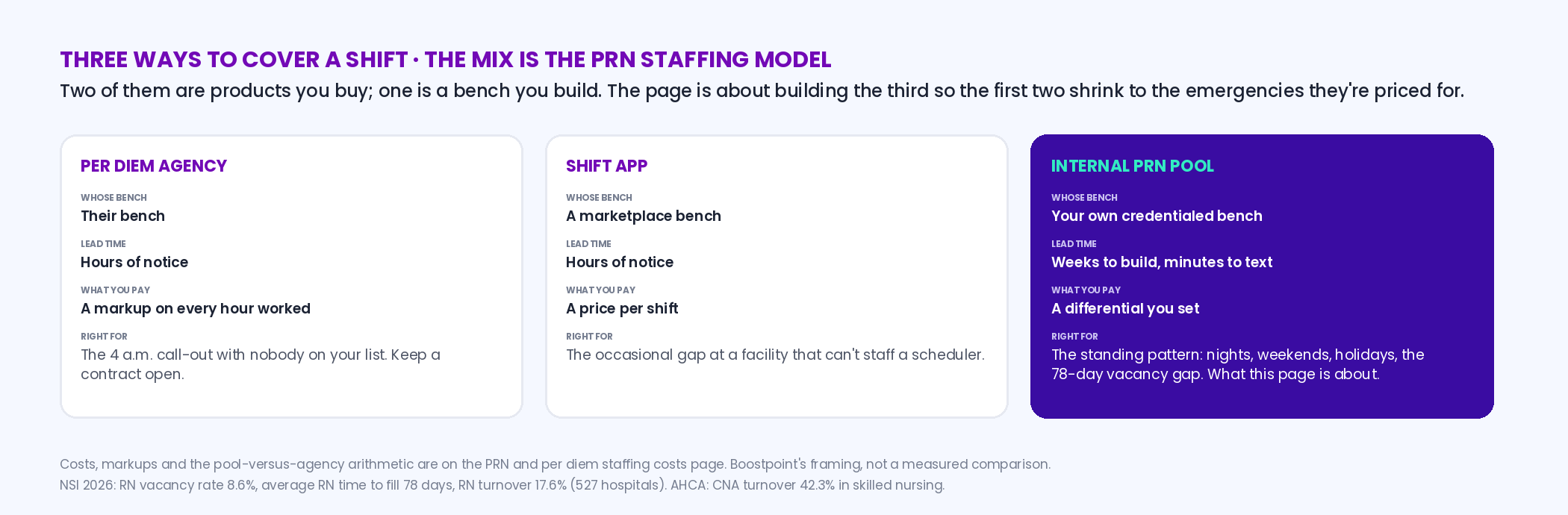
The honest version of this page starts with the alternatives. A per diem agency keeps a bench of credentialed people and sends one on short notice, billing a markup on every hour worked; for a 4 a.m. call-out with nobody on your own list, it is the only option that works, and a facility with no pool at all should keep a contract open. A shift app — the W-2 marketplaces where credentialed workers claim posted shifts — does the same thing with less lead time and a per-shift price, and is the right answer for an occasional gap at a facility that can't staff a scheduler. The internal PRN pool is your own bench: people you credentialed once, who know the unit, and who pick up shifts at a differential you set. It is cheaper per shift, which the cost page shows, and it is harder, because you have to recruit, credential, and keep it warm. The three are not rivals; the mix is the model. What follows is how to build the third so the first two shrink to the emergencies they're priced for.
Per diem employees: what the term changes, and what it doesn't
Per diem and PRN mean the same thing in practice: an employee scheduled shift by shift rather than to a fixed roster. The words describe how someone is scheduled. They are not an employment classification, and treating them as one is where the expensive mistakes start.
What does not change
- They are W-2 employees. A per diem nurse or aide you schedule, direct and pay is your employee. Paying someone on a 1099 because they work irregularly is a misclassification, not a per diem arrangement. That is a different question from using an agency, where the agency is the employer.
- Overtime applies. The Fair Labor Standards Act counts hours in a workweek, not shifts on a roster. A per diem CNA who picks up 46 hours in one week is owed overtime on six of them, whatever the schedule was called when they were hired.
- The I-9, the wage rules and the state's break rules all apply exactly as they do to your core staff.
What does change: how you count them for health coverage
This is the one that catches senior living and home care operators. If you are an applicable large employer, the regulations create a category for exactly this situation. A variable hour employee is one where, at the start date, "the applicable large employer member cannot determine whether the employee is reasonably expected to be employed on average at least 30 hours of service per week... because the employee's hours are variable or otherwise uncertain".
That description fits a per diem hire precisely, and it lets you use a measurement period rather than deciding on day one. But it cuts both ways: a per diem employee who consistently picks up 32 hours a week across the measurement period is a full-time employee for coverage purposes, no matter what their job title says. A float pool that has quietly become several people's full-time job is a coverage exposure, and the only way to know is to look at the hours rather than the labels.
One naming trap. "Per diem" also means a daily travel allowance in payroll and expense contexts, and the two have nothing to do with each other. If your finance team hears "per diem staff" and thinks about reimbursement rates, say "PRN" or "shift-by-shift" instead. It sounds trivial; it produces genuinely confused conversations about budget lines.
Size the pool to the shifts you actually miss
Many PRN pools are sized by feel — "a few extra CNAs" — and then fail on the first holiday weekend. Size it from the schedule instead. Count the shifts a unit failed to cover from its own core staff in a typical month: call-outs, open positions during the 78-day fill, leaves, and census. That number, divided by how many shifts a PRN staffer will realistically pick up in a month, is the pool you need to cover the gap once; multiply by a reliability factor for the share of offered shifts your pool actually accepts, and you have a pool that covers it on a Saturday in July. The calculator below does the arithmetic on your numbers. Two things it will show you immediately: a pool that is too small to cover its own attrition is an agency contract with extra steps, and the reliability factor — not the headcount — is what a holiday weekend tests.
Interactive
Bench-size calculator — how many PRN staff cover your real gap
Nothing is stored or sent — this runs in your browser. Use one unit or one credential at a time; the answer is a pool size, not a cost.
Arithmetic on your inputs: pool = uncovered shifts ÷ pickups per person ÷ acceptance rate, rounded up; recruits a year = pool × attrition. Nothing here is a cost — the agency-versus-pool money is on the PRN and per diem staffing costs page — and cost per applicant is not cost per hire.
Recruit for the shift, not the job
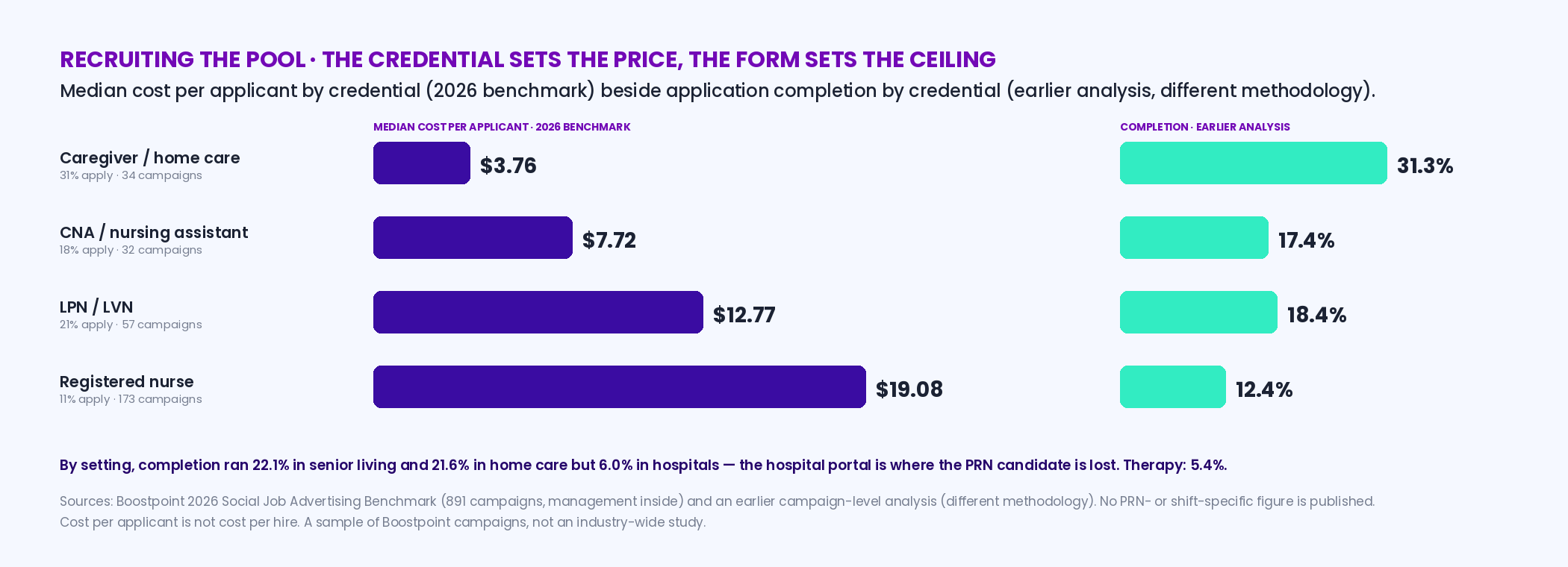
A PRN nurse is not a nurse who couldn't get a full-time job. She is usually a nurse who has one — or who left one for the schedule — and picks up shifts on her terms. That changes the ad completely. The full-time ad sells the unit and the benefits; the PRN ad sells the shift: which nights, which weekends, what the differential is in dollars, how far ahead the schedule posts, whether she can self-schedule from her phone, and what the minimum commitment is (two shifts a month, one weekend a quarter, a holiday a year). It also changes the audience. In our 2026 benchmark, campaigns for registered nurses ran at a median $19.08 per applicant with an 11% apply rate (173 campaigns), LPNs at $12.77 and 21% (57), CNAs at $7.72 and 18% (32), and caregivers at $3.76 and 31% (34) — so RN campaigns had both the highest cost per applicant and the lowest apply rate of the four. The PRN recruiting rule that follows is plain: the more credentialed the person, the more every lost applicant costs you, and a PRN candidate on a break between patients will not finish a portal application. Name, phone, license number, shift availability, submit.
Nights, weekends, holidays: staff the hard shifts as their own hires
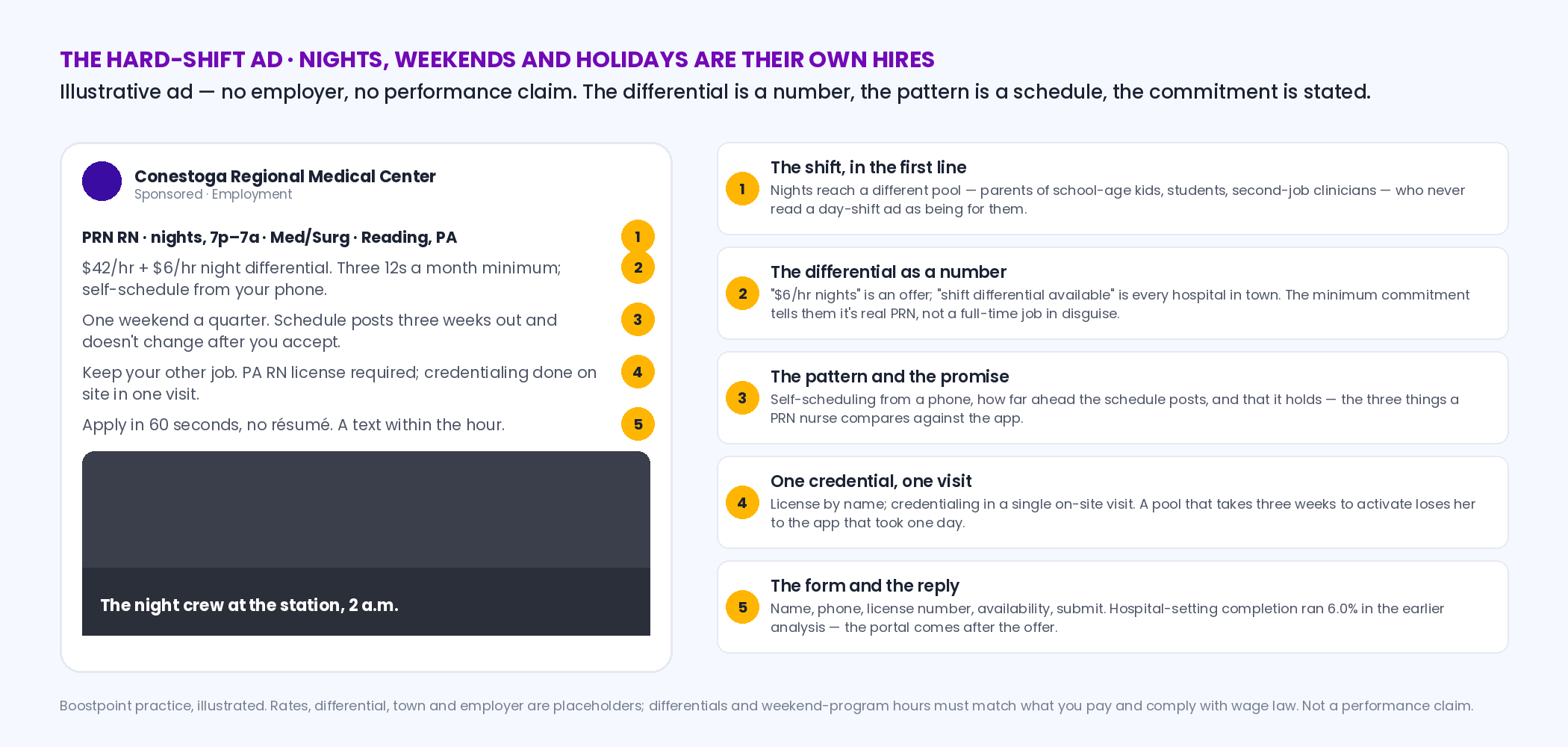
The shifts a pool exists for are the ones nobody on the core staff wants, and a general PRN ad does not fill them — it fills Tuesday days. Staff hard shifts as separate hires with separate ads. A night-shift ad names the differential as a number and the pattern ("three 12s, 7p–7a, self-scheduled"), and reaches the people who prefer nights — parents of school-age kids, students, second-job clinicians — who are invisible to a day-shift ad. A weekend program ad describes the arrangement most facilities already run under one name or another: work every Saturday and Sunday (two 12s or three 8s), be paid for more hours than you work, keep the weekdays; the ad has to say the hours-paid number and the commitment, because that is the whole offer. A holiday pool ad is sold months ahead with the dates listed and a premium stated per shift. In every case the form matters more, not less: a long hospital portal is where the hard-shift candidate is lost.
Interactive
Hard-shift offer builder — the first line for the shift nobody wants
Nothing is stored or sent — this runs in your browser. Pick the shift, fill in the specifics, and read the line a working clinician would stop for — plus the three questions the form should ask.
Boostpoint's practice, not a template to paste and not a measured lift. Rates are placeholders; differentials, hours-paid arrangements and premiums must match what you actually pay and comply with federal and state wage law. Employment ads on Meta run under the Special Ad Category — nothing about age, sex, or origin in the line or the questions.
Fill the pool with a date, then keep it warm
A PRN pool is built in two motions. The first is a dated event: a PRN open house on a Tuesday afternoon with credentialing on site — license verification, background check consent, the TB test scheduled, badge photo taken — so a nurse who walks in leaves on the schedule. In our 2026 benchmark, campaigns built around a date produced applicants at a median $8.02 with a 21% apply rate (78 campaign-months), against $14.45 and 18% for a single-role campaign launched after each vacancy (1,210 campaign-months); the mechanics are on open house hiring events. The second motion is the one most facilities skip: a standing campaign that never turns off, because the calculator above told you how many people the pool loses a year. Multi-role always-on campaigns ran at a median $9.83 per applicant (12% apply rate, 46 campaign-months) — one campaign for the unit's PRN needs across credentials, with the shift that is short leading the ad this week. The rule that comes with it is frequency: a hospital's radius is a small pool of licensed people, and the benchmark's cost per applicant rose from $7.85 below a frequency of 1.5 to $26.78 above 4.0. Check weekly; when a campaign passes 2.5, change the lead shift, not the budget.
How to fill an open shift this week: the operating rhythm
| Horizon | What fills the shift | What has to already exist | Where it breaks |
|---|---|---|---|
| Tonight (a 4 a.m. call-out) | A text blast to the pool with the shift, the differential, and one-tap accept; the agency contract if nobody takes it in 30 minutes | A pool sized at your real acceptance rate; a scheduler who can send at 4 a.m.; the agency terms signed in advance | A pool sized to headcount instead of reliability, or an "apply in the portal" reply to someone texting yes |
| This week | Open shifts posted to the pool's self-scheduling app with the premium visible; unfilled ones escalated Thursday | Self-scheduling on a phone; a posted premium ladder people trust; the weekend program covering Saturday and Sunday by default | Shifts posted without the rate, or a premium that changes after someone accepts |
| This month | The recruits the calculator says you need, from the always-on campaign, credentialed within a week of applying | A one-minute application (name, phone, license, availability), a same-day text, and credentialing that doesn't take three weeks | A 78-day process for a PRN hire; a long hospital portal application |
| This quarter | A dated PRN open house with credentialing on site, timed before the season you lose people — summer, the holidays, flu season | The campaign four weeks ahead ($8.02 median event-driven vs $14.45 single-role); a room; a manager who offers on the spot | Running it after the shortage instead of before it |
Two specifics decide whether any of this works. The first is response time: a PRN candidate applies from a break, and a text within the hour is the difference between a pool member and a name in an ATS. The second is credentialing speed: a pool that takes three weeks to activate a nurse who applied on Monday will lose her to the app that activated her on Wednesday. For the recruiting side by credential — what the RN, LPN, and CNA ads say and what each costs — see RN, LPN and CNA recruiting costs and CNA recruitment; for the settings where the pool is a housekeeping and dietary bench as much as a clinical one, senior living staffing; and for what the agency route costs when the pool isn't there yet, nurse staffing agency costs.
The agency's bench is a product. Yours is a schedule with names on it — sized to the shifts you miss, recruited for the shift, and never allowed to go cold.
Frequently asked questions
What is a per diem employee?
An employee scheduled shift by shift rather than to a fixed roster. Per diem and PRN mean the same thing. It describes how someone is scheduled, not how they are classified: a per diem nurse or aide you schedule, direct and pay is your W-2 employee, is owed overtime on hours above 40 in a workweek, and is covered by the same wage, break and I-9 rules as your core staff.
Do per diem employees get overtime and benefits?
Overtime, yes. The Fair Labor Standards Act counts hours in a workweek, so a per diem employee who works 46 hours in one week is owed overtime on six of them regardless of the schedule label. Benefits depend on hours, not titles. If you are an applicable large employer, a per diem hire usually starts as a variable hour employee, defined in the regulations as one whose expected hours cannot be determined at the start date because they are variable or otherwise uncertain, which lets you use a measurement period. If they then average 30 or more hours a week across that period, they are full time for coverage purposes.
What is PRN staffing?
PRN — pro re nata, "as needed" — staffing is covering shifts with credentialed people who work as needed rather than on a fixed schedule. It comes three ways: a per diem agency's bench at a markup per hour, a shift app's marketplace at a price per shift, or an internal float pool you recruited and credentialed yourself and pay a differential you set. Most facilities use a mix; the model is deciding how much of each.
How big should a PRN float pool be?
Size it from the schedule, not by feel: uncovered shifts in a typical month, divided by the shifts each PRN staffer actually picks up, divided by the share of offered shifts your pool accepts — rounded up. Then multiply the pool by its annual attrition to get the standing number of recruits a year. The calculator on this page does the arithmetic; the reliability factor, not the headcount, is what a holiday weekend tests.
How do you staff hard-to-fill shifts like nights and weekends?
As their own hires, with their own ads. A night-shift ad states the differential in dollars and the pattern (three 12s, 7p–7a, self-scheduled) and reaches the people who prefer nights; a weekend-program ad states the hours paid for the weekend commitment; a holiday-pool ad lists the dates and the premium months ahead. A general PRN ad fills Tuesday days. The form has to be finishable on a phone between patients.
How do you fill an open shift fast?
From a pool that already exists: a text to the pool with the shift, the differential, and one-tap accept, escalating to a pre-signed agency contract after a set window. Speed tonight comes from the pool built last quarter — the size, the self-scheduling app, and the posted premium ladder. For an open position rather than a shift, NSI puts the average RN fill at 78 days, which is why the pool covers the gap in between.
What does it cost to recruit PRN nurses and CNAs?
In our 2026 benchmark, campaigns for registered nurses ran at a median $19.08 per applicant (11% apply rate, 173 campaigns), LPNs $12.77 (21%, 57), CNAs $7.72 (18%, 32), and caregivers $3.76 (31%, 34); campaigns built around a date — a PRN open house — ran at $8.02. We publish no PRN-specific or shift-specific figure, and cost per applicant is not cost per hire. Agency and app costs are on our PRN and per diem staffing costs page.
Is an internal PRN pool cheaper than a per diem agency?
Per shift, once it exists — the markup comparison and the arithmetic are on our PRN and per diem staffing costs page. The cost this page cares about is the one that decides whether it exists: the recruiting and credentialing a pool needs to stay at size against its own attrition. A pool that isn't recruited for continuously becomes an agency contract with extra steps.
What is a weekend program (Baylor-type) schedule?
An arrangement many facilities run under different names: staff commit to working every Saturday and Sunday — two 12-hour or three 8-hour shifts — and are paid for more hours than they work, keeping weekdays free. The ad has to state the hours paid and the commitment plainly; that number is the offer. Terms and pay practices vary by employer and must comply with wage law.
Why do PRN candidates drop out of the application?
Because the credential makes each applicant expensive and the setting often makes the form long. In our 2026 benchmark, registered nurse campaigns had the lowest apply rate of the four credentials on this page (11%, against 31% for caregivers), and hospital applications often run through a long portal. A PRN nurse applying from a break needs name, phone, license number, availability, and a submit button; the portal can come after the offer.
Build the bench before the next holiday weekend
We'll run the PRN open house campaign and the standing pool campaign by credential and shift, with a one-minute application behind them — and show you the healthcare campaigns closest to yours, every number.
Book a DemoBoostpoint figures come from the 2026 Social Job Advertising Benchmark — 891 campaigns and 1,334 campaign-months: registered nurse median cost per applicant $19.08, 11% apply rate, 173 campaigns; LPN / LVN $12.77, 21%, 57; CNA / nursing assistant $7.72, 18%, 32; caregiver / home care $3.76, 31%, 34; by campaign type, counted in campaign-months: event-driven $8.02, 21%, 78; multi-role / always-on $9.83, 12%, 46; single-role $14.45, 18%, 1,210; frequency under 1.5 $7.85, over 4.0 $26.78, rule 2.5. No PRN-specific or shift-specific cost figure is published. Third-party figures are NSI Nursing Solutions' (2026 National Health Care Retention & RN Staffing Report) and AHCA's, attributed in place. The pool-sizing arithmetic, shift-ad practice, and operating rhythm are Boostpoint's practice, not measured results; the calculators run on your inputs. Cost per applicant is not cost per hire; we do not track hires and publish no cost-per-hire figure. A sample of Boostpoint campaigns, not an industry-wide study.