
CNA Recruitment: What It Costs and What Actually Works (2026 Data)
If you are working out how to hire CNAs, start with where the role sits. In Boostpoint's 2026 Social Job Advertising Benchmark, the median CNA applicant cost $7.72, between caregivers at $3.76 and LPNs at $12.77; an earlier sample of 21 Boostpoint-managed CNA campaigns ran $6.82. That middle position is the whole problem: certified nursing assistants are the one role in healthcare being pulled in two directions at once, and most facilities are only defending against one of them.
Source: 21 Boostpoint-managed CNA and nurse aide campaigns across four employers, 2025 through mid-2026, representing 506 applications — drawn from a wider set of 478 healthcare campaigns across 30 employers. Boostpoint's canonical 2026 Social Job Advertising Benchmark (891 campaigns, single methodology) reports median cost per applicant of $3.76 for caregivers, $7.72 for CNAs, $12.77 for LPNs and $19.08 for RNs; where this earlier analysis and the benchmark differ, the benchmark figure is canonical.
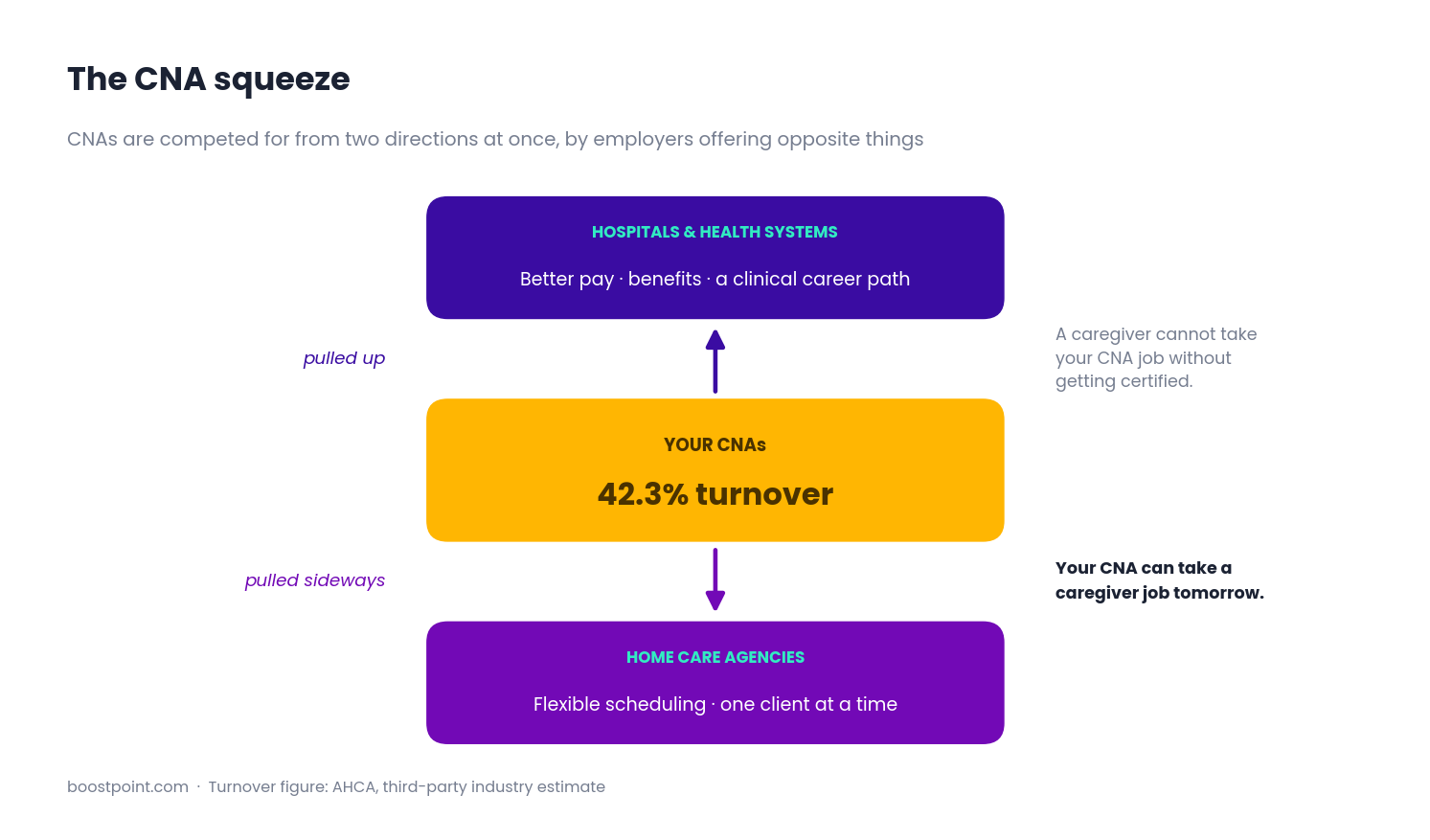
The CNA squeeze
Every role in healthcare recruiting competes for candidates. CNAs are unusual in that they get competed for from two directions simultaneously, by employers offering opposite things.
From above: hospitals and health systems. Better pay, better benefits, a name on a badge that carries weight. A CNA who wants a clinical career path and eventually an LPN or RN license goes this direction.
From below: home care agencies. Not below in status — below in credential requirement. Most home care roles need training, not certification. Which means every certified CNA in your market is automatically qualified for every caregiver job in it, and those jobs frequently offer flexible scheduling, one client at a time, and no assignment of twelve residents on a short-staffed hall.
That's the squeeze. A caregiver can't take your CNA job without getting certified. Your CNA can take a caregiver job tomorrow.
It shows up in the turnover numbers. CNA turnover in skilled nursing ran 42.3% in the most recent AHCA data — the highest of any position they track, above RNs, above LPNs, above dietary and housekeeping. It's a large part of why senior living and skilled nursing costs look better on reach than they do on retention.
Recruiting can't fix a pay gap or a staffing ratio. But understanding which direction you're losing people determines what your ads should say, and most facility job postings read as though the only competitor is the facility down the road.
What CNA recruitment costs
From 21 CNA and nurse aide campaigns across four employers in 2025–2026, representing 506 applications:
| Metric | CNA campaigns, 2025–26 |
|---|---|
| Cost per applicant | $6.82 |
| Application completion rate | 17.4% |
| Applications in sample | 506 |
| Campaigns | 21 |
| Employers | 4 |
Source: 21 Boostpoint-managed CNA and nurse aide campaigns across four employers, 2025 through mid-2026, representing 506 applications — drawn from a wider set of 478 healthcare campaigns across 30 employers. Boostpoint's canonical 2026 Social Job Advertising Benchmark (891 campaigns, single methodology) reports median cost per applicant of $3.76 for caregivers, $7.72 for CNAs, $12.77 for LPNs and $19.08 for RNs; where this earlier analysis and the benchmark differ, the benchmark figure is canonical.
Where that sits against the rest of the clinical ladder — the full cost by clinical role is broken down separately:
| Role | Cost per applicant | Relative to CNA |
|---|---|---|
| Caregiver / home health aide | $3.47 | 0.5× |
| CNA / nurse aide | $6.82 | — |
| LPN / LVN | $12.14 | 1.8× |
| RN / registered nurse | $15.93 | 2.3× |
| Therapy (PT / OT / SLP) | $40.93 | 6.0× |
Source: 21 Boostpoint-managed CNA and nurse aide campaigns across four employers, 2025 through mid-2026, representing 506 applications — drawn from a wider set of 478 healthcare campaigns across 30 employers. Boostpoint's canonical 2026 Social Job Advertising Benchmark (891 campaigns, single methodology) reports median cost per applicant of $3.76 for caregivers, $7.72 for CNAs, $12.77 for LPNs and $19.08 for RNs; where this earlier analysis and the benchmark differ, the benchmark figure is canonical.
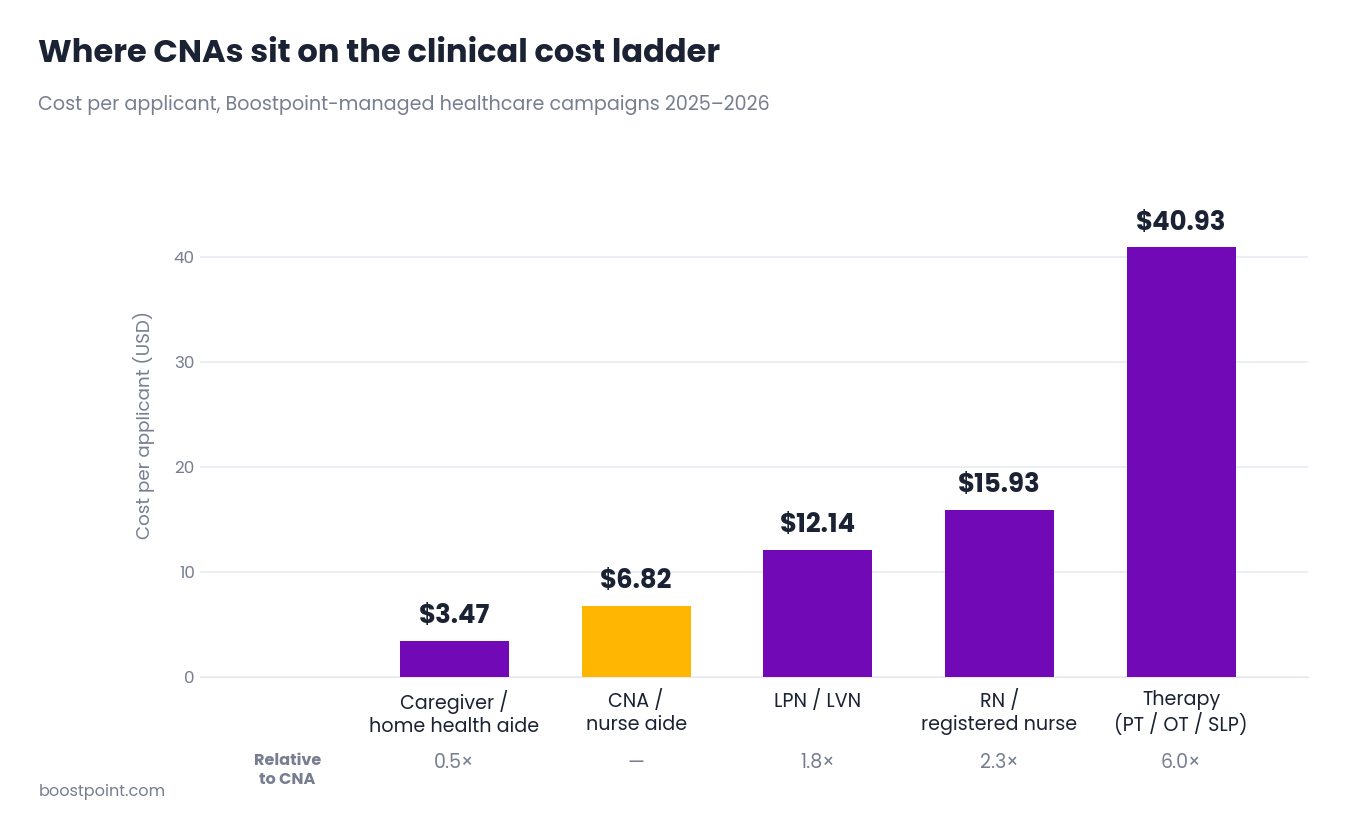
A CNA costs roughly twice a caregiver and less than half an RN — which tracks the size of the eligible population at each rung. Every step up the credential ladder shrinks the pool you're advertising into while the number of employers chasing it stays about the same.
A note on how solid this number is
We'd rather show you the seams than present a clean figure you can't check.
Most healthcare employers advertise CNA roles alongside other clinical positions — a single campaign for "RN / LPN / CNA" in one market. That's normal practice, but it means the CNA cost figure is partly drawn from blended campaigns.
So we split them:
| Campaign type | Cost per applicant | Applications | Completion rate |
|---|---|---|---|
| CNA and aide roles only | $6.28 | 242 | 19.8% |
| Blended with RN / LPN / NP | $7.32 | 264 | 15.6% |
| All CNA campaigns | $6.82 | 506 | 17.4% |
Source: 21 Boostpoint-managed CNA and nurse aide campaigns across four employers, 2025 through mid-2026, representing 506 applications — drawn from a wider set of 478 healthcare campaigns across 30 employers. Boostpoint's canonical 2026 Social Job Advertising Benchmark (891 campaigns, single methodology) reports median cost per applicant of $3.76 for caregivers, $7.72 for CNAs, $12.77 for LPNs and $19.08 for RNs; where this earlier analysis and the benchmark differ, the benchmark figure is canonical.
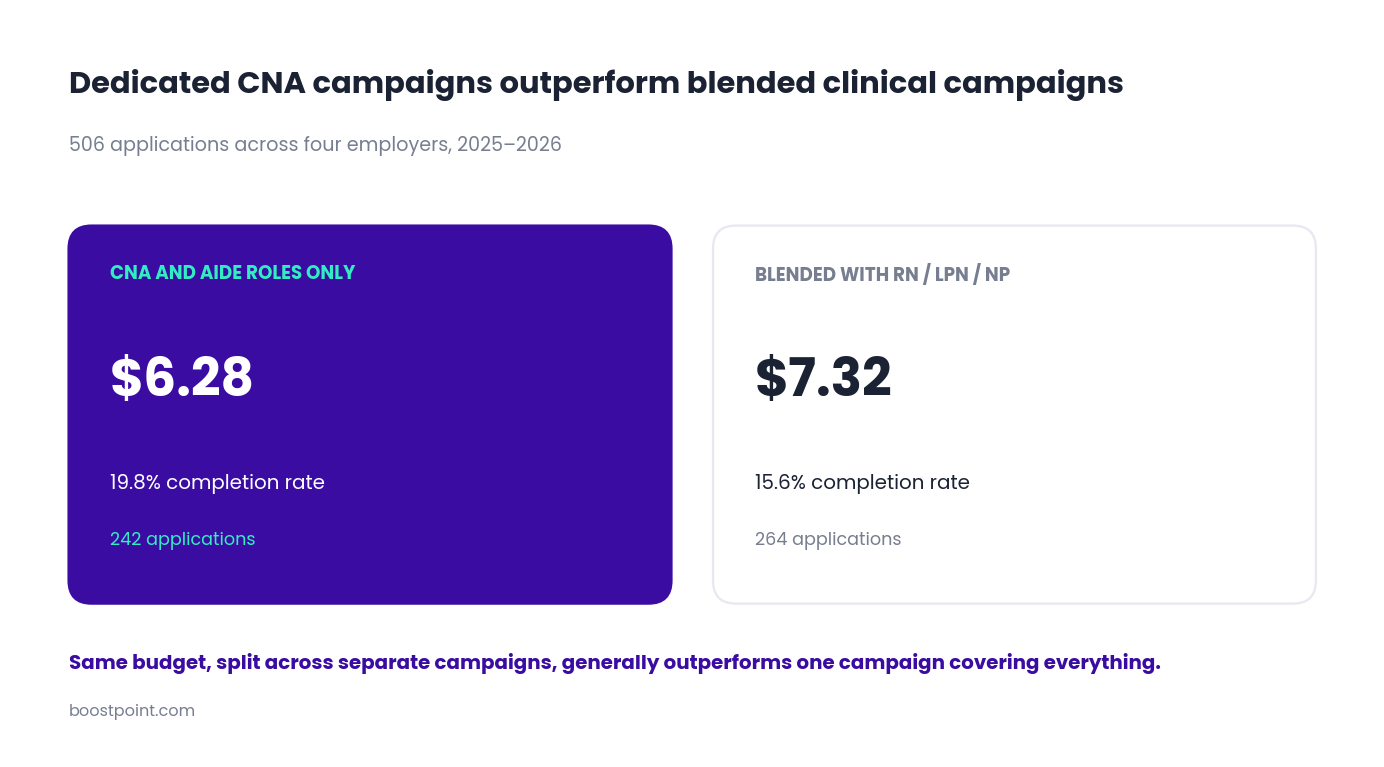
The two converge closely, which is reassuring — the blended figure isn't being distorted by clinical roles hiding inside it. Dedicated CNA campaigns performed slightly better on both cost and completion, which is itself a small argument for advertising the role on its own rather than bundling it.
In the latest 12 months of Boostpoint-managed Meta campaigns (October 2025–September 2026, 18 campaigns), the median CNA applicant cost $7.55; the RN and LPN figures from the same cut are on what it costs to recruit an RN, LPN or CNA.
Sample size caveat, stated plainly: 506 applications across four employers is a smaller base than our caregiver or RN figures. Treat $6.82 as a well-supported estimate rather than a precise benchmark.
Strategy 1: Write against home care, not just against the facility down the road
Most CNA job postings compete on the wrong axis. They lead with the facility's mission, its awards, its team culture — positioning against other facilities. Our CNA job description template leads with the hourly rate, the shift differential and the resident assignment instead.
But if you're losing CNAs to home care, none of that lands. The home care pitch is one client at a time, a schedule you help set, and no hall of twelve residents on a short-staffed evening.
Facility work has real advantages that job ads routinely fail to state:
- A predictable schedule. 7–3, 3–11, 11–7. Home care hours fluctuate with client census, and a caregiver whose client goes to hospital loses hours that week.
- No unpaid drive time. Home care involves travel between clients, usually unpaid, in your own vehicle. Facility work is one location.
- No vehicle requirement. This excludes a meaningful share of the workforce from home care entirely — particularly in markets with transit and in a workforce where 36% of direct care workers live in or near poverty.
- Colleagues. Home care is solitary. Some people prefer that; many don't.
If your CNAs are leaving for home care, those four points are your ad. Not your mission statement.
Strategy 2: Advertise CNA roles separately
Our data shows dedicated CNA campaigns outperforming blended clinical campaigns on both cost and completion — $6.28 against $7.32, and 19.8% completion against 15.6%.
The reason is straightforward. An ad for "RN / LPN / CNA — Pittsburgh" has to speak generically enough to cover three roles with different pay, different requirements and different motivations. It ends up speaking specifically to none of them. The RN and LPN openings deserve their own campaigns too, and our guide to nurse recruitment covers how to run those.
A CNA ad can state the actual hourly rate, the actual shift, and the actual resident-to-aide ratio. Why those specifics carry so much weight is the subject of the CNA shortage, where 98% of the openings turn out to be replacement. That specificity is what makes people stop scrolling.
This is worth doing even when you're hiring all three roles in the same building. Same budget, split across three campaigns, generally outperforms one campaign covering everything.
Strategy 3: Keep the application under a minute
CNA applications complete at 17.4% in our data. Caregiver applications complete at 31.3%.
Some of that gap is real — certified candidates are more selective and more often employed. But a large share is form length. CNA applications routinely ask for certification numbers, issue and expiry dates, full employment history and sometimes a resume upload, at the front of the process.
Consider where the person is when they see your ad: on a break, on a phone, possibly on facility wifi that barely works. They may not have their certification number memorized. They almost certainly don't have a resume on their phone.
Ask what disqualifies, not what verifies. For most CNA roles that's four questions:
- Do you hold an active CNA certificate, and in which state?
- Which shifts can you work?
- Do you have reliable transportation?
- How many years have you worked in a facility setting?
Certification numbers, references and background paperwork all get verified after you've spoken — the way they always did.
The arithmetic here is worth internalizing: cost per applicant is cost per click divided by completion rate. Raising CNA completion from 17% to 25% would cut your cost per applicant by roughly a third, with no change to spend, targeting or creative. We cover how the application affects your cost in more detail, with the funnel broken out by role.
Strategy 4: Reach the CNAs who aren't looking
The number of CNAs actively searching in your market this week is small and every facility in the area is bidding on them. That's why job board costs climb exactly when you most need to hire.
The CNA you actually want is working days at a facility twenty minutes away. She'd move for a better shift differential, a shorter drive, or a manager who doesn't call her on days off. She's not browsing job boards — she's on her phone like everybody else.
That's the entire case for paid social in this category: it doesn't require search intent. And it's why the approach performs relatively better in thinner markets, where a job board may produce nothing at all in a given week because nobody there searched.
Strategy 5: Call the same day
CNAs apply to several employers in one sitting. The facility that calls back within minutes is talking to somebody still thinking about changing jobs. The facility that calls Thursday about a Tuesday application is calling somebody who already accepted an offer.
This matters more for CNAs than for higher-credentialed roles, because the alternatives are close substitutes. If three facilities and two home care agencies in your market pay within a dollar of each other, response speed is your differentiator.
Automated SMS on submission holds attention until a person can call. Measure your median time from application to first human contact in minutes — most facilities that measure it for the first time are surprised.
Getting a CNA to the phone is the hard part, and the conversation that follows decides whether the effort paid off. Our CNA interview questions cover what to ask about the assignment, the transfer and the certification, and what the federal rules already settle before you ask anything.
Getting a CNA to the phone is the hard part, and the conversation that follows decides whether the effort paid off. Our CNA interview questions cover what to ask about the assignment, the transfer and the certification, and what the federal rules already settle before you ask anything.
What recruiting won't fix
Worth stating plainly, because CNA turnover at 42.3% is not primarily a recruiting problem.
- Staffing ratios. The most-cited reason CNAs leave facility work. No ad changes how many residents are on the hall.
- Pay below market. If home care agencies in your area pay two dollars more for less physically demanding work, advertising surfaces that faster and more expensively.
- Mandated overtime. A significant driver of burnout and departure in skilled nursing.
- Supervisor relationships. The most common reason people leave any job.
What recruiting does is give you enough flow to be selective, and enough screening to hire people the schedule actually fits. Those matter — but they're a portion of the retention picture, not the whole of it.
How to hire CNAs: the order of work, from the opening to the first shift
The five strategies above are about reach and conversion. Hiring a CNA also has a sequence, and most delays happen between the steps rather than inside them. This is the order that keeps a certified applicant moving.
- Write one ad per role and shift. Put the hourly rate, the shift and the resident assignment in the first lines. Our CNA job description template has the wording.
- Run it where employed CNAs scroll. Scope a Facebook and Instagram campaign to reasonable commuting distance. Employment ads run in Meta's special ad category, so you cannot target by age, gender or ZIP code, and the location radius has to be at least 15 miles.
- Ask four knockout questions, not twenty. Active certificate and state, shifts, transportation, facility experience. Everything else waits for the call.
- Text on apply, call the same day. A text within minutes holds the applicant until a person can call.
- Verify the certificate before the start date. Check the state nurse aide registry; our CNA verification guide walks through it.
- Interview for the assignment, not the resume. Our CNA interview questions cover what to ask.
For budgeting, the CNA / nursing assistant family in Boostpoint's 2026 Social Job Advertising Benchmark had a median of $7.72 per applicant, a middle half of $6.18 to $12.06, a blended cost of $8.17 and an 18% apply rate. Cost per applicant is not cost per hire: plan for several applicants per CNA you start, and track how many of yours reach the interview.
If you also hire people who could become CNAs, federal rules matter. Under 42 CFR 483.152, a nurse aide training program must include at least 75 clock hours, with at least 16 hours of supervised practical training, and an aide who is employed by, or has an offer from, a nursing facility on the day training begins may not be charged for any portion of it.
Frequently asked questions
How much does it cost to recruit a CNA?
CNA and nurse aide applicants averaged $6.82 across our 2025–2026 campaigns — roughly double a caregiver at $3.47 and about 43% of an RN at $15.93. Dedicated CNA campaigns performed slightly better at $6.28. That figure comes from 506 applications across four employers, so treat it as a well-supported estimate rather than a precise benchmark.
Why is CNA turnover so high?
CNA turnover in skilled nursing ran 42.3% in the most recent AHCA data — the highest of any position tracked. A structural reason is that CNAs are recruited from two directions at once: hospitals offering better pay and career progression, and home care agencies where the certification isn't required but is welcome, often with more flexible scheduling.
Should we advertise CNA roles separately or alongside RN and LPN openings?
Separately, based on our data. Dedicated CNA campaigns ran $6.28 per applicant with 19.8% completion, against $7.32 and 15.6% for campaigns blending CNA with RN or LPN roles. A single ad covering three roles can't state the specific pay, shift and ratio that make someone stop scrolling.
What should a CNA job ad say?
Hourly rate, shift, and resident-to-aide ratio, early. If you're losing CNAs to home care, also state the things facility work offers that home care doesn't: a predictable schedule, no unpaid drive time, no personal vehicle requirement, and colleagues on shift.
Why is our CNA application completion rate low?
Usually form length. CNA applications complete at 17.4% in our data against 31.3% for caregiver roles, largely because they front-load certification numbers, employment history and resume uploads. Ask the four things that genuinely disqualify someone and verify credentials after contact.
Does social media advertising work for hiring CNAs?
Yes, for a specific reason: the CNAs you want are usually employed and therefore not searching job boards. Social advertising reaches people without requiring search intent, which is most of the qualified population at any given moment.
Can we target candidates who hold an active CNA certificate?
No. Employment ads in the US run under Meta's Special Ad Category, which removes detailed audience targeting to prevent discrimination in hiring. Certification is confirmed through a knockout question in the application instead.
Will better recruiting reduce our CNA turnover?
Partly. Screening for shift availability and transportation up front means hiring people the schedule fits, and more applicant flow lets you be selective rather than taking whoever applies. It won't fix staffing ratios, mandated overtime or pay below market — those are operational problems.
How do I hire CNAs?
Reach certified nursing assistants who are working somewhere else, give them a short application and call the same day. Put the hourly rate, shift and resident ratio in the ad, advertise CNA roles separately from RN and LPN openings, and ask only whether the certificate is active, which shifts they can work and whether they have transportation. In Boostpoint's 2026 Social Job Advertising Benchmark, the median CNA applicant cost $7.72 and 18% of people who clicked finished the application.
How do I recruit CNAs for a nursing home?
Write the ad against the jobs your CNAs are actually leaving for, which are often home care roles as well as the facility down the road. State what facility work offers: a predictable shift, no unpaid drive time between clients, no personal vehicle requirement and colleagues on the floor. Scope the campaign to commuting distance, keep the application to about a minute on a phone, and have someone ready to call applicants the day they apply.
Why am I not getting CNA applicants?
Usually one of three things. The posting only reaches people searching job boards, and most CNAs you want are employed and not searching. The application is too long, asking for certification numbers, work history or a resume before anyone has spoken. Or the pay and shift are missing or below what nearby employers post. In Boostpoint's 2026 Social Job Advertising Benchmark, CNA campaigns converted 18% of clickers into applicants; a rate well below that points to the form.
What are some CNA recruiting ideas that actually work?
Write the ad against home care as well as the facility down the road, advertise CNA roles separately from RN and LPN openings, keep the mobile application to about four knockout questions, and call applicants the same day. Two more that facilities underuse: recruit caregivers and dietary or housekeeping staff into a sponsored CNA class (under 42 CFR 483.152, an aide employed by or offered a job by a nursing facility when training begins cannot be charged for it), and state the shift differential in the headline.
How many applicants does it take to hire one CNA?
It varies with your pay, shift and how fast you call back, so measure your own ratio. What Boostpoint's 2026 Social Job Advertising Benchmark can tell you is the cost of each applicant: the CNA / nursing assistant family had a median of $7.72 per applicant and an 18% apply rate. Multiply your applicants-per-hire ratio by your cost per applicant to get an advertising cost per CNA hired.
What is the CNA hiring process?
For a nursing facility, the CNA hiring process runs in this order: an ad for one role and shift with the hourly rate in the first lines; a short mobile application with four knockout questions (active certificate and state, shifts, transportation, facility experience); a text within minutes and a call the same day; an interview about the assignment; and a conditional offer. Before the new aide works, federal rules, with narrow exceptions for aides in or just out of a state-approved program, require the facility to receive registry verification that the individual has met the competency evaluation requirements (42 CFR 483.35(d)(4)) and to seek information from every state nurse aide registry it believes has information on the person (483.35(d)(5)). Background check rules are set by each state. Our CNA verification guide walks through the registry step.
What is the CNA application process?
On the employer side, it should take under a minute on a phone. The applicant taps the ad, answers four questions (active certificate and state, shifts they can work, reliable transportation, years in a facility), leaves a name and phone number and submits. Certificate numbers, work history, references and background paperwork come after the first conversation, when you verify them. In Boostpoint's 2026 Social Job Advertising Benchmark, the CNA / nursing assistant family converted 18% of people who clicked into applicants, so each extra field up front costs applicants. If you mean becoming a CNA, that runs through a state-approved nurse aide training and competency evaluation program and the state registry, and the details vary by state.
See what CNA hiring costs in your market
Book a 30-minute call and we'll walk through cost per applicant for the roles, shifts and markets your facilities are hiring for.
Book a Free DemoFigures come from 21 Boostpoint-managed CNA and nurse aide campaigns across four employers, 2025 through mid-2026, representing 506 applications — drawn from a wider set of 478 healthcare campaigns across 30 employers. Costs are what advertisers paid for advertising only. The CNA sample is smaller than our caregiver and RN samples and should be read as directional. Turnover figures are third-party industry estimates and cited as such. This is a sample of Boostpoint campaigns, not an industry-wide study.
Related: Healthcare Recruiting · What It Costs to Recruit an RN vs LPN vs CNA · Senior Living Staffing · Caregiver Turnover