
Meta's Special Ad Category for Employment Ads, Explained by People Who Run Nothing Else
Meta's Special Ad Category is a mandatory setting for any employment, housing, or financial-services ad run by a US advertiser or shown to people in the US, Canada, or certain parts of Europe. Declaring it locks age to 18–65+, requires all genders, removes ZIP-code targeting, location exclusions, lookalike audiences, and some interests, and widens any city or pin-drop audience to a 15-mile radius in the US. Every one of the 891 campaigns in Boostpoint's 2026 Social Job Advertising Benchmark ran under it, at a median of $13.88 per applicant. The restrictions decide who can see the ad; the application form decides what it costs.
Source: Boostpoint 2026 Social Job Advertising Benchmark — 891 Boostpoint-managed campaigns on Meta (1,334 campaign-months), 2026; costs are what advertisers paid for advertising only.
Policy status: every rule on this page was read on Meta's Business Help Center and Transparency Center on August 25, 2026 (Discriminatory Practices policy, change log dated December 21, 2024). We re-check quarterly; next scheduled review November 2026. Meta changes ad products without notice — if something here differs from what Ads Manager shows you, Ads Manager is right and we'd like to hear about it. This page is not legal advice.
A note on who's writing this
Boostpoint runs social media job advertising for employers, which means every ad we have ever placed on Facebook or Instagram ran inside the Employment Special Ad Category. That is why we're credible on this page and also why you should read it as a vendor's page: we sell the thing the restrictions apply to. Everything about Meta's policy below is quoted or closely paraphrased from Meta's own help pages, checked on the date above; the cost figures are ours, from the 2026 Social Job Advertising Benchmark, with the methodology at the bottom. If you want the how-to for the ads themselves rather than the policy, our Facebook ads for recruiting guide covers that, and how to post a job on Facebook covers the free routes, including the Local Jobs listing Meta brought back in October 2025.
What the Meta Special Ad Category is, and who must use it
When you build a campaign in Meta Ads Manager you are asked whether it falls into a Special Ad Category. Meta's Discriminatory Practices policy says that "any United States advertiser or advertiser targeting the United States, Canada or certain parts of Europe that is running financial products and services, housing or employment ads, must self identify as a Special Ad Category… and run such ads with approved targeting options." Choose wrongly, or not at all, and Meta's help page is blunt: "your ad may be rejected." The categories today are employment, housing, financial products and services (which replaced the old "credit" category and became required for US advertisers and audiences on January 21, 2025), and a separate social issues, elections or politics category that carries disclaimer rules rather than targeting limits.
Meta's definition of an employment ad is wider than a job post. In its words, it is "an ad that promotes or directly links to an employment opportunity," and the examples include full-time and part-time jobs, internships, apprenticeships, professional certification programs, job fairs, job boards or aggregation services, guaranteed interviews or career placement, and "promotion of company perks alongside employment opportunities." What it does not include: general advice on succeeding at work or on career development unrelated to specific listings, and "discussing a company without sharing employment opportunities or perks." So an employer-brand video with no job attached can run without the category; the moment it says "we're hiring" it can't.
What declaring the category locks, in Meta's words
| Option | What Meta says happens | What it means for a job ad |
|---|---|---|
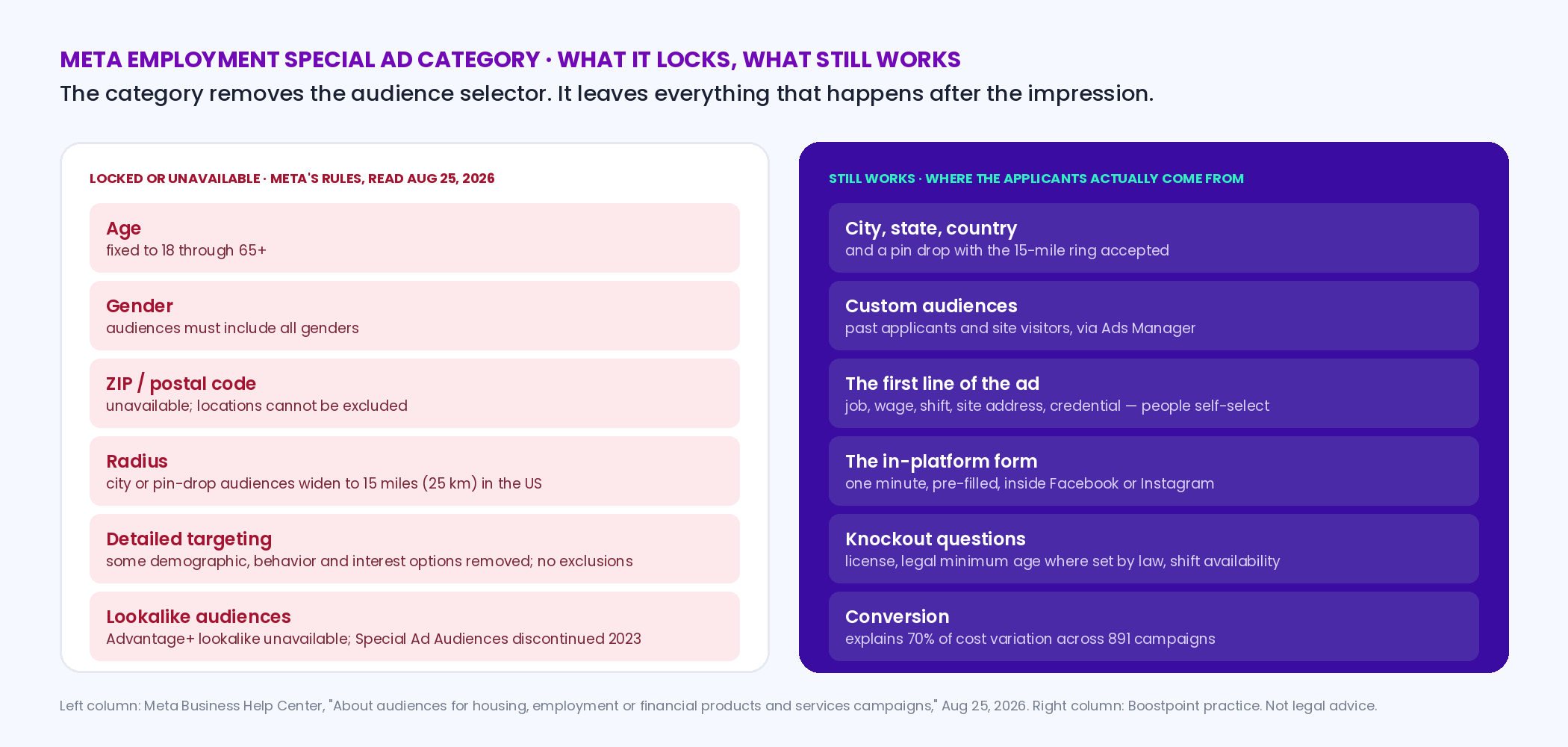
| Location | Country, region, state, province, or city allowed; "not by ZIP code or postal code. You also can't exclude locations." City, address, and pin-drop audiences "will include an expanded radius" — a 15-mile (25 km) minimum in the US and listed countries, 10 miles (17 km) in others. | You cannot draw a tight ring around one plant or facility. Seattle means Seattle plus everyone within 15 miles of the city center. |
| Age | "Options are generally fixed to include ages 18 through 65+ for housing, employment and credit ads." | No "25–45." Every adult sees the ad if the auction serves it to them. |
| Gender | "Audiences must include all genders. You can't edit this option." | No gender targeting in either direction. |
| Detailed targeting and exclusions | "Some demographic, behavior and interest options are unavailable. Excluding any detailed targeting selections is also unavailable." | Some interests remain; anything that proxies a protected class is gone, and you can't exclude anyone. |
| Lookalike audiences | "Advantage+ lookalike is unavailable." Saved audiences "will be updated to comply." Special Ad Audiences, the earlier substitute, were discontinued by Meta in 2023. | You can't clone your best hires' profiles into an audience. |
| Custom audiences | Not on the limited list; "certain audience options such as custom audiences may only be available via Meta Ads Manager." | Your own lists — past applicants, website visitors — still work, through Ads Manager. |
Why the rules exist: the short legal history
The category is Meta's response to discrimination law and to litigation about it. Federal law already forbids the underlying conduct: the Age Discrimination in Employment Act makes it unlawful to "print or publish… any notice or advertisement relating to employment… indicating any preference, limitation, specification, or discrimination, based on age" (29 U.S.C. §623(e)), and Title VII carries the same prohibition for race, color, religion, sex, and national origin. Meta's own policy restates it: ads "must not discriminate or encourage discrimination against people based on personal attributes such as race, ethnicity, color, national origin, religion, age, sex, sexual orientation, gender identity, family status, disability, medical or genetic condition." The targeting locks are the mechanism that stops an advertiser from doing with an audience selector what the law forbids doing with words.
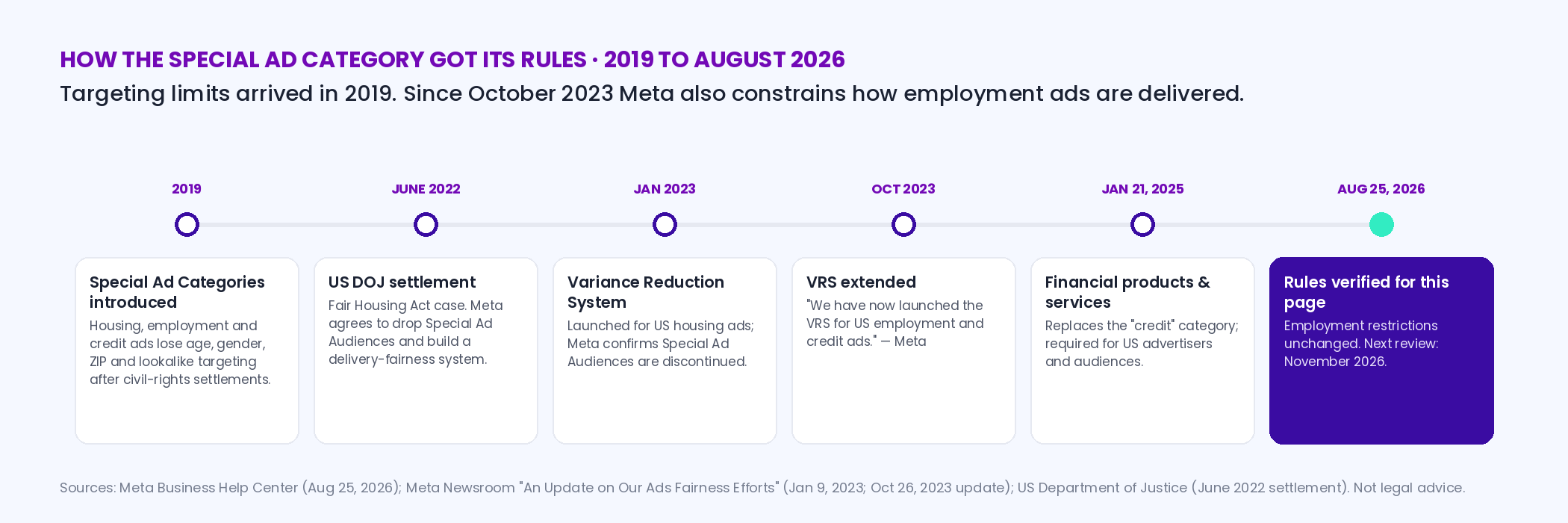
2019
Special Ad Categories introduced for housing, employment, and credit ads following civil-rights settlements; age, gender, ZIP, and lookalike targeting removed for those ads.
June 2022
US Department of Justice settlement under the Fair Housing Act. Meta agreed to stop using its "Special Ad Audiences" tool and to build a system that makes the audience an ad actually reaches look like the audience it was eligible to reach.
January 2023
Variance Reduction System launched for US housing ads; Meta confirmed it had "discontinued the use of Special Ad Audiences."
October 2023
Meta: "we have now launched the VRS for US employment and credit ads." Delivery, not only targeting, is now constrained for job ads.
January 21, 2025
"Credit" becomes "Financial products and services," required for US advertisers and audiences.
August 25, 2026
Rules verified for this page. Employment restrictions unchanged from the table above. Next review November 2026.
The part that matters: the category limits who sees the ad, not what the ad costs
The complaint we hear most is "we can't target, so it won't work." Our data says the opposite, and it is the one place on this page where we can add something Meta's help center can't. All 891 campaigns in our 2026 benchmark ran under the employment Special Ad Category — none had age, gender, ZIP, or lookalike targeting — and their cost per applicant still ranged from $2.91 at the cheapest decile to $66.45 at the most expensive. If targeting decided cost, campaigns with identical targeting locks could not vary by a factor of 22.84. What decided it was what happened after the click: applicant conversion explains 70% of the variation in cost per applicant across those campaigns, click-through rate 30%, and the auction price of impressions 18%.
| Apply rate (clicks that become applications) | Cost per applicant | Share of budget | Share of applicants |
|---|---|---|---|
| Under 5% | $53.77 | 18% | 3% |
| 5–10% | $23.13 | 24% | 8% |
| 10–20% | $11.11 | 32% | 23% |
| 20–35% | $4.41 | 21% | 38% |
| Over 35% | $1.61 | 6% | 28% |
Source: Boostpoint 2026 Social Job Advertising Benchmark — 891 Boostpoint-managed campaigns on Meta (1,334 campaign-months), 2026; costs are what advertisers paid for advertising only.
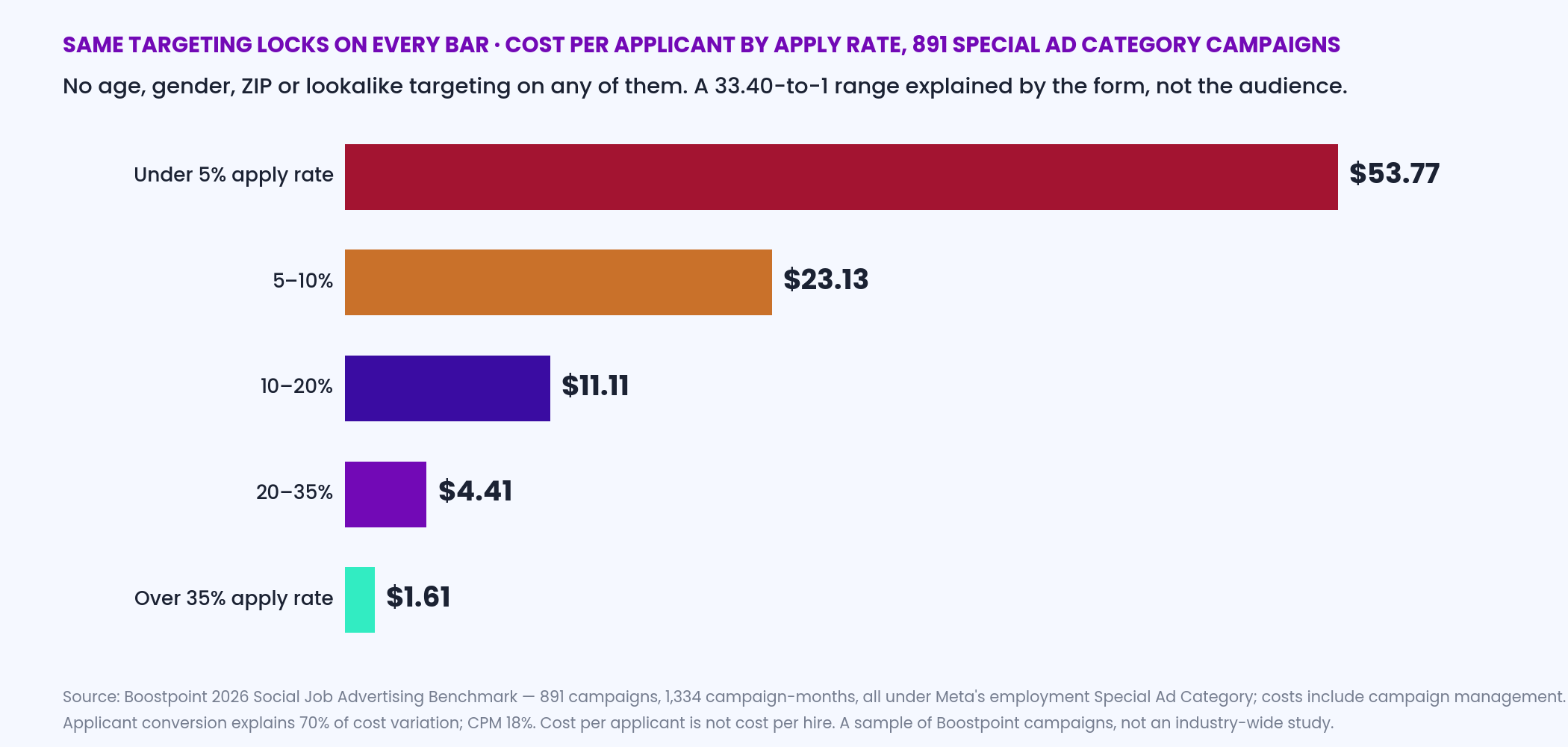
Read the bottom two rows against the top two: 41% of all budget ran in campaigns converting under 10% and returned 11% of all applicants. Those campaigns were not badly targeted — they couldn't be, the category doesn't allow it. They sent people to a long application. The practical consequence is that the hours you would have spent building an audience should go into the thirty seconds after the click instead; the role-by-role figures are on our frontline hiring benchmarks page.
Work authorization is one thing you cannot screen for in the ad and must handle after the hire. In nine states that handling is prescribed: our page on E-Verify requirements by state lists which employers have to enroll and from what size.
How you screen when you can't target: the knockout question
The category stops you from choosing who sees the ad. It does not stop you from asking, in the application, whether the person meets a real requirement of the job — and that is where every legitimate "targeting" need goes. A CDL-A, a state nursing license, the legal right to work, availability for nights, the ability to lift fifty pounds with or without accommodation, a start date: each is a bona fide requirement you may ask about, and each is a question you can put in a Meta instant form so that a "no" ends the application politely before it reaches your inbox. Three questions is the working number. Fewer and unqualified people get through; more and qualified people leave. In our campaigns the form lives inside Facebook or Instagram, opens pre-filled from the person's profile, and takes about a minute (the mechanics are on our social media job advertising page) — which is why the apply rates in the table above exist at all. The rules for what a knockout question may ask are the same rules that govern an interview: ask about the job, not the person. "Do you hold a current Class A CDL?" is a requirement. "How old is your CDL?" is a proxy for age and belongs nowhere near an application.
Translate the targeting you wanted into what you can do
Tick what you would have targeted on. The left side is Meta's rule as of August 25, 2026; the right side is the compliant way to get the same hiring result, which is almost always a question in the form or a line in the ad.
Nothing is stored or sent — this runs in your browser. Not legal advice; the left column is Meta's help-center text, the right column is our practice.
Tick anything above to see the rule and the replacement.
Meta text from "About audiences for housing, employment or financial products and services campaigns" and "About ads for employment," Business Help Center, August 25, 2026. Replacements are Boostpoint's practice across 891 Special Ad Category campaigns; check your own counsel for state-specific rules such as pay transparency, which our job posting requirements page covers.
Employment vs housing vs financial services: the same locks, different definitions
People searching "special ad category housing employment" usually want to know whether the rules differ. The targeting restrictions are the same set for all three categories; what differs is the definition that pulls an ad into each one and the law behind it. Housing ads — sales, rentals, insurance, mortgages, anything "for the sale or rental of a home" — sit under the Fair Housing Act and were the subject of the 2022 Justice Department settlement. Financial products and services replaced the narrower "credit" category and covers credit cards, loans, banking and related products, required since January 21, 2025. Employment is the definition quoted above. A property-management company advertising leasing-agent jobs is running an employment ad; the same company advertising apartments is running a housing ad; both get the same audience locks, and one campaign cannot be both, so build them separately.
The case for hating the category, made fairly
The restrictions cost real efficiency in three situations, and it would be dishonest to pretend otherwise. A single rural site loses money to the 15-mile radius when most of the ring is farmland; the fix is to run the ad anyway and let the site address in the first line filter, but you are paying for impressions on people who won't drive it. A role with a legal age floor — interstate CDL at 21, some security and alcohol-service roles — cannot be aged in the audience and must be aged in the form, which means you pay for clicks from 18-to-20-year-olds. And an employer with a strong referral culture cannot build a lookalike of its own workforce. Meta's rationale for all three is the same: an employer who can draw a fair ring can also draw an unfair one, and the platform cannot tell the difference at scale, so nobody gets the tool. That is a defensible position and an expensive one, and the honest summary is that the cost is small next to the cost of a twenty-minute application: the difference between a 5% and a 20% apply rate in our data is $53.77 against $11.11 per applicant, and no targeting tool ever moved a number that far.
The Special Ad Category removes the audience selector. It leaves the ad, the form, and the question — and those were always where the applicants came from.
The step-by-step for building the campaign this category applies to, in the order Ads Manager asks for it, is on how to post and advertise a job on Facebook.
Frequently asked questions
What is Meta's Special Ad Category?
A mandatory campaign setting in Meta Ads Manager for ads about employment, housing, financial products and services, or social issues, elections and politics. For the first three, Meta's Discriminatory Practices policy requires "any United States advertiser or advertiser targeting the United States, Canada or certain parts of Europe" to self-identify the category and run the ads "with approved targeting options." Declaring it limits or removes age, gender, ZIP-code, exclusion, lookalike, and some interest targeting. Ads that should be in a category and aren't may be rejected.
Which targeting options are removed for employment ads?
Per Meta's help center as of August 25, 2026: age is fixed to 18 through 65+; audiences must include all genders; ZIP and postal codes are unavailable and locations cannot be excluded; city, address, and pin-drop audiences include an expanded radius of 15 miles (25 km) in the US; some demographic, behavior, and interest options are unavailable and no detailed targeting can be excluded; Advantage+ lookalike audiences are unavailable; saved audiences are updated to comply. Custom audiences are not on the limited list but may only be available through Ads Manager.
What counts as an employment ad on Facebook and Instagram?
Meta defines it as "an ad that promotes or directly links to an employment opportunity," including full-time and part-time jobs, internships, apprenticeships, professional certification programs, job fairs, job boards and aggregation services, guaranteed interviews or career placement, and company perks promoted alongside opportunities. General career advice and content "discussing a company without sharing employment opportunities or perks" are excluded — so an employer-brand post with no opening attached does not need the category.
Does the Special Ad Category make recruiting ads more expensive?
Not in a way we can find in our data. All 891 campaigns in our 2026 benchmark ran under the employment category, with no age, gender, ZIP, or lookalike targeting, and cost per applicant still ranged from $2.91 to $66.45 across deciles with a $13.88 median. Applicant conversion — what happens after the click — explains 70% of that variation; the auction price of impressions explains 18%. Campaigns converting under 5% cost $53.77 per applicant; over 35%, $1.61. The form, not the audience, sets the price.
Can I still reach the right people without age or ZIP targeting?
Yes, by putting the requirement in the ad and the form instead of the audience. Name the job, wage, shift, site address, and credential in the first line so the right people recognize themselves, and add up to three knockout questions in the instant form — a current license, a legal minimum age where one exists, shift availability — so a "no" ends the application. In an earlier campaign-level analysis of our CDL campaigns, 64.6% of applicants were 55 or older with no age targeting possible; the ad's content did the selecting.
Are Special Ad Audiences still available?
No. Special Ad Audiences were Meta's restricted substitute for lookalikes in the special categories. Under its June 2022 settlement with the US Department of Justice, Meta agreed to stop using them, and in January 2023 it confirmed it had "discontinued the use of Special Ad Audiences." Meta's help page now lists Advantage+ lookalike as unavailable for these campaigns. The Variance Reduction System that replaced them constrains delivery of US housing ads since 2023 and, per Meta's October 2023 update, US employment and credit ads too.
What's the difference between the employment and housing special ad categories?
The targeting locks are the same; the definitions and the laws differ. Housing covers ads for the sale or rental of homes, mortgages, and related products and sits under the Fair Housing Act, which was the basis of the 2022 DOJ settlement. Employment covers ads that promote or link to a job opportunity, under Title VII and the ADEA. Financial products and services replaced "credit" and has been required for US advertisers and audiences since January 21, 2025. A campaign belongs to one category, so a company advertising both jobs and apartments builds two.
Is a knockout question in the application legal if targeting by the same trait isn't?
Asking about a bona fide requirement of the job is what applications are for — a license, a legal minimum age set by regulation, availability for the shift, the ability to perform an essential function with or without accommodation. What the law and Meta both prohibit is a preference based on a protected characteristic, so the test is whether the question is about the job or about the person. "Do you hold a current Class A CDL?" is about the job; anything that estimates age, sex, or national origin is not. This is not legal advice; check state rules and your counsel.
Do I have to use the Special Ad Category for a job ad?
Yes, for any employment ad run by a US advertiser or shown to people in the US, Canada and parts of Europe. Declaring it late means rebuilding the audience, so declare it when you create the campaign.
How do I target a job ad when the Special Ad Category removes targeting?
You screen instead of target. Set the widest radius you can genuinely staff from, leave detailed targeting alone, and put two or three genuine knockout questions on the form so the sorting happens after the click rather than in the audience.
Run it the way 891 campaigns already have
Every campaign we run is built inside the employment Special Ad Category with the knockout form doing the screening. We'll show you the ones closest to your roles — costs, no hire claims we can't back.
Book a Demo


Boostpoint figures come from the 2026 Social Job Advertising Benchmark — 891 campaigns and 1,334 campaign-months, all run as Meta employment Special Ad Category campaigns: $13.88 median cost per applicant, $8.02 volume-weighted average, $2.91 cheapest-decile and $66.45 most-expensive-decile thresholds; cost per applicant by apply rate ($53.77 under 5%, $23.13 at 5–10%, $11.11 at 10–20%, $4.41 at 20–35%, $1.61 over 35%; 41% of budget in campaigns converting under 10% for 11% of applicants); applicant conversion explaining 70% of cost variation, click-through rate 30%, CPM 18%. The CDL age finding (64.6% of applicants aged 55+) comes from an earlier campaign-level analysis and uses a different methodology. Cost per applicant is not cost per hire; we do not track hires and publish no cost-per-hire figure. Meta policy text was read on August 25, 2026 from the Meta Business Help Center pages "How to choose a Special Ad Category," "About ads for employment," and "About audiences for housing, employment or financial products and services campaigns," and from the Transparency Center's Discriminatory Practices policy (change log December 21, 2024); Meta Newsroom, "An Update on Our Ads Fairness Efforts," January 9, 2023, with its October 26, 2023 update on the Variance Reduction System for US employment and credit ads; US Department of Justice announcements of the June 2022 settlement. Statutes: 29 U.S.C. §623(e) (ADEA); 42 U.S.C. §2000e-3(b) (Title VII). Meta changes its ad products without notice; we re-verify this page quarterly, next in November 2026. Nothing on this page is legal advice. This is a sample of Boostpoint campaigns, not an industry-wide study.