Employer guideUpdated September 2026
E-Verify Requirements by State: Who Actually Has to Enroll
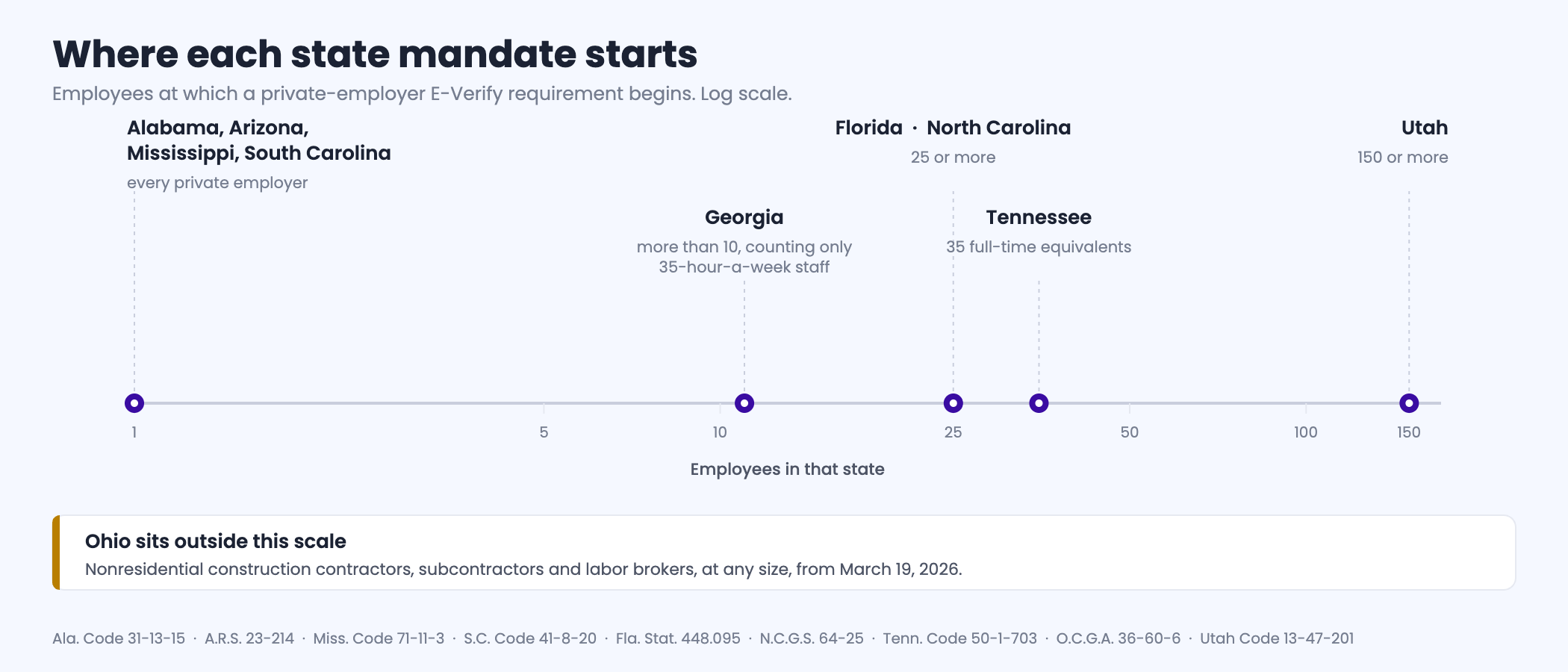
Nine states require private employers to use E-Verify, and no two of them define “employer” the same way. Alabama, Arizona, Mississippi and South Carolina require it of every private employer. Florida sets the line at 25 employees, North Carolina at 25, Tennessee at 35 full-time equivalents, Georgia at more than 10 — counting only people who work 35 hours a week or more — and Utah at 150. Ohio joined on March 20, 2026 for nonresidential construction only. Everywhere else the obligation reaches public employers and state contractors, not the general employer. This page cites the statute for each one.
E-Verify mandatory states at a glance
If you want the list of E-Verify required states before the detail, here it is. The question that matters is not only which states, but for whom: a state can make E-Verify mandatory for every private employer, for private employers above a size, for one industry, or only for public employers and companies holding state contracts.
| Who must use E-Verify | States |
|---|---|
| Every private employer, any size | Alabama, Arizona, Mississippi, South Carolina |
| Private employers above a size | Florida (25 or more employees), North Carolina (25 or more in the state), Tennessee (35 or more full-time equivalents), Georgia (more than 10 working 35 hours a week or more), Utah (150 or more) |
| One industry, any size | Ohio, nonresidential construction contractors, subcontractors and labor brokers, since March 20, 2026 |
| Public employers and state contractors only | Arkansas, Indiana, Michigan, Minnesota, Missouri, Nebraska, Oklahoma, Pennsylvania, Texas, Virginia, West Virginia, plus the contractor rules of the states above |
| Not mandatory: a choice | Louisiana, where E-Verify is one of two ways to comply |
Every other state leaves E-Verify voluntary for private employers. At the federal level it is mandatory only for federal contractors whose contract carries FAR 52.222-54, wherever they are based. The statute behind each private-employer row, and how each state counts its threshold, is further down this page.
What E-Verify is, in one screen
E-Verify is a federal internet service that checks whether a new hire is authorized to work. In the government's own words it is "an Internet-based system that compares information entered by an employer from an employee's Form I-9, Employment Eligibility Verification, to records available to the U.S. Department of Homeland Security and the Social Security Administration to confirm employment eligibility." It is run jointly by DHS and SSA, and it is free to use.
Three things follow from that definition and they are the source of most confusion.
- It does not replace Form I-9. The I-9 comes first and E-Verify reads from it. Every employer in the United States must complete an I-9 for every new hire; E-Verify is an additional check on top, run by a minority of employers.
- It is not federally mandatory for most employers. Federal law obliges only certain federal contractors, under FAR 52.222-54. Everyone else is there because a state told them to — which is what the rest of this page is about — or because they chose to enroll.
- It is a post-hire check, not a screening tool. A case is created after the person is hired and the I-9 is complete. Running an applicant is a violation, not a shortcut.
| Form I-9 | E-Verify | |
|---|---|---|
| Who has to | Every US employer, every new hire | Certain federal contractors, employers in the states below, and volunteers |
| When | Section 1 by the first day of work; Section 2 within 3 business days of the start date | Case created no later than the third business day after the employee starts work for pay |
| What it is | A form you complete and retain | A database check against DHS and SSA records, using the I-9 data |
| Cost | None | None |
| If it disagrees | You resolve it with the employee and the documents | A mismatch, which the employee has 10 federal working days to act on |
The deadline is the third business day after they start work for pay
Not after the offer, not after the I-9, and not after the first pay run. The E-Verify User Manual is explicit: "E-Verify cases must be created no later than the third business day after the employee starts work for pay", and an employer who discovers a missed case should "bring themselves into compliance immediately by creating a case". Creating a case three or more days late forces you to pick a reason for delay from a drop-down — awaiting Social Security number, technical problems, an audit that revealed a new hire was never run, or other — so late cases are visible to the government by design.
Five things an E-Verify employer may not do
Taken from the rules and responsibilities in the E-Verify User Manual, and each one is a real enforcement risk rather than etiquette. Do not pre-screen an applicant. Do not specify which I-9 documents the employee must present, beyond requiring that a List B document carry a photo. Do not use E-Verify to discriminate on national origin, citizenship or immigration status. Do not create a case for someone hired before you signed the E-Verify terms, outside the federal-contractor exception. And do not take adverse action against an employee because of a mismatch until the case reaches Final Nonconfirmation.
What a mismatch actually is
If the data does not line up, the case returns a Tentative Nonconfirmation, now generally called a mismatch. Within 10 federal government working days of the mismatch the employer must notify the employee, give them a copy of the Further Action Notice, review it with them in private, and tell them they have 10 federal working days from issuance to say whether they will contest it. Until the case becomes a Final Nonconfirmation the employer may not terminate, suspend, delay training, withhold or lower pay, or take any other adverse action because of the mismatch. If the employee declines to act, the employer may close the case and may then terminate without civil or criminal liability under the memorandum of understanding.
Federal contractors: the one place federal law says you must
Where the E-Verify clause at FAR 52.222-54 is in the contract, the deadlines are fixed: enroll as a federal contractor within 30 calendar days of contract award; within 90 calendar days of enrollment begin running all new hires, each within 3 business days of the date of hire; and for each existing employee assigned to the contract, start verification within 90 calendar days of enrollment or within 30 calendar days of that assignment, whichever is later. The clause flows down to subcontracts worth more than $3,500 that include work performed in the United States.
When the system itself goes down
It happens, most recently during the funding lapse in autumn 2025, and the rule is worth knowing before you need it: the days E-Verify was unavailable do not count toward the three business days. You create the case when the service returns, select "Other" as the reason for delay, and record that E-Verify was not available. Federal contractor deadlines pause the same way, on calendar days.
Why every list you find says something different
Search this question and you will get a dozen tables that do not agree with each other. They are not sloppy so much as flattened: they compress four legally distinct obligations into a single yes-or-no column.
| The obligation | What it actually means | Where |
|---|---|---|
| Universal private mandate | Every private employer enrolls, whatever its size | AL, AZ, MS, SC |
| Threshold mandate | Private employers above a headcount, defined differently in each state | FL, GA, NC, TN, UT |
| Sector mandate | One industry, regardless of size | OH (nonresidential construction) |
| Public and contractor mandate | Government employers and firms bidding for state work | IN, MI, MN, MO, NE, OK, PA, TX, VA, WV and the contractor arms of the states above |
| Choose-one safe harbor | Not a mandate at all: E-Verify or keep document copies | LA |
Louisiana is the clearest example of the problem
Louisiana appears on plenty of “states requiring E-Verify” lists. Read the statute and it is an election, not a requirement: R.S. 23:995 lets a private employer either run E-Verify or take and keep copies of specified identity documents. Choosing E-Verify buys something real — the employer is “presumed to have been in good faith” and escapes penalty for relying on the system — but an employer that keeps document copies instead has complied with Louisiana law.
The nine states that reach private employers
| State | Who must enroll | Since | Statute |
|---|---|---|---|
| Alabama | Every business entity or employer in the state | April 1, 2012 | Ala. Code § 31-13-15 |
| Arizona | Every employer, after hiring an employee | After December 31, 2007 | A.R.S. § 23-214 |
| Mississippi | Every employer, phased in by size | All employers by July 1, 2011 | Miss. Code § 71-11-3 |
| South Carolina | All private employers required to complete Form I-9 | Case within 3 business days of hire | S.C. Code § 41-8-20 |
| Florida | Private employers with 25 or more employees | July 1, 2023 | Fla. Stat. § 448.095 |
| North Carolina | Employers with 25 or more employees in the state | — | N.C.G.S. §§ 64-25, 64-26 |
| Tennessee | Private employers with 35 or more full-time equivalent employees | January 1, 2023 | Tenn. Code § 50-1-703 |
| Georgia | Private employers with more than ten employees | Phased in to July 1, 2013 | O.C.G.A. § 36-60-6 |
| Utah | Private employers with 150 or more employees | May 4, 2022 | Utah Code § 13-47-201 |
| Ohio | Nonresidential construction contractors, subcontractors and labor brokers, no size threshold | March 20, 2026 | E-Verify Workforce Integrity Act |
Look up a state
The threshold is a definition, not a headcount
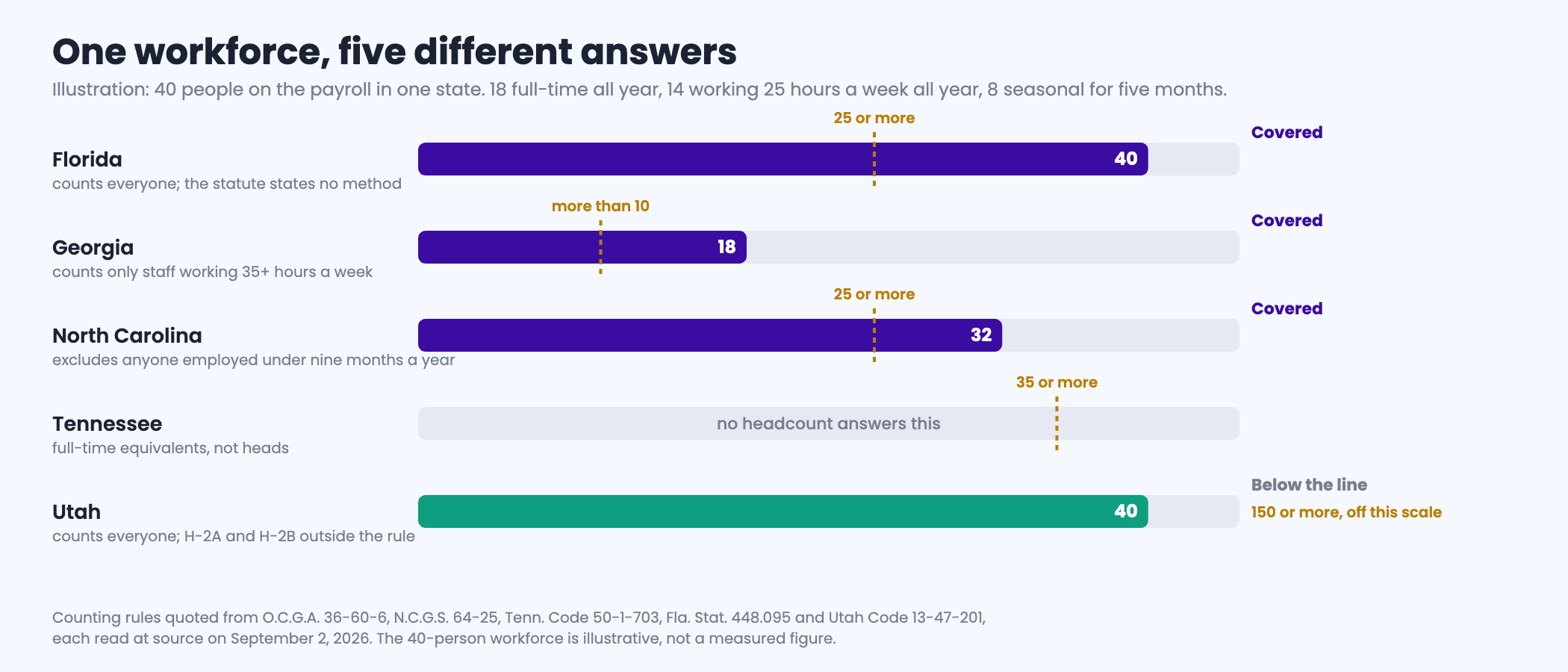
This is the part the tables lose, and it is the part that decides whether the rule applies to you. Five states set a number. All five count to it differently, and three of them exclude exactly the kind of worker a frontline employer has most of.
| State | The number | What the statute counts |
|---|---|---|
| Georgia | More than 10 | Only employees working not less than 35 hours per week, measured on January 1 of the year the affidavit is submitted |
| North Carolina | 25 or more | Employees in the state, excluding anyone whose employment term is under nine months in a calendar year |
| Tennessee | 35 or more | Full-time equivalent employees, not headcount |
| Florida | 25 or more | The statute sets the number and states no counting method |
| Utah | 150 or more | Employees, with foreign nationals on employer-petitioned H-2A or H-2B visas outside the rule |
Read across that table and the consequence is plain. A restaurant group with forty people on the payroll, half of them working twenty-five hours a week, is over the line in North Carolina and under it in Georgia. A packing operation that runs eight months of the year may employ two hundred people and count as none of them in North Carolina. A hotel counting heads in Tennessee is counting the wrong unit entirely.
Count your own workforce the way each statute counts it
What non-compliance actually costs
The federal I-9 penalty is a fine. Most state E-Verify penalties are not: they run at your license to trade. That is a different order of risk, and it is why these statutes sit with the operations team rather than with payroll.
| State | What happens |
|---|---|
| Alabama | First violation: terminate the unauthorized workers, three years of probation with quarterly employee reports, and licenses and permits suspended for up to 10 business days. Second: permanent revocation at that location. Beyond that: statewide suspension. |
| Florida | Three violations in 24 months brings a fine of $1,000 per day until the employer proves the noncompliance is cured, and noncompliance is grounds for suspension of all licenses. Verification records kept three years. |
| Mississippi | Cancellation of any state or public contract with up to three years of ineligibility, loss of any license or permit for up to a year, or both. |
| South Carolina | Failure to comply is a violation of the employer’s licenses. |
| Ohio | $250 for an initial violation rising to $25,000 for continued employment after a final nonconfirmation. The Attorney General investigates and issues the notice; the employer has 10 calendar days to request a hearing. |
| Louisiana | Failing both options: $500 per unauthorized worker, then $1,000, then $2,500 with license suspension of 30 days to six months. |
Two things changed in 2026, and one of them did not
Ohio is new and it is live. The E-Verify Workforce Integrity Act took effect on March 20, 2026 and covers nonresidential construction contractors, subcontractors and labor brokers with no minimum size. Covered employers create cases for new hires, keep records for three years from hire or one year from termination, whichever is later, and terminate anyone who receives a final nonconfirmation. Residential building, manufactured and mobile homes, industrialized units and agricultural structures are outside it.
Florida did not change. House Bill 197 would have removed the 25-employee threshold and reached every private employer from July 1, 2026. It passed the Florida House 80 to 30 on January 15, 2026 and then died in Rules on March 13, 2026. Florida’s threshold is still 25. Any page telling you Florida is about to cover everyone was written between those two dates and never updated.
And one quiet expiry worth diarizing
Utah’s private-employer requirement is written to repeal itself. Section 13-47-201 stands repealed on the earlier of July 1, 2027 or 120 days after the governor makes a finding described in Utah Code 63G-12-202(3)(a). Employers at or above 150 people in Utah are complying with a rule that currently has an end date on it.
Public employers and state contractors
Outside the states above, the obligation generally attaches to government employment or to bidding for government work rather than to employing people. These are listed as reported rather than re-read at statute, because the trigger in each case is a contract you would be reading anyway.
| State | Reach |
|---|---|
| Arkansas | State government departments, boards, bureaus, agencies and political subdivisions, for employees hired from January 1, 2026 (Act 948 of 2025) |
| Indiana, Nebraska, Oklahoma, Texas | Public employers and state contractors |
| Minnesota | State contracts over $50,000 |
| Missouri | Public employers, state contracts over $5,000, and recipients of tax credits or abatements |
| Pennsylvania | Construction businesses, and public works contracts of $25,000 or more |
| Virginia | Public employers, and state contractors with more than 50 employees |
| Michigan | State transportation contractors, plus county-level requirements |
| West Virginia | Service providers at the State Capitol Complex |
Hiring in more than one state
The obligation follows the worksite, not the head office. An employer headquartered in a state with no mandate that opens a location in Alabama, Arizona, Mississippi or South Carolina is enrolled from its first hire there, and one crossing 25 people in Florida or North Carolina crosses into the mandate without anyone filing anything. Remote hiring makes this sharper: a company with no premises in a mandate state can still acquire the obligation by employing people who live there.
The practical reading is that E-Verify enrollment is a function of your hiring plan rather than of your current footprint. If a market you are advertising into is in one of the nine, the question is settled before the first application arrives, not after the first offer.
Where our own numbers stop
We can tell you what it costs to reach candidates in these markets, because we measure that. Across the 891 campaigns in our 2026 social job advertising benchmark the median campaign cost $13.88 per applicant, with warehouse and production roles at $9.83 and CDL drivers at $26.86. We have no data at all on E-Verify enrollment rates, tentative nonconfirmation rates, or how long a case takes to resolve, and we are not going to estimate any of them. What we would say is that the enrollment question belongs with the decision to hire in a state, not with the paperwork after it — the same argument we make about Form I-9 requirements, where the clock also starts at the hire.
E-Verify runs on what the Form I-9 already records, so the document question comes first: our guide to work authorization covers the List A, B and C documents an employer may accept and what reverification each one triggers.
Who is required to use E-Verify
The state tables above answer the question by geography. It is worth answering once by employer type, because four separate rules can put an employer into E-Verify, and a business can be caught by one of them while sitting in a state with no mandate at all.
- Private employers in a mandate state. Every private employer in Alabama, Arizona, Mississippi and South Carolina; private employers above the state's threshold in Florida, Georgia, North Carolina, Tennessee and Utah; and nonresidential construction contractors, subcontractors and labor brokers in Ohio. The obligation follows where your employees work, not where the company is headquartered, so a location in one of these states is covered once you meet that state's rule.
- Federal contractors whose contract carries the E-Verify clause. FAR 52.222-54 applies wherever the employer is based. Under FAR 22.1803 the clause goes into solicitations and contracts over $150,000, except those performed entirely outside the United States, those with a period of performance under 120 days, and those only for commercially available off-the-shelf items and closely related services.
- Public employers and state contractors. The states in the public employers table further up this page, plus the contractor provisions of the private-mandate states. Here the trigger is the contract or the public payroll rather than headcount.
- Employers of students on the STEM OPT extension. A less familiar route in: under 8 CFR 214.2(f)(10)(ii)(C)(5), a student can only receive the 24-month STEM extension if the employer is enrolled in E-Verify and remains a participant in good standing. An employer that wants to keep such a student has to enroll, whatever state it is in.
Everyone else may enroll voluntarily. Enrolling is a decision about a hiring location rather than about one role, so make it with the whole site in view.
If you hire frontline staff across several states, check this list against your hiring plan rather than your head office. A single warehouse in South Carolina or a crew in Ohio nonresidential construction is enough to put that location into E-Verify.
E-Verify and rehires: when a returning employee needs a new case
A rehire at an E-Verify location does not automatically need a new E-Verify case. Whether it does depends on two things: how long ago the original Form I-9 was completed, and whether that earlier hire got an E-Verify result of employment authorized. The E-Verify User Manual (section 2.1.2, Rehires) sets it out, and it sits on top of the Form I-9 rehire rule in 8 CFR 274a.2(c), which lets an employer rely on a previously completed Form I-9 if the person is rehired within three years of the date that form was first executed.
| The rehire situation | What the E-Verify User Manual allows |
|---|---|
| Rehired within three years of the original Form I-9, earlier case returned employment authorized, no documents expired | Write the rehire date in Supplement B of the existing Form I-9 and do not create a new case, or complete a new Form I-9 and create a new case |
| Same, but a document on the old form has expired and does not trigger reverification (for example a U.S. passport, passport card, Permanent Resident Card or a List B document) | The same two options |
| Same, but an expired List A or List C document means work authorization must be reverified | Record the rehire date and the updated employment authorization in Supplement B without a new case, or complete a new Form I-9 and create a new case |
| Rehired within three years, but no E-Verify case was created for the earlier hire, or the case did not end in employment authorized | The employee completes a new Form I-9 and you create a case in E-Verify |
| Rehired more than three years after the original Form I-9 was first executed | The old form can no longer be relied on under 8 CFR 274a.2(c), so the rehire is verified as a new hire: a new Form I-9 and, at an E-Verify location, a new case |
The manual also allows the simplest policy of all: treat every rehired employee as a new hire, with a new Form I-9 and a new case. For a frontline employer with seasonal returners and boomerang hires, one rule applied to everyone is easier to audit than a decision tree applied by whichever manager is on shift. If you take the Supplement B route, remember the three years run from when the original form was completed, not from when the person left. Where a new case is created, the same deadline applies as for any new hire: no later than the third business day after the employee starts work for pay, as set out further up this page.
The restrictions listed further up this page still apply to a returning employee: no running a case to pre-screen them before they are hired, and no choosing which documents they show. The fuller rules on bringing people back, including what carries over on benefits and seniority, are on our rehire policy guide, and the Form I-9 side is on Form I-9 requirements.
Frequently asked questions
What is E-Verify?
A free federal internet service, run jointly by the Department of Homeland Security and the Social Security Administration, that compares the information an employer enters from an employee's Form I-9 against DHS and SSA records to confirm employment eligibility. It is a check performed after hiring, on top of the I-9, and it does not replace the I-9.
Is E-Verify required by federal law?
Only for certain federal contractors, where the clause at FAR 52.222-54 is in the contract. For everyone else, participation is a matter of state law or choice. Nine states require it of at least some private employers, and many more require it of public employers and state contractors.
What is the difference between E-Verify and Form I-9?
Form I-9 is a document every US employer must complete for every new hire and retain. E-Verify is an optional-for-most database check that reads the data from that completed I-9 and compares it against government records. The I-9 always comes first; E-Verify never stands in for it.
How long do I have to create an E-Verify case?
No later than the third business day after the employee starts work for pay. If you miss it, create the case immediately and select a reason for the delay from the drop-down E-Verify presents. Days on which E-Verify itself was unavailable do not count toward the three.
Can I run E-Verify on a job applicant before I hire them?
No. Using E-Verify to pre-screen an applicant is expressly prohibited by the E-Verify rules and responsibilities. A case may only be created after the person has been hired and Form I-9 is complete.
Which states require E-Verify for private employers?
Nine. Alabama, Arizona, Mississippi and South Carolina require it of every private employer. Florida requires it at 25 or more employees, North Carolina at 25 or more, Tennessee at 35 or more full-time equivalents, Georgia at more than ten, and Utah at 150 or more. Ohio requires it of nonresidential construction contractors, subcontractors and labor brokers with no size threshold, from March 20, 2026. Everywhere else the requirement reaches public employers and state contractors rather than employers generally.
Is E-Verify mandatory in Louisiana?
No. Louisiana R.S. 23:995 gives a private employer a choice: verify through E-Verify, or take and keep copies of specified identity and work authorization documents for each employee. Using E-Verify carries a benefit, since the employer is presumed to have acted in good faith and is not penalized for relying on the system, but an employer that keeps the document copies has complied. Louisiana is often listed as a mandate state and is not one.
How does Georgia count employees for its E-Verify threshold?
Georgia applies to private employers with more than ten employees, and counts only people employed to work not less than 35 hours per week. The count is taken on January 1 of the year the affidavit is submitted, and proof of E-Verify use is required before a business license or occupational tax certificate is issued. A business with thirty part-time staff working under 35 hours a week and eight full-time staff is under the threshold.
Do seasonal workers count toward the North Carolina threshold?
Generally not. North Carolina applies to employers with 25 or more employees in the state, and its definition of employee excludes an individual whose term of employment is less than nine months in a calendar year. A seasonal operation can employ a large workforce for part of the year and remain below the threshold, while a year-round employer of the same size is covered.
What is the Florida E-Verify threshold in 2026?
Twenty-five or more employees, unchanged. House Bill 197 would have extended the requirement to all private employers from July 1, 2026. It passed the Florida House on January 15, 2026 by 80 votes to 30 and then died in Rules on March 13, 2026. Private employers below 25 employees still verify each new hire within three business days using Form I-9 rather than E-Verify.
What are the penalties for not using E-Verify where it is required?
Mostly licensing rather than fines. Florida imposes $1,000 per day after three violations in 24 months and treats noncompliance as grounds to suspend all licenses. Alabama suspends licenses for up to ten business days on a first violation and revokes them permanently on a second. Mississippi can cancel public contracts with three years of ineligibility and withdraw a license for a year. Ohio runs from $250 to $25,000, enforced by the Attorney General.
Does Ohio require E-Verify?
For one sector, since March 20, 2026. The E-Verify Workforce Integrity Act covers nonresidential construction contractors, subcontractors and labor brokers working in Ohio, with no minimum employee count. Covered employers create cases for new hires, keep records for three years from the date of hire or one year after employment ends, whichever is later, and end the employment of anyone who receives a final nonconfirmation. Residential construction, manufactured homes and agricultural structures are excluded.
If I hire remote workers, whose state rules apply?
The state where the work happens, which for a remote worker is generally where they live rather than where the company is. An employer with no premises in a mandate state can acquire the obligation simply by employing people there, and an employer already in Florida or North Carolina can cross the 25-employee line without filing anything. Settle the question before advertising into a market rather than after making an offer.
Which states require E-Verify for every employer, regardless of size?
Four: Alabama, Arizona, Mississippi and South Carolina. Arizona’s rule is typical: every employer, after hiring an employee, “shall verify the employment eligibility of the employee through the e-verify program” (A.R.S. 23-214). South Carolina requires private employers to run every new employee within three business days (S.C. Code 41-8-20). Florida, Georgia, North Carolina, Tennessee and Utah require it only above a headcount, and Ohio only in nonresidential construction. E-Verify is not required in every state; elsewhere it is voluntary for private employers, apart from federal contractors and state public-contract rules.
What states require E-Verify?
For private employers generally, nine: Alabama, Arizona, Mississippi and South Carolina for every private employer, and Florida, Georgia, North Carolina, Tennessee and Utah above a headcount. Ohio also requires it, but only of nonresidential construction contractors, subcontractors and labor brokers, from March 20, 2026. A further group, including Arkansas, Indiana, Michigan, Minnesota, Missouri, Nebraska, Oklahoma, Pennsylvania, Texas, Virginia and West Virginia, requires it only of public employers or state contractors. The tables on this page give the statute and threshold for each.
Who is required to use E-Verify?
Private employers in the mandate states above their thresholds; federal contractors whose contract includes FAR 52.222-54, which FAR 22.1803 requires in most contracts over $150,000; public employers and state contractors in the states with public-sector rules; and employers of students on the 24-month STEM OPT extension, who must be enrolled under 8 CFR 214.2(f)(10)(ii)(C)(5). For everyone else, E-Verify is voluntary.
Are E-Verify required states and mandatory E-Verify states the same thing?
Yes, the two phrases describe the same list, but the list only makes sense with the second question attached: required for whom. A state can mandate E-Verify for every private employer, for private employers above a headcount, for one industry, or only for public employers and state contractors. A table that shows one yes-or-no column per state is flattening four different obligations, which is why lists found online disagree.
Do you have to run E-Verify on a rehired employee?
Not always. Under section 2.1.2 of the E-Verify User Manual, if you rehire someone within three years of their original Form I-9 and their earlier E-Verify case returned employment authorized, you may record the rehire date in Supplement B of the existing Form I-9 instead of creating a new case. You may also treat every rehire as a new hire, with a new Form I-9 and a new case. If no case was created for the earlier hire, or it did not end in employment authorized, the rehire needs a new Form I-9 and a new E-Verify case.
Does E-Verify for rehires work differently if the employee left more than three years ago?
Yes. The option to rely on the old Form I-9 under 8 CFR 274a.2(c) only applies when the person is rehired within three years of the date that form was first executed. After that, the rehire completes a new Form I-9 and, at an E-Verify location, you create a new case by the third business day after they start work for pay. The three years run from when the form was completed, not from when the employee left.
This is one rule among about a dozen that attach at different points in a hire. Our hiring compliance hub sets out which obligation bites at which stage, and the four federal deadlines every US employer is on.
Know the rule before you know the candidate
Bring the states you are hiring into and the roles you are filling. We will show you what applicant flow costs in those markets, so the enrollment question and the hiring plan get settled in the same conversation.
Book a Demo