
Employer guideUpdated September 2026
Form I-9 Requirements in 2026: What You Can Fix, and What You Get Fined For
Most Form I-9 guidance still tells employers that small mistakes are “technical failures” you get ten business days to correct. As of the ICE inspection fact sheet dated August 31, 2026, the curable list is eight bullet points long — and five of them are somebody’s name written at the top of a page. The other twenty-eight enumerated failures are substantive, which means they are fined at $288 to $2,861 per form with no correction period. This page sets out the three deadlines, the two lists, the retention rule, and the arithmetic ICE actually uses to size a fine.
The three deadlines
Almost everything that goes wrong with a Form I-9 goes wrong because a clock was missed, not because a judgment call was made. The same clocks are the reason a new hire orientation scheduled every two weeks is already out of step with the rule before anybody walks in. There are three clocks, all of them set by 8 CFR 274a.2, and all three start at the hire rather than at the offer, the orientation, or the first shift. The other forms due in that same window, federal and state, are set out on our new hire forms checklist, including two wage notice obligations that took effect on 1 January 2026.
| What | Who | Deadline | Citation |
|---|---|---|---|
| Section 1 — the employee attestation | Employee | At the time of hire | 274a.2(b)(1)(i)(A) |
| Section 2 — examine documents and certify | Employer | Within three business days of the hire | 274a.2(b)(1)(ii)(B) |
| Both, for a job lasting under three business days | Both | At the time of hire, and no receipts accepted | 274a.2(b)(1)(iii) |
| Reverification, where work authorization expires | Employer | Not later than the date authorization expires | 274a.2(b)(1)(vii) |
| Produce forms after a Notice of Inspection | Employer | At least three business days | 274a.2(b)(2)(ii) |
The one that catches high-volume employers
A seasonal or day-rate hire that lasts fewer than three business days does not get the three-day window at all. The same hire is still reportable to the state directory, which we cover on new hire reporting requirements. Section 2 has to be complete at the time of hire, and a receipt for a lost or stolen document cannot be accepted. Any employer running short assignments, event staffing or a two-day peak has a different rule applying to part of its workforce than the one its onboarding process was built around.
Which edition you must be using today
The current Form I-9 carries an edition date of 01/20/25 at the bottom of the page. USCIS also permits two earlier printings that share an 08/01/23 edition date and are distinguished only by the expiration date at the top: one expiring 05/31/2027, which is still acceptable, and one expiring 07/31/2026, which is not, because that date has passed.
The deadline that mattered more, and that got much less attention, applied to software rather than paper. USCIS instructed employers using an electronic Form I-9 to update their systems to the version expiring 05/31/2027 by 07/31/2026. That date is now behind us. An electronic onboarding system that was never updated is generating forms on a dead version every time somebody is hired, and it will keep doing so silently until an auditor opens the file. It is worth checking the version alongside the rest of your hiring process steps rather than waiting for the question to be asked.
Technical or substantive: the list that changed
Section 274A(b)(6)(B) of the Immigration and Nationality Act gives an employer at least ten business days to correct technical or procedural failures after ICE puts them in writing. Everything that is not on that list is a substantive violation, and a substantive violation is fined as found. The ICE fact sheet enumerates both lists. Counted from the fact sheet dated August 31, 2026, the substantive side runs to 28 bullet points and the technical side to eight — and ICE describes its substantive list as “including but not limited to” the examples given, while the technical list carries no such phrase.
Which documents may be recorded in the first place, and which of them ever need reverifying, is a separate question from filling the form in correctly. We cover it in work authorization, including the change of 30 October 2025 that ended the automatic extension of Employment Authorization Documents.
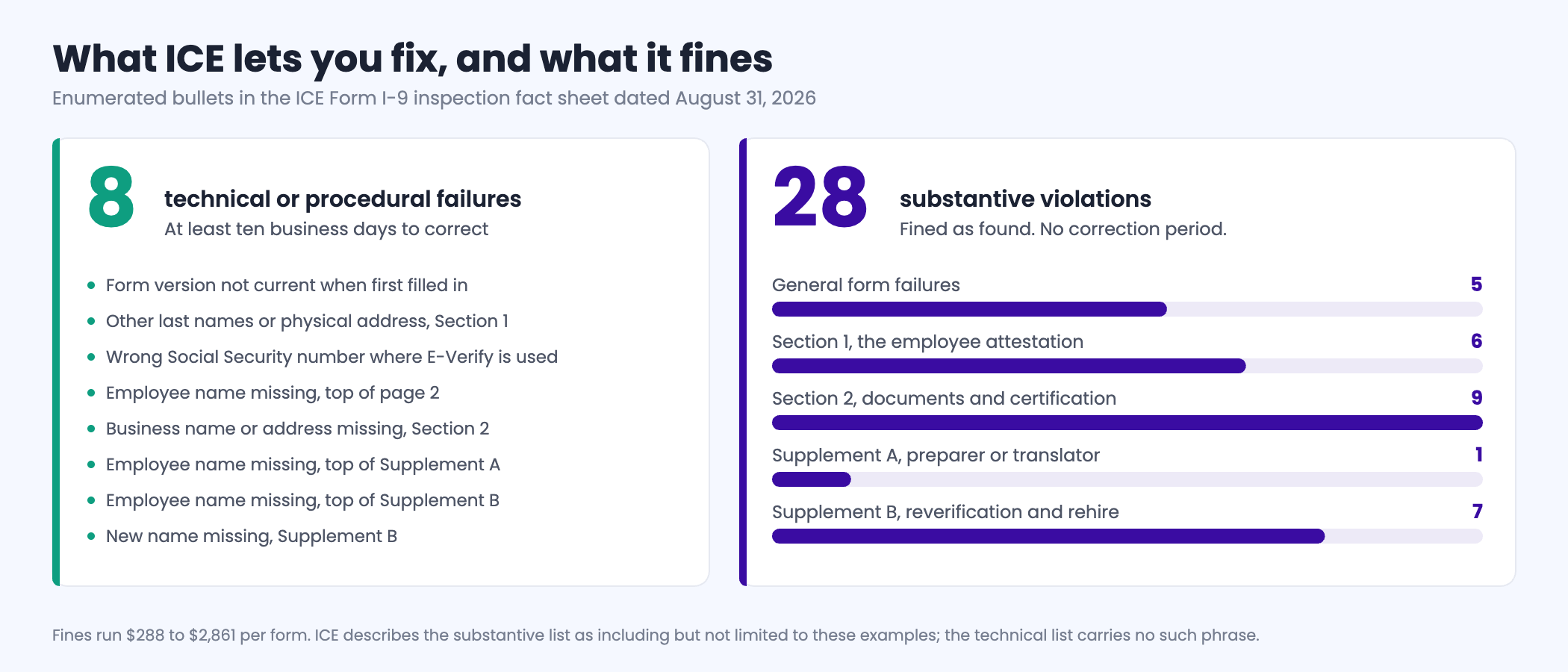
| Curable — at least ten business days after written notice |
|---|
| Using a version of the form that was not current when it was first filled in |
| Employee’s other last names used, or physical address, missing from Section 1 (a missing email address or phone number is not a violation at all) |
| Where E-Verify is in use, an incorrect Social Security number |
| Employee’s complete name missing from the top of page 2 |
| Business name or physical business address missing from Section 2 |
| Employee’s full name missing from the top of Supplement A |
| Employee’s full name missing from the top of Supplement B |
| Employee’s new name, where applicable, missing from Supplement B |
Read that list again and notice what it is. Five of the eight curable items are a name written at the top of a page. One is the business writing down its own address. One is a form version. One applies only to employers already running E-Verify. Nothing else on the form is curable.
Which means the things people actually get wrong are the things that are not curable. A missing signature in Section 1. A missing date under a signature. A date of birth left blank. Two attestation boxes ticked instead of one. A document number recorded without its issuing authority. A Section 2 certification signed but not dated. All of those are substantive, all of them are per-form, and none of them comes with a correction window. And the fact sheet is explicit that uncorrected technical failures do not stay technical: “After this correction period ends, uncorrected technical or procedural failures become substantive violations.”
Sort what your audit found
How a fine is actually sized
The number most articles quote is the ceiling, and the ceiling is the least useful figure in the process. ICE describes a four-step method, and the first step is a ratio rather than a count.
The violation percentage is the number of substantive violations and uncorrected technical failures divided by the number of forms that should have been presented for inspection. That percentage selects the base fine amount within the statutory band. Then five statutory factors — business size, good faith, seriousness, involvement of unauthorized workers, and history of previous violations — each move the base fine by five percent up or down, capped at twenty-five percent in either direction. The fine assessment date is the date ICE serves the Notice of Intent to Fine, and that date decides which year’s penalty band applies.
| Violation | Per | Minimum | Maximum |
|---|---|---|---|
| Substantive paperwork violation or uncorrected technical failure | Form I-9 | $288 | $2,861 |
| Knowingly hiring or continuing to employ, first offense | Worker | $716 | $5,724 |
| Second offense | Worker | $5,724 | $14,308 |
| Third or subsequent offense | Worker | $8,586 | $28,619 |
What an inspection of your file would put at stake
Whether you are allowed to use the alternative procedure at all turns on enrollment, and enrollment is often decided by state law rather than by preference. Our page on E-Verify requirements by state sets out which states compel it, at what headcount, and how each one counts to that number.
How long you keep the form, and why two years is the hinge
The retention rule is one sentence with a trap in it: keep the form for three years after the date of hire, or one year after employment ends, whichever is later. Almost every summary reproduces that sentence and stops. What it means operationally is that two different dates govern two different parts of your workforce, and the boundary between them is exactly two years of service.
Somebody who leaves before their second anniversary is governed by the hire date: three years from hire will always fall after one year from their departure. Somebody who stays past two years is governed by the leaving date instead. That matters because of who your workforce is. Median employee tenure in leisure and hospitality is 2.1 years, and in retail trade 2.9 years, against 3.9 years across all wage and salary workers and 4.9 in manufacturing. For a restaurant or a hotel, roughly half the workforce sits on the hire-date side of the hinge; for a manufacturer, almost nobody does.
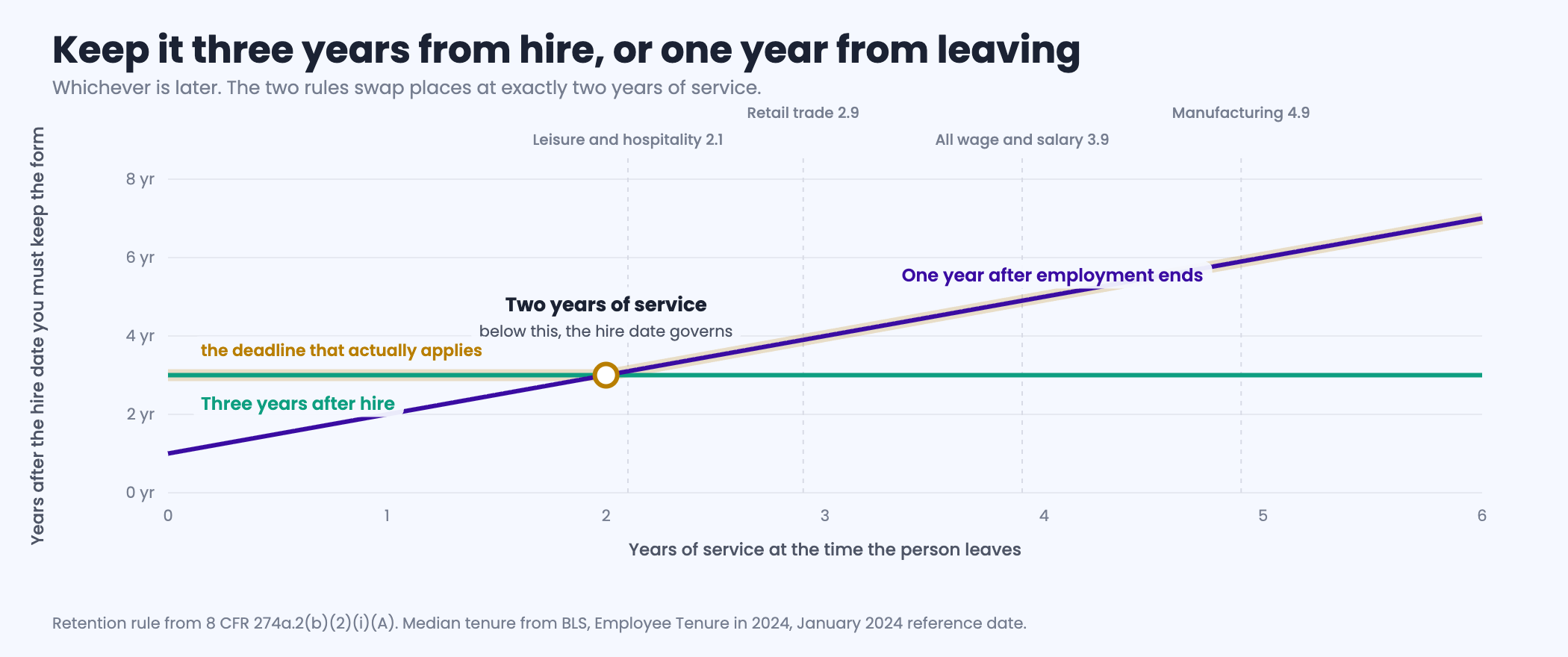
The practical consequence is that a purge schedule keyed only to termination dates will destroy forms too early for short-tenure staff, and one keyed only to hire dates will keep long-tenure forms years longer than required. Neither is what the rule says. The rule says compare the two dates and use the later one, per employee.
Remote document examination, and the condition attached to it
An employer may examine documents remotely under a DHS-authorized alternative procedure instead of physically, and must tick the alternative-procedure box in Section 2 to record that it did. The condition is the part worth reading twice. The ICE fact sheet lists as a substantive violation the failure to “be an active E-Verify participant or registered in a DHS Non-E-Verify Remote Document Examination Form I-9 program when putting a check mark to notate that an alternative procedure was authorized by DHS to examine documents.”
In other words, remote examination is not a method available to every employer. Ticking that box while not enrolled is not a paperwork slip that gets cured in ten days; it is a substantive violation on every form it appears on. The same requirement is listed again for Supplement B, which is where reverification and rehire entries go. If your onboarding runs remotely and nobody can name your E-Verify enrollment status without checking, that is the first thing to establish before the next hire, not the next audit.
How to run an internal I-9 audit
ICE and the Justice Department office now called the Immigrant and Employee Rights Section published joint guidance on internal Form I-9 audits in December 2015, and it is still the reference. Its core points, in order:
Choose the forms neutrally
“An employer may choose to review all Forms I-9 or a sample of Forms I-9 selected based on neutral and non-discriminatory criteria.” Auditing only employees who look or sound foreign, or only one nationality, is itself a violation. A sample by hire date, location or last name is neutral.
Correct errors the right way
For errors in Sections 2 or 3, “draw a line through the incorrect information; enter the correct or omitted information,” and initial and date the change. Never use correction fluid, and “the employer should not backdate the form.” If a form is missing, complete a new one now with the current date.
Let the employee fix Section 1
“If an employer discovers an error or omission in Section 1 of an employee’s Form I-9, the employer should ask the employee to correct the error.” The employer does not correct Section 1 itself.
Do not ask for specific documents
If new documentation is needed, “the employer should not request specific documents. The employee should be permitted to present his or her choice of other documents.”
Document what you did
“Attach a signed and dated explanation” to any form you corrected, describing what was changed and why. The memo is what shows an inspector that the corrections were a good-faith audit and not after-the-fact repair.
Sort what the audit finds using the technical-versus-substantive list above: technical and procedural errors can be corrected, while some substantive failures cannot be cured, only documented. Keep audit records separately from the forms themselves.
Why this page exists on a recruitment advertising site
Because the fine is charged per form, and the number of forms is a function of how much you hire. An employer filling twenty roles a year and one filling four hundred face the same rules, the same per-form band and, if their processes are equally good or equally bad, the same violation percentage. The difference is entirely in the denominator. High-volume hourly hiring is the environment where a small, consistent process defect gets multiplied several hundred times before anyone notices it. It is the same multiplier that makes new hire training expensive at scale, for the same structural reason.
Our own measurement stops well short of this. Across the 891 campaigns in our 2026 social job advertising benchmark we can tell you what an applicant costs — a median of $13.88, and as little as $2.71 in customer service and admin roles — and nothing whatsoever about what happens to the form after somebody is hired. We have no I-9 error-rate data, we are not going to publish an estimate of one, and we would tell you the same thing if we sold the software: the only reliable number here is the one you get from auditing your own file before somebody else does.
Related: Form I-9 Audit.
Frequently asked questions
What are the Form I-9 requirements for 2026?
Every employer must complete a Form I-9 for each person hired to work in the United States. The employee completes Section 1 at the time of hire. The employer examines acceptable documents and completes Section 2 within three business days of the hire. The current form carries an edition date of 01/20/25, and an 08/01/23 printing expiring 05/31/2027 remains acceptable. The completed form is kept for three years after the date of hire or one year after employment ends, whichever is later, and produced within at least three business days if ICE serves a Notice of Inspection.
Which Form I-9 edition is current right now?
The 01/20/25 edition, with the edition date printed at the bottom of the page. USCIS also allows an 08/01/23 edition whose expiration date at the top of the page reads 05/31/2027. A second 08/01/23 printing expired on 07/31/2026 and can no longer be used. Employers running an electronic Form I-9 were told to update their systems to the 05/31/2027 version by 07/31/2026, a deadline that has now passed.
What is the difference between a technical and a substantive I-9 violation?
A technical or procedural failure comes with at least ten business days to correct it after ICE gives written notice. A substantive violation does not, and is fined as found. The ICE fact sheet dated August 31, 2026 enumerates eight technical failures and twenty-eight substantive ones, and describes the substantive list as not exhaustive. Five of the eight technical items are simply a name missing from the top of a page. Uncorrected technical failures become substantive once the correction period ends.
How much is the fine for an I-9 paperwork violation?
From $288 to $2,861 per form for a substantive paperwork violation or an uncorrected technical failure. Knowing hire or continuing to employ violations are charged per worker at $716 to $5,724 for a first offense, $5,724 to $14,308 for a second and $8,586 to $28,619 for a third. These amounts come from the DHS inflation adjustment effective January 2, 2025 and are the figures in 8 CFR 274a.10 today.
How does ICE decide the size of the fine?
First it calculates a violation percentage, which is the number of substantive violations and uncorrected technical failures divided by the number of forms that should have been presented. That percentage sets a base fine within the statutory band. Five statutory factors are then applied to the base fine, each moving it five percent up or down, with a cumulative cap of twenty-five percent in either direction. The factors are business size, good faith, seriousness, involvement of unauthorized workers, and history of previous violations.
How long do you have to keep Form I-9?
Three years after the date of hire, or one year after the date employment ends, whichever is later. The two dates cross at exactly two years of service. Below two years of tenure the hire date governs, above it the termination date does. That distinction matters most in short-tenure industries, where median tenure is 2.1 years in leisure and hospitality and 2.9 years in retail trade against 3.9 years across all workers.
Can I verify documents remotely instead of in person?
Only under a DHS-authorized alternative procedure, and only if you qualify for it. ICE treats it as a substantive violation to check the alternative-procedure box in Section 2 or Supplement B while not being an active E-Verify participant or registered in a DHS Non-E-Verify Remote Document Examination program. Confirm your enrollment status before relying on remote examination, because a wrongly checked box is fined on every form it appears on.
What happens if a hire lasts fewer than three business days?
The three-business-day window does not apply. For employment of fewer than three business days, both Section 1 and Section 2 must be completed at the time of hire, and the employer may not accept a receipt in place of an actual document. Employers running short assignments, event staffing or peak-day labor are covering part of their workforce under a stricter rule than the one their standard onboarding process assumes.
How do you conduct an internal I-9 audit?
Review all Forms I-9 or a sample chosen on neutral, non-discriminatory criteria. Correct Section 2 and 3 errors by drawing a line through the error, writing the correct information, and initialing and dating it, without backdating. Ask employees to correct their own Section 1 errors, do not request specific documents, and attach a signed and dated memo explaining each correction. This follows the joint ICE and Justice Department guidance of December 2015.
This is one rule among about a dozen that attach at different points in a hire. Our hiring compliance hub sets out which obligation bites at which stage, and the four federal deadlines every US employer is on.
Hiring enough people that the paperwork is a volume problem
We will not audit your I-9 file. What we can show you is what a month of applicant flow costs in your roles and your markets, so the hiring plan the compliance process has to keep up with is a number rather than a guess.
Book a Demo