
New Hire Training for Hourly Roles: What It Costs, and How Long You Have to Earn It Back
New hire training is the only part of onboarding you pay for twice: once for the trainee, who is being paid and producing nothing, and again for whoever trains them, who was producing something and now is not. That is ordinary and unavoidable. What makes it a frontline problem is the second number: median tenure in leisure and hospitality is 2.1 years against 4.9 in manufacturing, so the same two weeks of training amortizes over less than half the working life. The question is not how good the training is. It is whether the ramp pays back inside the tenure you actually get.
A note on who's writing this, and what this page owns
Boostpoint is recruitment marketing software. We advertise open jobs and deliver applicants; our measurement stops at the submitted application, so we have no data at all on training outcomes and we will not pretend otherwise. The tenure figures below are federal and are cited; the arithmetic uses numbers you supply; everything else is described as practice.
Three neighboring pages divide this up. New hire orientation covers the session before the first productive shift and the compliance clocks inside it. The onboarding checklist covers the whole first weeks stage by stage. First 90 days turnover covers what makes an early hire leave. This page covers training itself: what it costs while it runs, and how long the workforce stays to repay it.
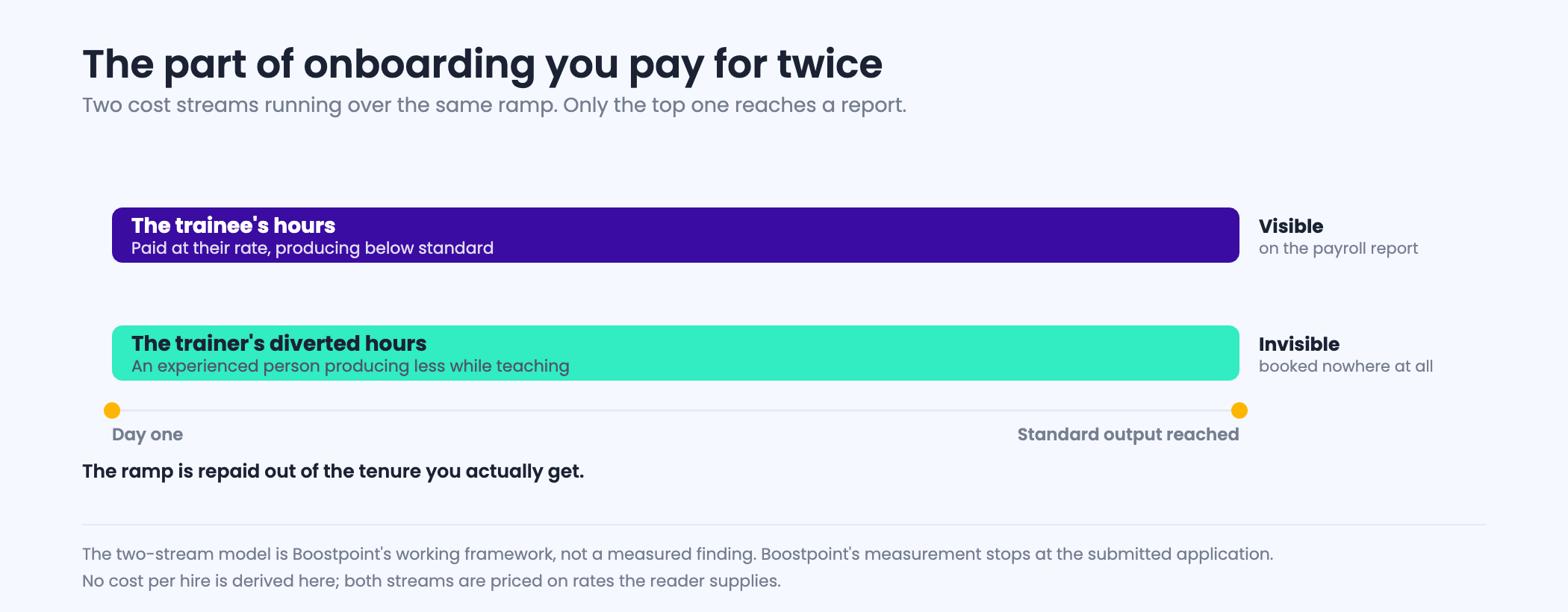
The part you pay for twice
Every other line in a hiring budget is paid once. Advertising is paid once. The background check is paid once. Training is paid twice over the same hours, and the second payment is the one nobody books. The returning worker is also a fresh filing obligation, as new hire reporting requirements sets out.
- The trainee's hours. Paid at their rate, producing at some fraction of standard, for as long as the ramp takes. This one is visible: it is on the payroll report — though what it costs you is the fully loaded hourly rate, not the wage.
- The trainer's diverted hours. A lead or an experienced worker producing less than usual because they are teaching. This one is invisible: it appears nowhere except in the output that did not happen.
In an office the second cost is real and diffuse. On a floor, a line or a route it is concrete: the trainer is one of a fixed number of people who were producing a countable thing, and now one of them is at half output. That is why frontline training plans get quietly shortened by the people running them, and why the shortening usually is not a decision anyone recorded.
How long you actually have to earn it back
Training investment is repaid out of the time the person stays. That window is not the same across industries, and the federal tenure data makes the spread hard to argue with.
| Industry | Median tenure | Against the all-industry median |
|---|---|---|
| Manufacturing | 4.9 years | a year longer |
| Financial activities | 4.7 years | ten months longer |
| Construction | 4.2 years | about the same |
| All wage and salary workers | 3.9 years | — |
| Transportation and utilities | 3.7 years | about the same |
| Retail trade | 2.9 years | a year shorter |
| Leisure and hospitality | 2.1 years | less than half of manufacturing |
Source: U.S. Bureau of Labor Statistics, Employee Tenure in 2024, released September 26 2024 with a January 2024 reference date, read September 2 2026. The comparison column is ours, rounded from the published medians; BLS does not publish it in that form.
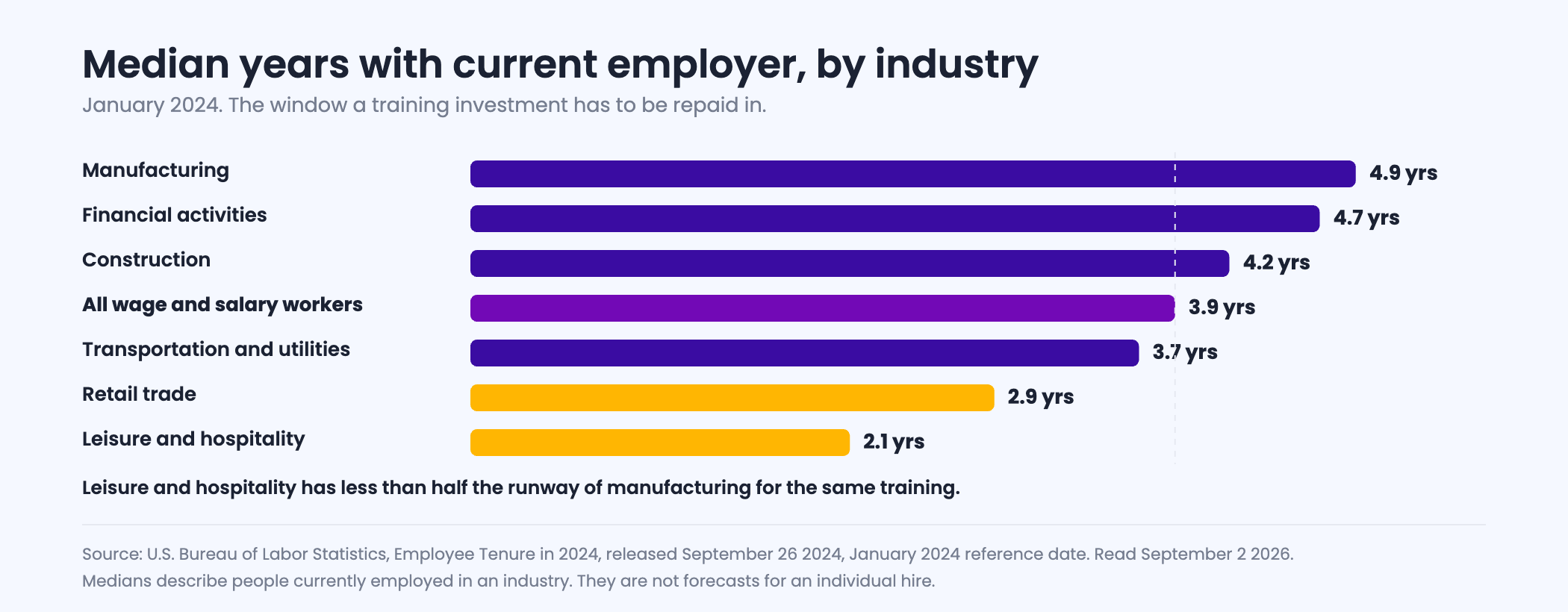
A two-week ramp is a modest investment against 4.9 years and a serious one against 2.1. Same training, less than half the runway.
Two honest caveats on that table. It is a median across everyone currently employed in the industry, not a prediction about your next hire, and long-tenured staff pull it upward. And it is a January 2024 reference date, which is the most recent published in this series. Use it to understand the shape of the difference between industries rather than as a forecast for an individual.
Price your own ramp
Both cost streams, over the tenure you actually expect. Every input is yours; we supply no pay rates and no tenure assumption, and the tool produces a training cost rather than a cost per hire.
Interactive
Ramp cost, and what it works out to per month of tenure
Nothing is stored or sent — this runs in your browser. Rate fields start at zero on purpose: we publish no pay figures and will not supply one.
Trainee hours are training days multiplied by shift length. The unproductive share is those hours at one minus the output percentage you entered, which is the part of the wage that buys no output yet. Trainer cost is the diverted hours at the rate you entered. Per month of tenure is the total divided by the months you expect. Twenty-five months is roughly the published leisure and hospitality median and fifty-nine roughly the manufacturing one, if you want a reference point. This is a training cost only: it excludes recruiting, orientation and everything else, and it is not a cost per hire.
Volume multiplies paperwork as reliably as it multiplies ramp cost, and the I-9 penalty is charged per form. Our page on Form I-9 requirements covers what is curable, what is fined and how the total is calculated.
Designing a ramp for a workforce that turns over
These are our working patterns rather than measured results, and we have no effect sizes to attach to any of them.
- Front-load the part that makes them useful, not the part that makes them complete. The order most training runs in is the order of the manual. The order that pays back is whatever gets a person to safe, independent output on one task soonest, with the rest layered after.
- Name the day they stop being a cost. If nobody can say which day a new hire is expected to reach standard output, nobody can tell whether the ramp is working, and the ramp will quietly stretch.
- Train the trainer's schedule, not just the trainer. The diverted hours are the invisible cost; leaving them unplanned means they come out of the trainer's own targets, and the trainer learns to train less.
- Assume the shorter tenure and design for it. In a 2.1-year industry, a ramp designed as though people stay five years is not thorough, it is unfunded.
- Split competence from certification. Where a credential is legally required, that is fixed. Where it is internal, ask whether the module is teaching the job or documenting that you taught the job.
- Check the ramp against the exits. If most departures happen before the training investment is repaid, the training is not the problem to fix first — the reason they left is.
Do you have the capacity to train the people you are hiring?
The constraint that stops most frontline training plans is not budget. It is that the number of hours experienced staff can give is fixed, and hiring volume is not.
Interactive
Trainer capacity against hiring volume
Nothing is stored or sent. Arithmetic on your own numbers, with no assumption about how well the training works.
Demand is hires multiplied by trainer hours per hire. Supply is trainers multiplied by the hours each can give. Both are figures you enter and neither is a judgment about training quality. Where demand exceeds supply the shortfall is expressed as hires that cannot be trained at the standard you set this month, not as a cost.
What we do not measure
Our data stops at the submitted application. We cannot see whether an applicant was hired, how their training went, or how long they stayed, so no figure on this page connects training design to retention or to output, and none of the six practices above carries a percentage.
The tenure figures are federal and are cited, but they describe industries rather than employers and they are medians of people currently employed rather than forecasts for a new hire. They tell you the shape of the runway you are designing against; they do not tell you how long the next person will stay.
And there is no cost per hire on this page. The ramp tool prices training hours on rates you supply. It does not know what the hire cost to find, and cost per applicant is not cost per hire.
What onboarding costs in total (not just training)
The ramp tool above prices the training hours. Onboarding is wider than that, and the lines it adds are small individually and awkward collectively, because most of them never appear on an invoice. Here is the whole list, with what decides each one.
| Line | What it is | Where the number comes from | Example |
|---|---|---|---|
| Paperwork and compliance admin | Form I-9 within three business days of the first day, Form W-4, the state new hire report, personnel file setup, policy acknowledgements | Your HR or manager hours at a loaded rate | 1.5 hours at $34 = $51 |
| Equipment, uniforms and PPE | Boots, hi-vis, tools, a badge, a device, a locker — whatever the person cannot start without | Your purchase orders. Some of it transfers to the next hire and some does not; count what does not. | $260 |
| The trainer's diverted hours | A lead or experienced worker producing less because they are teaching — the cost the page above calls the one you pay twice | Trainer hours × their burdened rate × the share of output they lose | 16 hours at $30.00 burdened, at half output = $240 |
| Formal training and materials | Courses, licenses, certifications, safety training, printed materials, seat time in a system | Your training budget, apportioned per head | $60 |
| The trainee's own hours at partial output | Already priced by the ramp tool above | Do not count it twice | — |
On that example the onboarding total is $611 per hire on top of whatever the ramp costs, and none of it is the cost of finding the person. For context on the training line specifically: US employers spent an average of $874 per learner on training in 2025, up from $774 the previous year, across an average of 40 training hours per employee a year — and the per-learner figure runs highest at small companies, at $1,091, against $782 at midsize and $468 at large employers. That is annual training spend across a whole workforce rather than an onboarding figure, so use it to sanity-check the size of your training line, not as an onboarding cost.
The reason to total it at all is comparison. An onboarding cost of $611 is small against what a departure costs and small against what an open seat costs, which means it is almost never the line to cut. It is, however, the line most often cut, because it is the only one on the list you can decide not to spend this week.
Related: New Hire Announcement and Welcome Email Templates.
HIPAA and bloodborne pathogens training for new healthcare hires
Two federal training duties land on almost every new healthcare hire, and they run on different clocks. HIPAA training for new employees has to happen within a reasonable period after they join; bloodborne pathogens training has to happen before the person does any task with occupational exposure.
| Rule | Who | When | Records |
|---|---|---|---|
| HIPAA Privacy Rule, 45 CFR 164.530(b) | "All members of its workforce" of a covered entity, on its policies and procedures for protected health information, "as necessary and appropriate" to their functions | Each new member of the workforce "within a reasonable period of time after the person joins"; again when a material change in policies affects their functions | Document that the training was given; keep documentation six years (164.530(j)) |
| HIPAA Security Rule, 45 CFR 164.308(a)(5) | "All members of its workforce (including management)" | An ongoing security awareness and training program; the rule sets no hour count | Not specified in this paragraph |
| OSHA Bloodborne Pathogens, 29 CFR 1910.1030(g)(2) | Each employee with occupational exposure to blood or other potentially infectious materials | "At the time of initial assignment to tasks where occupational exposure may take place," then within one year of the previous training, and again when tasks change the exposure | Dates, content summary, trainer names and qualifications, attendee names and job titles; keep three years |
Three details catch employers out. Bloodborne pathogens training must be "provided at no cost to the employee and during working hours," so it belongs on the paid schedule, not in homework. It must use material appropriate to the employee's "educational level, literacy, and language," and be given by someone knowledgeable about the subject as it relates to your workplace. And the hepatitis B vaccination has to be made available after that training and within 10 working days of initial assignment, which means the training date sets the vaccine clock. HIPAA, by contrast, sets no annual refresher in the rule text; many employers run one anyway, but the legal trigger is a new hire or a material policy change. General information, not legal advice.
OSHA training requirements for employers
There is no single OSHA new-hire course. OSHA training requirements for employers sit inside the individual standards, and each one fires when a worker is first exposed to that hazard. OSHA is explicit that its 10-hour and 30-hour cards do not satisfy them: "The Outreach Training Program is a voluntary program" and "Outreach training does not fulfill the training requirements found in OSHA standards." The general industry standards a frontline employer is most likely to trigger:
| Standard | Who needs it | When |
|---|---|---|
| Hazard communication, 1910.1200(h) | Employees working with hazardous chemicals in their work area | At the time of initial assignment, and whenever a new chemical hazard is introduced |
| Personal protective equipment, 1910.132(f) | Each employee required to use PPE | Before performing work that requires PPE; the employee must demonstrate understanding and proper use |
| Emergency action plan, 1910.38(f) | Each employee covered by the plan | When the employee is initially assigned to a job, when their responsibilities change, and when the plan changes |
| Lockout/tagout, 1910.147(c)(7) | Authorized employees who service equipment, affected employees who use it, and others working in the area | Training that ensures the knowledge and skills to apply and remove energy controls safely |
| Powered industrial trucks, 1910.178(l) | Every forklift operator | Before operating, except for training purposes; a performance evaluation at least once every three years |
| Respiratory protection, 1910.134(k) | Employees required to use respirators | Before use, and annually |
| Bloodborne pathogens, 1910.1030(g)(2) | Employees with occupational exposure | At initial assignment, then annually |
The practical rule for a training ramp is to map each new hire's first-week tasks against this list and schedule the required modules before the task, not after it. Forklift training has its own page: OSHA forklift training requirements. Construction, maritime and state-plan states add requirements of their own. General information, not legal advice.
Harassment training requirements by state
Workplace harassment training mandates for private employers come from states, and the states that set them disagree on employer size, hours and deadlines. The deadline for a new hire is what matters for a training ramp. The states with statewide private-employer mandates we read at source:
| State | Which employers | What | New hires | Refresher |
|---|---|---|---|---|
| California, Gov. Code 12950.1 | Five or more employees | Two hours for supervisors, one hour for nonsupervisory employees, interactive | Within six months of hire or of becoming a supervisor; seasonal and temporary staff hired for under six months within 30 calendar days or 100 hours worked, whichever comes first | Every two years |
| New York | All employers, regardless of size | Interactive training; online is allowed if interactive | No fixed deadline; the state encourages training as soon as possible | At least once a year |
| Illinois | Most employers operating in Illinois | Sexual harassment prevention training; the state publishes model training programs | Covered by the annual requirement | Once a year |
| Connecticut, Gen. Stat. 46a-54(15) | Three or more employees | Two hours of training and education | Within six months of hire | Supplemental training at least every ten years |
| Delaware, 19 Del. C. 711A(g) | 50 or more employees in Delaware | Interactive training, with additional training for supervisors | Within one year of starting | Every two years |
| Maine, 26 M.R.S. 807 | 15 or more employees | An education and training program, plus additional training for supervisors and managers | Within one year of starting | Not set in the section we read |
Two things to plan around. California's 30-day rule for short-term staff means a seasonal ramp has to include the training in its first month, and for staff placed by a temporary services employer the statute puts the duty on the agency, not the client. And where no state rule applies, training is still a common part of how employers show they took reasonable steps to prevent harassment. Some cities, and some industries in other states, add their own rules, so check where each site is located. General information, not legal advice.
Frequently asked questions
What is new hire training?
The period from the first productive shift until a new hire reaches standard output safely and independently. It is distinct from orientation, which is the session before that shift, and from onboarding, which is the social and administrative arc running alongside the first weeks.
How long should new hire training be for an hourly role?
Long enough to reach safe independent output on the core task, and no longer than the tenure you actually get can repay. Median tenure runs from 2.1 years in leisure and hospitality to 4.9 in manufacturing, so the same ramp is a modest investment in one industry and an unfunded one in another.
What does new hire training cost?
Two streams over the same period: the trainee's paid hours at reduced output, and the experienced person's diverted hours. The first is on the payroll report and the second is almost never booked anywhere, which is why the real figure is usually higher than the one people quote. The tool above prices both on your own rates.
Why do new hires quit during training?
We have no measurement of our own and will not assert a cause. What the arithmetic does say is that departures before the ramp is repaid make the training investment a total loss, so if most exits are early, the reason for the exit is the more urgent problem than the training design.
How long do employees stay, on average?
Median tenure with a current employer was 3.9 years in January 2024 across all wage and salary workers. By industry it ranged from 2.1 years in leisure and hospitality and 2.9 in retail trade up to 4.7 in financial activities and 4.9 in manufacturing.
Should experienced staff do the training?
Usually yes, and the cost of that decision should be planned rather than absorbed. Diverted trainer hours come out of that person's own output, and if nobody schedules them, the trainer resolves the conflict by training less. Plan the hours the way you would plan any other shift.
What is a training ramp?
The period during which a new hire is producing at less than standard output while learning. It has a start, a defined end and a cost. The most common failure is that nobody names the end, which means the ramp stretches and no one can say whether the training is working.
Does better training reduce turnover?
We do not know, and we sell recruitment advertising rather than training, so treat that non-answer as the honest one. Our measurement ends at the submitted application. Anyone quoting a percentage improvement in retention from a training program should be asked for the sample, the method and the date.
What is the cost of onboarding a new employee?
Four lines, plus the ramp. Paperwork and compliance admin at your HR hourly rate; equipment, uniforms and personal protective equipment that does not transfer to the next hire; the trainer's diverted hours at their burdened rate multiplied by the output they lose while teaching; and formal training and materials. On the worked example on this page those come to $611 per hire, before the trainee's own partial output during ramp, which the tool above prices separately.
What is the average onboarding cost per employee?
There is no reliable published average, and any single figure offered as one is usually a cost per hire wearing a different name. The nearest checkable benchmark is training spend: US employers averaged $874 per learner across all training in 2025, up from $774 in 2024, with small companies at $1,091 per learner against $468 at large ones. That is annual spend across a whole workforce, so treat it as a sanity check on the size of your training line rather than as an onboarding cost.
Do you have to pay employees for training time?
For new-hire training, almost always. Under federal law, training need not be paid only if all four tests in 29 CFR 785.27 are met: it is outside regular working hours, in fact voluntary, not directly related to the job, and involves no productive work. Onboarding and job training fail at least two of those, so the hours count as hours worked: at least minimum wage, and they count toward overtime. Training that makes someone better at their current job is job-related (29 CFR 785.29).
Is HIPAA training required for new employees?
Yes, for covered entities. The HIPAA Privacy Rule, 45 CFR 164.530(b), requires training on your protected health information policies for each new member of the workforce within a reasonable period of time after they join, as appropriate to their job. You must document it and keep that documentation for six years. The rule sets no hour count or annual refresher; a material policy change triggers retraining.
What are the bloodborne pathogens training requirements?
Under OSHA's 29 CFR 1910.1030, every employee with occupational exposure must be trained at the time of initial assignment to exposure tasks and within one year of the previous training after that, at no cost and during working hours. Records of dates, content, trainers and attendees are kept for three years, and hepatitis B vaccination must be offered after training and within 10 working days of assignment.
The ramp only starts if the seat gets filled
We put your open jobs in front of frontline candidates on Facebook and Instagram, collect applicants through a one-minute mobile application with automated text follow-up, and deliver them into your ATS. What happens after day one is yours to design; getting the right people to the offer is ours.
Tenure figures: U.S. Bureau of Labor Statistics, Employee Tenure in 2024, released September 26 2024 with a January 2024 reference date, read September 2 2026 — median years with current employer, all wage and salary workers 3.9; manufacturing 4.9; financial activities 4.7; construction 4.2; transportation and utilities 3.7; retail trade 2.9; leisure and hospitality 2.1. The comparison column in the table is ours, rounded from those published medians, and BLS does not publish it in that form. The reference points offered in the ramp tool, twenty-five and fifty-nine months, are those published medians for leisure and hospitality and manufacturing expressed in months and rounded. Medians describe people currently employed in an industry and are not forecasts for an individual hire. Both interactive tools use only figures the reader supplies; both pay-rate fields ship at zero by design and no pay figure is published on this page. The two-stream cost model and the six design practices are our working patterns rather than measured results and are labeled as such throughout. Boostpoint's measurement stops at the submitted application, so no relationship between training and retention or output is asserted anywhere, and no cost per hire appears on this page. Last updated September 2026.