
New Hire Orientation for Hourly and Frontline Staff: What Has to Happen, and When
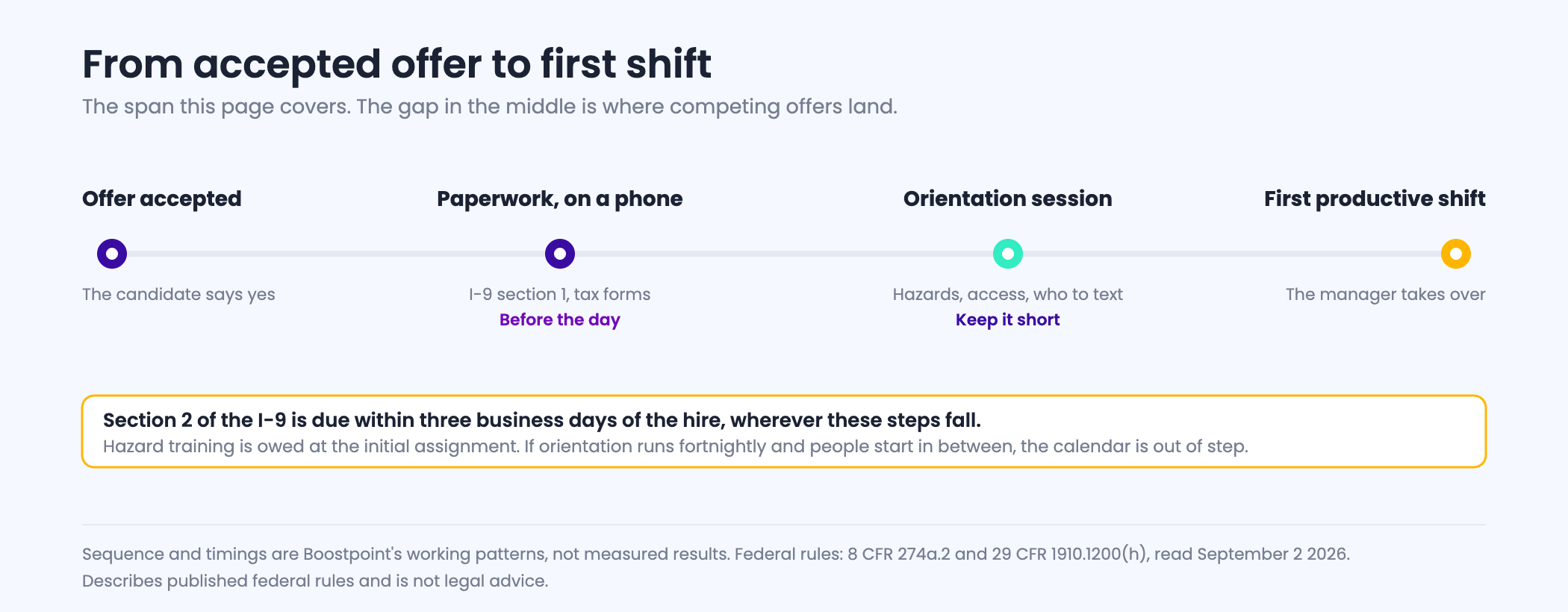
Orientation is not onboarding. It is the specific session between the accepted offer and the first productive shift, and for hourly and frontline roles it carries two jobs no other part of the process can do. It is the last cheap chance to stop a day-one no-show, and it is the only part of onboarding with a federal clock already running: section 2 of the Form I-9 is due within three business days of the hire, and hazard communication training is owed at the time of initial assignment rather than whenever the next class runs.
A note on who's writing this, and what this page owns
Boostpoint is recruitment marketing software: we advertise your open jobs and deliver applicants into your ATS. Our measurement stops at the submitted application, so nothing on this page about what orientation does to retention is a measured claim of ours, and we have said so wherever it matters. The federal rules quoted below are quoted from their own text and dated; everything else is described as practice.
Three of our pages sit close together and each owns a different span. The onboarding checklist covers the whole first weeks, stage by stage, including the paperwork list. First 90 days turnover covers the retention arc from the application through day 90 and the eight-touch cadence inside it. This page covers the session itself: what legally has to happen in it, what it costs in paid hours, and how to design it for people who work shifts. And the new hire forms checklist covers the paperwork side of the same week: the federal five, the state withholding certificate, the written wage notice owed in 19 states and DC, and whether you may require direct deposit.
Orientation, onboarding and training are three different things
These get used interchangeably and they are not the same span of time, do not have the same purpose, and are not owned by the same person in most frontline operations.
| Term | When | What it is for | Usually run by |
|---|---|---|---|
| Orientation | Between the accepted offer and the first productive shift | Paperwork, compliance, access, and the first impression of the employer | HR or the hiring administrator |
| Onboarding | The first weeks, running alongside real work | Belonging, expectations, and the relationships that make someone stay | The direct manager |
| Training | From the first shift until competent | Doing the job to standard, safely | A trainer, a lead, or a peer |
The confusion is expensive in one specific way: when orientation is treated as the whole of onboarding, everything gets loaded into a single long session, and a person who has not yet earned a dollar sits through four hours of policy before they have met anyone they will work with.
The two clocks that start at hire
Most of what a company puts in orientation is discretionary. Two things are not, and both are timed from the hire rather than from whenever orientation is scheduled. A third runs on its own clock in the background, set out on new hire reporting requirements. This is a description of the published rules and it is not legal advice; check anything specific with your own counsel.
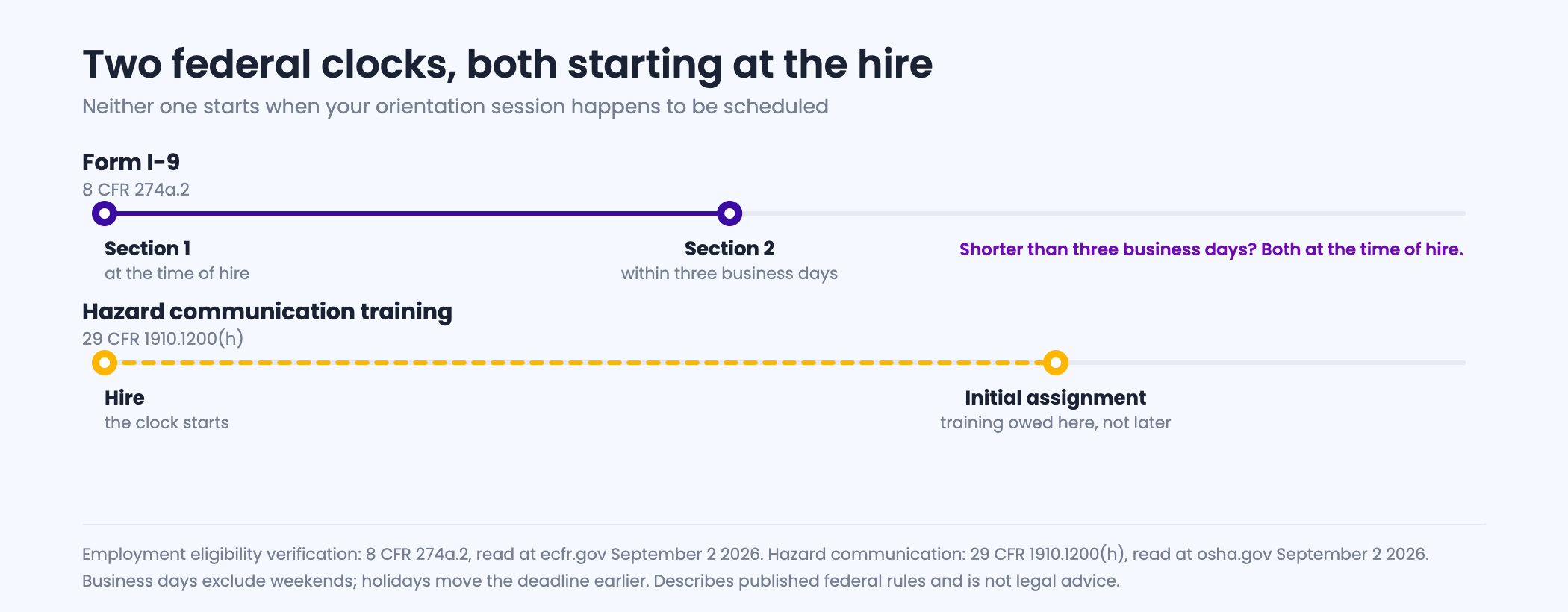
The Form I-9. The employee "Completes section 1 — 'Employee Information and Verification' — on the Form I-9 at the time of hire". The employer must, "within three business days of the hire", physically examine the documentation presented and "Complete section 2 — 'Employer Review and Verification' — on the Form I-9 within three business days of the hire". There is an exception for very short engagements: "An employer who hires an individual for employment for a duration of less than three business days must comply with paragraphs (b)(1)(ii)(A) and (b)(1)(ii)(B) ... at the time of the hire." Completed forms are retained for "three years after the date of the hire or one year after the date the individual's employment is terminated, whichever is later".
Hazard communication training. Where employees may be exposed to hazardous chemicals — which covers a great deal of manufacturing, food service, housekeeping, senior living and skilled trades work — employers "shall provide employees with effective information and training on hazardous chemicals in their work area at the time of their initial assignment, and whenever a new chemical hazard the employees have not previously been trained about is introduced into their work area". The trigger is the initial assignment, not the next available training date.
Both clocks start at the hire, not at the orientation. If your orientation runs every two weeks and people start in between, the calendar is already out of step with the rule.
Work out your own I-9 dates
The three-business-day rule is easy to get wrong when someone starts on a Thursday. The tool applies the published rule to a date you enter and shows the deadline, the short-engagement exception and the retention date.
Interactive
Form I-9 timing, applied to your hire date
Nothing is stored or sent — this runs in your browser. It applies the published federal rule and is not legal advice.
Business days here exclude Saturdays and Sundays only. Federal and state holidays are not accounted for: a weekday holiday counts here as a business day, so a count that skipped it would land later, not earlier. Use the date shown as the working deadline and check unusual schedules with your own counsel. Retention is the later of three years from the date of hire and one year from the termination date, exactly as the rule states it. This is a scheduling aid, not legal advice.
The clocks are only half of it. What ICE will fine you for, and what it gives you ten business days to fix, changed again this year: our page on Form I-9 requirements sets out the current curable list, the retention rule and how a penalty is actually sized.
What an orientation costs, in the only currency that is yours
Orientation is usually paid time for the attendee and paid time for whoever runs it, and in most frontline operations neither figure appears on any report. It is worth pricing before you decide how long the session should be, because the answer often changes the design.
We publish no cost-per-hire figure and we are not going to derive one here. What follows uses your own pay rates and your own session length, and reports paid hours and what they cost. Nothing else is included — not the recruiting that filled the seat, not the training that follows it.
Interactive
Orientation cost, in paid hours
Nothing is stored or sent. Every figure is one you enter; we supply none of them. This is a paid-hours cost and it is not a cost per hire.
Sessions a month is new hires divided by attendees per session, rounded up. Attendee hours are hires multiplied by session length; facilitator hours are sessions multiplied by facilitator hours. Money appears only if you enter rates, and both rate fields start blank at zero on purpose — we do not publish pay figures and will not supply one. This covers paid time in orientation and nothing else.
Everything after that first shift is a different cost with a different clock. Training is the one part of onboarding you pay for twice, and how long you have to earn it back depends on tenure that runs from 2.1 years in leisure and hospitality to 4.9 in manufacturing — the arithmetic is on new hire training for hourly roles.
Designing it for people who work shifts
Most published orientation advice assumes a salaried hire starting on a Monday morning with a laptop. Frontline orientation has a different set of constraints, and these are our working patterns rather than measured results.
- Do the paperwork before the day, on a phone. Section 1 of the I-9 is the employee's to complete at the time of hire, and most of the rest — tax forms, direct deposit, emergency contacts, policy acknowledgments — does not need a room. Sending it ahead turns a four-hour session into a ninety-minute one.
- Do not batch people into a session two weeks out. The gap between the accepted offer and the first day is where a competing employer wins. If orientation is what gates the start date, orientation is what is losing you the hire.
- Put the work first. Frontline candidates take the job to do the job. A session that opens with an hour of company history before anyone sees the floor is spending the person's goodwill on the least useful hour of the day.
- Name the person, not the department. One of the most useful outputs of orientation is that the new hire leaves knowing who to text when something goes wrong on their first shift, and that person's name is not "HR".
- Run it in the shift pattern that exists. If half the hires are on nights, a nine-to-five orientation quietly tells them the company is not built for them.
- Cover the hazards for their work area, on their assignment. The training obligation is tied to the initial assignment and to the chemicals in their own work area, which is not the same thing as a generic safety video.
What we do not measure, said plainly
Our data stops at the submitted application. We can see what it costs to get an interested person to raise their hand; we cannot see whether they were hired, whether they attended orientation, or whether they were still there at ninety days. So we publish no relationship between orientation design and retention, and we have no percentage lift to offer you for any of the practices above.
That is worth saying because the orientation literature is full of large retention numbers with vague provenance. If a figure matters to your business case, get its source, its sample and its date before you put it in a slide.
And no cost per hire appears anywhere on this page. The paid-hours tool prices orientation time on your own rates; it does not know what the hire cost to find, and cost per applicant is not cost per hire.
Frequently asked questions
What is new hire orientation?
The session between an accepted offer and the first productive shift, covering paperwork, compliance obligations, access and the employer's first impression. It is distinct from onboarding, which runs alongside real work for the first weeks, and from training, which teaches the job itself.
How long should new hire orientation be?
Shorter than most of them are. Section 1 of the I-9 and the majority of the administrative forms can be completed before the day on a phone, which typically leaves the in-person session covering hazards for the actual work area, access, introductions and the schedule. Length is a design decision, and the paid-hours tool above prices it on your own rates.
When is the Form I-9 due?
The employee completes section 1 at the time of hire. The employer must physically examine the documentation and complete section 2 within three business days of the hire. Where the engagement is shorter than three business days, both must be done at the time of the hire. This is the published rule, not legal advice.
How long do I keep I-9 forms?
Three years after the date of hire, or one year after the date employment is terminated, whichever is later. For a short-tenure hourly workforce that usually means the three-year date governs, and for long-tenured staff the one-year-after date does. The tool above works out which applies to a given hire.
Is safety training part of orientation?
Hazard communication training is owed at the time of initial assignment and whenever a new chemical hazard is introduced into the work area. If orientation happens before the assignment, it can carry that training; if the assignment happens first, the obligation has already started regardless of when orientation is scheduled.
What causes day-one no-shows?
We have no measurement of our own here and will not assert one. What we can say from the shape of the process is that the gap between an accepted offer and the first day is unmanaged time in most frontline operations, and if orientation scheduling is what stretches that gap, orientation is contributing to the problem it is meant to solve.
Should orientation be in groups or one at a time?
Groups are cheaper per attendee and the tool above shows by how much on your own numbers. The cost is the wait: batching means someone hired on the fourth waits until the next session, and that waiting period is where competing offers land. Most frontline operations end up doing paperwork individually and the in-person part in groups.
What is the difference between orientation and onboarding?
Orientation is an event, usually one session, run by HR or an administrator before the first productive shift. Onboarding is a period, usually the first weeks, run by the direct manager alongside real work. Treating the second as a longer version of the first is a common design error in this area.
Orientation only matters if the seat is filled
We put your open jobs in front of frontline candidates on Facebook and Instagram, collect applicants through a one-minute mobile application with automated text follow-up, and deliver them into your ATS. What happens on their first day is yours; getting them to the offer is ours.
Employment eligibility verification: title 8 of the Code of Federal Regulations, section 274a.2, read at ecfr.gov on September 2, 2026 — section 1 "at the time of hire" at 274a.2(b)(1)(i)(A); physical examination of documentation and completion of section 2 "within three business days of the hire" at 274a.2(b)(1)(ii); the shorter-than-three-business-days exception at 274a.2(b)(1)(iii); and retention for "three years after the date of the hire or one year after the date the individual's employment is terminated, whichever is later" at 274a.2(b)(2)(i)(A). Hazard communication: title 29 of the Code of Federal Regulations, section 1910.1200(h), read at osha.gov on September 2, 2026 — employers "shall provide employees with effective information and training on hazardous chemicals in their work area at the time of their initial assignment, and whenever a new chemical hazard the employees have not previously been trained about is introduced into their work area". Business-day arithmetic in the tool excludes Saturdays and Sundays only and does not account for federal or state holidays; a count that skipped a weekday holiday would move the deadline later, not earlier. The orientation cost tool uses only figures the reader supplies; both pay-rate fields are blank by design and no pay figure is published here. The six design practices are our working patterns rather than measured results and are labeled as such. Boostpoint's measurement stops at the submitted application, so no relationship between orientation and retention is asserted, and no cost per hire appears on this page. This page describes published federal rules and is not legal advice. Last updated September 2026.