
Employer guideRead at source, 3 September 2026
New Hire Forms Checklist: Every Federal and State Form Required in the First Week
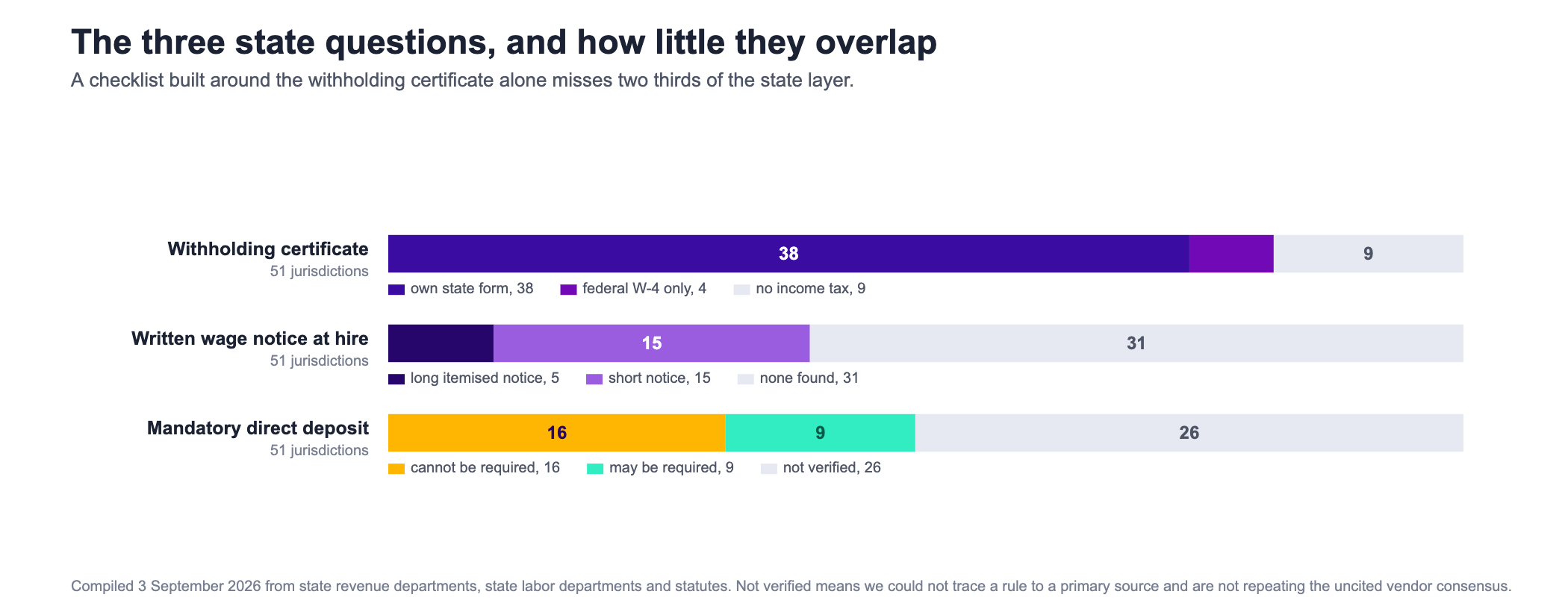
The federal list is short and everybody knows it: I-9, W-4, a new hire report, E-Verify where it applies. The state layer is where checklists go wrong, because it is three separate questions and almost nobody puts them on one page. Thirty-eight jurisdictions publish their own withholding certificate, but four income-tax states use the federal W-4 and four more treat their form as optional. Nineteen states plus DC require a written wage notice at hire, and two of those obligations are new since 1 January 2026. And direct deposit cannot be made a condition of employment in sixteen jurisdictions, a list circulating on vendor sites with no citations and at least two states missing. Everything below was read at the state revenue department, the state labor department or the statute on 3 September 2026.
The federal layer, and the only deadline that is genuinely hard
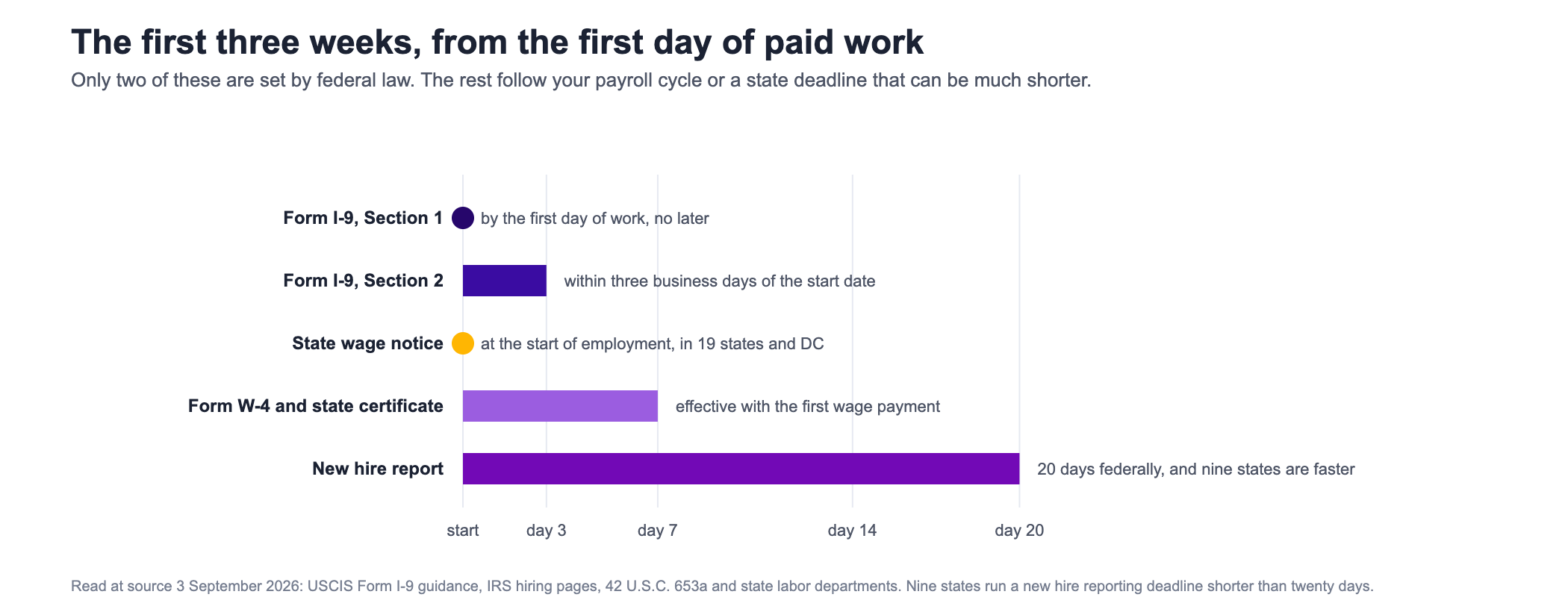
Five federal items, one real clock. The Form I-9 is the one with teeth: Section 1 by the employee first day of work, and Section 2 within three business days of the start date. Everything else is either governed by your payroll cycle or by a state deadline. This page deliberately does not restate the I-9 rules, the E-Verify thresholds or the new-hire reporting deadlines, because each has a page of its own here with the statute attached, and duplicating them would only mean two versions to keep current.
| Federal item | What it is | When | Retention |
|---|---|---|---|
| Form I-9 | Employment eligibility verification | Section 1 by the first day of work; Section 2 within three business days of the start date | Three years after hire or one year after termination, whichever is later |
| Form W-4 | Federal withholding certificate | Ask for it when they start; make it effective with the first wage payment. No completed form means withhold as single | Keep on file until replaced |
| New hire report | State directory of new hires | Twenty days federally, and nine states are faster | Per state |
| E-Verify | Electronic employment eligibility confirmation | Where a state or a federal contract requires it, generally within three business days of the start date | Per program rules |
| Social Security number | For the W-2 | Collect the name and number as they appear on the card. An ITIN is not acceptable in place of an SSN | With payroll records |
Three details from the IRS hiring page, read at source on 3 September 2026, that repeatedly catch people. If a new employee does not give you a completed W-4, withhold as if the employee is single rather than waiting. A W-4 stays in effect until replaced, and when a replacement arrives you have until the first payroll period ending on or after the thirtieth day from receipt. And an ITIN is not acceptable in place of a Social Security number for employee identification or for work, which is worth knowing before somebody in payroll accepts one.
The four pages that carry the detail: Form I-9 requirements for the three-day rule, the current edition and the penalty bands; E-Verify requirements by state for who is mandated and at what headcount, which is a definition rather than a number in several states; new hire reporting requirements for the twenty day federal ceiling and the nine states that run faster; and new hire orientation for what happens after the forms are signed.
IRS forms for a new employee
People searching for new hire forms from the IRS usually expect a packet. There isn't one. Of the federal forms above, only the W-4 is an IRS form: the I-9 belongs to USCIS, and the new hire report goes to your state. Here is everything the IRS touches for a new employee, and when.
| IRS form | Who completes it | When | What to know |
|---|---|---|---|
| Form W-4 | Employee | When they start work; effective with the first wage payment | Kept by you, not filed with the IRS. An employee claiming exempt must give you a new W-4 by February 15 each year to stay exempt |
| Form 8850 | Applicant and employer | On or before the day of the job offer; to the state workforce agency within 28 calendar days of the start date | Only if you screen for the Work Opportunity Tax Credit, which lapsed on December 31, 2025 and has not been reauthorized |
| Form W-2 | Employer | After year end: for 2026 wages, to the employee and the SSA by February 1, 2027 | Not a hire form, but it is why you collect the name and Social Security number exactly as they appear on the card |
| Form W-9 | Independent contractor only | Before the first payment | Never for an employee. If a new hire is being handed a W-9, the classification is wrong |
The practical point: the IRS side of onboarding is one form from the employee, and it is the one with the most forgiving rule. A missing W-4 does not stop payroll; you withhold as if the employee is single until one arrives. The deadline that can actually cost you money in the first week is the I-9, which is not an IRS form at all.
The state layer is three questions, not one
Ask a payroll vendor for the state new hire forms and you will get a withholding certificate. That is one third of the answer. The three questions are: which certificate, is a written wage notice owed, and may you require direct deposit. They do not correlate with each other and they do not correlate with whether the state has an income tax.
The withholding certificate. Forty-one states and DC have an income tax, and thirty-eight of those jurisdictions publish their own certificate. But four income-tax states have no state form at all and use the federal W-4: New Mexico, where you annotate the federal form; North Dakota; Utah; and Pennsylvania, which has a flat rate and no allowances. Four more have a form that is not universally required: Colorado DR 0004 says on its face that it is optional, Vermont recommends W-4VT rather than requiring it, New York IT-2104 is a fallback, and Kentucky K-4 is only needed to claim exemption or extra withholding. Delaware is the awkward one: a pre-2020 federal W-4 may be accepted, a 2020 or later one may not. Mississippi and Wisconsin say plainly that the federal form will not do.
The wage notice. Nineteen states plus DC require a written statement to the new hire, but they split into two very different obligations. Most are short — rate of pay, payday, place of payment — and can often be satisfied by a posting. Five are not: California, New York, Minnesota, Rhode Island and DC require a long itemised notice, and four of those require a signed acknowledgment you have to keep. New York requires it in the employee primary language with an affirmation that they identified that language correctly, and a six year retention. What each state’s notice must contain is on wage notice requirements by state.
| State | Withholding certificate | Wage notice at hire | Direct deposit |
|---|---|---|---|
| Alabama | Form A4 | — | Not verified |
| Alaska | No income tax | Rate of pay, payday, place | Not verified |
| Arizona | Form A-4 | — | Cannot be required |
| Arkansas | Form AR4EC | — | Not verified |
| California | Form DE 4 | Long itemised notice, Labor Code 2810.5 | Cannot be required |
| Colorado | Form DR 0004, optional | — | Not verified |
| Connecticut | Form CT-W4 | Rate, hours, pay schedule | Cannot be required |
| Delaware | Form DE-W4 | Rate, day, hour, place | Cannot be required |
| District of Columbia | Form D-4 | Long itemised notice, signed | Not verified |
| Florida | No income tax | — | Cannot be required |
| Georgia | Form G-4 | — | Not verified |
| Hawaii | Form HW-4 | Rate of pay and paydays | Cannot be required |
| Idaho | Form ID W-4 | — | Not verified |
| Illinois | Form IL-W-4 | — | Cannot be required |
| Indiana | Form WH-4 | — | Not verified |
| Iowa | Form IA W-4 | Wages and regular paydays | May be required |
| Kansas | Form K-4 | — | Cannot be required |
| Kentucky | Form K-4, only to claim exemption | — | Not verified |
| Louisiana | Form L-4 | Wages, method, frequency | Not verified |
| Maine | Form W-4ME | — | Not verified |
| Maryland | Form MW507 | Rate, paydays, leave benefits | Cannot be required |
| Massachusetts | Form M-4 | — | May be required |
| Michigan | Form MI-W4 | — | May be required |
| Minnesota | Form W-4MN | Nine item notice, signed | Cannot be required |
| Mississippi | Form 89-350 | — | Not verified |
| Missouri | Form MO W-4 | — | Not verified |
| Montana | Form MW-4 | — | Not verified |
| Nebraska | Form W-4N | — | Not verified |
| Nevada | No income tax | — | Cannot be required |
| New Hampshire | No income tax | Rate, day, place | Not verified |
| New Jersey | Form NJ-W4 | Rate and regular payday | Cannot be required |
| New Mexico | Federal W-4 only | — | Not verified |
| New York | Form IT-2104, not universal | Long itemised notice, signed, translated | Cannot be required |
| North Carolina | Form NC-4 | Promised wages, day, place | May be required |
| North Dakota | Federal W-4 only | — | Not verified |
| Ohio | Form IT 4 | — | Not verified |
| Oklahoma | Form OK-W-4 | — | May be required |
| Oregon | Form OR-W-4 | — | Cannot be required |
| Pennsylvania | Federal W-4 only | Time, place, rate, fringe benefits | Not verified |
| Rhode Island | Form RI W-4 | Nine item notice, signed, NEW 1 January 2026 | Not verified |
| South Carolina | Form SC W-4 | Hours, wages, time, place, deductions | Not verified |
| South Dakota | No income tax | — | Not verified |
| Tennessee | No income tax | — | Not verified |
| Texas | No income tax | — | May be required |
| Utah | Federal W-4 only | Day, place, rate | May be required |
| Vermont | Form W-4VT, not required | — | Cannot be required |
| Virginia | Form VA-4 | — | Cannot be required |
| Washington | No income tax | — | May be required |
| West Virginia | Form WV IT-104 | Rate, day, hour, place | Not verified |
| Wisconsin | Form WT-4 | — | May be required |
| Wyoming | No income tax | — | Not verified |
Build the checklist for one state
Two obligations that are new since 1 January 2026
Both took effect this year and both are missing from most checklists, because the checklists were written before them.
Rhode Island now requires a wage notice at the start of employment under R.I. Gen. Laws 28-14-12, added by chapters 337 and 338 of the 2025 public laws and effective 1 January 2026. It closely tracks Minnesota: nine items, including the rate and basis of pay, meal and lodging allowances, the policy on sick, vacation and personal leave, employment status and whether the role is exempt from minimum wage or overtime, the deductions that may be made, the days in the pay period and the payday of the first payment, the legal and operating names, the address and the phone number. The employer must keep a copy signed by the employee. Unlike New York, the statute is English only.
The District of Columbia expanded its notice on the same date. Under D.C. Code 32-1008(a) the hire notice must now also list the sources of compensation beyond base wages and gratuities: bonuses, sales commissions, any amount calculated as a percentage of service charges, and anything else. If your DC notice was drafted before this year, it is short a section.
One that is not a new hire form, whatever you have been told
California added the Workplace Know Your Rights Act, Labor Code 1550 to 1559, from 1 January 2026. It requires an annual written notice due by 1 February each year and an emergency contact election offered by 30 March 2026. The state own materials describe it as an annual obligation and it does not amend the section 2810.5 hire notice. Several vendor pages have reclassified it as a new-hire form. Treat that as unconfirmed, and keep it on the annual calendar rather than in the onboarding pack.
Direct deposit is not yours to require in sixteen jurisdictions
This is the row most likely to be wrong in your onboarding pack, and the one where the vendor content is worst. The same twelve-state list circulates verbatim across payroll sites with no citations attached, and it is both incomplete and missing the two clearest statutes in the country. Arizona says a person may not be denied employment, discharged or reprimanded for refusing to consent to payment by deposit. Florida says no employer shall terminate anyone solely for refusing to authorize direct deposit. Both are in statute and both are easy to check.
We verified sixteen jurisdictions that bar making direct deposit a condition of employment: Arizona, California, Connecticut, Delaware, Florida, Hawaii, Illinois, Kansas, Maryland, Minnesota, Nevada, New Jersey, New York, Oregon, Vermont and Virginia. Utah sits on its own: an employee may refuse in writing unless the employer federal employment tax deposits exceeded $250,000 last year and two thirds of staff are already paid electronically. New York has the other notable exception, for executive, administrative or professional employees earning more than $1,300 a week.
Nine states verifiably allow you to require it, all with conditions: Iowa only for employees hired on or after 1 July 2005, Massachusetts only if the employer does not choose the institution, Michigan only with a written choice form and thirty days notice, Texas only with sixty days advance written notice and only for employees who have suitable accounts, and Washington only where it imposes no cost on the employee. For the remaining states we could not verify a rule from a primary source, so the table says so. On a topic this heavily farmed by content sites, an honest blank is worth more than a confident guess.
Why this one matters more in frontline hiring
Roughly one in twenty US households has no bank account, and the share is higher in exactly the roles our customers hire for. A mandatory direct deposit policy in a state that permits it is still a policy that turns away qualified applicants, or quietly forces someone into a payroll card with fees. Several of the statutes above are written precisely around that: Illinois requires wages in a form convertible to cash without the need of a personal bank account, and Minnesota bars consent to a payroll card as a condition of hire.
Put the first week on a calendar
Tax forms for a new hire: federal, state and local
The IRS section above covers the federal side. The tax forms a new hire fills out come in three layers, and the third one is the layer most multi-state checklists leave out.
| Layer | Form | What to know |
|---|---|---|
| Federal | Form W-4 | The only IRS form the employee completes. You keep it; it is not filed with the IRS. A missing W-4 means withholding as if single, not a stopped payroll. |
| State | The state withholding certificate | Required in most income-tax states. Four income-tax states use the federal W-4 instead, and some, such as Mississippi and Wisconsin, say plainly that the federal form will not do. The state table above lists every one. |
| Local | A city, county or school-district form, where one exists | Pennsylvania is the clearest example: every employee completes a Residency Certification Form at hire (details below). Other states with local income taxes handle them in different ways, so check the local tax authority for each worksite. |
Pennsylvania: the local form a new hire must complete
Pennsylvania's local earned income tax is withheld by the employer under Act 32, and the Department of Community and Economic Development is direct about the paperwork: "Employees are required to complete a Residency Certification Form upon hire and to provide notification of a name or address change." The employer uses the form to compare the rate where the employee lives with the rate where they work and withhold the right one (DCED local withholding tax FAQs). Pennsylvania uses the federal W-4 for state withholding, so a Pennsylvania new hire's tax paperwork is the W-4 plus this local form, not a state certificate.
Two forms are not new hire tax forms, whatever an onboarding pack says. The W-2 is an employer form issued after year end. The W-9 is for independent contractors, and a new employee should never be handed one.
New hire packet: what goes in it, and what a welcome packet adds
A new hire packet (or hire packet, or new hire employee packet) is the forms above bundled with the company documents a new employee needs before or on day one. The forms are the legal part and the lists on this page define them. The rest of the packet is yours to design, and it is where most packets are either missing things or stuffed with things nobody reads. A practical packet for an hourly or frontline hire has three sections.
1. Forms to complete and return
- Form W-4 and the state withholding certificate for the worksite state, plus any local form (Pennsylvania's Residency Certification Form, for example)
- Form I-9 Section 1, with the list of acceptable documents so the new hire brings the right ones on day one
- The state wage notice, where your state requires one, with any signed acknowledgment
- Direct deposit authorization, offered as an option wherever the state bars making it a condition of employment
- Emergency contact form and handbook acknowledgment
2. Documents to read
- The signed offer or confirmation of pay rate, schedule and start date (our job offer letter template covers what it should say)
- The employee handbook, or at least the attendance, pay and safety policies
- Benefits summary and the enrollment deadline, if the role is eligible
3. The new hire welcome packet
A welcome packet is the part that is not paperwork: where to park, which door, who to ask for, what to wear, when the first break is, and when the first paycheck arrives. For frontline roles this page matters more than it looks: it answers the practical questions a new hire would otherwise have to call about, and a single page sent by text the night before costs nothing. The first day itself is planned on our new hire orientation page.
Send the forms section before the start date wherever the form allows it, so day one is spent on the job rather than on a clipboard. Section 2 of the I-9 still needs the employer's review of documents within three business days of the start date, as covered above.
New hire checklist template: hiring forms and tasks, in the order they fall due
The lists above group the forms by who requires them. A working new hire checklist sorts the same items by date and owner, because that is how they get missed. Copy the template below into your own document or HR system, delete what does not apply in your state, and keep one completed copy per new hire. The deadlines in it are the ones already set out on this page.
| When | Item | Owner | Done |
|---|---|---|---|
| Before day one | Signed offer or written pay-rate confirmation (rate, schedule, start date) | HR | ☐ |
| Before day one | Welcome message: where to report, who to ask for, what to wear and bring, including I-9 documents | Manager | ☐ |
| Before day one | Form W-4 and the state withholding certificate (plus any local form) sent for completion | HR | ☐ |
| Day one | Form I-9 Section 1 completed by the employee | Employee, checked by HR | ☐ |
| Day one | State wage notice given, with signed acknowledgment where your state requires it | HR | ☐ |
| Day one | Emergency contact, handbook acknowledgment, direct deposit authorization (optional where the state bars requiring it) | HR | ☐ |
| Day one | Job-specific items: uniform, keys or codes, equipment, license or certification copies | Manager | ☐ |
| Within three business days | Form I-9 Section 2: documents examined; E-Verify case if you are enrolled or required to be | HR | ☐ |
| By the state deadline (20 days federally, sooner in some states) | New hire report to the state directory | HR or payroll | ☐ |
| First payroll | W-4 and state certificate entered; if no W-4 was returned, withhold as single | Payroll | ☐ |
| By the plan's deadline | Benefits enrollment, where the role is eligible | HR | ☐ |
| First 30 to 90 days | Check-ins at the end of week one, day 30 and day 90 | Manager | ☐ |
Manager checklist for new hires
Hiring a new employee is a checklist for the manager too, and theirs is shorter but decides whether the person comes back for day two:
- Send the welcome text the day before, with the start time, the door to use and a name to ask for.
- Be there, or have a named person there, at the start of the first shift.
- Pair the new hire with one experienced coworker for the first week.
- Walk through the schedule, breaks, how to call out, and when the first paycheck arrives.
- Hold short check-ins at the end of week one, day 30 and day 90, and act on what you hear.
The first day in detail is on our new hire orientation page, and why the first 90 days matter so much in hourly roles is on first 90 days turnover.
New hire information sheet: a sample new hire form
A new hire information sheet (also called a new hire employee information form) collects the details payroll and HR need that the government forms do not. It is your own form, so keep it to what you will actually use. A sample new hire form for an hourly role:
New hire information sheet
Legal name, and preferred first name
Home address, mobile phone and personal email
Consent to receive work texts about schedules and shifts (yes or no)
Job title, department, site and shift
Start date and pay rate (completed by HR)
Supervisor's name (completed by HR)
Social Security number, exactly as shown on the card (for payroll; store it with restricted access)
Emergency contact: name, relationship and phone
Uniform or equipment sizes, if issued
Licenses or certifications held, with number and expiry date, where the job requires them
Employee signature and date
Two things to leave off it. Do not ask for health or disability information on a general information sheet; anything medical belongs on separate, confidential forms, and only where a law or a benefit plan needs it. And keep any voluntary demographic self-identification on its own form rather than mixed into the employee's working record.
Frequently asked questions
New hire employee forms: all of them, in one list
The sections above cover the federal deadlines and the state layer in detail. This is the index — everything a new hire signs or is asked for in the first week, in three groups, because the three groups have completely different consequences if you get them wrong.
Group 1: required by federal law
| Form | What it is | When | Who keeps it, and for how long |
|---|---|---|---|
| Form I-9 | Employment eligibility verification | Section 1 by the first day of work; Section 2 within three business days of the start date | Employer, stored separately from the personnel file: three years after the date of hire or one year after employment ends, whichever is later |
| Form W-4 | Federal income tax withholding certificate | Before the first wage payment | Employer, with your employment tax records: at least four years after the due date of the tax for the return period, or the date the tax is paid, whichever is later (26 CFR 31.6001-1(e)(2)) |
| New hire report | Name, address, SSN and the first day of work, reported to the state directory of new hires | Within 20 days of hire federally; sooner in a number of states | Nothing to keep — but keep proof you filed |
| E-Verify case | Electronic confirmation against DHS and SSA records | Only if you are enrolled, or required to be — by federal contract, state law or a court order | Employer, with the case number recorded against the I-9 |
Group 2: required by your state
Three questions, not one, and the answers do not travel between states: does your state have its own withholding certificate; does it require a written wage notice or pay-rate acknowledgment at hire; and does it require any paid-leave, workers' compensation or anti-harassment notice to be issued on day one? The state-by-state builder above resolves those for one state at a time. The common mistake is treating the federal W-4 as covering state withholding — in many states it does not.
Group 3: not legally required, and where disputes are actually decided
| Form | Why it earns its place |
|---|---|
| Signed offer letter or written pay-rate acknowledgment | The rate, the schedule and the classification in writing, agreed before day one. Nearly every wage dispute in frontline hiring is a disagreement about what was said at the offer |
| Direct deposit authorization | Needed to pay them — but in a number of jurisdictions you may not require direct deposit, so this is an authorization and not a condition |
| Emergency contact | The one form you will wish you had on a shift where something goes wrong |
| Handbook and policy acknowledgments | Attendance, safety, phone use, drug and alcohol policy. An unsigned policy is very hard to enforce in a termination |
| Job-specific acknowledgments | Equipment and tool issue, uniform, key or code receipt, vehicle and driving policy, food handler or license copy |
| Benefits enrollment and beneficiary designation | Missed enrollment windows are the most common avoidable onboarding complaint |
| Form W-9 — for contractors only | An independent contractor completes a W-9, not a W-4 or an I-9, and receives a 1099. If you are reaching for an I-9 for a contractor, the classification is the thing to check first |
One organizing principle worth adopting: keep Group 1 in its own place, on its own retention clock, and never inside the personnel file. Group 1 is what an audit asks for, and an auditor who has to go through a personnel file to find an I-9 is an auditor reading everything else in the file.
What forms does a new employee fill out on day one?
Federally: Section 1 of the Form I-9 by the first day of work, and a Form W-4. You collect the name and Social Security number as they appear on the card. On top of that, most states have their own withholding certificate, nineteen states and the District of Columbia require a written wage notice, and your own paperwork adds an emergency contact, a handbook acknowledgment, direct deposit authorization and any benefit elections.
Is the W-4 required?
You should have one on file for every employee, but a new hire who does not provide one does not stop payroll. The IRS position is that if a new employee does not give you a completed Form W-4, you withhold tax as if the employee is single. Make the form effective with the first wage payment. It then stays in effect until the employee gives you a new one.
Do employees need a state W-4 as well as the federal one?
Usually yes. Thirty-eight jurisdictions publish their own certificate, and several say explicitly that the federal form will not do, Mississippi and Wisconsin among them. Four income-tax states have no form at all and use the federal W-4: New Mexico, North Dakota, Utah and Pennsylvania. Colorado, Vermont, New York and Kentucky have forms that are optional, fallback or exemption only. Delaware accepts a pre-2020 federal W-4 but not a later one.
Can onboarding forms be completed electronically?
Generally yes, and the I-9 in particular may be completed and stored electronically provided the system meets the federal requirements. Two cautions. Where a state requires a signed acknowledgment of a wage notice, the electronic record has to show receipt and acknowledgment, not merely delivery. And an electronic I-9 system has to be kept on the current form edition, which is a maintenance task rather than a one-off.
How long do I keep new hire paperwork?
The I-9 has its own rule: three years after the date of hire, or one year after employment ends, whichever is later, and it should be stored separately from the personnel file. Application materials come under a one year rule. Wage notices vary by state, with New York requiring six years and South Carolina three. Payroll records have their own federal and state retention periods, which are generally longer.
What if an employee refuses to sign something?
It depends what it is. A wage notice generally has to be given rather than agreed, so if someone refuses to sign, give it anyway and document the refusal. California guidance says exactly that. A handbook acknowledgment is not a contract and a refusal does not exempt anyone from the handbook. The I-9 is different: an employee who will not complete Section 1 cannot lawfully be employed after the first day.
Do rehires need new paperwork?
Usually. A rehire is reportable to the state directory of new hires just like a first hire, and this is one of the most commonly missed obligations in seasonal and high-turnover operations. The I-9 may sometimes be reverified rather than redone if the rehire falls within three years of the original, but the conditions are narrow. State withholding certificates and wage notices generally start again.
What about independent contractors?
A contractor completes a Form W-9 rather than a W-4, gets no I-9, and receives a 1099 rather than a W-2. Two things to watch. Ten states require reporting of independent contractors to the state directory much as employees are reported, usually above a dollar threshold. And the classification itself is the real risk: getting the paperwork right for a contractor who should have been an employee does not fix anything.
What are the new hire employee forms?
In three groups. Federally required: Form I-9, Form W-4, the state new hire report, and an E-Verify case if you are enrolled or required to be. State-required: a state withholding certificate where one exists, plus any wage notice or day-one notices your state mandates. Employer forms that are not legally required but decide disputes: a signed offer letter or pay-rate acknowledgment, direct deposit authorization, emergency contact, handbook and policy acknowledgments, equipment and uniform receipts, and benefits enrollment.
Which new hire forms do you have to keep, and for how long?
The I-9 has its own rule — three years after the date of hire or one year after employment ends, whichever is later — and it should be stored separately from the personnel file, because an auditor who opens a personnel file to find it is reading everything else in the file. Keep the W-4 with your employment tax records, which 26 CFR 31.6001-1(e)(2) requires be held for at least four years after the due date of the tax for the return period, or the date the tax is paid, whichever is later. For the new hire report there is nothing to retain except proof that you filed it.
Do independent contractors fill out new hire forms?
No. A contractor completes a Form W-9 and receives a 1099; they do not complete a W-4 or an I-9, and there is no new hire report. If you find yourself reaching for an I-9 for someone you are treating as a contractor, the classification is the thing to check first — the paperwork question is usually a symptom of a worker-classification question.
What forms do new employees fill out?
Sorted by who asks for them: for USCIS, Section 1 of Form I-9 by the first day of work; for the IRS, Form W-4; for the state, a state withholding certificate in most income-tax states and, in the few states that require one, a signed acknowledgment of the written wage notice that nineteen states plus DC require at hire. Your own forms come on top: offer letter or pay-rate acknowledgment, direct deposit authorization, emergency contact, handbook acknowledgment and benefit elections. The employer, not the employee, files the new hire report. A new employee never fills out a W-9; that form is for contractors.
What IRS forms do new employees fill out?
Just one: Form W-4, effective with the first wage payment. You keep it; it is not filed with the IRS, and a missing one does not stop payroll. If you screen for the Work Opportunity Tax Credit, the applicant also completes part of Form 8850, on or before the day of the job offer. The Form I-9 is a USCIS form, not an IRS one, and a new employee never fills out a W-9, which is for independent contractors. Most income-tax states add their own withholding certificate.
What tax forms does a new hire fill out?
Federally, one: Form W-4. In most income-tax states, the state withholding certificate as well, though New Mexico, North Dakota, Utah and Pennsylvania use the federal W-4. Where local income tax applies, there may be a local form: in Pennsylvania every new employee completes a Residency Certification Form for local earned income tax. The W-2 is issued by the employer after year end, and a W-9 is for contractors, not employees.
Do new employees in Pennsylvania need a local tax form?
Yes. The Pennsylvania Department of Community and Economic Development says employees are required to complete a Residency Certification Form upon hire and to report any name or address change, so the employer can withhold local earned income tax at the correct rate. It sits alongside the federal W-4, which Pennsylvania uses in place of a state withholding certificate.
What is in a new hire packet?
The federal and state forms a new employee completes (W-4, state withholding certificate, I-9 Section 1, any state wage notice, direct deposit authorization), the company documents they need to read (offer confirmation, handbook, benefits summary), and a short welcome page covering where to report, who to ask for and what the first shift looks like.
Does every new hire need an I-9 form?
Yes. USCIS states that "all employers must complete and retain Form I-9, Employment Eligibility Verification, for every person they hire for employment after Nov. 6, 1986, in the U.S." (USCIS I-9 Central). That includes U.S. citizens. Section 1 is due by the first day of work; the deadlines and document rules are on our Form I-9 requirements page.
What is the ADP new hire form?
There is no government form called the ADP new hire form. ADP's onboarding product collects the standard new hire items inside its own workflow; its product page lists tax withholding, direct deposit, emergency contacts, company policies and documents, benefits (with ADP Benefits) and an integrated I-9 Section 1 (with ADP eI-9 or Workforce Now). The underlying forms are the same federal and state forms listed on this page.
What is new hire enrollment?
New hire enrollment usually means enrolling a new employee in benefits such as health insurance and retirement plans. The election window is set by your plan, but federal rules cap how long coverage can be delayed: a group health plan "must not apply any waiting period that exceeds 90 days" (29 CFR 2590.715-2708). Put the deadline in the new hire packet so it is not missed.
What is a hiring form?
"Hiring form" is used for two different documents. Before the hire it usually means the employment application; see our employment application form guide. After the offer it means the new hire forms on this page: Form I-9, Form W-4, the state withholding certificate and any state notices, plus your own information sheet and acknowledgments.
What is a new hire request form?
It is an internal form a manager uses to ask for approval to fill a position, often called a job requisition. It normally records the job title, department, reason for the opening (new role or replacement), pay range, schedule, target start date and who approved it. It comes before any recruiting starts, and it is not a government form.
What new hire documents does California require?
Besides the federal Form I-9 and Form W-4, California employers use the state withholding certificate, Form DE 4, and give the written wage notice required by Labor Code section 2810.5. The EDD says to give new hires its Disability Insurance Provisions brochure (DE 2515) and Paid Family Leave brochure (DE 2511) (EDD employer requirements), and California's workers' compensation rules require a written notice to every new employee at the time of hire or by the end of the first pay period (8 CCR 9880). New hires are also reported to the state; see new hire reporting in California.
Where can I get printable new hire forms?
Get the government forms from the agency that issues them, so you have the current edition: Form I-9 from USCIS, Form W-4 from the IRS, and the state withholding certificate from your state revenue department. Your own forms, such as the information sheet and checklist on this page, can be printed from any template.
What goes in a new hire folder?
The personnel folder holds the offer or pay confirmation, the W-4 and state certificate (or a copy kept with payroll records), the signed wage notice where required, the information sheet, emergency contact and policy acknowledgments. Keep Form I-9 out of it: store I-9s separately so an inspection of I-9s does not expose the rest of the file, and keep any medical information in its own confidential file.
Is there a new hire packet template?
Yes: use the checklist template on this page as the packet's table of contents. The packet itself has three parts, set out in the new hire packet section above: forms to complete and return, documents to read, and a one-page welcome sheet with where to report, who to ask for and when the first paycheck arrives.
The paperwork is the easy part. Finding the person is not.
Every form on this page assumes you already have someone to hire. Bring the roles you refill most often and the markets you hire in, and we will show you what a qualified applicant has actually cost there.
Book a Demo