
Employer guideRead at source, 3 September 2026
Employment Application Form: Free Template and What You Can (and Can’t) Ask in 2026
A paper or online employment application is still perfectly legal, and for a lot of frontline hiring it is still the right instrument. What has changed is the list of questions you may put on it. Eighteen states and the District of Columbia now restrict asking an applicant about pay history — and most of them also bar asking a former employer or a screening vendor, which is the part compliance checklists miss. Criminal history is gated in most of the country, cannabis questions are barred outright in California, and anything medical is off limits until after an offer. The template below is free to download and use; the table under it is the reason we built it, because a form that asks one prohibited question in one state is a form you cannot use anywhere.
Download the template
The PDF below is a fillable, printable employment application built to the rules in this page: no date of birth, no salary history, no criminal-history question on the form itself, no citizenship question beyond the one lawful attestation, and nothing medical. It has the fields a frontline employer actually needs — contact details, position and availability, work history, references, education and certifications where the role requires them, and the signature block that makes the rest enforceable.
Download the employment application template (PDF, fillable). Use it as it stands, or lift the field list into your own applicant tracking system. If you hire in California, Washington, Illinois or New York, have counsel look at it before you print a stack, because those four add requirements the others do not.
Employee application template: the four fields that are yours, not ours
Most employee application templates circulating online have the same two problems: they ask something you are not allowed to ask in the state where you hire, and they leave out the field that makes the rest of the document worth collecting. The template above is written for frontline hiring in 2026, but four of its fields are decisions rather than defaults, and they are worth five minutes before a stack goes to the printer.
- Position and availability. Replace the generic availability grid with your actual shift pattern. A form that asks “days available” when you hire on a four-on-four-off rotation collects an answer you cannot use, and it tells the applicant you have not thought about their week.
- Certifications. List only the credentials the role genuinely requires, and ask for the license or registry number rather than a yes or no. A tick box tells you nothing you can verify; a number you can check in ten minutes.
- References. Ask for a supervisor at the two most recent employers rather than three character references. Character references are near-universally useless and they add a field people abandon the form on.
- The signature block. This is the field most templates get wrong by omission. Without a dated signature attesting the information is accurate, the rest of the form is a questionnaire rather than a document you can rely on later.
The other thing people arrive here looking for is a simple job application — something shorter than a full employment application form. That instinct is usually right for hourly roles, and the arithmetic on how much each extra field costs you is in the next-but-one section. The short version: keep the four fields above, cut everything that is nice to know rather than needed to decide, and collect the rest at the interview when the person is already in front of you.
Field by field: allowed, restricted, prohibited
The useful way to read an application form is not question by question but stage by stage. Almost nothing is permanently forbidden; most of it is forbidden now and fine after an offer. The ADA is the clearest case: 42 U.S.C. 12112(d)(2) bars a pre-offer medical examination or any inquiry into whether an applicant has a disability or how severe it is, while expressly allowing questions about the ability to perform job-related functions. After an offer, the same statute permits a full medical examination, provided every entering employee gets one and the records live in a separate confidential file.
| Field | On the application? | The rule |
|---|---|---|
| Name, address, phone, email | Yes | No restriction |
| Position, availability, shift | Yes | No restriction, and the most useful screening you can do at this stage |
| Work history and references | Yes | No restriction on asking. What a former employer may say back is a separate question |
| Ability to perform the job functions | Yes | Expressly permitted pre-offer, 42 U.S.C. 12112(d)(2)(B) |
| Date of birth or age | No | Not unlawful in itself federally, but it evidences age discrimination and several states restrict it. Ask only whether the applicant meets a lawful minimum age for the role |
| Salary or wage history | No | Restricted in 18 states and DC, and in most of them the ban reaches former employers and screening vendors too |
| Criminal history | Not on the form | Gated by ban-the-box laws in most of the country; California reaches the job advertisement itself |
| Cannabis use | No in California | California Government Code 12954(b) bars asking an applicant about prior cannabis use |
| Disability, medical history, workers compensation claims | No | Pre-offer medical inquiry is prohibited, 42 U.S.C. 12112(d)(2)(A) |
| Citizenship or immigration status | Not as phrased | Ask whether the applicant is legally authorized to work in the United States. Documentation belongs on the I-9, after hire |
| Social Security number | Not on the form | Not needed until hire or until a background check with FCRA authorization. Collecting it early is data risk without benefit |
| Credit history | No | Restricted in a number of states, and a consumer report requires separate FCRA disclosure and authorization |
| Signature and certification | Yes | The clause that makes falsification grounds for withdrawal or dismissal is the reason the form exists |
Salary history: eighteen states, and the trap in the nineteenth
This is the field most old application templates still carry, and it is now the most likely one to be unlawful. As of 3 September 2026, eighteen states and the District of Columbia restrict private employers from asking about or relying on an applicant pay history: California, Colorado, Connecticut, Delaware, Hawaii, Illinois, Maine, Maryland, Massachusetts, Minnesota, Nevada, New Jersey, New York, Oregon, Rhode Island, Vermont, Virginia and Washington.
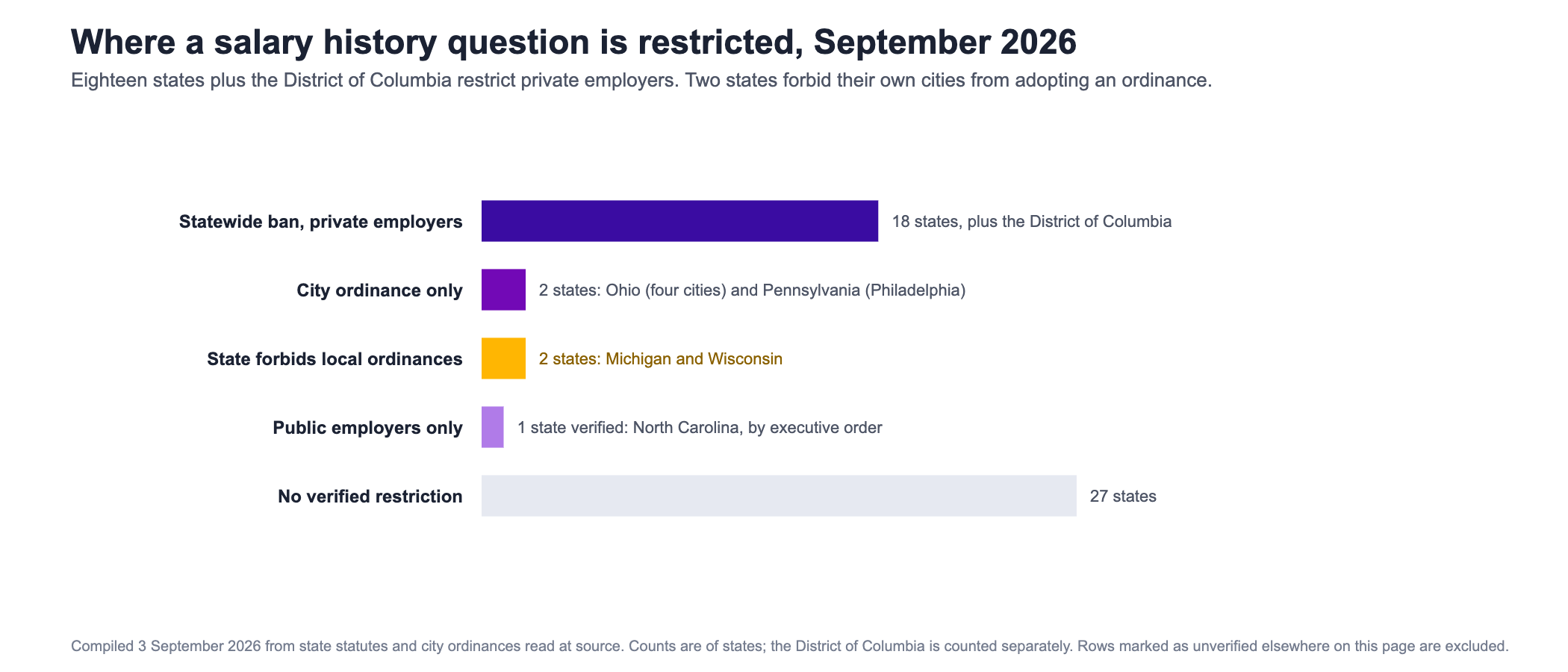
Three things about that list are worth more than the count. First, most of these laws reach the third party, not just the applicant. Delaware, Illinois, Maine, Maryland, Massachusetts, Minnesota, New York, Oregon, Vermont, Washington, Connecticut and DC all expressly bar seeking pay history from a current or former employer or through an agent. A form that omits the question while your background vendor asks it anyway is not compliant.
Second, the voluntary-disclosure safe harbor is not universal. Most states let you use what an applicant volunteers unprompted. Nevada carries no such exception in its text at all, and Oregon and Maine allow confirmation only after an offer has been made. Assuming the common rule in those three is how a compliant process becomes a claim.
Third, Alabama is on many published lists and does not belong there. The Clarke-Figures Equal Pay Act bars refusing to interview, hire, promote or employ someone because they will not provide wage history; it does not make the question itself unlawful. That is a meaningfully different rule, and treating Alabama as a ban state produces the wrong form for the wrong reason. Virginia is the newest genuine addition: Va. Code 40.1-28.7:12, in force since 1 July 2026, bars seeking wage or salary history and requires a wage or salary range in every posting, in one section. Most compliance lists written before mid-2026 still show Virginia as having nothing. Our pay transparency laws by state page covers the posting half of that same statute.
Two states forbid their own cities from acting
Wisconsin Statutes 103.36, created by 2017 Wisconsin Act 327, expressly permits an employer to solicit salary history, declares it a matter of statewide concern, and voids local ordinances to the contrary. Michigan reaches the same result through a broader preemption of local rules on what an employer may ask on an application or in an interview. Ohio has no such statute, which is why four Ohio cities have their own ordinances, Cleveland being the newest at 27 October 2025.
Check a question before it goes on the form
Job application questions to include (and the ones to leave out)
The field table above is sorted by what the law allows. This is the same ground turned into the actual questions an hourly application asks. The test comes from the EEOC’s page on prohibited practices: information requested before hire “should be limited to those essential for determining if a person is qualified for the job.” If a question would not change whether you call the applicant, it does not belong on the form.
Questions to include
- Which position are you applying for, and which of these shifts can you work? Print the real shifts, with start and end times and the weekend pattern, rather than an open availability grid.
- When could you start? For roles you need filled this month, this answer decides who gets the first call.
- Are you legally authorized to work in the United States? A yes or no. The documents belong on the Form I-9, after hire.
- Do you meet the minimum age for this role? Only where the job has a lawful minimum age, such as a license, equipment or alcohol-service rule. Ask whether they meet it, not their date of birth.
- Do you hold the license or certification this job requires, and what is the number? A CDL class and endorsements, a CNA registry number, a trade license. A number can be verified; a tick box cannot.
- Can you perform the duties of this job as described, with or without reasonable accommodation? Federal law expressly allows pre-offer questions about “the ability of an applicant to perform job-related functions” (42 U.S.C. 12112(d)(2)(B)). Describe the duty; do not ask about the person’s health.
- Where have you worked most recently? The last two employers, dates, title, a supervisor’s name and whether you may contact them.
- What pay are you looking for? Expectations, not history.
- How did you hear about this job? Not a screening question, but it is the cheapest source tracking you will ever set up, and it feeds the hiring metrics you will want later.
Questions to leave out
- Date of birth, age or graduation year. Age (40 or older) is a protected characteristic under federal law, and a graduation year is an age question in disguise.
- Salary history. Restricted in the eighteen states and DC listed above.
- Criminal history. Keep it off the form; the stage at which you may ask differs by state and city. See ban the box laws by state.
- Health, disability, medications or past workers’ compensation claims. Prohibited before an offer by 42 U.S.C. 12112(d)(2)(A).
- Marital status, children, childcare or pregnancy. State the shift and ask whether they can work it. The EEOC treats pregnancy as part of sex discrimination.
- Birthplace, citizenship, native language or religion. Ask about work authorization and the schedule instead. Ask about a language only when the job requires it.
Every item in the second list has a lawful version that asks about the job rather than the person, and our illegal interview questions page sets those pairs out against the federal regulations. The same rules apply to knockout questions on an online or social ad form; pre-screening questions covers which knockouts are worth their cost. And every question on either list is paid for in applicants who stop before the end, which is the subject of the next section.
How long the form should be, and what we can prove about it
Every article about application length quotes a completion-rate cliff at some number of fields. We are not going to, because we have not run that test and the numbers in circulation trace back to studies whose method we cannot check. What we can say is narrower and more useful.
In our 2026 social job advertising benchmark, apply rate explains roughly 70 percent of the variation in cost per applicant across campaigns, more than click-through rate or CPM. Cost per applicant runs from $2.91 at the tenth percentile to $66.45 at the ninetieth, with a median of $13.88. Apply rate is the ratio of people who finish to people who click, and the application is most of what sits between those two numbers. So the length of the form is not a UX preference. It is the largest single lever on what an applicant costs you, and the benchmark says so without needing a completion-rate statistic we cannot source.
The practical shape that follows: collect at the application only what you would screen on, and move everything else to the offer stage where it is both lawful and cheap. Contact details, the role and shift, work authorization as a yes or no, licenses or certifications the job legally requires, and enough work history to have a conversation. Not the Social Security number, not references you will not call, not education for a role that does not need it, and not a question you are only asking because the old form had it.
| Paper form | Online form or ATS | Instant form in a social ad | |
|---|---|---|---|
| Where it is filled in | In store, on a clipboard | A career site, usually on a phone | Inside the social app, prefilled from the profile |
| Typical field count | Whatever fits two sides | Often too many, because fields are free to add | Deliberately short, plus knockout questions |
| Biggest failure mode | Never gets keyed in | Account creation and resume upload | Volume without qualification if you skip the knockouts |
| Compliance risk | Old questions survive on old stock | One template used across states | Knockout questions are inquiries like any other |
| Best for | Walk-in hiring and hiring events | Roles with real qualification requirements | High volume frontline roles where reach is the constraint |
One thing about the third column, since we sell it. A knockout question on a social instant form is an inquiry in exactly the same sense as a line on a paper form. If you cannot ask about criminal history on an application in your state, you cannot ask it in a knockout question either, and California reaches the advertisement itself. The right knockouts are the ones a paper form could carry: license class and endorsements, availability for the shift, minimum age for the role, distance willing to travel. Our page on Meta special ad category covers what targeting you lose on employment ads and why qualification has to happen in the form rather than in the audience.
Estimate what your form is costing you
The printable version, and when paper is still the right call
The template above is the printable job application most employers are looking for: one form, designed to be printed double-sided, with no field on it that you are not allowed to ask. If you only came here to print something and hand it to somebody on a clipboard, that is the download, and you can stop reading.
Paper is not a relic in frontline hiring. It is still the fastest route to a completed application in four situations: a hiring event or job fair where people are standing in front of you, a walk-in at a shop or restaurant counter, a jobsite with no reception desk and patchy signal, and any role where a good share of your applicants arrive without a phone they are willing to fill a form in on. In all four, the alternative to paper is not a better application — it is no application.
What paper actually costs you is worth being clear about, because it is not legal risk. It is transcription: somebody has to retype the form, and that is where names get misspelled, phone numbers get transposed and a day gets added to your time to hire. It is also the audit trail. An electronic form timestamps itself; a paper one is a piece of paper in a drawer until someone files it.
Two things do not change when you move to paper. The field-by-field rules set out above apply identically — a question you cannot ask on a screen you cannot ask on a clipboard, and salary-history bans do not have a paper exemption. And the retention duty is the same: the one-year rule under 29 CFR 1602.14 described in the FAQ below runs from the date of the record or the personnel action, whichever is later, whether that record is a database row or a photocopy.
One accessibility point that gets missed. A process that exists only on paper can shut out applicants who cannot complete a printed form unaided, and a process that exists only online can shut out applicants without a device. The defensible position is to run both and say so in the advert — “apply online or pick up a form at the counter” costs nothing and widens the pool.
What we can tell you from our own data is narrow and worth stating plainly: we measure what it costs to get somebody to complete an application after they see an advert, not whether they completed it on paper or on a screen. We are not going to claim a paper-versus-digital completion rate we do not measure.
Where the rest of the detail lives
Four fields on that table are pages of their own here, because each carries a fifty-state answer that does not belong on a template page. Ban the box laws by state has the criminal-history gate positions, including the California rule that reaches the job advertisement. Drug testing laws by state covers the cannabis question and the states that protect lawful off-duty use. Form I-9 requirements is what happens after hire, and is the reason work authorization on the application is a yes or no rather than a document. And what is a background check covers the FCRA authorization the application does not give you.
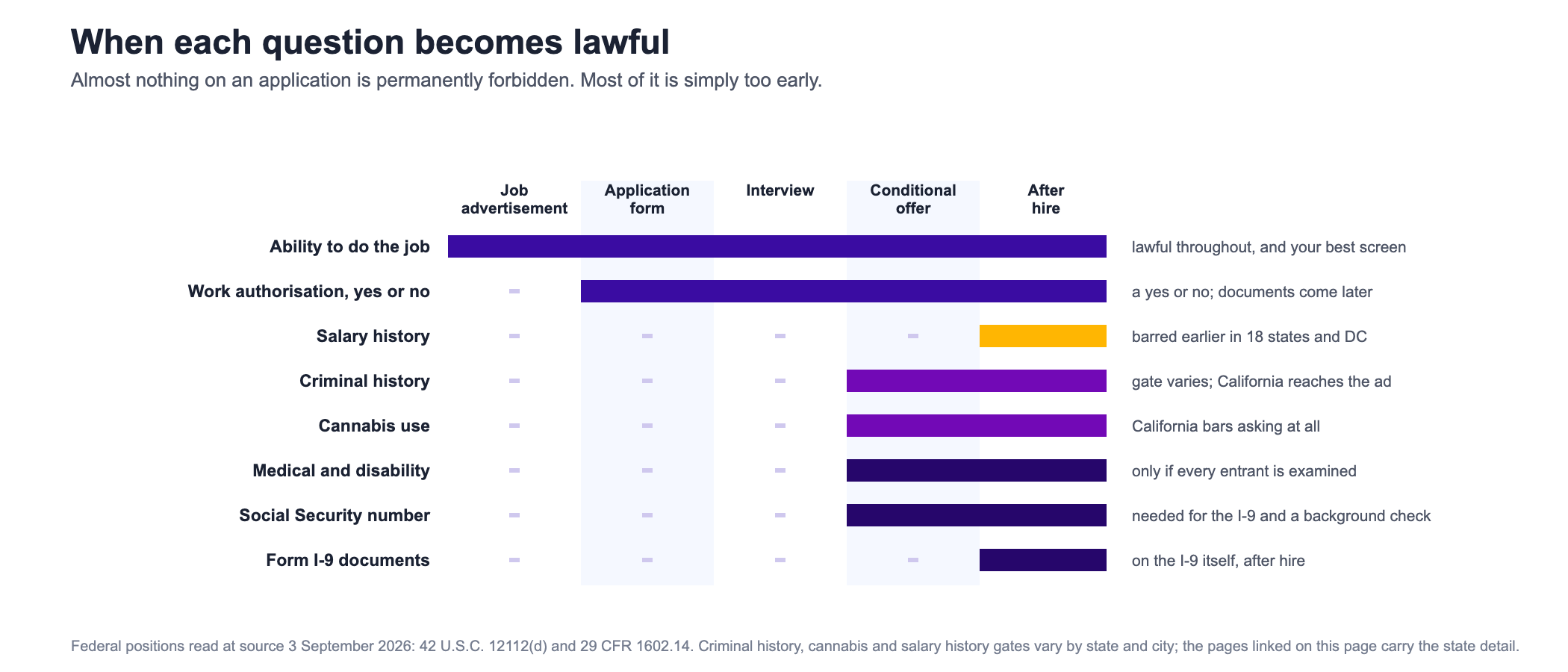
Two more that pair with this one. Illegal interview questions is the spoken version of the same problem, and it is where most of the risk actually sits, because a form is reviewed once and an interview is improvised every time. The job description generator is the step before: the description sets what you may lawfully screen on, and a requirement that is not in the description is hard to defend as a screening criterion.
Job application form: what the phrase is asking for
“Job application form” is searched by two groups who need opposite things, which is worth naming because most results serve only one. Job seekers want a blank form to fill in. Employers want a compliant form to hand out, host or print. This page is written for the second group, and the template above is the employer’s version: the fields you may ask about, the ones that are restricted by state, and the ones that are prohibited outright.
If what you need is the form itself rather than the legal detail around it, three practical points decide whether it works. Keep it to one page or one screen, because every additional field costs you completions and the drop-off is steepest on a phone. Ask only what you will actually use to make a screening decision; anything you collect and ignore is risk without benefit. And separate the application form from the screening questions — the form establishes who someone is, the screening questions establish whether they qualify, and merging them produces a document too long for either purpose.
Frequently asked questions
Where can I get a free printable job application?
The template at the top of this page is free, fillable and built to print double-sided on one sheet. It is written so that every field on it is one you are allowed to ask in 2026 — which is the part most printable forms circulating online get wrong, because they were written before salary-history bans and ban-the-box rules existed. Print it as it is, or delete the fields you do not need; do not add fields back in without checking the field-by-field section above.
Should we take paper applications at a hiring event?
Usually yes. At a hiring event, a job fair or a walk-in, the person is already standing in front of you and a paper form is the shortest path to a completed application — the realistic alternative is not a better application but no application at all. Budget for the transcription afterwards, keep the forms under the same one-year retention rule as everything else, and offer an online route as well so that neither format becomes the only way in.
Is a paper job application still legal?
Yes. No federal law requires an electronic application, and for walk-in hiring and hiring events a paper form is often the fastest route to a completed application. The risk is not the paper, it is the age of the questions on it. Old stock in a back room routinely carries a date of birth field, a salary history field and a criminal history box, all of which have become restricted in much of the country since the form was printed.
What must an employment application include?
Nothing is federally required. What makes an application worth having is the certification and signature block: a statement that the information is true, that falsification is grounds for withdrawal of an offer or dismissal, and consent to verify the information given. Beyond that, include only what you would actually screen on, because every additional field is paid for in applicants who do not finish.
Can I ask about criminal history on an application?
In much of the country, no. Ban the box laws move the inquiry to a later gate, and the gate position differs by state: after an initial screen, after an interview, or only after a conditional offer. California goes further and reaches the advertisement, so phrases such as no felons in a job ad are prohibited there. The safe default for a multistate employer is to keep the question off the form entirely and ask it at the conditional offer stage.
Can I ask for salary history?
Not in eighteen states or the District of Columbia. In most of those the ban also covers asking a current or former employer or a screening vendor, so removing the field from the form is not enough on its own. Nevada has no voluntary disclosure exception in its statute, and Oregon and Maine allow you to confirm history only after an offer. Ask about salary expectations instead, which is lawful everywhere and more useful.
Can I require a resume?
You can, and for most frontline roles you should not. A resume requirement excludes people who do not have one to hand on a phone, which in hourly hiring is a large share of qualified applicants, and it adds the single most abandonment-prone step in an online application. If you need the work history, ask for the last two employers as fields. If you need a resume for a specific role, ask for it after the first conversation.
How long do I have to keep applications?
Under 29 CFR 1602.14 an employer must preserve personnel and employment records, including application forms, for one year from the date of the record or the personnel action, whichever is later. If a discrimination charge is filed, all records relevant to the charge must be kept until final disposition, which means until the period for filing suit expires or the litigation ends. Federal contractors and some states have longer periods.
Can I ask for a Social Security number on the application?
You can in most places, and there is very little reason to. You do not need it to evaluate an applicant. You need it at hire for payroll and the I-9, and you need it for a background check, which requires its own written disclosure and authorization under the Fair Credit Reporting Act rather than a line on a form. Collecting it from every applicant creates a data protection liability in exchange for nothing.
Can I ask an applicant how old they are?
Asking date of birth is not itself unlawful under federal law, but it is evidence in an age discrimination claim and several states restrict it. Where the role has a lawful minimum age, whether from a child labor rule, a license, or a rule about operating equipment or serving alcohol, ask whether the applicant meets that age. That gets you the answer you actually need without collecting the one you do not.
What is an employee application template?
An employee application template is a reusable form that collects the same information from every applicant in the same order: contact details, the position and availability, work history, references, any certifications the role requires, and a dated signature. Using one rather than accepting resumes in whatever shape they arrive is what makes candidates comparable, and the signature block is what makes the answers something you can rely on later.
What should a simple job application include?
For an hourly role, five things: who the applicant is and how to reach them, which position and which shifts they can work, where they have worked recently, any credential the job legally requires, and a dated signature. Everything else can wait until the interview. Each additional field costs you completed applications, which is the trade the length section above puts numbers to.
How long should a job application be?
As short as your screening decision allows: for most hourly roles, contact details, position and shift, work authorization, any credential the job legally requires, recent work history and a signature, which fits on one page or one phone screen. In Boostpoint’s 2026 Social Job Advertising Benchmark, apply rate explained about 70% of the variation in cost per applicant, and campaigns where fewer than one in ten clickers finished the form used 41% of all budget while returning 11% of applicants. We have not measured completion time, so we do not quote a minutes figure.
The form is only half of it. The other half is who sees the ad.
A short, compliant application is worth very little if the wrong people reach it. Bring the roles and the markets you hire in, and we will show you what a qualified applicant has actually cost there.
Book a Demo