Employer guideUpdated September 2026
Drug Testing Laws by State: The Standard THC Panel Is Now the Wrong Instrument in Sixteen Places
In sixteen jurisdictions an employer can no longer refuse to hire someone for lawful off-duty cannabis use, and in several of those the specific thing that is barred is acting on a screen that found nonpsychoactive metabolites — which is exactly what a standard urine THC panel detects. Eight more states protect medical cardholders only. Twenty-five have no restriction we could find. California also makes it unlawful to ask: requesting information from an applicant about prior cannabis use is prohibited, which puts the rule inside your application form. And in the one place a frontline employer might expect leniency, the rule went the other way: since November 18, 2024 a CDL driver with a prohibited Clearinghouse status has their license downgraded by the state.
Three groups, and the middle one is narrower than it sounds
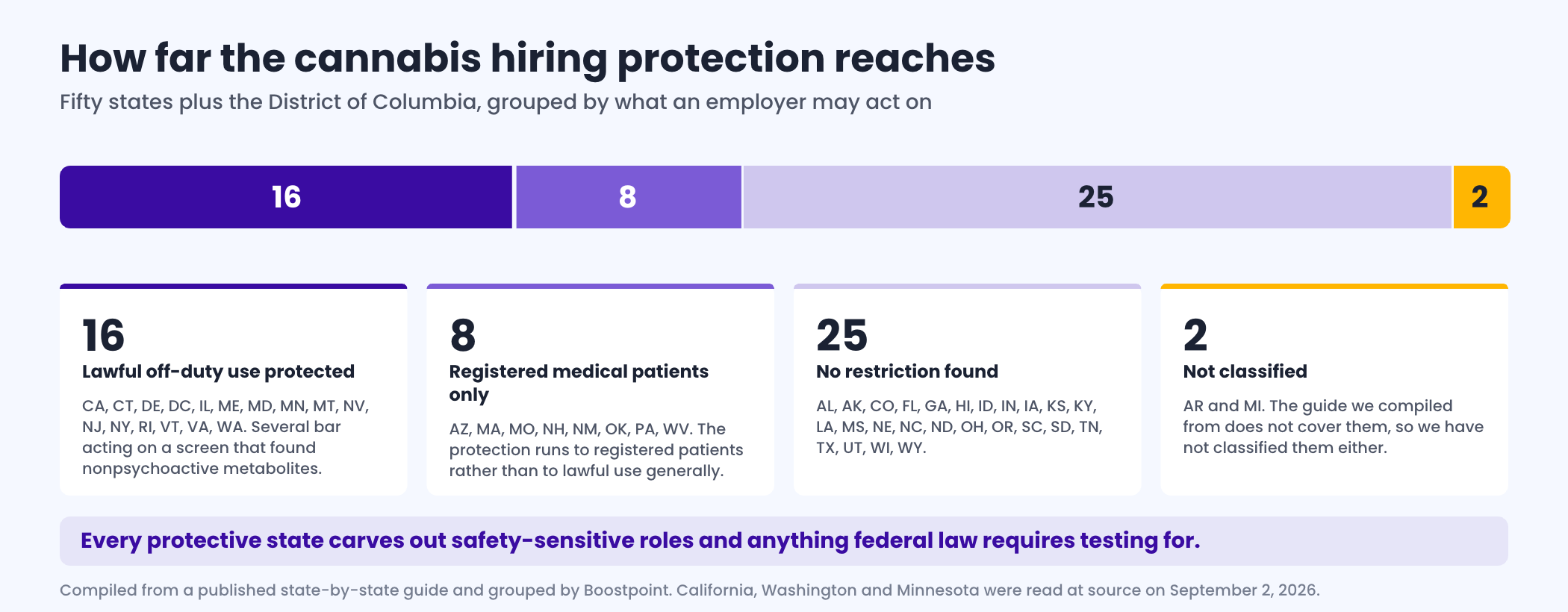
| Group | How many | Which ones |
|---|---|---|
| Lawful off-duty use protected | 16 | California, Connecticut, Delaware, the District of Columbia, Illinois, Maine, Maryland, Minnesota, Montana, Nevada, New Jersey, New York, Rhode Island, Vermont, Virginia and Washington |
| Registered medical patients only | 8 | Arizona, Massachusetts, Missouri, New Hampshire, New Mexico, Oklahoma, Pennsylvania and West Virginia |
| No restriction found | 25 | Alabama, Alaska, Colorado, Florida, Georgia, Hawaii, Idaho, Indiana, Iowa, Kansas, Kentucky, Louisiana, Mississippi, Nebraska, North Carolina, North Dakota, Ohio, Oregon, South Carolina, South Dakota, Tennessee, Texas, Utah, Wisconsin and Wyoming. Iowa has no off-duty cannabis protection, but Iowa Code 730.5 sets detailed procedures for any private-sector drug test (written policy, split samples, certified lab, medical review officer) |
| Not classified | 2 | Arkansas and Michigan, which the source we compiled from does not cover |
Three states, read at source
California: the panel and the question are both regulated
Government Code section 12954 makes it unlawful to discriminate in hiring based on a person’s use of cannabis off the job and away from the workplace, or based on an employer-required drug screening test that has found the person to have nonpsychoactive cannabis metabolites in their hair, blood, urine, or other bodily fluids. The statute leaves a route open: it does not prohibit acting on a scientifically valid pre-employment screen conducted through methods that do not screen for nonpsychoactive metabolites. Two more parts matter operationally. Subdivision (b) makes it unlawful to request information from an applicant relating to prior cannabis use, which puts the rule inside your application form rather than inside your lab contract. And subdivision (a)(2) exempts employees in the building and construction trades entirely.
Washington: the same instrument problem, with a long exemption list
RCW 49.44.240 bars discrimination in initial hiring based on off-duty cannabis use away from the workplace, or on a screening finding nonpsychoactive metabolites. The exemptions are specific: positions requiring a federal background investigation or security clearance, general authority law enforcement, fire departments and fire protection districts, first responders including dispatchers and emergency medical services, corrections officers, airline and aerospace positions, and safety-sensitive positions where impairment presents a substantial risk of death — which the employer must identify as safety-sensitive before the applicant applies. That last clause is a job-ad requirement disguised as an employment rule.
Minnesota: no pre-employment cannabis test at all, outside seven categories
Minnesota Statutes section 181.951, subdivision 8, states that an employer must not request or require a job applicant to undergo cannabis testing as a condition of employment unless otherwise required by state or federal law, and must not refuse to hire an applicant solely because an authorized test showed the presence of cannabis. Subdivision 9 then lists the positions where cannabis is still treated as a drug: safety-sensitive positions, peace officers, firefighters, positions requiring face-to-face care of children, vulnerable adults or patients, positions requiring a commercial driver’s license or otherwise subject to state or federal testing rules, positions funded by a federal grant, and anything else state or federal law requires testing for. For a senior living or home care operator, that list covers most of the payroll.
The pattern underneath all three
The law has moved from asking did this person use cannabis to asking is this person impaired at work, and a standard urine panel answers the first question rather than the second. It detects metabolites that can persist for weeks after use. In the states above, a positive on that panel is no longer evidence of anything the employer is allowed to act on — unless the role is on the exemption list, in which case nothing has changed at all.
Marijuana and pre-employment drug testing: what the panels actually detect
Whether a test looks for marijuana depends first on whether it is a DOT test. A DOT test always does. Under 49 CFR 40.82 the laboratory tests every DOT specimen for five drug classes, marijuana metabolites, cocaine metabolites, amphetamines, opioids and phencyclidine, and “must not test ‘DOT specimens’ for any other drugs.” The marijuana analyte in 49 CFR 40.85 is THCA, a metabolite, at a 50 ng/mL screening cutoff and 15 ng/mL on confirmation. For drivers, the pre-employment test itself is mandatory before the first safety-sensitive shift (49 CFR 382.301); the rest of that regime is on DOT drug testing requirements.
A non-DOT urine test detects whatever you ordered. No federal rule fixes the contents of a private employer’s non-DOT panel, so “4-panel”, “5-panel” and “10-panel” are laboratory product names, not legal categories, and whether marijuana is on one is a line on your lab order rather than something the name guarantees. Read the panel before you rely on it. In California and Washington a panel that screens for the nonpsychoactive metabolite is exactly the instrument the statutes quoted above address, and in Minnesota (Minn. Stat. 181.951, subd. 8) asking a non-exempt applicant for a cannabis test at all is barred.
As for pre-employment drug test laws in general: federal law requires a pre-employment test only for DOT-regulated safety-sensitive roles, and the Drug-Free Workplace Act below requires a policy, not a test. For every other role, whether you may test, what you may act on and what you may ask are set by the state, which is what the groups at the top of this page sort out.
Commercial drivers went the other way
For CDL roles the rules tightened rather than loosened, and the change has teeth. An employer must run a pre-employment query in the Federal Motor Carrier Safety Administration Drug and Alcohol Clearinghouse before hiring a driver into a safety-sensitive function, and must query every existing driver at least once every 365 days, on a rolling basis from the last query. A driver with a prohibited status may not operate a commercial motor vehicle. Since November 18, 2024 the consequence goes further: state driver licensing agencies must query the Clearinghouse before issuing, renewing or upgrading a commercial license or permit, and must downgrade the commercial driving privilege of any driver in prohibited status until the return-to-duty process is complete.
| Step | What it involves |
|---|---|
| 1. Substance abuse professional assessment | An initial assessment, reported by the professional to the Clearinghouse. |
| 2. Education or treatment | Whatever the professional prescribes, completed in full. |
| 3. Return-to-duty test | A negative result is required before the driver can perform safety-sensitive functions. |
| 4. Follow-up testing plan | Ordered by the professional and administered by the employer. Only on completion does the status change from prohibited to not prohibited. |
What a positive pre-employment panel means, by state
Who is still testable everywhere
The exemption lists are the part that decides whether any of this changes your process, and for a frontline employer they cover more of the payroll than the headline does. Reading the three statutes side by side produces a finding worth stating plainly: not one exemption category appears in all three. Four categories appear in two of them and five appear in only one. A single national screening policy cannot be built on that.
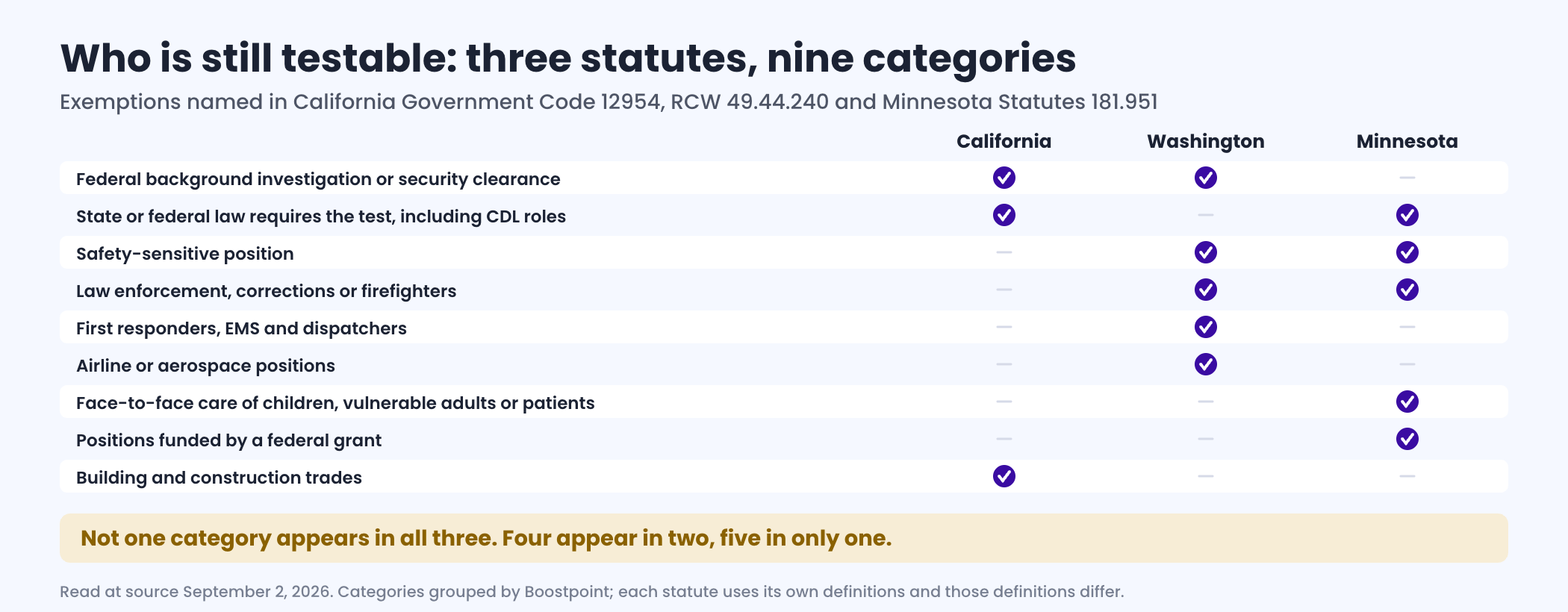
Two of those differences change real decisions. Building and construction trades are exempt in California and not named in the other two, which means the same crew role can be treated differently across a state line. And Minnesota is the only one of the three that names face-to-face care of children, vulnerable adults and patients, which is why a senior living operator in Minnesota has a very different answer from one in Washington. Washington adds a requirement the others do not: a safety-sensitive position has to be identified as safety-sensitive before the applicant applies, which means the designation belongs in the job ad.
What a failed screen costs you in advertising alone
Set aside the compliance question for a moment. A screen that fails after an offer does not just cost the offer; it costs the whole funnel that produced the offer, and you pay to run it again. That is a number we can price, because the top of the funnel is what we measure.
Price a failed screen
For scale, across the 891 campaigns in our 2026 social job advertising benchmark the median campaign delivered an applicant for $13.88, with warehouse and production at $9.83 and CDL truck drivers at $26.86. Those figures are the input to the calculation above, and the fuller picture of what each metric can and cannot tell you is on hiring metrics benchmarks. What we cannot tell you is whether screening improves retention or safety on your sites; that answer lives in your own records and we are not going to estimate it. The adjacent rule that catches the same applicants earlier in the same funnel is on ban the box laws by state, where the question is when you may ask rather than what you may test for.
The federal Drug-Free Workplace Act, and who it actually covers
The most common misreading in this area is that a federal law requires employers to have a drug-free workplace policy. It does not. 41 U.S.C. 8102 reaches federal contractors, and only those holding a contract worth more than the simplified acquisition threshold — a figure adjusted for inflation rather than fixed, which is why the widely quoted round number goes stale — and it expressly excludes contracts for commercial products and services. 41 U.S.C. 8103 reaches every recipient of a federal grant, with no threshold at all. Everyone else is governed by state law, which is what the table on this page is about.
Where it does apply, the statute is specific about what the policy must do, and it is more than a notice on a wall. The employer must publish a statement prohibiting the unlawful manufacture, distribution, dispensation, possession or use of a controlled substance in the workplace and specifying the actions that will be taken for violations; establish a drug-free awareness program covering the dangers of drug abuse, the employer policy, available counseling and assistance, and the penalties; give a copy of the statement to every employee engaged on the contract; state in it that as a condition of employment the employee will abide by it and will notify the employer of any workplace criminal drug statute conviction within five days; notify the contracting agency within ten days of receiving that notice; and impose a sanction on, or require rehabilitation of, any employee convicted.
Note what is absent from that list: the Act does not require testing. A drug-free workplace policy and a drug testing program are different things, and a great many employers who need the first have quietly adopted the second on the assumption that it was compulsory. If you do test, the mechanics (panels, specimen types, testing after a conditional offer and MRO review) are on our pre-employment drug screening page.
Frequently asked questions
Can employers still drug test for marijuana?
Yes, everywhere, but in sixteen jurisdictions you may not refuse to hire someone for lawful off-duty use or on the strength of a screen that found nonpsychoactive metabolites. Eight more states protect registered medical cannabis patients only, and twenty-five have no restriction we could find. Every one of the protective states carves out safety-sensitive roles and anything subject to federal testing rules, which is where most frontline positions sit.
Which states restrict pre-employment marijuana testing?
The group protecting lawful off-duty use is California, Connecticut, Delaware, the District of Columbia, Illinois, Maine, Maryland, Minnesota, Montana, Nevada, New Jersey, New York, Rhode Island, Vermont, Virginia and Washington. Minnesota goes furthest: an employer must not request or require a job applicant to undergo cannabis testing at all unless state or federal law requires it, or the role falls into one of seven listed categories.
Why does the type of test matter now?
Because California and Washington both write the instrument into the statute. Each bars acting on a screening test that found nonpsychoactive cannabis metabolites in hair, blood, urine or other bodily fluids, which is what a standard urine THC panel detects and which can persist for weeks after use. California explicitly leaves open a scientifically valid pre-employment screen conducted through methods that do not screen for those metabolites, so the question has become which test rather than whether to test.
Can I ask an applicant whether they use marijuana?
Not in California. Government Code section 12954 makes it unlawful for an employer to request information from an applicant for employment relating to the applicant’s prior use of cannabis. That reaches an application form, a screening question on a job ad and anything else you put in front of a candidate, which makes it a copy problem rather than a laboratory one. Other states in the protective group address the test and the hiring decision rather than the question.
What counts as a safety-sensitive position?
It depends on the statute, and the definitions differ. Washington describes a position where impairment presents a substantial risk of death, and requires the employer to identify the position as safety-sensitive before the applicant applies. Minnesota uses its own statutory definition and separately names peace officers, firefighters, roles involving face-to-face care of children, vulnerable adults or patients, commercial license roles and federally funded positions. Do not assume one label travels between states.
Do these protections apply to CDL drivers?
No. Every one of the protective statutes carves out positions subject to state or federal testing requirements, and commercial drivers are squarely inside the federal rules. An employer must run a pre-employment query in the FMCSA Drug and Alcohol Clearinghouse before hiring a driver into a safety-sensitive function, and must query every existing driver at least once every 365 days. Nothing a state has done about cannabis changes that.
What happens to a driver in prohibited status?
They cannot operate a commercial motor vehicle, and since November 18, 2024 they cannot keep the license either. State driver licensing agencies must query the Clearinghouse before issuing, renewing or upgrading a commercial license or permit, and must downgrade the commercial driving privilege of a driver in prohibited status. It is reversed only by completing the return-to-duty process: assessment, prescribed education or treatment, a negative return-to-duty test, and the follow-up testing plan.
Should we keep screening at all?
That is your decision and it turns on facts we do not have: your roles, your insurer, your safety record and your own view of the trade. What we can say is that a screen is a filter applied after you have paid for the whole funnel, so its cost is not the lab fee but the advertising and time spent reaching the person twice. Whatever you decide, decide it per role and per state rather than once for the company.
Does federal law require a drug-free workplace policy?
Only for two groups. 41 U.S.C. 8102 applies to federal contractors holding a contract worth more than the simplified acquisition threshold, excluding contracts for commercial products and services, and 41 U.S.C. 8103 applies to every recipient of a federal grant with no threshold. For everyone else this is a matter of state law. Where the Act does apply it requires a published statement, an awareness program, notice to employees, employee notification of a workplace drug conviction within five days, notice to the contracting agency within ten, and a sanction or rehabilitation requirement. It does not require testing.
What does a drug-free workplace policy have to contain?
Under 41 U.S.C. 8102, for the contractors it covers, six things. A published statement prohibiting the unlawful manufacture, distribution, dispensation, possession or use of a controlled substance in the workplace and specifying the actions that will be taken for a violation. A drug free awareness program covering the dangers, the policy, available counseling and assistance, and the penalties. A copy of the statement given to every employee working on the contract. A term making compliance a condition of employment and requiring the employee to report a workplace drug conviction within five days. Notice to the contracting agency within ten days of learning of one. And a sanction or a rehabilitation requirement for anyone convicted.
When is a DOT pre-employment drug test required?
Before the first time a driver performs safety sensitive functions. Under 49 CFR 382.301 the employer may not allow that work until it has received a verified negative controlled substances result from the medical review officer or the consortium. There is one narrow exception: no test is required if the driver participated in a compliant program within the previous 30 days and was either tested within the past six months or in random testing for the previous twelve, and the employer confirms that no prior employer it knows of holds a violation record for that driver within the previous six months. The rest of the driver file is on our driver qualification file checklist.
Does a non-DOT urine drug test include marijuana?
Only if the employer orders a panel that includes it. No federal rule sets the contents of a private employer’s non-DOT panel, so check the panel on your lab order. A DOT test is different: 49 CFR 40.82 requires every DOT specimen to be tested for marijuana metabolites, cocaine metabolites, amphetamines, opioids and phencyclidine, and nothing else. In the sixteen jurisdictions that protect off-duty use, a positive for marijuana metabolites on a non-DOT screen may be a result you cannot act on for a non-exempt role.
Does a 4-panel drug test include marijuana?
There is no legal definition of a 4-panel test, so it depends on what the laboratory includes; ask for the analyte list before you order. The only federally fixed panel is the DOT test, which covers five classes, marijuana among them (49 CFR 40.82). If you hire in California, Washington or Minnesota, choosing a panel with or without marijuana is a legal decision as well as a lab one; the state sections above explain why.
Drivers subject to federal rules are a separate regime with its own six testing occasions and deadlines: see DOT drug testing requirements.
This is one rule among about a dozen that attach at different points in a hire. Our hiring compliance hub sets out which obligation bites at which stage, and the four federal deadlines every US employer is on.
Whatever you screen for, you still have to fill the role twice.
Bring the roles you screen and the states you hire in. We will show you what applicant flow costs in those markets, so a failed screen is a delay rather than an empty requisition.
Book a Demo