
Employer guideRead at source, 3 September 2026
Driver Qualification File Checklist: Every 49 CFR 391 Document, Deadline and Retention Period
The driver qualification file is not a folder of whatever seems relevant. 49 CFR 391.51(b) lists eight things, and three of the most commonly published rules about them changed on 22 and 23 June 2025. Two more items that almost every checklist puts in the DQF do not belong there at all: the previous-employer safety history goes in a separate file under 391.53, kept in a secure location with controlled access, and the Drug and Alcohol Clearinghouse query is a part 382 obligation, not a part 391 one. The whole file is kept for as long as the driver is employed and three years afterwards, except five items that may come out three years after execution. Every rule below was read in the eCFR text of 49 CFR parts 391 and 382 on 3 September 2026.
The eight items 391.51(b) actually requires
Read the subsection literally and the list is shorter than most checklists suggest, because several familiar documents live in other files or other parts. Here is what the regulation names, with the deadline and the retention rule for each.
| Item | Regulation | When | Retention |
|---|---|---|---|
| Application for employment | 391.51(b)(1), 391.21 | At application | Employment plus 3 years |
| MVR from each licensing authority at hire | 391.51(b)(2), 391.23(a)(1) | Inquiry and filing within 30 days of the date employment begins, covering the prior 3-year history from every state the driver was licensed in | Employment plus 3 years |
| Road test certificate, or an accepted equivalent | 391.51(b)(3), 391.31(e), 391.33 | Before driving. A valid CDL may be accepted instead, but not for double or triple trailer or tank endorsements; or a road test certificate issued within the preceding 3 years | Employment plus 3 years |
| MVR from the annual inquiry | 391.51(b)(4), 391.25(a) | At least once every 12 months, covering at least the preceding 12 months | May be removed 3 years after execution |
| Note of the annual review | 391.51(b)(5), 391.25(c)(2) | At least once every 12 months. The note must carry the name of the person who did the review and the date | May be removed 3 years after execution |
| Medical examiner certificate, or the CDLIS record | 391.51(b)(6), 391.43(g) | Before the driver operates a CMV. For CDL holders this is the CDLIS motor vehicle record from the current licensing state, not a paper copy | May be removed 3 years after execution |
| Skill performance evaluation or medical exemption | 391.51(b)(7), 391.49 | Where the certification rests on a variance | May be removed 3 years after execution |
| National Registry verification note | 391.51(b)(8), 391.23(m) | Non-CDL drivers only. For CDL drivers this requirement ran through 22 June 2025 | May be removed 3 years after execution |
| Previous-employer safety history | 391.53, not 391.51 | Within 30 days of the date employment begins, in a separate secure file | Employment plus 3 years |
| Clearinghouse pre-employment query | 382.701(a), not part 391 | A full query before the driver performs a safety-sensitive function | Per part 382 |
Three things that changed in June 2025
A great deal of currently published DQF guidance describes rules that expired last summer. All three sit in the same place, the shift of medical certification onto the electronic driver record.
- The National Registry verification note is no longer a CDL requirement. Section 391.51(b)(8)(ii) requires it “through June 22, 2025” for drivers required to have a CDL. It remains in force for non-CDL drivers under 391.23(m)(1), which still requires the certificate, any variance, and verification that the examiner was on the National Registry on the date of issue, all in the file before the driver operates a CMV.
- The fifteen-day paper certificate no longer works for CDL drivers. Section 391.23(m)(2)(iii) allowed a copy of the certificate submitted to the state to serve as proof for up to fifteen days, through 22 June 2025. What 391.23(m)(2) requires now, before the driver operates a CMV, is the CDLIS motor vehicle record from the current licensing state, verified for the driver self-certified type of operation and, where the driver certified interstate operation, for a valid certificate and any variances.
- A new trigger for re-examination. Section 391.45(h) adds, on or after 23 June 2025, any person found by a medical examiner not to be physically qualified under 391.43(g)(3). That sits alongside the standing triggers: never certified, not certified in the preceding 24 months, and any driver whose ability to perform normal duties has been impaired by injury or disease.
The two files people merge, and the third they forget
391.53 creates a driver investigation history file that is not the DQF. It holds the driver written authorization to seek alcohol and controlled substances history and the responses from every previous employer, or documented good-faith efforts. The regulation requires it to be maintained in a secure location with controlled access, limited to people involved in the hiring decision, and says the data must only be used for the hiring decision. Your insurer may see it, except the alcohol and controlled substances data. Filing that material in the general DQF, which a roadside auditor or a supervisor may open, is a control failure whatever else is in order. And the Clearinghouse query is neither file: it is part 382, with its own records and its own annual cycle.
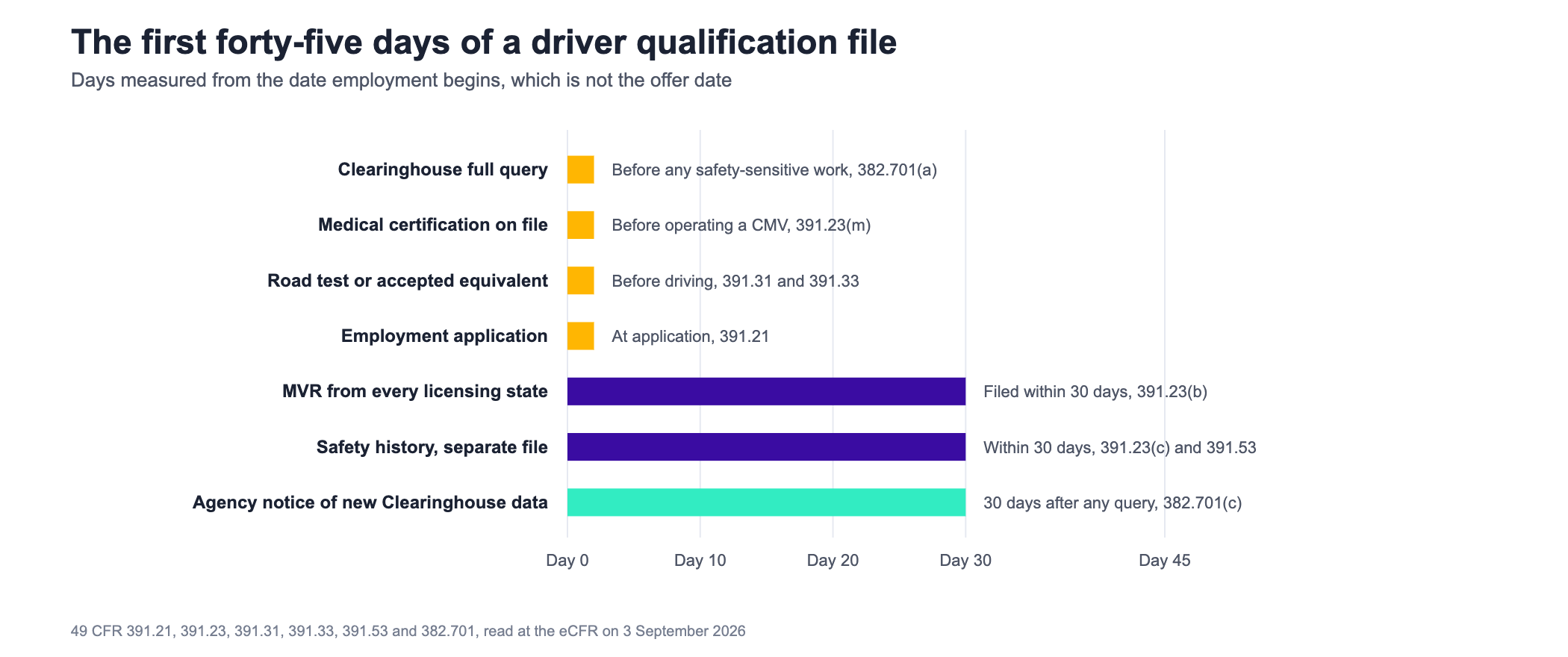
| Point in the hire | What has to happen | Authority |
|---|---|---|
| At application | The employment application in the form 391.21 prescribes, and the written authorization to seek alcohol and controlled substances history | 391.21, 391.23(f)(1) |
| Before any safety-sensitive work | A full Clearinghouse query, which requires the driver specific consent | 382.701(a) |
| Before the driver operates a CMV | Medical certification in the file. Non-CDL: certificate, any variance, National Registry verification. CDL: the CDLIS record verified for self-certified operation type and, for interstate, a valid certificate | 391.23(m)(1), (m)(2) |
| Before the driver drives | Road test certificate, or a legible copy of the CDL or certificate accepted as equivalent. Doubles, triples and tank need an actual road test | 391.31(e), 391.33 |
| Within 30 days of the start date | MVR inquiry to every state the driver was licensed in over three years, and the record filed. No reply means documenting a good-faith effort | 391.23(a)(1), (b) |
| Within 30 days of the start date | Safety performance history investigation of every DOT-regulated employer of the previous three years, filed under 391.53. No prior DOT employment means documenting that no investigation was possible | 391.23(c)(1), (c)(4), (d), (e) |
| For 30 days after any query | The agency notifies the employer if new Clearinghouse information is entered about that driver | 382.701(c) |
| Every 12 months | MVR inquiry, review against 391.15, a note naming the reviewer and the date, and a Clearinghouse query | 391.25, 382.701(b) |
| Every 24 months | Medical examination and certification, or every 12 months for the exempt intracity, insulin and vision-alternative cases | 391.45(b), (c), (e), (f) |
What this driver file must contain
CDL medical card requirements for the file
The "medical card" is the medical examiner's certificate, and the rule behind it is short. Under 49 CFR 391.41(a)(1)(i), a driver "must not operate a commercial motor vehicle unless he or she is medically certified as physically qualified to do so." What changed on June 23, 2025 is how that certification reaches you and what you file as proof, and the answer now depends on whether the driver holds a CDL or learner's permit.
| Question | CDL or CLP holder | Non-CDL driver of a CMV | Regulation |
|---|---|---|---|
| How the result travels | The examiner transmits the result to FMCSA electronically, by midnight local time of the next calendar day after the exam | The examiner completes the paper certificate, gives the original to the driver, and must give a copy to a prospective or current employer that asks | 391.43(g)(2)(ii), (g)(5) |
| What goes in the file | The CDLIS motor vehicle record from the current licensing state, verified for the self-certified type of operation and, for interstate drivers, a valid certification | The certificate, any variance, and a note verifying the examiner was on the National Registry on the date of issue | 391.23(m), 391.51(b)(6), (b)(8) |
| Must the driver carry it? | No, since June 23, 2025, provided the certificate is current. A driver certified through an FMCSA medical variance must still carry the variance documentation | Yes, the original or a copy, when on duty | 391.41(a)(1), (a)(2) |
| How long it lasts | No more than 24 months. Twelve months for drivers certified under the insulin-treated diabetes or vision standards and for exempt intracity zone drivers. The examiner may certify for less, so file the date on the record, not the maximum | 391.45 | |
| When it stops counting | If an examiner finds the driver not physically qualified, "all medical examiner's certificates previously issued to the person are not valid." A determination can also be held pending for up to 45 days while the driver supplies more information | 391.43(g)(3), (g)(4) | |
| If paper and electronic disagree | "The medical certification information provided electronically by FMCSA shall control" | 391.41(a)(2)(iv) | |
Two practical points for a CDL hire. A photocopy of the driver's card is no longer the proof for the file; the CDLIS record is, and it has to be in the file before the driver operates a CMV. And a card the driver shows you at the interview may already be void if a later exam found them unqualified, which is exactly the conflict the electronic record resolves. On the recruiting side, one question covers this: does the driver hold a current DOT medical card. Everything else is verified after the offer.
Retention: one rule, and five exceptions
Under 391.51(c) the qualification file is retained for as long as the driver is employed by that carrier and for three years afterwards. The separate investigation history file carries the same rule under 391.53(c). The exception at 391.51(d) is what lets a file stay a manageable size: five items may be removed three years after the date of execution, while the driver is still employed. They are the annual MVR, the annual review note, the medical certificate or CDLIS record, any medical variance or skill performance evaluation certificate, and the National Registry verification note.
Build the renewal calendar
FMCSA Part 391 requirements: where the DOT driver qualification file sits
The driver qualification file is one subpart of a longer rule. Part 391 of the Federal Motor Carrier Safety Regulations, 49 CFR part 391, sets the minimum qualifications for anyone who drives a commercial motor vehicle for a motor carrier, and the carrier’s minimum duties in checking them (391.1(a)). It has seven subparts and an appendix of medical advisory criteria. The file is subpart F; what an auditor checks it against is everything else.
| Subpart | Sections | What it covers |
|---|---|---|
| A. General | 391.1, 391.2 | Scope of the part and general exceptions |
| B. Qualification and disqualification of drivers | 391.11 to 391.15 | Who may drive at all, driver responsibilities for cargo securement, and the disqualifying events |
| C. Background and character | 391.21 to 391.25 | The application, the MVR and safety performance history inquiries at hire, and the annual inquiry and review |
| D. Tests | 391.31, 391.33 | The road test, or the license or certificate a carrier may accept as its equivalent |
| E. Physical qualifications and examinations | 391.41 to 391.49 | The physical standards, the medical examination and certificate, who must be examined, and the alternative standards for vision, insulin-treated diabetes and limb impairment |
| F. Files and records | 391.51 to 391.55 | The driver qualification file, the separate driver investigation history file, and LCV driver-instructor files |
| G. Limited exemptions | 391.61 to 391.69 | Intracity zone drivers, multiple-employer drivers, drivers furnished by other carriers, farm vehicle drivers of articulated vehicles, and private passenger carriers |
Subpart B is the one to read before you screen anyone, because it decides who is worth screening. Under 391.11(b), except as subpart G provides, a person is qualified to drive a commercial motor vehicle only if they:
- are at least 21 years old;
- can read and speak English well enough to converse with the general public, understand highway traffic signs and signals, respond to official inquiries and make entries on reports and records;
- can safely operate the type of vehicle they drive, by experience, training or both;
- are physically qualified under subpart E;
- hold a currently valid commercial motor vehicle operator’s license issued by only one state or jurisdiction;
- are not disqualified under 391.15; and
- have passed a road test under 391.31, or presented a license or road test certificate the carrier accepted as equivalent under 391.33.
Section 391.15 disqualifies a driver for as long as a license or driving privilege is suspended, revoked, withdrawn or denied, and for set periods after listed convictions such as driving a commercial motor vehicle under the influence of alcohol. It also puts a duty on the driver: one who receives a notice of suspension, revocation or withdrawal must tell the employing carrier before the end of the next business day. Most of what goes in the file exists to prove these conditions were checked.
The file is built during recruiting, and only two items come from the candidate
Here is where this becomes a recruiting question rather than a filing one. Of the ten items in the first table, exactly one originates with the candidate: the employment application. Add the written authorization to seek alcohol and controlled substances history, required by 391.23(f)(1) and filed under 391.53, and the candidate supplies two documents in the whole process. Everything else arrives from somebody else on somebody else timetable — the licensing state, the medical examiner, the previous employers, the Clearinghouse, and a truck with an examiner in it.
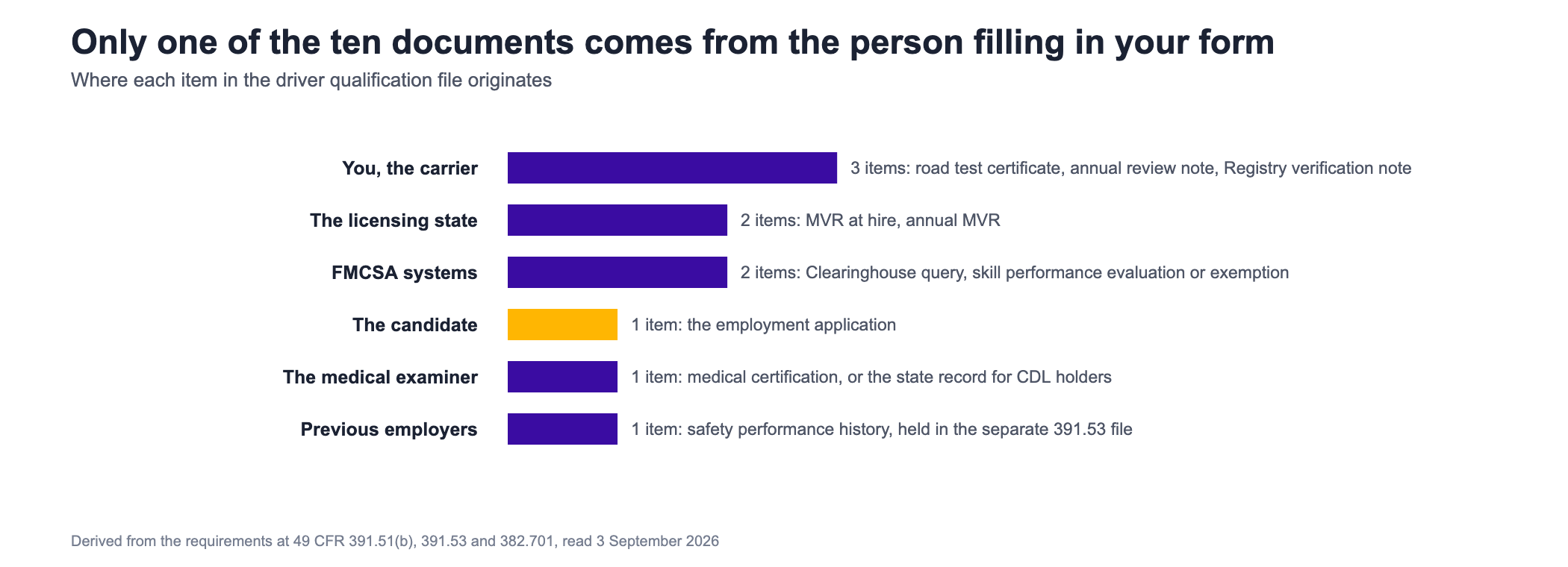
That matters because of what a driver advertisement can realistically collect. A social instant form can capture license class, endorsements held, the states the driver has been licensed in over three years, years of experience and consent to be contacted. It cannot capture a medical certificate, an MVR, a Clearinghouse result or a road test, and no amount of form-lengthening will change that, because those documents do not exist on the driver phone. Asking for them at the application stage does not accelerate the file. It just costs completions, in the role family that already has the lowest completion rate we measure: CDL campaigns run an 8 percent apply rate against a $26.86 median cost per applicant in our 2026 benchmark, against 31 percent for caregivers.
The sequence that works is the one our CDL recruiting page sets out: three questions on the form, a call within the hour, and the compliance sequence run after the conditional offer. The posting itself is on the CDL driver job description page, the testing rules that sit alongside the Clearinghouse are on drug testing laws by state, and what a screening check can and cannot legally return is on what is a background check.
File the pre-employment Clearinghouse query result with the driver's consent. Many carriers also pull a PSP report, which is optional and needs FMCSA's own consent form.
DOT physical requirements the file has to prove
The medical certificate or CDLIS record in the file proves one thing: that a medical examiner found the driver met the physical qualification standards in 49 CFR 391.41(b). The carrier does not apply the standards; it needs to know what they are, who may apply them, and which document comes out.
| Standard | What 391.41(b) says | Paragraph |
|---|---|---|
| Limbs | No loss of a foot, leg, hand or arm, and no impairment of a hand, finger, arm, foot or leg that interferes with operating a commercial motor vehicle, unless the driver holds a skill performance evaluation certificate under 391.49 | (b)(1), (b)(2) |
| Insulin-treated diabetes | No established medical history or clinical diagnosis of diabetes mellitus currently treated with insulin, unless the driver meets the requirements in 391.46 | (b)(3) |
| Heart, lungs and blood pressure | No current clinical diagnosis of cardiovascular disease of a kind known to be accompanied by syncope, dyspnea, collapse or congestive cardiac failure; no respiratory dysfunction or high blood pressure likely to interfere with driving safely | (b)(4) to (b)(6) |
| Musculoskeletal and vascular | No rheumatic, arthritic, orthopedic, muscular, neuromuscular or vascular disease that interferes with the ability to control and operate the vehicle safely | (b)(7) |
| Loss of consciousness | No established medical history or clinical diagnosis of epilepsy or any other condition likely to cause loss of consciousness or loss of ability to control the vehicle | (b)(8) |
| Mental health | No mental, nervous, organic or functional disease or psychiatric disorder likely to interfere with driving safely | (b)(9) |
| Vision | Distant visual acuity of at least 20/40 (Snellen) in each eye, with or without corrective lenses, and at least 20/40 in both eyes together; a field of vision of at least 70° in the horizontal meridian in each eye; and the ability to recognize the red, green and amber of traffic signals. A driver who misses the acuity or field standard in the worse eye may qualify under 391.44 | (b)(10) |
| Hearing | First perceives a forced whispered voice in the better ear at not less than 5 feet, or, tested with an audiometric device, an average hearing loss in the better ear of no more than 40 decibels at 500 Hz, 1,000 Hz and 2,000 Hz, with or without a hearing aid | (b)(11) |
| Drugs | Does not use a Schedule I drug, an amphetamine, a narcotic or another habit-forming drug. Other scheduled substances only when prescribed by a licensed medical practitioner who knows the driver’s medical history and has advised that it will not adversely affect safe driving | (b)(12) |
| Alcohol | No current clinical diagnosis of alcoholism | (b)(13) |
Who applies them is fixed too. Under 391.43(a) the examination must be performed by a medical examiner listed on the National Registry of Certified Medical Examiners. There are two narrow exceptions: a licensed ophthalmologist or optometrist may perform the vision part, and a certified VA medical examiner may examine only veteran operators. A card signed by anyone else does not qualify the driver.
Two forms come out of the exam, and only one concerns you. The examiner records the examination on the Medical Examination Report Form, MCSA-5875, and keeps it, with a copy of the certificate, for at least three years under 391.43(i). The certificate itself is Form MCSA-5876. For a non-CDL driver that certificate is what goes in the file. For a CDL or CLP holder the file holds the CDLIS motor vehicle record instead, and since 23 June 2025 the driver no longer has to carry the certificate at all (391.41(a)(2)(i)(B)). The check moved to you rather than disappearing, as the medical card table above sets out.
Frequently asked questions
What goes in a driver qualification file?
Section 391.51(b) lists eight items: the employment application, the motor vehicle record obtained at hire, a road test certificate or accepted equivalent, the annual motor vehicle record, a note of the annual review, the medical examiner certificate or for CDL holders the CDLIS record, any skill performance evaluation or medical exemption, and for non CDL drivers a National Registry verification note. The previous employer safety history is not in this file. It goes in a separate file under 391.53.
Entry-level driver training is another thing that does not belong in this file: it is completed before the state issues the license, and the record-keeping duty sits with the training provider. Our guide to entry-level driver training sets out when it applies and what changes if you run your own school.
How long do you keep a driver qualification file?
Under 391.51(c), for as long as the driver is employed by that carrier and for three years after. Five items may be pulled out earlier: under 391.51(d) the annual motor vehicle record, the annual review note, the medical certificate or CDLIS record, any medical variance or skill performance evaluation certificate, and the National Registry note may all be removed three years after the date of execution.
Is a DQF required for non CDL drivers?
Yes, if the vehicle is a commercial motor vehicle. Under 49 CFR 390.5 that includes any vehicle used in interstate commerce with a gross vehicle weight rating or gross combination weight rating of 10,001 pounds or more, whichever is greater, as well as certain passenger vehicles and placarded hazardous materials loads. Part 391 also sets a requirement specifically for drivers not required to have a CDL at 391.51(b)(8)(i), which would make no sense if the file were a CDL only obligation.
Can a driver qualification file be electronic?
Yes. Section 390.31 says that records required under this subchapter must be kept for the specified periods and that, except as otherwise provided, copies which are legible and accurately reflect the required information may be kept instead of originals. Watch the exceptions: 391.51(b)(3) calls for the original of the written statement in the vision alternative case at 391.44(d)(3)(ii)(A), and 391.53 requires the investigation file to be held in a secure location with controlled access.
Do I need a road test if the driver has a CDL?
Usually not. Section 391.33 lets a carrier accept a valid CDL in place of a road test, provided the state issued it after a road test in the type of vehicle you intend to assign. There is an express carve out: the CDL equivalence does not extend to double or triple trailer or tank vehicle endorsements. A road test certificate issued within the preceding three years also works, and 391.33(c) lets you require a road test anyway as a condition of employment.
Who can do the annual review of driving record?
The regulation does not name a job title. What 391.25(c)(2) requires is a note in the file including the name of the person who performed the review and the date it was done. Section 391.25(b) sets what the review has to consider: whether the driver meets minimum requirements for safe driving or is disqualified under 391.15, any evidence of violations of the federal safety or hazardous materials regulations, and the accident record, giving great weight to speeding, reckless driving and driving under the influence.
Is the PSP report part of the driver qualification file?
No. The Pre Employment Screening Program is a voluntary service that sells a driver crash and inspection history, and it appears nowhere in the list at 391.51(b). It is not the same thing as the safety performance history investigation, which is mandatory under 391.23(d) and (e), goes in the separate file under 391.53, and has to reach every Department of Transportation regulated employer of the previous three years within thirty days of the start date.
What are the penalties for an incomplete file?
Civil penalties for federal motor carrier safety violations are set under 49 CFR part 386 and are adjusted for inflation each year, so we are not going to quote a dollar figure we have not read at source today. The practical exposure is broader than the fine. Driver qualification records are a standard part of a compliance review, an unqualified driver on the road is a separate violation, and the investigation history file carries its own access controls whose breach is a problem in its own right.
What is Part 391 of the Federal Motor Carrier Safety Regulations?
49 CFR part 391 sets the minimum qualifications for anyone who drives a commercial motor vehicle for a motor carrier, and the carrier’s duties in checking them. Its subparts cover who may drive (at least 21, English proficiency, one valid license, not disqualified), the application and record checks, the road test, the medical standards and certificate, and the driver qualification file. Since 23 June 2025, 391.41(a)(2) no longer requires CDL and CLP holders to carry the medical examiner’s certificate.
How do you verify a driver's previous employment?
Start with the application: 391.21 requires every employer from the past 3 years, plus, for CDL drivers, CMV employers from the 7 years before that. Within 30 days of the start date, 391.23 requires you to investigate every employer that had the driver operating a CMV in the past 3 years, including employment verification and accidents. Previous employers must answer within 30 days, and you file replies or good-faith efforts under 391.53.
What are the DOT physical requirements for a truck driver?
49 CFR 391.41(b) sets thirteen physical qualification standards. They cover limbs, insulin-treated diabetes, heart and circulation, breathing, blood pressure, musculoskeletal disease, epilepsy or anything likely to cause loss of consciousness, psychiatric conditions, vision of at least 20/40 in each eye with a 70° field, hearing a forced whisper at 5 feet, drug use and alcoholism. A medical examiner on the National Registry applies them and issues the MCSA-5876 certificate, valid for no more than 24 months. The carrier verifies the certification; it does not run the exam.
The motor vehicle record side of the file is covered in more detail in our guide to MVR checks and the three clocks a carrier is running, and the testing program in DOT drug testing requirements.
Hiring drivers?
The file gets built after the offer, not on the application form. We put the ad where drivers actually are, keep the form to three questions, and tell you what each applicant cost.
Book a Demo