
How to Recruit CDL Drivers: A Seven-Step Playbook for a Driver Who Already Has a Job
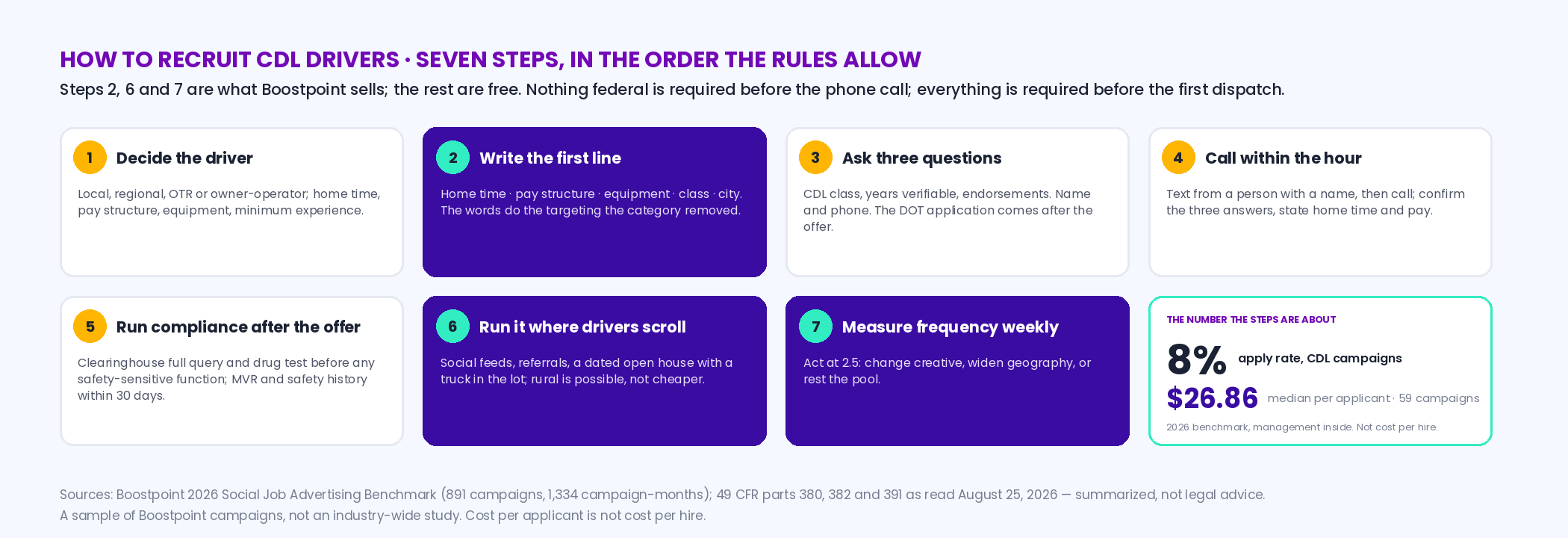
How to hire truck drivers in 2026 comes down to one number: in Boostpoint's 2026 Social Job Advertising Benchmark, CDL applicants ran a median $26.86 with an 8% apply rate, and the steps below are about that 8%. CDL recruiting is not a shortage problem any more, if it ever was: in ATRI's 2025 survey the driver shortage fell out of the top ten industry issues for the first time in 21 years, while driver compensation ranked fifth. The driver you want is driving for someone else, and recruiting him means a first line that names home time, pay structure and equipment; a form that asks three questions; a phone call within the hour; and the compliance sequence — Clearinghouse, MVR, safety history, medical card — run after the offer, not before the tap.
Source: Boostpoint 2026 Social Job Advertising Benchmark — 891 Boostpoint-managed campaigns on Meta (1,334 campaign-months), 2026; costs are what advertisers paid for advertising only.
A note on who's writing this
Boostpoint runs social media job ads for fleets, co-ops and agribusinesses that hire CDL drivers — CHS, Insight FS and Mid Kansas Co-Op among them — so the steps that involve advertising describe what we sell. The other steps don't: the form, the callback, the compliance sequence and the referral program cost nothing to run and are where most CDL recruiting is won or lost. The four trucking pages already on this site cover what CDL applicants cost by channel, what driver turnover costs, what job boards and agencies charge; this one is the sequence, and links to them where the numbers live. Federal rules are summarized from the CFR as read today and are not legal advice — your safety director owns the driver qualification file. We publish cost per applicant, never cost per hire.
The market, in the numbers that change the plan
BLS counts 2,235,100 heavy and tractor-trailer truck drivers (2024), growing 4% to 2034, with about 237,600 openings a year — nearly all of them replacements — at a median $57,440 a year or $27.62 an hour (May 2024); truck transportation pays a median $59,570, wholesale $57,260, manufacturing $54,860, construction $54,170. The median driver is 57. ATRI's 2025 Top Industry Issues survey of more than 4,200 industry stakeholders ranked the economy first, lawsuit abuse reform second, insurance third, truck parking fourth and driver compensation fifth; the driver shortage, ninth in 2024, "fell out of the top 10 for the first time in the survey's 21-year history" and settled at twelfth, though motor carriers still ranked finding and retaining qualified drivers as their fifth and sixth concerns. Read together: the pool is large, old, and employed. A driver who applies to you is leaving someone, and he applies on a phone in a truck stop, which is why the ad, the form and the callback matter more in trucking than in any role we measure — CDL campaigns ran an 8% apply rate in the benchmark, against 31% for caregivers. Our earlier campaign-level analysis found the same pool responding for free: 64.6% of CDL applicants were 55 or older and the cheapest to acquire, with no age targeting possible or used.
If you would rather buy the recruiting than run it, the choice is not really a vendor choice: it is a choice between four business models with different compliance consequences, which driver recruiting agencies works through in detail.
Step 1 — Decide which driver, before the ad
"CDL driver" is four jobs. Local drivers are home every night and read the ad for the shift and the equipment; regional drivers read it for the home-time pattern; over-the-road drivers read it for pay per mile, miles per week and the truck; owner-operators read it for the rate and the fuel program. A fleet that writes one ad for all four gets the applicants it deserves. Decide the lane, the home-time promise in a sentence a dispatcher would sign, the pay structure (hourly, per mile, percentage, salary — with the range the pay-transparency states require in postings), the equipment by model year, and the minimum experience the insurer requires. Those five decisions are the ad; everything else is the CDL driver job description. Tank work adds the N endorsement and liquid surge to that list; see how to recruit tanker drivers.
One supply route worth naming separately: military motor transport operators leave service with heavy-vehicle experience and often a route to the license. Our hiring veterans page covers the three federal programs, what each actually asks of an employer, and the fact that you cannot target an ad at veterans at all.
Two driver types read the opposite of what this ad says: owner-operators read the rate per mile first, and CDL grads read whether experience is required at all. Owner operator and CDL grad recruiting covers the two ends this playbook deliberately leaves in the middle.
Step 2 — The first line does the targeting
An employment ad on Meta runs in the Special Ad Category: no age, gender or ZIP targeting, no lookalike audiences, location no finer than a city with a 15-mile expanded radius — the policy is on Meta Special Ad Category, explained. So the words select the driver. "Class A · home daily · $[low]–$[high]/hr · 2024 Freightliners · [City]" is read by local drivers and skipped by OTR drivers; "Regional · home every weekend · $[X]/mile + [X] miles/week" is the reverse. The three things a driver compares are home time, pay structure and equipment, in that order, and an ad that leads with "Now hiring CDL-A drivers — great benefits!" has told him none of them. Everything else the ad needs — sign-on bonus only if it pays on a stated schedule, "no touch freight" only if true, the dispatcher's name — is detail; the first line is the decision. The channel arithmetic behind running it is on CDL driver recruiting costs and channels.
Step 3 — The form asks three questions
This is the step that moves the number. CDL campaigns converted 8% of clicks to applicants in the benchmark, and the reason is almost always the form: a driver in a sleeper berth at 9 p.m. will not complete a DOT application on a phone. The DOT application is required — 49 CFR 391.21 — but it is required before he drives, not before you call him. The ad's form asks three things: CDL class (A or B), years of verifiable experience, and endorsements (tanker, hazmat, doubles/triples). Name and phone, submit. Everything else waits for the offer. In our earlier campaign-level analysis, click-to-apply on trucking campaigns ran 16.8% where the form was short; the 8% benchmark figure is what the mix of short and long forms produced. If the endorsement you need is hazmat, how to recruit hazmat drivers covers the TSA threat assessment timeline.
Interactive
Pre-screen builder — the first line and the three form questions for the driver you decided on
Nothing is stored or sent — this runs in your browser. Pick the lane, class, minimum experience and endorsements; the builder writes the first line, the three knockout questions and the order of what comes after the offer.
Boostpoint practice, assembled from your choices; bracketed figures are yours. Federal steps are summarized from 49 CFR parts 382 and 391 as read August 25, 2026 and are not legal advice; your state and insurer may require more. Where a pay-transparency law applies, the range in the first line must be the range you pay. No cost is computed.
Step 4 — Call within the hour
A driver applies to several fleets from the same truck stop, and the first recruiter to reach him gets the conversation. Text first, from a person with a name, then call; ask the three questions again in his words; give him the home-time promise and the pay structure without being asked; and tell him exactly what happens next and when. A fleet that can't staff a callback within the hour during the hours drivers apply — evenings, weekends — should not be running ads at those hours, or should be running them into a recruiter's phone rather than an inbox. This step costs nothing and is where most of the 8% is lost after the form. The compliance sequence that follows the offer, item by item with the regulation attached, is on our driver qualification file checklist.
If you are recruiting drivers new to the license, entry-level driver training explains what they have already been through and the 2026 rules that reshaped the pool. For box, dump and bus work on a Class B license, see how to recruit CDL-B drivers.
Step 5 — The compliance sequence, after the offer
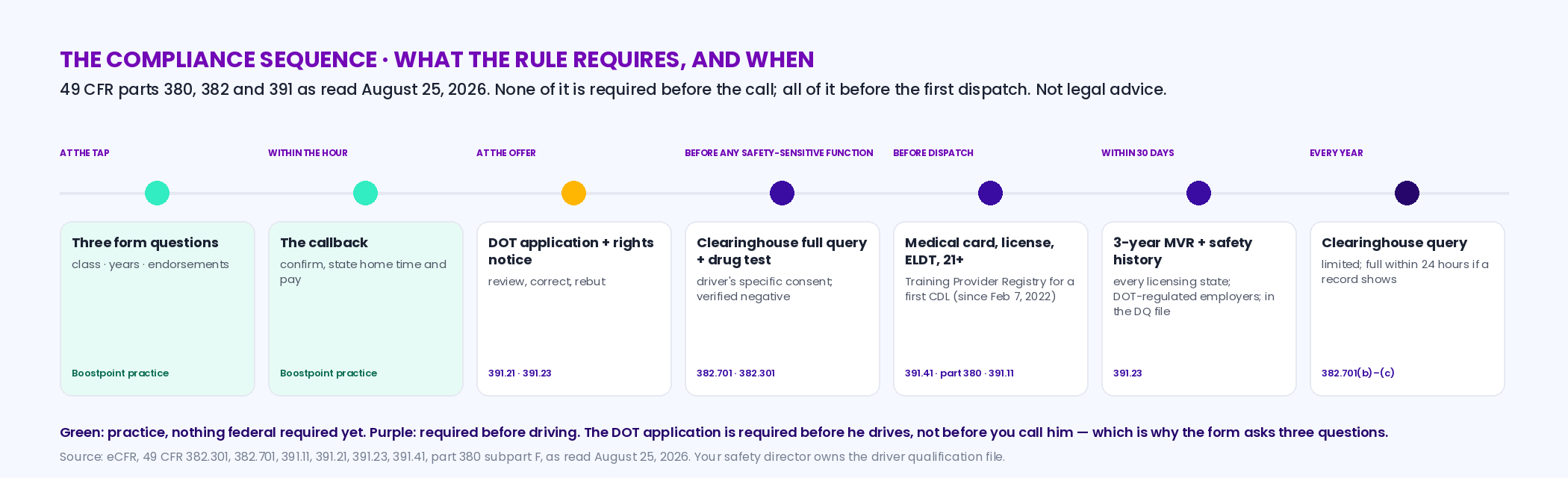
Federal rules decide the order, and the order protects the funnel: none of these steps has to come before the phone call, and every one of them has to come before the first dispatch. Before the driver performs any safety-sensitive function, the employer must run a full Drug and Alcohol Clearinghouse query with the driver's specific electronic consent (49 CFR 382.701) and a pre-employment controlled-substances test (382.301), and hold the driver's medical examiner's certificate and a completed DOT application. Within 30 days of the start of employment, the carrier must obtain the motor vehicle record from every state that licensed the driver in the preceding three years and complete an investigation of his safety performance history with DOT-regulated employers over the same three years, both filed in the driver qualification file (391.23) — after giving the driver written notice of his rights to review, correct and rebut what previous employers report. Interstate drivers must be 21 (391.11). A driver getting his first Class A or B CDL must have completed entry-level driver training from a provider on FMCSA's Training Provider Registry, a requirement since February 7, 2022. And once hired, every covered driver gets a Clearinghouse query at least once a year; a limited query that shows a record must be followed by a full query within 24 hours.
| Step | When | What | Rule |
|---|---|---|---|
| Three-question form | At the tap | CDL class, years of verifiable experience, endorsements; name and phone | Boostpoint practice — nothing federal is required at this point |
| Callback | Within the hour | Confirm the three answers, state home time and pay structure, set the next step | Practice |
| DOT application and rights notice | At the offer | Completed employment application; written notice of the driver's rights to review, correct and rebut previous-employer information | 49 CFR 391.21; 391.23 |
| Clearinghouse full query | Before any safety-sensitive function | Full query with the driver's specific consent; no query, no driving | 49 CFR 382.701(a) |
| Pre-employment drug test | Before any safety-sensitive function | Verified negative controlled-substances result | 49 CFR 382.301 |
| Medical certificate, license, ELDT | Before dispatch | Current medical examiner's certificate; CDL of the right class with the endorsements; ELDT from the Training Provider Registry for a first Class A or B CDL (since Feb 7, 2022); 21 for interstate | 49 CFR 391.41–.45; part 380 subpart F; 391.11(b)(1) |
| MVR and safety performance history | Within 30 days of starting | MVR from every licensing state, preceding 3 years; safety performance history from DOT-regulated employers, preceding 3 years; both in the DQ file | 49 CFR 391.23 |
| Annual Clearinghouse query | At least once a year | Limited query; if it shows a record, a full query within 24 hours | 49 CFR 382.701(b)–(c) |
Step 6 — Run the ad where drivers scroll, rural included
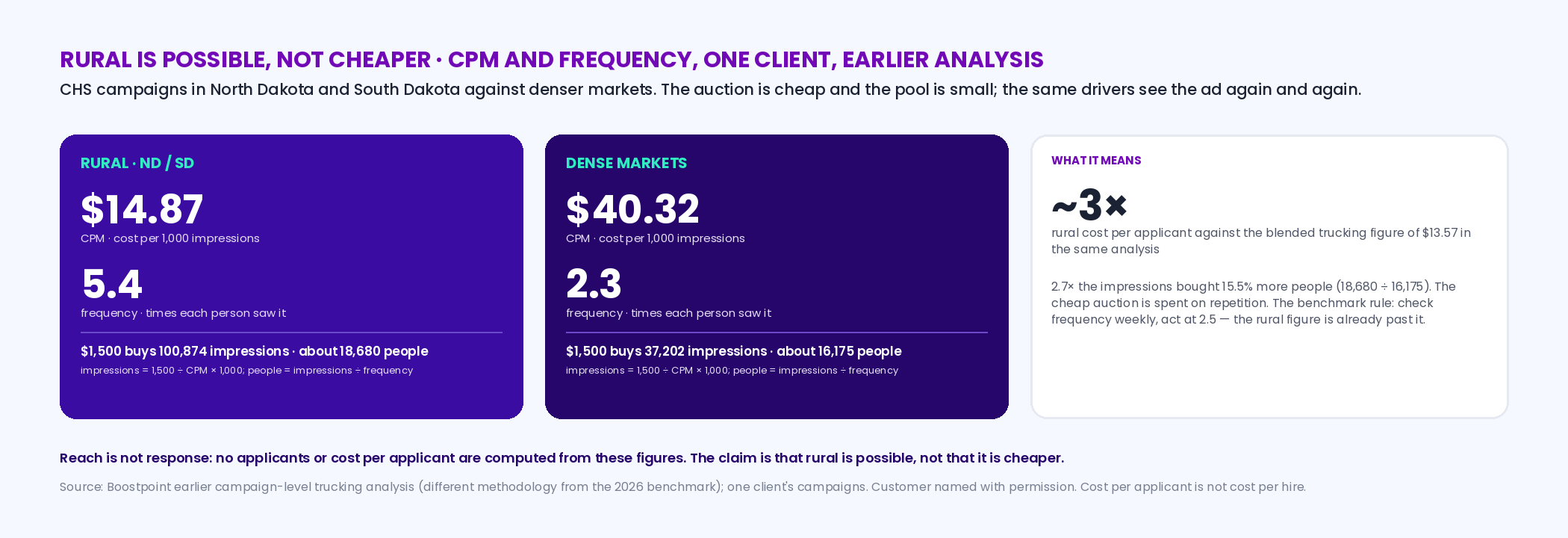
Drivers are on their phones at the dock, at the fuel island, in the sleeper — which is where a social feed reaches them and a job board waits for them; the case against waiting is on trucking and CDL job boards. Two findings from our data shape where to run. First, rural works, at a price: in the earlier campaign-level analysis, CHS's campaigns in North Dakota and South Dakota cost about three times our blended trucking figure per applicant, but the auction was cheaper — a CPM of $14.87 against $40.32 in denser markets — and the same people were reached over and over, a frequency of 5.4 against 2.3. The claim is that rural is possible, not that it is cheaper; the pool is small and the ad exhausts it. Second, a dated event converts drivers who won't fill out anything: an open house with a truck in the lot, a recruiter with a Clearinghouse tablet and a same-day conditional offer is the event-driven structure that ran at a median $8.02 per applicant across 78 campaigns in the benchmark, mechanics on open house hiring events. Co-ops recruiting CDL drivers found the same — agriculture CDL campaigns ran $21.13 per applicant across four co-ops in that analysis, the most expensive role in the co-op and still the one the open house filled; the co-op picture is on agriculture recruiting. And the cheapest channel is the one that isn't an ad: a referral bonus paid to drivers for drivers, at a rate you set, paid on the ninety-day mark, in an industry where every driver knows ten. Log hauling is the rural case at its sharpest; see how to recruit log truck drivers.
Interactive
Rural reach planner — what one budget buys in impressions and people at the rural and dense-market figures we measured
Nothing is stored or sent — this runs in your browser. Enter a monthly budget; the CPMs and frequencies are CHS's North Dakota / South Dakota campaigns against denser markets in our earlier analysis, and you can overwrite them with your own.
Arithmetic on your inputs: impressions = budget ÷ CPM × 1,000; people = impressions ÷ frequency. The measured figures are from one client's campaigns in one earlier analysis (different methodology from the 2026 benchmark) and are not a forecast; applicants and cost per applicant are not computed, because reach is not response. The operating rule from the benchmark: check frequency weekly and act when a campaign passes 2.5 — the rural figure is already past it. Cost per applicant is not cost per hire.
Step 7 — Measure the one number that predicts the rest
Frequency. In the benchmark, campaigns under 1.5 monthly frequency ran a median $7.85 per applicant and campaigns over 4.0 ran $26.78, with click-through falling from 1.69% to 0.94% across the range; a third of all budget ran above 3.0. For a CDL campaign in a market with a few hundred qualified drivers, frequency climbs fast — the rural figure above was 5.4 — and the rule is to check it weekly and act at 2.5: change the creative, widen the geography, or pause and let the pool rest. Cost per applicant by role, the CDL row included ($26.86 median, middle 50% $17.00–$42.31, 59 campaigns), is on the benchmark; what a driver who leaves in ninety days costs, and how the sourcing caused it, is on truck driver turnover; and the case for and against paying an agency instead of running the steps yourself is on truck driver recruiting agency cost. What the steps don't measure is a hire: we count applicants, and the applicants-per-hire ratio is yours.
The driver you want is already driving. Name the home time, ask three questions, call within the hour — and let the federal paperwork come after the offer, where the rule puts it.
Frequently asked questions
How do you recruit CDL drivers?
Decide which driver — local, regional, OTR or owner-operator — and lead the ad with home time, pay structure and equipment. Put a three-question form behind it (CDL class, years, endorsements), call within the hour, and run the compliance sequence — Clearinghouse, drug test, medical card, MVR and safety history — after the offer. Run the ad where drivers scroll, pay drivers to refer drivers, and watch frequency weekly.
Where do you find CDL drivers?
Driving for someone else. BLS counts 2,235,100 heavy and tractor-trailer drivers with about 237,600 openings a year, nearly all replacements, and a median age of 57. They are reached on their phones — social feeds, texts from a recruiter, referrals from drivers they know — and at dated events with a truck in the lot; job boards wait for the small share actively searching.
Is there still a truck driver shortage?
Not in the industry's own ranking: ATRI's 2025 Top Industry Issues survey of more than 4,200 stakeholders put the driver shortage at twelfth, out of the top ten for the first time in the survey's 21-year history, after ninth in 2024. Driver compensation ranked fifth, and carriers still ranked finding and retaining qualified drivers as their fifth and sixth concerns. Recruiting a driver means recruiting him from another fleet.
What should a CDL driver ad say first?
Home time, pay structure and equipment, in that order, with the class and the city: "Class A · home daily · $[low]–$[high]/hr · 2024 Freightliners · [City]." Meta's Special Ad Category removes age, gender and ZIP targeting from employment ads, so the first line is the targeting. Sign-on bonuses only if they pay on a stated schedule; "no touch freight" only if true.
What does a CDL driver applicant cost?
In our 2026 benchmark, a median $26.86 per applicant (middle 50% $17.00–$42.31, 8% apply rate, 59 campaigns), campaign; an earlier campaign-level analysis put trucking at a blended $13.57 with a typical range of $8–$24, and rural campaigns at about three times the blended figure. Cost per applicant is not cost per hire; we do not track hires.
What background checks are required to hire a CDL driver?
Before any safety-sensitive function: a full Drug and Alcohol Clearinghouse query with the driver's consent (49 CFR 382.701) and a pre-employment drug test (382.301), plus a current medical certificate and the right license class. Within 30 days of starting: a three-year MVR from every licensing state and a three-year safety performance history from DOT-regulated employers, filed in the driver qualification file (391.23). Then a Clearinghouse query at least yearly. Not legal advice.
How do you hire CDL drivers fast?
Shorten what happens before the offer, not what happens after it. A three-question form instead of a DOT application at the tap, a text and a call within the hour, a conditional offer on the call, and a dated open house with a Clearinghouse tablet and a same-day offer — the event-driven structure ran a median $8.02 per applicant in our benchmark. The federal sequence then runs in parallel with the notice period he gives his current fleet.
Can you recruit CDL drivers in rural areas?
Yes, at a price. CHS's North Dakota and South Dakota campaigns in our earlier analysis cost about three times our blended trucking figure per applicant, though the auction was cheaper (CPM $14.87 against $40.32) and frequency ran 5.4 against 2.3 — the pool is small and the ad exhausts it. Rural is possible, not cheaper; watch frequency and widen the geography when it climbs.
How do small trucking companies recruit new drivers?
Mostly through the drivers they already have, then through a local ad. Pay referral bonuses once the new driver has stayed, not for a name, and run an ad that names the lane, home time and pay in the first line with a three-question form behind it. If you fill one seat a quarter, a referral and a free job board post may be enough. If you replace drivers every month, budget ads against the $26.86 median CDL cost per applicant in Boostpoint's 2026 Social Job Advertising Benchmark.
How do I recruit local truck drivers?
Sell home time and hourly pay, and advertise around the terminal. Local drivers read an ad for home daily, the start time, the hourly rate and the equipment, so put those in the first line, for example "Class A · home daily · $[low]–$[high]/hr · [City]". Employment ads on Meta can’t target ZIP codes, and a city or address target always includes at least a 15-mile radius, so the wording, not the targeting, filters out OTR drivers. Ask three questions, then call within the hour.
What are some truck driver recruiting ideas that actually work?
Seven that cost little and move the numbers: write one ad per lane (local, regional, OTR) instead of one ad for every driver; put home time, pay structure and equipment in the first line; cut the form to CDL class, years of experience and endorsements; text and call within the hour, evenings and weekends included; hold a dated open house with a truck in the lot and a same-day conditional offer; pay drivers a referral bonus once the new driver has stayed; and check ad frequency weekly, refreshing the creative or widening the area when it passes 2.5. Our driver qualification file checklist covers what follows the offer.
What is the best way to recruit truck drivers?
Reach drivers who already have a job, because most of the pool does, and make it easy for them to say yes from a phone. That means an ad in the feeds they scroll that leads with home time, pay and equipment, a three-question form rather than a DOT application at the tap, and a recruiter who calls within the hour. Referrals from your own drivers are the cheapest source alongside it. In Boostpoint's 2026 Social Job Advertising Benchmark, CDL truck driver campaigns ran a median $26.86 per applicant with an 8% apply rate, so the form and the callback are where most of the gains are.
What is the truck driver hiring process?
Two halves: a fast recruiting half and a federal compliance half. Recruiting: decide the lane, lead the ad with home time, pay structure and equipment, ask three questions on the form (CDL class, years of verifiable experience, endorsements), and call within the hour. Compliance, after the conditional offer: the DOT employment application (49 CFR 391.21), a full Drug and Alcohol Clearinghouse query with the driver's specific consent (382.701), a pre-employment drug test with a verified negative result (382.301) and a current medical certificate before any safety-sensitive work, then the three-year motor vehicle record and safety performance history within 30 days of the start date (391.23). The driver qualification file checklist lists every document. Not legal advice.
How long does it take to hire a truck driver?
There is no single figure worth quoting; the time depends on steps you control and a few you wait on. Federal rules set the order, not a waiting period: the Clearinghouse query and a verified negative drug test must come before the driver's first safety-sensitive function (49 CFR 382.701 and 382.301), while the motor vehicle record and safety performance history may be completed within 30 days of the start date (49 CFR 391.23). So the clock is mostly set by how fast you call back and make a conditional offer, how quickly the drug test is collected and the result verified, when the medical exam is booked, the notice the driver gives his current fleet, and your orientation schedule. Starting the query and the test on the day of the offer is the biggest single time saver.
Before a driver reaches the road, two compliance clocks decide whether the hire stands: MVR checks and DOT drug testing requirements. Both are worth saying plainly in the ad rather than discovering at the collection site.
Run the seven steps with us on the ad
We'll write the first line for the driver you decided on, put the three-question form behind it, run it where drivers scroll — rural included — and show you the trucking and co-op campaigns closest to yours.
Book a DemoBoostpoint figures come from the 2026 Social Job Advertising Benchmark — 891 campaigns and 1,334 campaign-months: CDL truck driver median cost per applicant $26.86, middle 50% $17.00–$42.31, 8% apply rate, 59 campaigns; caregiver 31% apply; event-driven structure $8.02, 78 campaigns; frequency bands $7.85 under 1.5 to $26.78 over 4.0, CTR 1.69% to 0.94%, 33% of budget above 3.0. Earlier campaign-level analysis (different methodology): trucking blended $13.57, typical range $8–$24, median $12.94, 64.6% of applicants aged 55+, click-to-apply 16.8%; CHS ND/SD about 3× blended with CPM $14.87 vs $40.32 and frequency 5.4 vs 2.3; agriculture CDL driver $21.13 (140 campaigns, four co-ops). No seasonality claim is made for CDL roles; our data does not support one. Third-party figures — BLS Occupational Outlook Handbook (May 2024 wages, 2024–34 projections), ATRI 2025 Top Industry Issues (October 2025), 49 CFR parts 380, 382 and 391 as read August 25, 2026 — are theirs and attributed in place; regulatory notes are summaries, not legal advice. Customers are named with permission; the steps and builders are Boostpoint's practice, not measured results. Cost per applicant is not cost per hire; we do not track hires and publish no cost-per-hire figure. A sample of Boostpoint campaigns, not an industry-wide study.