
Driver Recruiting Agencies: Four Different Businesses Sharing One Name
We read seven driver recruiting agencies' own websites on August 29, 2026. Six publish no price at all. But price is the second question. The phrase "driver recruiting agency" is worn by four genuinely different businesses — driver staffing, contingency placement, recruiting-as-a-service, and lead generation — and they differ most in something no rate card shows: who employs the driver, and who has to hold the driver qualification file that 49 CFR 391.51 requires. Decide the model first. The invoice follows from it.
A note on who's writing this
Boostpoint is not a driver recruiting agency, and this page would read differently if it were. We build recruitment advertising software that carriers and private fleets use to run their own driver campaigns. So we have an interest in you keeping recruiting in-house, and you should read what follows knowing that.
What we are not going to do is pretend the category has no use. A fleet with two trucks and no HR function, a lane that has to be covered on Monday, a heavy-haul seat that needs a specific endorsement — those are real problems and an agency solves them faster than a campaign does. The useful thing we can add is not an opinion about whether to use one. It is a clear description of what you are actually buying under each model, because the four are priced differently, carry different compliance exposure, and are sold under the same three words.
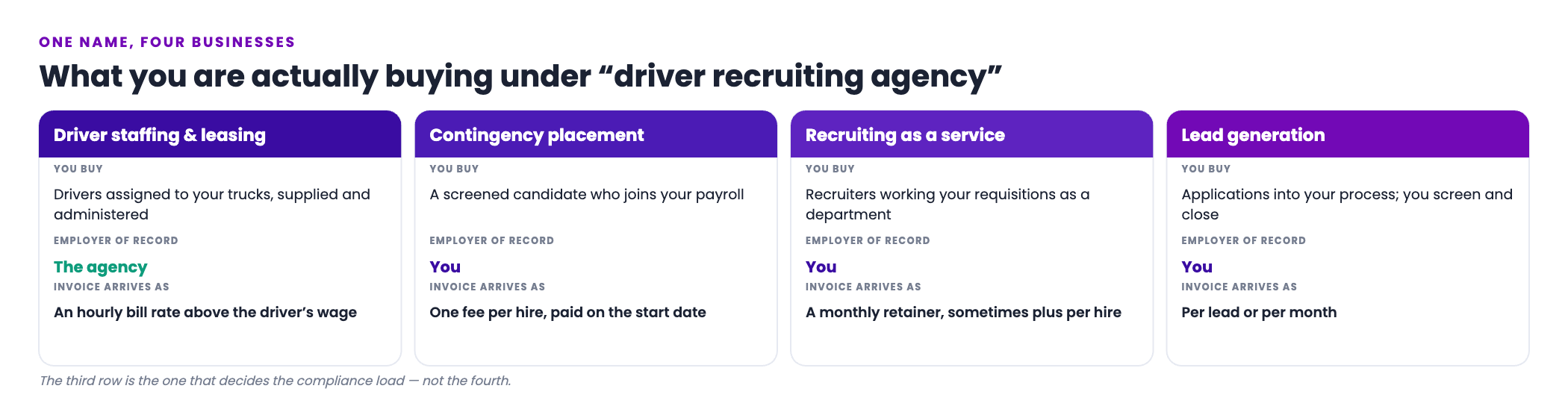
Four businesses, one name
TransForce is a good illustration of the problem, because it sells all four from one homepage: driver outsourcing ("outsource your driver workforce to a full-service partner"), driver staffing ("lease CDL drivers for short-term, long-term and temp-to-perm assignments"), driver recruitment ("expand your recruitment capabilities by tapping into our tenured staff") and driver marketing ("feed your recruiting team with qualified high-value leads from our proprietary platform"). Four products, four billing shapes, one word on the tin.
| Model | What you are buying | Who employs the driver | Billing shape |
|---|---|---|---|
| Driver staffing / leasing | Drivers assigned to your trucks and routes, supplied and administered by the agency | The agency | Hourly bill rate above the driver's wage, ongoing |
| Contingency placement | A candidate presented, screened, and hired onto your payroll | You | One fee per hire, paid on start |
| Recruiting as a service (RPO) | Recruiters who work your requisitions as if they were your department | You | Monthly retainer, or per-hire, or both |
| Lead generation / driver marketing | Applications delivered into your process; you screen, call and close | You | Per lead, per month, or per hire |
The distinction that matters most on that table is the third column, not the fourth. Everything downstream — payroll taxes, workers' compensation, the DOT file, who is liable when an MVR comes back wrong — hangs on whether the driver is your employee or the agency's. Three of the models leave that with you, and one of those three, lead generation, does not touch employment at all. One moves it.
Interactive
Which model fits what you're actually trying to do
Four questions about the situation, not the budget. The answer is a model and the question to ask a vendor first — not a price, because six of seven do not publish one.
What the category actually publishes
We opened seven agency websites on August 29, 2026 and looked for a number — any number a buyer could plan against. Here is the whole harvest. Rig on Wheels returned a 503 error on both attempts and is left out rather than guessed at.
| Agency | Model as described | Price published | What they publish instead |
|---|---|---|---|
| TransForce | All four: outsourcing, staffing, recruitment, marketing | No | "2.5K+" drivers dispatched daily, "3K+" carrier customers, "2,500+" veterans graduated annually |
| Centerline Drivers | Driver management, mobile drivers, flexible drivers | No | "45+ years of experience"; "only the most qualified candidates are presented to you" |
| Platinum Drivers | Direct hire, temp-to-perm, temporary | No | Ten named cities plus "all areas of the United States"; DOT compliance named as a benefit |
| DriverSource | Six models including leasing, contingent-to-hire and DRPO | No | "Act as your recruiting, accounting, safety and operations departments"; 24/7 supply |
| Class A Recruiting | Full-cycle recruiting, RPO-adjacent | No | "Over 150 years of combined experience"; can "replace entire driver recruiting departments" |
| Spec on the Job | Temporary, temp-to-hire, permanent, plus payroll administration | No | A quote request button |
| Leadgamp | End-to-end CDL staffing | Yes | Four monthly tiers, a pay-per-hire floor, and cost-per-candidate figures from its own case studies |
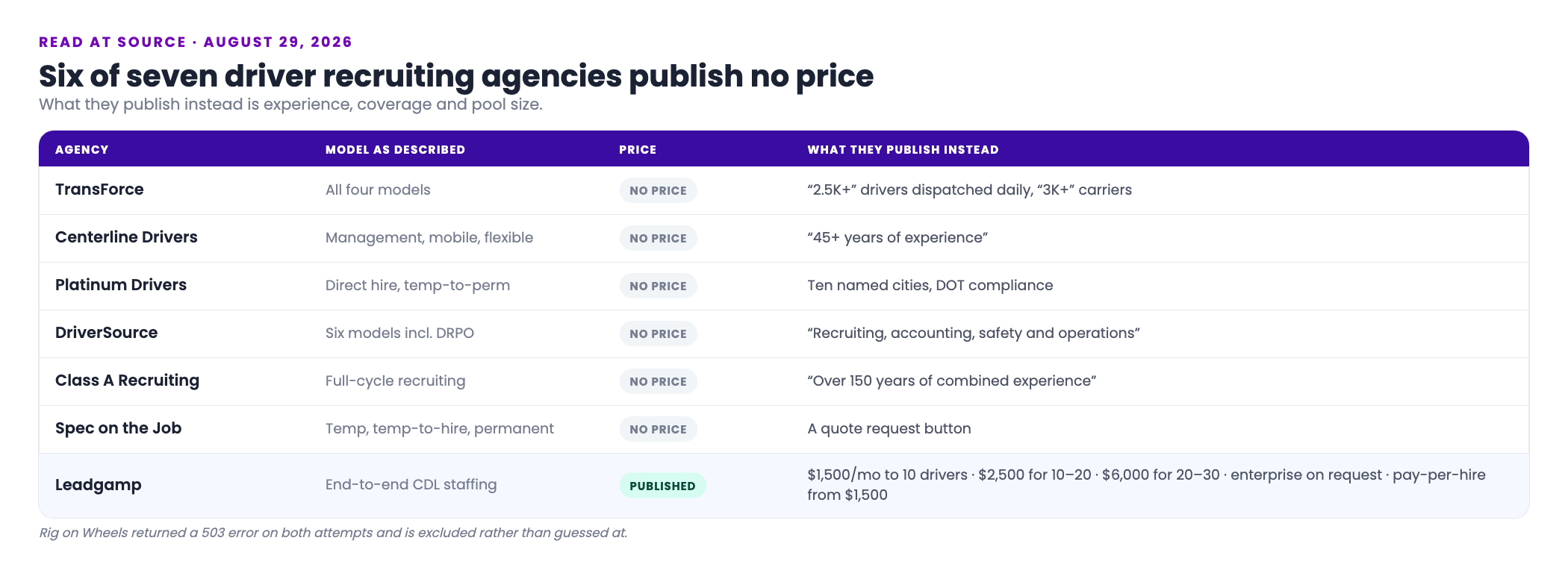
Not publishing a price is not a scandal. Bill rates genuinely vary by lane, endorsement, market and volume, and a fleet's quote will differ from yours. It does mean, though, that you cannot compare six of these seven vendors before a sales call — and that the one number you are given will arrive with no public anchor to check it against.
The one rate card in the category, read closely
Leadgamp publishes four monthly tiers: $1,500 a month for one to ten drivers a month, $2,500 for ten to twenty, $6,000 for twenty to thirty, and enterprise pricing on request above thirty. It also publishes a pay-per-hire alternative "from $1,500 per hire," and candidate-volume claims against each tier — "150+ per month" at Essential up to "10 000+ per month" at Enterprise.
The interesting part is elsewhere on the same site. Its case studies quote average cost per qualified candidate of $8.75, $25, $26 and $30. Those are the vendor's own figures for its own work, and they land in the same neighborhood as what carriers pay to generate applicants themselves: across 59 Boostpoint-managed CDL truck driver campaigns in the Boostpoint 2026 Social Job Advertising Benchmark, the median cost per applicant was $26.86, with the middle half of campaigns between $17.00 and $42.31.
Two honest caveats before anyone draws a conclusion from that comparison. First, "cost per qualified candidate" and "cost per applicant" are not the same metric — a qualified candidate has passed a screen that an applicant has not, so Leadgamp's figures are doing more work per dollar than ours are. Second, and this is the one carriers get wrong most often, neither number is a cost per hire. A cost per hire only exists once you divide by your own screening and MVR qualification rate, and that rate lives in your systems, not ours or theirs.
Who employs the driver, and who holds the file
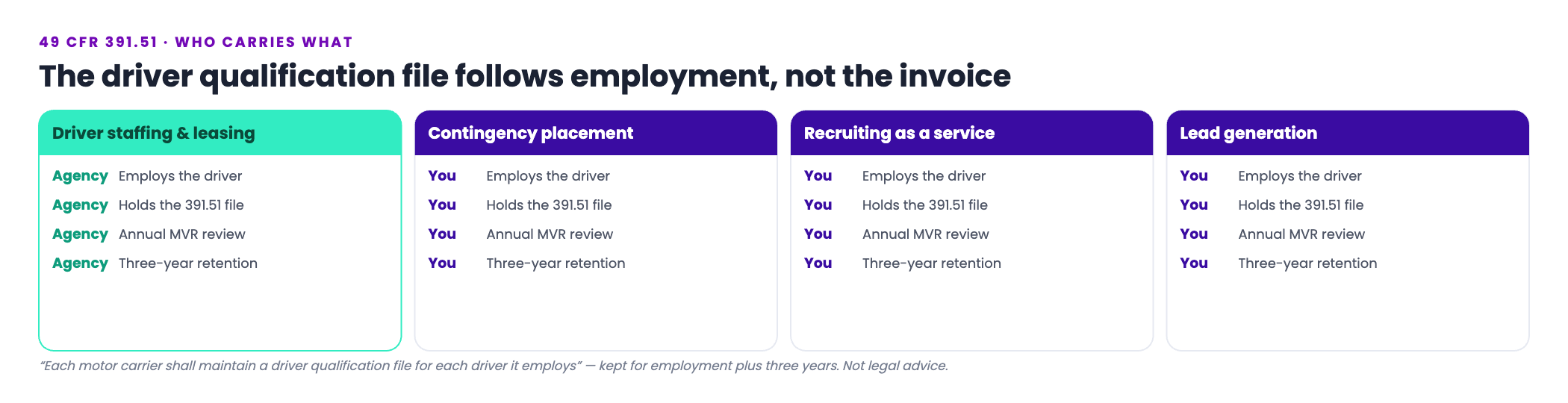
This is the part of the decision that no rate card covers and that the models genuinely differ on. Under 49 CFR 391.51(a), "each motor carrier shall maintain a driver qualification file for each driver it employs." Paragraph (b) sets out what has to be in it — the employment application, the motor vehicle record from the licensing authority, the road test certificate or its equivalent, the annual MVR inquiry and the note documenting the annual review of it, the medical examiner's certificate or CDLIS record for CDL holders, any Skill Performance Evaluation certificate, and a note verifying the medical examiner's listing on the National Registry. Paragraph (c) requires the file to be kept for as long as the driver is employed and for three years after.
Read the words "each driver it employs" against the third column of the table above and the consequence is immediate. Under contingency placement, RPO and lead generation, the driver is yours, so the file is yours — the agency may collect the documents, but the obligation does not travel with them. Under a staffing or leasing arrangement, the agency is the employer of record and holds the file for the drivers it employs. That is a real transfer of administrative load, and it is the substantive thing a bill rate is buying that a placement fee is not.
Interactive
Who carries what, by model
Pick a model and read down the column before you sign. Nothing here is legal advice — it is 49 CFR 391.51 laid against the four billing arrangements so you know which questions to put in the contract.
What to get in writing before you sign
Because six of seven publish nothing, the first quote you receive is also your only reference point. These are the questions that turn a quote into something comparable, and they work on any of the four models.
- Which of the four models is this, in the vendor's own words? Ask them to name it. A proposal that describes staffing and bills like placement is the single most common source of surprise.
- Who is the employer of record for each driver? Get the answer in the agreement, not the sales call.
- Who maintains the driver qualification file, and what happens to it if we part ways? Retention runs three years past employment; that outlives most contracts.
- What is the unit — an hour, a hire, a month, or a lead? And what specifically counts as that unit being delivered.
- What happens if the driver leaves in thirty, sixty or ninety days? Ask for the guarantee in days and in dollars, and whether it is a refund or a replacement.
- What is the conversion fee if we want to hire a leased driver onto our own payroll? On temp-to-hire this is often the largest number in the arrangement and the last one quoted.
- What of our data do we keep? Applicant records, source tags and contact history should come back to you, whoever generated them.
Six of seven agencies publish no price. All seven publish a promise. The model, the employer of record and the file are checkable before you spend anything — start there, and the quote becomes a detail instead of the whole decision.
When an agency earns it, and when it doesn't
An agency is the right answer when the need is a seat rather than a system: an urgent lane, a specialized endorsement, a short surge, or a fleet with genuinely nobody to own recruiting. It is also the right answer when you want the employment relationship off your books entirely and are willing to pay an ongoing bill rate for that, which is a legitimate trade rather than a defeat.
It stops earning it at the point where you are buying the same seat repeatedly. A model that charges per hire has no incentive to reduce how often you hire, and trucking's replacement rates make that a structural problem rather than a moral one. The Bureau of Labor Statistics counts 2,221,200 heavy and tractor-trailer truck driver jobs with about 214,500 openings projected each year against 4% growth from 2025 to 2035 and a median wage of $58,640 (May 2025 data, page modified August 27, 2026) — most of that churn is replacement, not expansion. If your own replacement rate is steady and forecastable, that is exactly the condition under which building a pipeline beats renting one.
Where this page stops and others start
This page is about choosing a model and a vendor. It deliberately publishes no fee ranges, because truck driver recruiting agency costs already carries the placement fees, hourly markups, conversion fees and the turnover arithmetic in detail, and two pages quoting the same numbers differently is worse than one page quoting them once. If you are comparing the software rather than the agencies — DQ systems, recruiting CRMs, lead vendors and advertising — that is driver recruiting software. If you want the seven-step version of running driver recruiting yourself, that is how to recruit CDL drivers. If you want where drivers are found rather than who finds them, trucking and CDL job boards covers the channels, and driver turnover costs and retention covers why the seat opens again.
Frequently asked questions
What is a driver recruiting agency?
It is not one thing. The phrase covers four different businesses: driver staffing or leasing, where the agency employs the driver and bills you an hourly rate above their wage; contingency placement, where you hire the driver and pay a fee per start; recruiting as a service, where the agency's recruiters work your requisitions for a retainer; and lead generation or driver marketing, where you buy applications and do the screening and closing yourself. Several vendors sell more than one of these from the same page, so the first question to ask is which one a proposal describes.
Do driver recruiting agencies publish their prices?
Almost none do. Of seven agency websites read at source on August 29, 2026, six published no price of any kind — TransForce, Centerline Drivers, Platinum Drivers, DriverSource, Class A Recruiting and Spec on the Job. One, Leadgamp, publishes a full rate card. What the other six publish instead is experience, coverage and pool size: years in business, cities served, drivers dispatched daily.
Who holds the driver qualification file when I use an agency?
It follows employment, not the invoice. 49 CFR 391.51(a) requires each motor carrier to maintain a driver qualification file for each driver it employs, and paragraph (c) requires it to be kept for as long as the driver is employed plus three years. So under placement, RPO or lead generation — where the driver joins your payroll — the file is yours even if the agency collected the documents. Under a staffing or leasing arrangement the agency is the employer of record for those drivers and holds their files. Put it in the agreement either way, and confirm it with your own safety and legal advisers.
Is a driver staffing agency the same as a driver recruiting agency?
No, and the difference is the one that costs money to get wrong. A staffing agency leases you drivers it employs and bills an ongoing hourly rate for as long as they drive for you. A recruiting or placement agency finds a driver who then becomes your employee, and bills once. The first never stops billing; the second stops at the start date. Both are commonly marketed as “driver recruiting”.
How do I compare agency quotes when nobody publishes rates?
Compare the structure rather than the number, because the number will not be comparable. Name the model, establish the employer of record, identify the billing unit and what counts as delivering it, get the replacement or refund guarantee in days and dollars, and ask for the temp-to-hire conversion fee up front — on leasing arrangements that is often the largest figure and the last one quoted. Two quotes described this way can be set side by side; two hourly rates cannot.
What does it cost to recruit CDL drivers without an agency?
In the Boostpoint 2026 Social Job Advertising Benchmark, 59 Boostpoint-managed CDL truck driver campaigns on Meta had a median advertising cost of $26.86 per applicant, with the middle half of campaigns between $17.00 and $42.31. Those are costs per applicant, not costs per hire — to get a cost per hire you have to divide by your own screening and MVR qualification rate, which is a number only your systems hold. The fee and markup comparison sits on our truck driver recruiting agency costs page.
When is a driver recruiting agency worth it?
When the need is a seat rather than a system: an urgent lane, a specialized endorsement, a short surge, or a fleet with nobody to own recruiting at all. It is also worth it if you specifically want the employment relationship off your books, which a leasing arrangement genuinely delivers. It earns less as your replacement rate becomes steady and predictable, because a per-hire model has no reason to reduce how often you hire.
How many truck drivers are hired each year?
The Bureau of Labor Statistics counts 2,221,200 heavy and tractor-trailer truck driver jobs and projects about 214,500 openings a year against 4% employment growth from 2025 to 2035, with a median wage of $58,640 a year or $28.19 an hour (May 2025 data; the occupational page was modified August 27, 2026). Because growth is modest and openings are large, most of that annual hiring is replacing drivers who left rather than adding new seats — which is the arithmetic that decides whether renting a pipeline or building one makes more sense for your fleet.
Build the pipeline instead of renting the seat
If your replacement rate is steady enough to forecast, it is steady enough to advertise against. See what direct driver campaigns cost and what they return.
Book a DemoAgency claims and pricing were read at source on August 29, 2026 on each vendor's own website; Rig on Wheels returned a 503 error and is excluded. Regulatory text is 49 CFR 391.51 as published on eCFR, read August 29, 2026, and is quoted for information rather than as legal advice. Occupational figures are the Bureau of Labor Statistics Occupational Outlook Handbook entry for heavy and tractor-trailer truck drivers, May 2025 data, page modified August 27, 2026. Boostpoint figures come from the 2026 Social Job Advertising Benchmark and are costs per applicant, which are not costs per hire.