
Trucking and CDL Job Boards: What Works (and What It Costs)
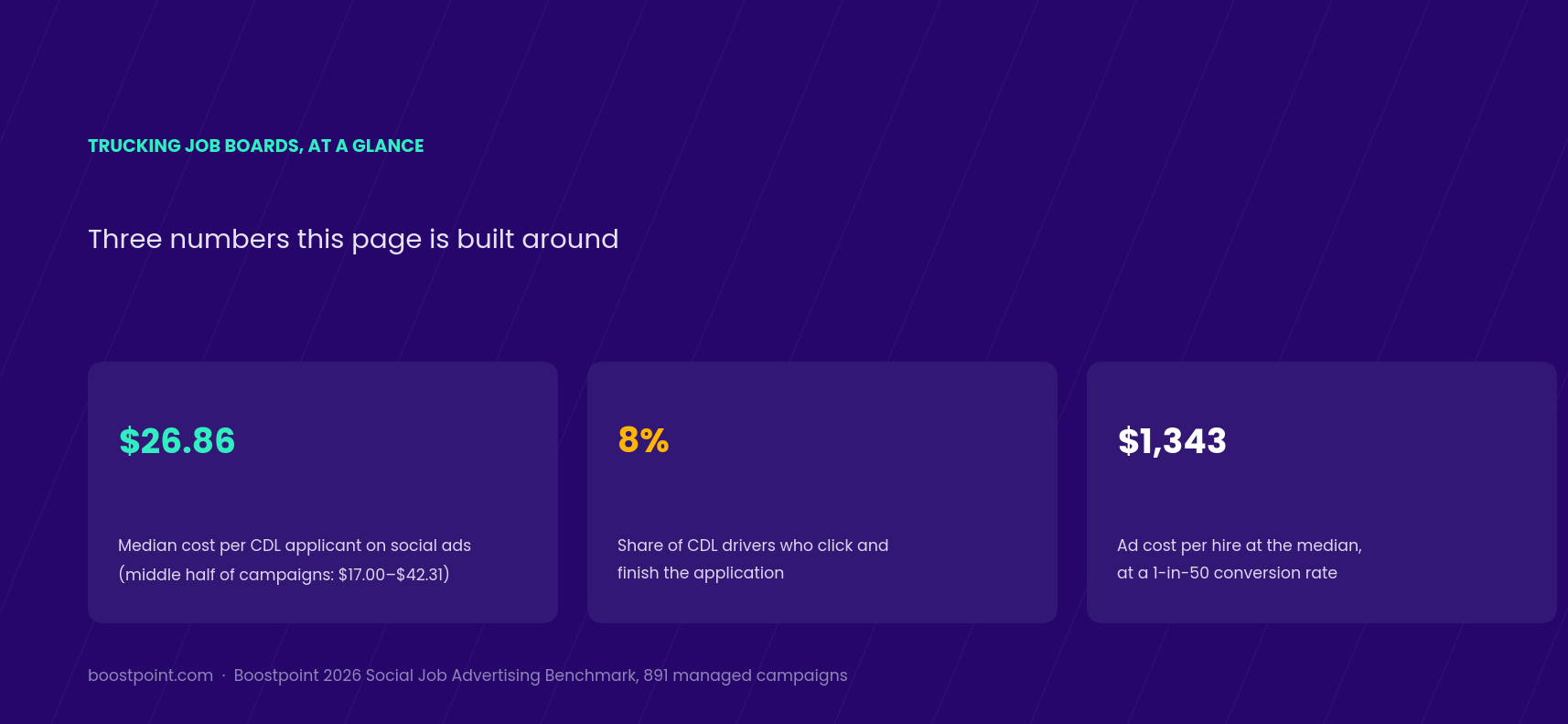
The best trucking job boards — such as CDLjobs.com, EveryTruckJob, and ClassADrivers — are effective for reaching active job seekers, but they feature intense competition from other carriers. Because job boards rely entirely on active search intent, costs can escalate quickly. By contrast, in Boostpoint's 2026 Social Job Advertising Benchmark, targeted social media advertising that reaches passive drivers produced CDL driver applicants at a median of $26.86 each, with the middle half of campaigns between $17.00 and $42.31, providing a highly cost-effective alternative to traditional CDL job boards.
Source: Boostpoint 2026 Social Job Advertising Benchmark — 891 Boostpoint-managed campaigns on Meta (1,334 campaign-months); costs are what advertisers paid for advertising only.
A note on who's writing this
Most reviews of the best CDL job boards are written by the job boards themselves or programmatic advertising agencies that resell job board traffic. Their goal is to convince you that buying more job slots is the only way to fill your empty trucks.
Boostpoint is not a job board. We build recruitment advertising software that helps motor carriers and private fleets bypass job boards entirely by running targeted social media ads on platforms like Facebook and Instagram.
We are sharing this comparison to provide transparency on what works in driver recruiting, backed by real 2026 benchmark data from thousands of frontline hiring campaigns.
The landscape of CDL job boards
When recruiting CDL drivers, carriers generally choose between three distinct sourcing channels. Each operates on a different pricing model and targets a different segment of the driver pool.
| Sourcing channel | Examples | How it works | Best for |
|---|---|---|---|
| General Job Boards | Indeed, ZipRecruiter | Pay-per-click (PPC) or pay-per-post | High-volume, non-CDL, or entry-level driving roles |
| Niche Trucking Job Boards | EveryTruckJob, CDLjobs.com | Monthly subscriptions or flat fee per post | Reaching active Class A CDL drivers actively looking to switch carriers |
| Targeted Social Media Recruiting | Boostpoint, Meta Ads | Cost-per-applicant via passive social feed targeting | Reaching the 70% of drivers who are currently employed but open to better pay or home time |
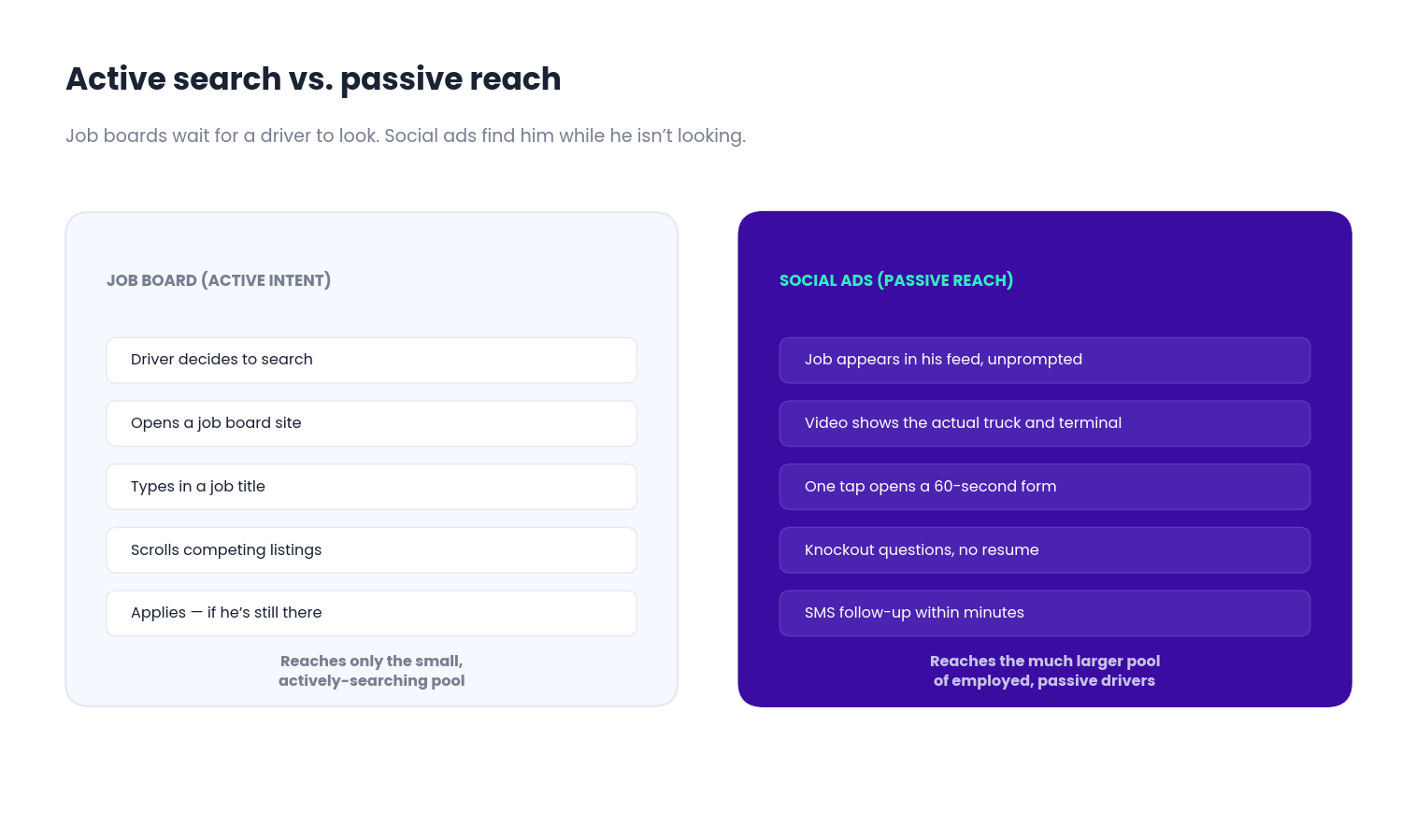
Niche CDL job boards filter out unqualified retail or warehouse workers, which saves your recruiting team time. However, every major carrier in your hiring radius is paying to be on those same niche boards, turning your recruitment effort into a bidding war over top-line sign-on bonuses.
Why job boards break for CDL recruiting
For years, the standard playbook was to post a requisition on a trucking job board and wait. In 2026, that model is fundamentally broken for deskless workers.
- Job boards run on search intent. A traditional job board requires a driver to actively decide they want a new job, open a website, type in a title, and scroll. Great drivers are already employed. A driver with six years of safe driving isn't refreshing a careers page during their off-duty hours.
- The active pool is fiercely contested. In any given week, the number of drivers actively searching for your specific lanes in your hiring radius is a fixed, small number — and every competitor is bidding on them.
- Long application forms kill conversions. Drivers apply from a smartphone in a truck cab, often with a poor cell signal. Standard job boards often redirect candidates to an Applicant Tracking System (ATS) that demands a 15-question form and a resume upload. Every additional question causes drop-off. If your click-to-application rate is under 10%, your form is too long.
The passive sourcing alternative (and what it costs)
Social advertising inverts the job board model. Instead of waiting for a driver to search for you, your job becomes an engaging video ad placed directly in their social media feed.
Because 70% of job seekers use social media to evaluate opportunities, this strategy reaches the massive pool of passive drivers. Based on 2026 Boostpoint benchmark data spanning 891 campaigns, here is what it costs to acquire candidates directly — the full breakdown across every role we track is in our published 2026 Social Job Advertising Benchmark data:
- CDL driver applicant cost: $26.86 per applicant at the median, with the middle half of campaigns between $17.00 and $42.31.
- Demographic profile: in driver recruitment campaigns, the applicant pool skews 94.7% male.
- Age and cost correlation: while older applicants are cheaper to acquire for physically demanding trades, driving roles require an experienced pool, and costs scale accordingly.
Calculating direct ad cost per hire across screening ratios
Advertising budget generates driver applicants, not onboarded hires. Because carriers must run Motor Vehicle Records (MVR), Clearinghouse checks, and verify experience, the conversion rate from applicant to hired driver is stringent.
Here is what direct ad cost per hire looks like across three candidate screening scenarios based on the $26.86 median cost per CDL applicant in the 2026 benchmark:
| Sourcing strategy | Cost per applicant | 1 in 10 hire rate (10% — high touch) | 1 in 50 hire rate (2% — realistic standard) | 1 in 100 hire rate (1% — strict vetting) |
|---|---|---|---|---|
| Direct Social Ad Campaign | $26.86 | $268.60 | $1,343.00 | $2,686.00 |
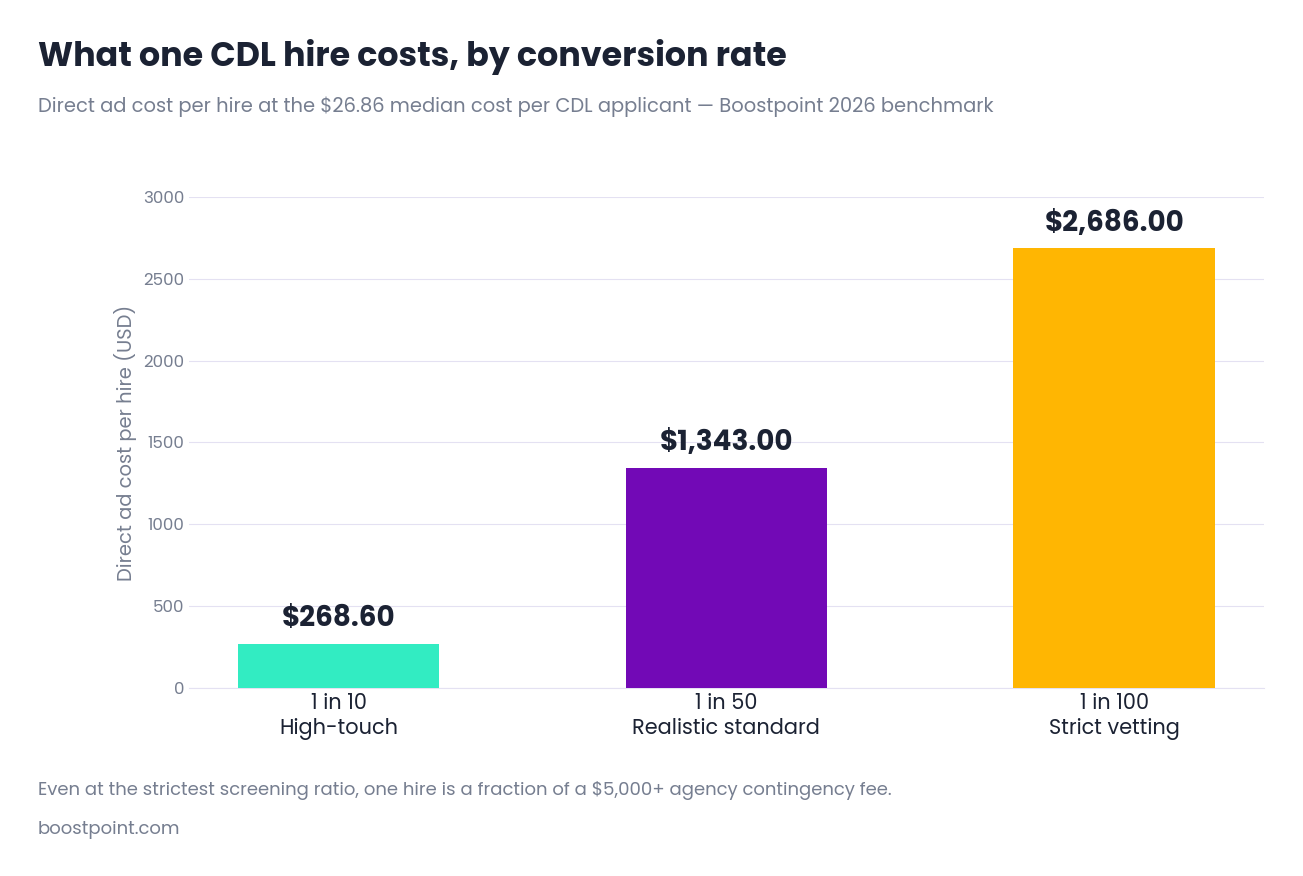
Even under a highly strict 1 out of 100 hire rate, acquiring a CDL driver for $2,686 via direct advertising is drastically more profitable than paying an external recruiting agency a $5,000+ contingency fee.
Best practices for bypassing CDL job boards
If you want to reduce your reliance on trucking job boards, you must modernize your candidate capture mechanics:
- Use Quick Apply formatting. Discard the standard job board redirect. Utilize custom knockout questions that let candidates apply in under a minute directly from their phone.
- Automate SMS follow-ups. Drivers cannot answer phone calls while operating a commercial vehicle. Integrate text message automation so drivers receive an SMS the moment they apply, allowing them to schedule an interview during their downtime.
- Use high-impact video ads. Do not use stock photos of trucks. Show your actual fleet, your terminal, and highlight home-time guarantees in a 15-second video ad to stop the scroll.
The pattern behind all of this is not specific to trucking. As the qualified pool shrinks, a specialist board beats a general one — right up to the point where the pool is too small for any board to reach, and the ad has to go and find people instead. That rule, and how it holds across nursing and the trades as well, is set out on niche job boards.
The honest summary
Job boards rent you access to a shrinking pool of active searchers. Direct advertising builds your own pipeline.
If you are hiring entry-level non-CDL roles, general job boards can still provide adequate volume. However, relying on niche trucking job boards to fill Class A CDL seats means you are engaging in a bidding war against every other carrier. By moving your budget toward targeted social media recruiting, you can capture experienced, passive drivers at a median of $26.86 per applicant while completely avoiding the resume black hole. Whichever channel you use, if you hold federal contracts your postings also have to meet listing rules — see OFCCP job posting requirements.
The calculation worth running this quarter
Fleet recruiting directors should calculate these four metrics:
- Audit your job board ROI. Divide your total monthly job board spend (Indeed, ZipRecruiter, CDLjobs) by the number of actual seated hires. Is your true cost-per-hire over $1,500?
- Track click-to-application drop-off. Look at your ATS analytics. If less than 10% of candidates who click your job board link actually complete the application, your form is causing candidate abandonment.
- Measure time to first contact in minutes, not days. In the trucking industry, speed wins. If your recruiters take 24 hours to call a job board lead, that driver has already spoken to a competitor.
- Compare against social benchmarks. Measure your current applicant costs against the $26.86 median CDL driver benchmark generated by passive social media campaigns.
Frequently asked questions
What are the best CDL job boards?
Niche trucking job boards like CDLjobs.com, EveryTruckJob, and ClassADrivers are highly targeted platforms for active CDL seekers. However, because they only capture the small percentage of drivers actively looking for work, many carriers are shifting budgets to passive social media advertising to reach employed drivers.
Why are job boards not working for truck drivers?
Job boards run on search intent. Experienced truck drivers are currently employed and do not spend their off-duty hours scrolling job boards. Furthermore, standard job boards often force mobile users through long, tedious ATS applications, which causes massive candidate drop-off.
How much does it cost to recruit a CDL driver directly?
Using targeted social media recruitment, carriers generated CDL driver applicants at a median of $26.86 each in our 2026 benchmark. Depending on the strictness of your MVR and Clearinghouse screening, that puts the ad cost per seated hire at roughly $269 to $2,686.
How does social media recruiting compare to job boards?
Not every driver is registered on a job board, but nearly everyone uses social media. Social recruiting leverages targeting algorithms to put your job ad in front of qualified, passive candidates, whereas job boards require candidates to actively seek you out.
Do these same limitations apply to the best job boards for nurses?
Yes. Much like truck drivers, clinical healthcare professionals are highly sought-after deskless workers who rarely actively browse job boards. Social media recruiting for healthcare bypasses saturated medical job boards, with median applicant costs across healthcare roles in our 2026 benchmark ranging from $3.76 for caregivers up to $74.62 for therapy roles.
What are the best job boards for truck drivers?
For experienced Class A drivers, the trucking-specific boards such as CDLjobs.com, EveryTruckJob and ClassADrivers reach drivers who are actively looking, alongside a free posting on a general board. Their limit is that most drivers are seated with a carrier and not searching, so the boards all compete for the same active pool. Social advertising reaches the rest, at a median of $26.86 per CDL applicant in our 2026 benchmark.
Stop fighting over the same candidates on trucking job boards
Book a 30-minute strategy call with our transportation recruiting team. We'll analyze your hiring lanes, review CDL cost-per-applicant data in your operating regions, and demonstrate how to build a direct driver pipeline using automated social ads.
Book a Demo →Explore Transportation Benchmark Data →



Boostpoint figures are from the 2026 Social Job Advertising Benchmark: 891 managed campaigns (1,334 campaign-months) on Meta. Cost-per-applicant metrics reflect what advertisers paid for advertising.