
Best Job Boards for Employers: When a Niche Board Beats the Big Three
A niche board wins when the pool of people who could legally do the job is small enough that self-selection does your screening for you. Below roughly a few hundred qualified people in a market, that is usually true. Above a few thousand, you are paying to narrow an audience that did not need narrowing.
A note on who's writing this
Boostpoint sells managed recruitment advertising on Meta, which competes with job boards for the same budget. Read this knowing that. What we can offer instead of neutrality is arithmetic from 891 of our own campaigns, a rule that tells you when to ignore us, and a refusal to quote a price we have not seen on a vendor's own page. Almost everything published about niche boards is written by companies that sell them, ourselves included.
What a niche job board actually is
A niche board is a job site scoped to one industry, credential or worker type rather than to everybody. iHireConstruction instead of Indeed. Vivian Health or Incredible Health instead of Monster. Roadtechs instead of Craigslist. The premise is that a smaller, self-selected audience beats a larger, indifferent one.
The category's own literature makes that case with numbers it does not source. Breezy HR's roundup, for example, promises “20 applications from people who actually know what they're doing” instead of 200 random ones, and cites a 54% figure to its own internal survey. That may well be right. It is not evidence, and you should treat it the same way you treat this page: as a vendor's argument, checkable only where it names a source.
The case for the niche board, made first
Three things a specialist board does that a general board cannot.
- It screens by attendance. Nobody visits a CDL board by accident. The audience filter happens before your posting is written, which is the only kind of screening that costs you nothing.
- It carries the vocabulary. Specialist boards have fields for the things that actually decide a frontline hire — endorsements, license class, shift, unit, certification — so the applicant answers them before you ask.
- It is cheap relative to the alternative. A few hundred dollars a month against a placement fee measured in thousands is not a close call when the board works.
There is a fourth argument we do not accept: that niche boards produce better candidates. Nobody has published data we can check on that, and neither have we.
A board is one destination on a pipe that usually carries the same opening to three others as well. Job ad distribution covers how that feed works and who each of the four destinations actually reaches.
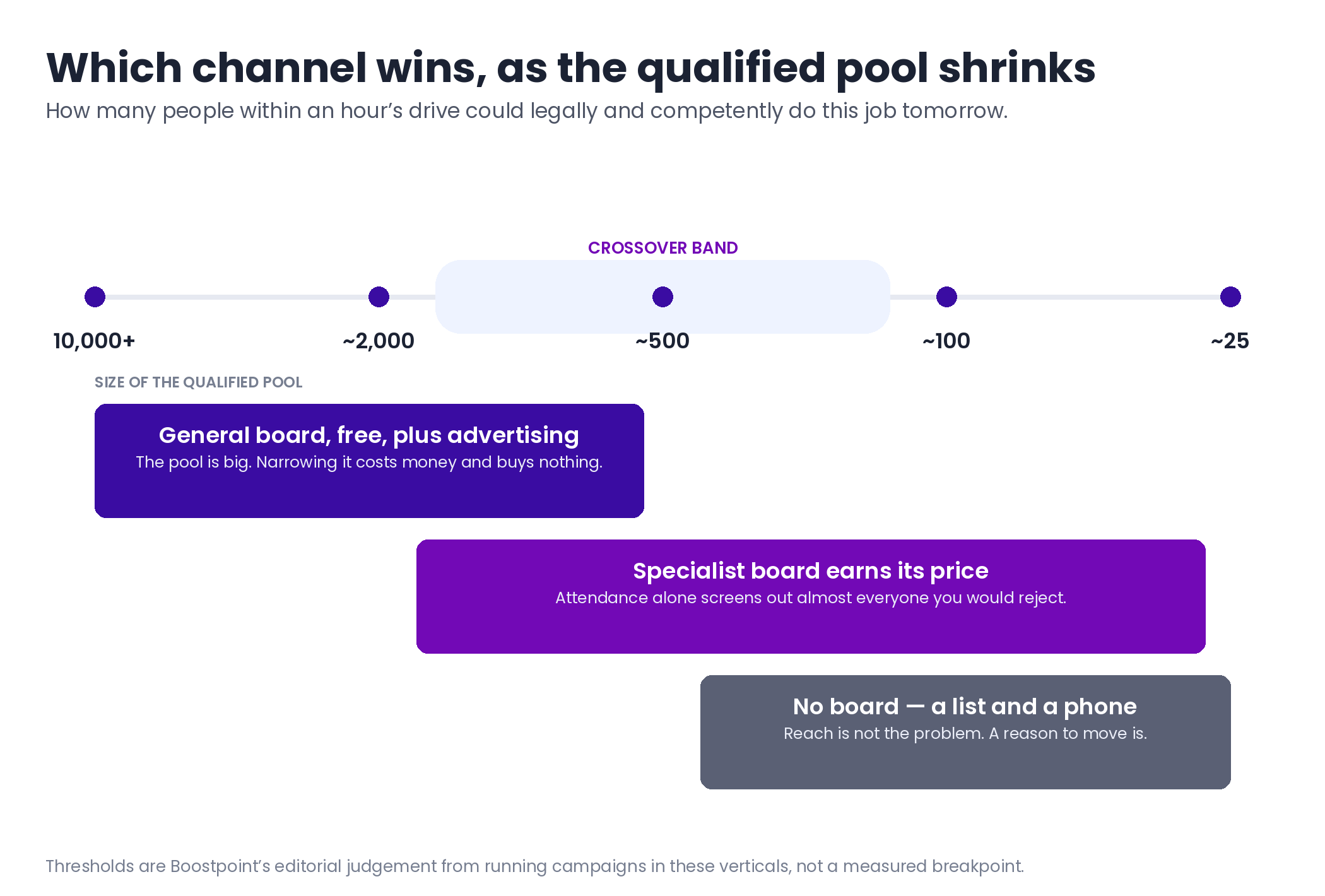
The rule: it is the size of the qualified pool, not the industry
The useful question is not “is my industry niche”. Every industry feels niche from inside it. The question is how many people within an hour's drive could legally and competently do this job tomorrow. As that number falls, the case for a specialist board rises — and past a certain point, no board works at all.
The frontline verticals, mapped
We have graded the specialist boards in three frontline verticals, each against the same test: what is this board genuinely best at, and where does it fall down. Start with the one that matches your opening.
| Vertical | Where the specialist board earns its price | The guide |
|---|---|---|
| Trucking and CDL | Endorsements, license class and route type are the whole hire, and a general board has no field for any of them. | CDL job boards |
| Nursing and healthcare | Credential and specialty split the pool into dozens of small ones; travel, per diem and permanent are three different markets with different boards. | Nursing job boards |
| Construction and skilled trades | Licensed trades and traveling industrial work, where the audience self-selects. Crew and helper roles, where it does not. | Construction job boards |
A pattern shows up across all three. The specialist board earns its money on the credentialed end of each vertical and loses to a free general posting at the unlicensed end — the aide, the helper, the warehouse picker. That is the threshold above, expressed one industry at a time.
What niche boards cost, and why you mostly cannot find out
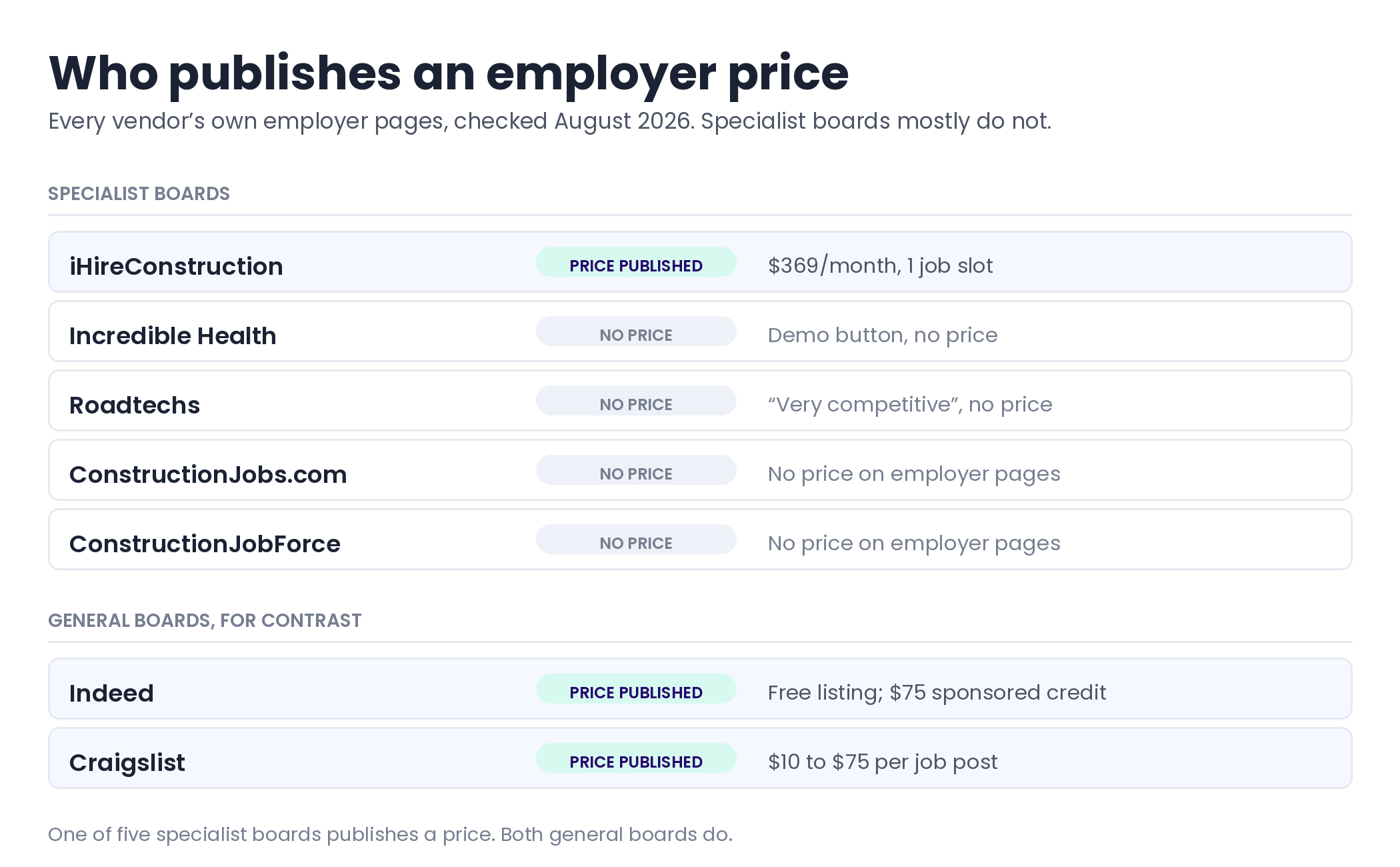
We checked the employer pages of the boards named across those three guides in August 2026. The result is the most useful thing on this page: almost none of them publish a price.
Hiring software behaves differently from boards on this point: Wizehire, for one, publishes its plan and add-on prices outright, which makes the arithmetic checkable — see Wizehire alternatives for what those prices come to once you run several roles across more than one location.
| Board | Published employer price | Source |
|---|---|---|
| iHireConstruction | $369/month for 1 job slot; $450/month for 3; $799/month for 10. | iHireConstruction employer pricing page |
| Incredible Health | Not published. The employer page carries a “$5 million+ saved annually per facility” benefit claim and a demo button, but no price. | Incredible Health employer page |
| Roadtechs | Not published. Rates are called “very competitive” without one being stated. | Roadtechs employer products page |
| ConstructionJobs.com | Not published on its employer pages. | Checked August 2026 |
| ConstructionJobForce | Not published on its employer pages. | Checked August 2026 |
| Indeed (general, for contrast) | Free and sponsored posting; new US accounts are offered a $75 Sponsored Job credit. | Indeed employer resources |
| Craigslist (general, for contrast) | $10–$75 per job post, varying by area. | Craigslist posting fees page |
Two consequences. First, you cannot budget a niche board without a sales call, which is a real cost even when the subscription is small. Second, any price you read in a roundup came from somebody else's call and has no expiry date printed on it.
Price one anyway, like this. Take the only published figure above. iHire's $369 for one job slot, if that slot returns 9 applicants in the month, cost you $41.00 per applicant. At 3 applicants it cost $123.00. Ask any board for its median applicants per posting in your role and market before you sign; if it will not answer, that is your answer.
The ceiling every board shares, niche or not
A narrower audience is still an audience of people who came looking for a job this week. Narrowing does not reach the credentialed person who is employed and content, and that person is most of your pool in exactly the small-pool verticals where niche boards otherwise win. Job board ROI works through what a posting can and cannot return; we will not repeat it here.
This is also the honest limit of our own argument. Advertising reaches people who are not looking, but it does not conjure licensed people who do not exist in your market. At the far end of the slider above, no channel substitutes for a list, a phone and a referral bonus.
When social ads beat job boards
Social job ads beat job boards when the people you need are employed, local and plentiful, which is the opposite end of the slider from the niche board. A board waits for someone searching this week; a Facebook or Instagram ad shows the job to adults within commuting distance whether or not they were looking. In Boostpoint’s 2026 Social Job Advertising Benchmark of 891 campaigns, the median cost per applicant was $2.71 for customer service roles, $3.76 for caregivers, $7.72 for CNAs and $9.83 for warehouse and production roles, against $26.86 for CDL truck drivers and $74.62 for therapy roles, the credentialed end where specialist boards make their strongest case.
That fits the rule above: the smaller and more credentialed the pool, the more a specialist board earns its price; the larger and more hourly the pool, the more an ad that reaches people who are not searching earns it. Most employers need both. Our guide on how to advertise a job sets out which channel to run for which opening.
The number that decides your cost, on any board
Across 891 Boostpoint campaigns and 1,334 campaign-months, post-click conversion — the share of people who click and then finish an application — explains about 70% of the variation in cost per applicant. Click-through rate explains about 30% and CPM about 18%, each measured separately. The channel you picked is not on that list.
Campaigns converting under 5% of clicks average $53.77 per applicant. Above 35%, $1.61. Our overall median campaign is $13.88 and our volume-weighted average $8.02, and the gap between those two is the same story at portfolio scale. Appcast's benchmark, built on more than 302 million clicks and 27 million applications from nearly 1,200 employers, reported cost per application rising sharply through 2025 — the underlying report is gated, so we cite the direction rather than a figure we have not seen.
Which means the board choice is worth an afternoon and the application is worth a quarter. Cost per applicant is not cost per hire either way — hires are recorded in your applicant tracking system, not on a job board.
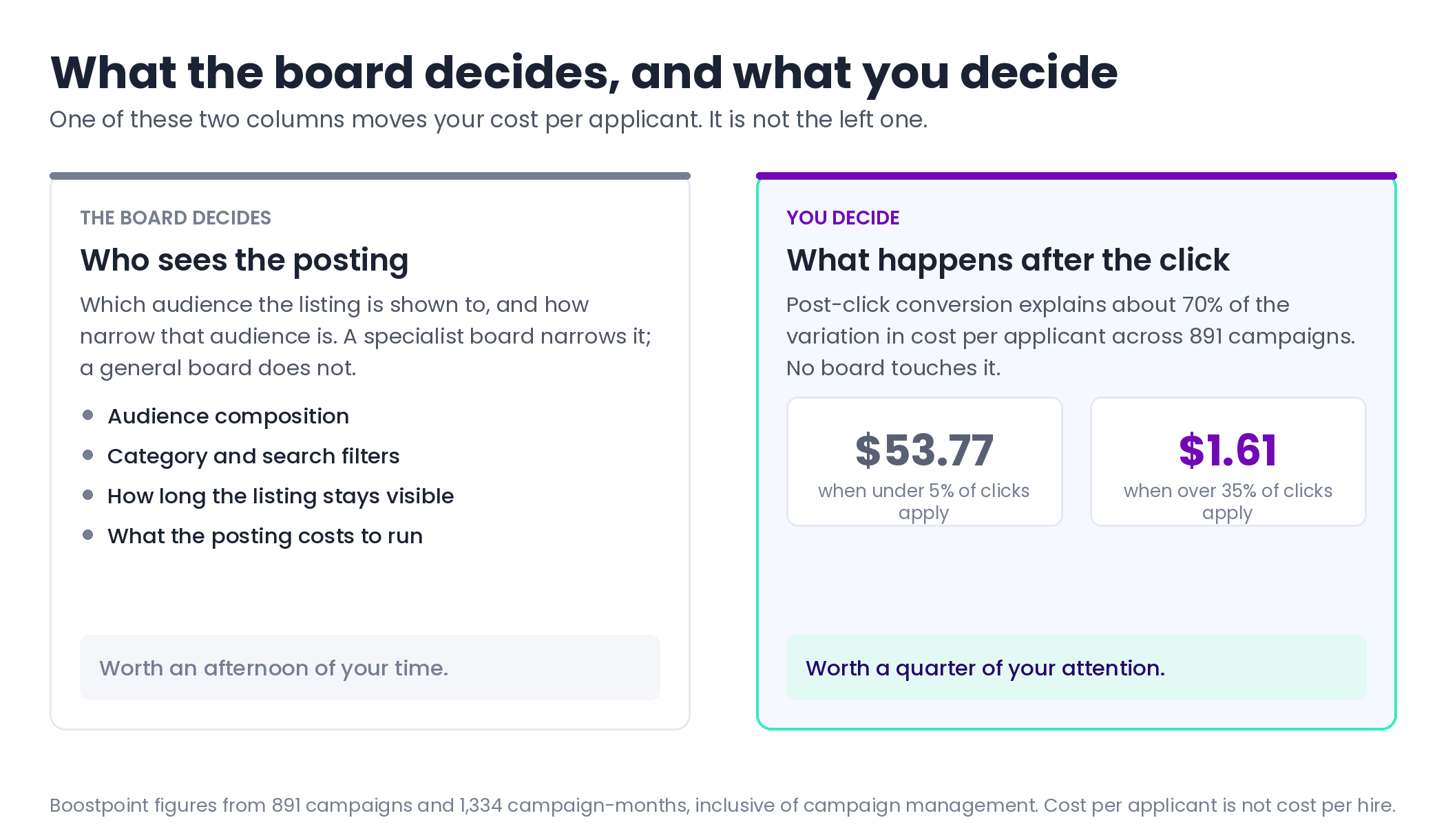
A niche board narrows who sees the job. It cannot touch what happens after the click — and that is where $53.77 becomes $1.61.
Frequently asked questions
Free job posting sites for employers: what is genuinely free
Most lists of free job posting sites are lists of places with a free tier that stops working at the point it becomes useful. These are the routes that cost nothing and keep costing nothing.
- Your own careers page. Free, permanent, and the only listing you control. Mark the posting up with job-posting structured data so it is eligible for the jobs results in Google, which is the highest-value free placement available to a small employer.
- Meta's Local Jobs listing in the Marketplace Jobs tab. Four minutes to place, aimed squarely at entry-level, trade and service roles, and its reach depends entirely on how many people in your county open that tab. Steps are on how to post a job on Facebook.
- Your state workforce agency job bank. Every state runs one, listing is free, and for some roles it also connects you to funded training and hiring events.
- Community college, trade school and apprenticeship program boards. Free, and they reach people who are about to be qualified rather than people who already left their last job.
- Union halls and trade associations in the trades that have them. Slow, relationship-driven and often the only route to a specific skill in a specific county.
- Local community and trade groups on social platforms, where admins allow job posts. Rules vary by group and patience is required.
- Your own staff. A referral bounty paid partly at hire is cheaper than any board and produces the hires that stay longest.
The honest limitation they share is the one on this whole page: every free listing is a pull channel. It waits for someone who is already looking. With the quits rate at 1.9%, that is a small and shrinking share of the qualified workforce, which is why the free layer should always be running and should never be the plan. What the paid layer costs by role is in the 2026 benchmark, and the whole channel-by-channel comparison is on how to find employees.
Best job boards for employers, by trade
There is no single best job board, because the only thing that matters is whether the board holds a large pool of the specific credential you need inside your commute radius. The shortlists we keep by vertical:
- Nursing and allied health — best job boards for nurses
- CDL and trucking — trucking and CDL job boards
- Construction and the trades — construction job boards
- What a board is worth once you measure it — job board ROI
- Manufacturing and warehouse — manufacturing and warehouse job boards
Blue collar job boards, and boards for hourly workers
Blue collar job boards come in two kinds. Trade boards serve one credential — drivers, electricians, welders — and are worth paying for where that credential is scarce. General blue collar and hourly boards serve everyone without a degree requirement, and mostly reach the same searching people the big general boards already reach. For warehouse, production, retail, food service and general labor, a free posting on a general board plus your own careers page usually does what a paid hourly board would.
The ceiling is the same one every board shares: it reaches people who are searching. Most hourly and blue collar workers are employed and not searching at any given moment, which is why the cost that decides your results is usually the application, not the board. The sections on manufacturing hiring and construction job boards work through the same question for their trades.
What is a niche job board?
A job site scoped to one industry, credential or worker type rather than to everybody — iHireConstruction rather than Indeed, Vivian Health or Incredible Health rather than Monster, Roadtechs rather than Craigslist. The audience filters itself before your posting is written.
Are niche job boards worth it?
They are worth it when the pool of people who could legally do the job is small enough that self-selection does your screening. Roughly a few hundred qualified people in a market is where the case turns. Above a few thousand, a free general posting usually does the same work for nothing.
How much do niche job boards cost?
Mostly you cannot find out. Of the boards we checked in August 2026, only iHireConstruction published a price — $369 a month for one job slot. Incredible Health, Roadtechs, ConstructionJobs.com and ConstructionJobForce publish none, so budgeting one means taking a sales call.
Do niche job boards get better candidates than Indeed?
Nobody has published data we can check, and neither have we. What a niche board reliably changes is who sees the posting. Whether those people are better hires depends on your screening and your offer, which no board controls.
Should I post on a niche board and a general board at once?
Usually yes, because the general posting is free and costs only your time. Run both, then compare applicants per posting after a month. The board that cannot tell you its median applicants per posting for your role is the one to drop first.
Why do my postings get so few applicants even on a specialist board?
Usually the application, not the board. Post-click conversion explains about 70% of the variation in cost per applicant across 891 Boostpoint campaigns, and campaigns converting under 5% of clicks average $53.77 each against $1.61 above 35%. Long forms and resume requirements are what frontline candidates abandon.
Which niche board should I use for my industry?
Start with the vertical guide that matches the opening: CDL job boards for drivers, nursing job boards for clinical roles, construction job boards for trades. Each grades the specialist boards on what they are genuinely best at rather than ranking them.
What is a reasonable cost per applicant to expect?
Across 891 Boostpoint campaigns the median campaign is $13.88 per applicant and the volume-weighted average $8.02. Cost per applicant is not cost per hire, and the ratio between the two lives in your own applicant tracking system, not in ours or a board's.
What are the best job boards for employers?
There is no single best board. What decides it is whether a board holds a large pool of the specific credential you need inside your commute radius, which is why the useful shortlists are by trade rather than general. The general boards give reach; the niche ones give relevance.
Where can I post jobs for free?
Your own careers page with job-posting structured data, a free Meta Local Jobs listing, your state workforce agency job bank, community college and apprenticeship boards, trade associations and union halls, local community groups, and your own staff through a referral bounty.
Are free job posting sites worth using?
Yes, and they should always be running, because they cost nothing. They are all pull channels, though: they reach people who are already searching, which at a 1.9% quits rate is a small share of the qualified workforce.
Is it better to use a niche job board or a general one?
Use the niche board when the credential is the constraint and the pool is small — nursing, CDL, licensed trades. Use a general board for high-volume roles where the pool is large. Neither reaches people who are not currently job hunting.
What are the best free job board posting sites?
The routes that are free all the way through are your own careers page, your state workforce agency's job bank, industry association and union boards where they exist, local community groups, and your own staff through a referral bounty. The section above works through each one. Most sites marketed as free job posting sites have a free tier that stops working at exactly the point it becomes useful — free to post, paid to be seen.
Are free job board posting sites worth using?
They are worth the time it takes to set them up once, and they are not a hiring plan. A free listing is a pull channel: it reaches people already searching for that title in your area this week, which in most frontline categories is a small fraction of the people who would take the job. Keep the free layer running permanently, and judge it on applicants per week rather than on impressions.
What are the best job boards for blue collar workers?
For licensed and scarce trades, the specialist board for that trade. For general labor, warehouse, production and similar roles, a free posting on a large general board usually reaches as many searching people as a paid blue collar board. No board reaches the workers who are employed and not searching.
What are the best job boards for hourly workers?
The large general boards, used for free, plus your own careers page. Paid hourly boards rarely add many people the general boards do not already reach. The bigger lever for hourly roles is a short mobile application and a fast reply, because that is where most applicants are lost.
Find out what your roles cost before you buy a subscription
We will show you what your open roles have cost other employers in your vertical and market, from the same 891-campaign dataset this page cites.
Methodology and sources. Boostpoint figures come from 891 campaigns and 1,334 campaign-months. Cited: overall median $13.88 per applicant and volume-weighted average $8.02; $53.77 per applicant below 5% post-click conversion and $1.61 above 35%; post-click conversion explaining about 70% of cost variation, click-through rate about 30% and CPM about 18%, each measured separately. Cost per applicant is not cost per hire — hires are recorded in your applicant tracking system, not in an ad platform or on a board. This is a sample of Boostpoint campaigns, not an industry-wide study. The pool-size thresholds in the slider and the crossover band in the first image are our editorial judgment from running campaigns in these verticals, not measured breakpoints. Third-party sources, all checked August 2026 unless dated: iHireConstruction employer pricing page; Incredible Health employer page; Roadtechs employer products page; the ConstructionJobs.com and ConstructionJobForce employer pages, neither of which states a price; Indeed employer resources for its free, sponsored and $75 credit terms; Craigslist posting fees page; Breezy HR’s niche job board roundup, whose 54% figure is sourced to its own internal survey and is presented here as a vendor claim rather than evidence; and Appcast’s 2026 Recruitment Marketing Benchmark Report as reported by HR Dive on 20 February 2026, covering more than 302 million clicks and 27 million applications from nearly 1,200 employers — the report itself is gated, so only the direction of travel is cited. The worked example is hypothetical arithmetic on iHire’s published price, not a Boostpoint measurement: $369 divided by 9 applicants is $41.00, and $369 divided by 3 is $123.00. See the full benchmark report and job board ROI.