
Job Ad Distribution: How It Works — the Feed, the Four Destinations, Who Each One Reaches, and What Breaks
Job ad distribution is the pipe that carries an opening from your ATS to the places people see it. One structured feed — a title, a description, a location, a unique ID, an apply path — is read by four kinds of destination: search engines (Google reads structured data on your own career page), aggregators and boards (Indeed scans career sites or takes an XML feed it re-reads four times a day), networks (LinkedIn's basic listings ingest an XML feed), and social (the feed becomes ads in front of people who aren't searching). The first three reach the searching pool; the fourth reaches the employed majority. Below: the fields each one requires, a checker, what breaks, and what it costs.
A note on who's writing this
Boostpoint runs the fourth destination: we take an employer's job feed and turn each opening into social media ads, which is the product on the programmatic page. So we have a stake in the claim that search-driven distribution misses the employed majority, and we say so up front. The rest of this page is mechanics you can verify: the field requirements are quoted from Google's, Indeed's and LinkedIn's own developer documentation as of August 26, 2026; Indeed's conversion claims are labeled as Indeed's; no vendor price appears that isn't on the vendor's page; and our own figures are benchmark medians, not a forecast. Nothing here is a cost per hire.
The case for distribution, made first
A job feed is the cheapest reach an employer has, and the case for it is easy to make honestly. Indeed says its technology "continuously scans career sites and job boards across the web, aggregates eligible jobs and surfaces them to relevant job seekers" — meaning a well-built career page gets indexed without anyone posting anything, and an ATS feed does the same with more control. Google reads JobPosting structured data straight off your own page and puts the opening in its job search results with no fee. LinkedIn takes a basic-listings XML feed of up to 500,000 jobs. ZipRecruiter says it sends a posting to "100+ job boards". One feed, maintained once, fans out to every place people search, and it does so automatically, which is the whole point: a recruiter posts a job once, in the ATS, and the pipe does the rest. If your candidates search for your title by name — nurses, accountants, drivers with a credential to look up — distribution is the first thing to get right, and most of it is free.
The pipe: what actually happens to a job ad
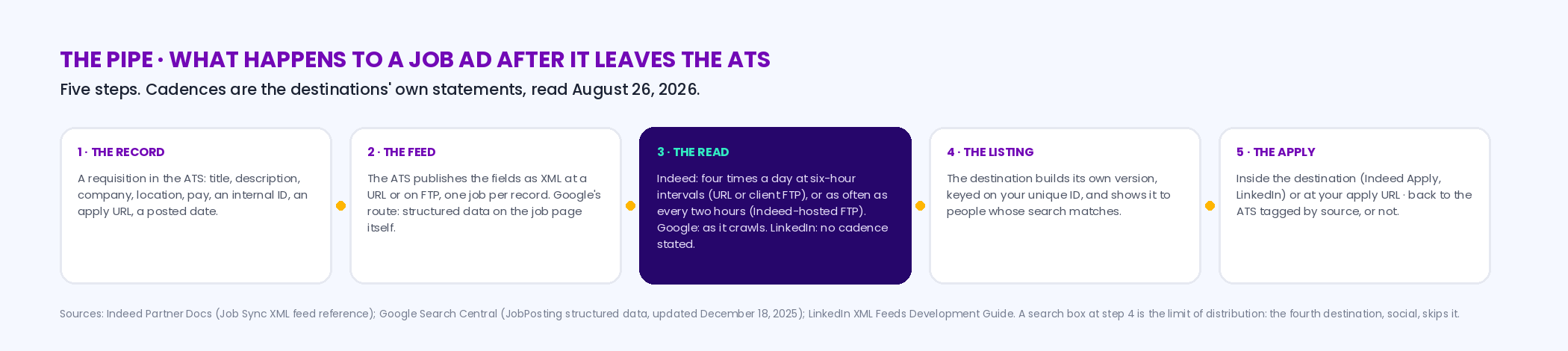
Strip the vendor language away and the mechanics are five steps. The record. A requisition in your ATS has fields: title, description, company, location, pay, an internal ID, an apply URL, a posted date. The feed. The ATS publishes those fields as an XML file at a URL (or drops it on an FTP server), one job per record, refreshed on a schedule. Google's route is different: it reads structured data embedded in the job page itself, so the "feed" is your career site. The read. Each destination pulls the feed on its own cadence — Indeed says four times a day at six-hour intervals for a URL or client FTP feed, or as often as every two hours on Indeed-hosted FTP; LinkedIn's guide states no cadence — and applies its own eligibility rules. The listing. The destination creates its own version of the job, keyed on your unique ID, and shows it to people who search terms that match it. The apply. The candidate either applies inside the destination (Indeed Apply, LinkedIn's apply flow) or is sent to your apply URL, and the application comes back to the ATS tagged with the source, or doesn't, which is where source tracking starts.
The four destinations, and what each one requires
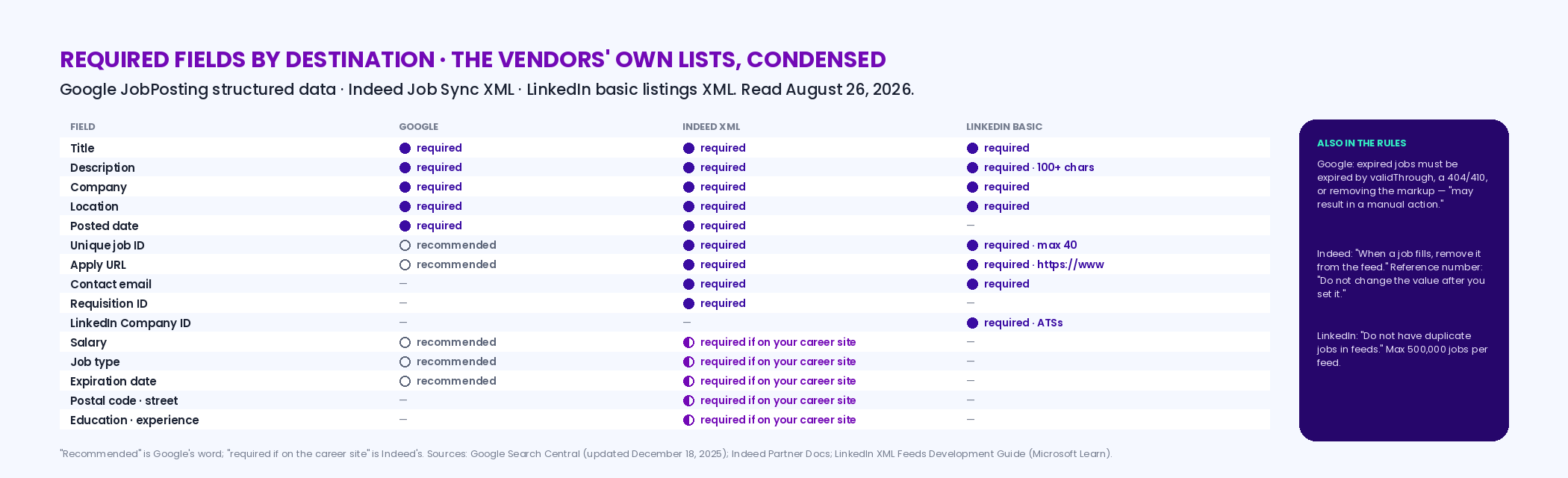
Every destination publishes its own field list, and the lists overlap but don't match. Google's five required properties are the smallest set; Indeed's XML reference requires nine elements for every job and seven more if they appear on your career site; LinkedIn's basic feed adds a minimum description length and a Company ID. The table is the documentation, condensed, with the date we read it.
| Destination | How it gets the job | Required fields (their words) | How often it reads | What it charges | Source |
|---|---|---|---|---|---|
| Google job search | Reads JobPosting structured data on your own job page; or via a third-party job site | Required: datePosted, description, hiringOrganization, jobLocation, title. Recommended: baseSalary, employmentType, identifier, validThrough, directApply, jobLocationType, applicantLocationRequirements | As Google crawls the page; expired jobs must be expired by validThrough, a 404/410, or removing the markup — "failure to take timely action … may result in a manual action" | No fee for the markup | Google Search Central, JobPosting structured data, updated December 18, 2025 |
| Indeed (indexed) | "Continuously scans career sites and job boards across the web" | Eligibility: an effective description, a clear application path (email or link), a listed location, a complete title | Continuous scan; no interval stated | Indexed listings: no price stated on the guide. Sponsored Jobs "start at $5 per day or $150 per month" (Indeed pricing page) | Indeed, Optimize jobs from your career site or ATS, updated May 11, 2026 |
| Indeed (XML feed) | Job Sync XML at a URL, client FTP, or Indeed-hosted FTP | Required: title, date, referencenumber, requisitionid, url, company, city, state, country, email, description. Required if on the career site: postalcode, streetaddress, salary, education, jobtype, experience, expirationdate | "Four times a day at six-hour intervals" (URL or client FTP); "as often as every two hours" (Indeed-hosted FTP) | As above | Indeed Partner Docs, Job Sync XML feed reference |
| LinkedIn (basic listings) | Basic Jobs XML feed, up to 500,000 jobs per feed | Mandatory: Job ID (max 40 characters), title, description (minimum 100 characters), location, apply URL beginning https://www, company name when posting to multiple pages, LinkedIn Company ID for ATSs, poster email | Not stated in the guide | Not stated in the guide; promoted listings are priced separately | LinkedIn XML Feeds Development Guide (Microsoft Learn) |
| ZipRecruiter | Posts and distributes to "100+ job boards" | Its own posting form; feed specifications are for partners | Not stated | No prices on the page; free trial offered | ziprecruiter.com, August 26, 2026 |
| Facebook job listings | Relaunched for US users in October 2025 in a Marketplace tab, also Groups and Pages, aimed at "entry-level, trade, and service jobs" | Meta's listing form; not a feed destination in the developer sense | — | Not stated in the coverage we read | TechCrunch, October 14, 2025 |
| Social ads from a feed | The feed becomes an ad per job on Facebook and Instagram — no search involved | The same record, but the ad is written from it: wage, shift, site in the first line; a three-question form behind it | Continuous; the ad runs until the job closes or its cap is hit | A product subscription plus ad spend ($750 a month minimum per job category); our 2026 benchmark median $13.88 per applicant, $8.02 volume-weighted, campaign management inside | Programmatic+; the benchmark |
Interactive
Feed field checker — tick the fields your ATS record actually has, and see which destination will take it as-is
Nothing is stored or sent — this runs in your browser. Field lists are Google's, Indeed's and LinkedIn's published requirements as of August 26, 2026; the destinations apply other rules too (content, duplicates, eligibility), so "complete" means complete on fields, not guaranteed to list.
—
—
—
Who each destination reaches — the part the diagrams leave out
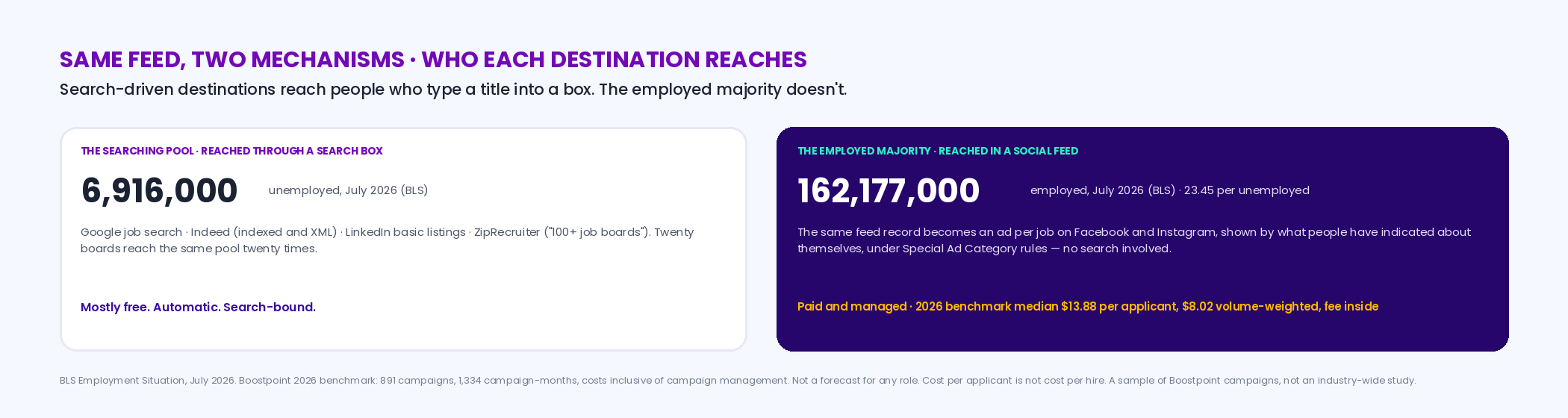
Every destination in the table except the last one works the same way at the candidate's end: a person types a title into a search box, and the listing appears if it matches. That is fine for the people who search, and it is the honest limit of distribution, because most of the people you want aren't searching. The BLS counted 23.45 employed people for every unemployed one in July 2026 — 162,177,000 against 6,916,000 — and the employed majority does not open Indeed on a Tuesday to type "forklift operator". A feed distributed to twenty boards reaches the same searching pool twenty times. Indeed's own guidance on what improves a listing is worth reading in that light: Indeed says 36% of job seekers search by exact title, that jobs with a salary get "up to 2.5X more applications", and that listings with salary, schedule and benefits get "50% more apply starts" — those are Indeed's figures, about Indeed's searchers, and they describe how to win a search, not how to reach someone who never runs one.
The fourth destination is a different mechanism. The same feed record becomes an ad in a social feed, shown to people by what they've indicated about themselves rather than by what they typed, under rules that allow no age, gender or ZIP targeting for job ads (the Special Ad Category page), so the copy does the selecting. It's the placement we run, and the comparison is honest only if it's stated plainly: distribution is cheap, wide, automatic, and search-bound; a social campaign is paid, managed, and reaches the employed. In our benchmark the median campaign produced applicants at $13.88 and the volume-weighted figure was $8.02, with a spread from $2.91 to $66.45 at the tenth and ninetieth percentiles; a normal campaign ran on $334 a month for 20 applicants, reaching 6,061 people. Those are applicants who mostly weren't looking, and the figures are advertising cost. Cost per applicant is not cost per hire.
What breaks: duplicates, stale jobs, and changed IDs
Distribution fails quietly, and it fails in three ways that the documentation warns about explicitly. Duplicates. Indeed requires a partner feed to be "the only visible version" or "the only visible duplicate" of a client's jobs, and says "Aggregators are not allowed on Indeed" — a feed that carries jobs collected from other sites is refused, and two feeds for the same client is a listed violation. LinkedIn: "Do not have duplicate jobs in feeds" and "Do not rotate jobs between feeds". If your ATS feed and a third-party service both push the same requisition, one of them gets suppressed, and you may not learn which. Stale jobs. Google says "We don't allow expired job postings" and that failing to expire them "may result in a manual action" against the site; Indeed's reference says "When a job fills, remove it from the feed." A job that stays listed after it's filled keeps taking applications from people who will never hear back, which is a reputational cost and a time cost, and the calculator below puts a number on the second one. Changed IDs. Indeed's referencenumber carries the instruction "Do not change the value after you set it" — an ATS migration or a template rebuild that regenerates IDs makes every listing a new job and every old one a duplicate or a ghost. Add to those the ordinary failures: a location field with "Multiple" in it, an apply URL that opens a portal login, a description pasted as one paragraph, and an email address that nobody reads.
Interactive
Stale posting calculator — how many applications land on jobs you've already filled, and what a faster feed changes
Nothing is stored or sent — this runs in your browser. Every input is your own record; the only outside number is Indeed's stated six-hour read interval.
jobs filled × days listed after filling
stale job-days × applications per job-day
applications × minutes ÷ 60
applications if the job leaves the feed within Indeed's interval
Distribution is not advertising: what a feed can't do
A feed moves a record. It doesn't write the ad, and every destination that reads the feed shows your description as you wrote it, to people who searched for it. Three things a feed can't do, which is where the category ends and recruitment advertising begins. It can't put the wage and the shift in the first line if the record doesn't have them in the first line — the description field is the ad, and most requisitions are written for HR, not for a phone. It can't shorten the application: in our benchmark, click-to-application conversion explained 70% of the variation in cost per applicant, and a feed that sends people to a twelve-field portal has decided that number for you. And it can't manage frequency, because nobody is shown a listing twice by a search box; a social campaign can be, and we act at a frequency of 2.5. The programmatic version of distribution — software reading the feed, creating an ad per job, setting a budget and a cap per role, stopping when the job closes — is what closes that gap, and it's a product, not a feed; the programmatic page is where we describe ours, with the costs.
Distribution puts the job where people are already searching. For what it takes to reach the ones who are not, from the ad build through applicant delivery, see social media job advertising.
What job ad distribution costs
Three honest price points, and a note about the fourth. Google's markup is free. Indeed's indexed listings carry no stated price on the guide we read; its Sponsored Jobs "start at $5 per day or $150 per month" on its pricing page as of August 26, 2026 — a floor, not a typical spend, and daily-budget sponsorship bills per click. LinkedIn's guide states no price for basic listings and prices promoted ones separately; ZipRecruiter publishes no prices at all. Our own placement is priced as a product subscription plus ad spend — the subscription on job volume, quoted on a call; the ad spend recommended at a minimum of $750 a month per job category; one bill, through Boostpoint — and every figure we publish includes campaign management: $13.88 median per applicant, $8.02 volume-weighted, single-role campaigns at $14.45 and multi-role at $9.83, across 891 campaigns and 1,334 campaign-months. Whether a board's per-click price or a campaign's per-applicant price is the better deal for a given role is arithmetic on your own records, and the job board ROI page is built to do it; the short version is that the price of a click is only useful once you know what share of clicks apply, and that share is the number no board publishes for you.
Multiposting, job distribution software, and which word you actually want
Three terms get used for overlapping things here, and the difference between two of them is a real difference in how the system behaves.
Multiposting is the older model, and it is a push. You fill in one form, and the tool creates a separate posting on each board you selected, one at a time, through each board's own interface or API. Each of those postings is then its own object with its own life. Edit the job and the edit has to be pushed again. Close the job and the closure has to be pushed again, to every board. When a push fails quietly — and they do — you get the failure mode every recruiter recognizes: a filled role still collecting applicants on a board nobody remembers connecting.
Feed-based distribution, described in the pipe section above, is a pull. You publish one feed, and each destination reads it on its own schedule. Nothing is pushed anywhere. The feed is the single source of truth: drop a job out of it and every destination drops the job at its next read, without anyone remembering to go and close it. That is the whole reason the industry moved this way, and it is why the fields and refresh intervals in the table above matter more than the number of boards on anyone's logo wall.
If a vendor says multiposting and means a feed, nothing is wrong — the word has drifted. It is worth asking which one it actually is, because the answer tells you who is responsible for taking a filled job down.
What "job distribution software" refers to
The category name covers the layer that maintains the feed and the destination integrations. It shows up in three places, and they are not competitors so much as different positions in the same pipe: inside your ATS, where distribution is a feature of the system that already holds the jobs; as a standalone distribution layer sitting between an ATS and the boards, usually where the ATS's own destination list is too short; or inside a programmatic bidder, where distribution is the delivery mechanism underneath a budget that is being spent per click or per application.
That third one is where the categories get conflated, so it is worth separating. Distribution moves the job. Programmatic decides how much to pay to promote it and where. A tool can do both, but they are separate functions and they are priced separately.
Five questions decide whether a given tool is the right one, and none of them is how many boards it claims:
- Which destinations, named? Not a count. The four destination types above behave differently, and a list of two hundred boards is mostly aggregators reading the same feed you already publish.
- How often is the feed read, per destination? This sets how stale your worst listing can be.
- How are fields mapped? Specifically what happens to the fields a destination requires and your ATS does not produce.
- Does it handle removals? Ask directly what happens to a live listing when the job closes, and how long that takes on each destination.
- Does it bid, and is that priced separately? If bidding is bundled into a distribution fee, you cannot see the cost per application, which is the only number that tells you whether any of it worked.
And the point the section below makes in full: whichever of these you buy, none of it is advertising. Distribution puts the job where people are searching. It does nothing for the far larger group who are employed and not searching at all.
Platform, tool or service: what changes when the word changes
Buyers search for a job distribution platform, a job distribution tool, job posting distribution software and job distribution services, and mostly mean the same outcome — one job, many destinations, without anyone retyping it. The four words do divide along one real line, though, and it is the line that decides who does the work.
| What you are buying | Who operates it | What you are responsible for | Suits |
|---|---|---|---|
| A tool | You, from a login | Mapping the fields, choosing destinations, watching for failed pushes and stale postings | A recruiter with time and a small set of destinations |
| A platform | You, but feed-based | Publishing a clean feed and keeping it accurate; destinations pull from it | An ATS with a working feed and enough jobs to justify it |
| A managed service | Someone else | The feed, and the decisions about budget and priority | Employers with more open jobs than attention |
The practical test is the one in the section above: when a job is filled, who takes it down everywhere? With a tool, you do, destination by destination. With a feed-based platform, the feed does it at the next read. With a managed service, that is somebody’s job and should be written into what you are buying.
A second distinction gets lost inside the same words. Distribution puts the job where people are already searching — boards, aggregators, your careers page. It does nothing for the much larger group of people who are employed and not searching. An employer whose feed is on twenty destinations and whose roles are still open does not have a distribution problem, and buying a wider distribution platform will not change the outcome. That is when the answer is advertising rather than distribution: Boostpoint Programmatic 2.0 reads the same feed you already publish and turns every open job into its own social ad, running while the job is open and stopping when it closes.
Frequently asked questions
The XML job feed itself: what the file looks like
Most of the destinations above read the same object: an XML job feed sitting at a URL your system refreshes on a schedule. The structure is plainer than the vendor language suggests. One root node wraps the file, and one node per opening sits inside it, each carrying the fields as child elements.
- One file, one root. Indeed’s Job Sync spec puts every posting inside a single <source> node, with one <job> node per opening. Adding a job means adding a node; filling one means removing it.
- Fields are child elements, not attributes. <title>, <date>, <referencenumber>, <requisitionid>, <url>, <company>, <city>, <state>, <country>, <email> and <description> are the required set; the conditional ones are listed in the source notes at the end of this page.
- Dates in ISO-8601. Indeed specifies the format rather than accepting whatever the ATS exports.
- Wrap text in CDATA, and do not escape it. Indeed states plainly that it does not support HTML entities in XML feeds and that literal characters should be used instead. A description full of & and < is one of the more common reasons a job reads strangely on arrival.
- The reference number is permanent. Indeed’s instruction is not to change the value once it is set. Changing it does not update the listing; it creates a second one.
Nothing about the file is exotic, and that is the point: the difficulty in feed-based distribution is almost never the XML. It is keeping the feed honest about which jobs are still open, and remembering that a feed reaches people who are already searching.
Job wrapping, and posting jobs to multiple job boards at once
Job wrapping is how a feed gets built when you do not have one. A vendor reads the jobs already published on your careers site or ATS, extracts them into a feed, and keeps it in step as jobs open and close. It solves the problem of an ATS with no feed export, at the cost of depending on the vendor’s scraper: if your careers site changes its layout, the wrap can break quietly. Job syndication is an older word for the same outcome — your listing reappearing on other sites — and usually means the destination is pulling your feed or scraping your site.
To post jobs to multiple job boards at once there are three routes, in order of how little work they leave you: the posting integrations already built into your ATS; a multiposting or distribution tool that pushes one form to many boards; or a single clean feed that every destination reads. Free listings and sponsored placements travel the same routes. What changes is who pays per click, which is where the costs in the section above come from.
What is job ad distribution?
The automated process that carries a job opening from an employer's ATS to the places candidates see it. The ATS publishes the job's fields — title, description, location, a unique ID, an apply path — as an XML feed or as structured data on the job page, and destinations read it on their own schedule: Google reads JobPosting markup on your career site, Indeed scans career sites or reads an XML feed four times a day, LinkedIn ingests a basic-listings feed, and a programmatic system turns each record into a paid ad. Also called job ad syndication or job posting distribution.
Where do job ads get distributed?
To four kinds of destination: search engines (Google job search, via structured data on your page), aggregators and job boards (Indeed, which indexes career sites and takes XML feeds; ZipRecruiter, which says it distributes to "100+ job boards"), professional networks (LinkedIn's basic listings, via an XML feed of up to 500,000 jobs), and social feeds, where a programmatic system converts each job into an ad on Facebook and Instagram. Facebook's own job listings were discontinued in 2023 and relaunched for US users in October 2025 in a Marketplace tab.
What fields does a job feed need?
It depends on the destination. Google requires five JobPosting properties — datePosted, description, hiringOrganization, jobLocation, title — and recommends baseSalary, employmentType, identifier and validThrough among others. Indeed's Job Sync XML requires title, date, referencenumber, requisitionid, url, company, city, state, country, email and description, plus postal code, street address, salary, education, job type, experience and expiration date if they appear on your career site. LinkedIn's basic feed requires a Job ID of at most 40 characters, a description of at least 100 characters, a location, an apply URL beginning https://www, a poster email and, for ATSs, a LinkedIn Company ID. The checker on this page runs your record against all three.
How often do job boards read a feed?
Indeed states it: "four times a day at six-hour intervals" for a feed at a URL or on the client's FTP, and "as often as every two hours" for a file on Indeed-hosted FTP. Google reads the job page as it crawls the site, with no interval promised. LinkedIn's XML feed guide states no cadence. In practice a change in your ATS reaches Indeed within six hours and the others on their own schedule, which is why removing filled jobs from the feed promptly matters more than the refresh rate.
Is job ad distribution free?
Much of it is. Google's markup costs nothing. Indeed's indexed and feed listings carry no stated price on the guide we read; Indeed's Sponsored Jobs "start at $5 per day or $150 per month" on its pricing page as of August 26, 2026. LinkedIn's guide states no price for basic listings and prices promoted ones separately. ZipRecruiter publishes no prices. Distribution to social is paid — a product subscription plus ad spend; our 2026 benchmark median is $13.88 per applicant with campaign management inside — because it isn't distribution in the search sense: it reaches people who weren't looking.
Why isn't my job showing up on Indeed?
The documented reasons: the job is a duplicate of one already visible (Indeed shows one version per client, and refuses aggregated content — "Aggregators are not allowed on Indeed"); it fails an eligibility test (an effective description, a clear application path, a listed location, a complete title); a required feed element is missing or the referencenumber changed after it was set; or the job expired by its expiration date. The undocumented reasons are the usual ones — a location that says "Multiple", an apply URL behind a login. Indeed's employer help and Partner Docs are the sources; this page summarizes them as of August 26, 2026.
What is the difference between job ad distribution and programmatic job advertising?
Distribution moves the record to places where people search for it, mostly free. Programmatic job advertising reads the same feed and buys placement per job — creating an ad for each opening, setting a budget and an applicant cap, moving money toward the ads that are producing applicants and stopping when the job closes. The original programmatic products bid per click across boards; the version we run turns the feed into social ads for people who aren't searching. The mechanics of the product, and the costs, are on the programmatic page; this page is about the pipe both of them sit on.
Does distributing a job to more boards get more applicants?
Up to a point, and the point comes fast. Every search-driven destination reaches the same population — people who are searching for that title — so the twentieth board mostly re-reaches the first board's searchers. The BLS counted 23.45 employed people per unemployed one in July 2026; the employed majority doesn't search. Adding destinations helps when a board has an audience the others don't (a niche board for a credentialed role); reaching the employed majority takes a different mechanism, which is what a social campaign is, and it is paid and managed rather than free and automatic.
What is multiposting, and how is it different from job distribution?
Multiposting pushes a separate posting to each board you select, so every posting is its own object that has to be edited, refreshed and closed individually — which is how filled roles end up still collecting applicants somewhere nobody is watching. Feed-based job distribution is the reverse: you publish one feed, each destination pulls from it on its own schedule, and dropping a job from the feed removes it everywhere at the next read. The words are now used loosely, so the useful question to ask a vendor is not which term they use but who is responsible for taking a filled job down, and how long that takes on each destination.
Before choosing where to distribute, it is worth knowing what each destination charges: how to advertise a job opening lists what every major channel publishes, and what most of them do not.
What is a job distribution platform?
The layer that takes your open jobs and gets them to multiple destinations from one source, usually by publishing a feed that each destination reads on its own schedule. The word platform normally implies feed-based distribution you operate yourself, as distinct from a tool that pushes postings one at a time, or a managed service where somebody else runs it.
What is the difference between job distribution software and job distribution services?
Software is something you operate from a login; a service is someone operating it for you. The difference that matters in practice is who is responsible for a filled job still collecting applicants somewhere — with software that is your team, with a service it should be written into the agreement. Feed-based distribution reduces the problem either way, because destinations drop a job when it leaves the feed.
Do I need a job distribution tool if my ATS already posts to job boards?
Usually not. Most applicant tracking systems include distribution to a standard set of destinations, and a separate layer is worth buying only when that destination list is too short for where your candidates actually are, or when you need control over budget and bidding that the ATS does not offer. Check the destination list and the refresh interval before assuming you need another product.
How do you post jobs to multiple job boards at once?
Through a feed. Your ATS or a distribution tool publishes an XML or JSON feed of your open jobs, and each destination pulls from it — so a job appears when it enters the feed and comes down when it leaves. That is the mechanism described above, and it is the only version that scales past a handful of roles. Posting manually to several boards works at low volume and fails predictably on the part nobody enjoys: taking filled jobs down.
Is posting to multiple job boards better than posting to one?
It adds surfaces rather than demand. Every board draws on people searching for that title in that area this week, and the overlap between them is large, so the tenth board rarely adds a tenth of the applicants. Distribution is worth having because it is cheap and automatic, not because reach multiplies — and it does not reach anyone who is not searching, which in most frontline categories is the majority of the people who would take the job.
What does automated job posting actually automate?
The copying, and nothing else. Automated job posting means your jobs leave your system on a schedule and appear on the destinations you have configured without anyone pasting them in. It does not decide where they should go, write them, or make them visible once they arrive: on a board that ranks by relevance and bid, an automatically posted job competes exactly like a hand-posted one. What you save is recruiter hours and stale listings, which is real, and is not the same thing as more applicants.
Is job multiposting still worth setting up?
It is, if you post the same roles repeatedly. Multiposting jobs from one place removes the two failure modes of doing it by hand: a job still live on four boards after it was filled, and four versions of one role with different pay in them. What job multiposting will not do is create demand. If a role is not getting applicants on one board, the same ad on six boards usually produces the same disappointing result six times over.
What is an XML job feed?
A single file, published at a URL your system refreshes on a schedule, holding one record per open job with the fields a destination needs to build its own listing. It is the standard way an applicant tracking system hands jobs to job boards. An XML job feed does not advertise anything by itself: it makes your openings available to be read, and what happens after that is decided by each destination’s own eligibility rules and ranking.
How do I create an XML job feed?
In most cases you do not write one. If you run an applicant tracking system, it almost certainly publishes a feed already, and the work is finding the URL and pointing destinations at it. If you have no ATS, the feed has to be generated from wherever the jobs live, which is a small development job rather than a product purchase. Either way, check the required fields, the date format and the rule against HTML entities before assuming a feed that validates will also ingest.
What is job wrapping?
Job wrapping is building a job feed from the jobs already published on your careers site or ATS, so that job boards and advertising platforms can read them. A vendor extracts the listings and keeps the feed in step as jobs open and close. It is useful when your ATS cannot export a feed, but it depends on the vendor’s scraper keeping up with changes to your site.
What is job syndication?
Job syndication is your job listing appearing on other sites beyond the one you posted it on, usually because those sites read your feed or scrape your careers page. It is an older term for what feed-based job distribution now does deliberately.
How many job boards should you multipost a job to?
As many as actually produce applicants for that role, which is usually fewer than the tool offers. Start with the boards your last hires for the same job came from, check each one's applications per job after thirty days, and drop the ones that sent none. Remember that the destinations overlap: Indeed indexes career sites and ZipRecruiter says it distributes to more than 100 boards, so the same searcher often sees your job several times and counts once. Job multiposting widens where a posting sits; it does not change the application behind it, and in Boostpoint's 2026 Social Job Advertising Benchmark the apply experience explained 70% of the cost variation between campaigns. If one board with a short application underperforms, six boards with the same application rarely fix it.
What does multi posting software do?
Multi posting software takes one job entry and creates a posting for it on each job board you select, so a recruiter does not retype the same job five times. The useful versions also track which board each applicant came from and take the posting down everywhere when the job closes. Before buying, check whether your applicant tracking system already does this, and ask the vendor exactly how a filled job is removed from each board and how long that takes. Multi posting widens where a job is listed; it does not add people who are not searching.
What is job posting management?
Job posting management is keeping every live job listing accurate from the day it opens to the day it closes: the same title, pay and location on every board and on your careers page, refreshed when details change, and removed when the job is filled. In most companies it lives in the applicant tracking system and its job feed. The common failure is a filled job still collecting applicants on a board nobody remembers connecting, which is why a single feed that every destination reads is easier to manage than separate postings.
What is job advertising management?
Job advertising management is the paid side of the same work: deciding which jobs get a budget, where it is spent, what each ad says, and moving money toward the jobs and ads producing applicants and away from the ones that are not. It is measured by cost per applicant per job rather than by how many places a job appears. Boostpoint Programmatic 2.0 does this for social: it reads your XML job feed, creates one Facebook and Instagram ad per job, and starts and stops each ad as the job opens and closes.
What is a recruitment advertising platform?
Software, or software with a team behind it, that places paid job ads and reports what they produced. Some buy clicks on job boards, some run ads on social feeds, and some are self-serve tools your team operates. Judge any of them on the cost per completed application with every fee included, because in Boostpoint's 2026 Social Job Advertising Benchmark the apply experience explained 70% of the difference in cost per applicant between campaigns. Boostpoint runs Facebook and Instagram job ads for frontline employers, managed for you with Attract or automated from your feed with Programmatic 2.0.
Put the same feed in front of people who aren't searching
Connect your job feed and we'll turn each opening into a social ad with the wage and the shift in the first line, a three-question form behind it, and a cap per role — reported every week against a published benchmark, every number.
Book a DemoThird-party statements on this page are quoted from the vendors' own documentation as read on August 26, 2026: Google Search Central, JobPosting structured data (updated December 18, 2025); Indeed Partner Docs, Job Sync XML feed reference; Indeed, "Optimize jobs from your career site or ATS" (updated May 11, 2026) and the employer help article "Third-Party Recruiters and Aggregators"; Indeed's pricing page; the LinkedIn XML Feeds Development Guide on Microsoft Learn; ziprecruiter.com; TechCrunch, October 14, 2025, on Facebook job listings. Indeed's figures on titles, salary and apply starts are Indeed's claims about its own users. BLS Employment Situation, July 2026. Boostpoint figures come from the 2026 Social Job Advertising Benchmark — 891 campaigns and 1,334 campaign-months across 15 role families: median $13.88 per applicant, $8.02 volume-weighted, percentiles $2.91, $6.48, $29.74 and $66.45; a normal campaign $334 a month, 20 applicants, 6,061 reached; single-role $14.45 (18% apply, 1,210 campaigns) and multi-role $9.83 (12%, 46); conversion explaining 70% of cost variation; frequency acted on at 2.5. Boostpoint is priced as a product subscription plus ad spend: the subscription is priced on job volume and quoted on a call, ad spend is separate and recommended at a minimum of $750 a month per job category, there is one bill, through Boostpoint, and every cost-per-applicant figure we publish includes campaign management. The field checker and the stale-posting calculator compute on the reader's inputs. Cost per applicant is not cost per hire; we do not track hires and publish no cost-per-hire figure. A sample of Boostpoint campaigns, not an industry-wide study.