
What Makes a Good Job Ad: The Anatomy, Part by Part, With the Data Behind Each
A good job ad puts the pay, the shift, and the place in the first line, names the role the way workers name it, states the one hard requirement, shows the real workplace, says how long the application takes, and then keeps that promise with a one-minute form and three knockout questions. Across the 891 campaigns in Boostpoint's 2026 Social Job Advertising Benchmark, what happens after the click explains 70% of the difference in cost per applicant; campaigns converting under 5% paid $53.77 per applicant, campaigns over 35% paid $1.61. The words in the ad decide who clicks; the form decides what you pay.
Source: Boostpoint 2026 Social Job Advertising Benchmark — 891 Boostpoint-managed campaigns on Meta (1,334 campaign-months), 2026; costs are what advertisers paid for advertising only.
A note on who's writing this
Boostpoint writes and runs job ads on Facebook and Instagram for frontline, healthcare, trades, and driving employers, so this page describes the ads we build and is a vendor's page. Where we cite a number it comes from the 2026 Social Job Advertising Benchmark or an earlier campaign-level analysis, labeled as such, with the methodology at the bottom. Where we state a practice — pay in the first line, three knockout questions — it is what we do, not a measured lift, and we say which is which. The examples are illustrative ads written for this page; they name no employer and carry no performance claim. And one thing this page will not do is compare video against photo, because we don't publish that comparison.
First, what a job ad is not
A job ad is not a job description. A job description is the document that lists duties and requirements for the person who has already decided to apply; it lives on the careers page and in the ATS. The ad is the six seconds before that decision, read by someone who is employed, not searching, scrolling a feed with a thumb. It has one job — get the right person to tap — and one constraint: everything the ad promises has to be true when they land. The most common way employers write a bad ad is to paste the description into it (our earlier post on high-converting social job ads covers the copy side). The second most common is to write a brand message that never says what the job pays.
The anatomy of a good job ad
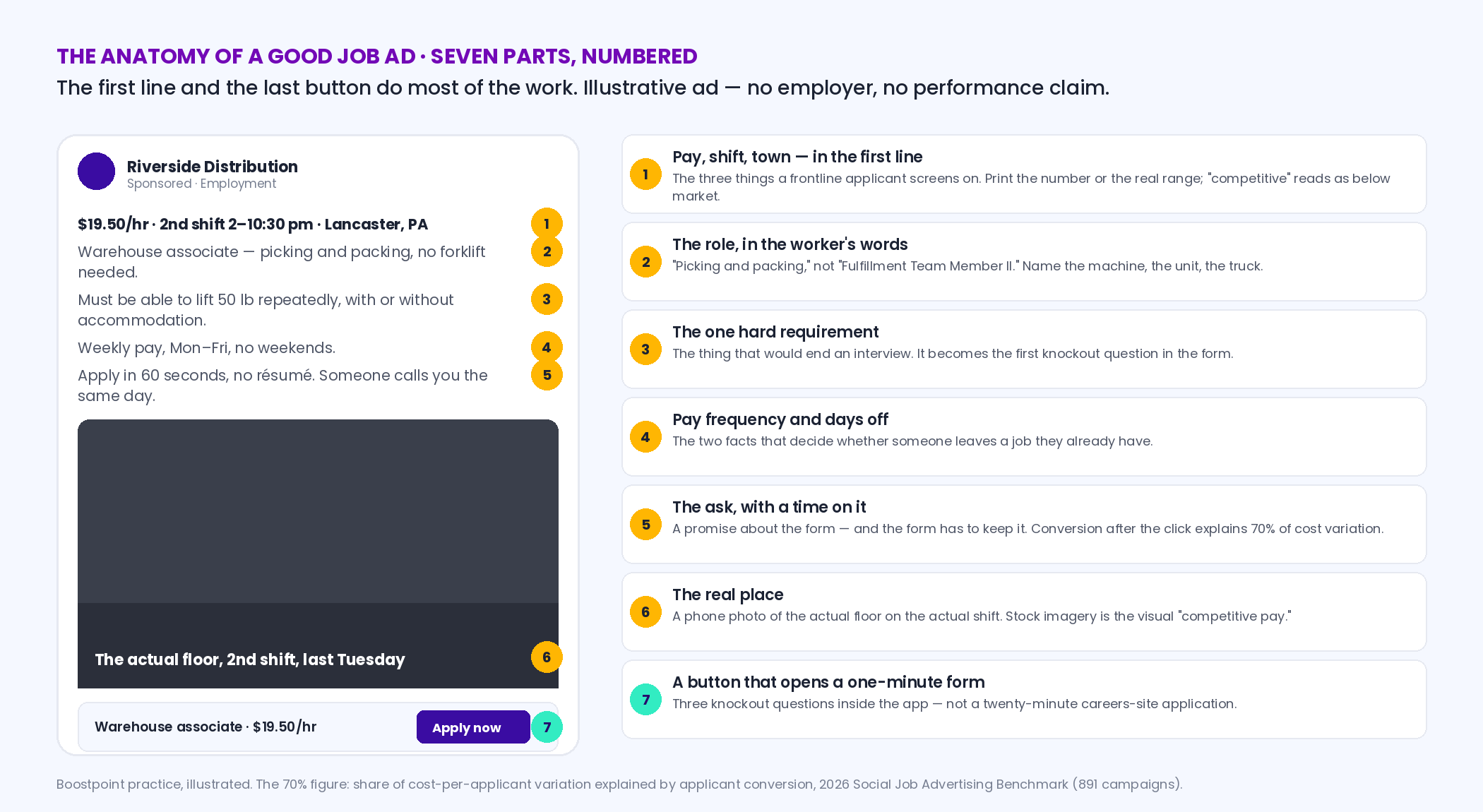
Here is a frontline job ad as we would build it, with each part numbered. In fourteen jurisdictions the pay range is not optional in that ad, which is set out on pay transparency laws by state. The role is a warehouse associate; the same skeleton holds for a CNA, a diesel tech, or a CDL driver, with the specifics swapped.
- 1The number, the shift, the town — in the first lineThe three things a frontline applicant screens on before reading anything else. If the pay is a range, print the real range; "competitive" reads as "below market." In a growing list of states a range is also legally required — see job posting requirements.
- 2The role, in the words the worker uses"Warehouse associate — picking and packing" beats "Logistics Fulfillment Team Member II." Name the machine, the unit, the truck. On our CNC operator page the ads that work name the controls and the axis count; same principle.
- 3The one hard requirement, stated plainlyThe thing that would end an interview. Lifting, a license, a certification, a start date. It becomes the first knockout question in the form and it filters before you pay for the application.
- 4The two facts about the week that decide whether they'll take itPay frequency and days off. Weekly pay and "no weekends" are worth more than any perk paragraph to someone deciding whether to leave a job they already have.
- 5The ask, with a time on it"Apply in 60 seconds, no résumé" is a promise about the form, and you have to keep it. This line is where cost is decided: applicant conversion explains 70% of cost variation in our data.
- 6The real placeA phone photo of the actual floor, on the actual shift, with the actual people. Not a stock image, not the logo. Applicants have worked in enough bad buildings to price the honest photo.
- 7The button goes to a form, not a careers siteThe instant form opens inside the app, pre-filled, three questions. Send people to a twenty-minute ATS application and the ad was fine but the campaign is expensive.
None of this makes the ad a branding exercise. For frontline roles reputation is a tiebreaker rather than the lever, and employer branding on a budget works through what it does and does not decide — and where pay and speed simply beat it. The same parts, cut to what can be read from a few feet away, make a hiring flyer; our recruitment flyer templates are built that way.
Why the form is part of the ad
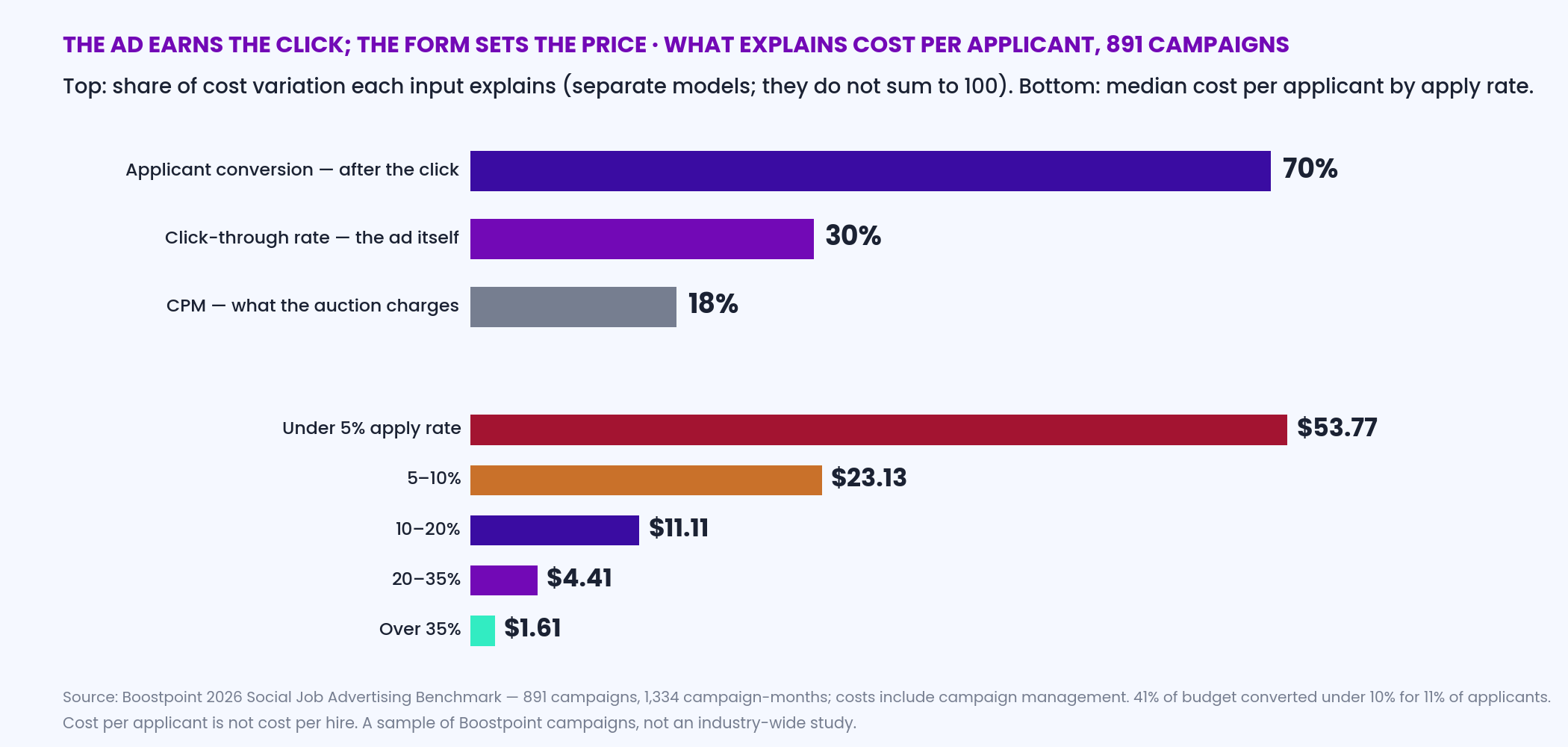
Employers grade job ads on clicks. Our data says grade them on what happens next. Across 891 campaigns and 1,334 campaign-months, the share of clickers who complete an application explains 70% of the variation in cost per applicant; how compelling the ad is (click-through rate) explains 30%, and what the auction charges for impressions explains 18%. The apply-rate bands make it concrete: campaigns converting fewer than 5% of clicks paid $53.77 per applicant; 5–10%, $23.13; 10–20%, $11.11; 20–35%, $4.41; over 35%, $1.61. Forty-one percent of all budget ran in campaigns converting under 10%, and it returned 11% of all applicants. Those campaigns were not badly written. They sent a good ad to a bad form. The in-app form we build is described on social media job advertising; role-by-role figures are on the frontline hiring benchmarks page.
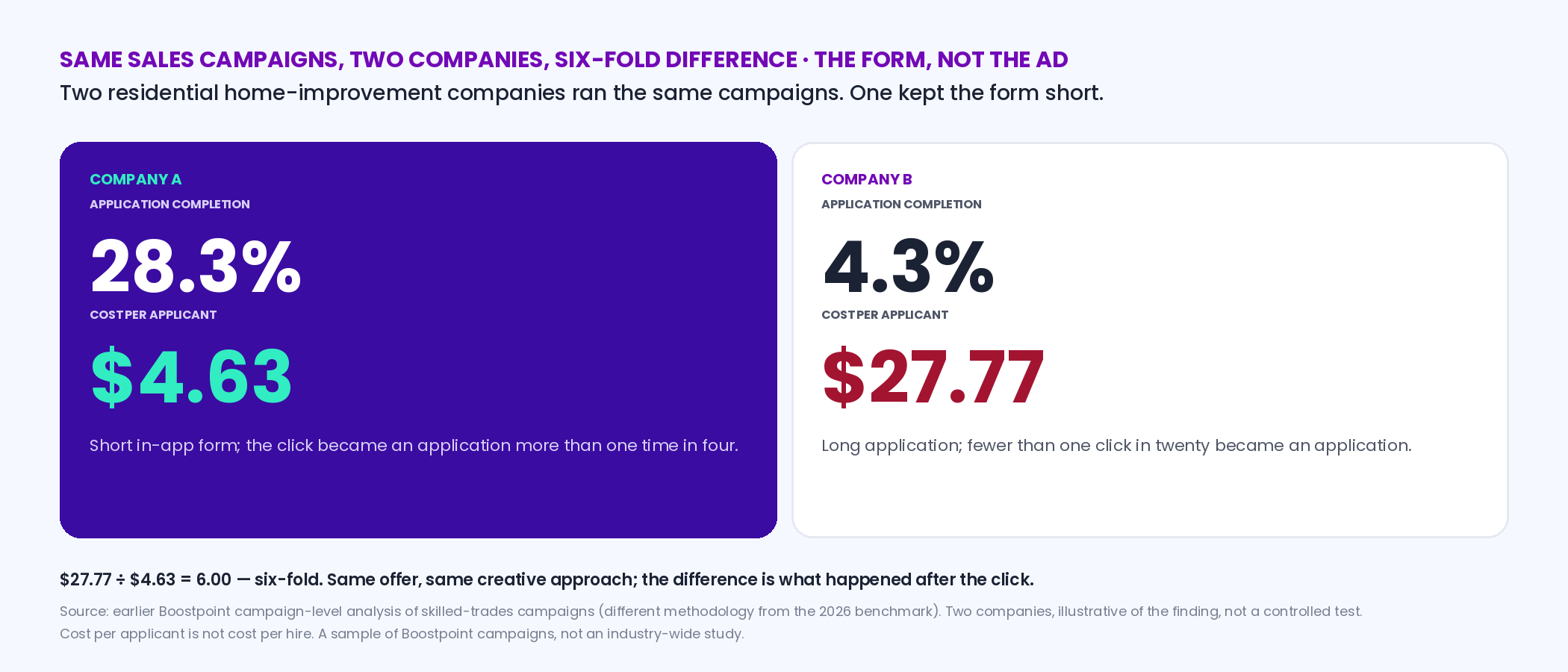
The clearest illustration we have comes from an earlier campaign-level analysis: two residential home-improvement companies ran the same sales campaigns — same offer, same creative approach — and one converted 28.3% of clicks at $4.63 per applicant while the other converted 4.3% at $27.77. Six-fold, on the form alone. Across trades contractors in the same analysis, application completion ranged from 3.5% to 18.6%; across healthcare settings, hospitals completed at 6.0% against 22.1% in senior living, because hospitals route the click into a long ATS application. A "good job ad" that ends at a twenty-minute form is a good ad you are paying too much for.
If this is one of the first roles the business has ever advertised, the administrative side of the hire has its own deadlines — the I-9 inside three business days, the state new hire report inside twenty. Our first-hire checklist for small businesses puts them on a calendar.
Good job ad examples, annotated
Three illustrative ads written for this page — no employer, no performance claim — with the reason each line is there.
CNA · skilled nursing
$21–$24/hr · 12-hour shifts, 3 on / 4 off · Reading, PA CNA on our memory care unit. Current PA CNA certification required. Shift differential for nights, paid weekly. Apply in 60 seconds — 3 questions, no résumé. We call the same day.
Why it works: the certification is the knockout question, not a paragraph; "3 on / 4 off" answers the schedule question a nurse asks first; the unit is named, so the applicant knows the work.
Diesel technician · fleet shop
$28–$36/hr by experience · Day shift, Mon–Fri · Harrisburg, PA Diesel tech for a 40-truck fleet: Cummins and Detroit, Class 8, our own tooling. Need your own hand tools and a valid driver's license. CDL a plus, not required. Apply in a minute from your phone.
Why it works: the engines and the truck class are named, which is how a tech judges a shop; the "plus, not required" line keeps qualified people from screening themselves out; day shift stated as the asset it is.
CDL-A driver · regional
$0.62–$0.68/mile, all miles · Home weekly · Out of York, PA Regional dry van, no touch freight, 2,200–2,600 miles a week. Class A CDL and 12 months OTR required. No SAP. Tap to apply — 4 questions, 60 seconds.
Why it works: drivers read rate per all miles and home time before anything else; miles per week turns the rate into a paycheck; the requirements are exactly the four knockout questions the form will ask.
Notice what none of them contain: "fast-paced environment," "rockstar," "we're like a family," "competitive pay," a paragraph about culture, or a link to a careers portal. Each of those either says nothing or says something the applicant has learned to read as a warning.
Three ads is enough to show the anatomy. If you want the pattern held across more of the roles you actually hire for, our help wanted ad examples library runs fifteen of them — trades, drivers, healthcare, restaurants and warehouse — each with its own teardown, plus the federal rule on the age words a help wanted notice may not use.
The other half of that block is the equal opportunity line. Which wording is actually required of you, and which of it is inherited habit, is in our EEO statement guide.
Grade a job ad
Paste an ad — yours or a competitor's — and the grader checks for the parts above and for the phrases that hurt. It reads words, not results; it can't tell you what an ad will cost. It can tell you whether the pay is missing.
Nothing is stored or sent — this runs in your browser. Paste the ad text as it would appear in the feed.
Checks: a dollar figure; a shift or schedule word; a place; a stated requirement; an application-time promise; days-off or pay-frequency detail; the role named; and the absence of "competitive pay," "fast-paced," "rockstar/ninja/guru," "like a family," and a careers-site send-off. Scoring is Boostpoint's; passing the grader is not a performance prediction. Employment ads must also follow Meta's Special Ad Category rules and applicable posting laws.
Job ad best practices that survive contact with the data
- Write the first line last. Draft the whole ad, then delete everything before the pay, the shift, and the town. That line is what gets read; the rest is what gets read if the line earned it.
- One requirement in the ad, three questions in the form. More requirements in the ad and qualified people screen themselves out; fewer questions in the form and unqualified people get through. The form is where the rest of the screening lives.
- Keep the form under a minute, and say so. The apply-rate bands are the whole argument: $53.77 per applicant under 5% conversion, $1.61 over 35%. Nothing you write in the ad moves cost as far as the length of the form.
- Use the real photo. The floor, the truck, the unit, the crew, taken this month on a phone. Stock imagery is the visual equivalent of "competitive pay."
- Say what happens next, then do it. "Someone calls you the same day" converts and then obligates you. Applicants who wait two days go cold, and the ad gets blamed.
- Don't target what the ad can say. Under Meta's Special Ad Category you can't select an audience by age, gender, or ZIP anyway. The first line does the selecting: the people the number and the shift fit will recognize themselves.
- Rotate before you rewrite. A good ad wears out from frequency, not from being wrong. Shoot the same offer with a different employee and a different first line, and swap when frequency passes 2.5.
A good job ad is a true first line, a real photo, and a promise about the form that the form keeps. The words decide who clicks. The form decides what you pay.
Job posting examples: the same seven parts, three different roles
The anatomy above uses a warehouse associate. Here it is applied to three other frontline roles from our own template library, with the part that carries the most weight in each. The pay figures are anchored to the published national median for the role so they are defensible rather than invented; substitute your own.
- CNA, night shift. “$22.50/hr + $2 nights · 12-hour nights, 3 on 4 off · Lancaster, PA. CNA — consistent assignment, 8 to 10 residents. Active PA certification required. Apply in 60 seconds, no resume.” The national median is $20.32 an hour, so a rate above it belongs in the first line. The part doing the work here is consistent assignment: for an experienced CNA it outranks almost everything except pay, and almost no posting says it. Full template on the CNA job description page.
- CDL driver, regional. “$0.62/mile · home every weekend · out of Harrisburg. Class A regional, dry van, no touch. Clean MVR and 12 months experience. Apply in 60 seconds — we call the same day.” Median pay for heavy and tractor-trailer drivers is $27.62 an hour. Drivers are the hardest audience we measure, at an 8 percent apply rate, so the promise about the form matters more here than anywhere: send a driver to a twenty-minute application and the ad was fine and the campaign was expensive. See CDL recruiting.
- Security officer, overnight post. “$19.75/hr · overnights, Fri to Mon · distribution yard, York. Security officer — access control and patrol. PA guard card required, we pay for renewal. Apply in 60 seconds.” Median is $18.29 an hour. The hard requirement is the card, and it should be the first knockout question rather than a surprise at interview. Naming the post type matters as much as the pay: a lobby post and an overnight yard share a job title and nothing else. See the security guard job description.
Three roles, one skeleton. Pay and place first, the role in the words the worker uses, the single hard requirement, the two facts about the week, and a promise about the form that the form actually keeps.
Frequently asked questions
Where can I find good job posting examples?
There are three annotated examples further up this page — a CNA role, a CDL driver role and a security role — each broken into the same seven parts so you can see which line is doing which job. Use them as a structure rather than as copy to lift: the parts transfer between roles, the specifics do not. If you are starting from a blank page rather than an existing advert, take the matching template from our job description templates first and write the advert from that.
What makes a good job ad?
Seven parts: the pay, shift, and town in the first line; the role named the way workers name it; the one hard requirement stated plainly; pay frequency and days off; an application-time promise ("60 seconds, no résumé"); a real photo of the workplace; and a button that opens a one-minute in-app form with three knockout questions rather than a careers site. In our 891-campaign benchmark, what happens after the click explains 70% of the difference in cost per applicant, so the form is part of the ad.
Should a job ad include the salary?
Yes, in the first line, as a number or a real range. A frontline applicant screens on pay before reading anything else, and "competitive pay" is read as below market. In a growing number of states and cities, posting a pay range is also a legal requirement; our job posting requirements page tracks which. Printing the number also does the audience selection that Meta's Special Ad Category no longer lets you do with targeting.
What makes a good hiring flyer?
The same things that make a good job ad, sized for paper. Put the pay, the shift and the work address near the top, large enough to read from a few feet away, name the role in the words the worker uses, and give one instruction: text this number, scan this code, or walk in on Thursday. A QR code should open a short form that works on a phone. Cut the mission statement, the legal small print and the stock photo.
How long should a job ad be?
Four or five lines for the feed: the first line with pay, shift, and place; one line naming the role and the work; one line for the requirement; one for pay frequency and days off; one for the ask and the time it takes. The job description belongs on the careers page, not in the ad. Everything the ad says must be true on the form and in the first phone call.
What is the difference between a job ad and a job description?
A job description is the full document of duties, requirements, and conditions for someone who has decided to apply. A job ad is the six seconds before that decision, read by someone who is employed and not searching. The ad's only job is to get the right person to tap; pasting the description into it is the most common way to write a bad one. Our job description templates cover the document; this page covers the ad.
Why do good-looking job ads still cost a lot per applicant?
Usually the form. Across 1,334 campaign-months, campaigns converting under 5% of clicks to applications paid $53.77 per applicant; over 35%, $1.61 — a 33.40-to-1 range on the same platform. In an earlier analysis two companies running the same sales campaigns differed six-fold on completion rate alone (28.3% at $4.63 vs 4.3% at $27.77). If the ad sends people to a twenty-minute ATS application, the ad was fine and the campaign is expensive.
What words should a job ad avoid?
"Competitive pay" (print the number), "fast-paced" (say the actual pace), "rockstar," "ninja," "guru" (say the job), "like a family" (applicants read it as unpaid overtime), and "apply on our careers site" (the click is paid for; the long form is where people leave). Also anything that indicates a preference by age, sex, or origin — unlawful in an employment ad regardless of platform.
Do job ad best practices differ by role?
The skeleton is the same; the specifics change. A CNA reads the certification and the shift pattern ("3 on / 4 off"); a diesel tech reads the engines and whether tools are provided; a CDL driver reads rate per all miles, miles per week, and home time; a machinist reads the controls and the axis count. In each case the first line carries the pay and schedule, and the one requirement becomes the first knockout question in the form.
How many knockout questions should the application have?
Three is the working number, four for roles with several legal requirements such as CDL driving. Each should be a real requirement of the job — a current license, availability for the shift, a legal minimum age where regulation sets one, the ability to perform an essential function with or without accommodation — and a "no" should end the application politely. Fewer, and unqualified applicants get through; more, and qualified ones leave.
Once the principles are settled, the job posting template turns them into a block you can fill in, with ten frontline examples and the pay-disclosure rules by state.
What images should a job ad use?
A recent phone photo of the real workplace: the floor, the truck, the unit or the kitchen, ideally with the crew doing the actual work on the actual shift. Skip stock photos and the logo on a plain background, which tell a worker nothing about the job. Keep the image uncluttered so it reads at thumbnail size on a phone, and ask employees before you feature them. The image mostly affects who stops and clicks; in Boostpoint's 2026 Social Job Advertising Benchmark, click-through rate explained 30% of the cost variation between campaigns, against 70% for what happened after the click.
Should the pay go on the job ad image?
For frontline roles, yes: put the hourly rate or range and the shift on the image itself, large enough to read at thumbnail size, as well as in the first line of the text. People scroll past the caption, and the number is the fastest qualifier you have now that employment ads on Meta cannot be targeted by age, gender or ZIP code. If a pay-transparency law applies where you hire, the figure on the image should match the range you actually pay.
See the ads that produced 891 campaigns' worth of applicants
We'll show you the ad and the form we'd build for your role, and the campaigns closest to yours — costs, no cost-per-hire claim we can't back.
Book a DemoBoostpoint figures come from the 2026 Social Job Advertising Benchmark — 891 campaigns and 1,334 campaign-months: $13.88 median cost per applicant, $8.02 volume-weighted average; applicant conversion explaining 70% of cost variation, click-through rate 30%, cost per thousand impressions 18% (shares from separate models; they do not sum to 100); cost per applicant by apply rate ($53.77 under 5%, $23.13 at 5–10%, $11.11 at 10–20%, $4.41 at 20–35%, $1.61 over 35%; 41% of budget in campaigns converting under 10% for 11% of applicants). The two-company comparison (28.3% completion at $4.63 vs 4.3% at $27.77, residential home-improvement sales campaigns), the trades within-book completion range (3.5%–18.6%), and completion by healthcare setting (hospital 6.0%, senior living 22.1%, home care 21.6%) come from earlier campaign-level analyses that use a different methodology from the benchmark. Pay in the first line, three knockout questions, the real photo, and same-day contact are Boostpoint's practice, not measured lifts. The example ads are illustrative, written for this page, name no employer, and carry no performance claim. We publish no comparison of video against photo creative. Cost per applicant is not cost per hire; we do not track hires and publish no cost-per-hire figure. Pay-transparency posting laws vary by state and city; verify before posting. This is a sample of Boostpoint campaigns, not an industry-wide study.