
Employer Branding on a Budget: Why It's a Tiebreaker for Frontline Roles, What Pay and Speed Do Instead, and the Five Assets a Small Business Can Build for Free
Employer branding is the reputation a company has as a place to work, and for frontline roles it is a tiebreaker, not the lever. The person you're hiring is employed, reads your ad in a feed for about a second, and decides on the pay, the shift and the town, then on how fast you call; across the 891 campaigns in Boostpoint's 2026 Social Job Advertising Benchmark, what happened after the click explained 70% of the difference in cost per applicant, and no part of that is a brand. A small business builds the brand that matters with five assets that cost nothing — the pay it prints, a real photo, a named manager, a same-day call, a first 90 days that keeps people — and a continuous presence in the feed that a normal campaign, $334 a month reaching about 6,061 people, already is.
Source: Boostpoint 2026 Social Job Advertising Benchmark — 891 Boostpoint-managed campaigns on Meta (1,334 campaign-months), 2026; costs are what advertisers paid for advertising only.
A note on who's writing this
Boostpoint runs recruitment ads on social platforms for employers, so we have a commercial interest in the feed and none in branding programs, and a page arguing that a small employer's brand is mostly its ad and its manager is a page arguing for what we sell. The figures are the published 2026 benchmark — 891 campaigns, 1,334 campaign-months — and the three campaign structures and the frequency bands are what the data drew. We don't track hires or retention, so every turnover figure here is a third party's, named and dated. The five assets are our practice; we have not measured any of them as an isolated lift, and we say so wherever one appears. No review-site statistic is quoted, because we couldn't find one with a primary source we could verify, and a page about honesty as a brand asset shouldn't open with a number it can't stand behind.
The case for employer branding, made first
The strong case is real and it's worth stating without the frontline caveat. For roles with a long consideration — an engineer, a nurse manager, a controller — candidates research the employer before they apply, and what they find decides whether they do; the brand is the funnel's first step. Reputation compounds: an employer people speak well of gets referrals, and referrals are the cheapest hire there is by every account, including Tenstreet's finding across roughly 5,000 carriers that a driver referred by another driver was 12 times more likely to be hired than the platform average. Retention is a brand: a place people stay is a place people recommend, and the alternative is expensive — Activated Insights put caregiver turnover at 75% in its July 2025 benchmarking report, and Work Institute's line is that over one-third of newly hired employees quit within their first year. And a bad reputation is a cost that shows up in the ad account: the same ad from an employer the town has heard about converts worse, and nothing in the copy fixes that. All of that is true. What the branding industry adds to it is the claim that a small employer should therefore fund a program — a careers site, a values video, an employer value proposition, a content calendar — and that is the claim this page disagrees with, because the people the small employer needs are not where the program is.
Why employer branding matters less than you were told for frontline roles
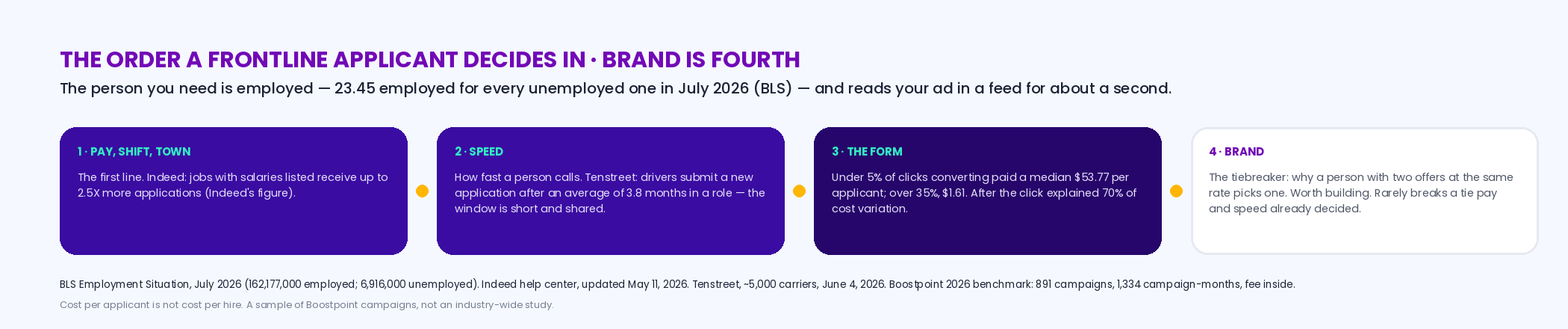
Start with who's hiring whom. In July 2026 the BLS counted 162,177,000 employed people and 6,916,000 unemployed — 23.45 employed for every unemployed one — so the warehouse associate, the CNA or the driver you need is almost certainly working somewhere else today. They are not browsing careers sites and they are not reading about culture. They see your ad between a cousin's photo and a marketplace listing, for about a second, and they decide on three facts: the pay, the shift, the town. Indeed's own figure is that jobs with salaries listed receive up to 2.5 times more applications — Indeed's number, from its help center — and in our data the first line with the number in it is where the ad is won. Then they decide on speed: an employed person who applies on Tuesday and hears nothing by Thursday has stopped being a candidate, and Tenstreet's data on drivers is that they submit a new application after an average of 3.8 months in a role, which means the window in which you're the employer they're considering is short and shared. Then the form: across 1,334 campaign-months, campaigns converting under 5% of clicks to applications paid a median $53.77 per applicant; over 35%, $1.61. Pay, speed, form. Brand enters at the end, as the reason a person with two offers at the same rate picks one — a tiebreaker, which is worth having and worth building, and which almost never breaks a tie that pay and speed already decided.
What a small business employer brand actually is: five assets, no agency
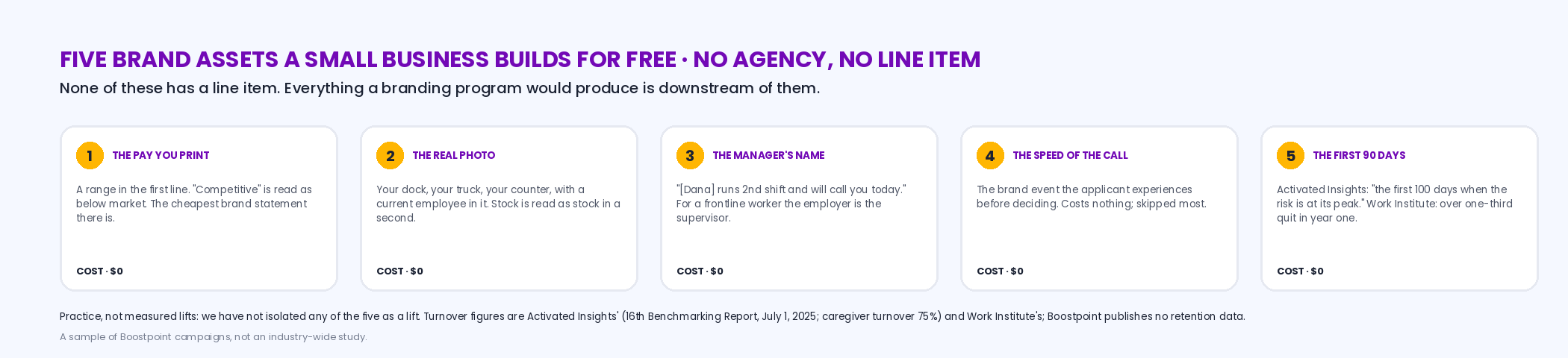
A small employer's brand is not a document. It's what a person in the town already knows about working there, and what the ad and the first week confirm or contradict. Five assets carry almost all of it, and none of them has a line item. The pay you print. An employer that puts the rate in the ad is, in the applicant's reading, an employer with nothing to hide; the one that writes "competitive" is read as below market. This is the cheapest brand statement there is and most employers withhold it. The real photo. The dock at shift change, the truck in the yard, the counter on a Saturday, with a current employee in it. People who do the work can tell stock photography in a second, and the real photo says the one thing a brand is supposed to say: this is what it's actually like. The manager's name. "Dana runs 2nd shift and will call you today" is a brand; "our team" isn't. For a frontline worker the employer is the supervisor, and naming the supervisor in the ad is a promise about who they'd be working for. The speed of the call. The same-day call is the brand event that matters most, because it's the one the applicant experiences before they've decided. It is also the one that costs nothing and gets skipped most. The first 90 days. Activated Insights' phrase for the early window is "the first 100 days when the risk is at its peak"; Work Institute's is that over a third of new hires quit within the first year. The employer whose new hires stay is the one the town talks about, and the first-90-days page has the cadence we use. Everything a branding program would produce — the values statement, the video, the page — is downstream of these five, and if the five are missing, the program is a description of an employer that doesn't exist.
Interactive
Brand asset audit — five questions about what a candidate in your town actually sees; get a score, the first line your ad currently makes, and the one asset to fix first
Nothing is stored or sent — this runs in your browser. The five assets and the scoring are Boostpoint's practice, not a measured lift; the score is a checklist, not a prediction.
—
of 10 · five assets, 0–2 each
—
The always-on presence: what a normal campaign already is
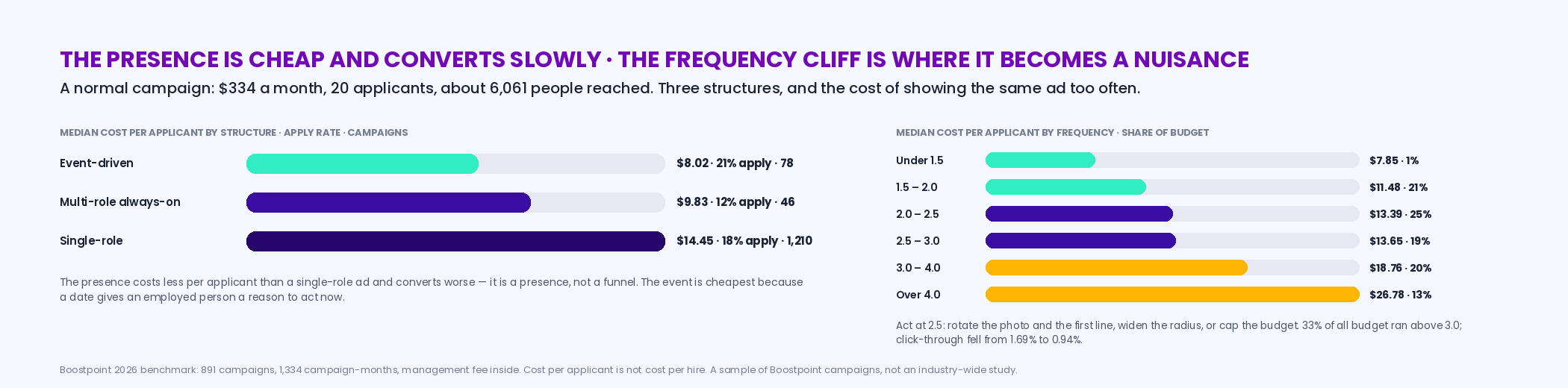
The part of employer branding that does need a budget is presence — being in the feed of the people who do the job for someone else, before you need them, so that the week you do they've already seen the dock and the rate. The honest thing about that budget is how small it is. A normal Boostpoint campaign runs about $334 a month, produces a median 20 applicants and reaches about 6,061 people: a continuous, small presence in the feeds of the people within driving distance who do that work. That's the employer brand program for a small business, and it's the one that also produces applicants. The benchmark splits campaigns three ways and the split is worth reading before spending. A multi-role always-on campaign — one campaign, several roles, running continuously — cost a median $9.83 per applicant with a 12% apply rate across 46 campaigns; a single-role ad cost $14.45 at 18% across 1,210; an event-driven campaign, built around a dated hiring day, cost $8.02 at 21% across 78. Read plainly: the always-on presence is cheaper per applicant than a single-role ad and converts worse, because it's a presence, not a funnel — people see it many times and act when the moment comes — and the event is cheapest of all because a date gives an employed person a reason to act now. The small-budget brand plan follows from that: a modest always-on presence for the roles you always need, single-role ads when a specific seat opens, and an open house when you need several at once.
One thing a presence must not become is frequency. A brand campaign in a small town saturates its audience fast, and the benchmark's frequency bands are the cost of letting it: campaigns showing the ad fewer than 1.5 times per person ran a median $7.85 per applicant; 1.5 to 2.0, $11.48; 2.0 to 2.5, $13.39; 2.5 to 3.0, $13.65; 3.0 to 4.0, $18.76; over 4.0, $26.78. Click-through fell from 1.69% to 0.94% across that range, and 33% of all budget ran above 3.0. "Always on" doesn't mean "always the same ad": the operating rule is to act at 2.5 — rotate the photo and the first line, widen the radius, or cap the budget — so that the presence stays a presence and doesn't become the ad everyone in town is tired of, which is the opposite of a brand. The calculator below splits a monthly budget between the presence and role-specific ads, and checks whether the budget is buying reach or repetition.
Interactive
Budget split calculator — a monthly budget, a share to the always-on presence, your sector and the size of the local audience; get applicants at each structure's benchmark median, the impressions the budget buys, and whether it's buying reach or repetition
Nothing is stored or sent — this runs in your browser. Applicant figures are illustrative: your budget divided by the benchmark medians for the always-on and single-role structures, and not a forecast.
—
÷ $9.83 median · illustrative applicants
—
÷ $14.45 median · illustrative applicants
—
budget ÷ CPM × 1,000
—
impressions ÷ people · act at 2.5
What the budget version leaves out, on purpose
A careers site, until the ad's form is three questions and the site is where people go after they've applied, not before. A values video, until there's a real photo; the video is the second thing, and a phone clip of the manager at the dock is the version we'd shoot. Review-site management, beyond answering the reviews that exist honestly and fixing the thing they name; we quote no figure on reviews because we couldn't verify one, but every employer knows what a page of one-star reviews from last year's crew does, and the fix is the first 90 days, not the response template. Awards and badges, which the applicant in the feed never sees. And the employer value proposition as a document — the exercise is useful, the document isn't; the proposition is the pay, the shift, the manager and the call, and it's already in the first line if the first line is right. The social job advertising page covers what the feed itself does; the referral page covers the channel a good brand feeds.
When brand is the lever after all
Three cases. A professional or managerial hire with a long consideration, where the candidate researches you first and the ad is only the door; there, the careers page and the reviews are the funnel, and this page's order flips. An employer whose reputation in the town is the problem — a plant that laid off the last crew, a home with a state citation in the paper — where no first line converts until the story changes, and the honest work is inside before it's in the feed. And a market where every employer pays the same and calls the same day, which is rarer than it sounds but exists; there the tiebreaker is the whole game, and the five assets are how a small employer wins it without a program.
Employer branding services: what an agency actually sells, and when to buy one
Search for employer branding services and you get three quite different offers wearing one label. Knowing which one you are being sold is most of the decision.
| What is sold | What you get | Typical fit |
|---|---|---|
| Research and positioning | Employee interviews, a written value proposition, messaging pillars, sometimes a survey | Large employers with several sites and a real internal disagreement about who they are |
| Creative production | Photography, video, careers-page design, templates | Anyone who lacks usable photographs of their own work — the most commonly worthwhile purchase |
| Always-on distribution | Ongoing paid campaigns that put the employer in front of a local audience | Employers hiring continuously, where the brand only matters because it is being shown to someone |
For a frontline employer under a few hundred staff, the honest order is: buy the photographs, write the four value-proposition lines yourself with the people who do the job, and put the money that is left into distribution. Research-led branding engagements are genuinely useful at scale and genuinely premature below it — an employer brand nobody in the county has seen is a document, not an asset.
- If you are comparing firms rather than deciding whether to hire one, employer branding agency sets out the four kinds and how each is priced. Ask what the deliverable is, in nouns. "A brand platform" is not a deliverable; twelve photographs, three videos and a careers page are.
- Ask who writes the value proposition. If the answer is not "with your supervisors and your best employees", the result will be generic.
- Ask how it will be shown to anyone. Distribution is the part that converts, and it is the part most branding proposals leave to you.
- Ask what happens in month four. Brand assets decay; the ones that keep working are the ones somebody keeps running.
The four lines themselves, and where they sit in an annual plan, are on talent acquisition strategy; the compressed public version that goes on an ad is on recruitment slogans.
Frequently asked questions
Employer branding best practices for hourly employers
Most employer branding best practices were written for companies competing for salaried professionals who research an employer before applying. Frontline applicants usually decide in a feed, in a few seconds, on pay, commute and shift. These eight survive that translation.
- Put the pay in public. The single strongest brand signal a frontline employer sends is a wage stated openly, because the alternative reads as something to be negotiated down.
- Use your own people, not stock. A photograph of the actual crew outperforms a produced image on believability, which is the only brand attribute that matters at this stage.
- Answer fast, every time. Reply speed is experienced as respect. An unanswered application does more brand damage than a weak careers page.
- Say one true difficult thing. Naming the hard part of the job filters out the people who would leave in week three and earns credibility with the ones who stay.
- Keep the five assets current. The set is listed above; an out-of-date one is worse than none, because it is checked.
- Answer your reviews. Not the angry ones only, and not with a template. A visible pattern of replies is read as a functioning management, which is what the reviewer is really being asked about.
- Be the same in the ad and on day one. The cheapest brand damage to avoid is a promise in an ad that the first shift contradicts.
- Leave it alone long enough to work. Brand assets compound over quarters. Rebuilding them every campaign is why most programs show nothing.
Measuring it is the part most guides skip, so here is the short version. Employer branding metrics worth keeping are ones you already generate:
| Metric | Where it comes from | What a change in it means |
|---|---|---|
| Cost per applicant, same role, same season | Your advertising reporting | The clearest available proxy. A brand people recognize converts attention more cheaply |
| Apply rate on the same ad | Campaign reporting | How many people who saw it were willing to start. Sensitive to recognition and to pay transparency |
| Referral share of hires | Your own hiring records | What your current staff say about you when nobody is watching |
| Offer acceptance rate | Hiring records | Whether what you promised matched what they found out later |
| Ninety-day retention | Payroll | The most honest brand measure there is, and the slowest |
Employer branding ROI for an employer this size is the movement in those five against what the work cost, measured over quarters rather than campaigns. Anyone offering a single brand score is selling the measurement rather than the result.
What is employer branding?
The reputation a company has as a place to work — what current employees, applicants and the town already believe about working there. For a small business it lives in five places: the pay printed in the ad, the real photo, the manager's name, the speed of the call, and whether new hires stay through the first 90 days. The careers site, the values video and the employer value proposition are downstream of those.
Why does employer branding matter?
Because it decides ties and it feeds referrals — Tenstreet found referred drivers 12 times more likely to be hired — and because a bad reputation makes the same ad convert worse. For frontline roles it matters less than the branding industry says: an employed applicant decides on pay, shift and town in a second, then on how fast you call, then on the form; in our benchmark what happened after the click explained 70% of cost variation, and none of that is brand.
How do you build an employer brand on a small budget?
Print the pay, use a real photo with a current employee in it, name the manager in the ad, call the same day, and plan the first 90 days with dates and an owner — all free — then keep a small always-on presence in the feed. A normal campaign in our benchmark runs about $334 a month and reaches about 6,061 people; a multi-role always-on campaign cost a median $9.83 per applicant. Those are our practice and our data respectively; we haven't measured the five assets as lifts.
Does a small business need a careers site for employer branding?
Not first. The applicant you need is employed, sees the ad in a feed and doesn't visit careers sites before applying; the site matters after they've applied, as the place that confirms what the ad said. Build the three-question form and the same-day call before the site, and keep the pay range on the site identical to the ad's.
What's the difference between employer branding and recruitment marketing?
Recruitment marketing is the ad, the audience and the form — the work that produces applicants this month. Employer branding is what the applicant already believes when the ad appears, and what the first week confirms. On a small budget they're the same five assets seen from two sides, and the always-on presence in the feed is where they meet.
How much should employer branding cost?
For a frontline employer, close to nothing beyond the presence. The five assets have no line item; the presence is a normal campaign, about $334 a month in our benchmark, split between an always-on campaign and role-specific ads as the calculator on this page shows. A program — agency, video, site, content — is the right spend for professional roles with a long consideration, and the wrong first spend for a warehouse.
Do employer reviews affect hiring?
Every employer's experience says yes, and we quote no figure because we couldn't verify one from a primary source. The response that works is not a reply template but the thing the reviews name — usually a manager or the first weeks — and the fix is the first 90 days. Answer the reviews that exist plainly; don't buy a program to bury them.
Can an always-on brand campaign run too much?
Yes, and the benchmark shows the cost: campaigns showing the ad fewer than 1.5 times per person ran a median $7.85 per applicant; over 4.0, $26.78; click-through fell from 1.69% to 0.94% across the range, and 33% of all budget ran above 3.0. In a small town a presence saturates in weeks. Act at 2.5 — rotate the photo and the first line, widen the radius, or cap the budget.
What do employer branding services include?
Usually one of three things: research and positioning, creative production such as photography and video, or always-on distribution. They get sold under one label, and knowing which you are buying is most of the decision.
Is an employer branding agency worth it for a small employer?
Buy the photography, write the value proposition yourself with your supervisors and best employees, and spend what is left on distribution. Research-led branding engagements pay off at scale and are usually premature for a single-site frontline employer.
What should I ask an employer branding agency before signing?
Ask what the deliverables are in nouns rather than concepts, who writes the value proposition, how the assets will actually be shown to candidates, and what keeps working in month four.
What is an employer brand campaign?
A time-bound run of paid and organic content about what it is like to work somewhere, aimed at people who are not currently applying — as distinct from a job ad, which asks for an application now. In frontline hiring the honest version is usually not a campaign at all but an always-on presence: the same five assets running continuously beside the recruitment advertising, which is what the section above describes.
Are employer branding campaigns worth it for frontline roles?
Rarely as a standalone spend, and often as a by-product. A frontline candidate decides on pay, schedule, commute and whether the place seems well run — and they learn the last one from your existing employees and your reviews, not from a campaign. The spend that reliably returns is the always-on presence plus fixing what the reviews say; a discrete branding campaign is the right call mainly when you are opening a new site, recovering from a reputation event, or hiring at a scale that outruns your local name recognition.
What are the benefits of employer branding?
Three, in the order they arrive. Advertising converts more cheaply when people recognize the name, because recognition removes a step. Offers are accepted more often when what was promised matches what candidates hear elsewhere. And people stay longer when the job matches the picture they were sold. The advantages of employer branding are real but slow; none of them arrive within one campaign, which is why it is a poor answer to an urgent opening.
How does employer branding help in recruitment?
By reducing how much persuading each ad has to do. Employer branding for talent acquisition works upstream of the campaign: the assets, the reviews and the consistency are already in place when someone sees the job, so the ad only has to carry the offer. Candidate experience is part of the same thing, since how you treat applicants is what they tell other people about working for you, and for frontline roles that circle is small and local.
What is the difference between employer branding and corporate branding?
Audience and promise. Corporate branding tells customers why to buy from you; employer branding tells workers why to work for you. Employer branding vs corporate branding matters practically because the two are often run by the same marketing team using the same assets, and the customer-facing story rarely answers what a candidate is actually asking, which is about pay, schedule, supervision and whether the place is run properly.
How does employer branding relate to an EVP?
The employee value proposition is the promise; the brand is how that promise travels. Employer branding and EVP work go wrong when they are done in the wrong order: an organization builds campaign assets before deciding what it is actually offering, and the assets end up saying what every competitor says. Decide the offer first. Our employee value proposition page covers how to write one for hourly roles.
What are the objectives of employer branding, and what usually gets in the way?
The objective is narrow: be known, and be accurately known, by the people you hire from. Everything else follows from that. The employer branding challenges that stop it are equally predictable, and mostly not creative: no budget separate from the advertising budget, no agreement internally on what the offer is, assets that go stale, and a gap between what the ad says and what the first week feels like. The last of those undoes the other three.
Where can I see employer branding examples?
We keep a set of them, with what each one is doing and what a smaller employer can copy, in our five employer branding examples. Read employer branding cases from large consumer brands with some caution: their budgets buy recognition that a regional employer cannot rent, and the transferable part is usually the specificity rather than the production.
Do you need an employer branding website or platform?
For most frontline employers, no. Employer branding platforms sell content management, review monitoring and careers site hosting, which are worth paying for when you hire at national scale. Below that, a single honest careers page, an up-to-date profile wherever your applicants already look, and a habit of answering reviews cover the same ground. Employer branding websites do not fail because they were cheap; they fail because they were built once and never updated.
What does employer branding look like in healthcare?
More specific than in most sectors, because candidates have more information and more choice. Employer branding healthcare workers respond to is about the things they ask about in the first two minutes: ratios, floating policy, scheduling, agency use, and whether management is present at night and on weekends. A campaign about compassion competes with every other provider in the region saying the same thing.
How does candidate experience affect employer branding?
It is most of it, for an hourly employer. Very few of your applicants will ever read your careers page, and almost all of them will experience how long it took you to reply, how the interview was handled and whether anyone told them no. Candidate experience and employer branding are the same thing seen from two sides, and the cheapest improvement available to most employers is answering everyone who applied.
Run the presence, keep the five assets
Bring the roles you always need, the rate you'll print and the manager who'll call. We'll build the always-on campaign and the role ads behind it, shoot the ad with your crew instead of stock, watch the frequency so the town never gets tired of you, and report every figure — and no retention number we didn't measure.
Book a DemoBoostpoint figures come from the 2026 Social Job Advertising Benchmark — 891 campaigns and 1,334 campaign-months: a normal campaign $334 a month, 20 applicants, 6,061 people reached; campaign structures event-driven $8.02 median cost per applicant, 21% apply rate, 78 campaigns; multi-role always-on $9.83, 12%, 46; single-role $14.45, 18%, 1,210; frequency bands under 1.5 $7.85, 1.5–2.0 $11.48, 2.0–2.5 $13.39, 2.5–3.0 $13.65, 3.0–4.0 $18.76, over 4.0 $26.78, click-through 1.69% to 0.94%, 33% of budget above 3.0, act at 2.5; conversion explaining 70% of cost variation; apply-rate bands under 5% $53.77, over 35% $1.61; sector CPMs retail/corporate $14.74, skilled trades $15.96, transportation $14.82, healthcare $25.18, behavioral and education $29.04. Third-party: BLS Employment Situation, July 2026 — 162,177,000 employed, 6,916,000 unemployed; Indeed, "How to Optimize Jobs from Your Career Site or ATS Directly on Indeed," updated May 11, 2026 — "Jobs with salaries listed receive up to 2.5X more applications," Indeed's figure; Tenstreet, approximately 5,000 carriers, June 4, 2026 — new applications after an average of 3.8 months, referred drivers 12 times more likely to be hired; Activated Insights 16th Benchmarking Report, July 1, 2025 — caregiver turnover 75%, "the first 100 days when the risk is at its peak"; Work Institute — "Over one-third of newly hired employees quit within their first year." No review-site statistic is used. Boostpoint is priced as a product subscription plus ad spend: the subscription is priced on job volume and quoted on a call, ad spend is separate and recommended at a minimum of $750 a month per job category, there is one bill, through Boostpoint, and every cost-per-applicant figure we publish includes campaign management. The five assets, the audit and the budget split are Boostpoint's practice; pay in the first line, the real photo, the named manager, the same-day call and the 90-day cadence are practice, not measured lifts. We publish no retention data. Cost per applicant is not cost per hire; we do not track hires and publish no cost-per-hire figure. A sample of Boostpoint campaigns, not an industry-wide study.
One of the cheapest employer-brand wins is being straight about the rota. Our guide to on-call pay laws covers when waiting time has to be paid and when it does not.