
Job Ad Copywriting: Copy-Paste Templates for Warehouse, CDL, Trades, Service and Sales Ads, a Job Posting Template, and the Rules Every Line Has to Pass
Job ad copywriting for frontline roles comes down to one line and one form: the first line carries the role in the words workers search, the pay as a number or a real range, the shift and the town; the form asks three questions and takes a minute. Everything else is optional. The reason is measured, not stylistic — across the 891 campaigns in Boostpoint's 2026 Social Job Advertising Benchmark, what happens after the click explained 70% of the difference in cost per applicant, and campaigns converting under 5% of clicks paid $53.77 per applicant against $1.61 over 35%. The templates below are written to that shape and to two sets of rules, Meta's Special Ad Category and the state pay-range laws, so they can be pasted, filled and run, with a job posting template further down for the board and the career site.
Source: Boostpoint 2026 Social Job Advertising Benchmark — 891 Boostpoint-managed campaigns on Meta (1,334 campaign-months), 2026; costs are what advertisers paid for advertising only.
A note on who's writing this
Boostpoint writes and runs job ads on social platforms for employers, so a page of job ad templates is a page of our own practice, and we say which parts are data and which are habit. The data is the published 2026 benchmark: 891 campaigns, 1,334 campaign-months, and the finding that conversion after the click explains most of the cost. The habits — pay in the first line, three knockout questions, a real photo of the workplace, a call the same day — are what we do, and we have not measured them as isolated lifts. Where a third party has a number, we quote it as theirs: Indeed says jobs with salaries listed receive up to 2.5 times more applications and that 36% of job seekers search by exact title. No template on this page asserts a wage; every pay figure is a bracket you fill, and where a pay-range law applies it has to be the range you'll actually pay. Nothing here is legal advice.
The case for the standard job posting, made first
The long posting that most employers already have — title, summary, responsibilities, qualifications, benefits, EEO statement — earns its place. It is what a job board's feed expects and what Google's job-listing structured data is built around; it holds the sections a pay-transparency statute or an OFCCP listing obligation wants to see in writing; it protects the employer, because a requirement that was in the posting is a requirement that was disclosed; and it tells a careful applicant what the job is before they spend an hour applying. For a salaried role with a résumé and a reference check, it is the right document, and the posting template further down this page is a version of it. What it is not is an ad. It was written to be complete, and a feed rewards something else: the one line a person reads in the second before they scroll. So the honest position is both. Keep the posting for the board and the career site; write the ad for the feed; make them agree on the pay, the shift and the place, because the applicant will see both.
The same principle governs the interview that follows the ad: ask about the requirement, not the person. We keep the federal rules on illegal interview questions quoted in full on their own page, including the two that run against the usual advice.
Two sets of rules every template obeys
Meta's Special Ad Category. Employment ads on Facebook and Instagram must be declared in the Special Ad Category, which removes age, gender and ZIP-code targeting and enforces a minimum location radius of 15 miles; our page on the category walks through every lock. The consequence for the copy is the central idea of this page: the words do the targeting. "CDL-A" in the first line reaches CDL-A holders; "$[low]–$[high]/hr" reaches people comparing rates; "2nd shift" reaches second-shift people. The copy can select on the job's requirements and never on the person's demographics, which is also the law off Meta: the EEOC's summary is that "it is illegal for an employer to publish a job advertisement that shows a preference for or discourages someone from applying for a job because of his or her race, color, religion, sex (including transgender status, sexual orientation, and pregnancy), national origin, age (40 or older), disability or genetic information," and its example is that an ad seeking "females" or "recent college graduates" may discourage men and people over 40 from applying. Pay in the posting. A growing list of jurisdictions requires the pay range in the posting itself: as of this writing fourteen are in effect — Colorado, California, Washington, New York, Hawaii, the District of Columbia, Maryland, Illinois, Minnesota, New Jersey, Vermont, Massachusetts, Virginia and Maine — with Connecticut's posting requirement taking effect October 1, 2026 and Delaware's in 2027, each with its own employee-count threshold. The job posting requirements page has the table with sources and dates. Every template below puts a range in the first line, so the ad is compliant where the law applies and merely better where it doesn't.
How to write a job posting that attracts: the first line, then four more
Write the first line last. Draft the ad, then delete everything before the pay, the shift and the town, because that is where the reader starts and, for most, where they stop. The formula is [Role, in the worker's words] · $[low]–$[high]/[unit] · [shift or schedule] · [town], and the reason it comes first is that the person deciding whether to leave a job they already have screens on those three facts before reading a word about culture. Pay is a number or a real range: "competitive" reads as below market, "DOE" reads as a negotiation you'll lose, and "up to $[X]" is a ceiling, not a range, in the states that require one. Then four lines. The work, in a sentence a worker would use: "picking and packing, no forklift," "regional dry van, no-touch freight," "residential service calls, truck and phone provided." The one hard requirement, stated plainly, because it becomes the first knockout question in the form and filters before you pay for an application. The two facts about the week — pay frequency and days off — which are worth more than a benefits paragraph to someone with a job. The ask and how long it takes: "three questions, 60 seconds, no résumé," a promise the form must then keep, since a form that takes ten minutes after an ad that promised one is the single fastest way into the under-5% band. Meta's Ads Guide recommends 50 to 150 characters of primary text and a 27-character headline for the feed; the templates fit, and the builder counts as you type.
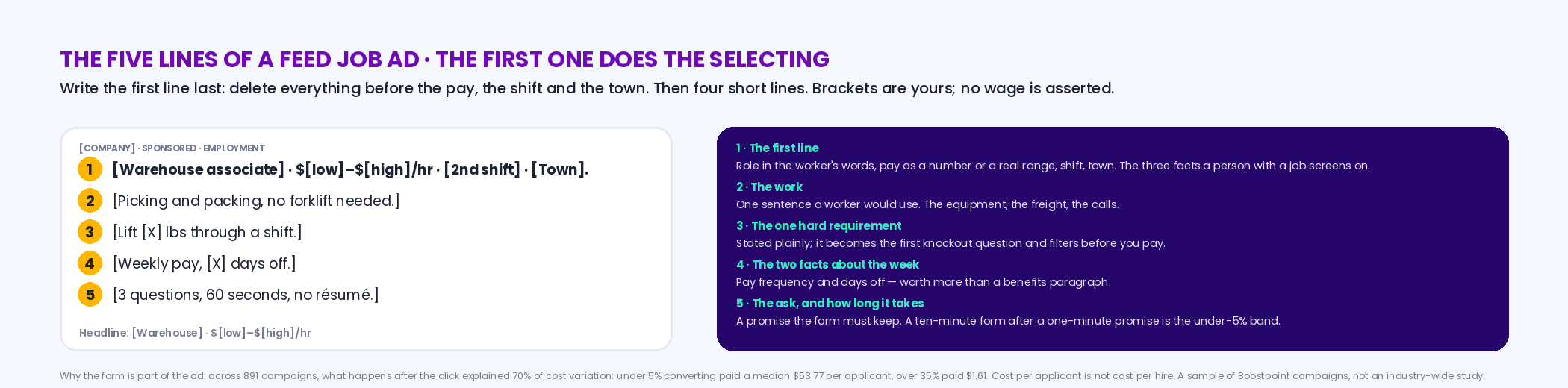
Two more habits, both ours and neither measured as a lift. The photo is the actual workplace — the dock at shift change, the truck, the panel, the counter — with an employee in it, not stock; people who do the work can tell in a second. And the ad names the day the manager will call, and then the manager calls, because the applicant applied to two other employers in the same sitting. The measured part is the form: the apply-rate bands are the whole argument, and they are on the conversion page in full.
The words do the targeting: a title translator
Indeed's figure is that 36% of job seekers search by exact job title, and on a social platform where demographic targeting is locked, the title in the first line is the targeting. A "Material Handler II" ad reaches people who know they are a Material Handler II, which is nobody who doesn't already work for you; a "Warehouse associate" ad reaches the people you meant. The rule is to name the job the way the person doing it names it to a friend: strip the level, the grade and the words "associate," "specialist," "professional" and "ambassador" unless they're the job, and put the tool or the license in the title when the tool or the license is the job — "forklift operator," "CDL-A driver," "diesel mechanic." Type a title below and see what we'd run instead.
Interactive
Title translator — type the title from your posting; get the name workers search, the first line we'd write with it, and the reason
Nothing is stored or sent — this runs in your browser. Thirty-two common posting titles are in the list; anything else gets the rule instead of a match. The translations are Boostpoint's practice, not a measured lift.
—
—
One rewrite is not optional in California. Its Fair Chance Act regulations prohibit any statement in an advertisement that a person with a criminal history will not be considered, which is why our page on ban the box laws by state spends as long on ad copy as it does on application forms.
The rewrite table: what fails, what to write instead, and which rule reaches it
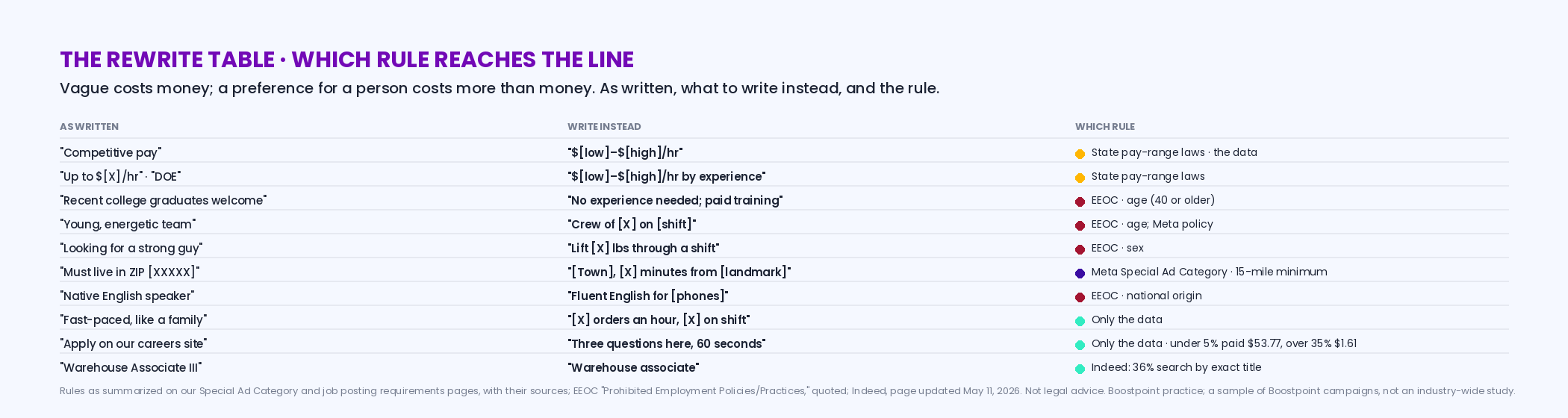
Most of the copy that costs money is not illegal; it's vague. Some of it is both. The table sorts the common lines by which rule reaches them — an anti-discrimination rule, a platform rule, a posting law, or only the data — because the fix is the same but the urgency isn't.
| As written | Write instead | Why | Which rule |
|---|---|---|---|
| "Competitive pay" | "$[low]–$[high]/hr" | Reads as below market; the applicant screens on the number first | State pay-range laws where they apply; otherwise the data (apply-rate bands) |
| "Up to $[X]/hr" or "DOE" | "$[low]–$[high]/hr by experience" | A ceiling isn't a range; several statutes require a good-faith range or scale | State pay-range laws (the table) |
| "Recent college graduates welcome" | "No experience needed; paid training" | The EEOC's own example of an ad that may discourage people over 40 | EEOC — age (40 or older) |
| "Young, energetic team" | "Crew of [X] on [shift]" | Age preference in the adjective; the fact you meant is the crew size | EEOC — age; Meta's employment-ad policy |
| "Looking for a strong guy" | "Lift [X] lbs through a shift" | A sex preference standing in for a physical requirement; state the requirement | EEOC — sex |
| "Must live in ZIP [XXXXX]" | "[Town], [X] minutes from [landmark]" | ZIP targeting is locked in the category; the town does the work | Meta Special Ad Category (15-mile minimum radius) |
| "Native English speaker" | "Fluent English for [phones / safety briefings]" | "Native" points at national origin; the job needs fluency, not birthplace | EEOC — national origin |
| "Fast-paced, like a family" | "[X] orders an hour, [X] people on shift" | Describes nothing; the number and the crew do | Only the data |
| "Apply on our careers site" | "Three questions here, 60 seconds" | The send-off to a portal is where conversion dies | Only the data: under 5% converting paid $53.77; over 35%, $1.61 |
| "Warehouse Associate III" | "Warehouse associate" (grade in the posting) | Nobody searches the grade; the title is the targeting | Indeed's 36%-by-exact-title figure; Meta's targeting locks |
The templates: seven role families, one ad each
Each card is one feed ad — primary text within Meta's recommended 150 characters, a headline within 27 — plus the three knockout questions for the form and the photo we'd shoot. The benchmark line on each card is the role family's median cost per applicant, its apply rate, and the number of campaigns behind it, from the 2026 benchmark; it tells you what the family cost to reach, not what your ad will cost, and it is not a cost per hire. Brackets are yours; nothing in a bracket is a number we assert. The differentiator — the one thing you offer that the employer down the road doesn't — is the line to change most, and if you can't name one, that's the finding. Caregiver, CNA, LPN and RN ads are on the healthcare templates page; the channel for each role is on the best way to recruit.
Warehouse associate
Benchmark $9.83 · 20% apply · 82 campaignsWarehouse associate · $[low]–$[high]/hr · [2nd] shift, [Mon–Fri] · [Town]. Picking and packing, no forklift needed. Weekly pay. 60-second application, no résumé.
Role in the worker's words, range, shift, days, town, the work in five words, pay frequency, the promise. No forklift needed is a requirement stated in the negative — it widens the pool on purpose.
Warehouse · $[low]–$[high]/hr
1. Which shift can you work: [1st / 2nd / 3rd]?
2. Can you lift [X] lbs through a shift?
3. Best number and time to reach you?
The dock at shift change, one employee in a vest, the racks behind — yours, not stock.
CDL-A driver
Benchmark $26.86 · 8% apply · 59 campaignsCDL-A driver · $[low]–$[high]/mile, all miles · Home [weekly] · Out of [Town]. [Regional dry van], no-touch freight, [year]+ trucks. Apply in 90 seconds.
Drivers screen on pay unit and home time before anything else; "all miles" answers the question they'd otherwise ask. The credential in the first two characters is the targeting.
CDL-A · $[low]–$[high]/mile
1. Do you hold a current CDL-A?
2. Months of verifiable experience: [0–6 / 6–12 / 12+]?
3. Home time you need: [daily / weekly / two weeks]?
Your truck, your yard, one of your drivers. The tractor's year is in the ad; the photo should agree.
Maintenance or field technician
Benchmark $13.41 · 16% apply · 145 campaignsMaintenance tech · $[low]–$[high]/hr · Days, Mon–Fri · [Town]. [Plant / fleet], [equipment brands], our own tooling. [Cert] a plus, not required. 2 questions.
Technicians read the equipment list the way nurses read the unit; name the brands. "A plus, not required" keeps the credentialed and the almost-credentialed both in the pool, and the form sorts them.
Maintenance tech · $[low]+/hr
1. Years on [equipment type]: [0–2 / 2–5 / 5+]?
2. Do you hold [cert]? (Not required)
3. Best number and time to reach you?
The line or the bay with the equipment named in the ad in frame, and the tech who works on it.
Skilled trades — electrician, plumber, HVAC (one family)
Benchmark $14.14 · 15% apply · 35 campaigns[Electrician] · $[low]–$[high]/hr · Mon–Fri, no weekends · [Town]. [Residential service], truck and phone provided, [license] required. Weekly pay. 60-second apply.
Swap the trade and the license and the card holds. We publish one cost figure for the whole trades family because 69% of trades applications in our data weren't labeled by trade, so no per-trade cost is claimed here.
[Electrician] · $[low]–$[high]/hr
1. Do you hold a [state] [license / card]?
2. Years in [residential / commercial]: [0–2 / 2–5 / 5+]?
3. Best number and time to reach you?
The truck with your name on it and the tradesperson who drives it, in a driveway, not a studio.
Customer service representative
Benchmark $2.71 · 25% apply · 24 campaignsCustomer service rep · $[low]–$[high]/hr · [Days / evenings], on-site · [Town]. Phones and chat for [what]. Paid training, [X] weeks. No experience needed. 60 sec.
The cheapest family to reach in the benchmark and the one most often sunk by a long form. Say on-site or remote in the first line; it's the second thing this pool screens on.
Customer service · $[low]/hr+
1. Can you work [days / evenings / weekends]?
2. Have you worked phones or chat before? (Not required)
3. Best number and time to reach you?
The floor with headsets on, daylight if you have it, and the trainer who runs the [X]-week class.
Sales rep or appointment setter
Benchmark $11.61 · 21% apply · 100 campaignsAppointment setter · $[base low]–$[base high]/hr + $[X] per set appointment · [Days] · [Town]. Setting for [what]. Paid training. Apply in 60 seconds.
Print the base as a range and the commission as a rule, not a story: "top setters earn" is a claim about someone else. Where a pay-range law applies, the base range is what it reaches; state the commission plan alongside it.
Setter · $[base]/hr + $[X]/appt
1. Have you sold or set appointments by phone before? (Not required)
2. Can you work [days / evenings]?
3. Best number and time to reach you?
The team on the floor mid-shift, or the product being sold in the customer's home — not a handshake.
Shift lead or supervisor
Benchmark $16.87 · 16% apply · 50 campaignsShift lead · $[low]–$[high]/hr · [2nd] shift · [Town]. Run a crew of [X] on [what]. [X]+ months lead or supervisor experience. Weekly pay, [X] PTO days. 90 sec.
The management family costs more to reach than the crews it leads because the pool is smaller; the crew size and the shift are the two facts a lead screens on, and the experience line becomes the first knockout.
Shift lead · $[low]–$[high]/hr
1. Months leading a crew or shift: [0 / 1–12 / 12+]?
2. Which shift can you run: [1st / 2nd / 3rd]?
3. Best number and time to reach you?
A current lead with the crew, on the floor, at the start of the shift named in the ad.
The job posting template: for the board and the career site
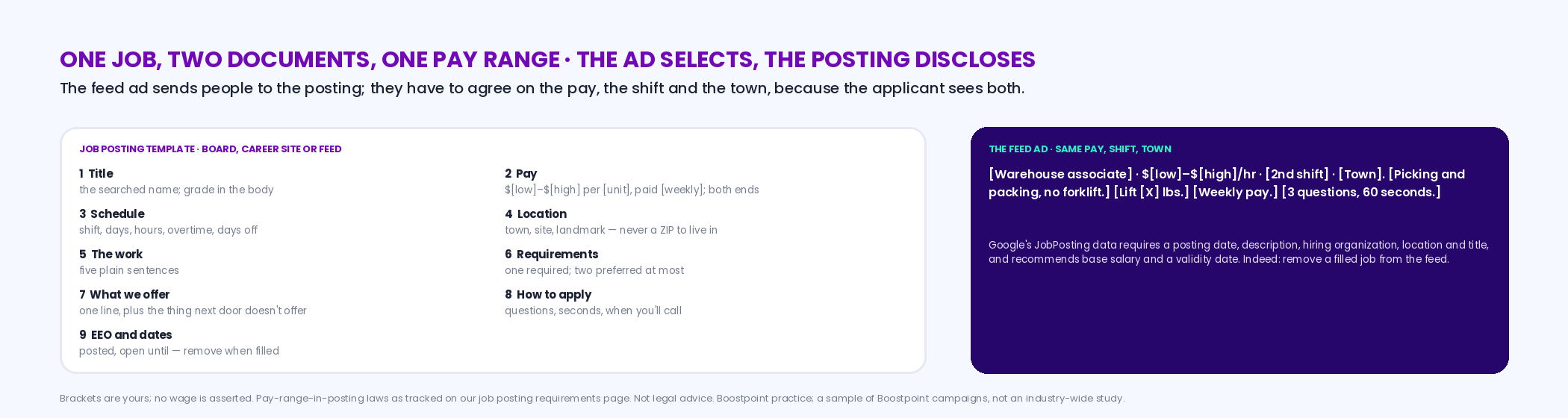
The ad above sends people somewhere, and where it sends them should agree with it. This is the long-form posting for a job board, an ATS career page or a feed to an aggregator, in the order a worker reads and a statute checks. It carries the sections Google's job-listing structured data requires — a posting date, a description, the hiring organization, the location, the title — and the ones it recommends, including base salary and a validity date, and it comes down when the job fills, because Indeed's instruction is to remove a filled job from the feed and Google's is that expired listings can draw a manual action; the distribution page has both in their own words. Fill the brackets; keep the pay range identical to the ad's; delete the sections you don't need rather than padding them.
[Warehouse associate] — [Town], [State]
Indeed: 36% of job seekers search by exact job title. "Warehouse associate" is searched; "Material Handler II" isn't.
$[low]–$[high] per [hour / mile / year], paid [weekly / biweekly] · [shift differential, if any] · [commission or bonus rule, if any]
A range with both ends, in the posting, where a pay-range law applies; the same range as the ad everywhere else.
[Shift], [days] · [hours per week] · [overtime practice] · [days off]
[Street address or site], [Town], [State] · [on-site / hybrid / remote] · [X] minutes from [landmark]
The town, the site and a landmark — never a ZIP code the applicant must live in.
[Five plain sentences: what a shift looks like, what you'd handle, who you'd work with, what the equipment is, what a good week is.]
Required: [the one hard requirement — license, certification, physical requirement stated as the task, minimum age where a law sets one].
Preferred, not required: [two at most].
The required line is the first knockout question. Every "preferred" is a person who scrolls past; keep two.
[Benefits in one line] · [paid training, length] · [equipment provided] · [the one thing the employer down the road doesn't offer]
[Three questions, X seconds, no résumé] · We call [the same day / within one business day] · Start date: [date]
The promise the form has to keep. In our benchmark, what happens after the click explained 70% of cost variation.
[Your EEO statement, as counsel wrote it.] Posted [date] · Open until [date] — remove when filled.
Google's JobPosting data needs a posting date and recommends a validity date; Indeed says remove a filled job from the feed.
One job, three formats: the builder
Every job needs the same facts in three shapes: a feed ad for the platform, a posting for the board and the career site, and a short message for the text a manager sends to a referral or last season's crew. Enter the facts once. The builder writes all three, counts characters against Meta's recommendations, and scans your entries for the words in the rewrite table — a ceiling instead of a range, an age or sex word, a ZIP code, "competitive," "DOE" — before you paste anything anywhere.
If you would rather start from a finished ad than from a blank builder, we keep a library of help wanted ad examples — fifteen of them across trades, drivers, healthcare, restaurants and warehouse work, each with the reason every line is there and a before-and-after rewrite.
Interactive
One job, three formats — enter the role, pay, shift, town, the work, the requirement and the ask; get the feed ad, the posting block and the referral text, with character counts and a rules scan
Nothing is stored or sent — this runs in your browser. The defaults are illustrative placeholders, not a wage claim; replace every one. The scan reads words, not results.
—
Headline:
—
—
The templates above assume you are running the ads yourself. If you would rather not, social media job advertising covers the same work end to end, from the ad build through applicant delivery.
When a template is the wrong tool
Three cases. A salaried professional role — an accountant, an engineer, a nurse manager — is read by people who want the long posting and will judge you on it; run the posting, and use the ad only to send them there. A role you can't state a range for, because pay is set in an interview you haven't had, isn't ready to advertise in fourteen jurisdictions and will underperform in the rest; settle the range first. And a role whose real differentiator is the manager — a small shop where the crew stays because of who runs it — needs the manager in the photo and one sentence in their voice more than it needs any line on this page. The template gives you the shape; the specifics are the only part that was ever going to work.
Catchy job posting phrases (and the ones to retire)
Ask for catchy phrases for job postings and most lists hand back the same twenty stock lines, which is why so many help-wanted ads in the same town read identically. What follows is shorter and organized by what the line has to do, because a phrase is only catchy if it is doing a job the next line cannot.
- Open on the money: “$24/hr, and we post the rate because you would ask anyway.” · “Starting at $19. Not ‘up to’. Starting.”
- Open on the schedule: “Home every weekend.” · “Out by 10, every night.” · “Four tens. Three-day weekend, every week.”
- Open on the barrier you removed: “No experience. We train. We pay you while we do.” · “Apply in 60 seconds, no resume.”
- Open on the reader’s current job: “If your last shift ran two hours over and nobody mentioned it, read this.” · “You already do this job. We pay $3 more for it.”
- Close with one action: “Comment DRIVE and we will call you today.” · “Walk in Tuesday, 9 to 3. Bring your ID.”
Three phrases to retire, because frontline applicants have learned to read them as warnings: join our family, which is heard as unpaid extra hours; competitive pay, which is heard as below market or you would have said the number; and fast-paced environment, which is heard as short-staffed. None of them is untrue in every case, but none of them is catchy either, and each costs you the readers who have been burned before.
Catchy and funny hiring ads that still convert
Funny hiring ads work when the joke is doing a job: stopping the scroll for the one second it takes to read the pay, the shift and the town. They fail when the joke is the ad. The pattern below keeps the humor to one short sentence and puts the same first line the templates use straight after it, so a reader who doesn’t laugh still gets the facts. Each example fits Meta’s recommended 150 characters of primary text as written; brackets are yours, and no wage is asserted.
- Forklift operator: “Our forklift has a name. You’ll learn it day one. Forklift operator · $[low]–$[high]/hr · 1st shift · [Town]. Certified on our dime. 60-second apply.” The joke is about the job, and it tells a new operator the place is small enough that the equipment has a name.
- CDL-A driver: “Your dog still remembers you. Let’s keep it that way. CDL-A · $[low]–$[high]/mile · home every weekend · out of [Town]. Apply in 90 seconds.” Home time is what drivers screen on, so the joke is the home time. It only works if home every weekend is true.
- HVAC technician: “It’s 97 degrees and every AC in [Town] quit at once. HVAC tech · $[low]–$[high]/hr · truck and tools provided · [license] required. 60-second apply.” A tech reads it and nods, because it is their July. Run it in the season it describes.
- Line cook: “Out by 10. Your friends at other kitchens will ask how. Line cook · $[low]–$[high]/hr · closed [Sundays] · [Town]. Walk in [Tuesday], 2 to 4.” The schedule is the joke and the offer at once. A cook who closes at 1am knows exactly what it means.
- Customer service rep: “You already explain things to people who didn’t read the email. Get paid for it. Customer service rep · $[low]–$[high]/hr · days · [Town].” It names the skill the reader already has in their current job, which is the whole pitch for a no-experience role.
- Warehouse associate: “We call back today. Not in 5–7 business days. Today. Warehouse associate · $[low]–$[high]/hr · [2nd] shift · [Town]. 3 questions, 60 sec.” Attention-grabbing because it is a promise nobody else in the feed makes. The manager then has to call the same day.
Four rules keep a catchy hiring ad from costing you applicants. Joke about the job, never about a kind of person. “Young, energetic team” and “looking for a strong guy” are lines the rewrite table above flags for age and sex, and a laugh doesn’t make them legal. The joke has to be true. “Home every weekend” that turns out to mean most weekends is the fastest way to lose a driver in week two. No rockstars, ninjas or unicorns. They describe nothing, and frontline workers read them as a sign you don’t know the job. The form still decides the cost. Humor is our practice, not a lift we have measured; what we have measured is that conversion after the click explained 70% of the difference in cost per applicant across the 891 campaigns in the 2026 benchmark, so an attention-grabbing ad in front of a ten-minute application still tends to land in the bottom two apply-rate bands. Run the funny version and the plain version side by side and keep whichever one fills the form. For the organic version of the same idea, see our hiring post examples.
Frequently asked questions
Job posting format: the same content, five different layouts
“What is the format for a job posting?” is usually asked as though there is one answer. There is one set of content — the blocks are on the job posting template page — and five different layouts, because the same posting has to survive a job board, a careers page, a social feed, a printed flyer and a Word document that somebody emails around. Getting the layout wrong is what makes a perfectly good posting underperform on one channel and work fine on another.
| Destination | Format that works | Where people get it wrong |
|---|---|---|
| Job board listing | Title, one-paragraph summary, then short bulleted blocks with subheadings. Pay and location in the first two lines. | Burying the pay and the schedule under three paragraphs of company boilerplate |
| Careers page on your own site | The same, plus structured data so the page is eligible to appear in Google's job listings, and one apply button above the fold | A PDF. A PDF is not a web page and cannot be indexed as a job posting |
| Social feed ad | No headings and no bullets at all. Three to five short lines, the first one doing all the work, then the apply prompt | Pasting the board version in. On a feed the reader is not searching, so the first line has to stop them |
| Printed flyer or window card | Six words of headline, the pay, the shift, a phone number or QR code. Nothing else | Trying to fit the full posting onto a sheet of paper nobody stops walking to read |
| Word or Google Doc for internal circulation | Plain headings, no tables, no columns, no text boxes | Text boxes and multi-column layouts, which survive neither a paste into a job board nor a colleague's older version of Word |
Two format rules apply everywhere. Put the pay and the schedule above the point where the page is cut off — on most boards that is roughly the first 300 characters and on mobile it is less. And keep the whole posting between about 300 and 700 words. Under 300 and it reads as thin or as a scam; over 700 and the parts that decide the application are below the fold on a phone.
One more thing worth knowing about the Word version, because it is the format most often asked for and the most likely to break. If you build a job posting template in Word with text boxes, tables or columns, it will look correct on your screen and turn into scrambled plain text the moment somebody pastes it into a job board's description field. Build it with ordinary headings and paragraphs, keep bullets as real list items, and it will paste cleanly into every destination in the table above.
How do you write a job ad that attracts applicants?
Put the role in the words workers search, the pay as a number or a real range, the shift and the town in the first line; add the work in a sentence, the one hard requirement, pay frequency and days off, and the ask with how long it takes; then keep the form to three questions. In our 891-campaign benchmark, what happens after the click explained 70% of cost variation — campaigns converting under 5% of clicks paid $53.77 per applicant, over 35% paid $1.61 — so the form is part of the ad.
What words attract applicants?
For hourly jobs, the words that attract applicants are the specific ones: the pay figure ("$19/hr," not "competitive pay"), the schedule ("home every weekend," "out by 4," "four tens"), "weekly pay," "no experience needed, we train," "apply in 60 seconds, no résumé," and the town or neighborhood. The words that repel them are the ones frontline workers have learned to read as warnings: "competitive pay," heard as below market; "join our family," heard as unpaid extra hours; "fast-paced environment," heard as short-staffed; and "rockstar" or "ninja," which say nothing about the job. The rewrite table above turns each weak line into one that works.
Should a job ad include the pay?
Yes, in the first line, as a range with both ends. Fourteen jurisdictions now require a pay range in the posting itself, with Connecticut following on October 1, 2026 and Delaware in 2027, and Indeed reports that jobs with salaries listed receive up to 2.5 times more applications — Indeed's figure. Putting pay first is our practice, not a lift we've measured; "competitive pay" reads as below market to the person screening on the number.
What is a job posting template?
A fixed order of sections for a board or career-site listing: the searched title, the pay range and pay frequency, the schedule, the location by town, the work in plain sentences, one required and at most two preferred qualifications, what you offer, how to apply and when you'll call, and the EEO statement with posting and removal dates. The one on this page maps to Google's JobPosting properties and to Indeed's feed rules, and it is meant to agree with the feed ad on pay, shift and place.
How long should a job ad be?
For a social feed, one line that carries the pay, shift and town, then four short lines: Meta's Ads Guide recommends 50 to 150 characters of primary text and a 27-character headline, and the templates here fit. The posting for a board can be as long as the sections need, but the requirements list should stop at one required and two preferred; every extra line is someone who scrolls past.
What words can't you use in a job ad?
Anything that shows a preference for or discourages an applicant by race, color, religion, sex, national origin, age (40 or older), disability or genetic information — the EEOC's summary, whose own example is an ad seeking "females" or "recent college graduates." On Meta, employment ads also run in the Special Ad Category with no age, gender or ZIP targeting and a 15-mile minimum radius, so the ad can't name a ZIP an applicant must live in. State the requirement, never the person.
Do these templates work on Indeed and other job boards?
The posting template does; it's written for boards, career sites and feeds and carries the fields Google's job-listing data and Indeed's feed expect. The feed ad templates are written for a social feed, where the person isn't searching and the first line has to do the selecting. Use both, keep the pay range identical, and take the posting down when the job fills.
Why don't the templates cover every trade separately?
Because we publish one cost figure for the whole skilled-trades family — a median $14.14 per applicant, 15% apply rate, 35 campaigns — since 69% of trades applications in our data weren't labeled by trade, and a per-trade cost would be a guess. The trades card works for any licensed trade by swapping the trade and the license; the copy rule doesn't change.
How is this page different from the good-job-ad page?
That page is the anatomy and the principles, with a grader that scores an ad on seven parts. This page is the copy: seven role-family templates you can paste, a long-form posting template, the rewrite table sorted by which rule reaches each line, a title translator, and a builder that writes the feed ad, the posting block and the referral text from one set of facts. Healthcare templates have their own page.
If you would rather start from a filled-in structure than a blank page, our job posting template and examples gives you the nine blocks in order.
What is the format for a job posting?
One set of content, five layouts. A board listing wants the title, a one-paragraph summary and short bulleted blocks, with pay and location in the first two lines. A careers page wants the same plus structured data and an apply button above the fold. A social ad wants three to five short lines with no headings at all. A flyer wants six words, the pay, the shift and a phone number or QR code. A Word version wants plain headings and no text boxes.
How long should a job posting be?
Between about 300 and 700 words in most frontline categories. Below 300 it reads as thin or as a scam. Above 700 the details that actually decide the application — pay, schedule, location — are pushed below the fold on a phone. Whatever the length, the pay and the schedule need to be inside roughly the first 300 characters, because that is what most job boards show before the description is cut off.
Is there a job posting template for Word?
You can build one, and the format rule matters more than the wording: use ordinary headings, paragraphs and real bulleted lists, and avoid text boxes, tables and multi-column layouts. A Word template built with text boxes looks right on your screen and turns into scrambled plain text when it is pasted into a job board's description field, which is where most postings eventually end up.
What makes good recruitment ad design?
For a social feed, recruitment ad design means an image or short video that does three things before anyone reads the caption: shows the actual workplace, carries the pay and the role as large text, and fits the placement (vertical 9:16 for Stories and Reels, 4:5 for the feed). A phone photo of your own dock, truck or floor with a current employee in it beats a stock handshake, keep the text to a few words so it reads on a small screen, and make two or three versions so you can rotate them as the audience tires. The design also has to be lawful: the EEOC says it is illegal to publish a job advertisement that shows a preference for or discourages someone from applying because of a protected characteristic, which covers who is pictured as much as what is written. The templates above give the copy and the photo for each role.
Have us write and run them
Bring the job, the range and the shift. We'll write the first line the way the templates do, build the three-question form behind it, shoot the ad with your crew instead of stock, and run it in the Special Ad Category where the words do the targeting — we report and no cost per hire we didn't measure.
Book a DemoBoostpoint figures come from the 2026 Social Job Advertising Benchmark — 891 campaigns and 1,334 campaign-months: conversion after the click explaining 70% of cost variation, click-through 30%, CPM 18%; apply-rate bands under 5% $53.77, 5–10% $23.13, 10–20% $11.11, 20–35% $4.41, over 35% $1.61; median $13.88 per applicant, $8.02 volume-weighted; role-family medians warehouse $9.83 (20% apply, 82 campaigns), CDL $26.86 (8%, 59), technician $13.41 (16%, 145), skilled trades $14.14 (15%, 35; one family, 69% of trades applications unlabeled by trade), customer service $2.71 (25%, 24), sales $11.61 (21%, 100), management $16.87 (16%, 50). Third-party, verified August 27, 2026: EEOC, "Prohibited Employment Policies/Practices" (job advertisements paragraph, quoted); Indeed, "How to Optimize Jobs from Your Career Site or ATS Directly on Indeed," updated May 11, 2026 ("36% of job seekers search by exact job title"; "Jobs with salaries listed receive up to 2.5X more applications" — Indeed's figures); Meta's Ads Guide character recommendations; Meta Special Ad Category limits and the state pay-range table as summarized on our own pages, with their sources. Boostpoint is priced as a product subscription plus ad spend: the subscription is priced on job volume and quoted on a call, ad spend is separate and recommended at a minimum of $750 a month per job category, there is one bill, through Boostpoint, and every cost-per-applicant figure we publish includes campaign management. Templates, the title list and the builder are Boostpoint's practice with placeholders; no wage is asserted; pay in the first line, three questions, the real photo and same-day contact are practice, not measured lifts. Nothing on this page is legal advice. Cost per applicant is not cost per hire; we do not track hires and publish no cost-per-hire figure. A sample of Boostpoint campaigns, not an industry-wide study.