
Recruitment ad examples and recruitment advertising samples
"Help wanted ad", "recruitment ad", "job advertisement", "employee advertisement" and "recruiting ad" are five names for the same artefact, and the fifteen examples above are all of them. The naming does matter in one narrow way: a recruitment advertisement usually implies a campaign — one ad running against a budget across a channel — while a help wanted ad implies a single posting. The copy is identical; the difference is whether anyone is paying to put it in front of people who were not looking.
Three sample shapes cover almost every recruitment advertisement you will need, and each has a different job to do.
Sample 1 — the direct offer
CDL-A Drivers — $1,450 a week, home every night, Lancaster County
Dedicated route, no touch freight, out at 5 and back by 4. Two years' experience, clean MVR. We pay weekly and we answer the phone. Text DRIVE to 00000 and we will call you back today.
Pay, geography, schedule, requirement, next step. Five lines, no adjectives. This is the highest-converting shape in our data across every frontline role family, and it is the one most employers skip because it feels too plain.
Sample 2 — the problem-first ad
Tired of being the only one who shows up?
We are hiring three experienced framers for a crew that is already full of people who do. $26–$34 an hour depending on whether you can run the job, weekly pay, trucks and tools provided, work within 30 minutes of the shop. Apply in two minutes — no resume needed.
Opens on the candidate's situation rather than the company's need. Works best on social, where the ad has to earn a stop in the feed. The risk is that a problem-first line with no pay behind it reads as manipulation, so the number has to be in the second sentence.
Sample 3 — the proof ad
Marisol started here as a dietary aide in 2021. She is a CNA now, and we paid for it.
We are hiring CNAs and dietary aides for day and evening shifts at our Manheim campus. $18.50–$23.00 an hour, shift differential for evenings, certification paid for anyone who wants it. Come see the building before you decide — walk-ins welcome Tuesday and Thursday, 2 to 5.
Uses one real person and one verifiable fact. Proof ads underperform direct-offer ads on raw apply rate and outperform them on retention at 90 days, which is the trade most employers should want.
How to write a job ad
The job description is the document that lives in your ATS. The job ad is what runs in a feed, on a board or on a sign, and it is a different piece of writing with a different job: get the right person to stop, and give them enough to decide. Here is the order that works.
1. Lead with the pay. Not "competitive pay". A number or a range. Every test we have run, in every role family, says the same thing: the ad with the number outperforms the ad without it, and it is not close. If you cannot publish a number, you have a compensation problem rather than a copywriting one.
2. Put the geography in the first line. Frontline candidates filter on commute before anything else. A town name beats a metro name, and a metro name beats a state.
3. Say the schedule out loud. Shift, days, start time, weekends, on-call. This is the fact most often withheld and the one most likely to cause a first-week quit.
4. Name one requirement, not seven. The ad is a filter with one hole in it. Put the disqualifying requirement — the license, the experience floor, the clean record — in the ad and leave the rest for the application.
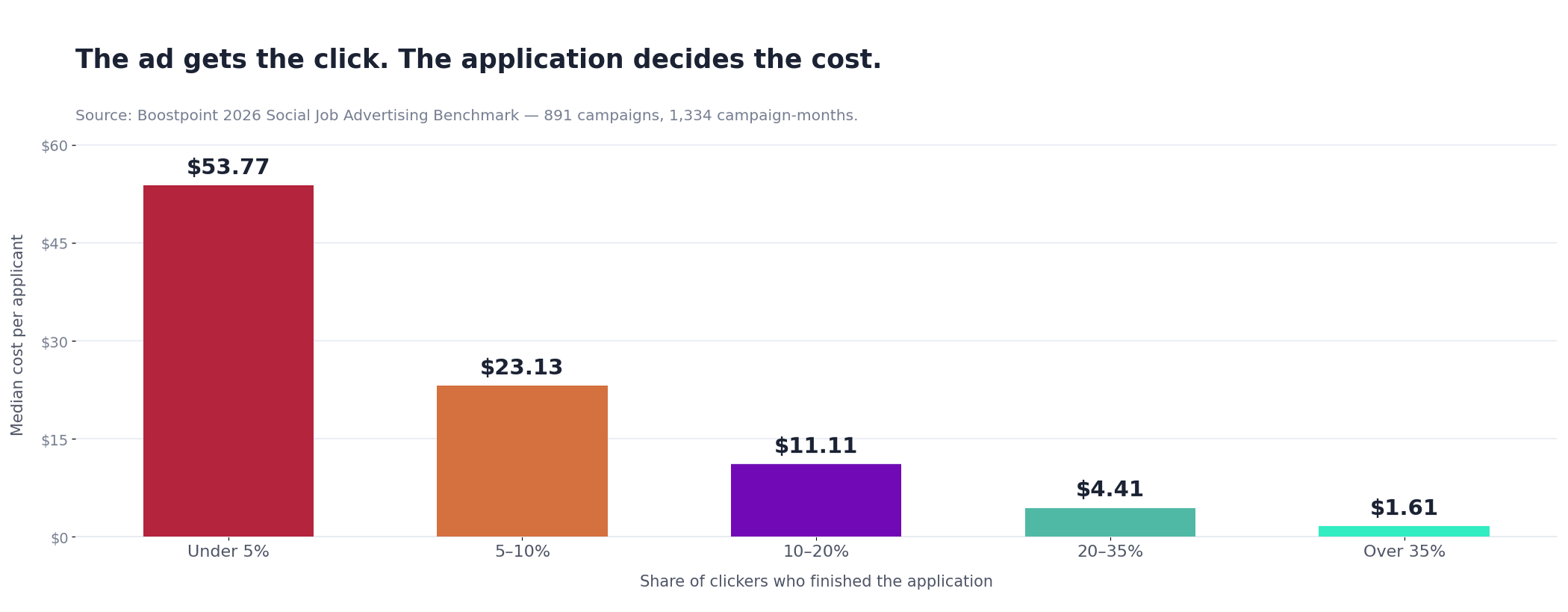
5. Make the next step take under two minutes. Text-to-apply, a four-question form, a phone number that a human answers. Every extra field costs completions, and in our benchmark data the apply rate is the single biggest driver of what an applicant costs: campaigns converting over 20% of clicks paid $4.41 an applicant, campaigns under 10% paid $53.77.
6. Keep it between 200 and 400 words. Under 200 and the ad is missing a decision fact; past about 700 the apply rate falls away.
The types of job advertisement worth knowing apart: the posting (a board listing, found by people searching), the paid social ad (interruption, found by people who were not looking), the internal or referral ad (written to be forwarded), and the sign or print ad (read at a distance, so one offer and one instruction only). The same job needs different copy in each, and the most common mistake is running the posting text as the social ad.
Hiring slogans, recruitment slogans and taglines
A hiring slogan is the one line that sits above the offer — on a sign, a truck door, a booth banner or the first line of a social ad. It cannot do the work of the pay figure, and it is not a substitute for a schedule, but it buys the half-second in which someone decides whether to read the rest. Twenty that work, grouped by what they are actually claiming.
Pay and stability
- Paid weekly. Every week. No exceptions.
- Overtime is available. It is never mandatory.
- The raise is on the schedule, not on a mood.
- Same pay in January as in June.
- Full-time hours, all year, in writing.
Respect and the crew
- Work with people who show up.
- Your name, not your badge number.
- The owner still knows everyone's first name.
- Small crew. No politics.
- Nobody here got hired by an algorithm.
Growth
- Start on the crew. Run the crew.
- We pay for the certification. You keep it.
- Every supervisor here started on the floor.
- Come for the job, stay for the trade.
- Learn a skill nobody can take back.
Speed and respect for the candidate's time
- Apply today. Interview tomorrow. Start Monday.
- Two minutes to apply. No resume.
- We answer every application within 24 hours.
- No ghosting. Ever. From either side.
- Text us. We will text back.
One rule about all twenty: a recruitment slogan is a promise, and a promise that the first week breaks costs more than no slogan at all. "We answer every application within 24 hours" is the best-performing line on this list and the most dangerous — it works because almost nobody does it, and it stops working the moment you do not.
What makes the best help wanted ad ever written
The ad usually cited is Ernest Shackleton's 1914 recruitment notice — small wages, bitter cold, constant danger, safe return doubtful, honor and recognition in case of success. There is no evidence it was ever actually published, and it is quoted far more often than it is understood. What it does right is not the bleakness. It is that every line is a specific, falsifiable claim about the job, in the order a candidate cares about, with the hardest fact first and no adjective doing work a fact should do.
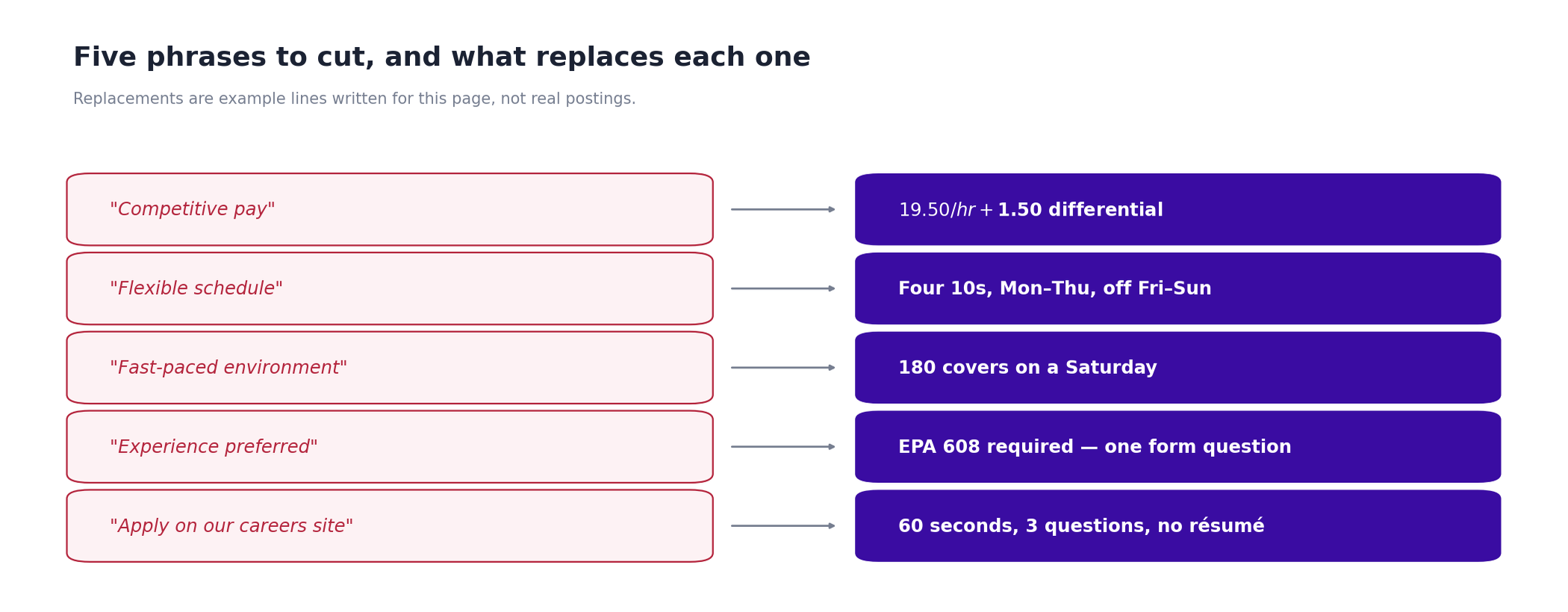
Apply that test to your own ad. Cross out every line that could appear in any other employer's posting — "fast-paced environment", "competitive pay", "team player", "growth opportunity". If what remains is shorter than four lines, the ad is not a help wanted ad yet, it is a category description.
Help Wanted Ad Examples: 15 Ads That Get Answered, and Why
A help wanted ad is not a shortened job description. It is a recruiting advertisement that has to survive a thumb moving at speed, so it states the pay, the shift and the place before it says anything about culture. Below are fifteen ads written for this page — real formats, invented employers — each with the reason every line is there, plus a before-and-after rewrite you can work through.
A note on who's writing this
Boostpoint writes and runs recruitment ads on Facebook and Instagram for employers hiring hourly and frontline workers, so we are not neutral about what a good one looks like. Two rules keep this page useful anyway. Every employer below is invented — no real brand, no performance claim attached to any specific ad. And every figure we cite about what ads cost or convert comes from our published 2026 benchmark report, which you can read without giving us an email address.
Two neighboring pages do different jobs and this page does not repeat them: job ad copywriting owns the method, and what makes a good job ad owns the anatomy and carries a grader you can paste your own ad into. This page is the library: the finished thing, fifteen times, with the reasoning shown.
What a help wanted ad is, and what it is not
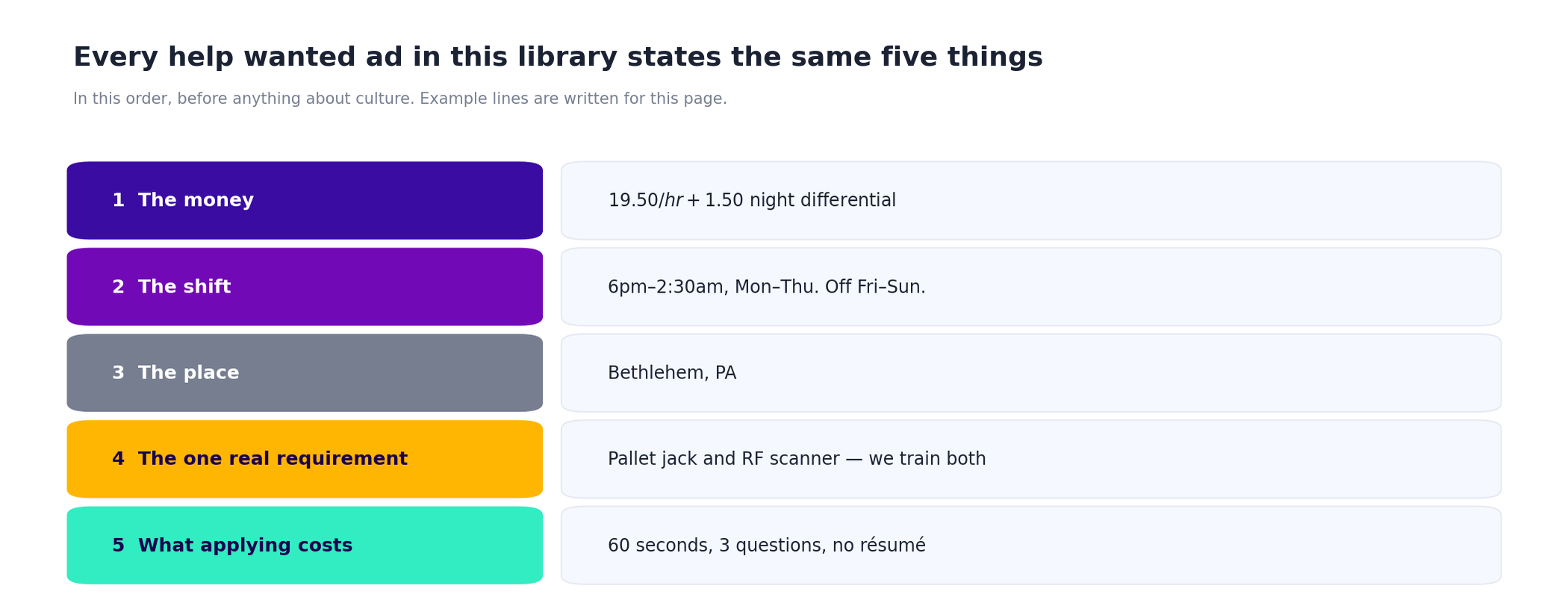
A job description is a document: it lives in your applicant tracking system, runs to several hundred words, and its job is to be complete. Our job description templates cover twenty-four roles in that format. A help wanted ad is the opposite — read in about two seconds by somebody who was not looking for a job, competing with everything else in the feed. Every line has to earn its place, which is why the ads below state the same five things and almost nothing else:
- The money, on the basis the worker compares — per hour, per mile, per week, with the differential named.
- The shift, as it will actually appear on a schedule, including which days are off.
- The place, as a town rather than a company address.
- The one real requirement, phrased as the question the form will ask.
- What applying costs — how long, how many questions, and when somebody calls back.
Need the long version rather than the ad? Our free job description generator builds the full posting for twelve frontline roles in about a minute — the document that goes in your applicant tracking system, which the ads below are then written from.
The library: fifteen help wanted ads
Skilled trades
Drivers
Healthcare and senior living
Restaurants and frontline service
Warehouse and production
Job posting examples, job posting samples, job advertisement templates: one thing, three names
People arrive at this page searching for all three phrases and they want the same object: a short piece of copy that makes somebody apply. The fifteen above are job posting examples. Read as samples, they are also the template — because what makes them work is the order of the lines, and that order is the same for every role.
| Line | What goes in it | The mistake |
|---|---|---|
| 1. The job and the place | Role, employer, and the town or site — not the metro area | “Greater Dallas area” when the site is in Mesquite. People filter by commute first. |
| 2. The pay | A number or a range, with the differential if there is one | “Competitive pay.” It reads as below market, because the employers paying above market say so. |
| 3. The shift | The actual pattern: days, hours, rotation, weekends | Leaving it out and discovering at interview that the candidate cannot work it |
| 4. The one reason this job is better | Whatever is genuinely true — the equipment, the route, the crew, the training | Listing five benefits nobody reads instead of one they remember |
| 5. What happens next | How to apply and how fast someone will call | “Apply now” with no indication anyone is at the other end |
That is the whole template. Anything you can write into those five lines belongs in the posting; anything you cannot belongs in the job description, which is a different document doing a different job — ours is at the job description generator. If you want the physical version for a window or a break room, the printable shapes are on recruitment flyer templates.
Before and after: the same job, rewritten
Most help wanted ads are not badly written — they are written to the wrong specification, as a condensed job description rather than an advertisement. Pick a role to see both versions and exactly what changed.
What most employers post
What we would run
Funny job ads: when humour helps, and when it costs you applicants
People look for funny job ad examples because they have seen one go around and want the same thing to happen to them. It is worth being clear about what actually happens when it does, because the mechanism that makes an ad shareable is not the mechanism that makes it fill a shift.
Humour raises the click. It does not raise the application. A joke pulls in everyone who enjoyed the joke, most of whom are not looking for work and will not fill in a form, and the cost of that gap is the largest single lever in the whole channel. In our campaign data, the campaigns where more than 35% of the people who clicked went on to finish the form delivered applicants at $1.61. The campaigns where fewer than 5% finished delivered them at $53.77. A funny ad with a weak offer lands in the second group, and it lands there while looking like a success in the engagement column.
Where humour actually works
In the first line, as the hook, followed immediately by the concrete part. The joke buys you the two seconds; the pay rate and the shift are what convert them. What fails is humour as the whole ad, where the offer never arrives.
| Version | Copy | What happens |
|---|---|---|
| Joke as the payload | "WANTED: someone who can survive our chaos. Must love coffee, dad jokes and the occasional dumpster fire. Think you can hang? Apply within." | Shares well. Reads as a warning about the workplace. The candidate learns nothing about pay, hours or location, so the people who do apply are guessing. |
| Joke as the hook | "Our last dishwasher left to open his own restaurant. We're not bitter. $17/hr, 4pm–11pm Wed–Sun, paid weekly, Elm Street. Apply in two minutes." | Same voice, same warmth, and every fact a person needs to decide. The humour earns attention and the offer converts it. |
Three ways funny ads go wrong
- The joke is about the job being hard. "Must survive our chaos", "not for the faint of heart", "we work hard and play harder" all read to an experienced frontline worker as understaffed, disorganized and short on breaks. That is not a joke to someone who has worked in a kitchen that was actually like that.
- The joke is internal. If it only makes sense to people who already work there, it is a staff post, not an advertisement.
- The joke covers a fact that should be stated. Humour is fine in the hook and wrong in the terms. Pay, hours, location and requirements are read literally by candidates and, if it ever comes to it, by a regulator. Do not be funny about any of them.
The short version: write it in a real voice, put a human line at the top, and then say what the job pays and when it starts. That combination outperforms both the joke that never gets to the point and the notice that was never worth reading.
Announcement and sign variants
Three formats sit next to the feed ad and fail for the same reason — they get treated as notices rather than advertisements.
| Format | What it is for | What changes from the feed ad |
|---|---|---|
| Now hiring sign or poster | Passers-by who already know where you are | The place is redundant, so drop it and spend the space on pay and shift. Add a QR code that opens the application directly, not the careers page — a sign with a URL somebody has to type is a sign nobody answers. |
| New-opening announcement | A new site, line or department, usually hiring several roles at once | Lead with the opening date and the number of roles, then list roles with their pay bands. Resist one ad for "all positions" — it is read by nobody in particular, because nobody applies for all positions. |
| Job fair or open house | Getting people through a door on one day | The date, time and address become the first line, and the offer becomes "interview and decision on the spot" rather than the wage. Our job fair alternatives page has the arithmetic on whether the day is worth running at all. |
What you cannot put in a help wanted ad
Three rules bind almost every ad above, and two of them catch people out.
Age language is regulated by name. The federal rule on help wanted notices, 29 CFR 1625.4, states that they "may not contain terms and phrases that limit or deter the employment of older individuals" and names the offenders directly: "terms such as age 25 to 35, young, college student, recent college graduate, boy, girl, or others of a similar nature violate the Act." Notably, the same rule treats a preference for older workers differently — "over age 60, retirees, or supplement your pension" are given as permissible. If your bus driver ad says "great for retirees", that is fine; if your warehouse ad says "young energetic team", it is not.
Pay ranges are required in a growing list of places. Our job posting requirements page tracks which — and every ad above states pay anyway, because it is the highest-value line regardless of the law.
Employment ads run under Meta's Special Ad Category, so age, gender and detailed location targeting are unavailable and the minimum radius is wide. The consequence is the point of this page: the words do the targeting. Our Special Ad Category page has the mechanics.
This is a summary of published rules read in August 2026, not legal advice. Employment law varies by state and city, and one review of your standard ad wording by counsel is worth more than checking every posting.
Recruiting ads for Facebook and Instagram
A help wanted ad is read by someone who went looking. A recruiting ad on Facebook or Instagram is seen by someone who didn’t, scrolling on a phone, and it has to earn a closer look before the thumb moves on. The facts stay the same; the order and the packaging change. Meta splits the ad into parts and each has one job. The primary text above the image carries the pay and the place in its first line, because the rest sits behind “See more”. The headline under the image says what tapping does. The image or video shows the actual workplace. And the form does the screening, because employment ads can’t be targeted by age, gender or ZIP code. Here are three ads from the library above, rewritten for the feed.
Each version keeps the form to two or three questions and keeps the applicant inside the app. The next section shows what that does to the cost of an applicant.
Which of these actually gets finished
An ad's job is not to be admired; it is to produce a completed application. Across 891 campaigns and 1,334 campaign-months in our benchmark, the split by completion rate is stark: campaigns where over 35% of clickers finished the form delivered applicants at $1.61 each and used 6% of budget to produce 28% of all applicants, while campaigns under 5% completion delivered them at $53.77. The median campaign overall cost $13.88 per applicant and the volume-weighted average was $8.02.
What separates the bands is what happens after the click: post-click conversion explains about 70% of the variation, against about 30% for click-through rate and 18% for what the auction charges. That is why every ad above ends with a promise about the application rather than a careers-site link. The conversion rate page has the detail, and the grader scores your own copy against these parts.
Fifteen ads, one pattern: say the number, say the hours, say the town — then make applying cost less than reading the ad did.
Creative, funny and catchy hiring ads — and when they backfire
A creative hiring ad earns attention it would not otherwise get. It also, reliably, attracts people who liked the joke rather than the job. Whether that trade is worth it depends on one number: what a completed application costs you in that role.
For a caregiver campaign at a median of $3.76 per applicant, a wider top of funnel is cheap and a funny ad that triples the click-through is a bargain. For a CDL driver campaign at $26.86, where only 8% of clickers finish the form, paying for clicks from people who enjoyed the pun is the most expensive mistake in the category. Be creative where applications are cheap and specific where they are dear.
What actually makes a hiring ad catchy, in the campaigns that worked, is rarely a joke. It is a concrete, slightly surprising detail — a real wage with the shift differential attached, a schedule posted four weeks ahead, "we pay for your CDL", "shoes and scrubs provided", "no experience, we train you in eight weeks". The specificity is the creative. A generic ad with an exclamation mark is not a creative ad; it is a generic ad.
Two constraints before you write anything funny. The ADEA advertising rule at 29 CFR 1625.4 prohibits terms such as "young", "college student" and "recent college graduate" in a help-wanted notice, which rules out a good deal of would-be playful copy. And in fourteen jurisdictions a pay range now has to appear in the posting itself — see the job posting template for where.
Frequently asked questions
Two pages pair with this one. The single line that goes on the ad image — the thing that stops the scroll before any of the copy is read — is on recruitment slogans, with sixty written out by trade. The short six-block job ad template is the skeleton every example on this page is built on.
Recruitment advertisement examples: the paid social versions
Everything above is written as a help wanted ad: a notice, for a window, a board or a job posting. A recruitment advertisement example on paid social is a different object, because it has to survive a person who was not looking for a job and did not ask to see it. Three shapes do most of the work.
- The pay-first ad. One line of copy carrying the wage and the town, over a photograph of the actual crew. It works because the two things a frontline worker decides on are visible before the caption is expanded. Use it when your pay is competitive and you want that known in the first second.
- The twelve-second video. A current employee, filmed vertically on a phone, saying what the shift is and one honest thing about the job. It reads as real rather than staged, and it is the format to reach for when the role is hard to picture from the outside.
- The objection ad. A single sentence answering the reason people do not apply: no experience needed, home every night, benefits from day one. It is the closest thing to a sales ad in recruiting, and it only works when the sentence is true.
A recruiting ads sample from another company is worth studying for structure, not for wording. The line that moves a stranger is your pay, your commute and your shift, which is exactly the part a template leaves blank. Whatever the format, the ad is only the first half; what an applicant costs is decided by what happens after the click, and our 2026 benchmark has the figures by role.
Hiring ad templates you can fill in
Three shapes cover almost every frontline opening. Replace what is in brackets, keep the order, and resist adding a duties list: the order is what makes them work on a phone.
| Template | Use it when | The copy |
|---|---|---|
| Pay first | Your wage is competitive and you want that settled in the first second | [Role] in [town], $[X]–$[Y] an hour. [Shift]. [One benefit that matters on payday]. Apply in 60 seconds from your phone. |
| Objection first | You know the reason people do not apply, and it is not true of you | [The objection, stated plainly: No experience needed. Home every night. Benefits from day one.] We are hiring [role] in [town], $[X] an hour, [shift]. Three questions to apply. |
| Now hiring, dated | There is an event, an opening date or a season with an end to it | Now hiring [number] [role] for [date or event]. [Town]. $[X] an hour, [shift]. Walk in [day, time, address] or apply here first. |
A hiring ad poster for a window or a break room is the same copy set larger, with one change: a printed ad has no click, so it needs a phone number or a short link a person can type. Whatever the format, the four facts that decide whether anyone responds are the role, the pay, the place and the shift.
Do funny job ads actually work?
They work as a hook and fail as a whole ad. Humour reliably raises clicks and shares, because it pulls in people who enjoyed the joke rather than people who want the job, and that gap is expensive: campaigns where more than 35% of clickers finished the application delivered applicants at $1.61, while campaigns under 5% delivered them at $53.77. Put the human line first and the pay, shift and location immediately after, and the humour earns attention that the offer can convert.
How should I use a job ad sample or template?
As a structure, not as copy. Take the order of information from the sample — role, pay, shift, location, one reason to work there, one clear action — and replace every word with something true about your business. A job advertisement example that is pasted unchanged produces the same generic ad every competitor in your area is running; the structure is the transferable part, the specifics are what make it work.
What should a hiring banner say?
Less than you think. A banner is read at a distance, often at speed, so it carries about four things: that you are hiring, the role, the pay, and one way to act. Drop the address, because anyone reading it is already there. Use a QR code that opens the application form directly rather than a careers homepage, and never a URL that has to be typed. The same discipline applies whether the banner is vinyl on a fence or an image in a feed.
What should a help wanted ad say?
Five things: the pay on the basis the worker compares, the shift as it will appear on a schedule with the days off named, the town, the one requirement that genuinely disqualifies people, and what applying costs in time and questions. Everything else — culture paragraphs, benefits lists, "fast-paced environment" — competes with those five and loses.
How long should a help wanted ad be?
Short enough to read in the feed without expanding it. Every ad above runs four or five lines, roughly the space you get before a reader has to tap "see more". The longer job description still belongs in your applicant tracking system — it is a different document doing a different job.
Do I have to put the pay in a help wanted ad?
In several states and cities, yes — a growing number require a pay range in the posting itself, and our job posting requirements page tracks which. Everywhere else it is optional and still the highest-value line you can write. "Competitive pay" is read by experienced hourly workers as a signal that it is not.
What words should you avoid in a help wanted ad?
Federal rule 29 CFR 1625.4 names age-limiting terms directly: "age 25 to 35, young, college student, recent college graduate, boy, girl, or others of a similar nature". Beyond the legal floor, cut "competitive pay", "fast-paced environment", "rockstar", "we're like a family" and "wear many hats" — each either says nothing or is read as a warning by people who have worked somewhere that used it.
Can a help wanted ad say it prefers retirees?
The same federal rule treats that differently from age limits aimed at younger workers. It gives "over age 60, retirees, or supplement your pension" as terms an employer may use, because they do not deter older workers, and notes that asking applicants to state their age does not by itself violate the Act, though it draws scrutiny. Check your state rules.
What is the difference between a help wanted ad and a job description?
Purpose and length. A job description is a complete internal document covering duties, requirements, physical demands and benefits. A help wanted ad is an advertisement of four or five lines that has to interrupt somebody who was not job hunting. Writing the ad by trimming the description is how both end up weak.
Where should a help wanted ad run?
Wherever the people who can do the job already are. For roles people actively search by title, job boards reach them. Where the qualified people are employed and not looking — most frontline and trades work — paid social reaches them and boards mostly do not. The ads above are written for the feed, which is why they lead with pay.
Why does my help wanted ad get views but no applications?
Usually the ad is fine and the application is not. In our benchmark, what happens after the click explains about 70% of the variation in cost per applicant, and the worst-converting campaigns are recognizable by form length, a login prompt or a required résumé upload. Count the screens between your ad and a submitted application.
Where can I find good job posting examples?
The fifteen ads above are job posting examples for real frontline roles — CNA, CDL driver, line cook, warehouse and more — each with a note on why the specific lines work. Read one from a role close to yours, then use the five-line order rather than copying the wording, because the order is what transfers between roles and the wording is what makes an ad sound like every other ad.
What should a job posting sample include?
Five lines, in this order: the job and the specific location, the pay, the actual shift pattern, the one thing that is genuinely better about this job than the one down the road, and what happens after someone applies. A posting that has those five is doing its work; anything longer is usually a job description wearing an advertisement’s clothes.
Is there a job advertisement template I can just fill in?
The five-line structure above is the template, and we have deliberately not published it as a fill-in-the-blank form. Blank-filling produces ads that read like every other ad in the feed, which is the specific failure mode that makes a posting invisible. Use the order, write the lines in your own words about your own workplace, and the ad will already be doing more than most of what it competes with.
For a full posting rather than the ad line, see the job posting template and its ten frontline examples.
Do creative or funny hiring ads actually work?
They widen the top of the funnel, which is worth more in some roles than others. Where a completed application costs $3.76, as in caregiver campaigns, extra clicks are cheap and creativity pays. Where it costs $26.86 and only 8% of clickers finish the form, as with CDL drivers, paying for clicks from people who enjoyed the joke is expensive. Be creative where applications are cheap and specific where they are not.
What makes a hiring ad catchy?
In the campaigns that performed, specificity rather than humour: a real wage with the differential attached, a schedule posted four weeks ahead, "we pay for your CDL", "shoes and scrubs provided", "no experience, we train you in eight weeks". A concrete, slightly surprising detail outperforms a joke, and a generic ad with an exclamation mark is still a generic ad.
Are there words you cannot use in a help wanted ad?
Yes. The ADEA advertising rule, 29 CFR 1625.4, prohibits terms in a help-wanted notice that deter older applicants, naming "age 25 to 35", "young", "college student", "recent college graduate", "boy" and "girl". The rule runs one way only: terms preferring older workers, such as "retirees" or "supplement your pension", are expressly permitted.
What is a recruitment ad example?
A recruitment ad example is a complete, runnable job advertisement rather than an outline — pay, location, schedule, one requirement and one next step. The three shapes that cover almost every case are the direct offer, the problem-first ad, and the proof ad built on one real employee.
How do you write a job ad?
Lead with the pay, put the town in the first line, state the shift out loud, name one requirement rather than seven, make the next step take under two minutes, and keep it between 200 and 400 words. The apply rate that follows is the single biggest driver of what an applicant costs.
What is the difference between a job ad and a job description?
The job description is the internal document in your ATS — full duties, requirements, classification and benefits. The job ad is the short piece of writing that runs in a feed or on a board, written to get the right person to stop and decide. Running the job description as the ad is the most common cause of a low apply rate.
What is a good hiring slogan?
One that makes a specific promise you keep. "Paid weekly, every week", "apply today, interview tomorrow, start Monday" and "we answer every application within 24 hours" all outperform generic lines, because they are falsifiable. A slogan the first week breaks is worse than no slogan.
What are catchy hiring ad ideas that actually work?
Ideas that are specific rather than clever: one named employee and their progression, a real weekly pay figure, the exact shift, or an open-door invitation to see the building before deciding. Humour works when it is true to the workplace and fails when it replaces a fact the candidate needed.
What are the types of job advertisement?
Four, and each needs different copy: the job board posting, found by people searching; the paid social ad, which interrupts people who were not looking; the internal or referral ad, written to be forwarded; and the print or sign ad, read at a distance, which should carry one offer and one instruction.
What is the difference between a help wanted ad and a job posting?
The posting is the full record on your careers page: duties, requirements, pay range and compliance lines. The help wanted ad is the forty words that have to stop someone scrolling, and it carries four facts: pay, shift, location and the one hard requirement.
What makes a help wanted ad get finished rather than just clicked?
The rate visible in the first line and on the image, the shift stated plainly, and an application that takes under a minute. Roughly 70% of the difference in cost per applicant between two campaigns comes from what happens after the click.
What does a job hiring advertisement example look like on Facebook or Instagram?
Shorter than a job posting and built for a phone. A workable job hiring advertisement example is a photograph or a vertical video, one line carrying the pay and the location, one line answering the obvious objection, and an application that can be finished in the same sitting. There is no place for a duties list, a company history or a benefits table; those belong on the page the ad points to, if anywhere.
Where can I find a sample advertisement for recruitment I can adapt?
The fifteen ads on this page are the library, and each is annotated with what it is doing and where it would fail. Treat any sample advertisement for job hiring the way you would treat a floor plan: copy the structure, replace every specific. A recruiting ads sample keeps its shape across industries because the reading order is the same, but the pay, the shift, the location and the honest objection have to be yours or the ad reads like everybody else.
What separates the best hiring ad from an average one?
Specificity, and what comes after the click. The best hiring ad names a wage, a place and a shift, and it is honest about the part of the job people ask about. Creative hiring ads do well when the creativity is in how clearly that is said and badly when it hides it, which is why a plain ad with the pay in it usually beats a clever one without. The other half is the application: a good ad pointed at a fifteen-minute form still produces almost nothing.
Is there a job advertising sample I can start from?
The fifteen ads on this page are the library, and the three templates above are the fill-in versions. Treat any employee advertisement sample as a structure rather than as wording: what makes a recruiting advertisement sample work is the order in which the facts arrive, and the facts themselves have to be yours. A recruitment ad sample with someone else’s pay in it tells your reader nothing.
What should an ad for hiring employees say?
Four facts and one next step: the role, the pay, the place, the shift, and how to apply. Good hiring ads add one honest sentence about the work and stop there. The instinct to include the full responsibilities list comes from job descriptions, which serve a different purpose; an ad for hiring employees is read in about two seconds on a phone, and everything after the fourth fact is usually not read at all.
What should a we are hiring ad say?
More than that it exists. A we are hiring ad that names only the company and the word hiring gives a reader nothing to decide about, which is why they collect reactions and no applications. The fix is a now hiring ad example with the specifics attached: the role, the pay, the town and the shift, plus a date if there is one. A deadline or an event is the strongest addition, because it answers why now rather than next month.
What does a restaurant hiring ad look like?
Short, and specific about the hours, because hours are what the reader is deciding on. Something like: Line cooks wanted in [town]. $[X]–$[Y] an hour, nights and weekends, meals on shift, paid weekly. Walk in Tuesday or Wednesday before 4pm and ask for [name]. A restaurant hiring ad that says competitive pay and flexible hours is asking the reader to guess, and most of them will not bother.
What does a construction hiring ad look like?
It answers the two questions every trades applicant has: where the work is, and whether they will be sent home when the weather turns. Something like: Hiring [trade] in [county]. $[X] an hour depending on experience, year-round work, tools provided, home every night. Text [number] to talk to the foreman. A construction hiring ad that leads with company history rather than the drive and the pay tends to be skipped.
What does a daycare hiring ad look like?
It should be clear about ratio, hours and credentials, because those are the facts that decide whether a qualified person applies. Something like: Hiring assistant teachers in [town]. $[X] an hour, Monday to Friday, no nights or weekends, paid CDA support, childcare discount for staff. A daycare hiring ad that mentions the discount and the weekday schedule tends to do better than one selling the mission, which every center in town is also selling.
What are recruiting ads?
Recruiting ads are paid advertisements for open jobs, placed where candidates spend time rather than only where they search: Facebook and Instagram feeds, TikTok, job boards and search results. A good recruiting ad states the pay, the place and the shift, and leads to a short application. In Boostpoint's 2026 Social Job Advertising Benchmark, the median recruiting ad campaign on Meta cost $13.88 per applicant.
How do I write job ads that get applicants?
Put the pay and the town in the first line, state the shift plainly, name the one requirement that really matters, and make applying take about a minute on a phone with two or three questions and no résumé. The application matters most: in Boostpoint's 2026 Social Job Advertising Benchmark, what happened after the click explained 70% of the difference in cost per applicant between campaigns.
Want these written and running by next week?
We write the ad, build the form, and run it where the people you need are already scrolling — then report what each applicant cost.





Methodology and sources. All fifteen ads, both sides of the before-and-after rewrite and the change ledgers are written for this page: the employers, towns, wages and schedules are invented illustrations of the format, not real postings, and no performance claim attaches to any of them. Legal statements: 29 CFR § 1625.4, Help wanted notices or advertisements, read August 28, 2026 — quoted for the phrase "may not contain terms and phrases that limit or deter the employment of older individuals", for the named terms "age 25 to 35, young, college student, recent college graduate, boy, girl, or others of a similar nature", and for the permitted "over age 60, retirees, or supplement your pension". This is a summary, not legal advice, and state and city rules differ. Boostpoint figures come from the Boostpoint 2026 Social Job Advertising Benchmark — 891 Boostpoint-managed campaigns on Meta across 1,334 campaign-months, advertising costs only: median $13.88 and volume-weighted average $8.02 per applicant; $1.61 per applicant above 35% completion against $53.77 below 5%, with the 6%-of-budget and 28%-of-applicants shares in the top band; and post-click conversion, click-through rate and CPM explaining about 70%, 30% and 18% of cost variation, each measured separately. Cost per applicant is not cost per hire; hires are recorded in your applicant tracking system, not in an ad platform. See the full benchmark report and the job ad grader.