
Job Fair Alternatives: Whose Crowd Is It, and What It Costs to Bring Your Own
A job fair is a multi-employer event: the organizer brings the crowd and every employer at a table bids on it. The alternatives are single-employer events where you bring the crowd — an open house, a walk-in afternoon, a virtual event — and the channels that need no event at all. In Boostpoint's 2026 Social Job Advertising Benchmark the dated, event-driven campaign was the cheapest structure we run: a median $8.02 per applicant at a 21% apply rate across 78 campaigns, against $14.45 for the always-on single-role campaign. Below: when the fair wins, the alternatives graded, virtual vs in person with the only public attendance data there is, and two calculators.
Source: Boostpoint 2026 Social Job Advertising Benchmark — 891 Boostpoint-managed campaigns on Meta (1,334 campaign-months), 2026; costs are what advertisers paid for advertising only.
A note on who's writing this
Boostpoint sells the social ad campaigns that fill an employer's own hiring event, so we have a stake in the "bring your own crowd" half of this page and we say so. We have tried to be fair to the other half: the case for a multi-employer job fair is made first and made properly, no job-fair fee is invented (the organizer's fee is your input), the attendance data is NACE's and labeled as campus data, and our own figures are structure medians across every industry we serve, not a forecast for your event. No cost per hire appears; we don't compute one.
The case for the job fair, made first
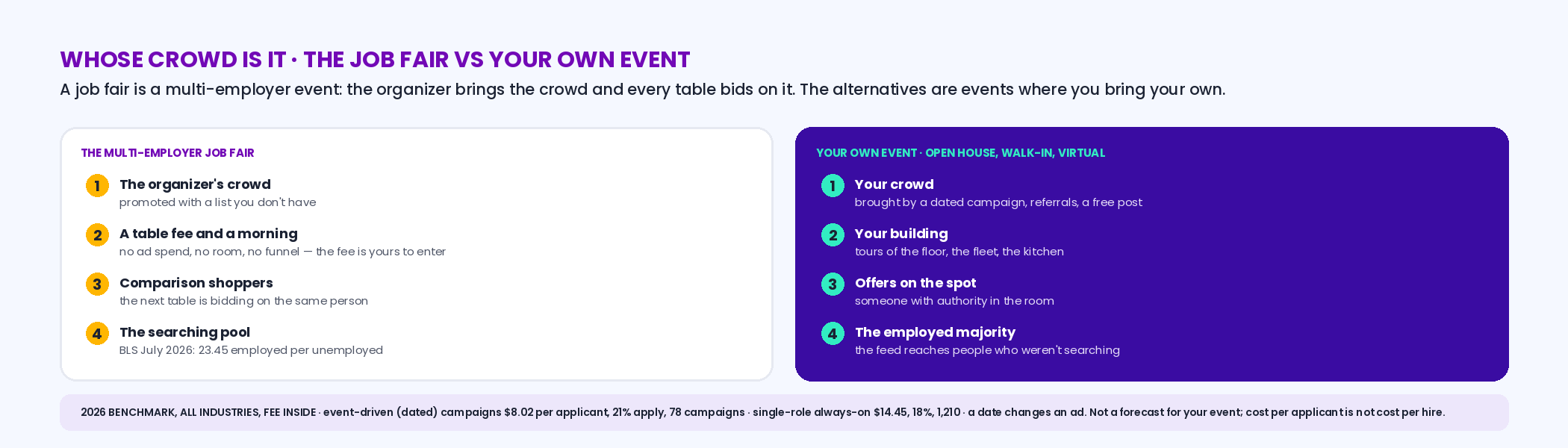
A multi-employer job fair — a workforce board's, a chamber's, a community college's, a veterans' organization's — does three things no single-employer event does. It brings foot traffic you did not have to generate, promoted by an organizer with a list you don't have. It puts a brand nobody knows in front of people who came to compare employers, which for a company entering a market is the cheapest way to be seen. And it costs a table fee and a morning, with no ad spend, no room to book and no funnel to build. If your hiring is a few roles a year, your brand is new in the market, or the organizer is a workforce board that sends you its UI claimants and veterans, the job fair is a reasonable first move and the calculator below prices it on your own numbers. Its weaknesses are the same facts turned over: the crowd is the organizer's, not yours; the candidates are comparison-shopping in real time at the next table; you can't tour them through a building across town or make an offer at a folding table; and the crowd is, by construction, people who are searching — the pool every board sells, which in July 2026 the BLS sized at 6,916,000 unemployed against 162,177,000 employed, 23.45 employed for every unemployed one. Our glossary entry on career fairs has the basics; the rest of this page is what to do when the fair's crowd isn't the crowd you need.
So are job fairs worth it?
Worth it when the crowd you need is the searching pool, when the organizer's list is one you could not build yourself, and when being seen matters as much as hiring — a brand that is new in a market, a few roles a year, a workforce board or a veterans' group running the room. Not worth it when you need volume on a date, when the roles need a tour or a demonstration to sell them, or when the people you want are already employed and not scanning tables.
The honest test is arithmetic rather than opinion, and you can run it on the last fair you attended: take the table fee, the hours your people stood there and what those hours cost, and divide by the applications you actually captured — not the conversations. The calculator further down does exactly that. Across 891 Boostpoint-managed campaigns, event-driven campaigns ran a median $8.02 per applicant at a 21% apply rate against $14.45 for single-role always-on campaigns, so the number your table has to beat is $8.02, and it is a demanding one. Cost per applicant is not cost per hire, and neither figure tells you who you actually hired.
Job fair alternatives, graded
Six alternatives, each good at something. The first three are events you run; the last three need no event. Prices are what you can verify: your own costs, the organizer's fee, and our published structure figures.
| Alternative | Whose crowd | Best at | What it costs | Runs it |
|---|---|---|---|---|
| Your own open house | Yours — a dated campaign fills a room at your site | A dozen hires on one date; tours of the actual floor; offers on the spot; the passive pool in a room at once | A room, a date, and the campaign: event-driven campaigns ran a median $8.02 per applicant, 21% apply, 78 campaigns (2026 benchmark, all industries) | Open house hiring events |
| A walk-in afternoon | Yours — "Tuesday 2 to 4, come meet the manager" | Hourly roles with fast decisions; the smallest event there is; repeatable every week | Two hours of a manager and a small always-on ad; whether it works, with the data, is on the page | On-the-spot hiring |
| A virtual hiring event | Yours — but only if the registration funnel is built | Roles across many markets; salaried and remote hiring; a screening step before an in-person day | A platform (quote-based for most vendors) and the registration campaign; nobody shows up to a link by itself | Virtual hiring events |
| An always-on campaign | Yours, continuously | Replacement hiring at a rate — the opening that never closes | A normal campaign ran on a median $334 a month for 20 applicants; single-role median $14.45, multi-role $9.83 (2026 benchmark) | The benchmark |
| Employee referrals | Your people's networks | The best-retained hires most frontline employers make; the passive pool with a warm introduction | A bonus you set, paid in installments | Run alongside everything |
| A staffing agency | The agency's bench | People on the floor this week with no event at all | An hourly markup; the arithmetic is on our staffing pages | Mass hiring for the bridge-crew pattern |
Interactive
Format picker — how many hires, how soon, whether the market knows you, and what there is to show; get the format and why
Nothing is stored or sent — this runs in your browser. The recommendation is Boostpoint's judgment of fit, and "the job fair" is a real outcome here.
Virtual vs in person: the only public attendance data there is
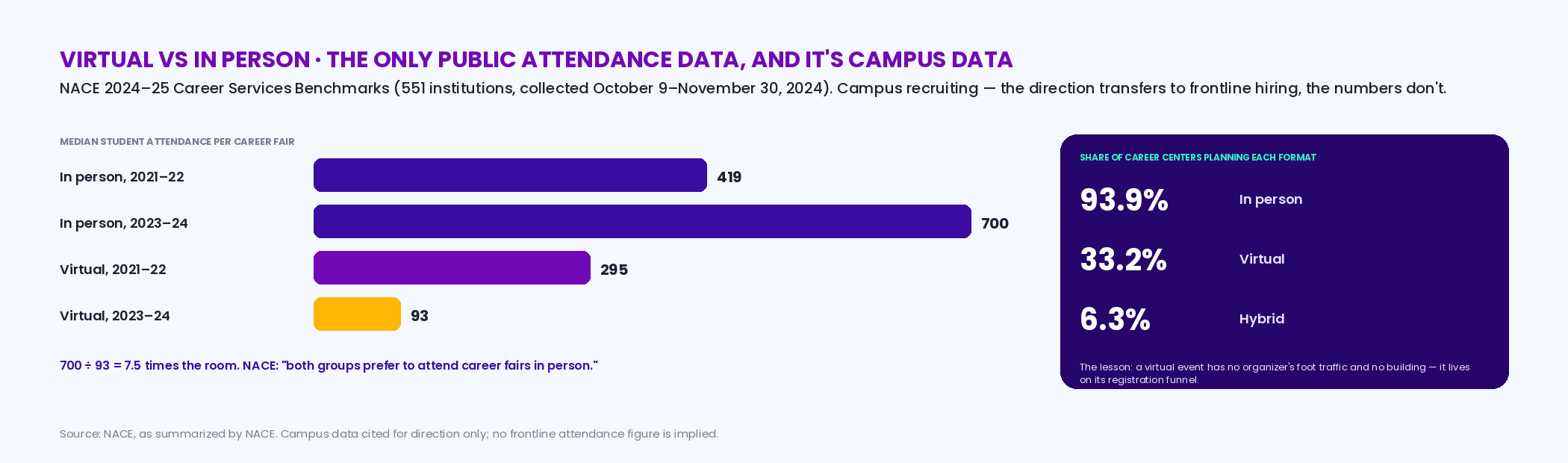
The best public numbers on event attendance are NACE's, and they are campus numbers, so read them as a direction rather than a forecast for a warehouse. NACE's 2024–25 Career Services Benchmarks survey (551 institutions, collected October 9 to November 30, 2024) found 93.9% of career centers planning in-person fairs, 33.2% planning virtual ones and 6.3% hybrid; median student attendance at in-person fairs rose from 419 in 2021–22 to 700 in 2023–24, while at virtual fairs it fell from 295 to 93 — 700 ÷ 93 is 7.5 times the room; and NACE's own summary was that "both groups prefer to attend career fairs in person." The lesson that transfers to frontline hiring is not "virtual is dead"; it is that a virtual event has no organizer's foot traffic and no building to walk into, so it lives or dies on the registration funnel, which is the whole subject of our virtual hiring event page. In person wins when there is something to see — a floor, a fleet, a kitchen — and someone with authority to make an offer in the room; virtual wins when the roles are in six markets or the candidates are salaried and remote, and as a screening step before an in-person day. Either way the crowd is yours to bring.
| Format | Wins when | Loses when | Data point |
|---|---|---|---|
| In person (open house, walk-in) | There is a floor, a fleet or a kitchen to show; hourly roles; someone with authority to offer on the spot; one market | The roles are spread across markets; candidates are remote; nobody can leave the floor to run it | NACE: in-person median attendance 419 → 700 (2021–22 to 2023–24); 93.9% of centers planning in-person fairs |
| Virtual | Many markets at once; salaried or remote roles; a screening step before an in-person day | You expect the platform to bring the crowd; hourly candidates who want to see the site | NACE: virtual median attendance 295 → 93; 33.2% of centers planning virtual |
| Multi-employer job fair | Your brand is new in the market; a few hires a year; a workforce-board organizer with a list | You need volume on a date, a tour, or the employed majority | The searching pool: BLS July 2026, 23.45 employed per unemployed |
What your own event costs per applicant — and why it's the cheapest structure we run
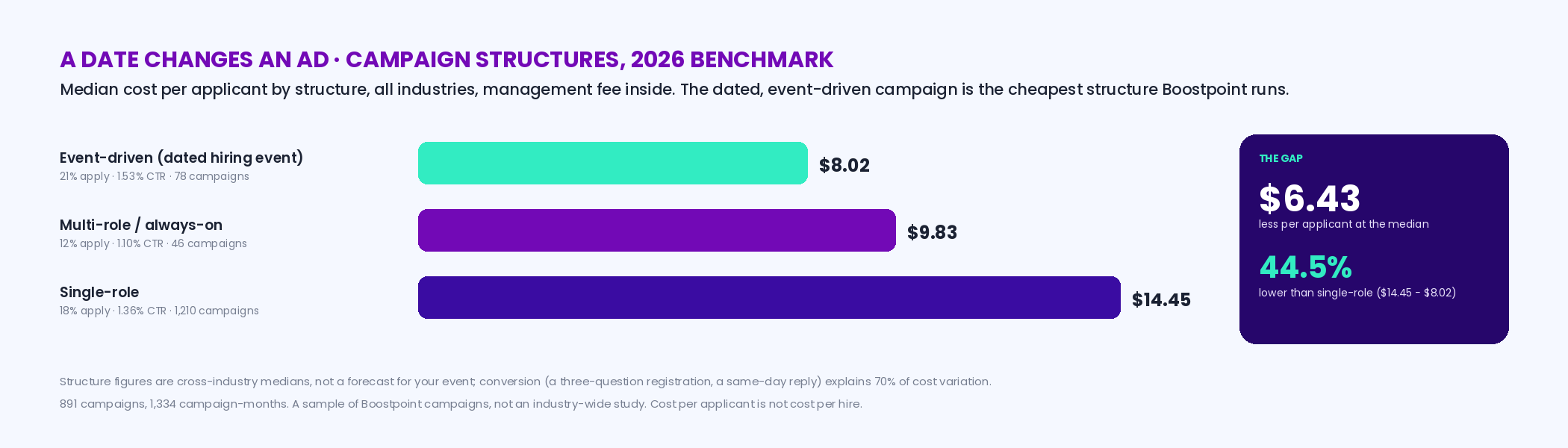
An event has a date, and a date changes an ad. "Open house Tuesday the 9th, 2 to 6, offers on the spot" gives a person who wasn't looking a reason to act this week, which is why, across every industry in our 2026 benchmark, dated event-driven campaigns ran a median $8.02 per applicant at a 21% apply rate and a 1.53% click-through across 78 campaigns, against $14.45, 18% and 1.36% for the 1,210 always-on single-role campaigns — $6.43 less per applicant, 44.5% lower at the median. That is a structure figure, not a promise about your event, and what decides where inside the range you land is the same thing that decides every campaign: conversion explains 70% of cost variation, and a registration form of three questions with a same-day reply is worth more than any creative. The mechanics of the day — invitations, reminders, no-shows, the interview station's arithmetic, offers in the room — are on the open house page; the one-day walk-in version, with its own data, is on on-the-spot hiring.
| Structure | Median cost per applicant | Apply rate | Click-through | Campaigns |
|---|---|---|---|---|
| Event-driven (dated hiring event) | $8.02 | 21% | 1.53% | 78 |
| Multi-role / always-on | $9.83 | 12% | 1.10% | 46 |
| Single-role | $14.45 | 18% | 1.36% | 1,210 |
Source: Boostpoint 2026 Social Job Advertising Benchmark — 891 Boostpoint-managed campaigns on Meta (1,334 campaign-months), 2026; costs are what advertisers paid for advertising only.
What the job fair table cost you — on your own numbers
The fair's own cost is easy to underestimate because most of it is time. The organizer's fee is the smallest line; the two people at the table for five hours, the banner and the giveaways, and the follow-up nobody did are the rest. Count what the table produced the way you would count any channel — conversations, applications actually captured (a QR code to your form, not a stack of paper), interviews booked — and divide. The calculator does it, with the organizer's fee as your input, because fair fees range from nothing at a workforce-board event to a table fee at a commercial one and we won't invent a number. Then compare the per-applicant figure with what a dated campaign into your own room ran in the benchmark, remembering that the fair's crowd was searching and your campaign's crowd was not.
Interactive
Job fair table calculator — the organizer's fee, your people's hours, materials, and what the table produced; the cost per conversation, per applicant and per interview, out
Nothing is stored or sent — this runs in your browser. Every input is yours, including the fee; no job-fair price is assumed.
If the table is already booked, the question changes from whether to attend to what to do with the four hours. Our job fair booth ideas page covers that half — twenty-four things that start conversations, the three that waste the table, and the throughput arithmetic that decides how many conversations your stand can actually hold.
Where the crowd comes from, either way
The job fair's real product is its crowd, and once you run your own event the crowd is your job. It comes from three places. Your own people's phones — a referral ask with the date in it, texted to the crew, is the cheapest invitation there is. The feed — a dated ad under Meta's Special Ad Category with the roles, the rate and the date in the first line, which reaches the employed people no fair's organizer can reach; the reach frame is on passive candidate recruiting. And a free post where posting is free — a state job bank, Google for Jobs on your own careers page — for the searching few, who are also welcome. What decides how many of them show up is the form and the reminder: three questions to register, a text the day before and the morning of, and a second date for the no-shows, which the open-house page walks through day by day. The ad itself is on what makes a good job ad.
Frequently asked questions
What are the alternatives to a job fair?
Events you run yourself — an open house at your site, a walk-in afternoon, a virtual hiring event — where you bring the crowd instead of renting the organizer's; and channels that need no event: an always-on campaign, employee referrals, and a staffing agency for this week. In our 2026 benchmark the dated, event-driven campaign was the cheapest structure we run, a median $8.02 per applicant at a 21% apply rate across 78 campaigns, against $14.45 for single-role campaigns.
Are job fairs worth it?
Sometimes, and the conditions are specific. Worth it when your brand is new in a market and being seen is the point; when you hire a few roles a year and don't want to build a funnel; and when the organizer is a workforce board or a veterans' group with a list you don't have. Its crowd is the searching pool — the BLS counted 23.45 employed people per unemployed one in July 2026 — and it belongs to the organizer, so it is not worth it for volume on a date, for a tour, or for reaching the employed majority.
Virtual or in-person hiring event — which works better?
In person when there is something to show and someone to make an offer in the room; virtual when the roles are in many markets or the candidates are salaried and remote, and as a screening step before an in-person day. The only public attendance data is NACE's campus survey: median in-person fair attendance rose from 419 to 700 between 2021–22 and 2023–24 while virtual fell from 295 to 93, and 93.9% of career centers planned in-person fairs against 33.2% virtual. The direction transfers; the numbers don't. Either way, the crowd is yours to bring.
How much does a job fair cost an employer?
The organizer's fee — none at many workforce-board events, a table fee at commercial ones; we don't publish a figure because it varies — plus the real cost: two people for five hours, materials, and the follow-up. Count it as a channel: cost divided by conversations, by applications actually captured, and by interviews booked. The calculator on this page runs it on your numbers.
Why does a dated event campaign cost less per applicant than a regular job ad?
Because a date gives someone who wasn't looking a reason to act this week. Across all industries in our benchmark, event-driven campaigns ran a median $8.02 per applicant at 21% apply and 1.53% click-through across 78 campaigns, against $14.45, 18% and 1.36% for 1,210 single-role campaigns — $6.43 less, 44.5% lower at the median. It is a structure figure, not a forecast; a three-question registration form and a same-day reply decide where in the range you land.
How do you get people to show up to your own hiring event?
Three sources and two habits. Sources: your own crew's phones with the date in the referral ask, a dated ad in the feed with the roles and the rate in the first line, and a free post where posting is free. Habits: a registration form of three questions, and a text the day before and the morning of, with a second date offered to the no-shows. The day-by-day version is on our open house page.
Can a small employer run its own hiring event?
Yes — the walk-in afternoon is the smallest event there is: "Tuesday 2 to 4, come meet the manager," a manager for two hours, and a small always-on ad. Whether on-the-spot hiring works, and when a full open house or a single-role ad makes more sense, is on our on-the-spot hiring page with the data. A normal campaign in our benchmark ran on a median $334 a month.
What does Boostpoint have to do with hiring events?
We sell the campaign that fills an employer's own event — the dated ad, the three-question registration, the reminders, the applicants delivered into your system — and we publish what those campaigns ran: a median $8.02 per applicant, 21% apply, 78 campaigns. We don't sell an event platform or run job fairs, and we don't compute a cost per hire.
Bring your own crowd
We'll build the dated campaign that fills your open house or walk-in afternoon — the roles and the rate in the first line, a three-question registration, reminders that cut no-shows — and show you the event campaigns closest to yours from the benchmark.
Book a DemoBoostpoint figures come from the 2026 Social Job Advertising Benchmark — 891 campaigns and 1,334 campaign-months: campaign structures event-driven median $8.02 per applicant, 21% apply rate, 1.53% click-through, 78 campaigns; multi-role $9.83, 12%, 1.10%, 46; single-role $14.45, 18%, 1.36%, 1,210; a normal campaign $334 a month, 20 applicants, 6,061 reached; conversion explaining 70% of cost variation. Structure figures are cross-industry medians, not forecasts for any event. NACE 2024–25 Career Services Benchmarks (551 institutions, collected October 9 to November 30, 2024) as summarized by NACE — campus recruiting data, cited for direction. BLS Employment Situation, July 2026. Job fair fees are the reader's input; none is stated. The format picker is Boostpoint's judgment; the table calculator computes on the reader's own records. Cost per applicant is not cost per hire; we do not track hires and publish no cost-per-hire figure. A sample of Boostpoint campaigns, not an industry-wide study.