
On-the-Spot Hiring and Walk-In Interviews: Costs, Conversion, and Do They Work?
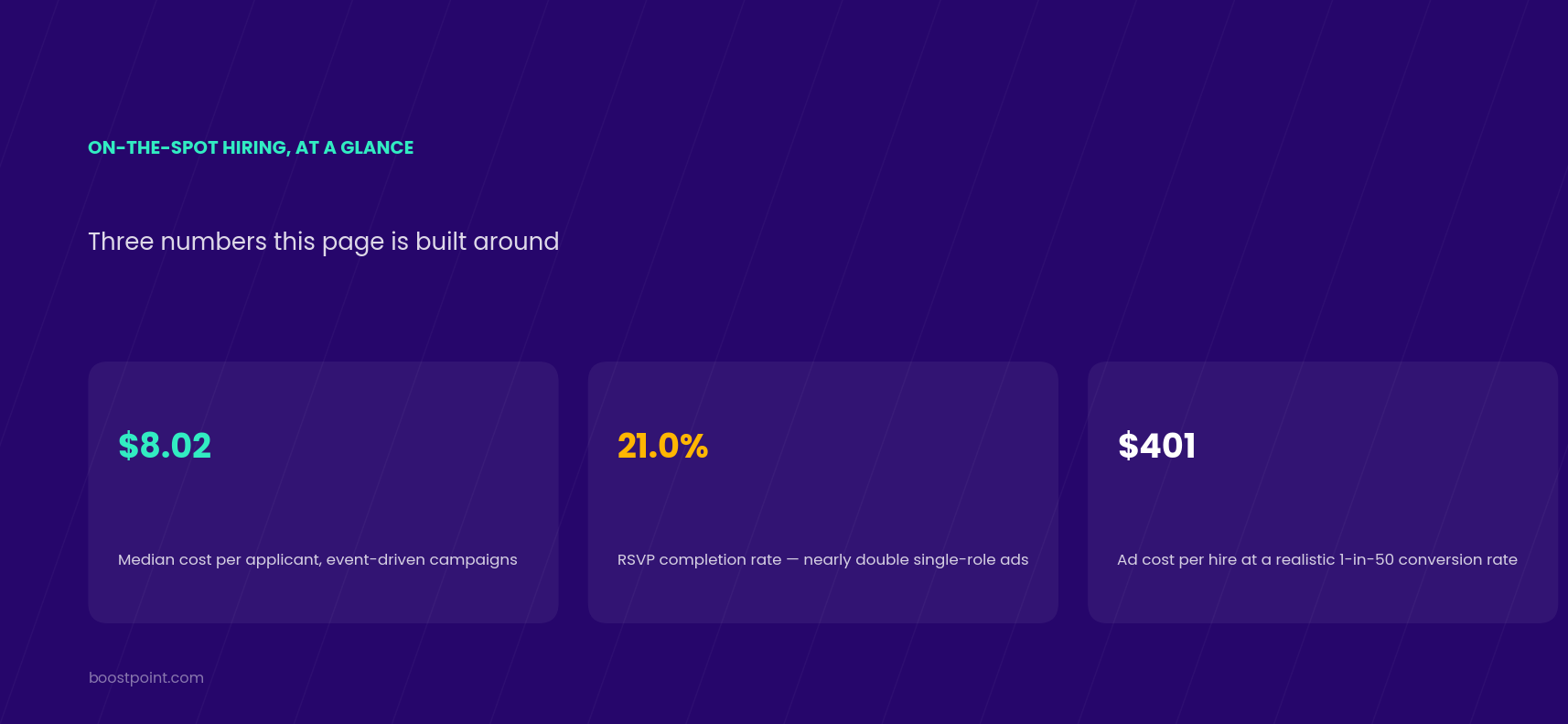
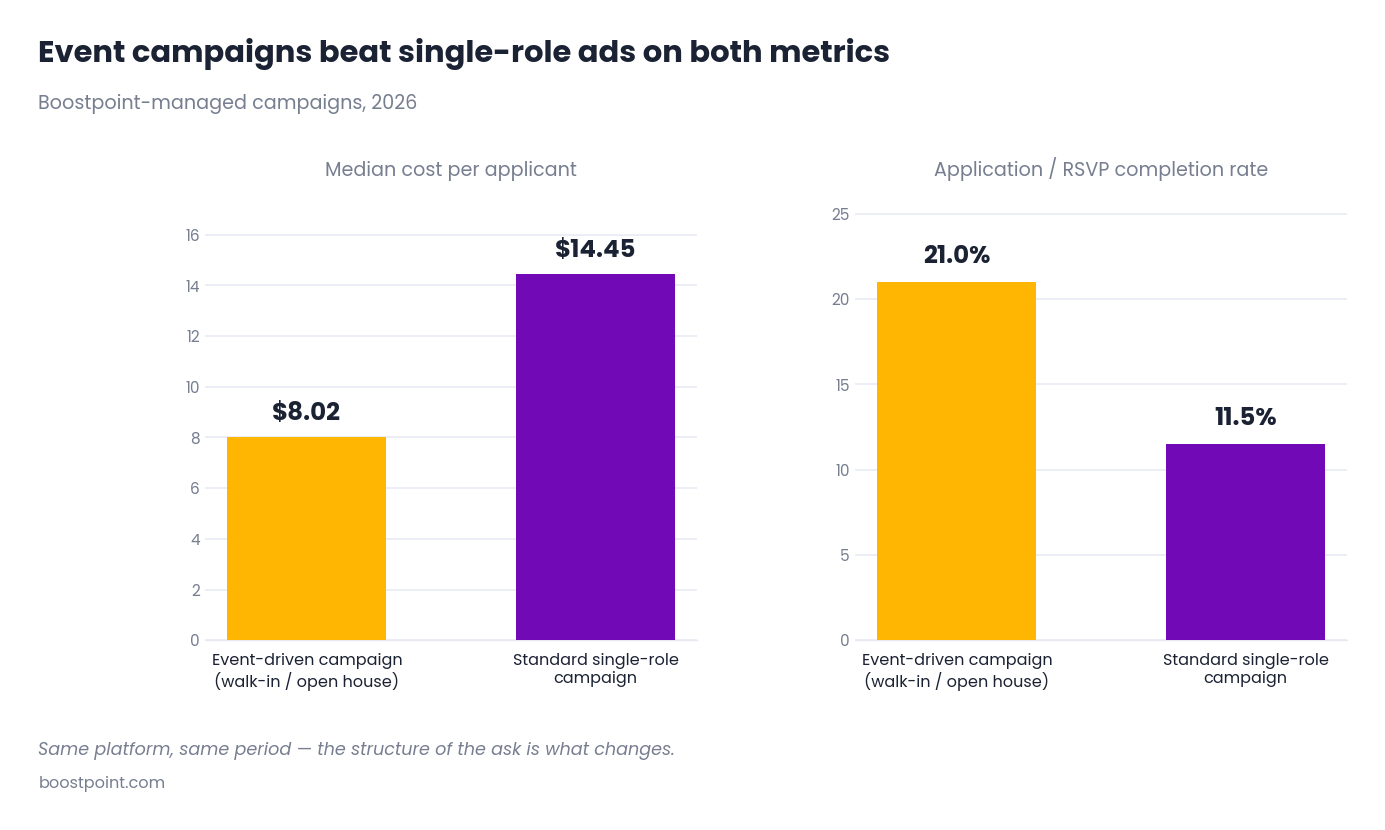
Do walk-in interviews and on-the-spot hiring events actually work? Yes. Based on Boostpoint's 2026 recruitment benchmark data, event-driven hiring campaigns produce the lowest median cost per applicant of any campaign structure — averaging $8.02 per applicant with a 21% application completion rate, compared to $14.45 for single-role campaigns. By driving foot traffic instead of just digital resumes, employers increase interview attendance and fill high-volume roles significantly faster.
Source: Boostpoint campaign data — 1,070 managed recruitment campaigns conducted in 2025–2026 across manufacturing, transportation, healthcare, and frontline industries nationwide.
A note on who's writing this
Most guides on walk-in interviews and open house hiring events are written by HR blogs offering theoretical pros and cons. They will tell you about candidate experience and interview bias, but they rarely provide the actual budget math required to get people through the front door.
Boostpoint is a recruitment marketing platform. We build the advertising software that helps talent acquisition teams, hospitals, and manufacturing plants run targeted social media campaigns to drive massive foot traffic to their local hiring events.
We aren't guessing whether on-the-spot hiring works. We can provide the exact financial data that HR blogs leave out: what it actually costs to market a hiring event, generate RSVPs, and turn digital clicks into physical hires, backed by 2026 campaign data nationwide.
The data: single-role campaigns vs. hiring events
The traditional recruitment marketing playbook is to advertise a single open position, collect resumes, screen candidates by phone, and schedule interviews weeks later.
An event-driven campaign (marketing a walk-in interview day or facility open house) flips that model. Instead of advertising a job description, you advertise an event date.
Across Boostpoint-managed recruitment campaigns in 2026, event structures vastly outperformed single-role structures — the wider pattern across every industry we track is in our published 2026 Social Job Advertising Benchmark data:
| Campaign structure | Median cost per applicant (CPA) | Application / RSVP completion rate |
|---|---|---|
| Event-Driven Campaign (Walk-in / Open House) | $8.02 | 21.0% |
| Standard Single-Role Campaign | $14.45 | 11.5% |
Source: Boostpoint campaign data — 1,070 managed recruitment campaigns conducted in 2025–2026 across manufacturing, transportation, healthcare, and frontline industries nationwide.
Why event campaigns drive down the cost per applicant
Why does advertising an open house yield applicants at almost half the cost of a standard job posting?
- Urgency and scarcity. A job board posting sits there indefinitely. An event happens on Thursday from 9 AM to 1 PM. That hard deadline forces passive candidates to act immediately.
- Lower friction. Standard applications require updating a resume and filling out work history. An RSVP for a walk-in interview usually only requires a name, phone number, and a single click to confirm attendance. (This explains the massive 21% completion rate jump.)
- Appealing to the deskless workforce. Frontline workers (machinists, nurses, CDL drivers, warehouse staff) often apply from mobile phones during their breaks. They prefer walking into a facility, seeing the environment, and meeting a manager face-to-face over navigating a 30-minute ATS portal.
The actual ad cost to hire from an open house
Generating an RSVP is just the first step. For on-the-spot hiring, the ultimate metric is how many attendees accept a job offer before leaving the building.
Depending on your baseline requirements, background checks, and the quality of the applicant pool, your hire rate will vary.
Here is what the direct advertising cost per hire looks like across three realistic screening scenarios for an event campaign (assuming the $8.02 median CPA):
| Campaign type | Median CPA | 1 in 10 hire rate (10% — high touch) | 1 in 50 hire rate (2% — realistic standard) | 1 in 100 hire rate (1% — strict vetting) |
|---|---|---|---|---|
| Walk-In / Open House Event | $8.02 | $80.20 | $401.00 | $802.00 |
| Virtual Hiring Event | $8.02 | $80.20 | $401.00 | $802.00 |
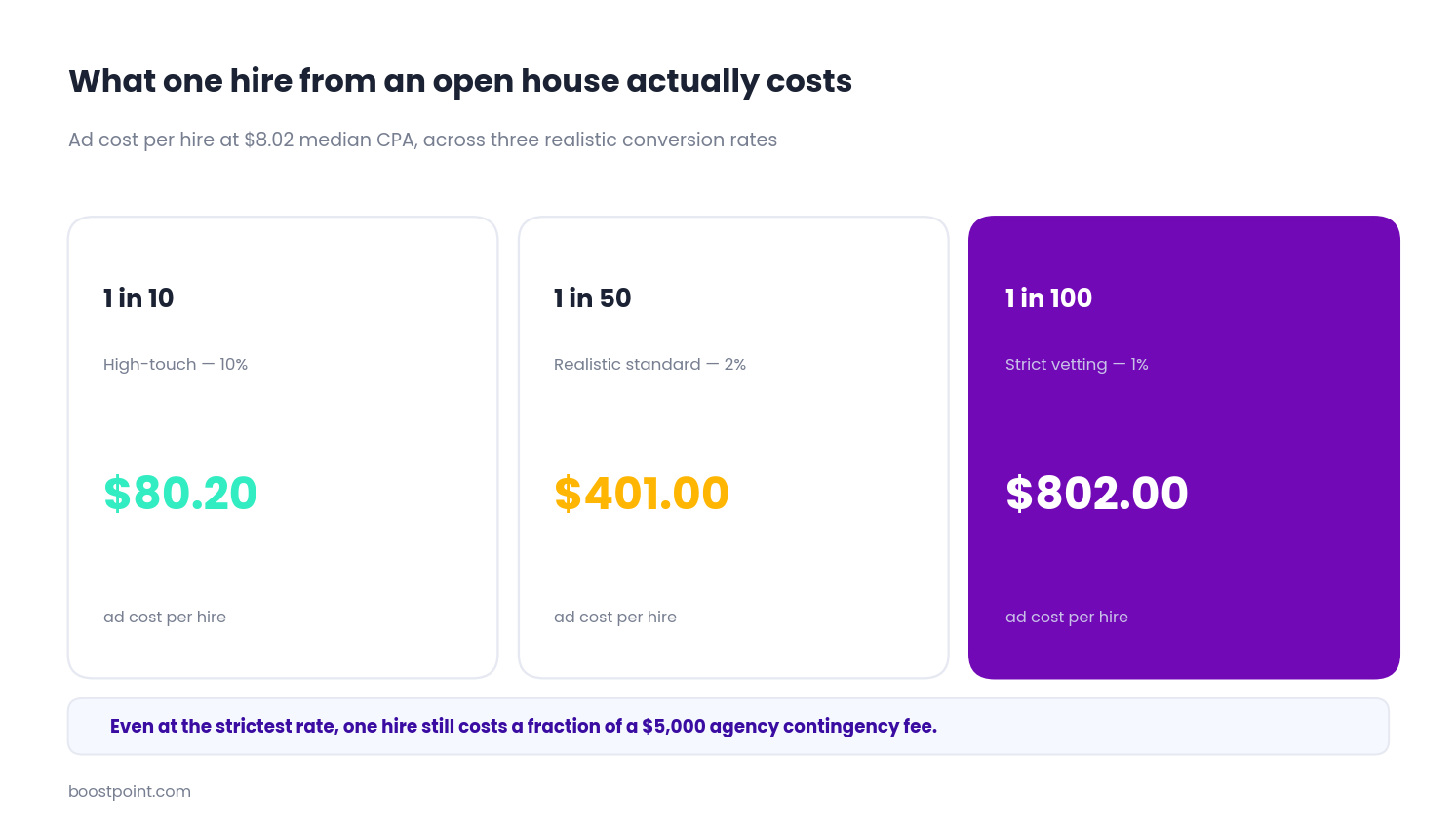
Even if only 1 out of 50 RSVPs actually walks through the door, passes the interview, clears a background check, and accepts the job, your advertising cost to secure that permanent hire is roughly $401.00. Compared to paying a staffing agency a $5,000 contingency fee, the ROI of a well-marketed walk-in event is undeniable. One caution on the sequence: at an event the reference call is the step that reintroduces the delay you just removed, so decide in advance which roles genuinely need one. Our page on reference checks sets out when the call is worth the days it costs.
Open interviews, walk-in interviews, on-the-spot hiring: which is which
These three phrases get used for the same afternoon, and the differences are small but they change what you have to staff. Employers and candidates also use them differently, which is worth knowing if you are writing the ad: the phrase most candidates search is open interviews, and it is the one least likely to appear on an employer’s careers page.
| Phrase | What it usually means | What you must have ready |
|---|---|---|
| Open interviews | A published window during which anyone may turn up and be interviewed, no appointment | Enough interviewers for the busiest hour, not the average hour |
| Walk-in interviews | The same thing described from the candidate’s side. In practice, interchangeable | Same |
| On-the-spot hiring | An open or walk-in session where someone present can make a conditional offer before the candidate leaves | A decision-maker in the building, and an offer letter you can produce in minutes |
The practical distinction is the third row. Open and walk-in interviews are a scheduling choice; on-the-spot hiring is an authority choice, and it is the one that changes the outcome. A walk-in session that ends with “we will be in touch” converts like any other interview, because the candidate leaves and the week happens to them. The same session with a conditional offer in it is a different product entirely, and it is the reason the format is worth the staffing.
If you are advertising one, use the candidate’s vocabulary in the ad and your own in the internal plan. “Open interviews Thursday, 9 to 4, no appointment needed” is what gets read. Whether you can also say “leave with an offer” is what decides how many of them come.
When on-the-spot hiring and walk-in interviews work best
Event-based hiring is the most efficient way to process high volumes of candidates, but it requires internal alignment to execute properly.
Use open house and on-the-spot hiring when:
- You are filling high-volume, uniform roles. Manufacturing assembly lines, warehouse fulfillment centers, and large retail locations need dozens of people with similar baseline skills. Walk-in interviews let you process them efficiently.
- You are opening a new facility. Standing up a new distribution center or hospital wing requires a massive influx of local talent. A well-promoted "Grand Opening Hiring Event" generates critical local buzz.
- You want to bypass the ATS black hole. Great frontline workers often have terrible resumes. On-the-spot hiring allows your floor managers to evaluate candidates based on communication, attitude, and immediate skills testing rather than formatting.
- You are fighting high candidate ghosting rates. In standard recruiting, candidates often ghost scheduled interviews because they accepted another offer in the interim. Walk-in interviews compress the timeline from first contact to job offer down to hours.
- You have the HR staff to support it. An open house requires all hands on deck. You need greeters, dedicated interviewers, and HR staff ready to process background checks and extend verbal offers immediately.
Interviewing on the spot at somebody else's event is a different setup again, because the queue is shared and your staffing is fixed. The booth version of this — where to put the chairs, who should be on the stand, and what it costs you to run an interview while the queue disperses — is on our job fair booth ideas page.
When virtual hiring events or single-role ads make more sense
Skip the walk-in model when:
- You are hiring specialized or executive roles. You cannot hire a Chief Nursing Officer or a Senior Controls Engineer via a walk-in interview. Those require structured, multi-round technical evaluations.
- Your facility is remote or hard to access. If your plant is 45 minutes outside of town with limited parking, driving physical foot traffic will be difficult. In this case, a virtual hiring event via Zoom or Teams is vastly more effective.
- You are hiring for a single open headcount. Do not throw a massive open house event to fill one open forklift operator seat. Single-role targeted social ads are better suited for maintaining baseline headcount.
- Your hiring managers cannot make decisions same-day. If your internal protocol requires three days of committee review before making an offer, you negate the entire advantage of "on-the-spot" hiring.
The honest summary
Single-role ads maintain the baseline. Hiring events conquer the surges.
If your organization needs to hire 15+ people rapidly for a seasonal peak or facility expansion, standard job boards will be too slow and too expensive. Event-driven campaigns drastically reduce application friction, dropping the median cost per applicant to $8.02 while nearly doubling the application completion rate to 21%. For the full surge playbook — timeline, budget and staffing the funnel — see mass hiring.
By concentrating your recruitment marketing budget into a two-week sprint leading up to a walk-in interview day, you bypass the resume black hole and get candidates directly in front of your hiring managers.
The calculation worth running this quarter
Talent Acquisition leaders should evaluate these three metrics before planning their next hiring surge:
- Calculate your current time-to-fill. Measure the total days from a candidate applying online to accepting an offer. If it exceeds 14 days for frontline roles, you are losing candidates to faster competitors. Walk-in events compress this to zero.
- Audit your candidate ghosting rate. How many scheduled phone screens or in-person interviews simply never show up? Event RSVPs expect a drop-off, but consolidating interviews into one day maximizes your HR team's time.
- Compare campaign ROI. Calculate the total budget needed to hire 20 people through traditional job boards, versus spending roughly $2,400 on targeted social media ads to drive 300 RSVPs to a Saturday open house.
Hiring event ideas that produce applicants rather than footfall
Eight formats we see work, in rough order of how little they ask of the candidate.
- Open house with the equipment in the lot. A truck, a lift, a service van, on site, with someone who can answer questions about it. Event-driven campaigns ran a $8.02 median cost per applicant across 78 campaigns in our 2026 benchmark.
- Same-day conditional offer. The single change that turns an event into hires. If a candidate leaves without a decision, the event was a job fair.
- Shift-specific sessions. One session per shift rather than one for everybody. Night staff cannot come at two in the afternoon, and they are the shift you are usually short on.
- Interview on the floor, not in a room. Walk the route, the ward, the yard. It answers the question the candidate actually has, which is what the place is like.
- Bring a friend, paid. A referral bonus that pays for anyone brought to the event and hired, announced in the invitation rather than after.
- License and document clinic. For credentialed roles, a session where someone helps with registry lookups, renewals or a Clearinghouse consent. It is a service, and it reaches people who have let a credential lapse.
- Community venue rather than the workplace. A library room, a fire hall, a church hall for candidates who cannot be seen visiting a competitor employer.
- Standing weekly slot. Same day, same time, every week, advertised once. It costs less than repeated event campaigns and it catches people at the moment they decide to leave.
Frequently asked questions
Do walk-in interviews actually work?
Yes. For frontline, industrial, retail, and healthcare roles, walk-in interviews are highly effective. 2026 data shows event-driven recruitment campaigns generate a median cost per applicant of $8.02, significantly outperforming single-role job ads.
What is the difference between an open house and on-the-spot hiring?
An open house hiring event invites candidates to tour a facility, meet the team, and learn about the company culture. On-the-spot hiring takes it a step further by conducting formal interviews, processing background checks, and extending contingent job offers before the candidate leaves the building.
How do you promote a walk-in hiring event?
Traditional job boards are poor tools for event promotion. The most effective method is utilizing hyper-targeted social media advertising (Facebook, Instagram, TikTok) within a 15-to-20-mile radius of the facility, driving users to a mobile-friendly RSVP landing page.
What is a virtual hiring event?
A virtual hiring event functions exactly like an open house but takes place online via video conferencing software. It is ideal for companies hiring remote workers, call center staff, or facilities located in geographically isolated areas.
Should we offer sign-on bonuses at hiring events?
While sign-on bonuses generate initial interest, making the offer contingent on immediate acceptance during an on-the-spot hiring event creates necessary urgency and drastically improves the day-of conversion rate.
What is a good cost per applicant for a hiring event?
Based on 2026 benchmark data spanning over 1,000 campaigns, a well-optimized event-driven recruitment campaign should yield a median cost per applicant (RSVP) of approximately $8.02, with top-performing campaigns driving costs even lower.
What are some hiring event ideas that actually work?
The formats that produce applicants rather than footfall have three things in common: the equipment or the workplace is present, the session is scheduled for the shift you are short on, and the candidate can leave with a conditional offer the same day. Event driven campaigns ran a median of 8 dollars 02 per applicant across 78 campaigns in our 2026 benchmark. A standing weekly slot, advertised once, tends to cost less than repeated one off event campaigns and catches people at the moment they decide to leave.
What are open interviews?
Open interviews are a published window during which anyone can turn up and be interviewed without an appointment. It is the same thing most employers call a walk-in interview, described from the candidate’s side, and it is the phrase candidates are far more likely to search for. Whether the session also ends in a same-day conditional offer is a separate decision, and it is the one that changes conversion.
What is the difference between open interviews and walk-in interviews?
In practice there is none: both mean turn up during a stated window and be seen without an appointment. The difference that matters is neither of those phrases but whether someone in the building can make a conditional offer before the candidate leaves, which is what on-the-spot hiring adds and what makes the format worth staffing.
What is same-day hiring?
Same-day hiring is making and accepting an offer in a single visit — the candidate walks in, interviews, and leaves with a start date. It requires three things most employers do not have ready: a manager with the authority to offer without a second approval, the pay range settled in advance, and any required check either waived or run on the spot. Without all three it becomes a normal interview with a longer wait attached.
Does same-day hiring actually work?
For high-volume hourly roles where the candidate is choosing between several employers in the same week, yes — speed is the deciding factor far more often than the offer itself. It works badly where the role needs a credential check that cannot be completed immediately, or where a bad hire is expensive to unwind. The failure mode is not hiring the wrong person; it is advertising same-day hiring and then making people wait, which costs more goodwill than never offering it.
What is an on-the-spot hiring event?
A scheduled block — usually a few hours on one or two days — in which candidates arrive without an appointment, interview immediately, and leave with a decision. What makes it an on-the-spot event rather than an open house is that somebody present has the authority to make an offer that day, and the paperwork to start it. If offers have to go back to a regional manager, it is a walk-in interview event with extra steps, and candidates experience the difference.
How do you get people to come to an on-the-spot hiring event?
Advertise the event the way you would advertise a job, not the way you would advertise a party: the roles, the pay, the date, the time window, the exact address and the words “interviews and offers the same day.” Run it for about two weeks ahead in a radius you can staff from, and text every applicant already in your system. Footfall is not the goal — the number that matters is qualified people who turn up in the window, which is why the ad has to carry the pay.
Drive massive traffic to your next hiring event
Book a 30-minute strategy call with our recruitment marketing team. We'll review your local labor market, show you the math on event-driven applicant costs, and help you launch social media campaigns that pack your open house.
Book a Demo →Boostpoint figures are derived from 1,070 managed recruitment campaigns conducted in 2025–2026 across manufacturing, transportation, healthcare, and frontline industries nationwide. Cost-per-applicant metrics reflect what advertisers paid for advertising. Event-driven campaign statistics reflect aggregated performance data from walk-in interviews, open houses, and virtual hiring events compared against single-role requisition campaigns.