
Employer guideRead at source, 3 September 2026
Reference Checks: Questions to Ask, What Former Employers Can Say, and State Immunity Laws
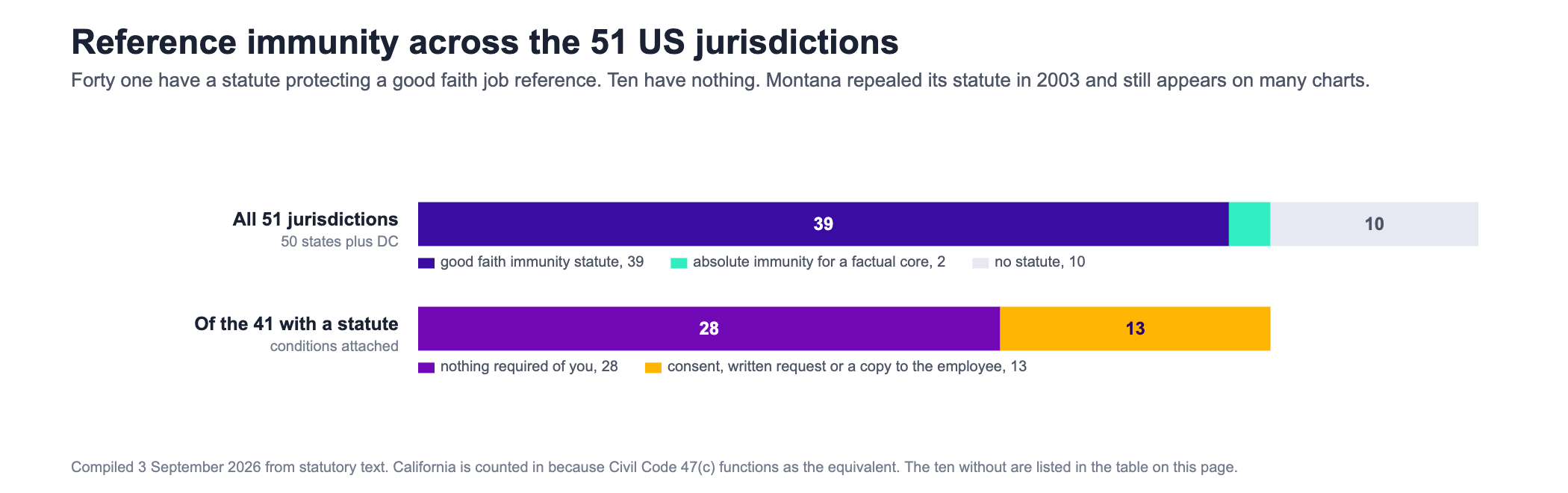
The belief that a former employer may legally confirm only dates and job title is one of the most expensive myths in hiring, and it is not what the law says either. Forty-one of the fifty-one US jurisdictions have a statute that protects an employer who gives a job reference in good faith, and most of them presume good faith so the burden falls on whoever sues. Ten have nothing. Two states, Kansas and North Dakota, go further and give absolute immunity for a factual core. What the statutes add are conditions almost nobody follows: four states require the employee’s written consent before you may answer, and four require a copy of what you said to be sent to them. Below: the questions worth asking, the state table, and when a reference is worth less than a paid working interview.
What a former employer can legally say
Almost everything, in most of the country, provided it is said in good faith. These statutes were passed through the 1990s and 2000s precisely because employers had retreated to name, rank and serial number, and the retreat was making hiring worse. A typical one reads like Colorado C.R.S. 8-2-114: the employer is immune, and immunity is defeated only where the information was false and the employer knew or reasonably should have known it. Florida requires clear and convincing evidence of knowing falsehood. Wisconsin is stricter still on the plaintiff, requiring express malice, ill will or spite, and expressly rejecting the lower reckless-disregard standard used elsewhere.
So the dates-and-title policy is a corporate choice, not a legal requirement. It is defensible: it removes judgment calls from untrained managers, and no statute anywhere requires you to answer. But it should be made knowing that your legislature probably went out of its way to protect the opposite.
The two-tier design is the one to copy
Kansas K.S.A. 44-119a and North Dakota N.D.C.C. 34-02-18 both split the question in two. A factual core — dates of employment, pay level, job description and duties — carries absolute immunity, with no written request required. Everything above it, evaluations and the reason for separation, is protected only in good faith and in Kansas needs a written inquiry first. That structure is the safest national reference policy anyone has written down: answer the factual core for everybody, and answer the performance tier deliberately.
The conditions almost nobody follows
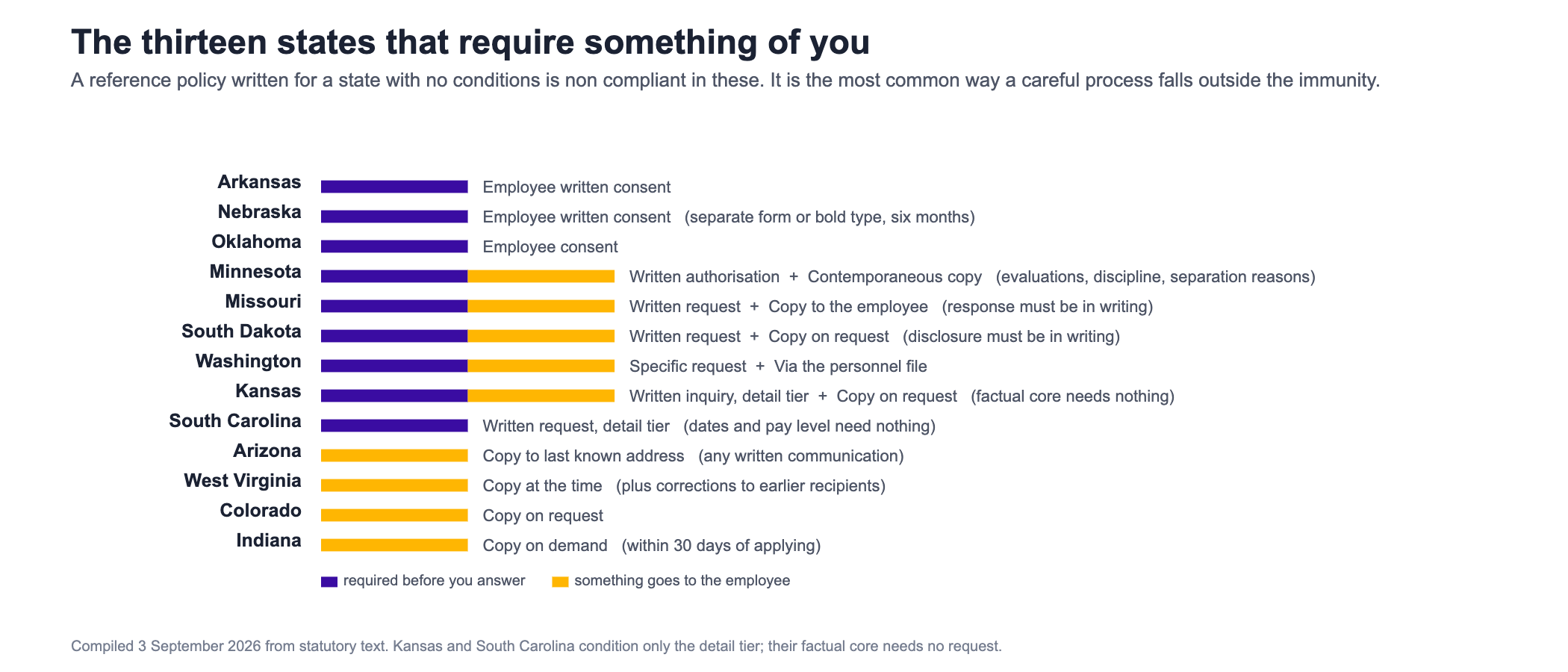
The immunity is not unconditional, and the conditions are where a well-meaning process quietly fails. Arkansas, Nebraska and Oklahoma require the employee’s written consent before it applies, and Arkansas and Nebraska specify the form: a separate document or bold, larger type, signed, dated, valid for a limited period. Minnesota requires written authorization for its sensitive tier, meaning evaluations, disciplinary warnings from the last five years, and the reason for separation. A reference policy written for Ohio is simply non-compliant in those four.
Then the copy rule. Arizona requires a copy of any written communication to go to the employee’s last known address. Missouri requires the response in writing and a copy to the employee, who may request one for a year afterwards. West Virginia goes furthest: adverse information must be in writing, copied to the employee at the time, and if it later proves wrong, corrections go to everyone who received the original. Colorado, Kansas and South Dakota provide a copy on request.
Two more catch people out. The immunity in Idaho is subsection (2) of the blacklisting statute and in Rhode Island subsection (c) of the personnel files statute, so searching for a reference law in either finds nothing. And Montana repealed its immunity statute in 2003. Montana now runs the other way: section 39-2-801 obliges an employer to give a discharged employee the reasons on demand, and refusing makes it unlawful to give those reasons to anyone else.
| State | Statute | Protection | Consent or request | Copy to employee |
|---|---|---|---|---|
| Alabama | — | None | — | — |
| Alaska | AS 09.65.160 | Good faith | — | — |
| Arizona | A.R.S. 23-1361 | Good faith | — | Yes |
| Arkansas | Ark. Code 11-3-204 | Good faith | Yes | — |
| California | Cal. Civ. Code 47(c) | Qualified | — | — |
| Colorado | C.R.S. 8-2-114 | Flat | — | On request |
| Connecticut | — | None | — | — |
| Delaware | 19 Del. C. 709 | Good faith | — | — |
| District of Columbia | — | None | — | — |
| Florida | Fla. Stat. 768.095 | Flat | — | — |
| Georgia | O.C.G.A. 34-1-4 | Good faith | — | — |
| Hawaii | HRS 663-1.95 | Good faith | — | — |
| Idaho | Idaho Code 44-201(2) | Good faith | — | — |
| Illinois | 745 ILCS 46/10 | Good faith | — | — |
| Indiana | Ind. Code 22-5-3-1 | Flat | — | On demand |
| Iowa | Iowa Code 91B.2 | Reasonable | — | — |
| Kansas | K.S.A. 44-119a | Two tier | For the detail tier | On request |
| Kentucky | KRS 411.225 | Flat | — | — |
| Louisiana | La. R.S. 23:291 | Good faith | — | — |
| Maine | 26 M.R.S. 598 | Good faith | — | — |
| Maryland | Cts. and Jud. Proc. 5-423 | Good faith | — | — |
| Massachusetts | — | None | — | — |
| Michigan | MCL 423.452 | Good faith | — | — |
| Minnesota | Minn. Stat. 181.967 | Qualified | For the detail tier | Yes |
| Mississippi | — | None | — | — |
| Missouri | RSMo 290.152 | Immunity | Written request | Yes |
| Montana | — | None | — | — |
| Nebraska | Neb. Rev. Stat. 48-201 | Good faith | Yes | — |
| Nevada | NRS 41.755 | Immunity | — | — |
| New Hampshire | — | None | — | — |
| New Jersey | — | None | — | — |
| New Mexico | N.M. Stat. 50-12-1 | Good faith | — | — |
| New York | — | None | — | — |
| North Carolina | N.C. Gen. Stat. 1-539.12 | Flat | — | — |
| North Dakota | N.D.C.C. 34-02-18 | Two tier | — | — |
| Ohio | Ohio Rev. Code 4113.71 | Flat | — | — |
| Oklahoma | 40 O.S. 61 | Good faith | Yes | — |
| Oregon | ORS 30.178 | Good faith | — | — |
| Pennsylvania | 42 Pa.C.S. 8340.1 | Good faith | — | — |
| Rhode Island | R.I. Gen. Laws 28-6.4-1(c) | Good faith | — | — |
| South Carolina | S.C. Code 41-1-65 | Immunity | For the detail tier | — |
| South Dakota | S.D.C.L. 60-4-12 | Good faith | Written request | On request |
| Tennessee | Tenn. Code 50-1-105 | Good faith | — | — |
| Texas | Tex. Lab. Code ch. 103 | Immunity | — | — |
| Utah | Utah Code 34-42-1 | Good faith | — | — |
| Vermont | — | None | — | — |
| Virginia | Va. Code 8.01-46.1 | Good faith | — | — |
| Washington | RCW 4.24.730 | Good faith | Specific request | Indirectly |
| West Virginia | W. Va. Code 55-7-18a | Good faith | — | Yes |
| Wisconsin | Wis. Stat. 895.487 | Good faith | — | — |
| Wyoming | Wyo. Stat. 27-1-113 | Good faith | — | — |
Look up one state
The service letter states, and the one that is new
A smaller group of states run the obligation the other way, requiring the employer to give a departing employee a written statement. Missouri is the classic: RSMo 290.140 requires a corporation with seven or more employees to give an employee of ninety days or more, on a certified-mail request citing the statute, a signed letter stating the nature and duration of service and the cause of discharge, within 45 days, on pain of nominal and punitive damages. Maine gives 15 days and a forfeiture of $50 to $500. Minnesota gives ten working days and immunizes the statement itself from any defamation action.
The one to know about is new. Washington added a service letter duty in 2025: under RCW 49.12.250(1)(b), anyone who separated within the last three years may make a written request, and the employer has 21 days to give a signed statement with the effective date of discharge, whether there was a reason, and if so the reasons. It sits inside the rewritten personnel-file provisions rather than under a service letter heading, which is why it is easy to miss. In the other direction, Nebraska repealed its service letter statute in 2020, so anything still citing section 48-209 as a live obligation is out of date.
Questions worth asking in five minutes
A reference call for an hourly role is not an investigation. It is five minutes with a supervisor who has thirty seconds of real information and no obligation to share it. The structure that works: verify what you have, ask two questions only they can answer, finish with the rehire question.
| Category | Question | Why it earns its place |
|---|---|---|
| Verification | Confirm the dates of employment you have, the job title, and whether the pay level shown is right. | Protected everywhere, absolutely so in Kansas and North Dakota |
| Verification | Was this person employed by you directly, or through an agency? | Answers a surprising number of resume discrepancies |
| Reliability | In a typical month, how often did they arrive on time and ready to start? | The single strongest predictor for shift work, and the hardest to get from a resume |
| Reliability | How did they handle a shift that ran long or a call to cover at short notice? | Ask for the last real instance, not a characterization |
| Performance | What did they do better than the other people doing that job? | Open ended, and a flat answer is itself informative |
| Performance | Where did they need the most supervision? | Better than asking about weaknesses, which invites a rehearsed answer |
| Performance | Tell me about the last time something went wrong on their shift. What did they do? | One concrete incident beats five adjectives |
| Safety and conduct | Were there any safety incidents or policy issues you had to address? | Covered by job performance language in most immunity statutes |
| Fit | What kind of supervision got the best out of them? | Useful to the hiring manager rather than to the file |
| Fit | What would you tell the next manager on their first day? | The question that most often produces the thing nobody wanted to volunteer |
| Rehire | Would you rehire this person if you had an opening? | The most informative question in the list, and the one most often refused |
| Rehire | Is there a policy reason you cannot answer that? | Separates a policy from a judgment, which is what you actually want to know |
Two techniques matter more than the list. Ask for the last real instance, not a characterization. Was she reliable produces a yes from everyone; tell me about the last time she could not make a shift produces something usable. And when the rehire question is refused, ask whether that is a policy. An employer citing policy tells you nothing about the candidate. An employer that pauses tells you a great deal.
Build a five minute script
When a reference is worth less than a working interview
Here is the part we can speak to directly. For many frontline roles the reference call is a ritual that produces almost no signal and costs something real: days of delay, in a market where the candidate applied to several employers in one sitting. In our 2026 social job advertising benchmark the median campaign delivered an applicant for $13.88 and the volume-weighted average was $8.02. A process that loses a candidate to a three-day reference delay has thrown away the whole acquisition cost and has to buy another one.
Weigh the two honestly. A reference is worth the delay where the risk is catastrophic and invisible: a safety record, a license issue, a pattern of conduct a shift will not reveal. It is worth much less where the question is simply can this person do the work, because a paid four-hour working interview answers that better, and answers it about the job you are actually offering. Where the certification is the risk, verify it with the issuing body rather than asking a supervisor to remember.
And if you check references to screen out rather than to decide, look at where that screening sits. The cheapest place to disqualify someone is the application, not a phone call three days later, which is what our employment application form page is about.
If a third party does it, it is a consumer report
Everything above is about you calling a former employer yourself. The moment you engage a screening company to do it, the result is a consumer report under the Fair Credit Reporting Act, and a different set of duties attaches: a standalone written disclosure, the applicant’s written authorization, and a pre-adverse-action notice with a copy of the report before you act on it. Our page on what is a background check covers that sequence. The state immunity statutes protect the employer giving the reference; they do not relieve you of the FCRA duties when you buy one.
Two neighboring pages finish the picture. Interview questions to ask candidates covers the conversation with the candidate, which is where most of the signal actually is. Hiring process steps puts the reference call in sequence with everything else, including the steps that carry a federal clock.
If a background report from a screening company, rather than a reference, drives the decision, the FCRA requires the pre-adverse and adverse action notices.
Frequently asked questions
Are reference checks legal?
Yes, and in most of the country the law actively protects the employer who answers. Forty-one of the fifty-one US jurisdictions give qualified immunity for a job reference given in good faith, and most presume good faith so the burden sits with whoever sues. What varies is the conditions: four states require the employee’s written consent first, and several require a copy of what was said to go to the employee.
What can a former employer legally say about you?
Far more than most people assume. The statutes generally cover job performance, attendance, the reason for separation and eligibility for rehire, not merely dates and title. Kansas and North Dakota give absolute immunity for a factual core of dates, pay level and duties. The limits are consistent: knowing falsehood, malice, reckless disregard, breach of a nondisclosure agreement, or a disclosure violating civil rights law.
Can a former employer say you were fired?
In most states, yes, if it is true and said in good faith. The reason for separation is inside what the typical immunity statute protects. Two caveats worth knowing. Minnesota requires the employee’s written authorization before the reason for separation may be disclosed. And in Montana, where the immunity statute was repealed, a discharged employee can demand the reasons in writing, and an employer who refuses may not then give those reasons to anyone else.
How many references should you check?
For an hourly role, one or two former supervisors beats four of anything else. A supervisor knows whether the person turned up and what happened when something went wrong; a colleague or a character reference does not. If a candidate can only offer people who never supervised them, that is worth noticing, but early in a working life it is normal rather than a red flag.
Do you need the candidate’s consent to check references?
To call a former employer yourself, generally no, though four states condition the former employer’s immunity on the employee’s written consent, so asking for it makes you easier to answer. If you engage a screening company instead, the answer changes completely: that is a consumer report under the Fair Credit Reporting Act, and it requires a standalone written disclosure, written authorization, and a pre-adverse-action notice with a copy of the report before you act on it.
What if a candidate has no references?
Ask what they can offer instead rather than treating it as disqualifying. Someone leaving their first job, someone whose employer closed, and someone leaving a bad situation quietly all produce the same empty box. A paid working interview answers the underlying question better, and for a certification the issuing body verifies it directly, which beats a supervisor memory.
Can you check references before making an offer?
Yes. A reference check is not a medical inquiry and not a criminal history inquiry, so the pre-offer restrictions that apply to those do not apply to it. Keep the questions to the job. If a reference volunteers medical information or criminal history, do not pursue it and do not record it, because acting on it can drag you into rules that would not otherwise have applied.
How long does a reference check take?
The call takes five minutes. Getting the call takes days, and that is the real cost. In frontline hiring a candidate applies to several employers in one sitting, so a three day gap while you chase a supervisor is a gap in which somebody else makes an offer. Either run references in parallel with the rest of the process, or reserve them for roles where the risk justifies the delay.
What can employers say about former employees when another company calls?
Anything true and job-related, said in good faith: dates, title, pay, duties, attendance, performance, the reason for leaving and whether you would rehire. Forty-one of the fifty-one US jurisdictions protect that by statute. Stay away from anything you cannot document, anything touching health, disability or another protected characteristic, and anything a separation agreement covers. Then check the state table above: Arkansas, Nebraska and Oklahoma require the employee’s written consent first, Minnesota requires it for the detail tier, and Arizona, Minnesota, Missouri and West Virginia require a copy to the employee. A dates-and-title policy is a choice, not a legal rule.
Can an employer give a bad reference?
Yes, if it is true, job-related and given in good faith. Forty-one of the fifty-one US jurisdictions protect good-faith references by statute, and an honest negative assessment of performance sits inside that protection. What removes it is knowing falsehood, malice or retaliation: EEOC guidance treats an unjustified, untruthful negative reference given because someone made an EEO complaint as retaliation. Stick to what you can document, and check the state table for consent and copy rules.
References tell you about the last job. We can tell you about the market.
The reference call answers whether one person worked out somewhere else. Bring the roles and the counties you hire in, and we will show you what a qualified applicant has actually cost there.
Book a Demo