
Interview Questions to Ask Candidates
For hourly and frontline roles, the interview questions that work are short, concrete and specific to the job: the real conditions of the shift, the one credential that matters, and a situation the person has actually lived through. Ask every candidate the same questions in the same order so you are comparing answers instead of impressions. Long behavioral question banks are built for salaried hiring, and in a twenty-minute frontline interview they crowd out the four or five questions that predict whether someone shows up on Monday.
What this page owns, and what it does not
This is the general employer-side set: the questions that work across warehouse, care, trade and service roles, and how to score the answers. Role-specific sets live on their own pages, because the useful questions for a certified nursing assistant are not the useful questions for a machine operator. The questions you are legally not allowed to ask are a separate subject with a separate page, and the written job description that should exist before you interview anyone is a separate asset again.
One thing we are not: an interview-training company. Boostpoint runs recruitment advertising on Meta, so our data ends at the moment somebody completes an application form. We can show you, with real numbers, where candidates stop before they ever reach your calendar. What happens inside the interview room is something we have opinions about and no measurement of, and this page labels which is which.
A frontline interview is a different problem from a salaried one
Most published interview-question lists were written for salaried, office-based hiring: forty-five minutes, a panel, a candidate who has rehearsed. Frontline hiring runs on different physics. The candidate is often applying from a phone between shifts, has never been coached on interviewing, and is talking to two or three other employers the same week. The interview is short, sometimes same-day, and frequently the first and only conversation before an offer.
The pipeline in front of that interview leaks in ways that are measurable. Across 891 Boostpoint-managed campaigns on Meta, the share of people who clicked an ad and then finished the application ranges from 31% down to 5% depending on the role, and the difference is not a small tuning effect.
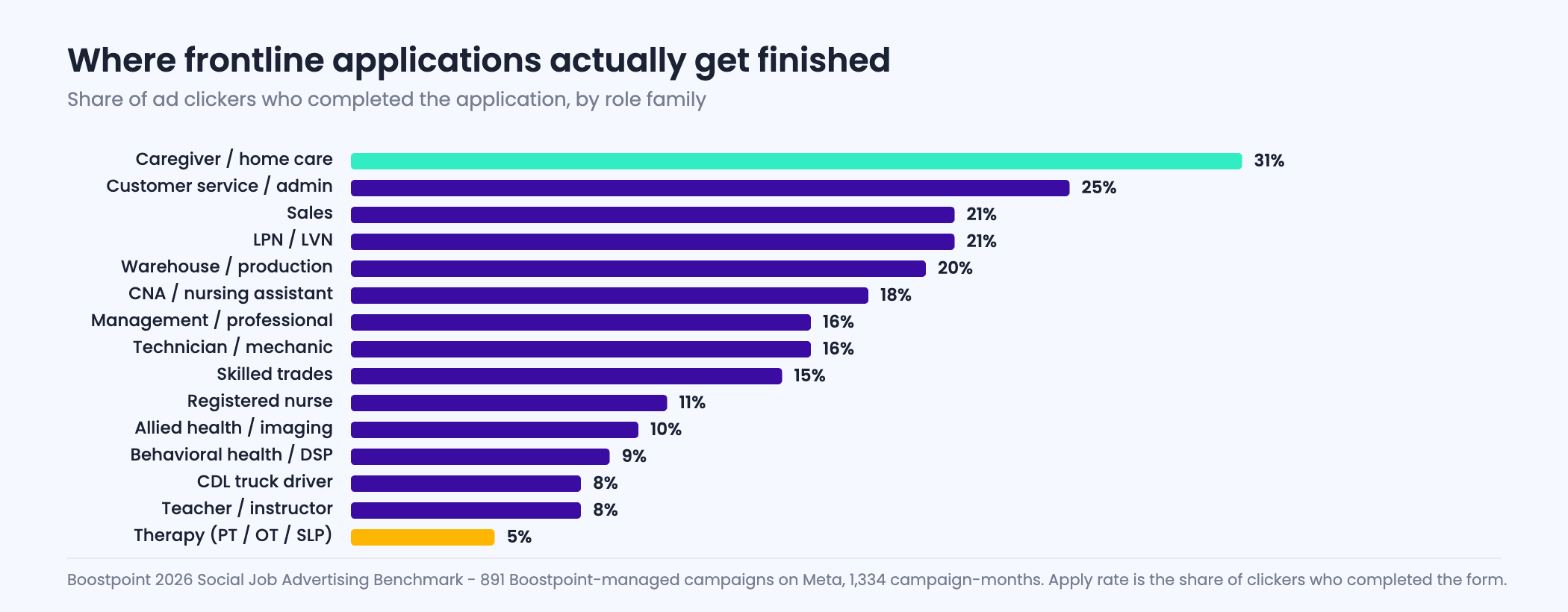
| Role family | Apply rate | Click-through rate | Campaigns |
|---|---|---|---|
| Caregiver / home care | 31% | 2.32% | 34 |
| Customer service / admin | 25% | 1.77% | 24 |
| Sales | 21% | 1.45% | 100 |
| LPN / LVN | 21% | 1.11% | 57 |
| Warehouse / production | 20% | 1.67% | 82 |
| CNA / nursing assistant | 18% | 1.15% | 32 |
| Management / professional | 16% | 1.46% | 50 |
| Technician / mechanic | 16% | 1.17% | 145 |
| Skilled trades | 15% | 1.07% | 35 |
| Registered nurse | 11% | 1.15% | 173 |
| Allied health / imaging | 10% | 1.01% | 23 |
| Behavioral health / DSP | 9% | 0.75% | 19 |
| CDL truck driver | 8% | 0.88% | 59 |
| Teacher / instructor | 8% | 1.12% | 15 |
| Therapy (PT / OT / SLP) | 5% | 0.84% | 39 |
Source: Boostpoint 2026 Social Job Advertising Benchmark — 891 Boostpoint-managed campaigns on Meta (1,334 campaign-months), 2026; advertising costs only. Apply rate is the share of clickers who completed the form. Campaigns counts campaign-months.
Across the whole dataset, 70% of the variation in what an applicant costs is explained by what happens after the click, against 30% for the click-through rate of the ad itself and 18% for what the auction charges per thousand impressions. That is a statement about forms and follow-through, not about interviews — but it points the same direction. The expensive failures in frontline hiring are almost never at the top of the funnel. They are in the handoffs: the form that asks too much, the callback that takes four days, the interview that nobody shows up to.
Our figures describe advertising. Cost per applicant is not cost per hire, and nothing on this page derives one from the other. What an interview costs you, and what a bad hire costs you, live in your own records.
The five questions that do the most work
If you only have twenty minutes, these five cover the ground that matters for an hourly role: whether the person can actually work the schedule, whether they understand the physical reality of the job, how they behave when a shift goes wrong, what would keep them, and whether the credential is real and current. Everything else is a nice-to-have.
1. “Walk me through your last working week — what time did you start, and what did you actually do?”
This is the highest-yield opening question in frontline interviewing, and almost nobody asks it. It is not a trick. It gives a candidate who has never interviewed before something concrete to talk about, and it surfaces the schedule reality in the candidate's own words rather than yours: what time they really started, how long the commute was, whether the last job was full-time in practice or full-time on paper. A strong answer has texture — specific times, specific tasks, a complaint or two. A weak answer stays abstract because the person is guessing what you want to hear.
2. “Here is what this job is actually like. Which part of that would be hardest for you?”
Read the real conditions out loud first: the shift pattern, the lifting, the drive, the pace, the part of the job people quit over. Then ask which part is hardest. This inverts the standard “are you comfortable with…” question, which teaches the candidate to say yes. Asking which part is hardest gives them permission to be honest and gives you a real answer. A candidate who names something specific and then tells you how they would handle it is telling you they have thought about it. A candidate who says “none of it” has either not listened or is telling you what you want to hear, and both are worth a follow-up.
3. “Tell me about a shift that went badly. What did you do?”
Keep exactly one behavioral question and make it this one. It works because every hourly worker has a story: short-staffed, a machine down, a resident who fell, a truck that did not arrive. What you are listening for is whether they acted, who they told, and whether the story has anyone else in it. The strongest answers usually contain a moment where the person escalated to someone rather than either freezing or improvising alone.
4. “What would have to be true for you to still be here in a year?”
Retention questions are usually asked as “where do you see yourself in five years”, which invites a rehearsed answer and tells you nothing. This version asks for conditions instead of ambitions, and the conditions are the things you can actually control: a schedule that does not change every week, a route that stays the same, hours that hold up, a manager who answers the phone. Candidates answer this one honestly more often than you would expect, and the answer is a list of your own retention risks — most of which show up in the first ninety days rather than the first year.
5. “What is your [license, certification, endorsement] status today, and when does it renew?”
Ask about the credential directly, by name, with the renewal date. This is a job-related question about a job requirement, and it avoids the far more dangerous drift into questions about health, age, family or country of origin that credential conversations sometimes wander into. Ask what they hold, when it renews, and whether anything is pending. If the credential is one your organization can pay for or help finish, say so in the interview, because that is frequently the single sentence that wins a frontline candidate.
The five questions are worth less than the discipline of asking the same five, in the same order, of everyone. Comparability is the whole point.
What a good answer sounds like — and what is not a red flag
Scoring anchors are what turn an interview from an impression into a comparison. Write down, before the first interview, what a strong and a weak answer look like for each question. The third column below matters just as much: frontline interviewing is full of signals that feel like problems and are not, and a hiring process that penalizes them will reject people who would have been good at the job.
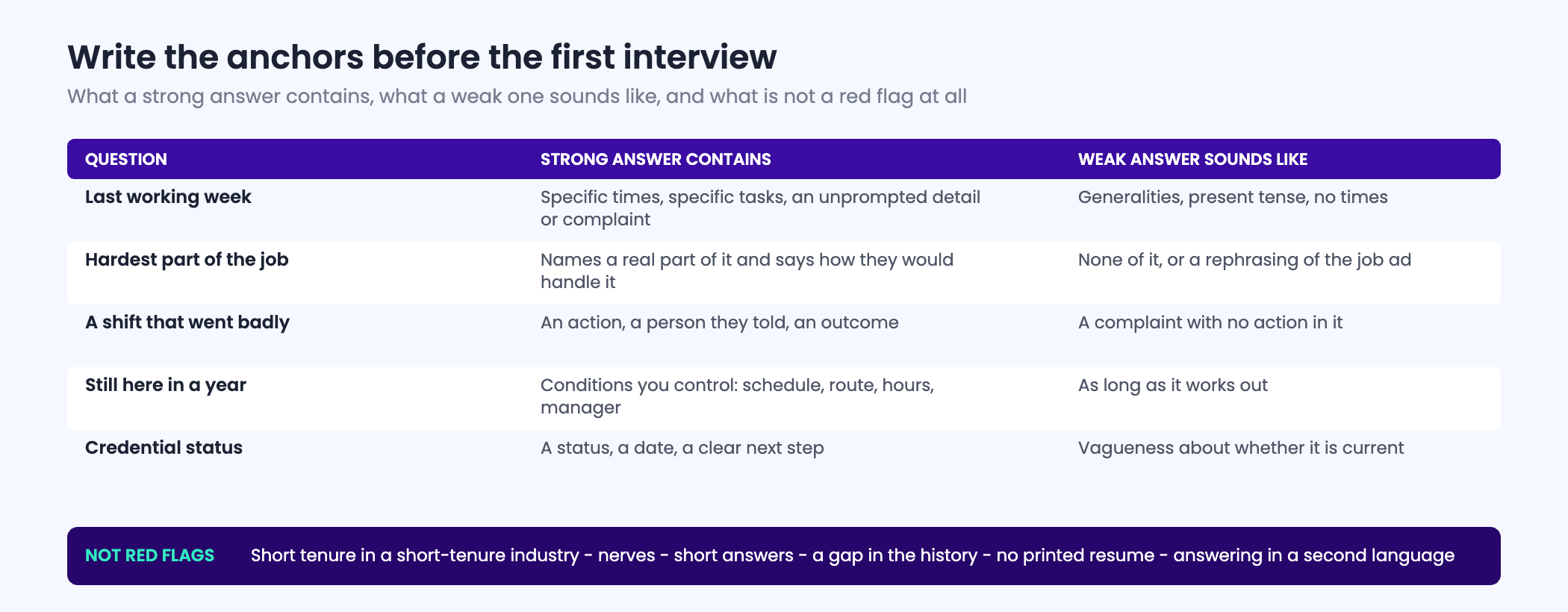
| Question | Strong answer contains | Weak answer sounds like |
|---|---|---|
| Last working week | Specific times, specific tasks, an unprompted detail or complaint | Generalities, present tense, no times |
| Hardest part | Names a real part of the job and how they would handle it | “None of it” or a rephrasing of the job ad |
| Shift that went badly | An action, a person they told, an outcome | A complaint with no action in it |
| Still here in a year | Conditions you can control: schedule, route, hours, manager | “As long as it works out” |
| Credential status | A date, a status, a clear next step | Vagueness about whether it is current |
The anchors above are Boostpoint's working pattern for frontline interviews, not a measured result. Adapt the wording to your roles; keep the discipline of writing them down before the first interview.
Signals that are routinely mistaken for red flags: short tenure in an industry where everyone has short tenure, a candidate who is nervous or gives short answers, a gap in a work history, arriving without a printed resume, or answering in a second language. None of those predicts whether someone will do the job well. Fluency in interviews is a rehearsed skill, and the people who most need frontline work have had the fewest opportunities to rehearse it.
Build your set
Interview question builder
Pick the shape of the role and get a five-question interview with scoring anchors, ready to copy into your notes.
Suggested wording only. Check anything credential-related against the rules that apply to your roles and your state.
Ask the same questions, in the same order, of everyone
Structured interviewing is the least glamorous recommendation in hiring and the one with the most behind it. The mechanics are simple: a fixed question list, a fixed order, written anchors, and notes taken during the interview rather than reconstructed after it. The reason it matters for hourly hiring in particular is volume. When you interview thirty people for six openings across three weeks, unstructured impressions decay into a ranking of who you spoke to most recently and who reminded you of someone who worked out.
Two practical rules make it stick. First, whoever is running the interview writes the answer down as the candidate gives it, not a verdict. “Started 5:45, drove 40 minutes, ran the packing line alone Thursday” is a note. “Good attitude” is not. Second, score immediately after each interview and before the next one, because a scorecard filled in at the end of the day is a memory test.
Do not re-ask what your screener already answered
If you advertise on social platforms, most of your applications arrive through an instant lead form, and a well-built form has already asked the disqualifying questions: distance, license, availability, the certification, the shift. Asking all of those again at the top of the interview burns four of your twenty minutes and signals that nobody read the application — which frontline candidates notice and mention. It also wastes the work you already did in the ad itself, where the disqualifying conditions should already have been stated plainly.
The useful move is to map the two against each other once. Anything the screener established, you confirm in a single sentence rather than re-ask. Anything the screener cannot establish — judgment, how someone handles a bad shift, what would keep them — is where the interview time should go.
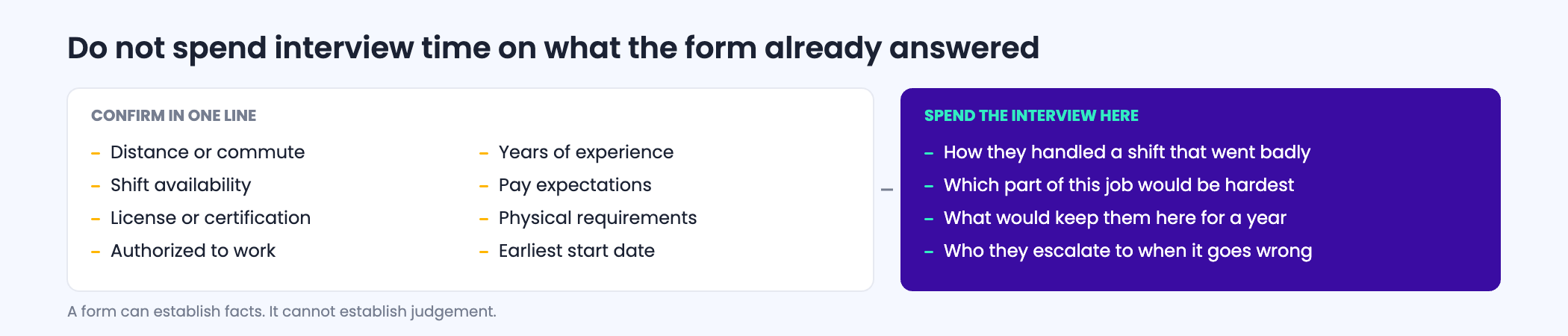
Handoff map
Screener-to-interview handoff
Tick what your application form already asks. The tool splits your interview into what to confirm in one line and what genuinely needs the time.
The questions you are not allowed to ask
Some questions are unlawful to ask regardless of intent, and the ones that catch employers out are rarely malicious — they are friendly small talk that drifts into protected territory. Where are you originally from, do you have kids at home, when did you graduate, is that your husband dropping you off, how is your back. Each of those touches a characteristic that federal law protects, and asking it creates a record you do not want, whether or not it influenced the decision.
The safe reframing is always the same: ask about the job requirement, not the person's circumstances. Instead of asking about childcare, state the schedule and ask whether they can work it. Instead of asking about health, describe the physical demands and ask whether they can perform them with or without a reasonable accommodation. We keep the full list, with the federal basis for each, on a separate page. None of this is legal advice, and employment rules vary by state and city — check yours or ask counsel before you finalize an interview script. The same care applies to the reference call afterwards, where the constraints sit on the person answering rather than on you: see reference checks for the state immunity position and a five minute script.
Great interview questions to ask an interviewee — and what each one reveals
A question is only good if a weak candidate and a strong one answer it differently. Most interview questions fail that test: “are you a team player” has one correct answer and everybody knows it. The nine below all have a spread, and the table says what the spread looks like so you are not judging on gut feel alone.
Use them in the same order with every interviewee, write the answers down while they are talking, and score afterwards rather than during. That is the whole method; the questions are the easy part.
| Question | What it reveals | A weak answer | A strong answer |
|---|---|---|---|
| Walk me through your last shift, start to finish. | Whether they have done the work, and how they organize time under load. | A recital of the job description. | A sequence with a hiccup in it, and what they did about the hiccup. |
| What made you start looking? | The condition that will eventually make them leave you, too. | “Looking for growth.” | Something specific and checkable: hours cut, a promised raise that never came, a route change. |
| What time would you need to leave the house for a 6am start? | Whether the commute survives February. Attendance is the most common first-90-days failure in frontline roles. | They have not thought about it. | A number, and a backup plan for the day the car does not start. |
| Tell me about a time you disagreed with a supervisor. | Escalation instinct — whether problems reach you early or late. | “I never disagree with anyone.” | They raised it once, accepted the decision, and moved on without carrying it. |
| What part of this job do you like least? | Self-knowledge, and whether they will still be here in six months. | “Nothing, I love all of it.” | They name the genuinely unpleasant part and say how they handle it. |
| How would your last supervisor describe you? | Accuracy of self-image — and it is checkable on a reference call. | Three adjectives from a resume. | A phrase they have actually heard said about them, good or awkward. |
| What do you need from us to do this job well? | Whether you can deliver what they need, before you find out the hard way. | “Nothing, I am easy.” | Specifics: a schedule constraint, training on one machine, the right boots. |
| When could you start, and what notice do you owe? | Whether the timeline in your head is the one in theirs. | “Right away” from someone currently employed. | Two weeks, named, with a reason — the same courtesy they will show you later. |
| What questions do you have for me? | How much homework they did, and what they actually care about. | None. | Questions about the crew, the schedule, or what good looks like at 90 days. |
Notice what is missing: no brainteasers, no “where do you see yourself in five years,” and nothing that rewards interview practice over job competence. An interviewee who is good at interviews and bad at the job is the most expensive hire you can make, because you will not find out for ninety days.
Role-specific question sets
The general five hold up everywhere, but each role has two or three questions that only make sense for that job: infection control and lifting for nursing assistants, room-turn times and access to occupied rooms for housekeepers, tolerances and line-down decisions for machine operators. Those sets live on their own pages and are written for the person doing the hiring, with the red flags attached. Every one of them assumes you already have a written job description — if you do not, start there, because the interview questions fall out of the duty list almost automatically.
What happens between the interview and the offer
Frontline candidates are usually in three processes at once, and the employer who moves first frequently wins someone who was not the strongest candidate on paper. The gap between a good interview and a slow decision is where most of the loss happens, and it is entirely within your control — the same logic behind on-the-spot hiring and every other attempt to shorten time to fill.
Three things close it. Tell every candidate at the end of the interview exactly when they will hear from you, and then beat that time. Send the people you are not moving forward a short, specific note rather than silence, because the frontline labor market in any given town is small and people talk. And have the offer ready to go in writing the day you decide — pay, shift, start date and any contingency — so the moment of yes is not followed by four days of waiting for paperwork.
For role-specific sets built on this method, see our caregiver interview questions page.
See also our server interview questions page for the tipped-role version of this method.
See also our janitor interview questions page for the building-services version of this method.
See also our HVAC interview questions page for the licensed-trade version of this method.
See also our electrician interview questions page for the state-licensed-trade version of this method.
Entry-level candidates: six questions that work when there is no experience to ask about
Most frontline interview guides assume a work history to probe. For a first job, a return to work, or a career change, that assumption produces a silent candidate and an interviewer who mistakes nerves for unsuitability. These six ask about behavior rather than about a job.
- Walk me through how you would get here for a 6am start. The single best predictor of week-three attendance, and it is a logistics question rather than a character one.
- Tell me about something you learned to do that was hard at first. A hobby, a language, a game, a repair. You are listening for how they describe getting past the difficult part.
- When have you had to keep going after something went wrong? Any setting counts. School, sport, family, a previous shift.
- What would the person who knows you best say you are like to work with? Easier to answer honestly than the same question asked directly, and it surfaces self-awareness.
- What do you already know about what this job involves? Tests whether they read the posting and gives you the chance to correct a wrong picture before they start rather than after.
- What would make you stay somewhere two years? The most useful answer in the whole interview, because it tells you what you would have to provide.
Structured interviews: the same questions, the same scale, written down
A structured interview means every candidate for a role gets the same questions in the same order, scored against a defined scale, with the score written down before the interviewers talk to each other. It is not a formality. It is the only practical defense against the two failure modes of frontline hiring: the interviewer who decides in the first minute and spends the rest confirming it, and the panel where the most senior voice moves everyone else.
A workable scorecard for a frontline role has four rows and a five-point scale. Reliability, evidenced by the commute and schedule answers. Task fit, from the scenario question for the actual job. Working with others, from the conflict or handover question. Motivation to stay, from the two-year question. Score one to five with a written line of evidence for each, total, and set the hire threshold before you start interviewing rather than after you meet someone you like. Our page on the competency-based interview covers how to build the underlying competencies.
Strategic interview questions to ask candidates
A strategic question is one whose answer changes your decision. That is the whole definition, and it rules out most of what gets asked in frontline interviews — questions whose answers are interesting but which no candidate could fail in a way that would stop you hiring them.
Three tests, and a question has to pass all three:
- Could a candidate answer it badly? “Are you a hard worker?” has one available answer, so it carries no information.
- Would a bad answer change your decision? If you would hire them anyway, you are making conversation, not deciding.
- Does it test something the job actually needs? Not something the job sounds like it needs.
The five questions in the section above are the strategic set for most hourly roles. If you want a sixth, the one that most often changes a decision is: “What would make you leave a job like this in the first month?” Candidates answer it honestly far more often than employers expect, and the answer is frequently something you can either fix or rule out on the spot.
Good interview questions to ask candidates — and the bad ones they replace
Good questions are specific, behavioral and past-tense. Bad ones are hypothetical, leading or about personality. The swap is usually mechanical:
| Instead of | Ask | Because |
|---|---|---|
| “How do you handle pressure?” | “Tell me about the busiest shift you have worked. What happened?” | Everyone handles pressure well hypothetically |
| “Are you reliable?” | “How many shifts did you miss in the last six months, and what happened?” | The second one is checkable and people mostly tell the truth |
| “What is your greatest weakness?” | “What part of your last job did you never get good at?” | The first is a rehearsed performance; the second is a real answer |
| “Where do you see yourself in five years?” | “What would make you still be here in a year?” | Five years is fiction for an hourly role; a year is a decision |
| “Why should we hire you?” | “What do you want to know about the job that the ad did not tell you?” | Tells you what they are actually weighing |
Unique interview questions to ask candidates, and when they are worth it
Unique questions have a bad reputation they mostly deserve. The brainteaser genre predicts nothing, and the quirky-personality genre costs you credibility with an experienced candidate who has run a crew for a decade.
There is a narrow version that does work: a question unique to your operation rather than unique in general. “Our shop is a hundred and ten degrees in August and the fans are the only cooling — what is the hottest place you have worked?” is unique, entirely fair, and it surfaces the thing that would have made them quit in week three.
The rule is that a unique question should be unique because your job is unusual, not because you want the interview to be memorable.
Related: Situational Interview Questions, Customer Service Interview Questions, Medical Assistant Interview Questions, EMT Interview Questions, Dental Assistant Interview Questions, Patient Care Technician Interview Questions, Sterile Processing Interview Questions, Bartender Interview Questions, Barista Interview Questions, Cashier Interview Questions, Dishwasher Interview Questions, Front Desk Interview Questions, Lifeguard Interview Questions, Store Manager Interview Questions, 911 Dispatcher Interview Questions, Maintenance Technician Interview Questions, Production Supervisor Interview Questions, Warehouse Supervisor Interview Questions, Interview Questions for Teenagers.
Frequently asked questions
Questions are one part of the process. The order they go in, the eight-minute phone screen before them, and how to close the same day are on how to interview someone; the sheet you score them on is on interview scorecard template.
What are the best interview questions to ask candidates for hourly roles?
Five cover most of the ground: walk me through your last working week, which part of this job would be hardest for you, tell me about a shift that went badly, what would have to be true for you to still be here in a year, and what is your credential status and renewal date. They are short, concrete, and answerable by someone who has never been coached on interviewing.
How many interview questions should I ask?
For a twenty-minute frontline interview, four to six questions with follow-ups is realistic. More than that and you are reading a list rather than listening. The constraint is not the number of questions but the time you leave for the candidate to answer them properly and for you to write down what they said.
Should every candidate get the same questions?
Yes. A fixed question list in a fixed order is the single change that most improves hiring decisions at volume, because it lets you compare answers instead of impressions. Follow-up questions can and should vary; the core set should not.
What interview questions are illegal to ask?
Questions that seek information about a protected characteristic rather than a job requirement: national origin, age, religion, disability or health, marital and family status, pregnancy, and in many jurisdictions salary history and criminal record timing. The safe version of nearly every one of them is to state the job requirement and ask whether the candidate can meet it.
Are behavioral interview questions useful for frontline hiring?
One is. A single question about a shift that went badly gives you the action, the escalation and the outcome, which is what the behavioral format is good for. A full behavioral battery is built for longer salaried interviews and tends to reward candidates who have rehearsed rather than candidates who can do the job.
How do I score interview answers fairly?
Write the anchors before the first interview: what a strong answer contains and what a weak one sounds like, for each question. Take notes in the candidate's words during the interview, score immediately afterwards, and treat nervousness, short answers, short tenure and gaps as neutral rather than negative unless something in the answer explains why they matter for this job.
Should I re-ask questions the application form already covered?
No. Confirm those in one sentence and spend the interview on what a form cannot establish. Re-asking availability, distance and license status at the start of an interview burns time and tells the candidate nobody read their application.
Does asking better interview questions reduce hiring cost?
We cannot tell you that from our data, and we will not pretend otherwise. Our figures come from advertising and stop at the completed application, so they describe cost per applicant, not cost per hire. Better questions make decisions more comparable and defensible; what that is worth shows up in your records, not ours.
What interview questions work for entry level candidates?
Ask about behavior rather than about a job, because a first time candidate has no work history to probe. Six that work: how they would get here for an early start, something they learned that was hard at first, a time they kept going after something went wrong, what the person who knows them best would say they are like to work with, what they already know about the job, and what would make them stay somewhere two years. The last one is usually the most useful answer in the interview, because it tells you what you would have to provide.
What is a structured interview?
One where every candidate for a role gets the same questions in the same order, scored against a defined scale, with each interviewer writing their score down before the panel discusses the candidate. For a frontline role a workable scorecard has four rows scored one to five: reliability, task fit, working with others, and motivation to stay, each with a written line of evidence. Set the hire threshold before you start interviewing rather than after you meet someone you like.
What are structured interview questions?
Structured interview questions are a fixed set asked of every candidate for a role, in the same order, and scored against the same written scale. The structure is the whole point: it is what makes two candidates comparable and what stops the interview drifting into whichever direction the conversation happens to take. The five questions above are the frontline set, and the scoring instrument is the interview scorecard template.
What are some great interview questions to ask?
The great ones are the ones a strong candidate and a weak candidate answer differently. “Walk me through your last shift, start to finish” separates people who have done the work from people who have read the job description. “What made you start looking?” surfaces the condition that will eventually make them leave you. “What part of this job do you like least?” tests self-knowledge. Questions with one obvious correct answer — are you a team player, are you reliable — tell you nothing, because everyone knows the answer.
What questions should you ask an interviewee?
Ask the same set of eight to ten questions of every interviewee, in the same order, and write the answers down as they speak. Cover the work itself, why they are leaving, the practical constraints such as commute and schedule, one example of handling conflict, what they need from you, and their notice period. Close by asking what questions they have for you. Improvising a different set for each person makes candidates impossible to compare and pushes the decision onto rapport.
What are good interview questions to ask candidates?
Specific, behavioral and past-tense ones. Swap “how do you handle pressure” for “tell me about the busiest shift you have worked, what happened”, and “are you reliable” for “how many shifts did you miss in the last six months”. Hypothetical questions collect rehearsed answers; past-tense ones collect facts you can weigh.
What are strategic interview questions to ask candidates?
Questions whose answers would actually change your decision. Test each one three ways: could a candidate answer it badly, would a bad answer stop you hiring them, and does it test something this job genuinely needs. Most questions asked in frontline interviews fail at least one of those.
What are behavioral interview questions to ask candidates?
Questions that ask what someone did rather than what they would do — “tell me about a time you...” followed by the situation, what they did and how it ended. They work because past behavior in comparable conditions is the best available predictor, and because they are much harder to rehearse than hypotheticals.
What interview questions should employers ask?
Employers should ask a small, fixed set in the same order for every candidate for the same role, scored as they go. Five to eight specific questions asked consistently beat twenty asked differently each time, because the comparison between candidates is the part that actually produces a decision.
Questions decide what you ask; a scorecard decides how you compare the answers. Build one and download it at interview scorecard template.
Getting enough candidates to interview is the other half
A structured interview only helps if people are showing up to it. If the constraint is volume rather than selection, that is the part we measure.
Apply rate, click-through rate and campaign counts: Boostpoint 2026 Social Job Advertising Benchmark — 891 Boostpoint-managed campaigns on Meta across 1,334 campaign-months in 2026, advertising costs only. Apply rate is the share of clickers who completed the form; campaigns counts campaign-months. Role-family apply rates used on this page: caregiver and home care 31%, customer service and admin 25%, sales 21%, LPN and LVN 21%, warehouse and production 20%, CNA 18%, technician and mechanic 16%, skilled trades 15%, registered nurse 11%, allied health and imaging 10%, behavioral health and DSP 9%, CDL truck driver 8%, therapy 5%. Cost variation explained: 70% by applicant conversion after the click, 30% by click-through, 18% by cost per thousand impressions. Cost per applicant is not cost per hire, and no cost per hire is derived from it anywhere on this page. Twenty-minute interview lengths, the five-question structure, the scoring anchors and the screener handoff are Boostpoint's working patterns rather than measured values, and are labeled as such. Federal protected characteristics are as described by the U.S. Equal Employment Opportunity Commission; nothing here is legal advice and state and local rules vary. Last updated August 2026.