
Housekeeper Interview Questions
Two numbers decide whether a housekeeping hire works out, and one conversation decides whether they stay. Ask how many rooms they carried and how long they were given, because rooms per shift is the whole job, and the answer tells you immediately whether your assignment will feel normal or impossible to them. Then ask about being alone in other people's private space, because that is the part of the job no other frontline role has. Chemicals are your obligation to train on, not a question to screen with.
What this page covers
Questions for hiring room attendants, housekeepers and cleaners in hotels, senior living and facilities work, with what a good answer sounds like. The general interviewing method — structure, anchors, the handoff from your application form — is on our interview questions to ask candidates guide. Costs and channels for filling these roles sit with hospitality recruiting, and this page does not repeat either.
Before the interview comes the posting: our housekeeper job description template is free to copy.
We sell recruitment advertising, so what we can measure is what it costs to get someone to complete an application. What happens in the interview is a working pattern, labeled as such throughout. One thing we cannot do honestly is give you a housekeeping cost benchmark, and the reason why is below rather than buried.
The number the whole interview turns on
Housekeeping is one of the few frontline jobs where the entire experience of the work is a single ratio: how many rooms, in how many hours, with what mix of checkouts and stayovers. A room attendant who has been doing fourteen checkouts in eight hours and one who has been doing twenty-two are not doing the same job, and neither of them will describe the difference unless you ask for the numbers.
Ask for all three — rooms, hours, and the checkout share — because a checkout takes substantially longer than a stayover and a candidate quoting a high room count on mostly stayovers is describing an easier day than the number suggests. Then do the arithmetic out loud, against your own assignment, in the interview.
Do the math in the room
Rooms per shift, side by side
Enter what the candidate described and what you are actually offering. The comparison is arithmetic from your own numbers, not a benchmark.
What they described
What you are offering
Minutes per room is your two numbers divided, nothing more. The checkout share is shown because a checkout and a stayover are not the same room.
Seven questions worth asking
1. “How many rooms did you have on your last shift, and how many were checkouts?”
Ask for the number before anything else, while it is still a factual question rather than a negotiation. Strong answers come with a shape: the count, the split, whether they had a runner or stripped their own beds, whether the property was full. If the number is far below yours, the honest move is to say so and talk about it, because the alternative is a hire who quits in week two and tells everyone why.
2. “What slows a room down that a manager would not notice?”
This is the question that separates people who have done the job from people who have watched it. The answers are specific and unglamorous: a linen cart parked on the wrong floor, an elevator out, a room that was not stripped, a guest still in the room at eleven, running out of amenities halfway down the hall. Anyone who names two of those has real hours behind them.
3. “You are alone in an occupied room and something is not right. What do you do?”
Housekeeping is the only frontline role where the work happens alone inside other people's private space, and the judgment that matters is knowing when to stop and call rather than handle it. Leave the scenario open and let the candidate choose what “not right” means — medication on the floor, a guest asleep, a smell, cash on the dresser, damage. The good answers all end with them telling somebody rather than deciding alone.
4. “What do you do when a guest is still in the room at the end of your window?”
A concrete version of the same judgment, and one that happens every day. You are listening for whether they knock and how, whether they have a way to flag it without abandoning the schedule, and whether they know that pushing the guest is never their job. The answer also tells you what their last property's culture was, which is usually more informative than anything on the resume.
5. “Which part of a room takes you longest, and what did you change to speed it up?”
A craft question, and one people enjoy answering. Bathrooms are the usual answer, sometimes beds if the property has heavy duvets. The second half is the important half: someone who has changed their own sequence — stripping the bed before starting the bathroom so it can air, staging supplies at the door — is telling you they think about the work rather than merely getting through it.
6. “What have you been trained on for chemicals, and what happened if you were not sure about a bottle?”
Ask this to find out what their last employer did, not to screen them. Under the federal hazard communication rule the employer must provide effective information and training on hazardous chemicals in the work area at the time of initial assignment, and again whenever a new chemical hazard is introduced. That obligation is yours regardless of what the candidate arrives knowing. What the answer tells you is whether they came from a property that took it seriously, and whether they will ask rather than guess.
7. “What would make you stay somewhere for a year?”
The answers in housekeeping are unusually consistent: a predictable board, being able to finish on time, a supervisor who does not add rooms at two in the afternoon, and getting the same section often enough to get fast at it. Every one of those is free. Write down what they say, because it is a list of the things that will cause them to leave if you do the opposite.
Chemical training is an obligation you owe them on day one, not a qualification you screen for at interview.
| Requirement | When | Citation |
|---|---|---|
| Effective information and training on hazardous chemicals in the work area | At the time of initial assignment | 29 CFR 1910.1200(h)(1) |
| Training again on a new chemical hazard | Whenever one is introduced into the work area | 29 CFR 1910.1200(h)(1) |
| Chemical-specific information available through labels and safety data sheets | Always | 29 CFR 1910.1200(h)(1) |
Source: Electronic Code of Federal Regulations, Title 29, read August 29 2026 (eCFR displaying Title 29 up to date as of August 27 2026; Title 29 last amended August 4 2026). Federal requirement; states with their own OSHA plans may require more. Not legal advice.
Hotel housekeeper and housekeeping supervisor questions
The seven questions above work in any setting. A hotel adds guests, keys and a checkout rush, and a supervisor role adds the board, the inspection and the callout at 7 a.m. These are the extra questions we would add for each, with what a strong answer sounds like. They are Boostpoint working patterns, not measured results.
Hotel housekeeper interview questions
- “A door has a Do Not Disturb sign on it all day. What do you do?” Strong answers follow the property's policy and tell the supervisor rather than knocking repeatedly or skipping it silently. The answer tells you whether they know a missed room is a guest-welfare question as well as a schedule one.
- “A guest stops you in the hall and asks for towels, a crib and a late checkout. What happens next?” You want the person who handles what is theirs, the towels, and passes the rest to the front desk quickly instead of promising what they cannot give.
- “You find a phone and cash left in a checkout room. Walk me through it.” The good answer is a process: log it, hand it in, never leave it on the cart. It overlaps with question 3 above but is more concrete in a hotel.
- “How do you keep your key or key card with you all shift?” Key control is a guest-safety issue. Listen for a habit, such as a lanyard or a clip, not a promise.
- “Which do you prefer, checkouts or stayovers, and why?” There is no wrong answer. It tells you how they think about the board and gives you a natural opening to describe your checkout share.
Housekeeping supervisor interview questions
- “Two attendants call out at 7 a.m. and the hotel is full. What do you do in the first hour?” Strong answers are a sequence: who they call first, how they rebuild the board, what they tell the front desk about room readiness, and whether they pick up rooms themselves.
- “How do you build the board for a mixed day of checkouts and stayovers?” Listen for fairness: spreading checkouts, keeping sections consistent so attendants get fast, and posting it early. Question 7 above says those are what keep people.
- “Walk me through how you inspect a room.” A real supervisor has a set order and can tell you what they check first and why. Ask what they do when the same attendant keeps failing the same item.
- “How would you train a new room attendant in their first week?” Good answers pair the new hire with a strong attendant, start with a lighter board and build up, and include chemical safety training on day one, which the employer owes under 29 CFR 1910.1200(h)(1).
- “An attendant tells you their room count is impossible. How do you respond?” You want someone who checks the numbers before deciding, because that conversation is where good attendants either stay or leave.
For a supervisor role it is tempting to promote your strongest attendant; ask the board and callout questions anyway. Running a room and running a floor are different jobs. The posting side is on our how to hire housekeepers and janitorial staff page.
Ask it better: the same question, worded two ways
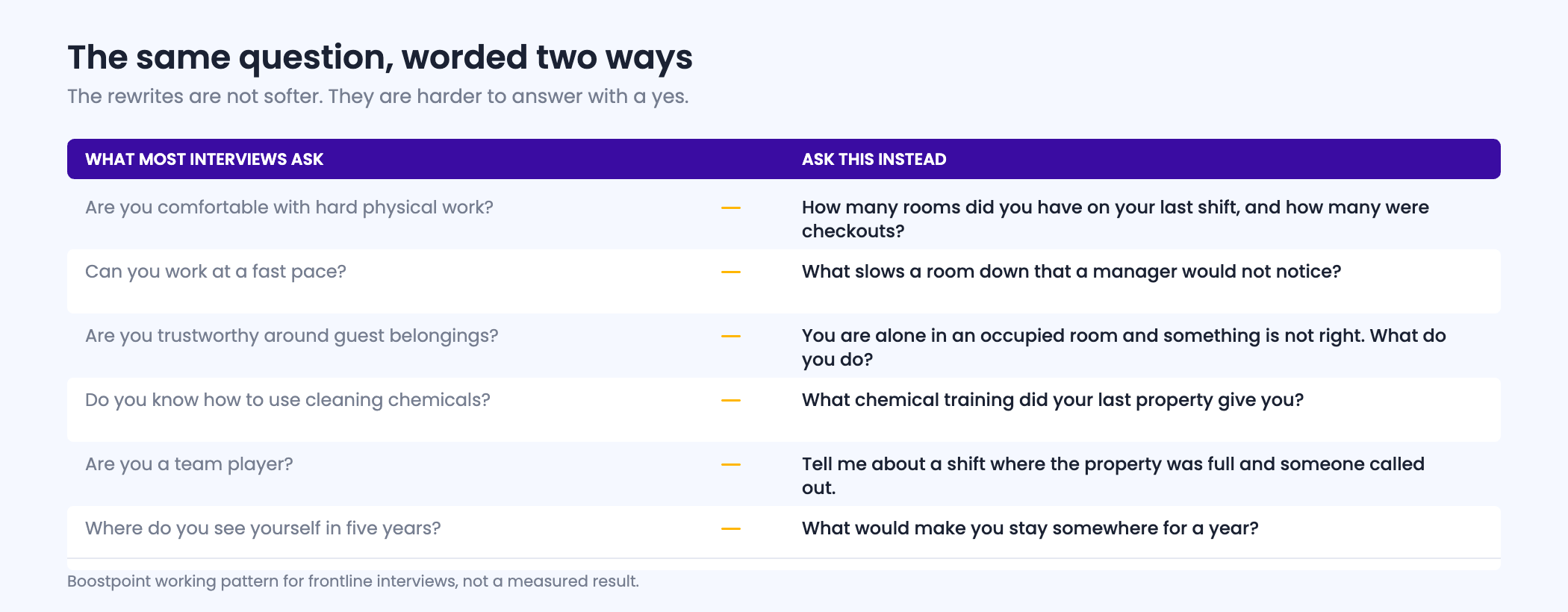
Most bad housekeeping interview questions are not unlawful or unkind, they are simply built to be answered yes. Flipping the wording costs nothing and changes what you learn.
Rewrite
Say this, not that
Flip each row to see the version that gets a real answer, and why the usual one does not.
The turnover you are hiring into
It is worth knowing the shape of the market you are interviewing in, because it explains why candidates are comfortable walking and why speed matters. Accommodation and food services has the highest separation and quit rates of any industry the federal labor turnover survey publishes, and it is not close.
| Industry | Total separations | Quits | Hires |
|---|---|---|---|
| Accommodation and food services | 5.5% | 4.2% | 5.5% |
| Leisure and hospitality | 5.6% | 3.9% | 5.7% |
| Retail trade | 3.8% | 2.6% | 3.7% |
| Health care and social assistance | 2.9% | 2.0% | 3.1% |
| All industries | 3.3% | 2.0% | 3.3% |
Source: U.S. Bureau of Labor Statistics, Job Openings and Labor Turnover Survey, annual average rates by industry, not seasonally adjusted, read August 29 2026. The annual rate is built from summed monthly levels over summed employment; it is not a monthly rate multiplied by twelve.
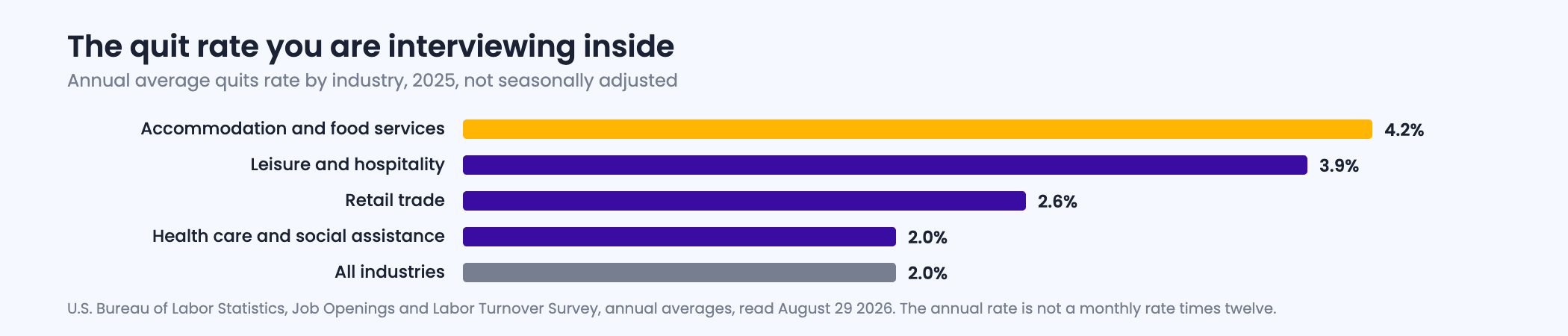
A quit rate of 4.2% a year against an all-industry 2.0% does not mean housekeepers are unreliable. It means the roles are close substitutes for one another across a town, the switching cost is a single conversation, and the property that answers fastest and schedules most predictably wins people who were not looking.
What we cannot tell you, and why
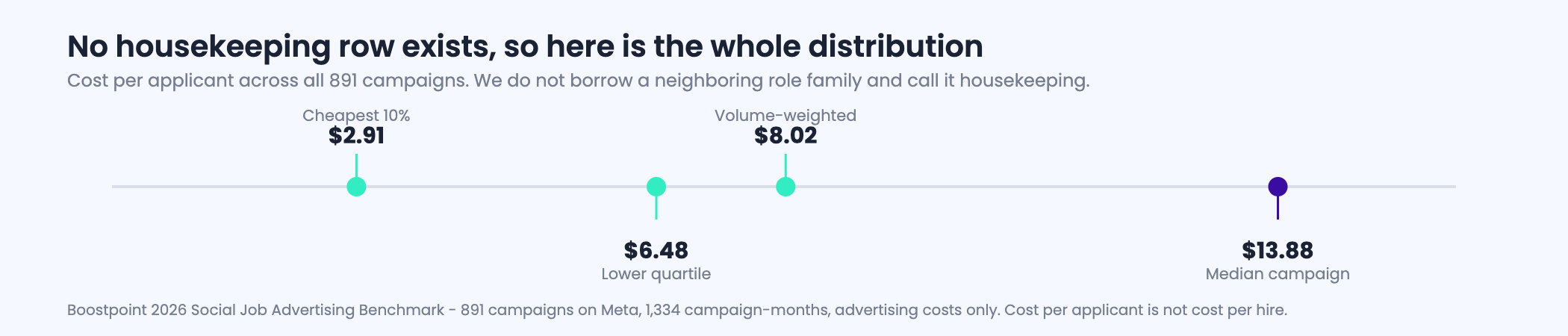
Our benchmark covers 891 campaigns across fifteen role families, and housekeeping is not one of them. There is no housekeeping row, and we are not going to borrow a neighboring family and present it as one — the whole value of the dataset is that the categories mean something.
The closest family by how the applicant pool behaves is customer service and administrative roles, at a $2.71 median cost per applicant with a 25% apply rate across 24 campaign-months. Treat that as adjacent, not as a substitute: it is drawn from different jobs. The honest wider context is the all-campaign distribution — a $13.88 median across every campaign, $8.02 volume-weighted, with the cheapest tenth at $2.91 and the lower quartile at $6.48.
| Point in the distribution | Cost per applicant |
|---|---|
| Cheapest 10% of campaigns | $2.91 |
| Lower quartile | $6.48 |
| Median campaign | $13.88 |
| Volume-weighted average | $8.02 |
Source: Boostpoint 2026 Social Job Advertising Benchmark — 891 Boostpoint-managed campaigns on Meta (1,334 campaign-months), 2026; advertising costs only. No housekeeping role family exists in the dataset. Cost per applicant is not cost per hire, and nothing on this page derives one from the other.
What to say before they leave the room
Say the real assignment, in numbers, including the checkout share on a busy day. Say what happens when the property is full and someone calls out, because that is the day the job is decided and every candidate has been burned by a vague answer to it. Say when the board is posted and whether sections rotate. And say when you will call, then call sooner — in a labor market with a 4.2% annual quit rate, the property that decides on Tuesday beats the property that decides on Friday.
Frequently asked questions
What questions should I ask a housekeeper in an interview?
Start with rooms per shift, hours and the checkout share on their last job. Then ask what slows a room down that a manager would not notice, what they do when something is not right in an occupied room, what happens when a guest is still there at the end of the window, which part of a room takes longest and what they changed to speed it up, what chemical training they have had, and what would make them stay a year.
How many rooms per shift is normal?
There is no published national standard, and any number quoted as one is somebody's internal target rather than a measured norm. What matters in an interview is the comparison: the rooms, hours and checkout share the candidate is used to, set against yours, worked out loud in front of them so nobody is surprised in week two.
Should I ask whether a candidate knows the cleaning chemicals?
Ask what training they have had, but not as a screen. Under the federal hazard communication rule the employer must provide effective information and training on hazardous chemicals in the work area at the time of initial assignment, and again whenever a new chemical hazard is introduced. The obligation sits with you whatever the candidate already knows.
What is a good answer to a question about finding something in a guest room?
One that ends with telling someone. The specific find matters less than whether the candidate stops and reports rather than deciding alone, because housekeeping is the only frontline role performed unsupervised inside private space. Answers that involve handling it personally, however well meant, are the ones to follow up on.
Is high turnover in housekeeping a candidate problem?
Accommodation and food services runs a 4.2% annual quit rate against 2.0% across all industries, which reflects how easily these roles substitute for one another within a town rather than anything about the people doing them. Treating a work history with several properties in it as a red flag will screen out most of the experienced candidates in your market.
Do you have a cost benchmark for hiring housekeepers?
No, and we will not borrow one. Our benchmark has fifteen role families and housekeeping is not among them. The closest by pool behavior is customer service and administrative roles at a $2.71 median cost per applicant with a 25% apply rate, which is adjacent rather than a substitute, and the honest wider context is the all-campaign median of $13.88 with a volume-weighted average of $8.02.
How fast should I decide after a housekeeping interview?
Faster than feels necessary. In a market where quitting costs a candidate one conversation, the property that makes a decision within a day or two routinely takes people away from properties offering more money and answering on Friday. Tell the candidate when you will call, and then call earlier than you said.
What should I avoid asking?
Anything that invites a yes rather than a fact: are you comfortable with hard work, can you handle a fast pace, are you a team player. Replace each with a question that asks for something specific and checkable, and avoid anything touching family, health, age or origin, which are protected characteristics rather than job requirements.
What questions are asked in a hotel housekeeper interview?
Ask about rooms per shift and the checkout share, what they do with a Do Not Disturb sign, how they handle guest requests in the hall, how they log items left in rooms, how they keep their key card secure, and what chemical training they have had. Add what slows a room down and what would make them stay a year, because those answers predict turnover.
What should I ask a housekeeping supervisor in an interview?
Ask how they would handle two callouts on a full day, how they build a fair board of checkouts and stayovers, how they inspect a room, how they train a new attendant in the first week, and how they respond when an attendant says the room count is impossible. Each answer should be a concrete sequence, not a general statement about leadership.
Filling housekeeping roles is a speed problem
If the calendar is empty rather than the interview being wrong, that is the part we measure.
Turnover figures: U.S. Bureau of Labor Statistics, Job Openings and Labor Turnover Survey, annual average rates by industry, not seasonally adjusted, 2025, read August 29 2026 — accommodation and food services 5.5% total separations, 4.2% quits, 5.5% hires; leisure and hospitality 5.6%, 3.9%, 5.7%; retail trade 3.8%, 2.6%, 3.7%; health care and social assistance 2.9%, 2.0%, 3.1%; all industries 3.3%, 2.0%, 3.3%. The annual rate is built from summed monthly levels over summed employment rather than a monthly rate multiplied by twelve. Chemical training requirement quoted from 29 CFR 1910.1200(h)(1), Electronic Code of Federal Regulations, Title 29, read August 29 2026, displayed as up to date as of August 27 2026 and last amended August 4 2026; states operating their own plans may require more, and nothing here is legal advice. Advertising figures: Boostpoint 2026 Social Job Advertising Benchmark — 891 Boostpoint-managed campaigns on Meta across 1,334 campaign-months in 2026, advertising costs only. There is no housekeeping role family in the dataset and none is invented here; customer service and administrative roles are named as adjacent at a $2.71 median and a 25% apply rate across 24 campaign-months, and the all-campaign distribution is given as $2.91 at the cheapest decile, $6.48 at the lower quartile, $13.88 median and $8.02 volume-weighted. Cost per applicant is not cost per hire, and no cost per hire is derived from it anywhere on this page. Room counts, question wording and the interview sequence are Boostpoint's working patterns rather than measured values, and are labeled as such. Last updated August 2026.