
How to Hire Housekeeping and Janitorial Staff Without Relying on Job Boards
To hire housekeepers and janitorial staff effectively, shift your budget from active job boards to passive social media advertising. Traditional job boards suffer from high competition and candidate recycling. By running targeted social media campaigns (on platforms like Facebook and Instagram), hotels and commercial facilities can — in an earlier Boostpoint analysis of 1,070 frontline campaigns (2025–2026) — generate hospitality and cleaning applicants for an average of $4.98 each. Using short, 1-minute mobile applications drastically increases candidate conversion and speeds up time-to-hire.
Source: earlier Boostpoint analysis — 1,070 managed frontline recruitment campaigns conducted in 2025–2026 across hospitality, retail, and commercial facilities nationwide. The canonical current figures are in the 2026 Social Job Advertising Benchmark (891 campaigns; all-role median $13.88).
A note on who's writing this
Most guides on how to hire housekeepers are written by commercial cleaning franchises or hospitality staffing agencies. They usually tell you to focus on writing a "catchy job description" on a saturated job board or, predictably, to outsource your hiring entirely to their temp agency.
Writing the posting itself? Our free housekeeper job description template covers duties, requirements and 2025 BLS pay.
Boostpoint is a recruitment advertising platform. We build the software that helps hotels, hospitals, and commercial facilities build direct talent pipelines for deskless workers through targeted social media campaigns.
We are sharing the exact 2026 data and recruitment mechanics to help you capture frontline applicants at scale, bypassing traditional job boards and staffing agencies completely.
Why traditional job boards are failing for cleaning staff
If you are struggling to keep your facility fully staffed, your sourcing channel is likely the bottleneck. For years, the standard playbook was to post a requisition on a job board and wait. Today, that model is broken for frontline hiring.
- Job boards run on search intent. A traditional job board requires a candidate to actively decide they want a new job, open a website, type in "housekeeping jobs," and scroll. Great housekeepers are usually already employed.
- The active pool is fiercely contested. In any given week, the number of people actively searching for janitorial roles in your radius is a fixed, small number — and every hotel and commercial facility is bidding on them.
- Application friction. Deskless workers apply from their smartphones, often during a break. Forcing them through a 15-question Applicant Tracking System (ATS) kills conversion. Every extra question costs you completions.
The passive sourcing alternative (and what it costs)
Social advertising inverts the job board model. Instead of waiting for a candidate to search for you, your job becomes an engaging ad placed directly in their social media feed.
Because the retail and hospitality sector is highly active on social media, the acquisition costs are extremely favorable for employers.
An earlier Boostpoint analysis of 1,070 frontline campaigns (campaign-level, a different method from our benchmark) produced the figures below. The canonical, current figures are in our 2026 Social Job Advertising Benchmark, where Retail / Corporate campaigns ran a $8.58 median cost per applicant and Healthcare & Senior Living $15.42:
| Industry / role category | Cost per applicant (CPA) |
|---|---|
| Retail & Hospitality | $4.98 |
| Healthcare & Senior Living | $11.54 |
| Blended Frontline Average | $8.49 |
Source: earlier Boostpoint analysis — 1,070 managed frontline recruitment campaigns conducted in 2025–2026 across hospitality, retail, and commercial facilities nationwide. The canonical current figures are in the 2026 Social Job Advertising Benchmark (891 campaigns; all-role median $13.88).
Data from an earlier Boostpoint analysis spanning 1,070 campaigns; the 2026 Social Job Advertising Benchmark (891 campaigns, 1,334 campaign-months) is the canonical source.
Who actually applies on social media?
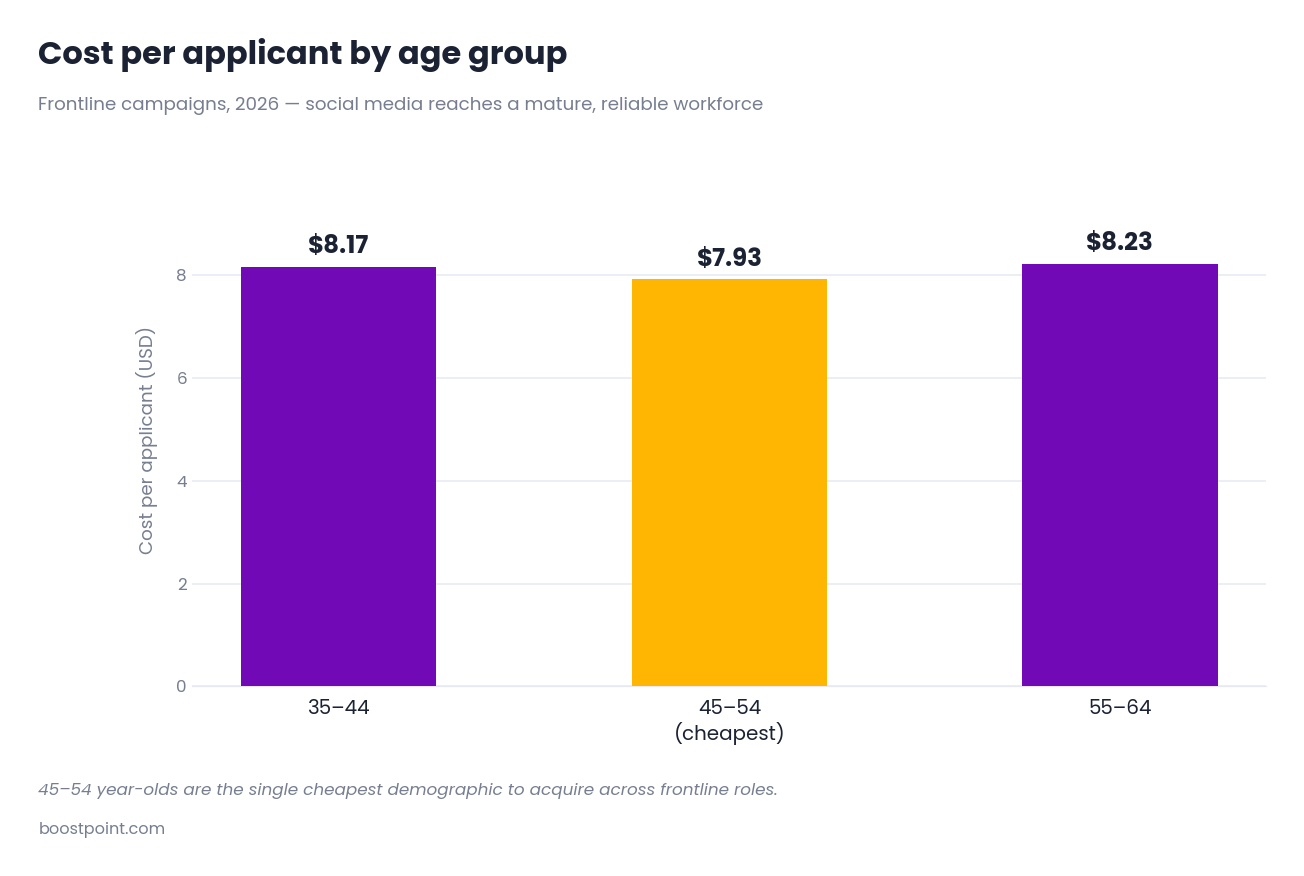
A common misconception is that social media only reaches entry-level, younger demographics. However, our earlier campaign analysis showed that experienced workers convert well across frontline roles:
- 35–44 year-olds: $8.17 per applicant.
- 45–54 year-olds: $7.93 per applicant (the cheapest demographic to acquire).
- 55–64 year-olds: $8.23 per applicant.
This demographic spread perfectly aligns with the reliability and stability needed in commercial cleaning and housekeeping teams.
From applicants to hires
Generating applicants is step one; getting them to show up, pass a background check where the site requires one, and still be cleaning in sixty days is step two, and step two happens inside your process, not in the ad. Our campaign data measures advertising, not hiring outcomes, so we don't publish a cost per hire, and any figure that multiplies a cost per applicant by an assumed hire rate is an assumption, not a benchmark. Take the cost per applicant above, apply the applicant-to-hire ratio you measure over a few months, and set the result against what a temp agency's hourly markup costs on the same shifts. Cost per applicant is not cost per hire.
4 best practices for hiring housekeepers and janitors
To build a reliable talent pipeline, update your recruiting mechanics to match how deskless workers actually apply:
- Shorten the application to 1 minute. Remove the resume upload requirement. Use 3-4 simple knockout questions (e.g., Are you available for weekend shifts? Can you lift 25 lbs?) to qualify them instantly.
- Automate your follow-up. Frontline candidates move fast. The first employer to call usually gets the interview, so speed matters more than polish. Automate an SMS message to trigger immediately after they apply.
- Advertise the shift and location. Do not be vague. Housekeeping and janitorial jobs live and die by commuting distance and shift alignment. Put the exact hours and location in the ad creative.
- Use video, not stock photos. Show the actual hotel rooms or commercial facilities they will be cleaning. A 15-second video builds immediate trust compared to generic stock images.
How to hire janitors: the site is the job, and the shift is in someone else's building
Housekeeping and janitorial are cousins, not twins, and the second half of this page is about the janitorial side. The Bureau of Labor Statistics counts 2,432,600 janitors and building cleaners (2025) at a median $17.71 an hour ($36,840 a year, May 2025), projects about 321,800 openings a year through 2035 on 2% growth, and puts 35% of them at services-to-buildings firms — the contractors — with 17% in education, 7% in healthcare and 5% self-employed; "many cleaners work evening hours" because office buildings are cleaned when they are empty, and the training is short and on the job (Occupational Outlook Handbook, read August 2026). Three things about janitorial hiring follow from those numbers and from how the work is sold. The job is a site, not a title — a school on days, an office tower from 6 to 10 p.m., a medical office that needs a background check, a route of five small buildings with a company van — and the ad has to name it. The shift is usually an evening or a night in a building the cleaner has never seen, alone or in a small crew, which recruits a specific person: the one who wants to work unsupervised after hours, often as a second job. And for a contractor, hiring comes in bursts: a new account starts on a date and needs a crew on that date, which is a start-up hire, not a replacement hire, and the campaign has to be built for it.
| Site type | Who takes it | The knockouts | The first line of the ad |
|---|---|---|---|
| Office building, evenings | Second-job workers, students, people who want to be left alone from 6 to 10 | Can you work 6–10 p.m., Mon–Fri? Transportation after 10? Comfortable working alone? | "Evening cleaner, [building], 6–10 p.m., Mon–Fri, $X/hr, same building every night" |
| School or campus, days | Daytime workers who want school hours and a public-sector-style schedule; often in-house, not contract | Can you clear a school background check? Days 7–3? Floor care experience? | "Day custodian, [school], 7–3, school calendar, $X/hr, background check required" |
| Medical office or clinic | Cleaners who have done healthcare and know the protocols | Background check? Healthcare cleaning experience? Evenings after the last patient? | "Medical office cleaner, evenings, $X/hr, background check, we train the protocol" |
| Route (several small sites, a van) | Drivers who want a route and independence; the future site lead | Valid driver's license and clean record? Comfortable with 4–6 stops a night? Keys and alarms? | "Route cleaner, 5 buildings, company van, 5–11 p.m., $X/hr — you run the route" |
| Floor tech / project work | The cleaner who wants the skilled rate: strip-and-wax, carpet extraction, machines | Which machines have you run? Weekend project availability? Lift 50 lbs? | "Floor technician, strip-and-wax and carpet, weekends and nights, $X/hr — machine experience paid" |
| New account start-up crew | All of the above at once, on a date; the crew that opens the building | Can you start [date]? Which nights? Have you worked a start-up (deep clean) before? | "Start-up crew, [building], starts [date], $X/hr, first two weeks are deep-clean nights" |
The best way to recruit janitors: the crew's phones, then the feed
Cleaning crews are built by referral more than any other frontline workforce we see: the cleaner who works your office tower has a cousin who wants the building next door, and the family crew that runs a route is how a lot of routes get run. A referral bonus paid at sixty days for a referral who is still cleaning, said out loud at the start of the shift and texted to the crew with the ad, is the cheapest sourcing a contractor has and it reaches people no job board reaches. When the crew's phones run out — a new city, a new account, a floor tech nobody knows — the feed is next, with the site, the hours and the rate in the first sentence, under Meta's Special Ad Category with no age, gender or ZIP targeting (the rules), so "Evening cleaner, [building], 6–10 p.m., same building every night" does the selecting. Then a three-question form (which nights, transportation after the shift, can you start on the date), a call the same evening from the site supervisor — cleaners are awake at 9 p.m. and asleep at 9 a.m. — and a paid walk of the building on the first night as the interview. Same-day contact is our practice, not a statistic we have measured. The shift-specific mechanics — the differential said out loud, one campaign per shift, watching frequency in a small radius — are on how to fill open shifts, and the security-guard version of "the site is the job" is on how to hire security guards.
The start-up crew: hiring for a date, not an opening
A contractor wins a 100,000-square-foot account starting the first of the month and has to put a crew in it that night. That is a mass-hiring problem in miniature, and it is priced by the account's production rate: the square feet one cleaner covers in an hour at your standard, which is your number and varies by building type and scope. At 3,000 square feet an hour, 100,000 square feet is 33.3 cleaner-hours a night; in four-hour shifts that is 8.3 cleaners, so nine on the floor and, with a 1.2 roster factor for call-offs, eleven on the roster, plus a site lead. The ad for that is dated and event-driven — "Start-up crew, [building], starts [date]" — and where a dozen people have to be hired in two weeks, a walk-through open house at the building with offers on the spot is the structure that ran a median $8.02 per applicant at a 21% apply rate across 78 campaigns in our 2026 benchmark (a cross-industry figure, not a cleaning figure); the mechanics are on open house hiring events and, for larger starts, mass hiring. The planner below runs the crew arithmetic on your production rate.
Interactive
Start-up crew planner — how many cleaners a new account needs on the floor and on the roster, at your production rate
Nothing is stored or sent — this runs in your browser. The production rate is yours; Boostpoint publishes no cleaning production figure and no cost per hire.
The honest summary
Stop trading the same active candidates with the hotel down the street.
If your facility is short-staffed on housekeepers and janitors, spending more money on the same saturated job boards will not solve the problem. By shifting your strategy to passive social media sourcing and optimizing for mobile applications, you can bring applicant costs down toward the under-$5.00 figures our earlier analysis found for retail and hospitality and build a reliable, permanent workforce.
The calculation worth running this quarter
HR and Operations managers should evaluate these three metrics immediately:
- Audit your job board ROI. Divide your total monthly job board spend by the number of actual seated hires. That is your own cost per hire on that channel — a number only you can compute, and one we don't publish.
- Measure your ATS drop-off. If less than 10% of candidates who click your job board link actually complete the application, your form is too long and is causing candidate abandonment.
- Compare against social benchmarks. Measure your current applicant costs against the $4.98 retail and hospitality figure from our earlier analysis, and the sector medians in the 2026 benchmark.
How to hire employees for a cleaning business
Across all 891 campaigns in Boostpoint’s 2026 Social Job Advertising Benchmark, the median cost per applicant was $13.88; the benchmark does not report cleaning roles as a family of their own, so that all-role median is the fair reference for a cleaning business, not a cleaning-specific price. What it buys is people who raise their hand. Whether they become a reliable crew depends on doing the rest in the right order.
- Set up as an employer before the first hire. Payroll, an employer identification number, workers’ compensation where your state requires it, and a Form I-9 for every employee. Our small business hiring checklist puts these in order.
- Decide employee or contractor honestly. If you set the schedule, supply the equipment and send the cleaner to your clients, those facts weigh toward employee status under the federal tests, and your state may apply a stricter one. Get this right before the first paycheck.
- Write one posting per real job. Residential team cleaner on days, commercial cleaner on evenings, a route with a company vehicle: each draws a different person. Put the pay, the hours and the area in the first line. The housekeeper and janitor job descriptions are ready to adapt.
- Ask for referrals first. Anyone who has cleaned for you, and your first hire above all, knows someone. A bonus paid once the referral is still working at sixty days costs less than any ad.
- Keep the application to three questions. Which days or nights, transportation between sites, and start date. Add a background check question only if your clients require one and you actually run it.
- Call the same day, and make the interview a paid trial clean. An hour working beside you shows more than any answer.
For the interview itself, see housekeeper interview questions and janitor interview questions.
How to recruit cleaners: house, hotel and office cleaning are three different hires
The janitorial section above is about office buildings at night. Most "cleaner" hiring is one of two other jobs, and the recruiting is different for each. The BLS counts 1,332,100 maids and housekeeping cleaners (2025), projects about 175,500 openings a year through 2035, and puts the median at $35,510 a year (May 2025). That is a pool that turns over constantly, so the question is never whether cleaners exist but whether your ad reaches the right one.
Residential cleaners
A house cleaner works days, weekdays, often in a team of two, and drives between homes. The person who takes this job wants daytime hours and a predictable finish, and the thing that stops them applying is the car. Say in the first line whether you supply the vehicle or pay mileage, the hours ("Monday to Friday, 8 to 3"), the rate and the area. Ask three questions: a valid driver's license and a car (if the job needs one), the days available, and whether they can pass the background check your clients expect. Recruit through your current cleaners first, since residential crews grow by referral, then through a social job ad aimed at people already cleaning, cooking or caring for someone in the area.
Hotel and resort housekeepers
Hotel housekeeping is weekends and holidays, a room count per shift and a lot of lifting. The ad has to say the room quota or the typical workload, the weekend pattern and the rate, because an applicant who finds those out on day three is a no-show on day four. Seasonal properties should start the ad weeks before the season, when the local pool has not yet been claimed by every other hotel.
What all three share
The applicant is on a phone and usually already working, so the application has to take a minute, and the first call has to come the same day. Boostpoint Connect, an add-on to Attract, texts every applicant the moment they apply and lets your team reply from a shared inbox, which matters for a workforce that answers texts and ignores email. The role descriptions are on our housekeeper and janitor job description pages.
Frequently asked questions
How to recruit housekeeping staff effectively?
The most effective way to recruit housekeeping staff is to run targeted, localized social media ads on platforms like Facebook and Instagram. This reaches passive candidates who are not actively searching job boards. Pair this with a 1-minute, mobile-friendly application process to maximize conversion.
How much does it cost to advertise for janitorial jobs?
Using passive social media recruiting, employers can generate retail and hospitality applicants (including janitorial and housekeeping staff) for an average of $4.98 per applicant in an earlier Boostpoint analysis of 1,070 campaigns; across all roles, the 2026 Social Job Advertising Benchmark median is $13.88.
Why do I get so few applicants for my cleaning jobs?
If you are relying solely on job boards, you are competing against every other local facility for a very small pool of active job seekers. Furthermore, if your application requires a resume upload or takes longer than 3 minutes to complete on a mobile phone, deskless workers will abandon the form.
Does social media work for hiring older housekeeping staff?
Yes. In an earlier Boostpoint analysis of frontline recruitment campaigns, candidates aged 45–54 were the most cost-effective demographic to acquire at $7.93 per applicant, and candidates aged 55–64 accounted for 23.6% of applications. Social media reaches a mature, reliable workforce.
Should I use a staffing agency for housekeeping?
Staffing agencies provide a quick fix for sudden emergencies, but they typically charge a 40% to 55% hourly markup over the worker's base wage. For permanent, baseline scheduling needs, building a direct pipeline via social media advertising is significantly more cost-effective.
How do you hire janitors?
Hire the site, not the title: the ad's first line names the building, the hours, the rate and whether it is the same building every night; the form asks which nights, transportation after the shift and the start date; the site supervisor calls the same evening; and the interview is a paid walk of the building on the first night. The BLS counts 2,432,600 janitors and building cleaners, 35% of them at contractors, and says many work evenings because buildings are cleaned when empty — so the ad has to reach a phone at 9 p.m., not a job board at 9 a.m.
What is the best way to recruit janitors?
Your own crew's phones first — cleaning crews are built by referral, and a bonus paid at sixty days for a referral who is still cleaning is the cheapest sourcing a contractor has. Then the feed, with the site and the hours in the first sentence; then a dated walk-through open house at the building when a new account needs a crew on a date, which is the event-driven structure that ran a median $8.02 per applicant across 78 campaigns in our 2026 benchmark (cross-industry, not a cleaning figure). Job boards reach the between-jobs few and every other contractor's ad.
How do you staff a new cleaning contract fast?
Size it from your production rate, then hire for the date: 100,000 square feet at 3,000 square feet an hour is 33.3 cleaner-hours a night, nine cleaners on the floor in four-hour shifts and eleven on the roster plus a lead. Run a dated start-up ad two to three weeks before the first night, hold an open house at the building with offers on the spot, and put the first two weeks' deep-clean schedule in the ad so the crew that shows up is the crew that knew what it signed up for. The planner on this page runs it on your numbers.
Where can I find housekeepers to hire?
Referrals from current cleaning staff are the strongest single channel — housekeepers move in networks and often bring a second person with them. After that, social job ads reach people who are already employed cleaning somewhere else, which is where most experienced housekeepers are. Signage at the site itself works for building and hotel roles. Job boards reach the actively searching slice only, and for this role that slice is small.
How do you hire cleaning staff quickly?
Advertise the specific site and shift rather than a generic housekeeping role, state the hourly rate, make the application short enough to finish on a phone in a parking lot, and call the same day. For janitorial and housekeeping work the commute and the shift decide the application, so putting both in the first line filters out the people who would have dropped out later anyway.
How do I hire my first employees for a cleaning business?
Register as an employer and set up payroll, workers’ compensation where required and Form I-9 before the first hire. Decide whether the role is an employee or a contractor under the federal and state tests. Then write one posting per job with the pay, hours and area in the first line, ask past helpers and your first hire for referrals, keep the application to three questions, call applicants the same day, and use a paid trial clean as the interview. Across Boostpoint’s 2026 benchmark, the all-role median was $13.88 per applicant.
How do you recruit cleaners?
Decide which cleaner you are hiring, because house cleaning, hotel housekeeping and office cleaning attract different people. Put the hours, the rate, the area and (for house cleaning) the car or mileage policy in the first line; ask three questions; text or call the same day; and ask your current cleaners for referrals before you spend anything. The BLS counts 1,332,100 maids and housekeeping cleaners with about 175,500 openings a year, so the pool is large and moving; the ad decides which part of it you reach.
How do you hire cleaners for a house cleaning business?
Hire for the day shape and the car. Residential cleaners work days, often in pairs, driving between homes, so the ad should name the hours, the rate, the area and whether you supply a vehicle or pay mileage. Ask about a driver's license, availability and the background check your clients expect, then make the interview a paid trial clean alongside you or a lead. Referrals from your existing cleaners are the strongest source for a residential business.
Is there a housekeeper shortage?
Not in the sense of a shrinking workforce. The BLS Employment Projections 2025-35 count 1,332,100 maids and housekeeping cleaners in 2025, projected to grow 0.6 percent to 1,339,500 by 2035, with about 175,500 openings a year and a May 2025 median annual wage of $35,510. That describes a large, flat occupation that turns over constantly, so almost every opening is a replacement. What employers feel as a housekeeper shortage is competition: hotels, home cleaning companies and janitorial contractors are all hiring from the same hourly pool at the same time. The employer who states the rate, the hours and the area in the first line and calls back the same day gets the applicant.
See what it costs to hire housekeepers directly
Book a 30-minute strategy call with our hospitality recruiting team. We'll analyze your local labor market, review cost-per-applicant benchmarks for your region, and demonstrate how to build a direct hiring pipeline using automated social ads.
Book a Demo →Unless another source is named, Boostpoint figures on this page are from an earlier analysis of 1,070 managed frontline recruitment campaigns conducted in 2025–2026 across hospitality, retail, and commercial facilities nationwide. Cost-per-applicant metrics reflect what advertisers paid for advertising.