
How to Hire Security Guards: The Post Is the Job, the License Is the Clock, and the Ad Has to Name Both
To hire security guards, hire the post, not "security officers": the site, the shift, armed or unarmed, and the rate, in the first line of the ad. Then fit the hire around the state license clock — card in hand starts this week; sponsoring the card starts when the state says — run a paid ride-along on the actual post as the interview, and staff a 24/7 post as 4.2 full-time guards, not one opening. Boostpoint has no security campaign data and says so below; cost per applicant is never cost per hire.
A note on who's writing this
Boostpoint runs social media job ads for employers who hire hourly, licensed, shift-based staff, and this page is the sequence we use with them when the role is a guard. Two things to say plainly first. We have no security-industry campaign data — no guard-company or in-house security campaign is broken out in our benchmark — so every figure of ours here is cross-sector and labeled as such, and every security figure is a third party's, dated where it appears. And this page is the how-to; what a guard costs by either route, contract bill rates, the benefits share, licensing fees and the background check, is on its sibling, the cost to hire a security guard, and is linked from here rather than repeated. The ride-along, the first lines and the same-day call are our practice, not measured results. Licensing rules are summarized for two states only and are not legal advice.
The labor market: 1.3 million guards, 157,200 openings a year, most of them at contract firms
The Bureau of Labor Statistics counts 1,304,000 jobs (2025) in the occupation that pairs security guards with gambling surveillance officers, projects about 157,200 openings a year through 2035 against 1% growth, and puts the median at $18.29 an hour, $38,050 a year (May 2025; guards alone $38,020, gambling surveillance officers $43,370). 58% of security guards work for investigation, guard and armored car services — contract firms — with 7% in education, 6% in healthcare and social assistance, 5% in retail and 4% in accommodation and food services, and the medians by employer run from $44,920 in healthcare and social assistance and $44,250 in education down to $37,350 at guard services and $35,640 in retail. Entry is a high school diploma or equivalent; "most states" license guards; the BLS describes shifts of about eight hours, rotating, with nights common (Occupational Outlook Handbook, read August 2026). Three things to take from that. The pool is big and almost entirely employed, mostly at a contract firm down the road, which is where your next guard is standing tonight. The employer-type wage gap is the whole recruiting pitch for an in-house program: a hospital or a campus paying its own median is bidding roughly $6,900 to $7,600 a year — about $3.30 to $3.60 an hour on a 2,080-hour year — above what the guard firm's median pays. And 157,200 openings a year against 1% growth means the market is almost pure replacement, which is why guards are hired at a rate, not for an opening.
The post is the job: six posts, six ads
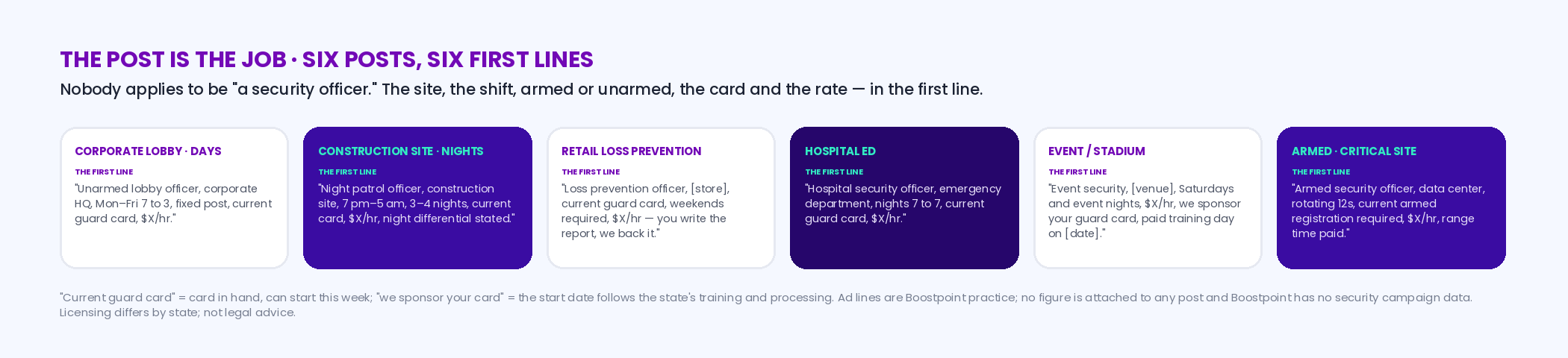
Nobody applies to be "a security officer." A person applies to stand a corporate lobby on days, or walk a construction site on nights, or work loss prevention in a store, or sit a hospital emergency department, or work a stadium on Saturdays, or carry a weapon at a data center; each of those is a different person with a different license, a different tolerance for nights and a different reason to leave the firm they are at. So the ad names the post — the site type, the shift, armed or unarmed, the rate — in the first line, and where you have several posts open at once, it is one campaign with a distinct ad per post. That is the multi-role structure, and in our 2026 benchmark multi-role campaigns ran a median $9.83 per applicant at a 12% apply rate across 46 campaigns, against $14.45 and 18% for single-role campaigns across 1,210 — cross-sector figures, not security figures. Under Meta's Special Ad Category a job ad has no age, gender or ZIP targeting (the rules), so the first line is the only targeting there is.
Interactive
Post ad builder — pick the post and get who it's for, the three knockouts, the first line of the ad and what the ride-along is
Nothing is stored or sent — this runs in your browser. Lines and ride-alongs are Boostpoint practice, not measured results; Boostpoint has no security campaign data.
The license is the clock: card in hand vs. sponsoring the card
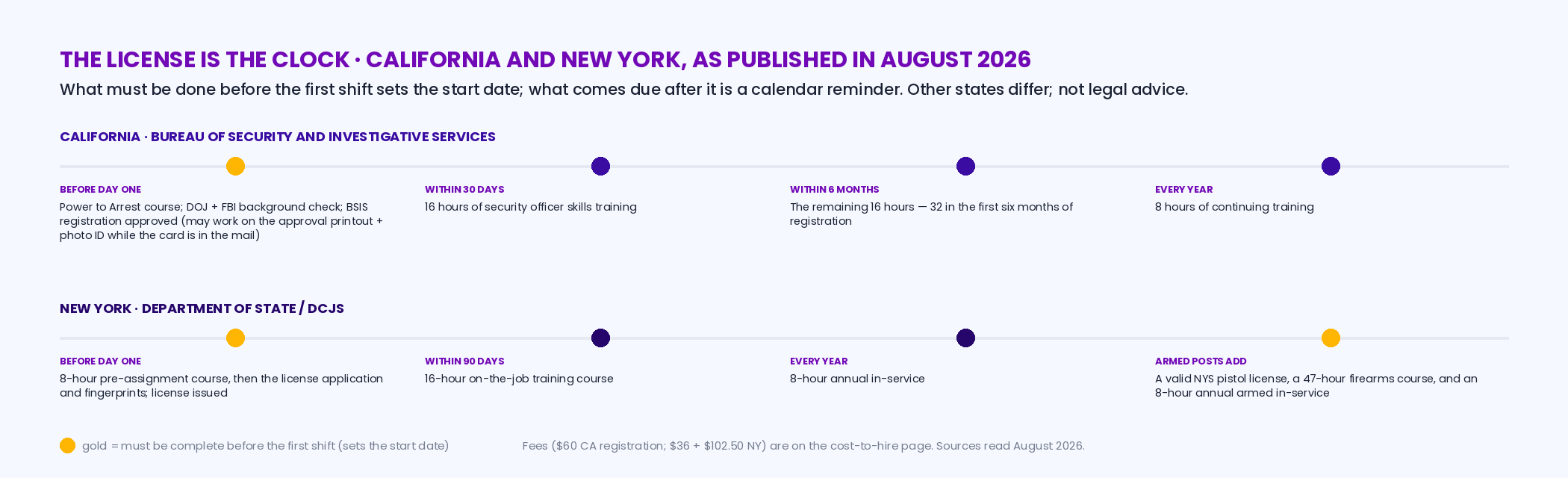
Every guard hire is one of two hires, and the ad should say which. A card-in-hand hire holds a current state registration: in California that means the Bureau of Security and Investigative Services registration, in New York the Department of State license, and in most states something equivalent. That guard can start as soon as your own background check and post training clear — days, not weeks — and the ad's first line says "current guard card required" so that the applicants are the ones who can start. A sponsored-card hire is someone new to the trade, and the start date belongs to the state. In California a person must complete the Power to Arrest course before the Bureau issues the registration, passes a DOJ and FBI criminal history check, may work while the hard-copy card is in the mail with a printout of the Bureau's approval and photo ID, and then owes 32 hours of security officer skills training within six months — "16 hours of the training within 30 days of the registrant's employment date and … the 16 remaining hours within six months" — plus 8 hours of continuing training every year (BSIS Security Guard Fact Sheet, read August 2026). In New York it is an 8-hour pre-assignment course before the license application, a 16-hour on-the-job course within 90 days of starting, and an 8-hour annual in-service; an armed guard adds a valid state pistol license and a 47-hour firearms course (NY Department of State and DCJS, verified August 2026). What those fees cost is on the cost page. What matters here is the calendar: a sponsored hire's first day is set by the course schedule and the state's processing, so a firm that needs a post covered next Monday hires card-in-hand and advertises for it, and runs the sponsored-card ad continuously for the bench.
Interactive
License clock planner — pick the state and a start date and see what has to be done before the first shift and what comes due after it
Nothing is stored or sent — this runs in your browser. California and New York rules as published in August 2026; every other state is a placeholder for you to fill from your own regulator.
Where security guards actually come from
With 58% of security guards at contract firms, the honest answer is: from the guard company across town, from the guard company you are replacing, and from the people who stood posts for someone else last year and left. Those are passive candidates, working tonight, and they are reached where they are — on a phone on a post, in the feed, between rounds — with an ad that names a better post, a better shift or a better rate than the one they have. The second pool is people leaving adjacent work: veterans and reservists, retired and former law enforcement, corrections, loss prevention, and campus safety, most of whom already clear a background check and many of whom hold a card. The third is new to the trade, sponsored-card hires drawn by the schedule and the path, which is the bench a contract firm has to keep filling. Referrals reach the first two better than any ad: guards on a post know the guards on the next post, and a bonus paid at ninety days for a referral who stays, said out loud at the shift briefing, costs nothing until it works. Job boards reach the between-jobs few and everyone else's post beside yours. A staffing agency reaches tonight, and that is sometimes the right call; how one makes its money is on how staffing agencies make money.
| Pool | Who is in it | How to reach them | What the ad leads with | Source |
|---|---|---|---|---|
| Guards at contract firms | The 58% at investigation, guard and armored car services; card in hand, working a post tonight | The feed, referrals from your own guards, the post next door | A better post, shift or rate than the one they stand now; "current card, start this week" | BLS OOH; Boostpoint practice |
| In-house guards elsewhere | Hospital, campus, retail and corporate guards, often at the higher employer medians ($44,920 healthcare, $44,250 education) | The feed, referrals | The site, the schedule, the benefits; matching or beating the in-house median | BLS OOH; Boostpoint practice |
| Adjacent: veterans, former law enforcement, corrections, loss prevention | Already background-cleared, often carded, used to posts and shifts | The feed; veteran and transition programs; referrals | The armed post, the supervisory path, the rate | Boostpoint practice |
| New to the trade (sponsored card) | People drawn by the schedule, the uniform and a licensed path; the bench | An always-on ad; a dated open house at the training site | "We pay for your guard card and training; start on [date]"; the schedule | Boostpoint practice |
| Tonight's post | Not a hire — a shift | A staffing agency or an app | Not an ad | Linked, not repeated |
The ad, the form and the ride-along
The first line names the post, the shift, armed or unarmed, the card requirement and the rate: "Unarmed guard, hospital emergency department, nights 7 to 7, current guard card, $X/hr." The second line says the schedule pattern and whether it rotates, because the BLS's "rotating, nights common" is exactly what a guard wants to know before applying. The form is three questions and a phone number — do you hold a current state guard card (and armed, if the post is armed); which shifts can you stand; when can you do a paid ride-along on the post — with nothing that duplicates the background check you will run anyway (what a background check is). Then a call the same day from the account manager or the site supervisor, not from a recruiter; a guard applies on a phone on a post and can't talk until the round is over, so the callback that lands before the shift ends is the one that gets the ride-along. Same-day contact is our practice, not a measured statistic. The interview is the ride-along: two paid hours on the actual post, on the actual shift, with the guard who stands it now — the post orders, the access points, the radio, the incident log — because the only thing an interview across a desk tests is whether someone interviews well, and a guard who has seen the post at 2 a.m. and still wants it is the hire. Make the offer at the end of the ride-along with the start date set by the license clock. Our general form guidance is on what makes a good job ad.
A 24/7 post is 4.2 guards, not one opening
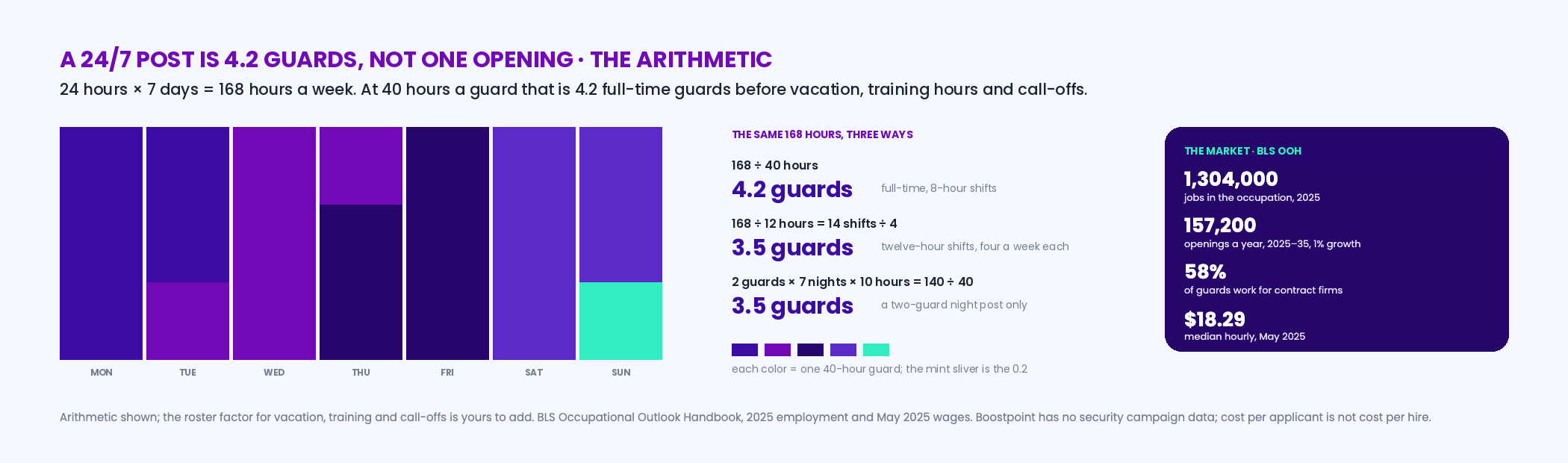
The arithmetic every security manager knows and every job posting hides: a post covered around the clock is 24 × 7 = 168 hours a week, which at 40 hours a guard is 4.2 full-time guards before vacation, sick time, training hours and call-offs; in twelve-hour shifts it is 14 shifts a week, 3.5 guards at four shifts each. A two-guard night post of 10 hours, seven nights, is 2 × 7 × 10 = 140 hours, 3.5 guards. So a contract that says "one post" is a recruiting target of four or five people, and a firm with twenty 24/7 posts is recruiting for the equivalent of eighty to a hundred seats before turnover. That is why security officer recruiting is done by rate, not by opening: at 157,200 openings a year on 1.3 million jobs the market replaces roughly one guard in eight every year before anyone grows, and a firm's own turnover is usually higher than the market's. The always-on ad, one per post type, is the structure for that; the volume version for a new contract with a dozen posts starting on one date is on mass hiring.
How to hire security guards fast
Fast has one rule in security: hire card-in-hand. A sponsored hire starts when the state and the course schedule say, and nothing in your process changes that. For a post that has to be covered next week, the ad says "current guard card required" in the first line, the form asks for the card, the call comes the same day, the ride-along is on the next shift, and the offer is at the end of it; your own background check and post training are the only days left. The dated version, when a new contract needs a dozen posts at once, is an open house at the branch with ride-alongs booked from the room, which is the event-driven structure — a median $8.02 per applicant at a 21% apply rate across 78 campaigns in our 2026 benchmark, the cheapest structure we run, and a cross-sector figure. The general sequence for any frontline role is on how to fill open positions fast; and when the post is tonight, that is a staffing agency, not an ad.
What our data can and can't say about security
Nothing about security specifically. Our 2026 benchmark has no security row, and we will not invent one from an adjacent sector. What it has is a cross-sector shape: a median campaign of $13.88 per applicant and a volume-weighted average of $8.02; a normal campaign at $334 a month producing 20 applicants and reaching 6,061 people; event-driven campaigns at $8.02 and 21%, multi-role at $9.83 and 12%, single-role at $14.45 and 18%. All of it is advertising cost, and the sector cuts are on the benchmark. Those are anchors for what a first campaign might look like, not a forecast for a guard firm, and the cost page says the same thing at more length. What no figure of ours can say is how many ride-alongs it takes to fill a post with a guard who is still standing it in ninety days; we measure advertising, and you measure that. Cost per applicant is not cost per hire.
Frequently asked questions
How do you hire security guards?
Hire the post, not the title: the ad's first line names the site type, the shift, armed or unarmed, the card requirement and the rate; the form asks three questions (current card, which shifts, when can you ride along); the site supervisor calls the same day; the interview is a paid ride-along on the actual post; and the offer is made at the end of it with a start date set by the state license clock. Most of the BLS's 1.3 million guards are working a post tonight, mostly at a contract firm, so the ad has to reach a phone on a post, not a job board.
How do you hire security guards fast?
Hire card-in-hand. A guard with a current state registration can start once your background check and post training clear, in days; a sponsored-card hire starts when the state's training and processing allow, which you can't compress. Put "current guard card required" in the first line, call the same day, ride along on the next shift, offer at the end of it. For a dozen posts at once, an open house at the branch with ride-alongs booked from the room; for tonight's post, a staffing agency.
What license does a security guard need?
Most states license guards, and the rules differ. In California a guard needs a BSIS registration — the Power to Arrest course first, a DOJ and FBI background check, then 32 hours of skills training within six months (16 within 30 days of employment) and 8 hours a year; a guard may work on the Bureau's approval printout while the card is in the mail. In New York it is an 8-hour pre-assignment course before applying, 16 hours on the job within 90 days, 8 hours a year, and for armed work a pistol license plus a 47-hour firearms course. Check your state's regulator; this is not legal advice. Fees are on our cost-to-hire page.
Where do you find security guards?
At the contract firm down the road, where 58% of security guards work, reached through the feed and through referrals from your own guards; in adjacent pools that already clear a background check — veterans and reservists, former law enforcement and corrections, loss prevention, campus safety; and among people new to the trade through an always-on sponsored-card ad. In-house employers can lead with the employer-type wage gap: the BLS median is $44,920 in healthcare and social assistance and $44,250 in education against $37,350 at guard services.
What should a security guard job ad say?
The post, the shift, armed or unarmed, the card requirement and the rate, in the first sentence: "Unarmed guard, hospital ED, nights 7 to 7, current guard card, $X/hr." Then whether the schedule rotates, the site, and three questions to apply. Under Meta's Special Ad Category a job ad has no age, gender or ZIP targeting, so the first line does the selecting; "security officers wanted, all shifts" is read by nobody in particular.
How many guards does a 24/7 post need?
168 hours a week (24 × 7) at 40 hours a guard is 4.2 full-time guards before vacation, training hours and call-offs; in twelve-hour shifts it is 14 shifts a week, 3.5 guards at four shifts each. A two-guard night post of 10 hours a night, seven nights, is 140 hours, 3.5 guards. Recruit for the seats, not the post, and expect to replace them: the BLS projects 157,200 openings a year on 1.3 million jobs against 1% growth.
Should you use a staffing agency to hire security guards?
For tonight's post, a coverage gap, or a contract that starts before your own recruiting can, yes — that is what an agency sells, and how one prices it is on our staffing-agency pages. For the standing roster, direct recruiting by post with a sponsored-card bench is the cheaper structure over a year; the contract-vs-direct arithmetic, bill rates and benefits share are on the cost-to-hire page, not repeated here.
What does it cost to recruit security guards?
We have no security campaign data and publish no security figure. Our cross-sector 2026 benchmark shows a median campaign at $13.88 per applicant, a volume-weighted average of $8.02, and a normal campaign at $334 a month for 20 applicants — anchors, not a security forecast. What a guard costs by contract or direct hire, with licensing fees and the background check, is on the cost-to-hire-a-security-guard page. Cost per applicant is not cost per hire; we do not track hires.
What is the security guard hiring process?
Seven steps: an ad that names the post, shift, armed or unarmed, card requirement and rate; a short mobile application asking whether the applicant holds a current state guard card, which shifts they can work and when they can ride along; a same-day call from the site supervisor or account manager; a paid ride-along on the actual post as the interview; a conditional offer; your background check, run only after you give the applicant a stand-alone written disclosure and get their written permission, as the FTC explains under the Fair Credit Reporting Act; and post training before the first shift. For a new guard without a card, the state's licensing steps sit between the offer and the start date.
How long does it take to hire a security guard?
It depends mostly on one thing: whether the guard already holds a current state license. A card-in-hand guard can start as soon as your own background check and post training are done, so the days you control are the time to first call, the ride-along and the offer. A guard you sponsor starts when the state's training and license processing allow, which you cannot shorten, so start that paperwork the day you make the offer. We publish no time-to-hire figure for security; the license clock planner above shows the published California and New York steps.
Put the post in the first line
We'll write one ad per post with the shift, the card and the rate in it, run them where working guards scroll, put a three-question form and a ride-along booking behind them, and show you the shift-based campaigns closest to yours — costs, and never a security figure we don't have.
Book a DemoBoostpoint has no security-industry campaign data; no security figure is stated or implied. Boostpoint figures come from the 2026 Social Job Advertising Benchmark — 891 campaigns and 1,334 campaign-months: median campaign $13.88 per applicant, volume-weighted average $8.02; campaign structures event-driven $8.02, 21% apply rate, 78 campaigns; multi-role $9.83, 12%, 46; single-role $14.45, 18%, 1,210; a normal campaign $334 a month, 20 applicants, 6,061 reached — all cross-sector. No seasonality claim is made. Third-party figures are dated where they appear: BLS Occupational Outlook Handbook (2025 employment, May 2025 wages, 2025–35 projections, page modified August 27, 2026); California BSIS Security Guard Fact Sheet (read August 2026); New York Department of State and DCJS (verified August 2026). Post lines, the ride-along and same-day contact are Boostpoint practice, not measured results; licensing summaries are not legal advice. Cost per applicant is not cost per hire; we do not track hires and publish no cost-per-hire figure. A sample of Boostpoint campaigns, not an industry-wide study.