
Cost to Hire a Security Guard: Contract Bill Rates, Direct Wages, Licensing, and What Recruiting One Costs
The cost to hire a security guard depends on which of two things you're buying. A contract guard bills at roughly $25 to $40 an hour unarmed and $40 to $75 armed in 2026 vendor price guides, insurance and supervision included. Employing one directly starts at BLS's $18.46 an hour median (May 2024), plus about 30% for benefits, plus state licensing (from $60 in California; $138.50 in New York with fingerprints), training hours, a background check from about $30, and the cost of finding the applicant. Every number here is sourced; none of the security ones is ours.
A note on who's writing this
Boostpoint runs social media job ads for frontline employers, and the last section of this page — what it costs to find a security guard applicant — describes what we sell. Read it that way. We should also say plainly what we don't have: no security guard campaign data. Our 2026 benchmark covers 891 campaigns across healthcare, trades, logistics, retail, and education, and security is not a sector in it, so the only Boostpoint figures on this page are cross-sector averages, labeled as such, and we will not dress them up as a security number. Everything about guard bill rates, wages, licensing, training, and background checks is from the Bureau of Labor Statistics, two state licensing agencies, a background-check vendor's price list, and two security companies' published rate guides, each named where used. If a figure on this page isn't attributed, it's arithmetic, and the arithmetic is shown.
Two routes, two very different bills
"Hire a security guard" means one of two things. Most businesses contract a guard company, which employs, licenses, insures, schedules, and supervises the guard and bills you an hourly rate for the post. Some employ guards directly — a hospital, a school district, a distribution center with a gate — and carry the wage, the benefits, the licensing, the training, the liability, and the recruiting themselves. The first route is a price per hour of coverage; the second is a payroll line plus a set of one-time costs per person hired. They are not comparable on a per-hire basis, and this page doesn't try; it compares the annual cost of covering a post, then itemizes what the direct route adds on top of the wage.
The case for contracting first
Before the direct-hire math: for most employers, contracting is the right answer, and the reasons are structural. The guard company holds the state license, carries general liability and workers' compensation, trains to the state's hour requirements, fills the post when someone calls in, and absorbs turnover in an occupation BLS projects will generate about 162,300 openings a year with essentially no growth — meaning nearly every opening is a replacement. If you need coverage tonight, or one post at one site, or armed coverage without wanting to own a firearms policy, you are buying exactly what a guard company sells, and the bill rate is the price of not building that apparatus yourself. The direct route only wins when the posts are many, permanent, and yours — and when you already run the HR, training, and recruiting machinery for a large hourly workforce. Even then, the recruiting piece is the one most employers underbuild, which is why the last section of this page exists.
Contract security: what the bill rate is and what's inside it
Two security companies publish 2026 rate guides that agree closely. Reliable Security Staffing (published June 15, 2026, updated July 30) puts a standard unarmed guard at $25–$40 an hour nationally, an armed officer at $40–$75, event security at $35–$65, fire watch at $30–$55, and executive protection at $60–$120 and up; the rate, in their description, covers the guard's base wage, agency commission and taxes, workers' compensation, liability insurance, and administrative overhead. Building Security Services (New York City, updated June 5, 2026) quotes $25–$45 unarmed and $40–$75 armed for NYC, and lists what a rate should include: vetted, background-checked officers; state licensing and registration; general liability; workers' comp; uniforms and equipment; supervision; incident reporting. These are the vendors' own figures for their own markets, and a quote for your site will depend on hours, post count, armed or not, and how fast you need it. Treat the ranges as the shape of the market, not a price list.
| Service | Reliable Security Staffing (national, June–July 2026) | Building Security Services (NYC, June 2026) | What the rate is described as covering |
|---|---|---|---|
| Unarmed guard | $25–$40 / hr | $25–$45 / hr | Wage, agency commission and taxes, workers' comp, liability insurance, overhead (RSS); vetting, licensing, insurance, uniforms, supervision, reporting (BSS) |
| Armed guard | $40–$75 / hr | $40–$75 / hr | As above plus firearms licensing and training |
| Event security | $35–$65 / hr | — | Short-notice, short-duration staffing |
| Fire watch | $30–$55 / hr | — | Code-required coverage during system outages |
| Executive protection | $60–$120+ / hr | — | Specialized personnel |
The arithmetic that matters is hours. One post, 40 hours a week, is 40 × 52 = 2,080 hours a year: at $25 that is $52,000; at $40, $83,200. A 24/7 post is 24 × 7 = 168 hours a week, 168 × 52 = 8,736 hours a year: $218,400 at $25 and $349,440 at $40, before holidays, overtime, or an armed premium. Most surprise in a security bill comes from the second calculation — round-the-clock coverage is 4.2 full-time positions, and the bill rate is multiplied by all of them.
Direct hire: the wage, the benefits share, and the one-time costs
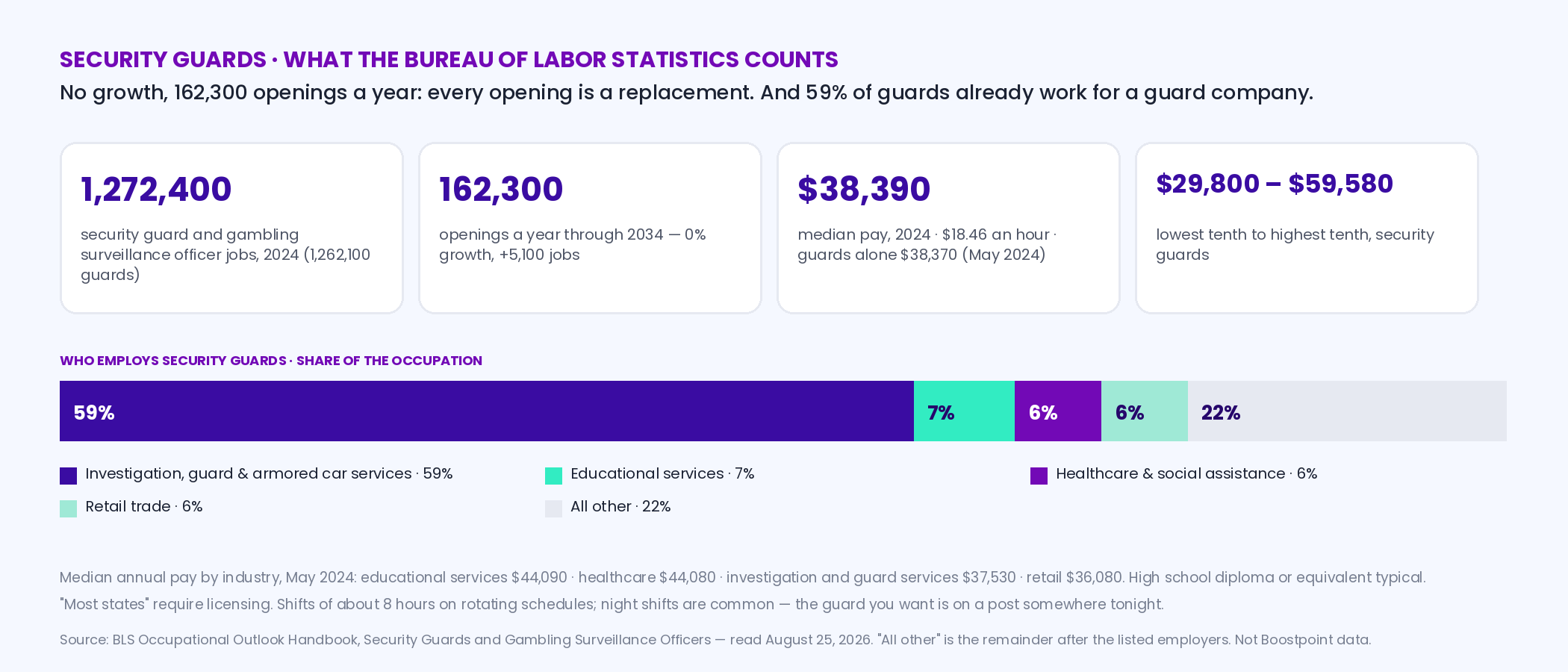
BLS's Occupational Outlook Handbook gives security guards and gambling surveillance officers a 2024 median of $38,390 a year, $18.46 an hour; security guards alone had a median of $38,370 in May 2024, with the lowest tenth under $29,800 and the highest tenth above $59,580. By industry, guards employed by schools and hospitals earned more (medians of $44,090 in educational services and $44,080 in healthcare) than guards employed by guard companies ($37,530) or retail ($36,080) — a useful fact if you employ directly, because you are likely competing with the guard companies on wage and can say so in the ad. The wage is not the cost. BLS's Employer Costs for Employee Compensation for March 2026 (released June 12, 2026) puts private-industry wages and salaries at 69.9% of total compensation and benefits — insurance, paid leave, legally required contributions, retirement — at 30.1%. Grossing the median wage up at that share: 2,080 × $18.46 = $38,396.80 in wages; $38,396.80 ÷ 0.699 = $54,931.04 in total compensation, or $26.41 per hour worked. That is the honest comparison to a contract bill rate, and it's before licensing, training, background checks, uniforms, supervision, and the cost of the vacancy while you recruit.
Interactive
Coverage cost — one post, contract bill rate against direct wage plus benefits
Nothing is stored or sent — this runs in your browser. Defaults: 40 hours a week, a $25 unarmed bill rate (low end of both 2026 vendor guides), BLS's $18.46 median wage, and BLS's 30.1% benefits share of compensation (ECEC, March 2026).
Cost of coverage, not cost per hire. The direct figure excludes licensing, training hours, background checks, uniforms, supervision, overtime and holiday premiums, and the cost of the empty post while you recruit — all of which the contract rate is designed to include. Hours above 40 a week are treated as straight time here; the direct route would owe overtime under the FLSA. Sources: two 2026 vendor rate guides (as published), BLS OOH (May 2024 wages), BLS ECEC (March 2026). Your inputs, your arithmetic.
Licensing, training, and the background check
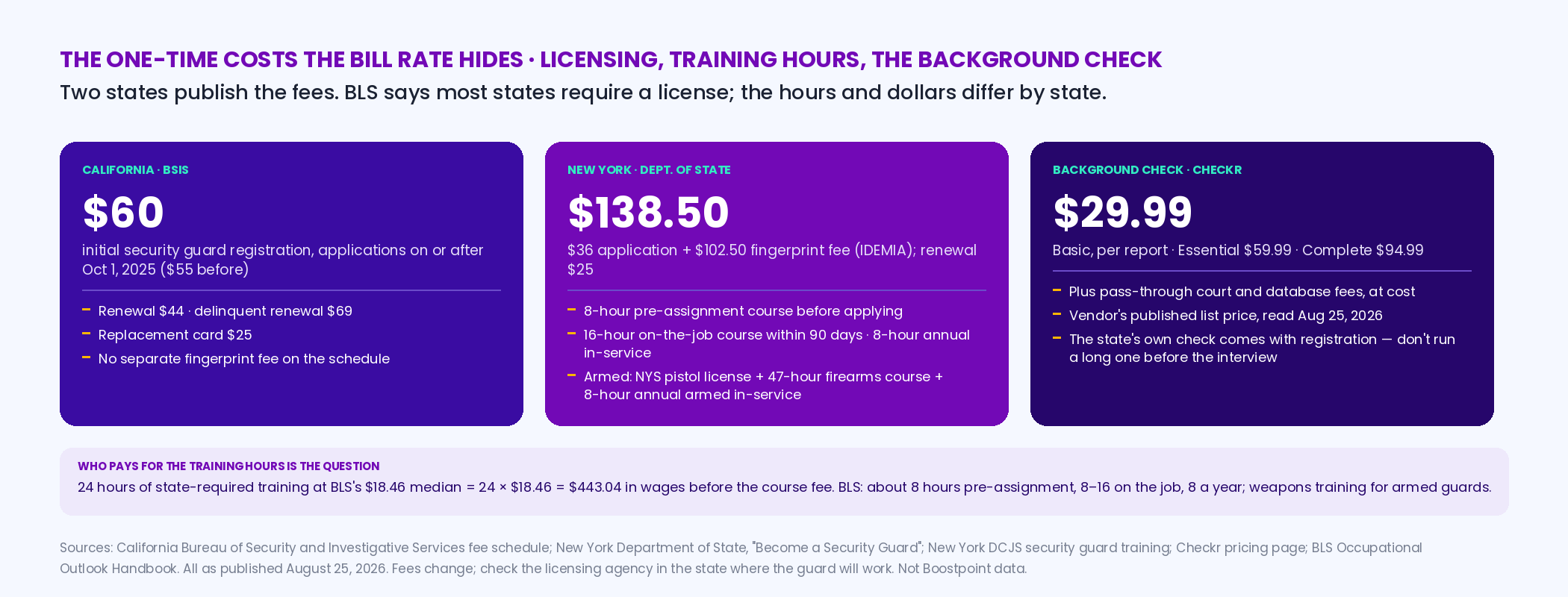
BLS says most states require security guards to be licensed by the state in which they work, and recommends about 8 hours of pre-assignment training, 8 to 16 hours on the job, and 8 hours a year after that; armed guards need weapons training and periodic testing. Two states publish the fees. In California, the Bureau of Security and Investigative Services charges $60 for a security guard's initial registration (for applications on or after October 1, 2025; $55 before), $44 to renew, $69 for a delinquent renewal, and $25 for a replacement card; BSIS lists no separate fingerprint fee on that schedule. In New York, the Department of State charges $36 for the initial application, $102.50 for fingerprinting (payable to IDEMIA), and $25 to renew — $36 + $102.50 = $138.50 to register a new guard — and the Division of Criminal Justice Services requires an 8-hour pre-assignment course before applying, a 16-hour on-the-job course within 90 days of hire, and an 8-hour annual in-service course; armed guards need a valid New York pistol license and a 47-hour firearms course, then 8 hours of armed in-service training a year. Who pays for the training hours — the guard, the employer, or a guard company that folds them into the bill rate — is the question to ask, because at BLS's median wage, 24 hours of paid training is 24 × $18.46 = $443.04 in wages before the course fee.
| Item | Figure | Who sets it | Source, as read August 25, 2026 |
|---|---|---|---|
| California guard registration, initial | $60 (on/after Oct 1, 2025; $55 before); renewal $44; delinquent $69; replacement card $25 | State | California BSIS fee schedule |
| New York guard registration, initial | $36 application + $102.50 fingerprint fee = $138.50; renewal $25 | State | NY Department of State, "Become a Security Guard" |
| New York training hours | 8-hour pre-assignment; 16-hour on-the-job within 90 days; 8-hour annual in-service; armed: 47-hour firearms course + NYS pistol license + 8-hour annual armed in-service | State | NY DCJS, Security Guard Training |
| Training, BLS's general description | About 8 hours pre-assignment, 8–16 hours on the job, 8 hours annually; weapons training for armed guards | Varies by state | BLS Occupational Outlook Handbook |
| Background check, per report | Basic $29.99; Essential $59.99; Complete $94.99 — plus pass-through court and database fees at cost | Vendor | Checkr pricing page |
| 24 hours of paid training at the median wage | 24 × $18.46 = $443.04 in wages, before course fees | Arithmetic | BLS median × hours |
The labor market you're hiring in
BLS counted 1,272,400 security guard and gambling surveillance officer jobs in 2024 (1,262,100 of them guards) and projects little or no change through 2034 — 5,100 more jobs, or 0% — yet about 162,300 openings a year, essentially all replacement. 59% of guards work for investigation, guard, and armored car services — that is, for guard companies — with 7% in education, 6% in healthcare, and 6% in retail. A high school diploma or equivalent is the typical entry requirement. Guards usually work shifts of about 8 hours on rotating schedules, and BLS notes night shifts are common, which is the sentence that should shape the ad: the guard you want is on a post somewhere tonight, employed by a guard company at a $37,530 median, and the direct employer's advantage — if it has one — is the schedule, the site, and a wage the school and hospital medians show is possible.
The 2026 update, and the number that should change your plan
The Bureau of Labor Statistics Occupational Outlook Handbook, read on 9 September 2026, puts the combined security guards and gambling surveillance officers occupation at 1,304,000 jobs in 2025, a median of $38,050 a year, $18.29 an hour, and growth of just 1% through 2035 — about 11,200 additional jobs across the whole decade. Note that this is the Handbook's combined grouping; the $18.46 figure above is the narrower security guards wage series, and the two are not interchangeable.
The number worth stopping on is the next one. Against 1% growth, the Handbook projects about 157,200 openings a year. Practically none of that is expansion. It is replacement — people leaving the occupation and being replaced, roughly one opening a year for every eight people employed. If you staff a post directly rather than contracting it, that is the churn rate you are buying into, and it is the reason a security guard budget is a recurring advertising line rather than a one-off cost. Our hiring plan template turns your own headcount and turnover into that number, and pre-screening questions covers the shift-and-post questions that stop the wrong applicants reaching an interview.
Contract vs. direct, a year, side by side
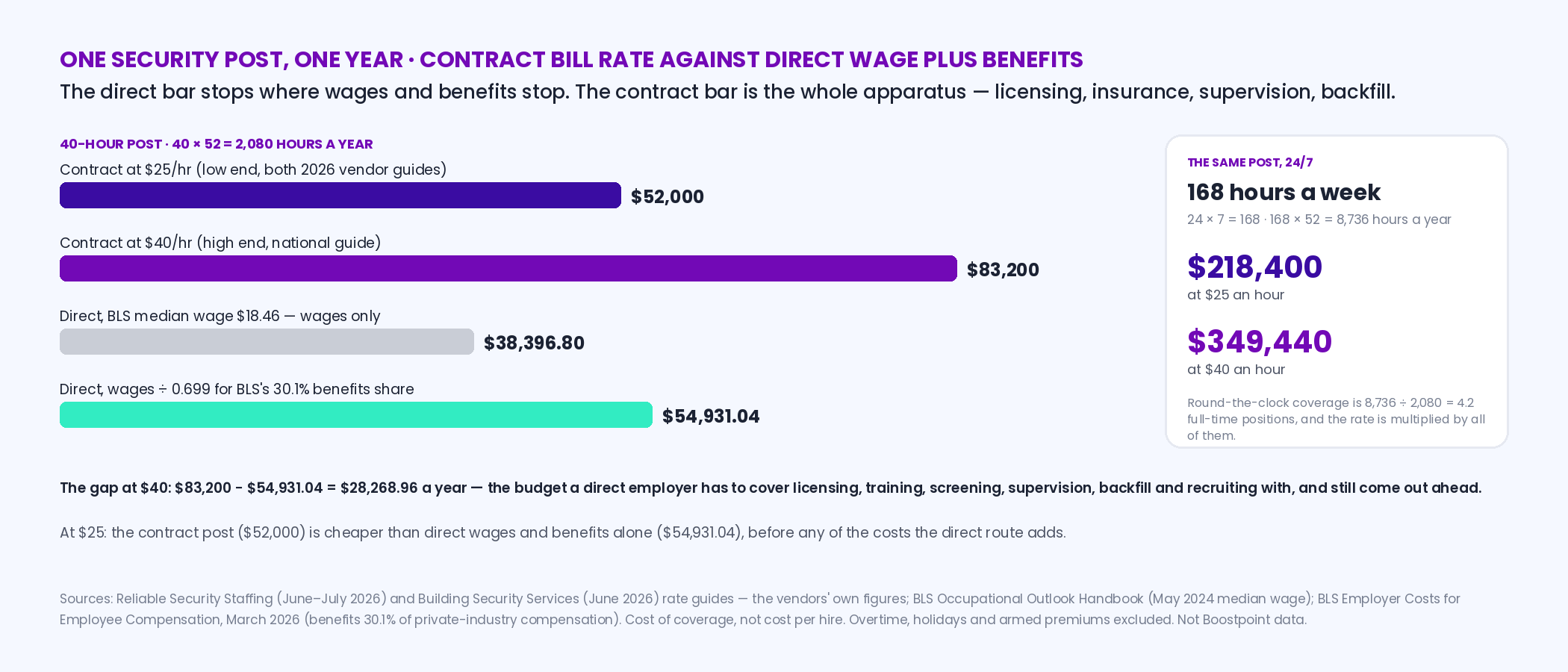
Read the chart the way a controller would. At the low end of the vendor ranges the contract post costs $52,000 a year and the direct post $54,931.04 in compensation alone — the direct route is not cheaper until you count what it leaves out, and it leaves out everything that makes a guard company a guard company. At $40 an hour the contract post is $83,200 and the gap opens to $28,268.96 a year, which is the budget a direct employer has to cover licensing, training, screening, supervision, backfill, and recruiting for that post and still come out ahead. Whether it does depends almost entirely on how many posts you have and whether the recruiting is already built.
What it costs to find the applicant — and what we can't tell you
This is the part we sell, so here is what we can and can't say. Across the 891 campaigns and 1,334 campaign-months in our 2026 benchmark — none of them security — the volume-weighted average cost per applicant was $8.02 and the median campaign ran at $13.88. The single biggest driver was not the industry but the application: campaigns with an apply rate under 5% paid a median $53.77 per applicant, and campaigns over 35% paid $1.61; applicant conversion explained 70% of cost variation, audience 30%, creative 18%. We have no reason to think security guards behave differently from other hourly, licensed, shift-working applicants — the audience is large (1.27 million guards, most of them on a phone during a night shift), the credential is a state registration rather than a scarce degree, and the ad is a schedule and a wage — but "no reason to think" is not data, and we won't print $8.02 as a security number. It is the cross-sector average, offered as the right order of magnitude to plan a first campaign against, and the translator below does nothing more than divide a budget by it.
Interactive
Budget-to-applicants translator — a monthly ad budget divided by the cross-sector benchmark
Nothing is stored or sent — this runs in your browser. Not security data: the divisors are the 2026 benchmark's volume-weighted average and median across every sector we track.
Applicants, not hires: cost per applicant is not cost per hire, and this tool computes no hire figure. The divisors are medians across all sectors in the 2026 Social Job Advertising Benchmark (891 campaigns); Boostpoint has no security guard campaign data, and a security campaign may land anywhere on this scale. The apply-rate bands are the point — the form decides which one you're in.
If you employ guards directly and recruit them, the practical guidance is the same as for any licensed shift role, and it's short. Put the wage, the site, the shift, and the licensing arrangement in the first line — "$20/hr · nights, Thu–Mon · [site] · guard card required, renewal paid" — because the guard reading it is comparing you to the guard company's $37,530 median and to whichever post they're standing at. Say who pays for the state training hours and the registration; at $138.50 in New York or $60 in California plus 24 paid hours, it's a small number that decides whether an employed guard bothers. Keep the form to name, phone, current registration, and shift availability — the state's background check is coming anyway, so don't run a long one before the interview. And answer the same day; a guard applying from a night post is deciding on a break, and BLS's 162,300 openings a year mean somebody else is hiring. The anatomy is on what makes a good job ad; how a guard company's markup compares with other staffing models is on staffing agency markup and fees and how staffing agencies make money; what a background check is and isn't is in our recruitment toolkit.
The bill rate is the price of an apparatus. Direct hire only wins when you already own one — including the part that finds the applicants.
How much does it cost to hire security? Match the question to the quote
"How much does it cost to hire security" gets asked by three different buyers, and each one needs a different number from the sections above. Work out which one you are before you compare quotes.
| What you need | What you are buying | The figure to start from |
|---|---|---|
| A guard for one event or a short-notice shift | Contract event security, by the hour | $35 to $65 an hour for event security in Reliable Security Staffing's 2026 guide |
| Ongoing coverage of a post at your site | A contract guard company, by the hour | $25 to $40 an hour unarmed and $40 to $75 armed (national 2026 vendor guide); $52,000 to $83,200 a year for a 40-hour unarmed post |
| Your own guards on your payroll | Direct employment, by the year | About $54,931.04 a year in compensation for one full-time guard at the BLS median wage with benefits added, before licensing, training, screening and recruiting |
Three things move any of these numbers more than the vendor does: how many hours the post runs (a 24/7 post is 8,736 hours a year), whether the guard is armed, and how much notice you give. When you ask for quotes, give every company the same hours, post count, armed or unarmed status and start date, and ask what the rate includes, so you are comparing like with like.
If the direct route is the plan, the cost that most budgets leave out is finding the applicants, and that is a recurring line: the BLS Handbook projects about 157,200 openings a year for the occupation, almost all of them replacement. Boostpoint has no security campaign data; the cross-sector figures in Boostpoint's 2026 Social Job Advertising Benchmark are the order of magnitude to plan a first campaign against.
Across 891 campaigns in every sector we track, the median applicant cost $13.88. We will tell you what a security applicant is likely to cost in your market.
Get my security numberFrequently asked questions
How much does it cost to hire a security company?
Contract security is bought by the hour rather than by the head. Vendor price guides for 2026 put unarmed coverage at roughly $25 to $40 an hour and armed at roughly $40 to $75, with insurance, supervision, uniforms, scheduling and cover for absence already inside the rate. A single 24/7 post is about 168 hours a week, so the arithmetic runs to six figures a year before any of it is negotiated. The trade-off against employing guards directly is set out in the side-by-side comparison above.
How much does it cost to hire a security guard?
Contracted through a guard company, 2026 vendor price guides put an unarmed guard at $25–$40 an hour nationally (Reliable Security Staffing) and $25–$45 in New York City (Building Security Services), and an armed guard at $40–$75 in both; the rate is described as including wages, taxes, insurance, licensing, and supervision. Employed directly, BLS's median wage was $18.46 an hour in May 2024, about $54,931.04 a year for one full-time guard once benefits are added at BLS's 30.1% share of compensation, before licensing, training, screening, and recruiting.
How much does an unarmed security guard cost per hour?
Two 2026 vendor guides publish $25–$40 an hour (national) and $25–$45 (New York City) for a standard unarmed contract guard. Those are the companies' own figures; a quote for your site depends on hours, number of posts, and notice. For a 40-hour post, $25 an hour is 40 × 52 × $25 = $52,000 a year; $40 an hour is $83,200.
How much does an armed security guard cost?
Both 2026 vendor guides cited on this page put armed guards at $40–$75 an hour, and executive protection at $60–$120 and up (Reliable Security Staffing). The premium reflects firearms licensing and training — in New York, a state pistol license, a 47-hour firearms course, and 8 hours of armed in-service training a year — plus the insurance that goes with it.
How much does a security guard license cost?
It varies by state; most states require one, per BLS. California's BSIS charges $60 for an initial security guard registration (applications on or after October 1, 2025) and $44 to renew. New York's Department of State charges $36 for the application plus a $102.50 fingerprint fee — $138.50 — and $25 to renew, with an 8-hour pre-assignment course required before applying and a 16-hour on-the-job course within 90 days. Check your state's licensing agency; fees and hours differ.
Is it cheaper to hire security guards directly or use a security company?
Per hour of coverage, the direct wage is lower than the bill rate; per post per year, once benefits are added at BLS's 30.1% share, the direct figure ($54,931.04 at the median wage) is close to the low end of the contract range ($52,000 at $25 an hour) and well under the high end ($83,200 at $40) — but the direct figure excludes licensing, training, screening, supervision, backfill, and recruiting, which the bill rate includes. Direct usually wins only for employers with many permanent posts and an existing hourly-hiring operation.
How much do security guards make?
Per the BLS Occupational Outlook Handbook, the 2024 median for security guards and gambling surveillance officers was $38,390 a year or $18.46 an hour; security guards alone had a median of $38,370 in May 2024, with the lowest tenth under $29,800 and the highest above $59,580. Guards in educational services ($44,090) and healthcare ($44,080) earned more than guards at guard companies ($37,530) or in retail ($36,080).
How do you recruit security guards?
Like any licensed shift role: the wage, site, shift, and licensing arrangement in the first line; say who pays the state registration and training hours; a form that asks for name, phone, current registration, and shift availability and nothing else; and a same-day response, because BLS projects about 162,300 openings a year and 59% of guards already work for a guard company that will hire them back. Most guards are on a night post with a phone, which is where the ad has to reach them.
What does it cost to advertise for security guard applicants?
We don't know for security specifically, and we say so: Boostpoint has no security guard campaign data. Across all sectors in our 2026 benchmark, the volume-weighted average cost per applicant was $8.02 and the median campaign $13.88, with the apply rate driving most of the spread ($53.77 under 5%, $1.61 over 35%). Use those as an order of magnitude for a first campaign, not as a security figure. Cost per applicant is not cost per hire.
How much does it cost to hire security for an event?
Event security is usually bought from a guard company by the hour. Reliable Security Staffing's 2026 rate guide puts event security at $35 to $65 an hour, and the total depends on the number of guards, the hours including setup and teardown, whether any guard is armed, and how much notice you give. Ask each company to quote the same staffing plan, and check whether a minimum shift length applies.
What is the cost per hire for security guards?
Boostpoint does not publish a security guard cost per hire: we measure cost per applicant and have no security guard campaign data. Cost per hire is total internal plus external recruiting costs divided by the number of hires. For a guard you employ directly, the external side usually includes advertising, the state registration and fingerprint fees, a background check and any paid pre-assignment training hours shown in the licensing table above. The advertising share is your cost per applicant divided by your applicant-to-hire rate. Across every sector in Boostpoint's 2026 Social Job Advertising Benchmark, the median campaign cost $13.88 per applicant and the volume-weighted average was $8.02; those are cross-sector figures, not security figures. If you contract guards instead, the guard company recruits and replaces them, and that cost sits inside its hourly bill rate rather than in a cost per hire of yours.
Find out what a security applicant actually costs you
We'll run a first campaign with the wage, site, and shift in the ad and a one-minute form behind it, and report the real number — cost, and no security figure we didn't measure on your campaign.
Book a Demo



Boostpoint figures come from the 2026 Social Job Advertising Benchmark — 891 campaigns and 1,334 campaign-months across healthcare, skilled trades, transportation, retail, and education: volume-weighted average cost per applicant $8.02; median campaign $13.88; median monthly budget $334 producing 20 applicants; apply-rate bands under 5% $53.77, 5–10% $23.13, 10–20% $11.11, 20–35% $4.41, over 35% $1.61; applicant conversion explains 70% of cost variation, audience 30%, creative 18%. Security is not a sector in the benchmark; Boostpoint has no security guard campaign data, and every security-industry figure on this page is third-party, attributed in place: BLS Occupational Outlook Handbook (May 2024 wages, 2024–34 projections), BLS Employer Costs for Employee Compensation (March 2026), California BSIS and New York Department of State fee schedules, New York DCJS training requirements, Checkr's published price list, and two security companies' 2026 rate guides quoted as their own figures. Cost per applicant is not cost per hire; we do not track hires and publish no cost-per-hire figure. The coverage calculator compares annual cost of coverage on your inputs; the translator divides a budget by benchmark medians. A sample of Boostpoint campaigns, not an industry-wide study.