
Recruitment toolkitUpdated September 2026
Cost Per Hire: Definition, Formula and a Worked Example
Cost per hire is total internal recruiting costs plus total external recruiting costs, divided by the number of hires in a period. That is the whole formula, and it is the one behind every published benchmark: SHRM's Human Capital Benchmarking Report put the average at $4,129 for fiscal 2015, and SHRM reported an average of nearly $4,700 in April 2022. The reason two employers using this formula on the same hire can report numbers several times apart is not the arithmetic. It is where each of them drew the line around "recruiting cost".
What cost per hire means
Cost per hire measures the recruiting process, not the employee. It answers one question: across some period, what did it cost the organization to fill the seats it filled? It is a one-time charge per filled seat, and it stops the moment the person starts.
Three properties make it useful and also make it easy to misread.
- It is an average, not a price. The denominator is every hire in the period, so one executive search inside a quarter of frontline hiring will drag the average somewhere no individual hire ever went.
- It is bounded by a decision, not by a rule. No law or accounting standard forces a particular boundary. Whether hiring-manager interview hours count is your choice, and it is usually the single largest reason two figures differ.
- It says nothing about quality. A cost per hire falls when you stop screening, and it falls again when you hire the first person who applies. Read it beside retention and time to fill, never on its own.
The cost per hire formula
The formula
Cost per hire = (total external recruiting costs + total internal recruiting costs) ÷ total number of hires in the period
External costs are money paid out to someone else. Internal costs are your own people's time and your own systems, converted into money. The denominator is hires who started in the period, not offers accepted.
The categories below are the ones the standard and SHRM's guidance name. You will not have every line; the discipline is to decide once which lines are inside your boundary and then keep the boundary still, so this quarter is comparable to last.
| External costs | Internal costs |
|---|---|
| Job advertising and social recruitment spend | Recruiter and coordinator compensation, apportioned to the requisitions |
| Job board and posting subscriptions | Hiring manager and interviewer hours, at a loaded rate |
| Agency, search and headhunter fees | Applicant tracking system and recruiting tools |
| Employee referral bonuses paid | Onboarding and compliance administration |
| Background checks, drug screens and assessments | Recruiting overhead apportioned to the period |
| Candidate travel, career fairs and events | Training and development of the recruiting function |
| Signing bonuses and relocation, where you count them |
A worked example
A regional employer fills 12 frontline roles in one quarter. Every figure below already exists somewhere: an invoice, a platform report, a timesheet or a payroll export.
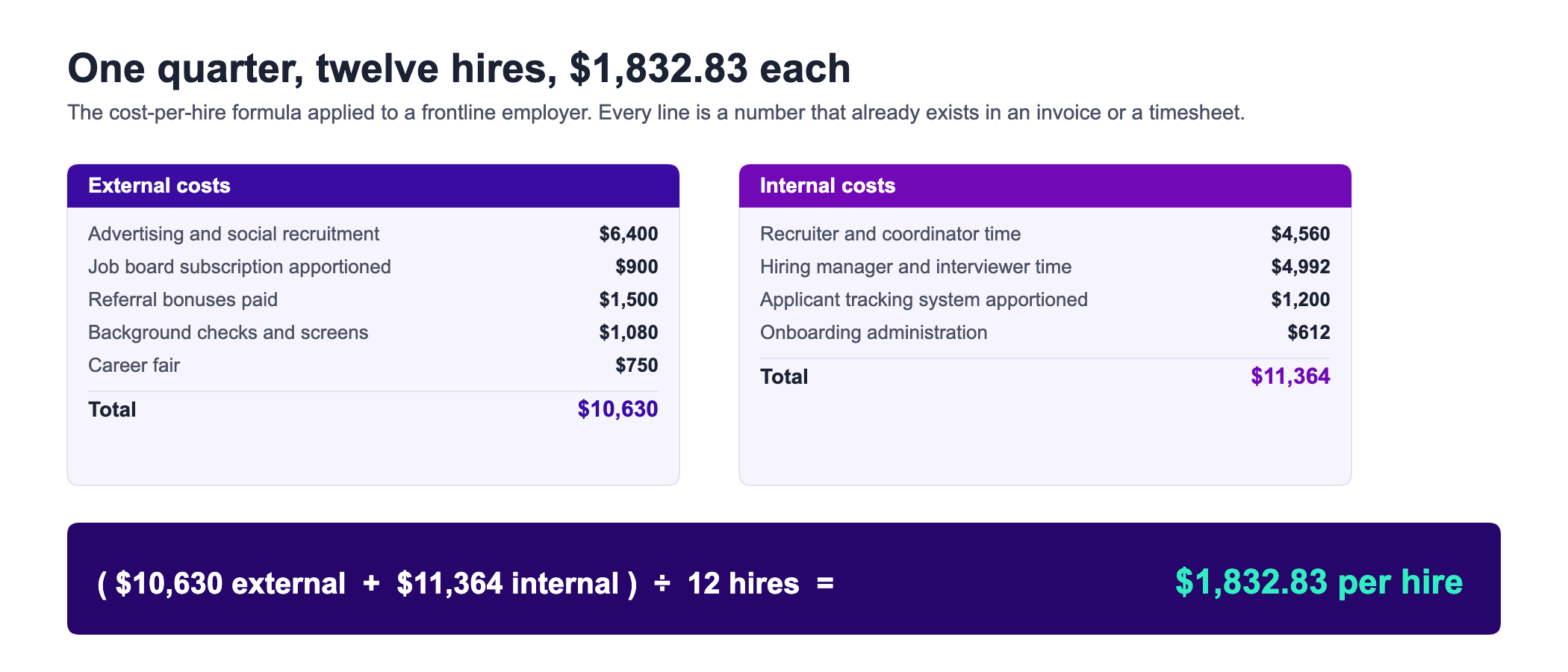
External costs come to $10,630: $6,400 of advertising, $900 of job board subscription apportioned to the quarter, $1,500 of referral bonuses actually paid, $1,080 of background checks and drug screens across 36 candidates, and $750 for a career fair. Internal costs come to $11,364: 120 recruiter hours at a $38 loaded rate, 96 hiring manager and interviewer hours at $52, $1,200 of applicant tracking system license apportioned to the quarter, and 18 hours of onboarding administration at $34.
Total recruiting cost is $21,994. Divided by 12 hires, cost per hire is $1,832.83.
Notice how far that sits below the published averages, and why. There is no agency fee in this quarter, the roles are frontline rather than professional, and interview loops are short. Move any one of those and the number moves with it — which is the argument for reporting your own figure with its inputs attached rather than borrowing a benchmark. If you want the same arithmetic done three ways at once, with an ad-only, a recruiting-cost and a fully loaded definition side by side, use the cost per hire calculator.
Does cost per hire include unsuccessful applicants?
Yes, and this is the part most often got wrong. Every cost in the numerator was incurred across the whole funnel: the advertising reached everyone who saw it, the screening calls were made to people who were rejected, the background checks were run on candidates who then declined. Only the denominator narrows to the people who started. That is what makes it a cost per hire rather than a cost per applicant.
The practical consequence is that cost per hire is sensitive to your funnel, not just your spending. Improve the offer acceptance rate and cost per hire falls without a dollar leaving the budget, because the same numerator is divided by more starts. If you want the funnel measured at its front end instead, that is a cost per applicant, and it is a different metric with a different use.
Why cost per hire matters
Three uses justify tracking it, and one common use does not.
- Budgeting. Multiply your own figure by planned headcount and you have a defensible recruiting budget that finance can check.
- Channel comparison. Held to a fixed boundary over time, the trend tells you whether a change in how you recruit paid for itself.
- The build-or-buy decision. A cost per hire calculated in-house is the only honest comparison against an agency placement fee or an RPO price.
- Not for benchmarking against other employers. Unless you know exactly where they drew their boundary, the comparison is noise. Use published averages for orientation and your own figure for decisions.
Cost per hire template
An Excel workbook with the external and internal cost lines above already laid out, the two subtotals and the cost-per-hire result as live formulas, and a notes sheet stating the boundary. Fill the amount column, leave what you do not track empty, and report the number with its inputs.
What does recruiting cost?
The short answer: a completed job application costs a median of $13.88 on social, and the volume-weighted average is $8.02. That is the advertising cost of getting one interested person to raise their hand — not the cost of a hire, which includes everything that happens afterwards and lives in your ATS rather than an ad platform.
By role, across the 891 campaigns in our 2026 benchmark, that figure runs from $2.71 for customer service and $3.76 for caregivers to $26.86 for CDL drivers and $74.62 for licensed therapy roles. The middle half of all campaigns landed between $6.48 and $29.74, which is why a single average is a poor basis for any one requisition.
On budget size: half of all campaign-months in the study ran on under $334 and returned a median of 20 applicants. The upper quartile begins at $554 and the top decile at $988. Recruiting is not usually expensive because the budget is small; it is expensive when the application is hard to finish. Apply rate explains 70% of the difference in cost between campaigns, against 18% for what the ad auction charges.
Set a recruiting budget per role family rather than per opening, and set it from the middle-50% band for that family rather than the headline median. Recruiting strategies ranks what actually moves the number.
Hiring cost vs cost per hire: the cost of hiring a new employee is bigger than the formula
Cost per hire, as defined above, stops the day the person starts. The full cost of hiring a new employee does not. When an owner or finance team asks what hiring costs, they usually mean everything it takes to get a productive person into the seat, which adds three layers after the recruiting cost:
| Layer | What is in it | Where to get the number |
|---|---|---|
| Recruiting (cost per hire) | Advertising, job boards, agency fees, referral bonuses, screening, recruiter and interviewer time | The formula and template on this page |
| Onboarding and training | Orientation time, trainer time, reduced output while the new hire learns, equipment and uniforms | Timesheets and your trainer's loaded rate |
| Employer payroll taxes from the first paycheck | Social Security at 6.2% and Medicare at 1.45% of wages for the employer share (IRS Topic 751); federal unemployment tax at 6.0% of the first $7,000 of wages, or 0.6% after the maximum 5.4% state credit (IRS Topic 759); plus state unemployment tax and workers' compensation | Your payroll provider |
| Early turnover | The whole cost again if the person leaves in the first weeks | Your own 90-day retention rate |
The payroll tax layer is a cost of employing anyone, not of hiring as such, but it starts with the hire and belongs in any hiring cost you present to finance. The employee cost calculator adds wages, taxes and benefits for a given role, and new hire training for hourly roles prices the training layer.
The cost of hiring a new employee vs retaining one
The comparison finance actually needs is not hiring cost against zero. It is the cost of replacing someone against the cost of keeping them: a raise, a schedule change, a retention bonus. To make it with your own numbers, add up the four layers above for one replacement, then compare that with what it would cost to keep the person for the same period. If a $1 an hour raise for a full-time employee costs less over a year than one replacement, and your turnover in that role is running at one or more replacements a year, retention is the cheaper line. We do not publish a universal replacement-cost percentage, because it depends entirely on your roles and your boundary; the turnover cost calculator does this arithmetic with your inputs, and employee retention strategies covers what the retention side can buy.
Frequently asked questions
What is cost per hire?
Cost per hire is the total recruiting cost of a period divided by the number of hires who started in it. It measures the recruiting process rather than the employee: advertising, agency and referral fees, screening, recruiter and hiring manager time, and the systems that support them. It is a one-time charge per filled seat and it stops when the person starts.
What is the cost per hire formula?
Cost per hire = (total external recruiting costs + total internal recruiting costs) ÷ total number of hires in the period. External costs are money paid to other parties, such as advertising, job boards, agency fees, referral bonuses and background checks. Internal costs are your own recruiters' and hiring managers' time at a loaded rate, plus recruiting systems and overhead apportioned to the period.
How do you calculate cost per hire?
Pick a period. Add every external recruiting cost invoiced in it. Add every internal recruiting cost, converting hours to money at a loaded hourly rate. Count the hires who actually started in the period. Divide the combined cost by that count. Then write down which lines you included, because the boundary is what makes the number comparable to the next one you produce.
How do you calculate average cost per hire?
The standard formula already produces an average, because the denominator is every hire in the period rather than one hire. If you want an average across several periods, sum the numerators and sum the hires before dividing — do not average the quarterly cost-per-hire figures, because periods with different hire counts would then carry equal weight and the result would be wrong.
What is a cost per hire calculation example?
Twelve hires in a quarter, $10,630 of external cost (advertising $6,400, job board subscription $900, referral bonuses $1,500, background checks $1,080, career fair $750) and $11,364 of internal cost (recruiter time $4,560, hiring manager and interviewer time $4,992, applicant tracking system $1,200, onboarding administration $612). Total $21,994, divided by 12, gives $1,832.83 per hire.
What is the SHRM cost per hire formula?
The same one. SHRM's formula, published as an ANSI-approved standard and carried internationally into ISO/TS 30407:2017, is internal costs plus external costs divided by the number of hires. What the standard adds is a common vocabulary for which costs belong in each bucket, so that two employers who both follow it can at least compare their boundaries even when their numbers differ.
What counts as an external recruiting cost?
Money that leaves the organization because of the search: job advertising and social recruitment spend, job board and posting subscriptions, agency, search and headhunter fees, referral bonuses actually paid, background checks, drug screens and assessments, candidate travel, career fairs and events, and signing or relocation payments if you choose to count them. If it arrives as an invoice, it is external.
Is there a cost per hire template?
Yes — the Excel workbook linked above has the external and internal cost lines pre-listed, both subtotals and the cost-per-hire result as live formulas, and a notes sheet stating the boundary and the formula's source. Fill in the amount column only. It asks for no email address and it invents no figures.
What does recruiting cost in 2026?
On social job advertising, a median of $13.88 per completed application with a volume-weighted average of $8.02, across 891 campaigns and 1,334 campaign-months. By role it ranges from $2.71 for customer service to $74.62 for licensed therapy roles. That is advertising cost per applicant, which is a different and much smaller number than cost per hire.
How much should a recruiting budget be?
Less than most teams assume, and set per role family. Half of all campaign-months in the 2026 benchmark ran on under $334 and returned a median of 20 applicants; the upper quartile begins at $554. Budget from the middle-50% band for the role you are hiring rather than from a single company-wide average.
What is the difference between cost per applicant and cost per hire?
Cost per applicant is total advertising spend divided by completed applications, and an ad platform can measure it. Cost per hire adds screening, interviewing, referral and onboarding costs and divides by hires, and no ad platform can see it. Any cost-per-hire figure drawn from advertising data alone is an extrapolation.
What is the cost of hiring a new employee?
It is cost per hire (the recruiting spend and time divided by hires) plus what follows the start date: onboarding and training time, reduced output while the person learns, and employer payroll taxes such as the 6.2% Social Security and 1.45% Medicare employer shares. Add them up with your own figures; the recruiting part alone is what the cost per hire formula measures.
Is it cheaper to retain an employee than to hire a new one?
It depends on the role, so check it with your own numbers rather than a borrowed percentage. Add up recruiting, onboarding, training and lost output for one replacement, then compare it with what keeping the person would cost, such as a raise or a retention bonus, over the same period.
Two neighbors to this page: the cost per hire calculator runs the arithmetic under three different definitions at once, and the employee cost calculator answers the other question people mean by "what does a hire cost" — what the person costs to employ once they are on payroll. The published benchmarks, by industry and with the mean-and-median split, are on average cost per hire by industry.
Put a real number on the advertising line
Tell us the roles you are filling and where, and we will show you what an applicant costs in those markets before you commit a budget.
Book a Demo