
How Staffing Agencies Actually Make Money: Markups, Fees, and Margins
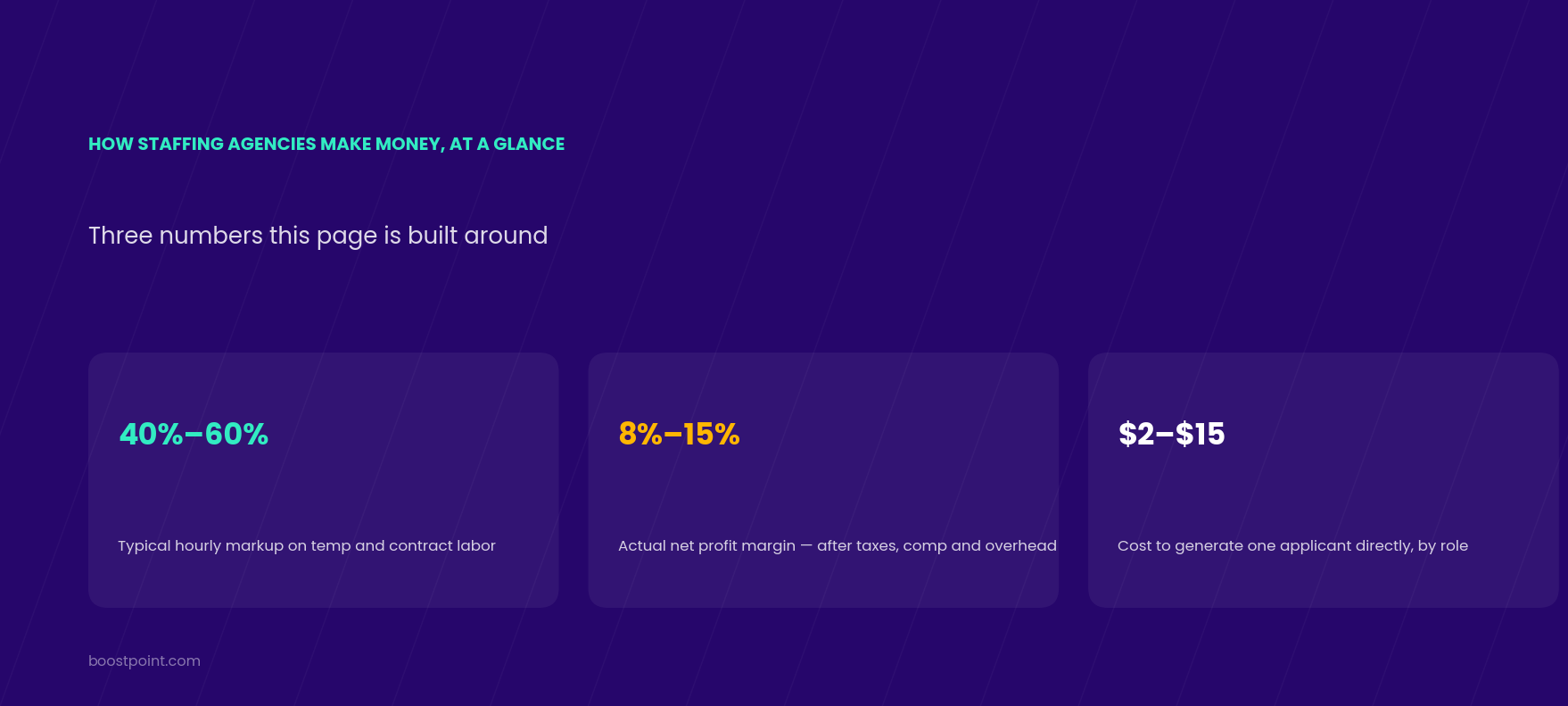
Staffing agencies and external recruiters make money through three primary models. For temporary labor, they charge an hourly markup (typically 40% to 60%) over the worker's base wage. For permanent direct-hire placements, they charge a contingency fee equal to 15% to 25% of the candidate's first-year salary. Finally, through Recruitment Process Outsourcing (RPO), they charge fixed monthly management fees to act as a company's internal HR department.
A note on who's writing this
Most articles explaining how staffing agencies make money are written by the staffing agencies themselves. Their content naturally frames their markups and placement fees as the standard, unavoidable cost of acquiring talent in a difficult labor market.
Boostpoint is not a staffing agency. We build recruitment advertising software that helps HR leaders, plant managers, and healthcare operators generate their own direct applicants through targeted social media campaigns, completely bypassing external recruiters.
We are pulling back the curtain on how the recruitment industry monetizes your open headcount. More importantly, we are providing the 2026 financial benchmarks that agencies omit: what it actually costs to run direct applicant acquisition campaigns yourself.
How much do recruiters charge? The three revenue models
External recruiting firms categorize their services into three main buckets, each with a distinct pricing model designed to capture revenue from your hiring budget.
1. The Temp/Contract Staffing Markup
For temporary, seasonal, or contract-to-hire labor, agencies act as the employer of record. They pay the worker a base wage and bill your company an hourly rate that includes a markup. An agency is not the only kind of employer of record: a standalone provider can employ someone you found yourself, priced per employee per month or as a percentage of salary, as set out on employer of record cost.
- Average markup: 40% to 60%
- Example: if a warehouse associate earns $18/hour, a 50% markup means the agency bills your company $27/hour. That $9/hour difference is the agency's gross margin.
- Where they maximize profit: long-tenure temp workers. If an agency temp works on your floor for 6 months, the agency collects that hourly premium indefinitely.
2. Contingency and Retained Search Fees (Direct Hire)
When an agency recruits a permanent employee for your payroll, they charge a placement fee. "Contingency" means they only get paid if you hire their candidate. "Retained" means you pay a portion upfront to guarantee their dedicated search effort.
- Average fee: 15% to 25% of the candidate's guaranteed first-year compensation.
- Example: hiring a specialized maintenance technician at $75,000/year carries a 20% placement fee, resulting in a one-time $15,000 invoice from the recruiter.
3. Recruitment Process Outsourcing (RPO) Cost
In an RPO model, a staffing firm completely takes over a segment (or all) of your internal talent acquisition function. What that arrangement actually costs is covered in RPO cost.
- RPO cost structure: RPO providers usually charge a combination of a fixed monthly management fee plus a smaller transactional cost-per-hire.
- The catch: while RPO cost-per-hire appears lower on paper than contingency fees, the high fixed monthly management fees ensure the agency generates predictable recurring revenue regardless of your hiring volume.
Gross margin vs. net profit (where the markup goes)
When an employer sees a 55% hourly markup, the immediate assumption is that the agency is pocketing a massive profit. The reality of staffing economics is more complex. If the question is simply how much do staffing agencies charge, the industry-by-industry markup ranges, the direct hire and temp-to-hire fee structures and a bill-rate solver are all set out there.
That 40% to 60% hourly premium represents Gross Margin. From that slice, the agency must pay:
- Payroll taxes: employer FICA, FUTA/SUTA (unemployment taxes).
- Insurance: workers' compensation liability (which is very expensive for industrial and healthcare roles).
- Overhead: recruiter commissions, background checks, drug screens, and administrative software.
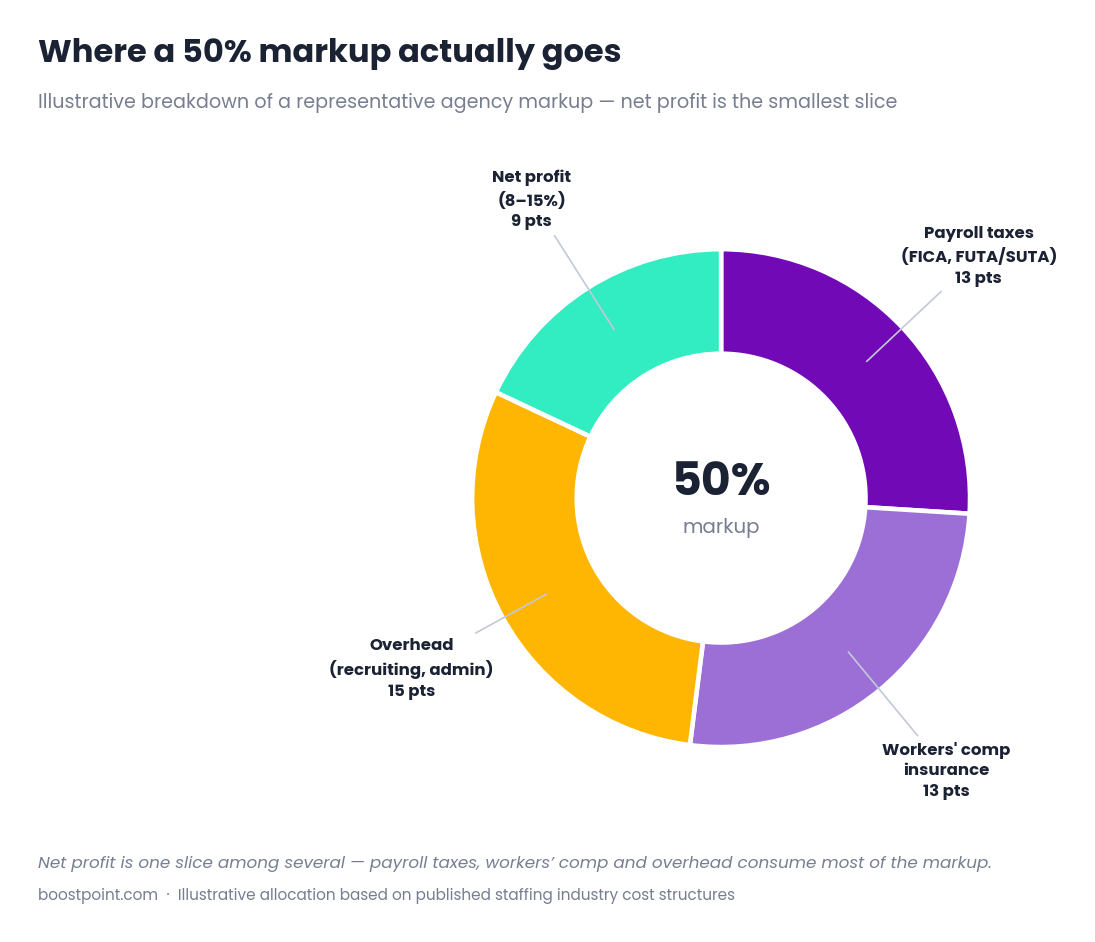
The net profit: after burdened labor costs and operating expenses, the average staffing agency operates on a net profit margin of 8% to 15%.
When you build an internal recruiting pipeline, you still have to pay the payroll taxes and workers' comp. However, by bypassing the agency, you entirely eliminate their 15% net profit margin and their internal recruiter commissions.
What it costs to generate applicants directly
Agencies make their money by bridging the gap between your open jobs and the talent market. But in 2026, technology allows employers to bridge that gap directly.
By shifting budget away from agency fees and into targeted social media advertising (Facebook, Instagram, TikTok), employers can generate local applicant flow at a fraction of the cost — the platform behind that shift is covered in more depth on our social media job advertising page.
Across Boostpoint-managed frontline recruitment campaigns in 2026:
| Industry / role category | Median cost per applicant (CPA) |
|---|---|
| Warehouse & Light Industrial | $2.14 |
| Healthcare (Caregivers & CNAs) | $6.82 |
| Logistics & CDL Truck Drivers | $13.57 |
| Skilled Trades & Construction | $15.80 |
| Blended Frontline Average | $8.49 |
Source: Boostpoint campaign data — managed frontline recruitment campaigns conducted in 2025–2026 across manufacturing, healthcare, transportation, and retail sectors nationwide.
Data based on the 2026 Boostpoint Frontline Benchmark Report spanning thousands of campaigns. Full methodology and role-level detail is in our published 2026 Social Job Advertising Benchmark data.
Calculating direct ad cost per hire across screening ratios
To compare direct advertising against a recruiter's $5,000 placement fee, you must calculate your true ad cost per hire. Because ad budgets generate applicants — not finished hires — you must account for your internal vetting, interview drop-offs, and background check failures.
Here is the direct advertising cost to secure one permanent hire across three realistic screening scenarios:
| Industry role | Cost per applicant (CPA) | 1 in 10 hire rate (10% — high touch) | 1 in 50 hire rate (2% — realistic standard) | 1 in 100 hire rate (1% — strict vetting) |
|---|---|---|---|---|
| Warehouse / Assembly | $2.14 | $21.40 | $107.00 | $214.00 |
| Healthcare (CNA) | $6.82 | $68.20 | $341.00 | $682.00 |
| CDL Driver | $13.57 | $135.70 | $678.50 | $1,357.00 |
| Journeyman Trade | $15.80 | $158.00 | $790.00 | $1,580.00 |
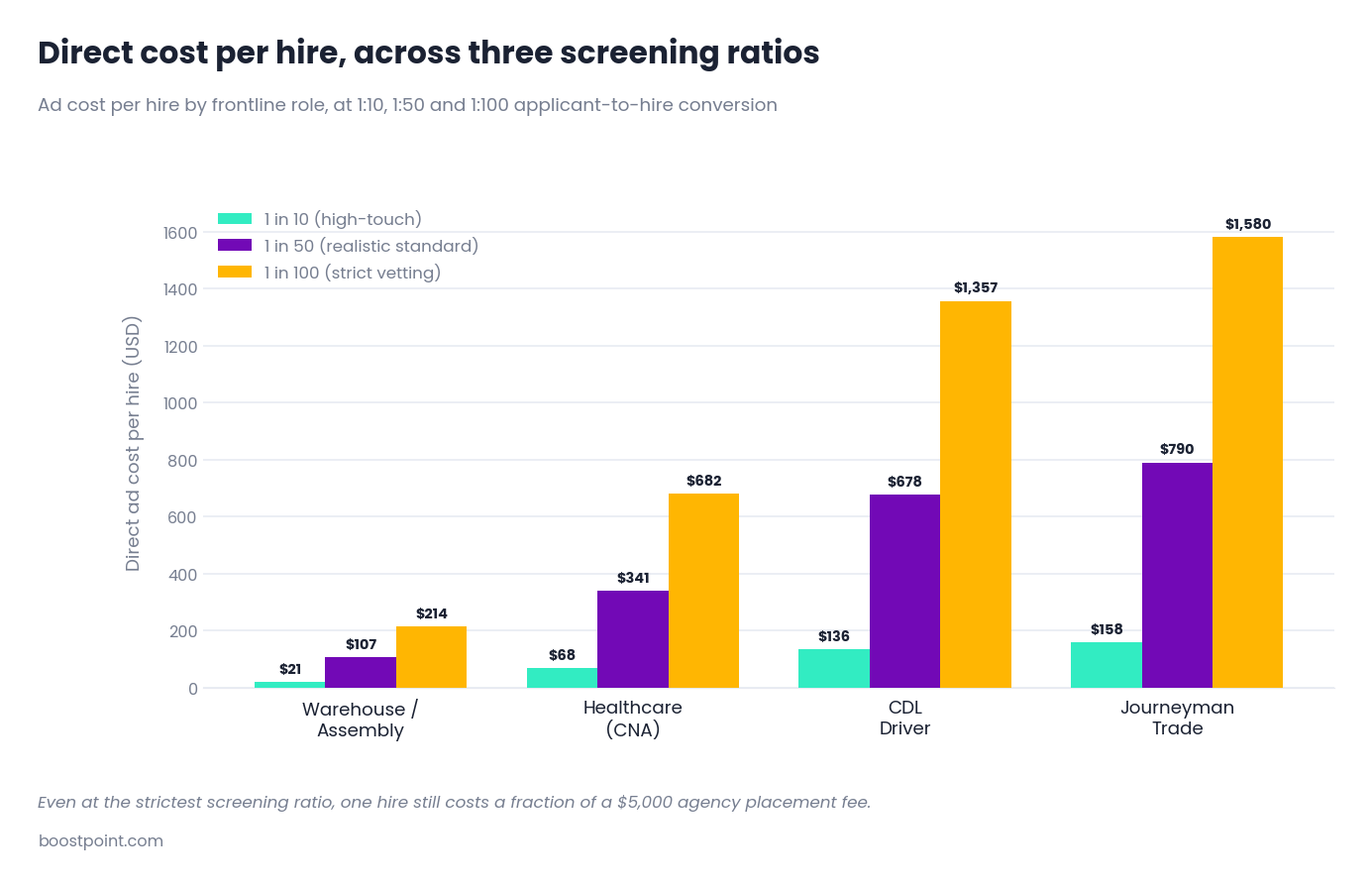
Even under a highly strict 1 out of 100 hire rate for a CDL truck driver, your direct acquisition ad cost is $1,357. This is a fraction of the typical $4,500+ contingency placement fee an agency would charge for the same driver.
When paying an agency markup is actually worth it
Despite the cost, staffing agencies sell a valuable product: administrative convenience and speed.
Pay the recruiter's fee when:
- You need emergency 24-hour coverage. If three nurses call out sick, or you land a massive unexpected 10-day production contract, agencies have idle, pre-vetted talent ready to deploy immediately.
- You are hiring a C-suite executive. Retained search firms excel at confidentially poaching high-level executives from competitors.
- You want to offload workers' comp liability. For highly hazardous, short-term work (like a two-week roofing or steel erection job), having the agency act as the employer of record protects your internal safety rating.
When direct advertising makes more sense
Bypass the agency and recruit directly when:
- You are filling core, permanent headcount. If a role exists on your schedule year-round, paying a 50% agency markup on those hours is a catastrophic drain on your operational profit margin.
- You want to reduce high turnover. Agency-placed temp workers inherently lack brand loyalty to your facility. Direct hires consistently exhibit stronger engagement and retention.
- You are executing a known seasonal surge. If you mass-hire 100 workers every Q4, running your own automated direct campaigns saves hundreds of thousands of dollars in aggregate markups compared to outsourcing the surge.
The honest summary
Agencies monetize your lack of a candidate pipeline.
Staffing agencies make their money by providing the candidate flow and vetting infrastructure that your internal HR team currently lacks. If you rely on them for emergencies, their 15% net profit margin is a fair price for triage.
However, if you rely on staffing agencies to maintain your daily baseline headcount simply because traditional job boards stopped working, you are unnecessarily forfeiting massive amounts of operational budget. By investing in direct social media advertising and applicant automation, companies can build their own talent pipelines and recapture the recruiter's margin.
The calculation worth running this quarter
Finance and Talent Acquisition leaders should run these numbers together:
- Audit your total external agency spend. Sum all temp markups, contingency placement fees, and RPO costs over the last 12 months.
- Calculate your premium tax. If you spent $500,000 on temp labor billing, roughly $165,000 of that was pure markup.
- Compare against direct ad costs. Multiply your total annual hires by the direct ad cost per hire benchmarks (e.g., $341 for a CNA at a 1:50 screening ratio).
- Identify the ROI gap. Subtract the direct advertising cost from your total agency premium tax. This is the budget you can reclaim by implementing a direct recruitment strategy.
Frequently asked questions
How do staffing agencies make money?
Staffing agencies generate revenue primarily through three models: charging an hourly markup (40% to 60%) on temporary workers, charging contingency placement fees (15% to 25% of salary) for direct hires, or charging fixed monthly management fees for Recruitment Process Outsourcing (RPO).
How much do recruiters charge for a direct hire?
External recruiters and contingency staffing agencies typically charge a placement fee equal to 15% to 25% of the candidate's first-year guaranteed salary. For a $60,000/year role, the fee ranges from $9,000 to $15,000.
What is the average RPO cost?
Recruitment Process Outsourcing (RPO) costs vary heavily by volume, but generally include a fixed monthly management fee (often $3,000 to $10,000+) plus a transactional fee per successful hire. While the per-hire cost looks lower, the fixed fees ensure high recurring revenue for the agency.
Is a 50% agency markup all profit?
No. Out of a 50% markup, the agency must pay employer payroll taxes, unemployment insurance, workers' compensation premiums, background checks, and internal commissions. The actual net profit margin for a staffing agency is usually 8% to 15%.
Is direct hiring cheaper than using a recruiter?
Yes. Direct recruitment marketing via social media allows employers to generate applicants for $2 to $15 each. Even factoring in strict screening drop-offs, the direct ad cost per hire rarely exceeds $500 to $1,000, which is vastly cheaper than a $5,000+ recruiter fee or an ongoing 50% hourly markup.
Stop paying agency markups for core headcount
Book a 30-minute strategy call with our recruitment marketing team. We'll analyze your external agency spend, review direct cost-per-applicant benchmarks for your industry, and show you how to build a profitable internal pipeline.
Book a Demo →Boostpoint figures are derived from managed frontline recruitment campaigns conducted in 2025–2026 across manufacturing, healthcare, transportation, and retail sectors nationwide. Cost-per-applicant metrics reflect what advertisers paid for advertising. Staffing agency markups, recruiter fees, RPO costs, and net margin statistics are aggregated from published industry financial audits, Staffing Industry Analysts (SIA) reports, and standard recruitment vendor pricing models.