
Recruitment outsourcing services: what is actually in scope
"Recruitment process outsourcing services" and "recruitment outsourcing services" are the same category, and the price only makes sense once you know which of four service shapes you are buying. Two providers quoting the same rate can be selling very different amounts of work.
| Service shape | What the provider runs | What stays with you | Typical commercial model |
|---|---|---|---|
| End-to-end (enterprise) RPO | The whole function: employer brand, advertising, sourcing, screening, scheduling, offer management, onboarding coordination, reporting, and often the ATS configuration | Hiring decisions, interview panels, compensation, the employment relationship | Management fee plus cost-per-hire, or a fixed monthly management fee |
| Selective or partial RPO | Named stages — usually sourcing and screening — or named job families, while your team keeps the rest | Interviewing, offers, everything outside the named scope | Cost-per-hire, or a monthly fee per recruiter seat |
| Project or on-demand RPO | A defined burst: a new site, a seasonal ramp, a backlog of open reqs, with a start and end date | Steady-state hiring once the project ends | Fixed project fee, or a monthly rate for a set number of recruiters |
| Recruitment marketing or media only | Advertising, campaign management and applicant generation — the top of the funnel, without the recruiter seats | Screening, interviewing, offers and hiring | A management fee on media spend, or a flat monthly fee |
The distinction that most often gets blurred in a proposal is the fourth row against the first two. If the problem is that not enough of the right people are applying, buying recruiter seats solves a stage that is not broken. If the problem is that applicants arrive and nobody calls them for four days, more advertising makes it worse. Diagnose which stage is failing before pricing anything — the arithmetic for that is further up this page.
Three scope questions decide what a recruitment outsourcing service actually costs you, and all three are routinely left ambiguous in the first proposal:
- Is media spend inside or outside the fee? A cost-per-hire that excludes job board and social advertising is not a cost per hire. Ask for both figures, and ask who owns the ad accounts at the end of the term.
- Which roles count? Volume hourly hiring and hard-to-fill licensed roles have very different economics, and a blended rate across both usually favors the provider. Price the families separately.
- What happens to the work product? Candidate pipelines, talent pools, campaign data, employer brand assets and ATS configuration are all things you can either keep or lose at the end of a contract. It is a clause, and it is negotiable.
Boostpoint sits in the fourth row of that table and says so plainly: we run the advertising and generate the applicants, for your monthly ad budget plus a separate subscription, and your team does the hiring. That is a narrower service than enterprise RPO and it is priced accordingly — the comparison worth making is not which is cheaper but which stage of your funnel is actually the bottleneck. That service is managed social job advertising.
RPO Cost and Pricing: What Recruitment Process Outsourcing Actually Charges
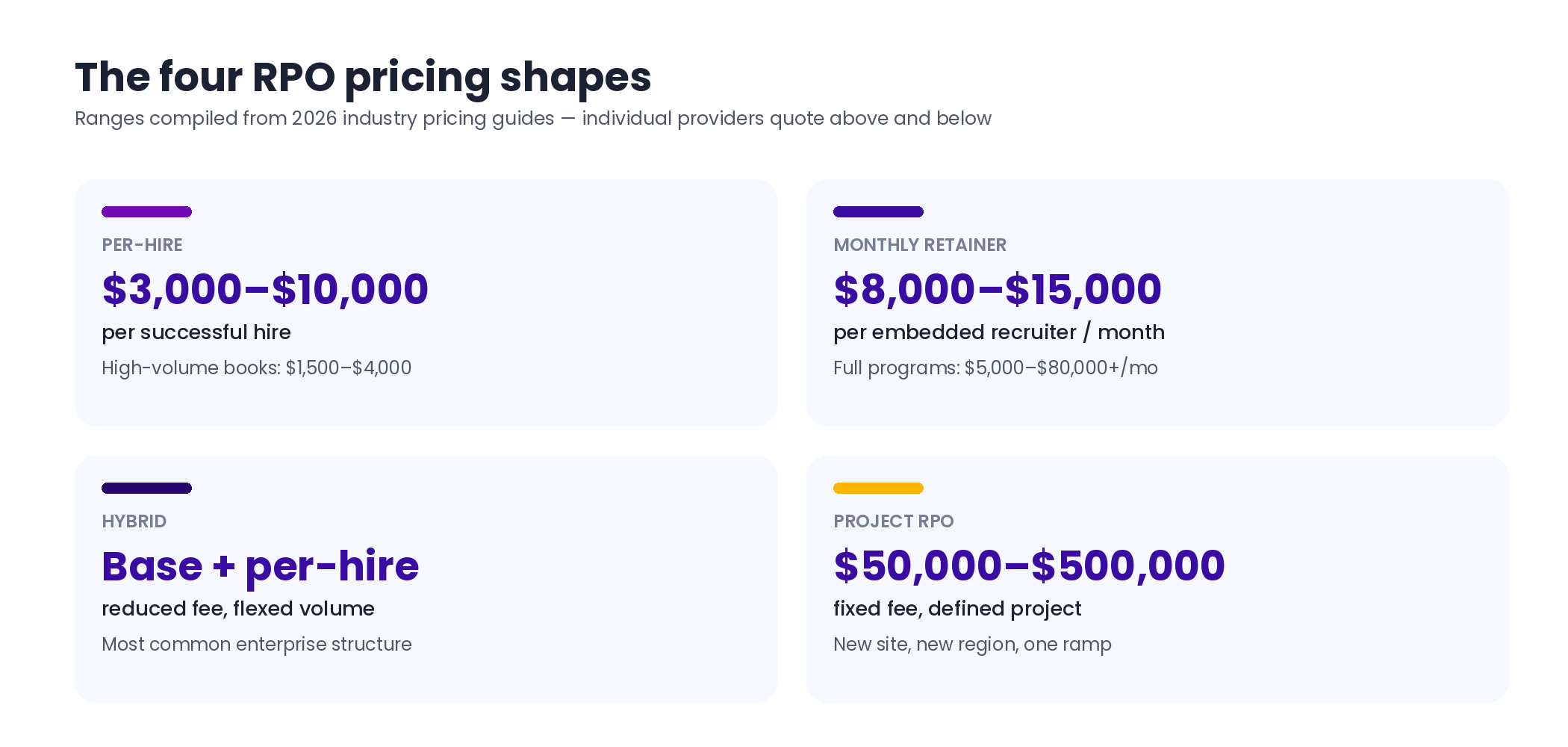
Recruitment process outsourcing typically costs $3,000–$10,000 per hire, or $8,000–$15,000 per embedded recruiter per month on retainer models — with high-volume programmatic books negotiated down to $1,500–$4,000 per hire and project engagements running $50,000–$500,000. Industry guides put the break-even against contingency agencies around 15–25 sustained hires a year. Here's each model decoded, and the math at three hiring volumes.
First, the definition in one line, since half the searches for this term are really asking it: RPO means handing part or all of your recruiting function to an outside provider — sourcing, screening, scheduling, sometimes the whole process under your brand — priced as an ongoing program rather than per-placement contingency fees. It sits between a staffing agency (transactional, per-role) and building your own team. And a disclosure: Boostpoint sells recruitment advertising, one of the alternatives compared below, so weigh our framing accordingly — the RPO figures here are the industry's own published ranges, cited in the methodology note.
Outsourcing the hiring process: what that phrase can buy
Most employers do not start by searching for RPO. They start by wanting to outsource the hiring process, which is a plain description of four quite different purchases. Sorting out which one you mean is worth doing before any price is discussed, because the four are priced on different things and fail in different ways.
| What you are buying | What you hand over | What it is priced on | What stays yours |
|---|---|---|---|
| Recruitment process outsourcing | The process itself: sourcing, screening, scheduling, offer management | Per hire, a monthly fee, or both | The decision, the employer brand, and the requisition |
| Staffing or recruiting agency | One search at a time | A percentage of first-year salary, on placement (fees by model: recruiter cost) | Everything outside that search |
| On-demand or contract recruiter (see recruiting as a service) | Capacity, not process | An hourly or monthly rate for a person | The process design and the tools |
| Managed recruitment advertising | Only the top of the funnel: reaching candidates and collecting applications | Media spend plus a fee, judged on cost per applicant | Screening, interviewing and hiring |
The fourth is worth separating out, because it is the one most often bought by accident. An employer whose problem is that nobody applies does not need the hiring process run for them; they need more applicants into the process they already have. Outsourcing the hiring process when the constraint is supply moves the same thin pipeline to someone else’s desk at a materially higher price. The rest of this page covers what the first option costs; our 2026 benchmark covers what the fourth returns.
The four RPO pricing models
Per-hire (cost-per-hire)
You pay per placement. Common for project RPO and high-volume single functions. Executive roles command $10,000–$25,000; the programmatic tier is where volume discounts live.
Monthly retainer / management fee
A fixed fee for dedicated capacity regardless of hires made. Predictable, but minimum-commitment clauses mean you pay in slow months too.
Hybrid
The most common enterprise structure: a smaller management fee buys the program, per-hire fees flex with volume. Watch how "successful hire" is defined.
Project RPO
A burst engagement — staff a new site, open a region — priced all-in. The right shape for one-time ramp-ups that would distort an ongoing contract.
What's actually inside the price — and what isn't
Core recruiter capacity is included in the headline number. The lines that move total spend, per the same industry guides: implementation fees at the start, sourcing tools and technology integration, minimum-volume clauses that bill whether you hire or not, surcharges for scope changes mid-contract, and early-termination penalties. Two contract questions to ask before price: where are the break windows (quarterly windows exist; annual-only windows lock you in for twelve months), and how is a "successful hire" defined for per-hire billing — offer accepted, day-one start, or 90-day retention are three very different products.
The math at three hiring volumes
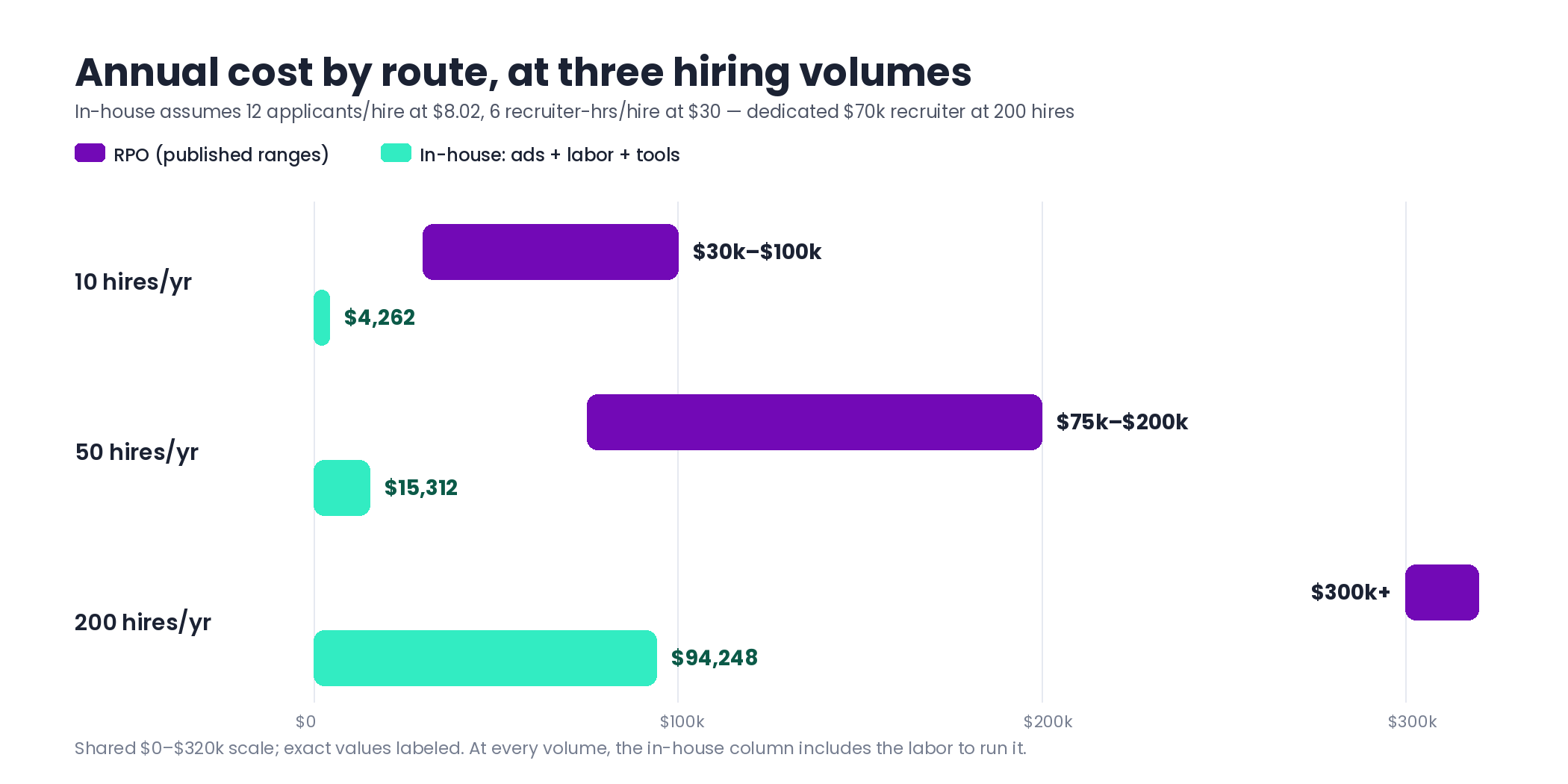
RPO economics are all about volume, so here's the same comparison at 10, 50, and 200 hires a year. RPO figures use the published ranges above; the in-house column uses our 2026 benchmark advertising cost ($8.02 volume-weighted average per applicant) plus stated labor assumptions — 12 applicants per hire, 6 recruiter-hours per hire at $30/hour loaded, and at 200 hires a dedicated recruiter instead of fractional time. Swap in your own ratios:
| Hires / year | RPO (published ranges) | In-house: the math | In-house total |
|---|---|---|---|
| 10 | $30,000–$100,000 (per-hire $3,000–$10,000) | 120 applicants × $8.02 = $962.40 + 60 hrs × $30 = $1,800 + $1,500 tools | $4,262.40 |
| 50 | $75,000–$200,000 (high-volume per-hire $1,500–$4,000) | 600 applicants × $8.02 = $4,812.00 + 300 hrs × $30 = $9,000 + $1,500 tools | $15,312.00 |
| 200 | $300,000+ (even at the $1,500 floor) | 2,400 applicants × $8.02 = $19,248.00 + dedicated recruiter $70,000 loaded + $5,000 tools | $94,248.00 |
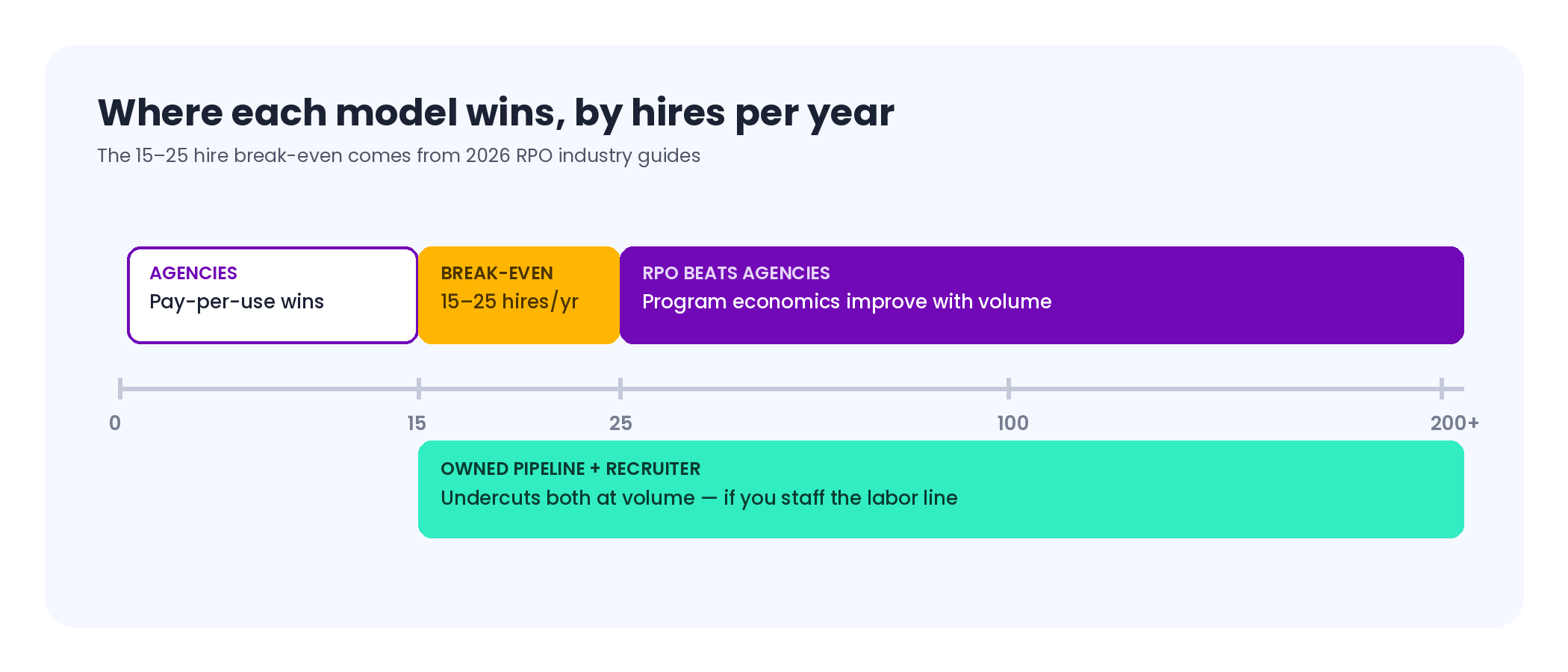
Read it honestly in both directions. Below the 15–25 hire break-even, RPO's fixed costs work against you — but so does building anything, which is why very small hirers often stay with agencies. Above it, the in-house column wins on cost at every volume, if you staff the labor line: at 200 hires the comparison only holds because a real recruiter is in the math. What RPO is genuinely selling at that scale isn't cheaper hires — it's a recruiting function you don't have to build, run, or manage. That's worth real money to some organizations. It's just worth knowing what the premium is: at 200 hires, roughly $205,752 a year against the staffed in-house column.
RPO vs staffing agency vs in-house
These three get conflated constantly, so the one-paragraph map: a staffing agency sells placements and temp coverage per transaction — fees per role, nothing ongoing (the full fee breakdown). RPO sells the recruiting function as a program — an outside team running your process under your brand. In-house means you own the function: your people, your pipeline, your channels. RPO's honest niche is the middle: organizations hiring enough that agency fees hurt, but unwilling or unable to build the function themselves. The four-question framework on our agency-vs-in-house page applies here too — RPO answers "no" to the capacity question on your behalf, for a fee. For contingent labor there is a fourth arrangement, the managed service provider, and how it is paid is covered in MSP staffing cost.
A PEO is the other thing employers weigh against this, and it answers a different question — administration rather than recruiting. Our guide to PEO cost covers the two pricing models and why quotes are not comparable until you convert them.
When RPO is worth the price
- You have no recruiting function and don't want one. RPO delivers a working process — people, tech, reporting — in weeks. Building the same thing takes quarters and management attention you may not have.
- Hiring is spiky across many role types. A retainer that flexes across requisitions beats per-role agency fees when this quarter's mix looks nothing like last quarter's.
- A defined ramp with a deadline. Project RPO exists for the new plant, the new region, the acquisition — bursts that would break both an agency relationship and a lean internal team.
- Process and compliance are the actual problem. If requisitions die in scheduling chaos rather than sourcing, you're buying operations, and RPO operations are genuinely good.
When it isn't
- Below the break-even. Under roughly 15–25 hires a year, minimum commitments and implementation costs routinely erase the savings the model promises.
- High-volume, single-role-family hiring. The programmatic tier RPO prices at $1,500–$4,000 per hire is exactly the hiring an owned advertising pipeline does for a fraction of that — the 50-hire row above is the argument.
- You already have the team. Layering RPO onto a functioning internal recruiting group usually buys duplication, not capacity.
- You'd be locked in blind. No tracked cost per applicant, no applicants-per-hire ratio, no baseline — signing a multi-year RPO contract without your own numbers means you'll never know what the program actually saved. Instrument first, sign second.
RPO sells you a recruiting department by subscription. Fair product, real price. Just compare it against what the subscription replaces — and for recurring frontline volume, an owned pipeline plus one good recruiter is usually the cheaper department.
RPO pricing is a rate and a set of terms, and the terms decide what it costs
Everything above prices the work. What the arrangement actually costs you over three years is decided by four commercial terms that rarely appear in the rate card, and none of them is negotiable once you have signed.
Term length. RPO agreements commonly run twelve to twenty-four months rather than month to month, because the provider is amortizing the implementation work described above. A longer term usually buys a lower rate. It also means that if your hiring plan changes in month five, you are still paying in month eighteen.
Exclusivity. Some agreements make the provider the sole channel for the roles in scope, which sounds administratively tidy and is the clause most likely to hurt. It means you cannot run your own campaign alongside, cannot test whether a direct channel is cheaper, and cannot hire the person who walks in the door without a fee attached. If you sign exclusivity, carve out referrals and walk-ins explicitly.
Notice and termination. There is a difference between a contract you can leave and a contract you can leave cheaply. Ask for the notice period in writing, ask what happens to candidates already in process when notice is served, and ask whether unpaid minimums accelerate on termination. That last one is the clause that turns an exit into a bill.
How the minimum behaves in a slowdown. Monthly minimums are priced against your forecast, and forecasts are optimistic. Ask directly: if we hire half what we projected, what do we pay? A minimum that holds regardless converts a variable cost back into a fixed one, which is the opposite of the reason most employers buy RPO in the first place.
None of this is legal advice, and the terms vary widely by provider. The point is narrower: get the rate and these four answers in the same conversation, because a low rate attached to a long exclusive term with an accelerating minimum is more expensive than a higher rate you can walk away from.
Whatever you sign, sign it against a number you own. Work out your current cost per hire before the first quote lands, and read how to measure recruitment marketing for the measures that will tell you afterwards whether the arrangement paid for itself.
On-demand, contract and outsourced recruiting services: what each one costs
Full recruitment process outsourcing is the largest version of a family of arrangements, and the smaller ones are often the better fit for an employer hiring in bursts. The vocabulary is loose — outsourced recruiting services, on-demand recruiting, contract recruiting and RPO get used for overlapping things — so it is worth separating them by what you are actually buying and how it is billed.
| Arrangement | What you get | How it is billed | Fits when |
|---|---|---|---|
| Full RPO | The hiring function, or a defined part of it, operated by a provider | Per hire, or a monthly management fee | Steady volume across many roles, over a year or more |
| Project RPO | A defined hiring burst — a new site, a season, an expansion | A fixed project fee | A known number of hires in a known window |
| On-demand recruiting | A recruiter’s time, drawn down as needed | Hourly or by blocks of hours | Irregular hiring with no case for a permanent recruiter |
| Contract recruiting | An individual recruiter embedded in your team for a period | An hourly or daily rate, often through an agency | Covering a vacancy or a temporary spike in requisitions |
| Outsourced recruitment marketing | The advertising and applicant generation only — no interviewing or offers | Media spend plus a fee or subscription | Your team can handle candidates, but not enough arrive |
The published rates for the first four are in the pricing models above. The difference worth being deliberate about is the last row, because it is the one most often bought by accident inside something larger: if the reason you are considering outsourcing is that too few people apply, you are buying an applicant supply problem dressed as a staffing problem. Separating the two is usually cheaper, and it is what outsourced recruitment marketing covers in detail.
Two questions to ask of any on-demand or contract arrangement before signing. First, what happens to the candidates and the data when it ends — pipelines built during an engagement should not leave with it. Second, is advertising spend inside the rate or billed separately, because an hourly recruiter with no media budget is being asked to source from a pool that may not exist.
Frequently asked questions
What is recruitment process outsourcing (RPO)?
RPO is handing part or all of your recruiting function to an outside provider — sourcing, screening, scheduling, and often the full process run under your employer brand — priced as an ongoing program or defined project rather than per-placement agency fees. It sits between transactional staffing agencies and building an internal recruiting team.
How much does RPO cost?
Published 2026 ranges: $3,000–$10,000 per hire on cost-per-hire models, $8,000–$15,000 per embedded recruiter per month on retainers (full programs span $5,000–$80,000+ monthly), $1,500–$4,000 per hire on negotiated high-volume books, and $50,000–$500,000 for defined project engagements. Implementation fees, tooling, and minimum-volume clauses add to headline rates.
What are the main RPO pricing models?
Four: per-hire (pay per placement), monthly retainer or management fee (fixed cost for dedicated capacity), hybrid (reduced base fee plus smaller per-hire charges — the most common enterprise structure), and project RPO (one fixed fee for a defined hiring push). Each shifts risk differently between you and the provider.
How many hires per year does RPO need to make sense?
Industry guides put the break-even against contingency agency fees at roughly 15–25 sustained hires per year. Below that, fixed monthly commitments and setup overhead often make RPO more expensive than agencies; above it, per-hire economics improve — though owned recruiting typically undercuts both at volume if you staff it.
Is RPO cheaper than a staffing agency?
At sustained volume, usually — an RPO per-hire fee of $3,000–$10,000 generally beats repeated direct-hire placement fees of 15–30% of salary once you're past the 15–25 hire break-even. Below that volume, agencies' pay-per-use model wins. The two also sell different things: agencies sell placements; RPO sells your whole process.
Is RPO cheaper than in-house recruiting?
Rarely, at volume — but that's not quite what it sells. In our worked comparison, 50 hires cost $75,000–$200,000 via high-volume RPO against $15,312.00 in-house (ads at $8.02 per applicant, labor, and tools); at 200 hires, RPO's $1,500 floor still totals $300,000 against $94,248.00 with a dedicated recruiter in the math. What RPO offers is a functioning recruiting operation without building one — a premium you should price knowingly.
What hidden costs show up in RPO contracts?
Implementation fees, sourcing-tool and technology-integration charges, minimum-volume clauses that bill in slow months, surcharges for mid-contract scope or geography changes, and early-termination penalties. Also check the break windows (quarterly vs annual-only) and how "successful hire" is defined for per-hire billing — offer accepted, day-one start, and 90-day retention are different products.
What should I measure before signing an RPO contract?
Your own baseline: tracked cost per applicant by channel, applicants-per-hire by role family, and current time-to-fill. Without those, you can't evaluate the program's savings claims afterward — and you'll negotiate from the provider's numbers instead of yours. An in-platform application flow makes the applicant side measurable in weeks.
What should I ask about RPO pricing before signing?
Four things, and none of them is the rate. How long is the term, and what does a shorter one cost? Is the provider exclusive for the roles in scope, and are referrals and walk-ins carved out? What is the notice period, what happens to candidates in process when notice is served, and do unpaid minimums accelerate on termination? And if we hire half what we forecast, what do we actually pay? A low per-hire rate attached to a long exclusive term with an accelerating minimum costs more over three years than a higher rate you can leave.
What is RPO cost per hire?
On a per-hire model, published ranges run $3,000 to $10,000 per successful hire, dropping to $1,500 to $4,000 on negotiated high-volume programs and rising to $10,000 to $25,000 for executive roles. On a retainer model there is no per-hire price until you divide: an $8,000-a-month embedded recruiter filling four roles a month is $2,000 a hire, and filling one is $8,000. That division, not the rate card, decides whether RPO is cheap.
What are recruitment outsourcing services?
A category covering four shapes: end-to-end RPO, where the provider runs the whole recruiting function; selective or partial RPO, covering named stages or job families; project and on-demand RPO for a defined ramp; and recruitment marketing or media-only services, which generate applicants without providing recruiter seats. The commercial model differs in each.
What is the difference between recruitment process outsourcing and recruitment marketing?
RPO supplies the people and process that move candidates through your funnel. Recruitment marketing supplies the candidates arriving at the top of it. If applicants are scarce, recruiter seats solve a stage that is not broken; if applicants arrive and nobody calls them, more advertising makes the problem worse.
Does an RPO fee include advertising spend?
Often not, and it is the single most important thing to clarify. A cost per hire that excludes job board and social media spend is not a cost per hire. Ask for the figure both ways, and ask who owns the advertising accounts and campaign data when the contract ends.
Should RPO pricing be blended across all roles?
Usually not in your favor. Volume hourly hiring and hard-to-fill licensed roles have very different economics, and a single blended rate across both tends to price the easy hires like the hard ones. Price the job families separately and review them separately.
What are outsourced recruiting services?
A family of arrangements rather than one product: full RPO, where a provider operates the hiring function; project RPO for a defined burst; on-demand recruiting bought by the hour; contract recruiters embedded for a period; and outsourced recruitment marketing, which covers only the advertising and applicant generation. They differ in what is delegated and how it is billed, and the right one depends on whether your constraint is capacity or applicants.
What is on-demand recruiting and what does it cost?
Recruiter time drawn down as you need it, billed hourly or in blocks rather than as a per-hire fee or a retainer. It suits irregular hiring that cannot justify a permanent recruiter. Ask whether advertising spend is inside the rate or separate — an hourly recruiter without a media budget can only work the candidates who already exist.
What is the difference between contract recruiting and RPO?
Contract recruiting is a person: an individual recruiter working inside your team for a period, at an hourly or daily rate. RPO is a function: a provider operating a defined part of your hiring process, with their own tools, process and reporting, billed per hire or on a management fee. One adds capacity to your process; the other replaces part of it.
What does it cost to outsource the hiring process?
It depends which version you buy. Full recruitment process outsourcing is priced per hire or as a monthly fee, and the ranges are set out in the pricing models above. An agency is priced as a percentage of first-year salary, per placement. A contract recruiter is priced as a person. Managed advertising is priced on media spend plus a fee, and judged on cost per applicant rather than per hire. Comparing the four on headline price alone is the most common mistake, because they are not selling the same unit.
What does an outsourced hiring process actually include?
Usually sourcing, screening, interview scheduling and offer coordination, with the hiring decision left with you. What varies between providers, and what decides the real price, is everything around that: implementation, advertising spend, the tools, minimum volume clauses, and how a successful hire is defined for billing. An outsourced hiring process that does not include advertising spend is quoting you a fee, not a total.
Why is RPO so expensive?
Because you are buying a recruiting function, not a placement. Published ranges run $3,000 to $10,000 per hire, or $8,000 to $15,000 per embedded recruiter per month on retainer, and that price carries recruiter capacity, sourcing tools, technology integration and implementation work the provider spreads over terms that commonly run twelve to twenty-four months. Minimum-volume clauses mean you pay in slow months too. Below roughly 15 to 25 hires a year, those fixed costs usually outweigh the savings.
What is outsourcing talent acquisition?
The same arrangement described at a department level rather than a requisition level. Outsourcing talent acquisition usually means a provider takes on the whole function, including workforce planning and employer brand work, rather than filling named roles. It suits organizations hiring continuously at scale. For an employer with a handful of hard-to-fill frontline roles, the narrower purchases above are almost always the better fit.
Which parts of an outsourced hiring process should stay in-house?
The hiring decision, the requisition and the employer brand, as the comparison table above shows, plus the records. Federal rules at 29 CFR 1602.14 require an employer to keep application forms and other hiring records for one year from when they were made or the personnel action, whichever is later, so make sure the contract gives you the provider's application and screening records, not only a list of hires.
Is an outsourced hiring process worth it for hourly roles?
Only if the bottleneck is capacity inside the process: too many applicants to screen and schedule, not too few. If the problem is that too few people apply, an outsourced hiring process moves the same thin pipeline to another desk at a higher price. Check your applicants per opening first; the Boostpoint 2026 benchmark shows what an applicant costs by role family when the constraint is supply.
Get your baseline before you sign anything
We'll show you what applicants cost for roles like yours across 891 real campaigns — the number every RPO comparison should start from.
Book a Demo


RPO pricing ranges are third-party 2026 figures compiled from industry pricing guides and providers — EORHQ's RPO cost guide ($3,000–$10,000 per hire; $8,000–$15,000 per embedded recruiter monthly; 15–25 hires/year break-even), InterviewCost's 2026 pricing analysis ($1,500–$4,000 programmatic per-hire; $5,000–$80,000+ monthly retainers; $50,000–$500,000 project RPO), Hudson Talent Solutions, and TinRate's RPO pricing references — individual providers quote above and below these ranges, and contracts control. In-house comparison figures use the 2026 Social Job Advertising Benchmark ($8.02 volume-weighted average cost per applicant across 891 campaigns) plus stated assumptions (12 applicants per hire; 6 recruiter-hours per hire at $30/hour loaded; $70,000 loaded dedicated recruiter at 200 hires; tools as stated) meant to be replaced with your own ATS figures. Cost per applicant is not cost per hire. This page replaces our earlier glossary entry on recruitment process outsourcing. General information, not advice on specific contracts.