
Staffing Agency vs In-House Recruiting: How to Actually Decide
Neither option wins in general — they win in situations. Agencies win on speed, scarce searches, and offloaded employment administration. In-house recruiting wins on recurring roles, cost per hire, and owning the pipeline. Four questions decide it for any specific role, and the math below — including what in-house genuinely costs, which most comparisons skip — shows why most employers end at a hybrid. If the option on the table is handing over the whole recruiting function instead, RPO cost sets out the four pricing models.
A note on who's writing this
Boostpoint sells recruitment advertising — the engine of the in-house route — so we have a side here, and you should weigh our framing accordingly. Two things we've done to earn the read anyway: the agency fee figures are the industry's own published ranges, and the in-house column includes the labor and overhead costs that vendor comparisons conveniently forget. If you're in the skilled trades specifically, we've run this exact comparison with trades campaign data at staffing agency vs direct hiring for trades — this page is the cross-industry version.
Four questions that decide it
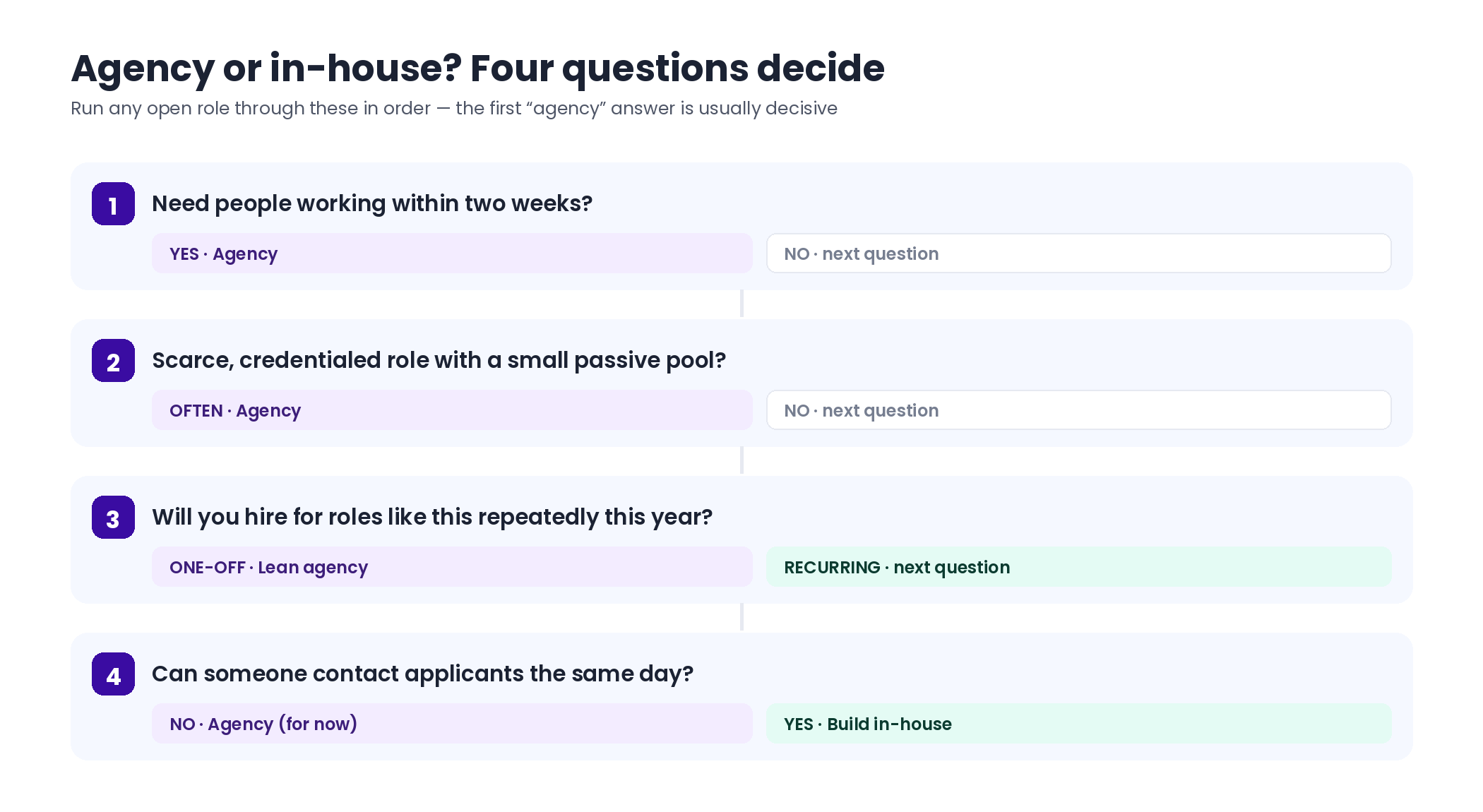
Run any open role through these in order. The first "agency" answer you hit is usually decisive; if you clear all four, build in-house.
What each route costs
The fee side, briefly — the full breakdown lives on our staffing agency markup and fees page: direct hire placements run 15–30% of first-year salary, temp markups run 25–100% on hourly wages by industry, and temp-to-hire conversions add 11–21%. (How a direct placement differs from temp and temp-to-hire is set out in our glossary.) On the in-house side, the advertising engine: across the 891 campaigns in our 2026 benchmark, applicants cost a volume-weighted average of $8.02 (median campaign $13.88), with the median campaign running on a $334 monthly budget.
The worked example: 25 frontline hires in a year
Say you'll make 25 permanent frontline hires this year at a $40,000 salary — a warehouse, a care agency, a multi-site retailer. Every assumption is stated; swap in your own numbers:
| Line item | The math | Annual cost |
|---|---|---|
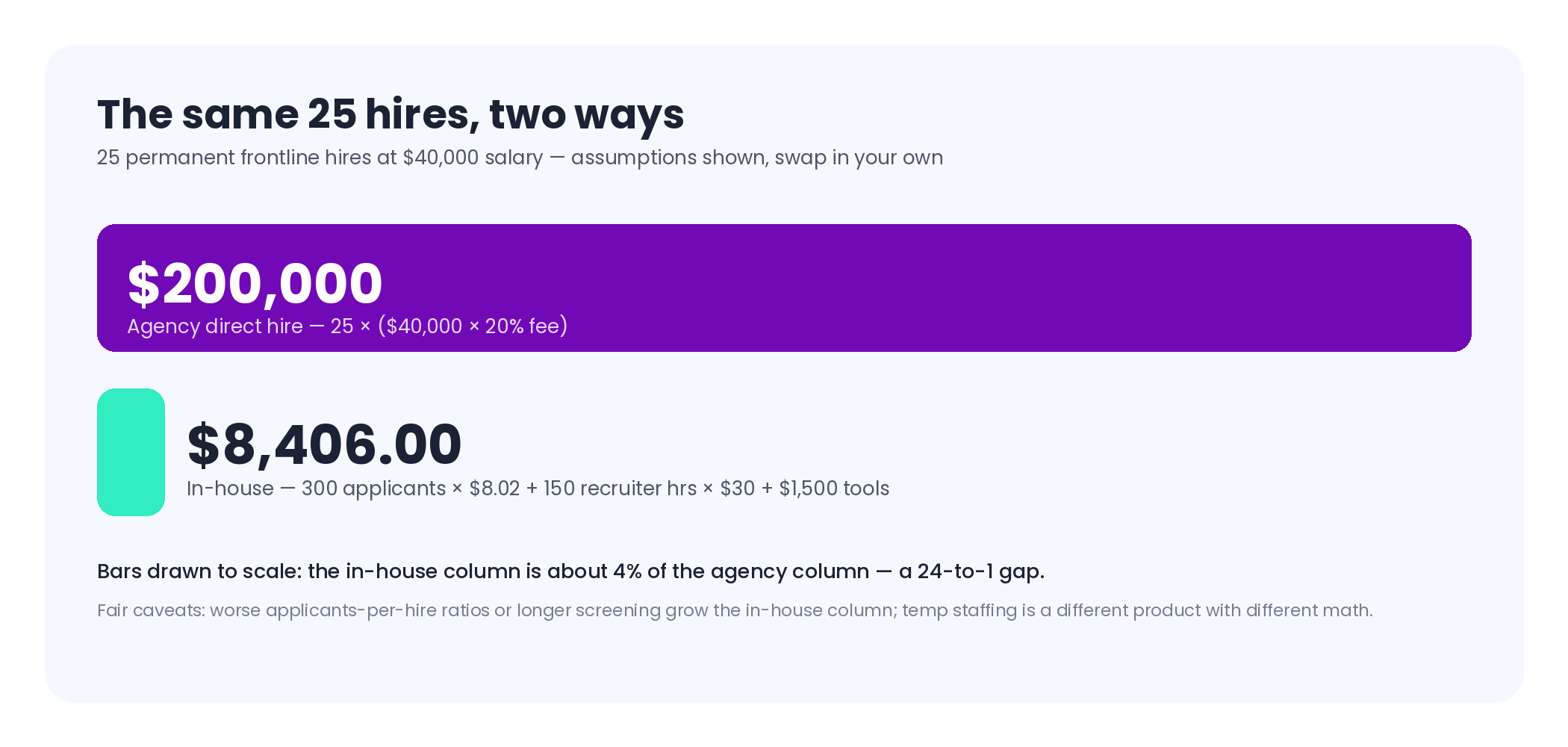
| Agency route: placement fees | 25 hires × ($40,000 × 20% fee) = 25 × $8,000 | $200,000 |
| In-house: ad spend | 25 hires × 12 applicants per hire = 300 applicants × $8.02 | $2,406.00 |
| In-house: recruiter time | 6 hours per hire (screen, interview, offer) × 25 hires = 150 hours × $30/hr loaded | $4,500 |
| In-house: tools & misc share | ATS seat, assessments, background checks — stated estimate | $1,500 |
| In-house total | $2,406.00 + $4,500 + $1,500 | $8,406.00 |
That's roughly a 24-to-1 gap — and it's honest about why: at 25 recurring hires, the agency's fee structure charges you for a full search twenty-five times, while the in-house machine builds once and reuses everything. Two fair caveats. If your applicants-per-hire ratio is worse than 12, or screening takes far longer than 6 hours, your in-house column grows — recompute with your ATS numbers. And if those 25 seats would actually be filled with temps rather than direct hires, that's a different product with different math; the markup page prices it.
In-house isn't free — the column most comparisons hide
The honest case for in-house recruiting requires admitting what it costs beyond the ads: someone's hours to work applicants (the single biggest line, and the one that kills in-house programs when it's nobody's actual job), tools, and the ramp-up period where your first campaigns underperform your eventual ones. In our benchmark, the top 10% of campaigns produced 57% of all applicants on 22% of the budget — the spread between a tuned pipeline and a neglected one is enormous, and tuning is labor. Budget for the person, not just the ads, or you'll build the cheap applicant machine and let its output expire in an inbox.
Staffing agency pros and cons
- Speed — a bench that can cover shifts this week
- Employer-of-record burden carried for you: payroll taxes, workers' comp, no-show replacement
- Access to scarce specialists a recruiter already knows
- Screening and process capacity you don't have to staff
- Guarantee periods on placements (30–90 days is common)
- Cost at volume — fees repeat with every placement, forever
- Nothing accrues to you: the next search starts at zero
- "Temporary" arrangements that quietly become permanent taxes
- The agency's candidate pool is also your competitors' candidate pool
- Conversion fees complicate keeping the people who work out
In-house recruiting pros and cons
- Cost per hire at volume — the 24-to-1 math above
- Everything compounds: audiences, creative, forms, employer brand
- Candidates meet your company, not an intermediary
- Reaches passive candidates who never contact agencies
- Scales across locations at marginal cost
- Needs a real owner — orphaned pipelines fail
- Slower to first hire than a staffed bench
- You carry all employment administration
- Weak for scarce, credentialed one-off searches
- Ramp-up period before campaigns hit their numbers
The hybrid most employers actually land on
In practice this is rarely all-or-nothing. The stable end state for most frontline employers splits by role profile: owned pipeline for the recurring volume roles — the warehouse associates, caregivers, CSRs, and drivers you hire all year — and agencies held for what they're genuinely best at: same-week coverage spikes and the occasional scarce specialist. The transition usually runs one role family at a time: build the pipeline for your highest-volume role first, prove the cost per hire against the fees you were paying, then expand — while keeping an agency relationship warm for the emergencies. The mistake isn't using agencies; it's using them as the default for hiring you do every month of the year.
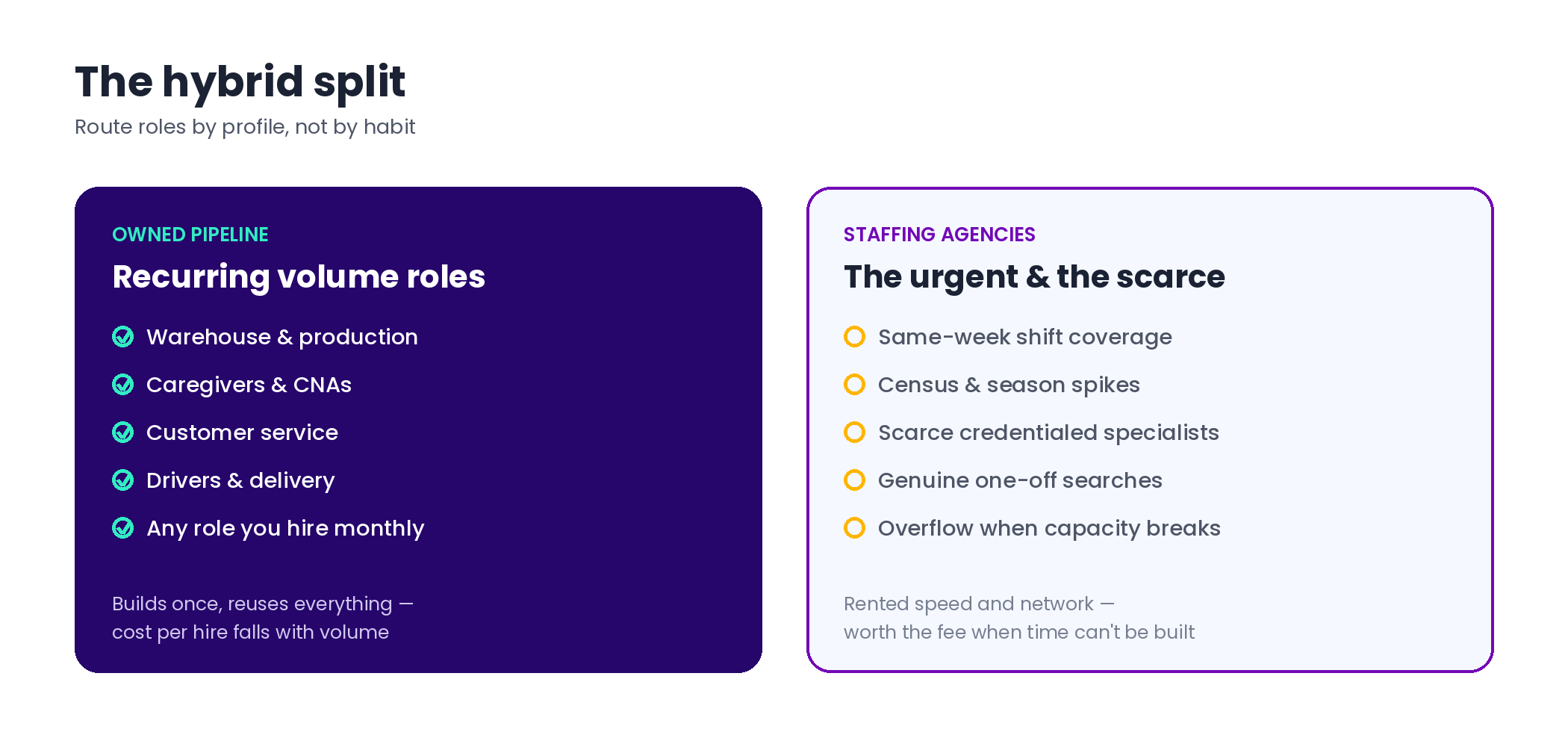
Agencies are a service you rent; a pipeline is an asset you own. Rent for emergencies and rarities. Own the hiring you repeat.
Joint employer and co-employment risk when you use a staffing agency
Using a staffing agency does not make you a bystander. When you direct a temp's work on your site, you are very likely a joint employer of that person under at least some federal laws, and the agency's fee does not buy that exposure away. “Co-employment” is the industry word for the same shared relationship. What matters in practice is which law is asking, because each one draws the line differently.
| Rule | What it says | What it means for the client |
|---|---|---|
| OSHA (workplace safety) | The agency and the host employer “are joint employers of temporary workers and, therefore, both are responsible for providing and maintaining a safe work environment” | Site-specific training, hazards and injury prevention are yours as well as the agency's |
| FMLA (29 CFR 825.106) | Joint employment “will ordinarily be found to exist when a temporary placement agency supplies employees to a second employer”; the agency is most commonly the primary employer | Temps count toward your 50-employee coverage threshold, and you must take a worker back from leave if you still use that agency and it places them with you |
| FLSA (wages and overtime) | No DOL regulation in force since 2021; a proposed rule published April 23, 2026 would restore one in 29 CFR part 791, with comments closed June 22, 2026 | Courts decide case by case for now; if both of you employ the worker, hours for both are totaled for overtime (29 CFR 778.103) |
| NLRA (unions) | Joint employer only if you possess and exercise “substantial direct and immediate control” over essential terms: wages, benefits, hours, hiring, discharge, discipline, supervision and direction (29 CFR 103.40) | The 2023 broader rule was vacated in 2024 and formally withdrawn effective February 27, 2026 |
The proposed FLSA rule would ask whether a potential joint employer hires or fires the employee, “supervises and controls the employee's work schedule or conditions of employment to a substantial degree,” determines the rate and method of pay, and maintains employment records. It is a proposal, not the law, as of this update.
Practical ways to keep the risk proportionate
- Put the split in the contract. Spell out who handles pay, overtime, workers' comp, safety training, FMLA notices and discipline, and require the agency to indemnify you for its own failures.
- Route pay and discipline through the agency. Directing the day's work is normal. Setting a temp's pay rate, firing them directly or keeping your own personnel file on them points toward joint employment under several of these tests.
- Train for your hazards. OSHA holds you responsible for the site, so do the site-specific training yourself and document it.
- Watch long assignments. A temp who has worked in your building for a year looks a lot like your employee. Convert the good ones and end the rest; our staffing agency markup page covers what conversion costs.
For roles you hire directly, the question does not arise, which is one more line in the in-house column. General information, not legal advice; state law, such as state wage and safety rules, can reach further than the federal tests. Sources: OSHA, Protecting Temporary Workers; 29 CFR 825.106; DOL proposed joint employer rule, April 23, 2026; NLRB withdrawal of the 2023 standard; 29 CFR 103.40. Read at source 24 September 2026.
Frequently asked questions
Is it better to use a staffing agency or recruit in-house?
It depends on four things: timing (need people within two weeks → agency), scarcity (small passive candidate pool → often agency), frequency (recurring roles → in-house), and capacity (nobody to work applicants same-day → agency until that's fixed). Most employers end at a hybrid — owned pipeline for recurring volume roles, agencies for urgent coverage and rare specialists.
What are the pros and cons of using a staffing agency?
Pros: speed from an existing bench, employer-of-record administration carried for you, access to known specialists, screening capacity, and placement guarantees. Cons: fees that repeat with every placement, nothing accruing to your own pipeline, temp arrangements that drift into permanent markup, and a candidate pool shared with your competitors.
How much does a staffing agency cost compared to in-house recruiting?
Agencies charge 15–30% of first-year salary per direct hire, 25–100% markups on temp wages, and 11–21% conversion fees. In our worked example — 25 permanent $40,000 hires — placement fees total $200,000 against an in-house total of $8,406.00 including ad spend ($8.02 per applicant), recruiter time, and tools. The gap narrows for one-off or scarce roles and widens with volume.
When is a staffing agency worth it?
When you need people working within two weeks, when the role is a scarce credentialed search with a small passive pool, when the need is genuinely one-off, or when no one on your team can process applicants same-day. In those situations the fee prices real value — speed, network, and capacity — that an owned pipeline can't deliver on that timeline.
What does in-house recruiting actually cost?
Three lines, not one: advertising (a volume-weighted average of $8.02 per applicant across our 2026 benchmark, with a median campaign budget of $334 a month), the labor to work applicants (the biggest and most-forgotten line — budget real hours per hire), and tooling. The programs that fail usually funded the ads and skipped the person.
Can a small company recruit in-house?
Yes — the budgets are smaller than assumed. The median campaign in our benchmark ran $334 a month and reached 6,061 people, and in-house doesn't require a dedicated recruiter at small scale, just a named owner with same-day time for applicants. The four-question framework applies at any size; small companies mostly fail question 4, and that's fixable.
What is a hybrid recruiting model?
Splitting channels by role profile: an owned advertising pipeline handles the recurring volume roles you hire all year, while staffing agencies are reserved for same-week coverage needs and scarce specialist searches. It captures the cost advantage of ownership where volume justifies it, without giving up the speed agencies genuinely provide.
How do I transition from an agency to in-house recruiting?
One role family at a time. Start with your highest-volume role, build the campaign and an in-platform application flow, assign a same-day owner for applicants, and run it alongside the agency for one cycle. Compare your measured cost per hire against the fees, then expand role by role — keeping an agency relationship warm for emergencies rather than cutting it entirely.
Is a company a joint employer of staffing agency workers?
Often, yes, depending on the law. OSHA treats the staffing agency and the host employer as joint employers responsible for temp worker safety, and the FMLA regulations say joint employment will ordinarily be found when a temporary placement agency supplies workers. Under the NLRA it turns on direct and immediate control over pay, hours, hiring, discipline and supervision. General information, not legal advice.
What is co-employment with a staffing agency?
Co-employment is the shared employer relationship that forms when an agency employs a worker on paper and the client directs that worker's daily job. Both can carry legal duties at once: the agency usually handles payroll, taxes and benefits, while the client shares responsibility for safety and can share liability for wage, leave and discrimination issues, depending on the law involved.
What is the current joint employer rule under the FLSA?
There is no DOL joint employer regulation in force under the FLSA; the 2020 rule was rescinded in 2021. The Department published a proposed rule on April 23, 2026, with comments closing June 22, 2026, that would restore a standard in 29 CFR part 791. Until a final rule issues, courts apply their own tests case by case.
Price the in-house route for your roles
We'll show you what applicants cost for roles like yours across 891 real campaigns — the number the four-question framework runs on.
Book a DemoAgency fee ranges (15–30% direct hire, 25–100% temp markups, 11–21% conversion) are third-party staffing-industry figures detailed with sources on our staffing agency markup and fees page. Advertising figures ($8.02 volume-weighted average and $13.88 median cost per applicant, $334 median monthly budget, 6,061 median monthly reach, budget-concentration finding) come from the 2026 Social Job Advertising Benchmark — 891 campaigns, 1,334 campaign-months. The 25-hire worked example uses stated assumptions (12 applicants per hire, 6 recruiter-hours per hire at $30/hour loaded, $1,500 tools share) intended to be replaced with your own ATS figures; cost per applicant is not cost per hire. The therapy figure ($74.62 median, 5% apply rate) is the benchmark's, cited here as evidence against our own case. This is general information, not advice on specific contracts.