
Staffing Agency vs. Direct Hiring for Trades: A Cost Comparison
A staffing agency placing a skilled tradesperson typically charges 15 to 30 percent of first-year salary. Temporary placement markups commonly run 25 to 100 percent over the worker's wage. Recruitment advertising for skilled trades roles costs a median $14.14 per applicant in Boostpoint's 2026 benchmark. Those numbers aren't measuring the same thing, and the comparison only becomes useful once you're honest about what each one buys.
Source: Boostpoint 2026 Social Job Advertising Benchmark — 891 Boostpoint-managed campaigns on Meta (1,334 campaign-months), 2026; advertising costs only. Skilled trades: 35 campaigns.
Three different invoices
Most contractors have used all three of these at some point and never compared them side by side, because they arrive as three different kinds of bill. One is a percentage of salary, one is a markup on an hourly rate, and one is a media spend. It's a recurring conversation in skilled trades recruiting.
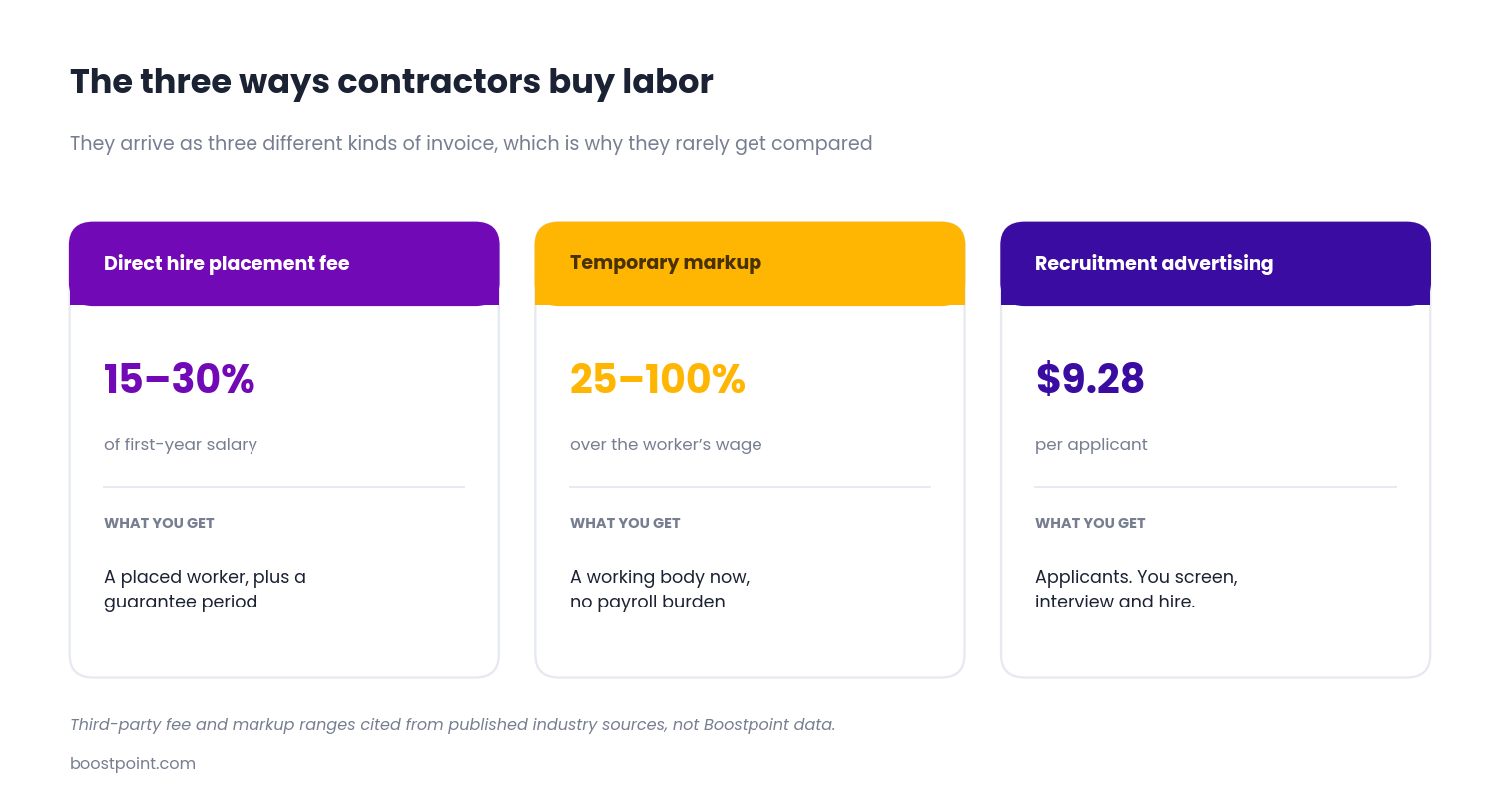
Direct hire placement fees
Published ranges for skilled trades direct hire placements cluster between 15 and 30 percent of first-year salary. Recruiters specializing in trades commonly quote 15 to 25 percent; some construction recruiters publish 20 to 30 percent for harder searches.
Most include a guarantee period — if the placement leaves inside 30, 60 or 90 days, you get a replacement or a partial refund. That guarantee is a real part of what you're paying for and it's usually left out of these comparisons.
Temporary and temp-to-hire markups
Temporary staffing is billed as a markup over the worker's wage, commonly 25 to 100 percent depending on trade, market and duration. At the lower end you're covering payroll taxes, workers' comp and the agency's margin. At the upper end you're paying for speed and flexibility.
Temp-to-hire adds a conversion fee if you want to bring the person onto your own payroll — often 11 to 21 percent of salary, sometimes waived after a qualifying period.
Recruitment advertising
Across the 35 skilled trades campaigns in our 2026 benchmark, the median applicant cost $14.14, with the middle half of campaigns between $7.58 and $21.49. That's the advertising cost of getting one interested person to raise their hand. It buys an applicant, not a hire — a distinction that matters more than anything else on this page, and one we cover in more detail in what trades recruiting actually costs.
The same hire, bought three ways
Take a journeyman electrician at $65,000.
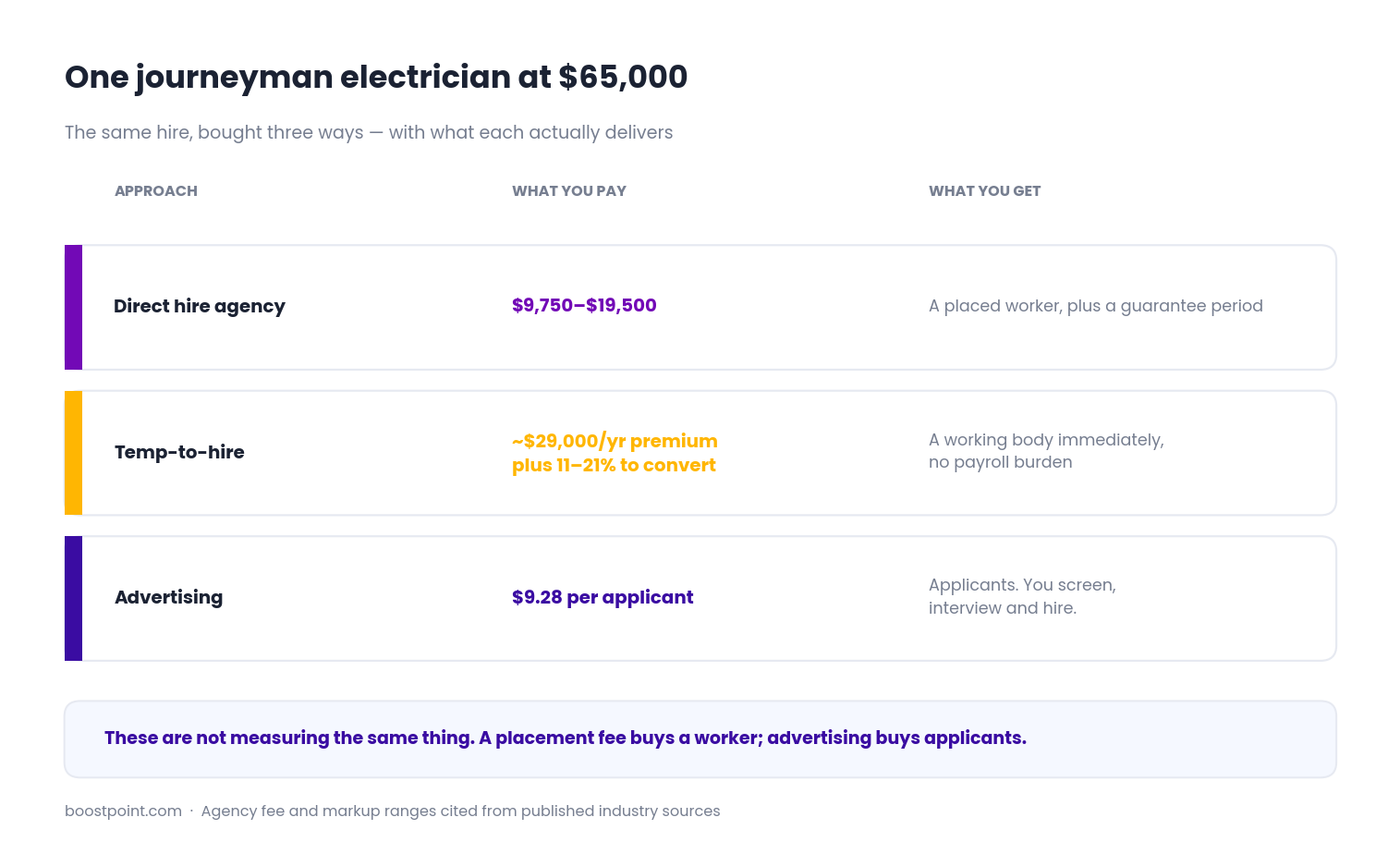
| Approach | What you pay | What you get |
|---|---|---|
| Direct hire agency | $9,750–$19,500 | A placed worker, plus a guarantee period |
| Temp-to-hire | ~$29,000/yr premium at a 45% markup, plus 11–21% to convert | A working body immediately, no payroll burden |
| Recruitment advertising | $14.14 per applicant (median) | Applicants. You screen, interview, verify and hire. |
Run advertising to a hire and the arithmetic looks lopsided. At a conservative one-in-fifty applicant-to-hire rate, that's about $707 in advertising per hire. At a pessimistic one in a hundred, about $1,414. Even the higher figure is under a sixth of the $9,750 low-end placement fee.
But that comparison is doing something dishonest, and it's worth naming. The agency number includes work you'd otherwise do yourself — sourcing, screening, reference checks, scheduling interviews, and often the guarantee. The advertising number doesn't. Your own time isn't free just because it doesn't appear on an invoice.
Which problem do you actually have?
The useful question isn't which is cheaper. It's which constraint you're actually up against — and buying the wrong one is where contractors waste money.
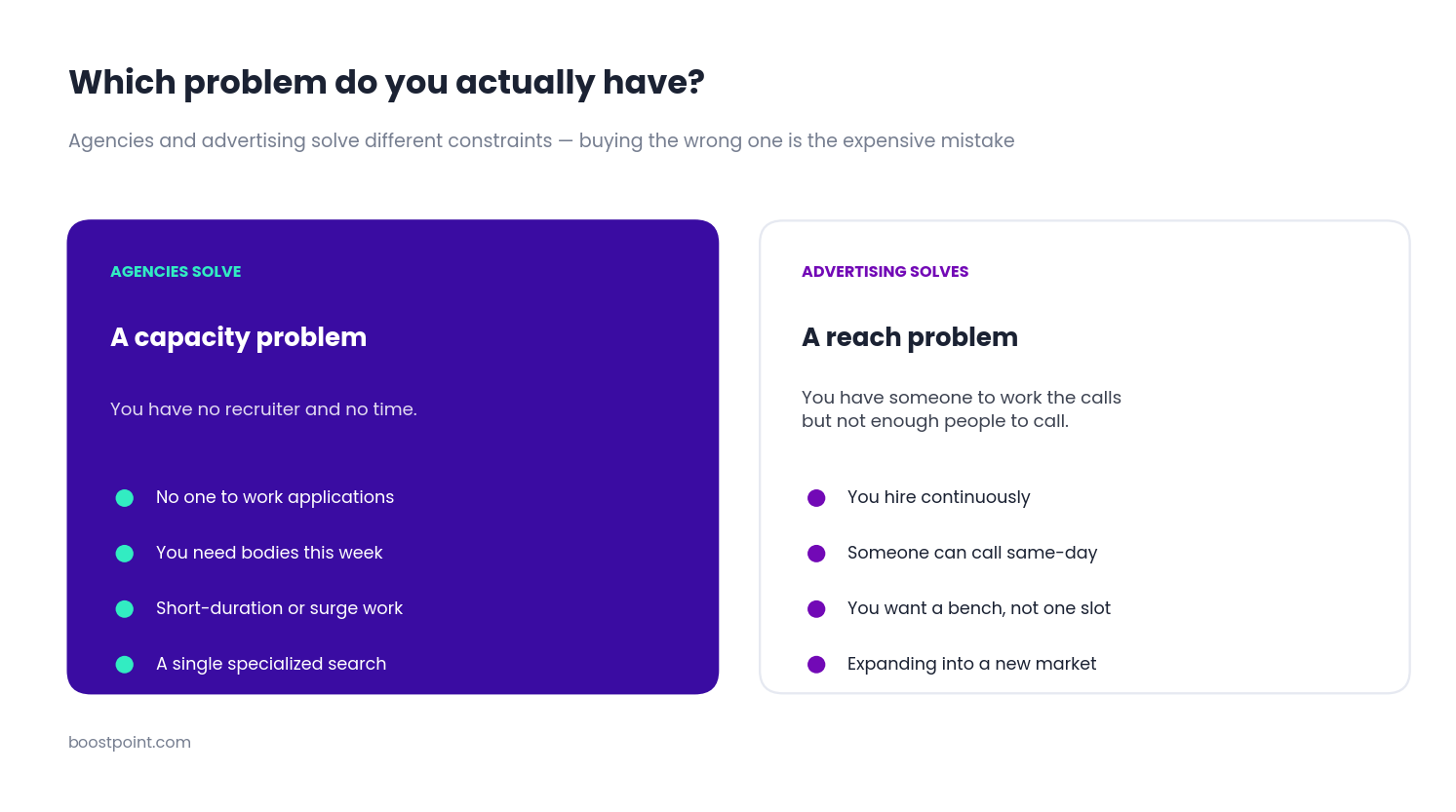
Agencies solve a capacity problem
You have no recruiter, no time, and nobody who can work a list of applications. A placement fee buys you out of that work entirely. If a truck needs a driver Monday and it's Friday afternoon, an agency is the right answer and advertising is not.
Agencies are the better choice when:
- Nobody at your company can work applications same-day
- You need bodies this week, not this month
- The work is short-duration, seasonal or a genuine surge
- You're filling one highly specialized role where the qualified population is tiny
Advertising solves a reach problem
You have someone who can work the phone. What you don't have is enough people to call. The applicants exist — they're employed at the contractor twenty minutes away and they aren't reading job boards.
Advertising is the better choice when:
- You hire continuously rather than occasionally
- Someone can call applicants the same day they apply
- You want a bench of candidates, not one filled slot
- You're expanding into a market where you have no network
Most contractors we work with run both. Advertising for the steady-state crew hiring, agencies for the emergency and the specialist search. Treating them as alternatives is what produces the wrong decision.
What advertising doesn't cover
Being straight about this, because the $14.14 figure looks better than it is if you stop reading there.
- Your time. Someone screens the applicants, makes the calls, schedules the interviews and chases the no-shows. If that person is your foreman, it's coming out of billable hours.
- No guarantee. If the hire leaves in three weeks, nobody replaces them and nobody refunds you. Direct hire agencies usually carry a guarantee period; advertising carries none.
- No pre-screening. Knockout questions filter for basics. They don't verify certifications, check references or assess whether someone can actually run the equipment they claim to.
- Volume you have to handle. Advertising produces applicants in numbers. Without someone to work them, you've bought a list, not a hire.
The honest framing is that an agency sells you a finished outcome, and advertising sells you the raw material. Whether that trade is worth it depends entirely on whether you have someone to do the work in between. The same decision outside the trades, with a worked example, is in staffing agency vs in-house recruiting.
A practical way to decide
Three questions, in order:
- Do you have someone who can call applicants the same day? If no, use an agency or fix that first. Advertising into a black hole is the most expensive mistake in this category.
- Is this a one-off or a pattern? One specialized hire a year favors an agency. Continuous crew hiring favors advertising — the cost structure rewards volume.
- How fast do you need them? This week is an agency question. This quarter is an advertising question.
If you're running advertising and it isn't working, the first thing to check isn't the ads. It's your application completion rate — in our campaign-level analysis of trades campaigns only 9.1% of people who click go on to finish the form, and it is the largest lever most contractors have.
Frequently asked questions
How much do staffing agencies charge for skilled trades?
Published ranges for direct hire placements cluster between 15 and 30 percent of first-year salary — roughly $9,750 to $19,500 for a tradesperson earning $65,000. Temporary placement markups commonly run 25 to 100 percent over the worker's wage, and temp-to-hire conversion fees often run 11 to 21 percent of salary.
Is it cheaper to hire tradespeople directly than through an agency?
On advertising cost alone, yes by a wide margin — a $14.14 median per applicant against a placement fee in the thousands. But that comparison leaves out your own screening and interviewing time, and the guarantee period most direct hire agencies include. The two aren't measuring the same thing.
When should a contractor use a staffing agency?
When you have a capacity problem rather than a reach problem: nobody available to work applications, a genuine need for bodies this week, short-duration or surge work, or a single highly specialized search where the qualified population is very small.
When is recruitment advertising the better choice?
When you hire continuously, someone can call applicants the same day, you want a bench of candidates rather than one filled slot, or you're expanding into a market where you have no existing network.
What does a staffing agency include that advertising doesn't?
Sourcing, screening, reference checks, interview scheduling, and usually a guarantee period covering early departures. Advertising delivers applicants — you do everything after that, and there's no replacement if the hire doesn't stick.
Can we use both?
Most contractors we work with do. Advertising handles steady-state crew hiring where volume and cost matter; agencies handle emergencies and specialist searches where speed or a tiny candidate pool makes advertising a poor fit.
What's the real cost per hire through advertising?
It depends on your applicant-to-hire rate, which we don't track. At a conservative one in fifty it works out around $707 in advertising per hire; at a pessimistic one in a hundred, about $1,414. Neither figure includes your own screening and interviewing time.
What's the most expensive mistake in this decision?
Running advertising when nobody can follow up. Trades applicants apply to several contractors in one sitting and go cold within hours. If applications arrive and sit, you've paid for a list rather than a hire — and that failure looks like the channel not working.
See what it costs to fill your crews
Book a 30-minute call and we'll walk through cost per applicant for the trades, markets and shifts you're hiring for.
Book a Free DemoBoostpoint cost per applicant comes from the Boostpoint 2026 Social Job Advertising Benchmark — 891 Boostpoint-managed campaigns on Meta (1,334 campaign-months), 2026; skilled trades $14.14 median, $7.58–$21.49 middle 50%, 35 campaigns. The 9.1% completion rate comes from an earlier campaign-level analysis of trades campaigns. Costs are what advertisers paid for advertising only — not screening, interviewing or onboarding time. Staffing agency fee and markup ranges are cited from published industry sources and are not Boostpoint data; actual fees vary by trade, market and agreement. This is a sample of Boostpoint campaigns, not an industry-wide study.
Related: Skilled Trades Recruiting · What It Costs to Recruit Skilled Trades Workers · Why 91% of Trades Applicants Never Finish Your Application