
Social Media Recruiting for Contractors: What the Data Shows
Reaching tradespeople on social media is cheap — in Boostpoint's 2025–2026 field and trades campaigns, $13.27 per thousand impressions and $0.84 per click, the lowest click cost of any industry we advertise for. The catch is what happens next. Only 9.1% of people who click finish an application, so a qualified applicant ends up costing $9.28.
Source: 45 Boostpoint-managed field and trades campaigns across ten contractors and industrial service companies, 2025 through 2026, representing 2,590,544 impressions and 3,703 applications on Meta platforms.
The funnel, end to end
Most content about social recruiting for contractors stops at "reach passive candidates." Here's the actual arithmetic from 45 field and trades campaigns — and it's the numbers behind everything else in our skilled trades recruiting work.
| Stage | Trades average |
|---|---|
| Cost per 1,000 impressions | $13.27 |
| Click-through rate | 1.57% |
| Cost per click | $0.84 |
| Click-to-application rate | 9.1% |
| Cost per completed application | $9.28 |
Source: 45 Boostpoint-managed field and trades campaigns across ten contractors and industrial service companies, 2025 through 2026, representing 2,590,544 impressions and 3,703 applications on Meta platforms.
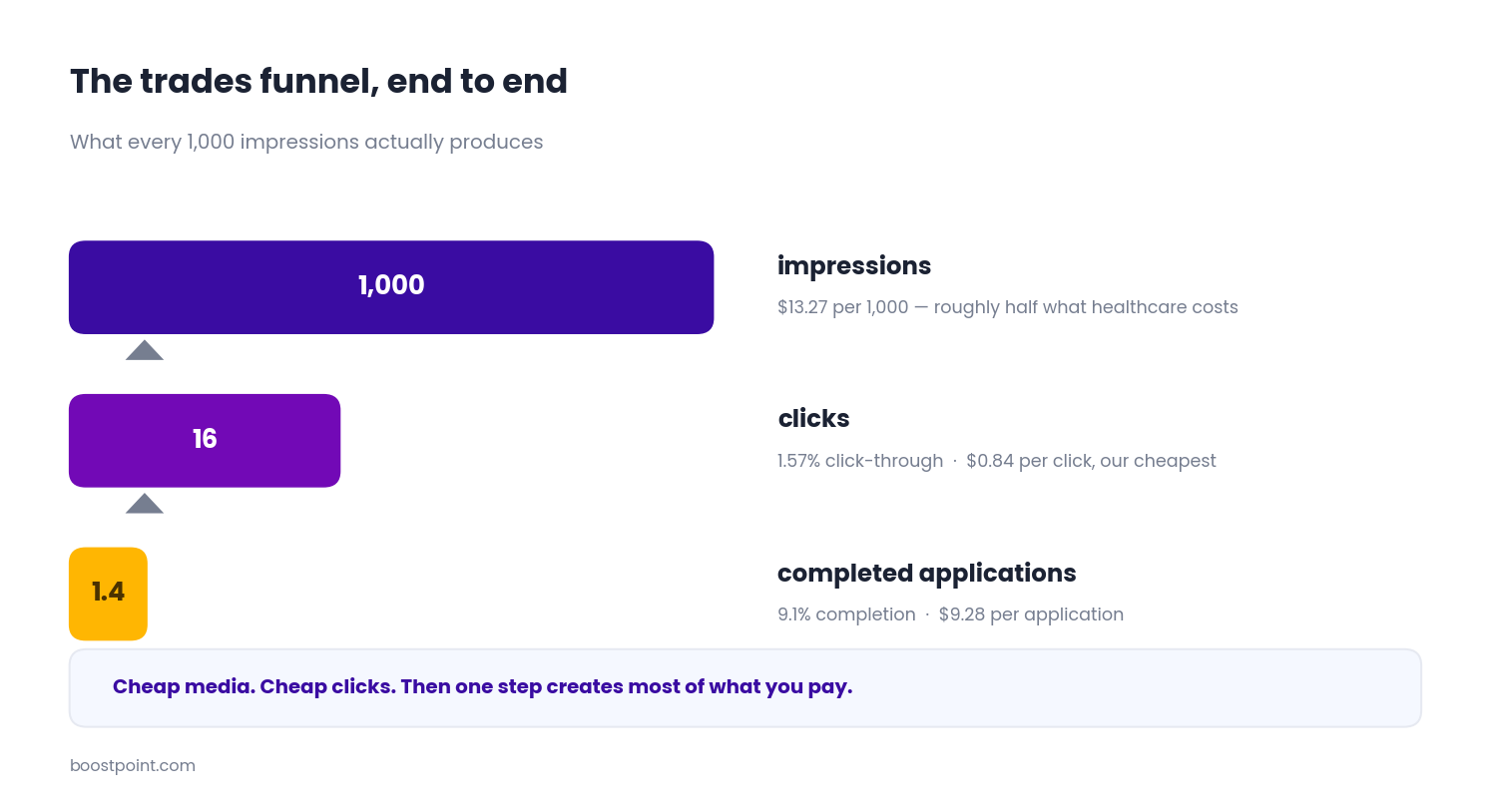
Every thousand impressions produces about 16 clicks and 1.4 completed applications.
Two of those three numbers are the best we see anywhere. Media in the trades costs roughly half what healthcare costs. Click-through at 1.57% beats healthcare's 1.27%. Tradespeople notice job ads and they tap them.
Then 91% of them don't finish the form. That single step is where nearly everything you pay per applicant gets created — and it's the part you control for free.
Why reaching tradespeople is cheap
The economics are favorable for a reason worth understanding, because it affects how you plan.
Nobody else is bidding for their attention. Advertising inventory is priced by auction. Consumer brands, retailers and B2B software compete hard for professionals in dense urban markets. Far fewer advertisers are trying to reach a pipefitter in a mid-sized metro on a Tuesday afternoon. Less competition, cheaper impressions.
That effect is strongest in exactly the markets where contractors struggle most — smaller cities and rural draw areas, where job boards produce almost nothing because nobody is actively searching that week.
And the ads land. A 1.57% click-through rate on a job ad is genuinely good. It suggests trades job ads aren't fighting for attention the way a consumer ad does — a crew member scrolling on a break has a reason to look at a hiring ad in his trade.
Who actually applies
Trades break a pattern that holds everywhere else in our data, and the exception is instructive.
| Age | Share of applicants | Cost per applicant |
|---|---|---|
| 18–24 | 5.4% | $9.42 |
| 25–34 | 19.6% | $8.47 |
| 35–44 | 27.0% | $8.29 |
| 45–54 | 22.8% | $9.25 |
| 55–64 | 17.8% | $10.04 |
| 65+ | 7.5% | $13.25 |
Source: 45 Boostpoint-managed field and trades campaigns across ten contractors and industrial service companies, 2025 through 2026, representing 2,590,544 impressions and 3,703 applications on Meta platforms.
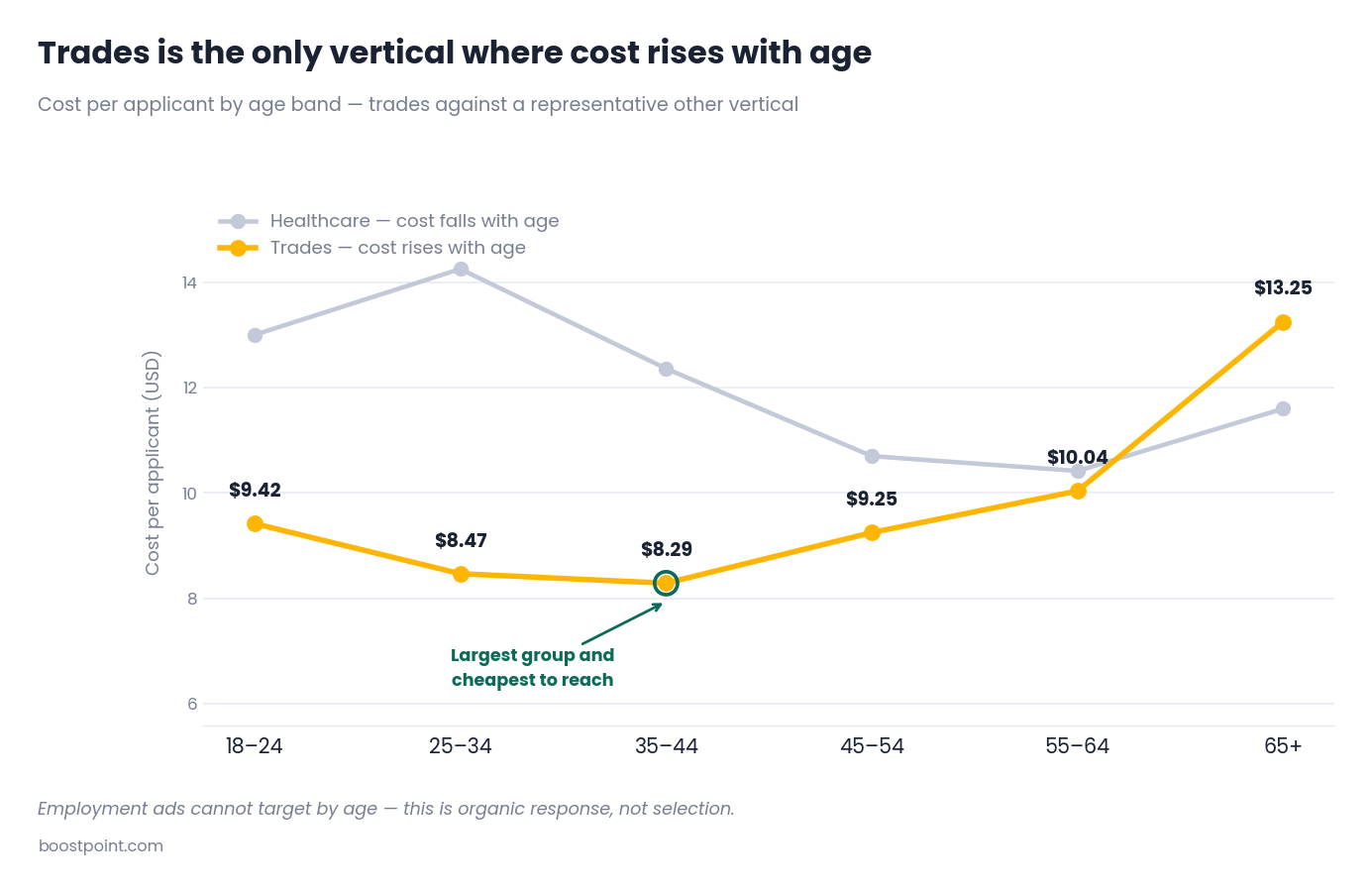
In every other industry we run, older applicants are the least expensive to acquire. In trades it's reversed. The 35–44 bracket is both the largest share of applicants and the cheapest, and cost climbs steadily from there — applicants over 65 cost about 60% more than applicants in their late thirties.
Roughly half of applicants fall between 35 and 54. That fits the work: trades roles are physically demanding, and the response curve reflects who is realistically in the market for them.
The mid-career worker you most want — experienced, still on the tools, likely to stay a decade — is also the one this channel reaches most efficiently.
We didn't select for any of this. Employment ads in the United States run under Meta's Special Ad Category, which removes age targeting entirely. Every advertiser operates under the same rules, so this is organic response rather than a targeting choice.
On gender: 84.9% of applicants were men. For contractors working to broaden their applicant base, the 15% that isn't arrives without any targeting effort.
What you can and can't target
This is the most misunderstood constraint in the category, and it's why self-managed campaigns tend to disappoint.
Special Ad Category removes detailed audience targeting for employment ads to prevent discrimination in hiring. No age targeting, no gender targeting, detailed interest and demographic options unavailable, and a minimum radius on location targeting.
So you cannot build an audience of "journeyman electricians with five years of commercial experience."
Qualification moves to two places instead:
- The creative and the offer. An ad stating the pay rate, the hours and where the work is does most of the sorting before anyone clicks.
- The application form. Knockout questions filter the rest, after the click and before your foreman.
Teams who don't know this spend weeks trying to narrow an audience they can't narrow, conclude the targeting is broken, and abandon the channel. The targeting isn't broken — it's constrained by design.
How to read your own numbers
Because cost per applicant is just cost per click divided by completion rate, the two halves of the funnel fail in visibly different ways.
If your click cost is high — well above a dollar — the ad or the offer is the problem. The creative isn't stopping the scroll, or the pay and hours aren't competitive for the market.
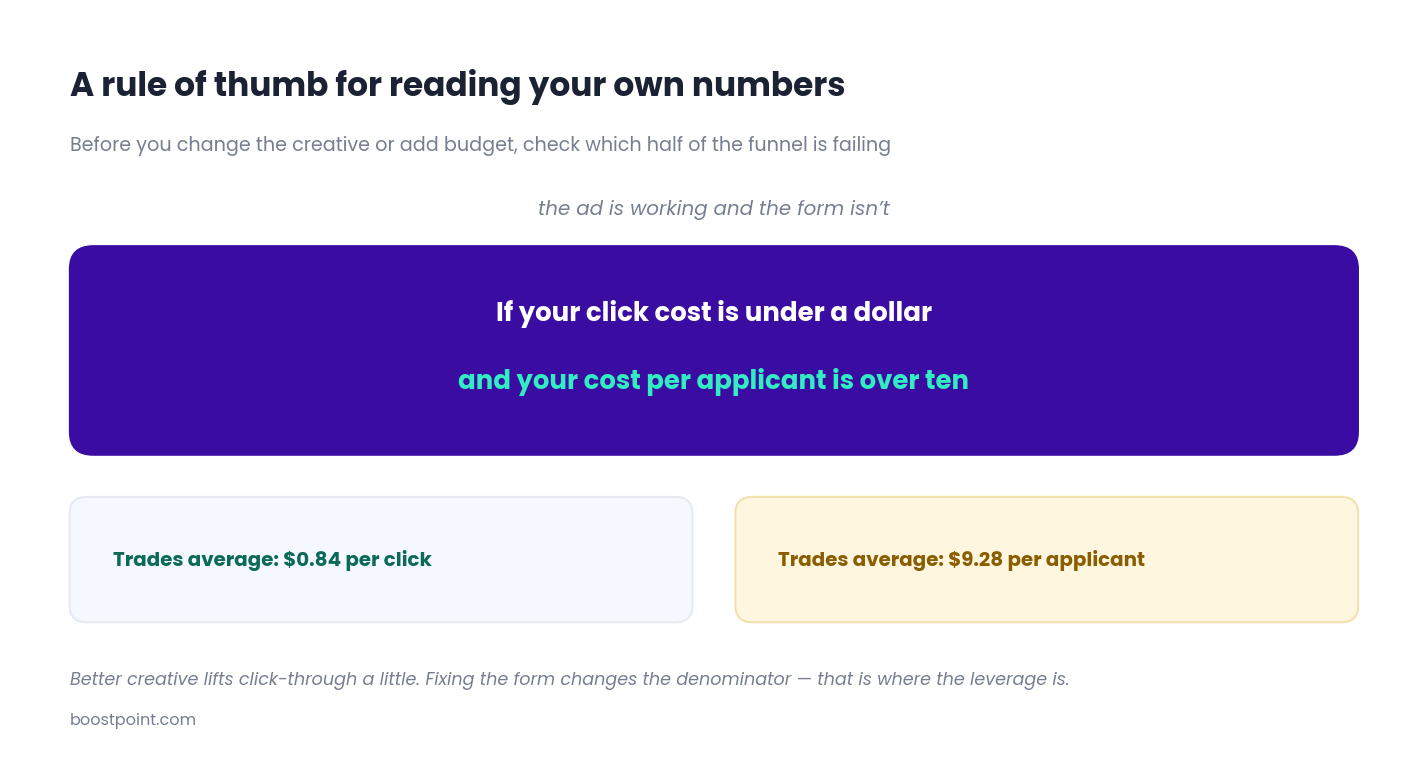
If your click cost is under a dollar and your cost per applicant is over ten, the ad is working and the form isn't. People are seeing the role, they're interested enough to tap, and then something between the tap and the submit button is losing them.
That second case is the common one in trades, and it's why the completion rate is the lever worth pulling first. Better creative lifts click-through a little. Fixing the form changes the denominator.
Practical setup
Creative
- Video over static. Short, vertical, shot on a phone is fine — footage of the actual crew, the equipment, the yard.
- Pay rate, hours and location in the first two lines. Tradespeople screen on those three before reading anything else.
- Refresh before fatigue. One ad running unchanged for months is the most common reason self-managed campaigns look good for three weeks and then flatten.
- Real jobsite footage beats stock, and tradespeople can tell the difference in two seconds. If you don't have any, creative can be built from the job description — it isn't a prerequisite.
Geography
Scope campaigns to a real draw area — one yard, one metro, or a new market you've just won work in. Because reach doesn't depend on local search volume, opening a market is a campaign setting rather than a supply problem.
Application and follow-up
- Three or four knockout questions, captured in-platform rather than redirecting to an ATS.
- No resume upload. Most tradespeople don't have one on their phone.
- Automated SMS on submission, then a human call the same day. Applicants apply to several contractors in one sitting.
What to measure
- Cost per click and completion rate separately. Watching only cost per applicant hides which half is failing.
- Time to first contact, in minutes. The second-largest lever after the form.
- Cost per applicant by market. Thin draw areas cost more — that's a siting and pay-band signal, not just a recruiting one.
- Show-up rate on day one. The trades metric that reveals whether your ad set accurate expectations about hours, travel and physical demands.
And give it three weeks. The first two are a learning period while the platform calibrates — judging on ten days of data leads to the wrong call.
Frequently asked questions
Does social media recruiting work for contractors?
Yes, and the media economics are unusually good — $13.27 per thousand impressions and $0.84 per click, the cheapest of any industry we advertise for, with a 1.57% click-through rate. The constraint is application completion at 9.1%, which is what pushes cost per applicant to $9.28.
How much does it cost to advertise construction jobs on Facebook?
In our 2025–2026 campaigns, $13.27 per thousand impressions, $0.84 per click and $9.28 per completed application. Most campaigns landed between $6 and $17 per applicant depending on trade, market and screening strictness.
Why is reaching tradespeople so cheap?
Advertising inventory is priced by auction, and far fewer advertisers compete for a tradesperson in a mid-sized market than for professionals in dense urban ones. Less competition means cheaper impressions — and the effect is strongest in exactly the markets where job boards produce least.
Can we target electricians or welders specifically?
Not in the audience. Employment ads run under Meta's Special Ad Category, which removes detailed targeting to prevent discrimination in hiring. Qualification happens through the ad creative — stating the trade, pay and hours — and through knockout questions on the application.
What age are trades applicants?
Roughly half are between 35 and 54, with 35–44 the largest single group at 27%. Trades is the one vertical we run where cost per applicant rises with age rather than falling — applicants over 65 cost about 60% more than those in their late thirties.
How do I tell whether my ads or my form is the problem?
Look at cost per click. If it's high, the creative or the offer is the issue. If it's under a dollar but your cost per applicant is over ten, the ad is working and the application is where you're losing people.
Do we need our own video?
It helps — real jobsite footage outperforms stock, and tradespeople can tell the difference immediately. But creative including video can be produced from your job description, so a content library isn't a prerequisite to launching.
How long before we see applicants?
Usually within days, though the first two weeks are a learning period while the platform calibrates. Judging performance on fewer than three weeks of data typically leads to the wrong conclusion.
See what it costs to fill your crews
Book a 30-minute call and we'll walk through the funnel for the trades, markets and shifts you're hiring for.
Book a Free DemoFigures come from 45 Boostpoint-managed field and trades campaigns across ten contractors and industrial service companies, 2025 through 2026, representing 2,590,544 impressions and 3,703 applications on Meta platforms. Costs are what advertisers paid for advertising only. Cross-vertical comparisons are drawn from Boostpoint campaigns in healthcare, manufacturing, agriculture and senior living over the same period. This is a sample of Boostpoint campaigns, not an industry-wide study.
Related: Skilled Trades Recruiting · Why 91% of Trades Applicants Never Finish Your Application · What It Costs to Recruit Skilled Trades Workers