
Electrician Recruiting: Why the Application Form Is the Shortage
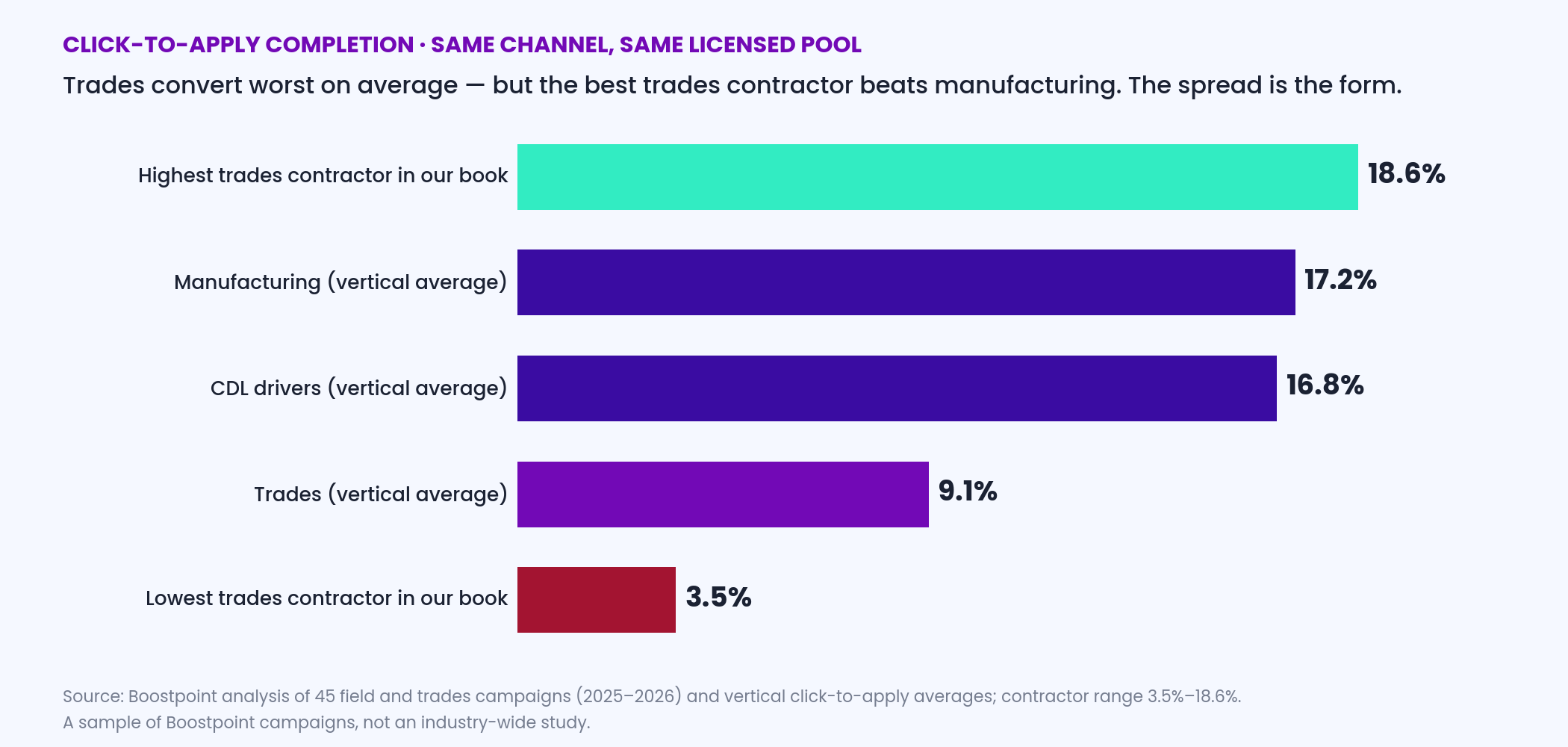
Electrician recruiting fails at the form, not the feed. In Boostpoint's trades campaigns, application completion ranges from 3.5% to 18.6% across contractors reaching the same licensed pool through the same channel — a five-fold spread that has nothing to do with the electrician shortage. Trades applicants click cheaply and finish rarely: 9.1% click-to-apply, the lowest of any vertical we run. Fix the form, name the pay and license, and skilled-trades campaigns run a $14.14 median cost per applicant.
A note on who's writing this
Boostpoint sells social recruitment advertising to electrical and mechanical contractors, so this page leans toward the channel we run and shows our own numbers, including the ones that are unflattering — trades applicants complete applications less often than any other group we advertise to. The advertising figures come from the skilled-trades campaigns in our 2026 Social Job Advertising Benchmark and from an earlier analysis of 45 field and trades campaigns; wages, employment, apprenticeship, and licensing facts are from the Bureau of Labor Statistics, O*NET, and the training organizations named where they appear. The wider trades context lives on our skilled trades recruiting pages. If you need the posting itself, our electrician job description is the template; this page is about getting licensed people to finish applying.
The five-fold spread nobody talks about
When contractors say "we can't find electricians," the sentence hides an assumption: that the people who saw the ad and didn't apply weren't there. Our data says most of them were there and clicked. Across the 45 field and trades campaigns we analyzed, 9.1% of people who clicked went on to complete an application — the lowest click-to-apply rate of any vertical we run, against 16.8% for CDL drivers and 17.2% for manufacturing. The click itself was the cheapest of any vertical, at $0.84. Electricians and their peers are easy to reach and hard to convert, which is the opposite of a sourcing problem.
The stronger evidence is the spread. Within the same book of trades contractors — same platform, same targeting rules, the same regional pool of licensed people — application completion ranged from 3.5% at one contractor to 18.6% at another. In residential home improvement, two companies running the same sales campaigns differed six-fold: one completed at 28.3% and paid $4.63 per applicant, the other at 4.3% and paid $27.77. Nothing about the labor market changed between those two employers. What changed was the application.
What a completion rate is worth
Cost per applicant is cost per click divided by the share of clickers who finish. That arithmetic is the whole page in one line, so here it is as a dial. The default click cost is the $0.84 our trades book averaged; the completion range is the one we measured. Move the completion slider and watch what the "shortage" costs.
Nothing is stored or sent — this runs in your browser. Cost per applicant = cost per click ÷ completion rate.
at your completion rate
the best contractor in our book
4 hires × 12 applicants per hire
Illustrative arithmetic from stated inputs, not a measured cost for your company. The 12-applicants-per-hire planning ratio is an assumption for licensed roles — replace it with your ATS ratio. Cost per applicant is not cost per hire.
Where to find electricians: the channels, graded honestly
There are about 818,700 electrician jobs in the United States, and BLS projects roughly 81,000 openings a year through 2034 — most of them from people retiring or changing occupations, not from growth, even though growth itself is 9%, "much faster than the average for all occupations." Almost all of those 818,700 people are employed today. That is the fact every channel below has to be read against: you are recruiting from a working pool, and most of it is not on a job board this week.
| Channel | Who it reaches | Best for | Third-party facts and source |
|---|---|---|---|
| Social feed advertising | Employed, licensed electricians who are not searching | Journeymen open to better pay, local work, or a truck | Skilled-trades campaigns: $14.14 median cost per applicant, 15% apply rate (Boostpoint 2026 benchmark) |
| IBEW / NECA apprenticeship (electrical training ALLIANCE) | Union apprentices and journeymen through local JATCs | Signatory contractors; long-term pipeline | "Trained over 350,000 apprentices to journeyman status"; at least one training center in each state (electrical training ALLIANCE) |
| IEC apprenticeship | Merit-shop apprentices and graduates | Non-union contractors building a bench | 70+ training locations; about four years, minimum 8,000 OJT hours and 576 classroom hours; DOL-registered (IEC) |
| Trade schools and community colleges | Pre-apprentices and helpers | Entry-level hiring you intend to train | BLS: most electricians learn through a 4–5 year apprenticeship with roughly 2,000 hours a year of paid on-the-job training |
| Employee referrals | Your crews' former coworkers | Retention; the highest-quality single source | Pay in installments (30/90/180 days); no third-party figure claimed |
| Indeed and job boards | Active searchers this week | Always-on free listings; unemployed or between-projects electricians | Small share of an employed pool; sponsored trade keywords are bid up in every tight market |
| Staffing agencies | Their bench, which is other contractors' turnover | Same-week coverage; short projects | Direct-hire fees 15–30% of first-year salary; construction temp markups 25–100% (see sources in note) |
One BLS number belongs next to the agency row. The May 2024 median wage for electricians employed by electrical contractors was $61,290; for electricians employed through employment services — the staffing industry — it was $57,490, a gap of $3,800. Agency electricians are, on average, the lower-paid electricians in the market, which is why they answer a direct ad that leads with a real hourly rate.
The case for an agency, made fairly
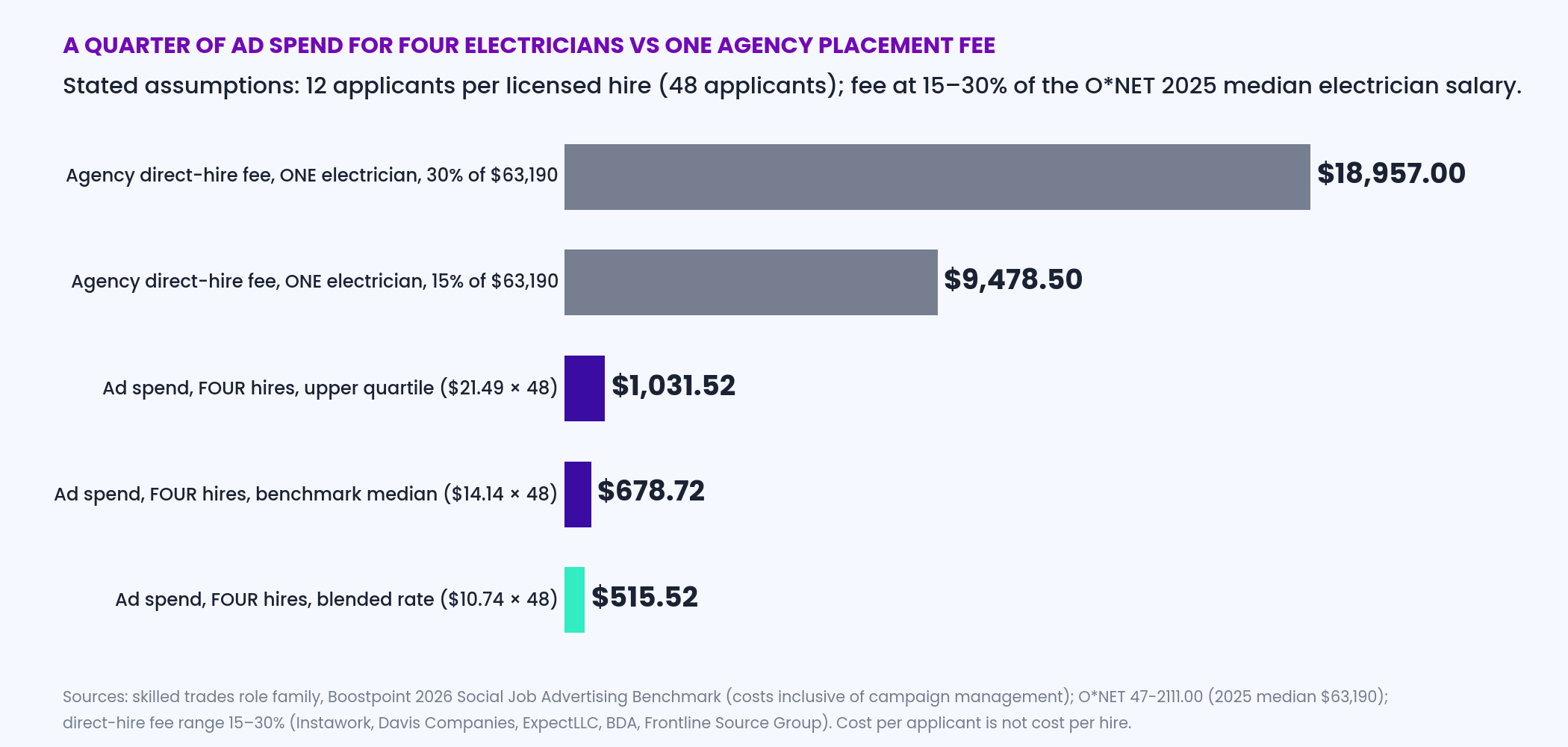
Electrical staffing agencies solve real problems. If a project starts Monday and you are two journeymen short, an agency's bench is the only same-week answer, and paying a 25–100% construction temp markup (Leapros, Hunter Recruiting) for eight weeks of coverage is a rational trade against liquidated damages. For a single licensed hire in a market you don't know, a direct-hire fee of 15–30% of first-year salary (Instawork, Davis Companies, ExpectLLC, BDA, Frontline Source Group) buys a screened shortlist without building anything. And agencies absorb the administrative work — payroll, workers' comp, license verification — that a small contractor may not want to own. On the O*NET 2025 median electrician salary of $63,190, that direct-hire fee works out to $9,478.50 to $18,957.00 for one placement, and for one urgent, one-time hire that can be money well spent.
Where the case weakens is the second hire, and the third. A contractor that needs four electricians a quarter is not buying a one-time shortlist; it is renting a pipeline at placement-fee prices. Everything the agency learns about your market stays with the agency. And the bench it draws from is disproportionately the $57,490 end of the wage table — the electricians most likely to leave you for the next direct offer. The comparison with worked math is on our staffing agency vs direct hiring for trades page; the rest of this page is the owned-pipeline version.
What electrician applicants cost on social — and what we won't claim
Electricians fall into the skilled trades role family in our 2026 benchmark. Across 35 campaigns, the median cost per applicant was $14.14, the middle half of campaigns ran $7.58–$21.49, the blended (volume-weighted) average was $10.74, 15% of clickers completed an application, and click-through rate was 1.07%. The wider Skilled Trades & Field Service sector — 335 campaigns including technicians and field service — ran an $11.89 median and an 18% apply rate.
| Metric | Skilled trades (role family) | Skilled Trades & Field Service (sector) | All 891 campaigns |
|---|---|---|---|
| Median cost per applicant | $14.14 | $11.89 | $13.88 |
| Middle 50% of campaigns | $7.58 – $21.49 | $6.50 – $24.89 | $6.48 – $29.74 |
| Blended (volume-weighted) average | $10.74 | $6.65 | $8.02 |
| Apply rate (click to completed application) | 15% | 18% | — |
| Click-through rate | 1.07% | — | — |
| Campaigns in sample | 35 | 335 | 891 |
What you will not find on this page is a cost per electrician applicant. Most of our trades applications sit in campaigns that advertise several trades at once — electricians alongside HVAC techs and plumbers — so any electrician-only figure we published would be a guess dressed as data. The published role-family figures are the honest ceiling and floor. Two things from the earlier 45-campaign trades analysis (a campaign-level cut with a different date range; the benchmark wins where they conflict) are worth knowing: the blended cost was $9.28 with most campaigns between $6 and $17, and trades is the only vertical where older applicants cost more — the 35–44 band was cheapest at $8.29 and the 65+ band cost $13.25 — so an ad that reads like it was written for a 25-year-old apprentice is leaving the cheapest applicants on the table.
The application form autopsy
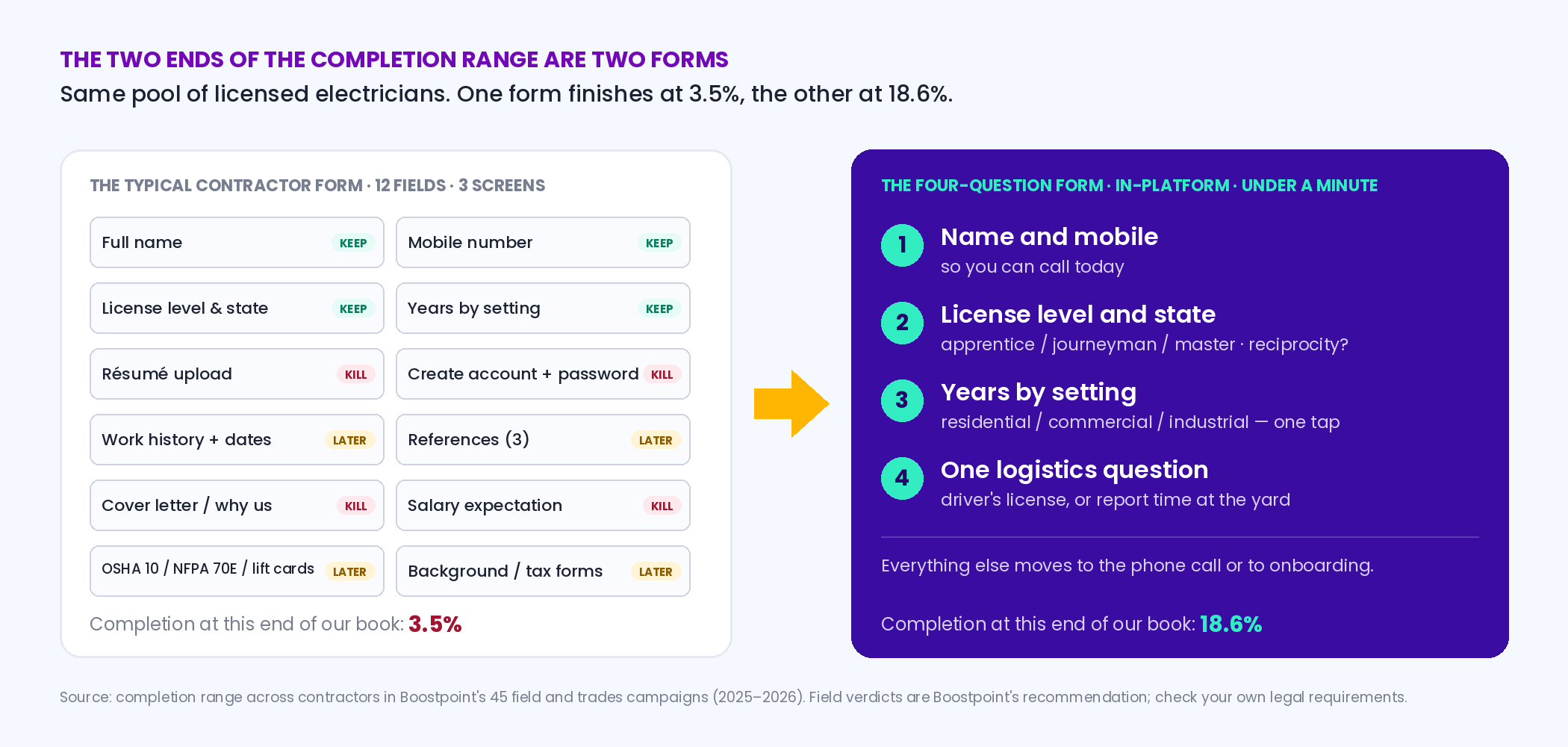
Here is the form that produces 3.5% completion, field by field, with the verdict on each. The logic is simple: a licensed electrician on a phone between jobs will give you sixty seconds. Every field that isn't needed to decide whether to call them costs you a share of the people you already paid to reach.
The playbook, in order of impact
- 1. Cut the form to four questions and keep it in-platform. This is the lever behind the five-fold spread; nothing else on this page comes close. Name and mobile, license level and state, years by setting, one logistics question. Benchmark-wide, what happens after the click explains 70% of cost variation.
- 2. Put the hourly rate, the setting, and the schedule in the first line. "Journeyman electricians · $36–$46/hr · commercial · 4×10s · local, home every night" answers what a working electrician asks before tapping. Hiding the rate does not protect it; it pays for clicks from people who will leave when they learn it.
- 3. Say "we'll help you get licensed here" if you can. Most states require a license, and reciprocity near state lines can widen the eligible pool. If your state honors another state's journeyman exam, say which ones in the ad.
- 4. Write for the 35–44 band, not the apprentice. The cheapest trades applicants in our data are mid-career. Lead with the work — the backlog, the projects, the crew, the truck — not a benefits list built for a first job.
- 5. Call the same day, with a time. A licensed electrician who applied to you applied to two other contractors on the same drive home. The first call with a start date and an interview slot wins, and it usually isn't the highest rate.
- 6. Run the apprenticeship channel in parallel, not instead. A JATC or IEC pipeline is the four-year answer; the ad is the four-week answer. Contractors that stay staffed run both, and use the second to feed the first. Our construction recruiting page covers the reach-side mechanics for crews that are already employed.
- 7. Treat the completion rate as your dashboard. Read it weekly, by campaign. When it drops, the ad, the rate, or the form changed — in that order of likelihood. When it sits under 5%, stop spending and fix the form first; more budget buys more abandoned applications.
The math for a contractor that needs four electricians
Say you need 4 electricians this quarter and plan on 12 applicants per licensed hire — a stated assumption for licensed roles; use your own ratio — so 48 applicants. At the skilled-trades benchmark median, 48 × $14.14 = $678.72. At the upper quartile, 48 × $21.49 = $1,031.52. At the blended rate, 48 × $10.74 = $515.52. Against that, a single direct-hire agency placement at 15–30% of the $63,190 median salary is $9,478.50 to $18,957.00 — for one electrician. The ad budget for the whole quarter, at the expensive end of our range, is about a tenth of one placement fee at the cheap end of theirs. That comparison holds even before the form is fixed; fixing it is what moves you from the $21.49 end of the range toward the $7.58 end.
The electrician shortage is real in the aggregate and mostly irrelevant to your form. Between 3.5% and 18.6% completion there is a five-fold difference in what every applicant costs, and it is decided by twelve fields you can delete this afternoon.
Once they are booking in, our electrician interview questions page covers what to ask and what to verify before the first day.
Frequently asked questions
How do you recruit electricians?
Reach the employed pool where it actually is — social feeds, referrals, and apprenticeship programs — then remove the reasons licensed people abandon applications: cut the form to four questions (name and mobile, license level and state, years by setting, one logistics question), keep it in-platform, put the hourly rate and setting in the first line, and call the same day with an interview time. In our trades campaigns, application completion ranged from 3.5% to 18.6% across contractors, and that spread, not the labor market, is what most contractors are paying for.
Where can I find licensed electricians?
Almost all of the roughly 818,700 electricians in the U.S. are employed, so the main sources are channels that reach working people: social feed advertising, employee referrals, and local apprenticeship pipelines — the IBEW/NECA electrical training ALLIANCE, which reports training more than 350,000 apprentices to journeyman status with at least one center in every state, and IEC, with more than 70 training locations. Job boards reach the small active slice; staffing agencies rent you their bench at 15–30% direct-hire fees or 25–100% temp markups.
Why don't electricians finish job applications?
Because the form asks for things a licensed electrician doesn't need to give you to get a phone call: a résumé upload, an account and password, employment history with dates, references, a cover letter, and a salary expectation — usually across three screens on a phone. Trades applicants completed applications at 9.1% in our earlier analysis, the lowest of any vertical, while clicking at the cheapest rate ($0.84). The best contractor in the same book completed at 18.6%, so the trade isn't the cause.
What does it cost to recruit an electrician?
We publish the skilled-trades figures, not an electrician-only number, because most of our trades campaigns advertise several trades at once. In the 2026 benchmark, skilled-trades campaigns ran a $14.14 median cost per applicant, a $7.58–$21.49 middle range, a $10.74 blended average, and a 15% apply rate. Cost per applicant is not cost per hire; at a stated planning ratio of 12 applicants per licensed hire, that is roughly $91 to $258 in ad spend per hire at the middle of our range, against a $9,478.50 to $18,957.00 agency placement fee on the median salary.
Should I use a staffing agency to hire electricians?
For same-week coverage on a project that is already short, or a single urgent hire in a market you don't know, yes — that is what a 25–100% temp markup or a 15–30% direct-hire fee buys. For recurring hiring it weakens: you are renting a pipeline at placement prices, the agency keeps what it learns about your market, and BLS data shows electricians in employment services earned a median of $57,490 in May 2024 against $61,290 at electrical contractors, which makes the agency bench the most likely to leave for a direct offer.
What should an electrician job ad say?
The decision facts in the first line: hourly rate or range, setting (residential, commercial, industrial), schedule, whether the work is local, the truck, and the license you require, including whether you accept reciprocity. "Journeyman electricians · $36–$46/hr · commercial · 4×10s · local, home every night · state license required · apply in 60 seconds" is a complete ad. Write it for the mid-career electrician — the 35–44 band was the cheapest in our trades data — and skip the benefits paragraph and the mission statement.
Should I hire apprentices or journeymen?
Both, on different clocks. A journeyman fills a seat in weeks and is the only answer to a backlog you have now; an apprentice is a four-to-five-year investment that BLS says involves roughly 2,000 hours a year of paid on-the-job training plus classroom instruction, through a registered program such as an IBEW/NECA JATC or an IEC chapter. Contractors that stay staffed run direct advertising for journeymen while feeding a registered apprenticeship in parallel, and use the journeymen they hire to train the apprentices they sponsor.
Is there an electrician shortage in 2026?
By the numbers, demand is strong: BLS projects electrician employment to grow 9% from 2024 to 2034, "much faster than the average for all occupations," with about 81,000 openings a year, most from retirements and occupation changes. But a national shortage is not the reason a specific contractor's campaign converts at 3.5% while another's converts at 18.6% on the same pool. For most contractors the practical shortage is self-inflicted — a form, a hidden rate, and a slow callback — and those are fixable this week.
See what your completion rate is costing you
We'll show you the skilled-trades campaigns closest to yours across 891 real campaigns — and the four-question form that moves contractors from the 3.5% end of the range to the 18.6% end.
Book a DemoAdvertising figures come from the skilled trades role family and the Skilled Trades & Field Service sector in the 2026 Social Job Advertising Benchmark — 891 campaigns and 1,334 campaign-months overall: role family $14.14 median cost per applicant, $7.58–$21.49 middle 50%, $10.74 blended (volume-weighted) average, 15% apply rate, 1.07% click-through rate, 35 campaigns; sector $11.89 median, $6.50–$24.89 middle 50%, $6.65 blended, 18% apply rate, 335 campaigns; benchmark-wide $13.88 median, $6.48–$29.74 middle 50%, $8.02 blended, and post-click conversion explaining 70% of cost variation. The 9.1% click-to-apply rate, $0.84 cost per click, $9.28 blended cost with a $6–$17 typical range, 3.5%–18.6% completion range across contractors, the residential home-improvement comparison (28.3% / $4.63 vs 4.3% / $27.77), the 35–44 ($8.29) and 65+ ($13.25) age figures, and the CDL (16.8%) and manufacturing (17.2%) click-to-apply comparisons come from an earlier campaign-level analysis of 45 field and trades campaigns with a different date range; where they conflict with the benchmark, the benchmark is canonical. No electrician-specific cost figure is published because most trades campaigns advertise several trades at once. The completion dial computes cost per applicant as cost per click divided by completion rate from whatever inputs you enter; its defaults ($0.84, 9.1%, 18.6%, 12 applicants per hire) are stated assumptions, and the $9.23 and $4.52 defaults are that arithmetic, not measured per-contractor costs. The four-hire example uses a stated 12-applicants-per-hire planning assumption to be replaced with your own ATS ratio ($678.72, $1,031.52, and $515.52 resolve exactly from 48 applicants at $14.14, $21.49, and $10.74; $9,478.50 and $18,957.00 are 15% and 30% of $63,190). Cost per applicant is not cost per hire; we do not track hires and publish no cost-per-hire figure. Third-party figures: electrician wages, employment, growth, openings, apprenticeship length and hours, licensing, and industry wages ($61,290 electrical contractors vs $57,490 employment services, May 2024) from the BLS Occupational Outlook Handbook, Electricians; the $30.38 / $63,190 2025 median from O*NET OnLine (47-2111.00); apprenticeship program facts from the electrical training ALLIANCE (About Us) and Independent Electrical Contractors (Apprenticeship); staffing fee ranges from Instawork, Davis Companies, ExpectLLC, BDA, and Frontline Source Group (direct hire, 15–30%) and Leapros and Hunter Recruiting (construction temp markups, 25–100%), as cited on our skilled trades recruiting cost page. Licensing rules vary by state and city; verify yours. This is a sample of Boostpoint campaigns, not an industry-wide study.