
How to Recruit Construction Workers Who Already Have a Job
Most advice on hiring construction workers is about growing the pipeline — apprenticeships, trade schools, upskilling. All worth doing, and none of it fills a crew this quarter. The people who can do the work already exist within thirty miles of your yard. The government data behind that claim, openings against actual hires month by month, is on our construction labor shortage page. They're employed, they're not searching, and in Boostpoint's 2025–2026 trades campaigns reaching them costs $0.84 a click.
Source: 45 Boostpoint-managed field and trades campaigns across ten contractors and industrial service companies, 2025 through 2026, representing 2,590,544 impressions and 3,703 applications on Meta platforms.
The advice everyone gives, and what it misses
Search for how to recruit construction workers and you'll get a consistent list: build an apprenticeship program, partner with trade schools, invest in upskilling, strengthen your employer brand, start a referral program. It's the standard answer across skilled trades recruiting advice.
None of that is wrong. Apprenticeships and trade school partnerships are how the industry replaces a retiring workforce, and any contractor planning past next year should be doing them.
But notice what that advice actually is: it's a strategy for creating tradespeople who don't exist yet. It pays off in two to five years. It does nothing for the foreman who is three people short on a job starting Monday.
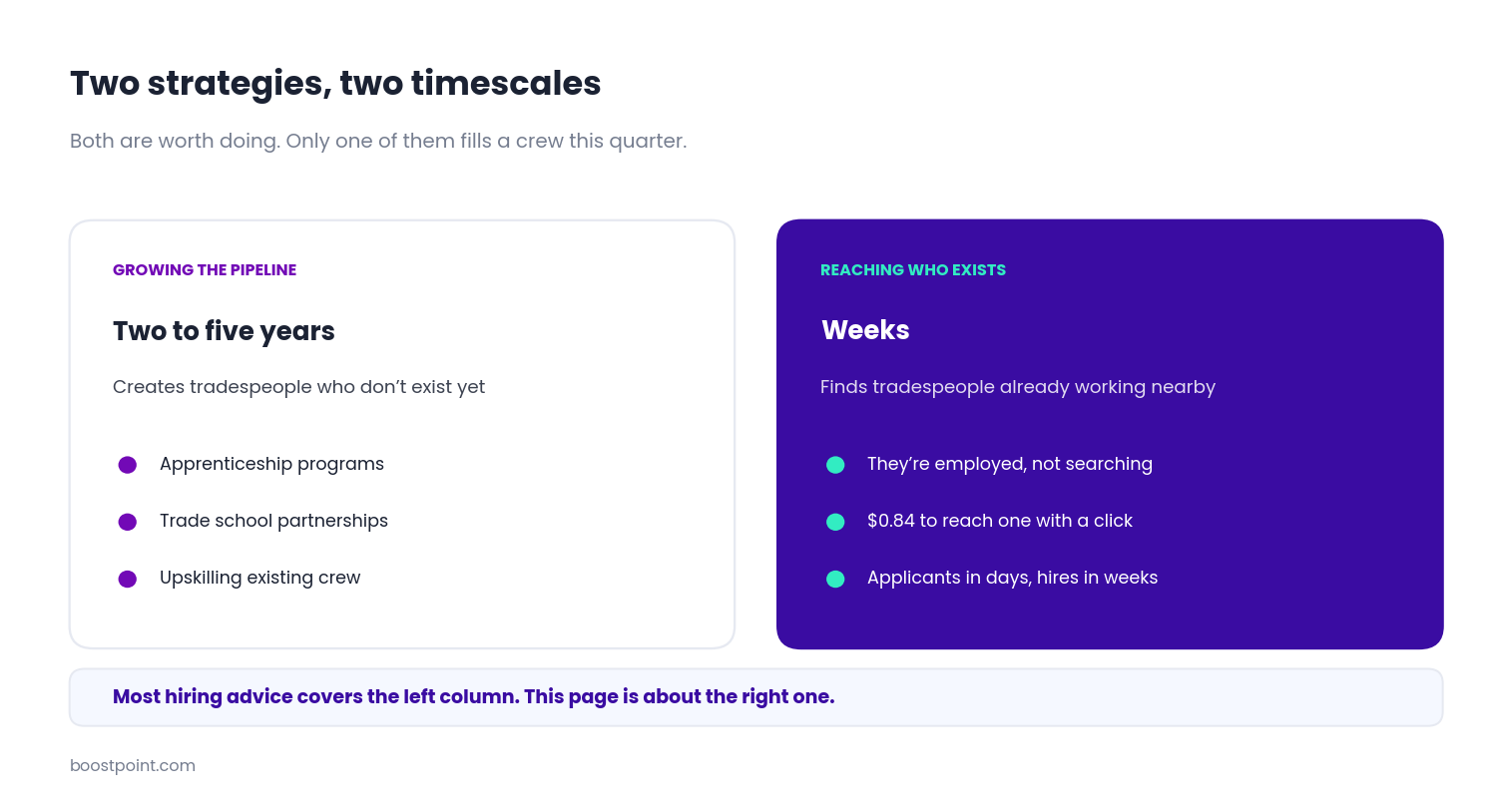
The short-term question is different, and almost nobody writes about it: how do you reach the qualified people who already exist in your market?
Because they do exist. In any reasonable draw area there are hundreds or thousands of people who can frame, weld, run equipment or pull wire. They're not unemployed. They're working for somebody else, twenty minutes away, and most of them would take a call about better pay, better hours or a shorter drive. On public works the pay side of that call is not yours to set, because a wage determination has already fixed it: prevailing wage by state lists the contract value that triggers one in each state.
They will never see your job posting, because they aren't looking for one.
Why job boards can't reach them
A job board is a search engine. It shows your posting to people who typed a trade into a search box this week.
That's a small and heavily contested group. Every contractor within thirty miles is bidding on the same handful of active searchers, which is why job board costs rise exactly when hiring gets hard — you aren't reaching more people, you're paying more for the same ones.
It also selects for the wrong thing. The tradespeople actively browsing job listings are disproportionately those between jobs. Some of them are excellent and between jobs for ordinary reasons. But the best crew member in your market is almost certainly employed and not searching, and a search-based channel has no way of showing him anything.
If you are going to post anyway, it is worth knowing which boards publish a price and which do not. Construction and skilled trades job boards grades eight of them on what each one is actually good at.
What reaching them actually costs
Here's the part that surprises most contractors. Reaching tradespeople who aren't looking is the cheapest advertising we do — the full breakdown is in what trades recruiting costs.
| Metric | Field & trades campaigns, 2025–26 |
|---|---|
| Cost per 1,000 impressions | $13.27 |
| Cost per click | $0.84 |
| Click-through rate | 1.57% |
| Cost per applicant | $9.28 |
| Typical campaign range | $6–$17 |
Source: 45 Boostpoint-managed field and trades campaigns across ten contractors and industrial service companies, 2025 through 2026, representing 2,590,544 impressions and 3,703 applications on Meta platforms.
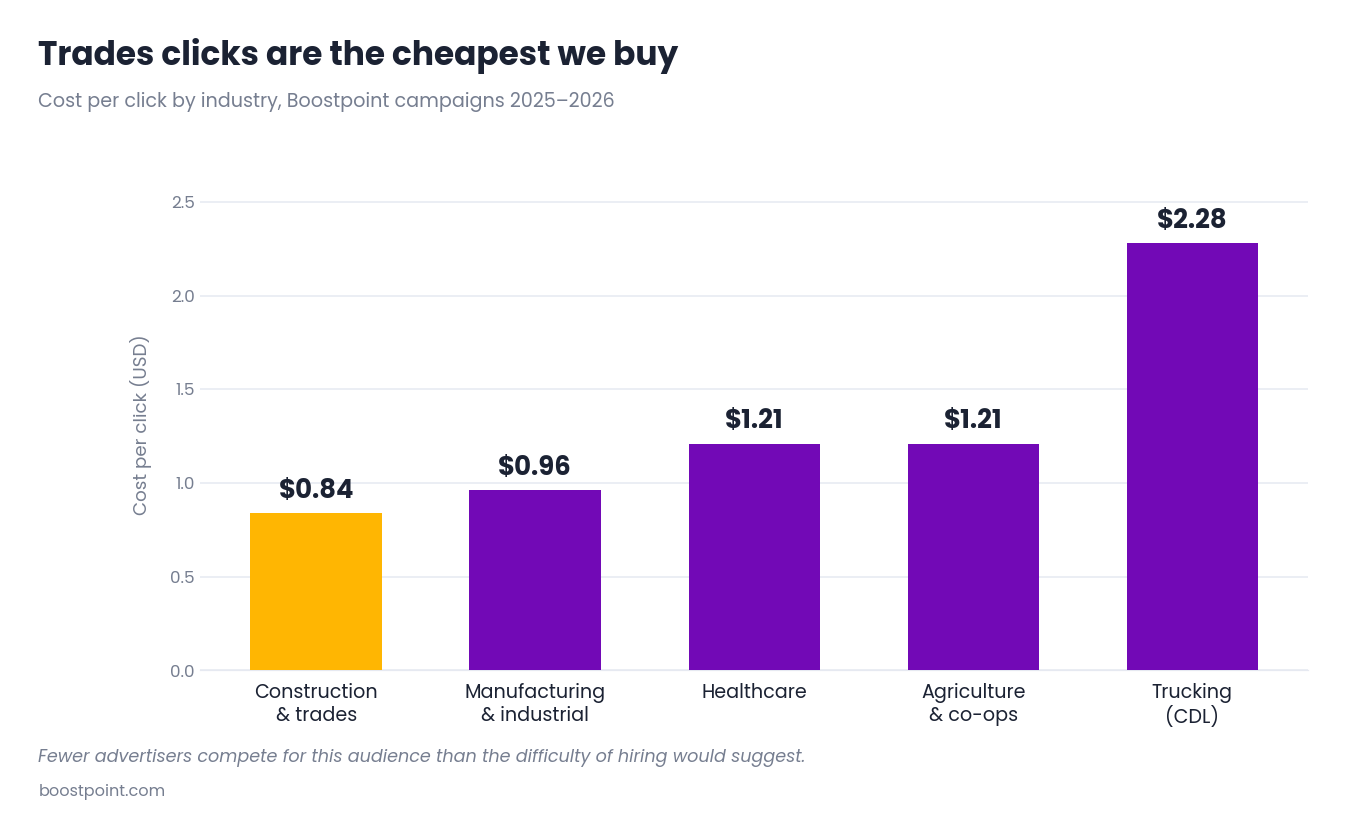
$0.84 per click is the lowest of any industry we advertise for — cheaper than healthcare, manufacturing or trucking. Fewer employers are competing for this audience's attention than the difficulty of hiring would suggest.
Put that next to the alternatives. A staffing agency placing one journeyman charges 15–30% of first-year salary. A job board listing runs a few hundred dollars and only shows your role to people already searching. Reaching a thousand working tradespeople who weren't looking costs about $13.
Who actually responds
Because employment ads can't target by age — Meta's Special Ad Category removes it to prevent discrimination in hiring — the response profile is organic. Which makes it worth reading closely, and it's covered stage by stage in how the funnel works.
| Age | Share of applicants | Cost per applicant |
|---|---|---|
| 18–24 | 5.4% | $9.42 |
| 25–34 | 19.6% | $8.47 |
| 35–44 | 27.0% | $8.29 |
| 45–54 | 22.8% | $9.25 |
| 55–64 | 17.8% | $10.04 |
| 65+ | 7.5% | $13.25 |
Source: 45 Boostpoint-managed field and trades campaigns across ten contractors and industrial service companies, 2025 through 2026, representing 2,590,544 impressions and 3,703 applications on Meta platforms.
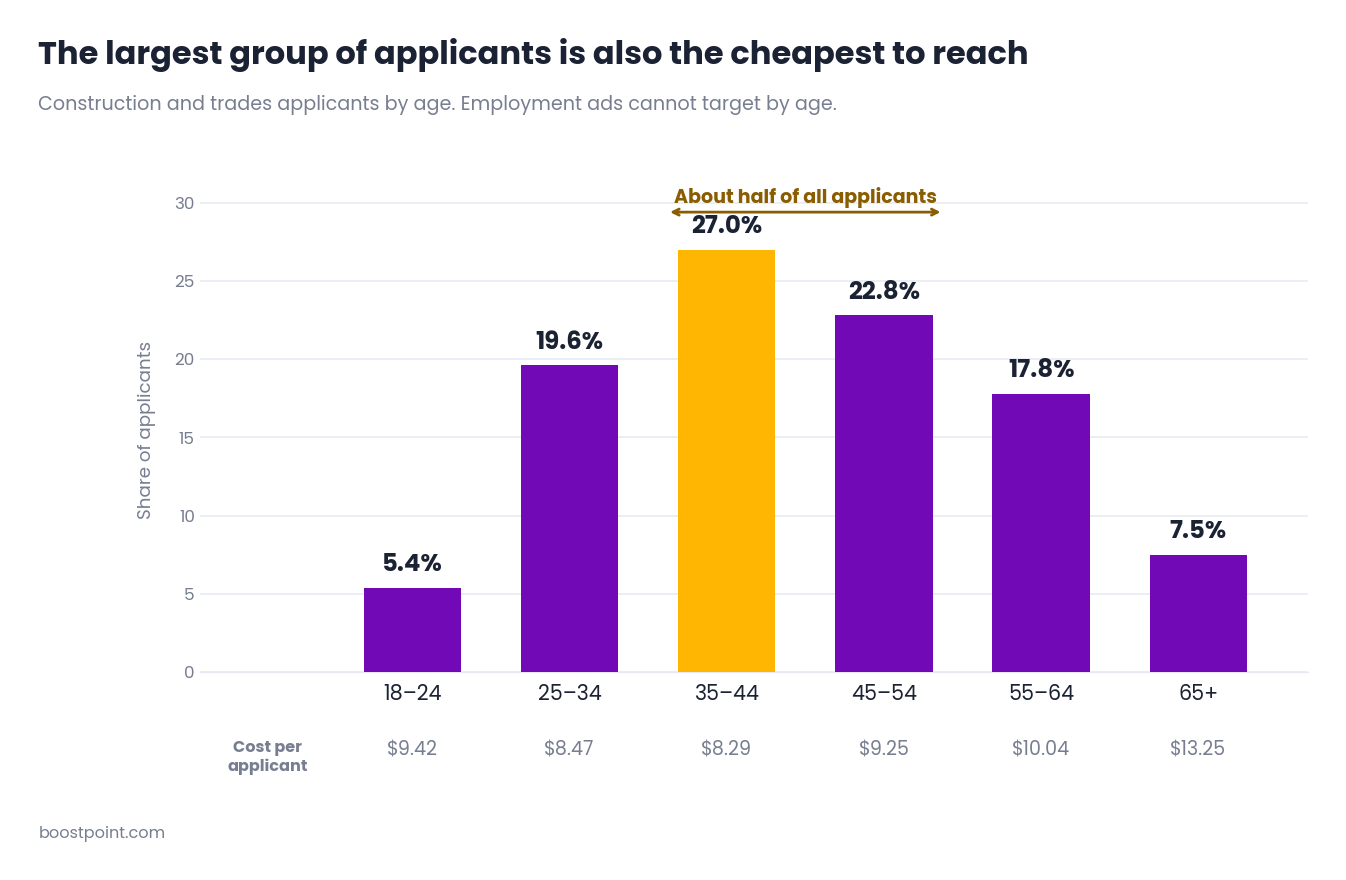
The 35–44 bracket is both the largest group of applicants and the cheapest to reach. About half of everyone who applied was between 35 and 54 — experienced tradespeople in the middle of their working lives.
This runs against the assumption that social advertising delivers a pile of teenagers with no experience. Applicants under 25 were 5.4% of the total, at above-average cost.
It's also the reverse of what we see everywhere else. In our trucking, healthcare, manufacturing and agriculture campaigns, older applicants are consistently the cheapest to acquire. Trades is the only vertical where cost climbs with age. That fits physically demanding work — and it means the mid-career hire most contractors want is also the one this channel reaches most efficiently.
What makes an employed tradesperson move
If your ad is aimed at someone who already has a job, it has a different job to do than a job posting. It isn't announcing an opening. It's making a case for switching.
In practice, three things move working tradespeople, and they should be the first two lines of the ad:
- Pay rate. A real number or a real range, not "competitive wages." Someone comparing your ad to a job he already has needs something to compare.
- Hours and start time. A 6am start, weekend work, or overtime expectations. Stating them costs you applicants and saves you day-three walk-offs.
- Where the work is. Yard location or service area. Tradespeople will drive — they need to know how far.
Everything else — benefits, culture, equipment, safety record — matters, and it matters after those three clear. Most contractor job ads lead with the company and bury the pay.
Video outperforms static images for this consistently, and it doesn't need to be produced. Phone footage of your actual crew, your actual equipment, an actual job site. Tradespeople can tell in two seconds whether the person who made the ad has ever been on a site.
The step where most contractors lose the money
Reaching working tradespeople is cheap. Capturing them is where it goes wrong.
Across trades campaigns, only 9.1% of people who click go on to complete an application — the lowest rate of any industry we run. Manufacturing runs 17.2%.
Cost per applicant is cost per click divided by completion rate, so the effect is direct:
| Application completion rate | Cost per applicant |
|---|---|
| 9.1% (current trades average) | $9.28 |
| 12% | $7.04 |
| 15% | $5.63 |
| 17.2% (manufacturing average) | $4.91 |
Source: 45 Boostpoint-managed field and trades campaigns across ten contractors and industrial service companies, 2025 through 2026, representing 2,590,544 impressions and 3,703 applications on Meta platforms.
Think about the context. The person you're trying to reach is at work — on a roof, in a bay, on a site — with one hand free and maybe two bars of signal. He has ninety seconds. Then your application asks for a resume upload, full employment history and a certification number he doesn't have memorized.
Ask three or four things that genuinely disqualify someone: what he can run, years in the trade, transportation and start-time availability, and any legally required certification as a yes or no. Verify the rest on the phone call, the way the industry always has.
And the step after that
An employed tradesperson who fills out an application on his lunch break has done something slightly risky. He's put his name in while working for somebody else, and his interest has a short half-life.
Call him that day. Preferably that hour.
Contractors who let applications sit for two days are calling people who have already reconsidered. If nobody at your company can work applications same-day, fix that before you spend anything on advertising — otherwise you're paying to generate candidates you'll never speak to.
Where this doesn't work
Honestly, because a channel that claims to solve everything solves nothing:
- One specialized hire. A superintendent, or a technician with an unusual certification combination, is a search problem. The qualified population is too small for broad reach. Use your network.
- A crew needed this week. Advertising produces applicants in days and hires in weeks. For Monday, that's a staffing agency.
- When your rate is below market. If the contractor across town pays three dollars more for the same work, advertising surfaces that faster and more expensively than doing nothing.
- Replacing pipeline development. Reaching employed tradespeople competes for the existing workforce. It doesn't grow it. Apprenticeships and trade school partnerships still matter — they're just a different timescale.
Where to find construction workers, channel by channel
Hiring construction workers means reaching people who already have a job, usually on a site within twenty miles of yours. That rules out most of the places employers look first. Here is what each channel actually reaches, and what it is good for.
| Channel | Who it reaches | Best for | The catch |
|---|---|---|---|
| Crew referrals | Employed tradespeople, through someone who vouches for them. | Every role, especially journeyman and lead. | Only works if the bonus is written down and paid visibly. An informal “ask around” produces nothing. |
| Social job ads | Employed workers who are not searching — the large majority. | Volume roles, helpers, and rebuilding a crew fast. | The ad has to carry pay, start date and location in the first line, or it is scrolled past. |
| Yard, truck and site signage | Anyone driving past your work. | Local laborers and helpers. | Needs a phone number, not a URL. Nobody types a web address from a moving vehicle. |
| Union halls and hiring halls | Certified, dispatch-ready trades. | Signatory contractors on scheduled work. | Only relevant if you are signatory, and availability follows the local’s book, not your schedule. |
| Apprenticeship and trade programs | People entering the trade. | Building a bench over years, not filling next Monday. | Requires someone on your crew willing to actually teach. |
| Supply houses and rental counters | Working tradespeople, in person, several times a week. | Small contractors hiring one or two. | Unscalable, and it depends entirely on the counter staff liking you. |
| Job boards | People actively between jobs. | Filling a gap quickly when you are not fussy. | The smallest and most picked-over slice of the market. |
| Staffing agencies | Whoever the agency has on the bench. | Genuine surge work with a known end date. | The markup, and that the good ones get placed permanently by someone else. |
The pattern worth noticing: the three channels that reach employed tradespeople — referrals, the feed, and signage on live work — are the three that most contractors treat as afterthoughts, while job boards and agencies get the budget. That is backwards for a trade where roughly nine in ten of the people you want are working today. For the same map trade by trade, from electricians and welders to HVAC and diesel technicians, see where to find skilled trades workers.
Where to find heavy equipment operators
Equipment operators are a smaller and better-paid pool than general construction labor. BLS Employment Projections 2025-35 count 489,500 operating engineers and other construction equipment operators, projected to reach 511,800 by 2035, with about 39,200 openings a year and a May 2025 median wage of $59,850. That is roughly a third of the openings construction laborers generate, spread across every contractor, quarry, utility and public works department in your area, so operators are almost always employed when you want them.
Where they come from, in rough order of yield:
- Other contractors' seats. An operator comparing your ad with the machine he runs today decides on the hourly rate, the equipment (name the machines: excavator, dozer, loader, grader), overtime and the season length. A social job ad within driving distance of your yard reaches him; a job board mostly does not.
- Your own laborers. The laborer who already spots for the excavator is your cheapest future operator. Say in your laborer ads that you train operators, and mean it.
- Union halls and apprenticeship programs. If you are signatory, the operating engineers' dispatch and apprenticeship programs are the direct route. If not, see apprenticeship recruiting for running your own.
- Equipment dealers and rental counters. Useful for one or two hires, not for a crew.
One legal point belongs in the requirements line rather than the wish list. Crane operators are different from other operators: under 29 CFR 1926.1427 the employer must ensure each operator of equipment covered by the construction cranes and derricks standard is trained, certified or licensed, and evaluated before operating it, with exceptions for derricks, sideboom cranes and equipment rated to lift 2,000 pounds or less. For excavators, dozers and loaders, ask for experience by machine as a multiple-choice question rather than a certificate. The equipment operator job description has the posting.
How to recruit laborers
Laborers are the opposite problem: a large pool, low barriers, and a hire that is won on speed. BLS counts 1,489,300 construction laborers in 2025, projected to reach 1,598,600 by 2035, with about 120,000 openings a year and a May 2025 median wage of $47,120. The typical entry requirement is no formal credential and short-term on-the-job training, which is why the laborer who shows up Monday is usually the one whose phone rang first.
- Lead with the hourly rate, the start time and the yard or site. A laborer compares those three things against whatever he is doing now: landscaping, warehouse work, a restaurant kitchen.
- Say "no experience needed" if it is true, and name what you will teach. It widens the pool more than any change of channel.
- Ask two questions: reliable transportation to the site, and availability for the start time. A driver's license only if the job needs one.
- Call the same day and book a site visit. The follow-up section above explains why the first call wins.
- Keep a bench. Laborer turnover means a standing campaign costs less than restarting one every time a crew loses two people.
For the cost reference, the Skilled trades family in Boostpoint's 2026 benchmark ran a $14.14 median cost per applicant with a 15% apply rate. The construction laborer job description covers the posting, and construction laborer interview questions covers the conversation.
Frequently asked questions
What's the best way to recruit construction workers?
Reach the ones who already have a job. The tradespeople actively browsing job boards are a small and heavily contested group; most qualified people in your market are employed and not searching. Paid social advertising reaches them without requiring search intent, at $0.84 per click in our 2025–26 campaigns.
How much does it cost to recruit a construction worker?
Across our field and trades campaigns, $9.28 per applicant, with most campaigns between $6 and $17. That's advertising only — it doesn't include screening, drug testing, onboarding or your team's time.
Do apprenticeship and trade school programs work?
Yes, on a two-to-five-year timescale. They grow the workforce, which is the long-term answer to a shrinking trade population. They don't fill a crew this quarter, which is a different problem requiring a different approach.
Does social media recruiting just reach inexperienced young workers?
Not in trades. Applicants aged 35 to 44 were the largest group and the cheapest to reach, and about half of all applicants were between 35 and 54. Under-25s were 5.4% of applications, at above-average cost.
What should a construction job ad say?
Pay rate, hours and location in the first two lines. Someone who already has a job needs something concrete to compare against. Benefits, equipment and culture matter after those three clear — most contractor ads reverse that order.
Why do we get clicks but no applications?
Almost always the application form. Trades campaigns average 9.1% completion, the lowest of any industry we run, because applicants are on job sites with poor signal and limited time. Resume uploads, employment history and certification numbers asked up front are the usual culprits.
How fast do we need to call applicants?
The same day, ideally the same hour. An employed tradesperson applying on a break has a short window of interest, and he's applying to more than one contractor. If nobody can work applications same-day, fix that before spending on advertising.
Should we use a staffing agency instead?
For a crew needed this week, or a single specialized search, yes. Agencies solve a capacity problem — they're supplying the recruiting function. Advertising solves a reach problem. Most contractors we work with use both, for different situations.
How do you hire construction workers?
Write one ad per role, with the hourly rate, hours and job location in the first two lines. Keep the application to two or three knockout questions such as trade, years and license, with no resume, and call every applicant the same day. Then invite them to the yard or a live site to meet the foreman before the offer. In Boostpoint's 2026 Social Job Advertising Benchmark, skilled trades campaigns ran a median $14.14 per applicant, with 15% of people who clicked finishing the application.
Where can I find construction workers to hire?
The three channels that reach employed tradespeople are crew referrals with a written, visibly paid bonus, social job ads that appear in a feed rather than on a job board, and signage on your trucks, yard and live sites. Union halls apply if you are signatory, apprenticeship programs build a bench over years rather than filling next Monday, and job boards and staffing agencies reach the small slice of the trade that is currently between jobs.
How do you hire construction workers fast?
Put the hourly rate, the start date and the job location in the first line of the ad, make applying take under two minutes with no resume, and call every applicant the same day. Construction candidates are usually deciding between two or three crews at once, and the deciding factor is which foreman called first. Nothing about the wording of the posting compensates for a three-day callback.
For the document itself, start from our construction laborer job description template, which also explains when to post the role as "general laborer" instead.
Should construction job ads separate skilled and unskilled roles?
Yes. Run a separate ad for each role. A journeyman electrician and a general laborer decide on different things: the licensed tradesperson compares rate, license tier and the work itself against a job they already have, while a laborer weighs hourly pay, start time and the drive. One combined "now hiring all positions" ad speaks to neither. Separate ads also let each form ask only the knockout questions that role needs, and our construction laborer job description template shows how to write the laborer version.
Where can I find heavy equipment operators?
Mostly at other employers. BLS counts 489,500 operating engineers and construction equipment operators with about 39,200 openings a year, so most qualified operators are working. Reach them with a social job ad around your yard that names the machines and the hourly rate, promote and train your own laborers, use union dispatch and apprenticeship programs if you are signatory, and ask equipment dealers and rental counters for referrals. Crane operators must also be certified or licensed and evaluated under 29 CFR 1926.1427.
How do you recruit laborers?
Put the hourly rate, start time and site in the first line, say no experience is needed if you train, ask only about transportation and availability, and call every applicant the same day with a site visit booked. Construction laborers are a large pool, with about 120,000 openings a year on BLS projections, and the typical entry requirement is no formal credential, so speed of contact decides most hires.
How do construction companies find workers?
Mostly through people they already know, then through channels that reach people they do not. The usual order is the recall list of workers laid off at the end of the last job or season, crew referrals with a bonus paid after a set number of weeks, union hiring halls and apprenticeship programs where the company works union, trade schools, staffing agencies for short-term labor, job boards for people actively searching, and social job ads on Facebook and Instagram that reach tradespeople who are working and not looking. Companies that fill crews fastest put the pay, the trade and the start date in the ad's first line, keep the application to a few questions on a phone, and call the same day. Channel-by-channel detail is on where to find skilled trades workers.
See what it costs to fill your crews
Book a 30-minute call and we'll walk through cost per applicant for the trades, markets and shifts you're hiring for.
Book a Free DemoFigures come from 45 Boostpoint-managed field and trades campaigns across ten contractors and industrial service companies, 2025 through 2026, representing 2,590,544 impressions and 3,703 applications on Meta platforms. Cross-industry comparisons are drawn from Boostpoint campaigns in manufacturing, healthcare, trucking and agriculture over the same period. Costs are what advertisers paid for advertising only. Staffing agency fee ranges are cited from published industry sources. This is a sample of Boostpoint campaigns, not an industry-wide study.
Related: Skilled Trades Recruiting · What It Costs to Recruit Skilled Trades Workers · Staffing Agency vs. Hiring Direct · Social Media Recruiting for Contractors