
Where to Find Skilled Trades Workers: The Active Pool, the Passive Pool, and the Map for Every Trade
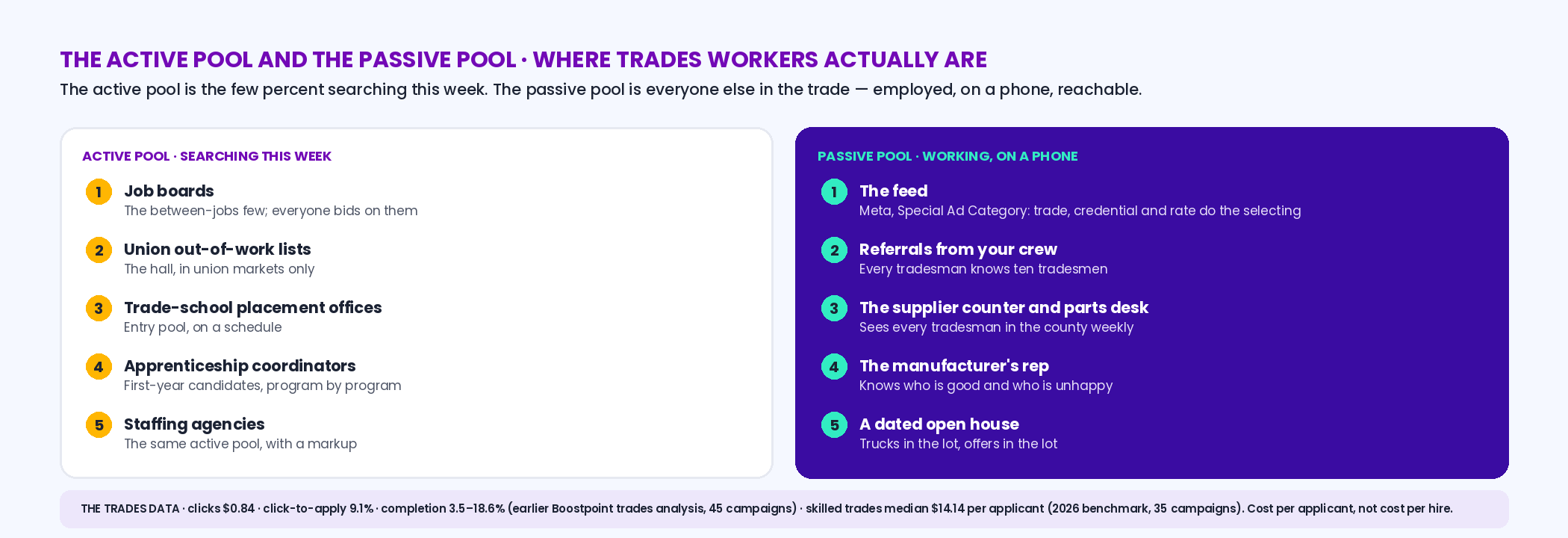
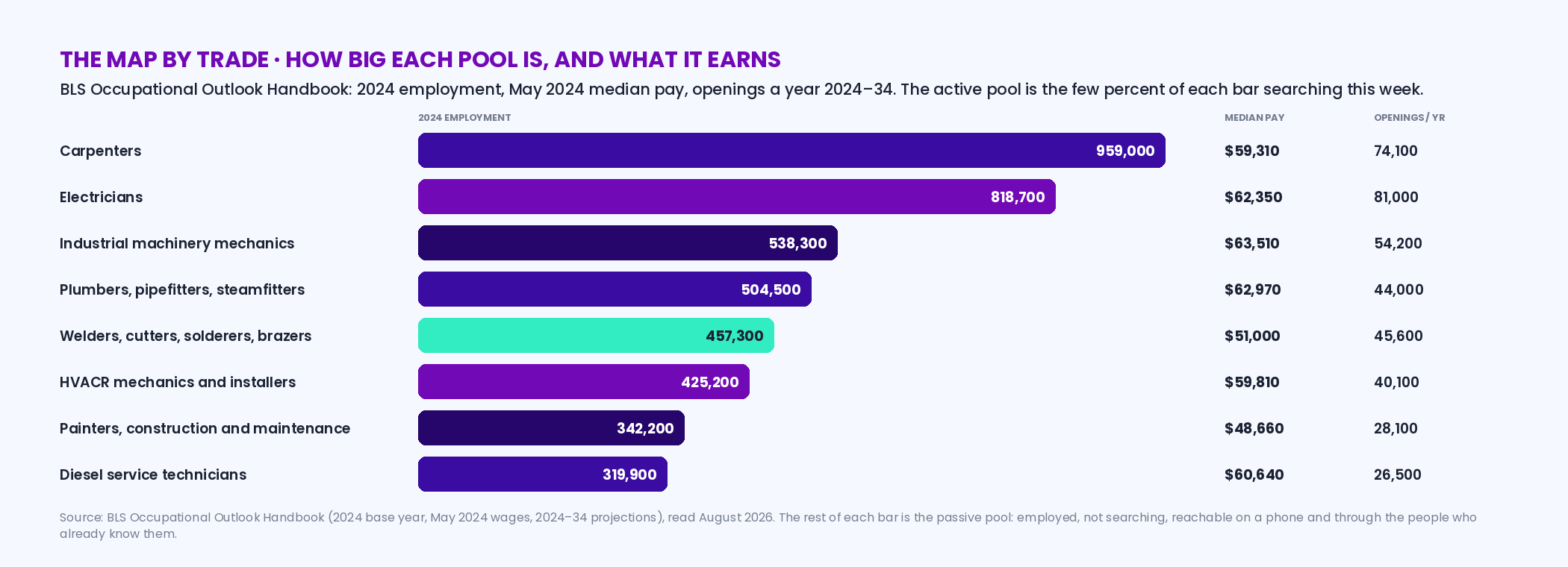
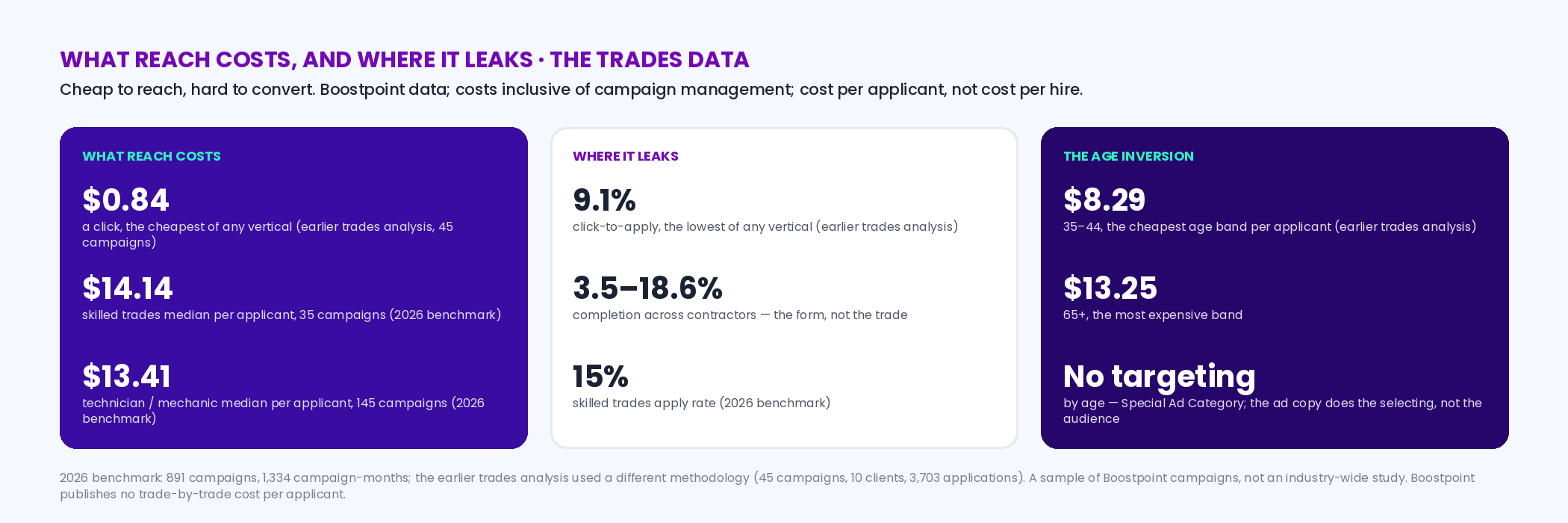
Every trade has two pools. The active pool — people searching this week — is where job boards, union halls and trade-school placement offices reach, and in the trades it is small, because the person you want is employed: BLS counts 818,700 electricians, 457,300 welders, 425,200 HVAC technicians and 319,900 diesel technicians, and ABC says construction needs 349,000 new workers in 2026. The passive pool — the same people on their phones at the supply counter, in the truck, on break — is where a social feed, a referral from a coworker and a dated open house reach, and it is where Boostpoint's data lives: trades clicks were the cheapest of any vertical at $0.84, click-to-apply the lowest at 9.1%, and completion ran 3.5% to 18.6% across contractors. This page is the map, trade by trade, and the index to the page for each.
Source: Boostpoint 2026 Social Job Advertising Benchmark — 891 Boostpoint-managed campaigns on Meta (1,334 campaign-months), 2026; costs are what advertisers paid for advertising only.
A note on who's writing this
Boostpoint reaches the passive pool for a living — social media job ads for contractors, shops and plants — so the passive half of this map is what we sell and the active half is what we don't. We've tried to describe both honestly: a union hall or a trade-school placement office is the right source for some trades in some markets, and this page says so. We publish no role-by-role cost for the trades and won't estimate one; 69% of applications in our trades data sit in campaigns whose names don't identify the role, so every trade on this page shares the same two labeled rows from the benchmark. No contractor is named. Every figure of ours is a cost per applicant, never a cost per hire.
Active and passive: the frame that decides where you look
An active candidate is searching: he has a résumé, or at least a job-board profile, and he reads postings. A passive candidate is working: he has a phone, a truck and an opinion about his current employer, and he reads the feed. Job boards, union out-of-work lists, trade-school placement offices, apprenticeship program coordinators and staffing agencies reach the first pool; they are indispensable for some trades — a union electrician in a union market comes through the hall, a first-year apprentice through the program, a new welder through the school — and they are all fishing the same small pond, which is why the "no applicants" complaint is usually a job-board complaint. Social feeds, referrals from your own crew, the supplier counter and the parts desk, the manufacturer's rep, and a dated open house reach the second pool, which is the whole trade minus the few percent searching this week. Our trades data describes the passive pool's economics: in the earlier campaign-level analysis, 45 field campaigns for 10 contractors produced 3,703 applications at a blended $9.28, with the cheapest clicks of any vertical at $0.84 and the lowest click-to-apply at 9.1% — cheap to reach, hard to convert, and the conversion gap between contractors (3.5% to 18.6% completion) sat in the form, not the trade. In the 2026 benchmark the skilled trades row ran a median $14.14 per applicant with a 15% apply rate across 35 campaigns, technicians and mechanics $13.41 with 16% across 145, and the Skilled Trades & Field Service sector $11.89 across 335. One more finding shapes the passive ad: trades is the only vertical where older applicants cost more — 35–44 was the cheapest band at $8.29 and 65+ the most expensive at $13.25 — with no age targeting possible or used, and the ad reaches the experienced tradesman through what it names, not who it's shown to.
The map, trade by trade
Each row below is where the pool actually is for one trade — the active sources that matter for it, the passive sources that matter more, the credential that decides the ad's first line — and links to the page that goes deep. The BLS figures are the national pool; your county is a fraction of them.
| Trade | BLS pool · median · openings a year | Active pool (searching) | Passive pool (working) | The page |
|---|---|---|---|---|
| Electricians | 818,700 · $62,350 · 81,000; most states license; about one-fifth over 55 (ABC) | Union hall in union markets; apprenticeship program; board postings for the few searching | The supply house counter; the feed with the license class and van in the first line; referrals | Electrician recruiting |
| Welders | 457,300 · $51,000 · 45,600; some employers require certification | Welding schools and community college programs; boards | The feed with process, position and rate; the test plate at an open house; referrals from the shop | Welder recruiting |
| Diesel technicians | 319,900 · $60,640 · 26,500; industry certification may be required | Diesel programs; dealer training pipelines; boards | The parts desk; the feed with equipment and tool allowance; a unit in the bay at an open house | Diesel mechanic recruiting |
| HVAC technicians | 425,200 · $59,810 · 40,100; EPA Section 608 for refrigerant handling | HVACR programs; distributor training; boards | The distributor counter; the feed with the certification and the truck; referrals | HVAC technician recruiting |
| Plumbers | 504,500 · $62,970 · 44,000 (with pipefitters and steamfitters); most states license | Union hall; apprenticeship program; boards | The supply house; the feed with license and service-vs-new-construction; referrals | Plumber recruiting |
| Carpenters and concrete crews | 959,000 carpenters · $59,310 · 74,100; 27% self-employed; 206,700 cement masons · $54,660 | Boards for the lead; the lumber yard's bulletin board, still | The lead brings the crew; the laborer ad for the rest; the yard open house | Carpenter and concrete crew hiring |
| Painters | 342,200 · $48,660 · 28,100; 34% self-employed | Boards; paint-store bulletin boards | The paint store counter; the feed with the rate and interior/exterior; referrals | How to hire painters |
| Maintenance technicians | 538,300 industrial machinery mechanics and millwrights · $63,510 · 54,200 | Industrial maintenance programs; boards | Other plants' floors; equipment vendors' field techs; the feed with two crafts named | Maintenance technician recruiting |
| Installers and specialty technicians | Small pools: telecom 268,500 · solar 28,600 · fire sprinkler inside pipefitters; NICET for fire alarm | Program coordinators; NICET's own listings for the credentialed few | The feed with the credential clock in the entry ad; the distributor; referrals | Installer and specialty technician recruiting |
| Laborers, helpers, grounds crews | 1,649,100 laborers and helpers · $46,050 · 149,400; 1,296,400 grounds · $18.50/hr · 171,600 | Boards; day-labor halls; high-school programs | Warehouses and restaurants, on a phone; the no-experience ad; the crew lead's referrals | Landscaping and grounds crews · Construction workers |
Interactive
Trade finder — pick a trade and see the active sources, the passive sources, the credential in the first line, and the page
Nothing is stored or sent — this runs in your browser. BLS national pools; sources are Boostpoint's practice, and which ones matter in your market is yours to judge.
BLS Occupational Outlook Handbook, May 2024 wages and 2024–34 projections; ABC, January 15, 2026. Sources and ad lines are Boostpoint practice, not measured results; Boostpoint publishes no trade-by-trade cost per applicant. Cost per applicant is not cost per hire.
The passive source that costs nothing: your own crew
Every tradesman knows ten tradesmen, and the one source that reaches the passive pool with a warm introduction is the crew you already have. A referral bonus paid at ninety days — for a hire who lasts, not a name on a form — costs nothing until it works, and it turns each technician into a recruiter for the two or three people he'd want beside him. The planner below runs the arithmetic on your headcount, your referral rate and the bonus you set; what it produces is hires and bonus spend, not a cost per hire, which we don't publish. Where referrals run out — a new market, a second shift, a trade the crew doesn't know — the feed picks up: an ad in Meta's Special Ad Category with no age, gender or ZIP targeting (the rules), so the trade, the credential and the rate in the first line do the selecting. And where you need the passive pool in a room at once, a dated open house with the trucks in the lot is the event-driven structure that ran a median $8.02 per applicant across 78 campaigns in the benchmark; the mechanics are on open house hiring events.
Interactive
Referral planner — what your own crew produces in a year, and what the bonus costs when it works
Nothing is stored or sent — this runs in your browser. Your headcount, your rates, your bonus; hires and bonus spend, not a cost per hire.
Arithmetic on your inputs. The bonus is a number you set and pay only when a referral lasts; it is not a cost per hire and is not compared to any Boostpoint figure. Boostpoint publishes no referral statistic and no cost per hire.
Every trades page on this site
The pages below are the deep versions of the map — one per trade or problem, each with its own data, its own ad and its own tools.
By trade
By problem
The active pool is the few percent searching this week, and every board is fishing it. The passive pool is the trade — on a phone at the supply counter, one referral away from your crew — and the page for each trade says how to reach it.
Frequently asked questions
Where do you find welders?
Actively, at welding schools and community college programs and on job boards; passively — which is most of the trade — in the shop next door, on a phone in the feed with the process, position and rate in the first line, through referrals from your own welders, and at a dated open house with a test plate. BLS counts 457,300 welders with about 45,600 openings a year. The full playbook is on the welder recruiting page.
Where do you find electricians?
In a union market, at the hall; everywhere, at the supply house counter, through the apprenticeship program, by referral, and in the feed with the license class and the van named in the first line. BLS counts 818,700 electricians with about 81,000 openings a year, most states license them, and ABC says about one-fifth are over 55. The electrician recruiting page has the ad, the form and the data.
Where do you find diesel mechanics?
At the parts desk, in dealer training pipelines and diesel programs, by referral, and in the feed with the equipment and the tool allowance in the first line; a unit in the bay at an open house is the interview. BLS counts 319,900 diesel service technicians and mechanics with about 26,500 openings a year. The diesel mechanic recruiting page covers the rest.
What is the difference between active and passive candidates in the trades?
Active candidates are searching — a résumé, a board profile, reading postings — and in the trades they are a few percent of the pool, because the rest are employed. Passive candidates are working, with a phone and an opinion about their current employer; they are reached by social feeds, referrals, the supply counter and events, not by postings. Most "no applicants" complaints are job-board complaints about a pool that was never on the board.
Are job boards worth it for skilled trades?
For the active few, and for some trades in some markets, yes — a new graduate, a tradesman between jobs, a union member on the out-of-work list. For the employed majority, no posting reaches them. Our trades data is about the passive pool: clicks at $0.84, click-to-apply 9.1%, completion 3.5% to 18.6% across contractors — cheap to reach, and converted or lost by the form.
What does it cost to reach skilled trades workers?
We publish no trade-by-trade figure — 69% of applications in our trades data sit in campaigns whose names don't identify the role. The 2026 benchmark's skilled trades row ran a median $14.14 per applicant (15% apply rate, 35 campaigns), technicians and mechanics $13.41 (16%, 145), and the sector $11.89 across 335; the earlier analysis blended $9.28. Cost per applicant is not cost per hire.
How do you get referrals from tradespeople?
Pay a bonus at ninety days for a referral who lasts, say so out loud, and make it easy — a text to the crew with the ad and the bonus, not a form. Every tradesman knows ten tradesmen; the planner on this page shows what a crew produces at your rates. It costs nothing until it works, and it reaches the passive pool with a warm introduction no ad can match.
Where do you find tradespeople for a new market?
Where the crew's referrals don't reach: the feed, with the trade, the credential and the rate in the first line and city-level location under Meta's Special Ad Category; the supply houses and distributors in that market; and a dated open house with the trucks in the lot, the event-driven structure that ran a median $8.02 per applicant across 78 campaigns in our benchmark.
Trade communities online are worth reading even when they are not worth posting in, and the honest arithmetic on how many people they actually reach is on Reddit recruiting.
Reach the passive pool for your trade
We'll write the first line for the trade and the credential, run it where working tradespeople scroll, put a three-question form behind it, and show you the contractor and shop campaigns closest to yours.
Book a Demo



Boostpoint figures come from the 2026 Social Job Advertising Benchmark — 891 campaigns and 1,334 campaign-months: skilled trades median cost per applicant $14.14, middle 50% $7.58–$21.49, 15% apply rate, 35 campaigns; technician / mechanic $13.41, 16%, 145; Skilled Trades & Field Service sector $11.89, 335 campaigns; event-driven $8.02, 21%, 78 campaigns. Earlier campaign-level trades analysis (different methodology): 45 field campaigns, 10 clients, 3,703 applications, blended $9.28, CPC $0.84, click-to-apply 9.1%, application completion 3.5% to 18.6% across contractors, age bands 35–44 $8.29 and 65+ $13.25 with no age targeting. No trade-by-trade figure is published, because 69% of trades applications are in campaigns whose names don't identify the role; no seasonality claim is made. Third-party figures — BLS Occupational Outlook Handbook (May 2024 wages, 2024–34 projections) for each trade named; ABC (January 15, 2026) — are theirs and attributed in place; licensing is set by states and localities and this page is not legal advice. No customer is named. The finder and planner are Boostpoint practice and arithmetic on your inputs, not measured results. Cost per applicant is not cost per hire; we do not track hires and publish no cost-per-hire figure. A sample of Boostpoint campaigns, not an industry-wide study.