
Blue Collar Hiring: Sourcing Strategies, Benchmarks, and What Actually Works
Blue collar recruiting works best when the job reaches workers who already have one: skilled tradespeople, drivers and operators are mostly employed and rarely browsing job boards. In Boostpoint's 2026 Social Job Advertising Benchmark of 891 campaigns, warehouse and production roles ran a median $9.83 per applicant. Targeted recruitment ads on Facebook and Instagram let employers reach those passive frontline workers directly, in the hiring radius that matters.
Source: Boostpoint 2026 Social Job Advertising Benchmark — 891 Boostpoint-managed campaigns on Meta (1,334 campaign-months), 2026; costs are what advertisers paid for advertising only.
A note on who's writing this
Most guides on blue collar hiring and hourly recruitment strategies are written by generalist HR blogs or massive job board platforms. Their advice typically revolves around writing a "catchy job description" or buying more sponsored clicks on their own saturated platforms.
Boostpoint is a recruitment advertising platform. We build the software that helps talent acquisition teams across manufacturing, trucking, and healthcare generate their own direct applicants through targeted social media campaigns.
We aren't here to offer generic HR advice. We are providing the exact 2026 financial benchmarks and recruitment mechanics required to get qualified deskless workers through your doors.
The reality of blue collar recruitment
If you are struggling with blue collar hiring, you are not simply experiencing a local geographic issue. You are fighting a macroeconomic skills shortage.
The U.S. Bureau of Labor Statistics reported roughly 439,000 open manufacturing positions in early 2026, against a stable workforce of 12.6 million. The turnover rate is high, and job openings remain elevated even without massive sector growth.
The critical takeaway for HR leaders is this: You are not competing for general headcount; you are competing for specific skills. Whether you need CNC machinists, CDL drivers, or maintenance technicians, the people possessing those skills are currently employed. They are not actively looking for work, which means your job board postings are invisible to them.
Why traditional job boards fail hourly workers
The traditional blue collar recruiting strategy — posting a job on Indeed and waiting — is broken.
- Job boards run on active search intent. To find your job, a candidate has to actively decide to leave their current employer, open a job board, and search. Great workers rarely do this.
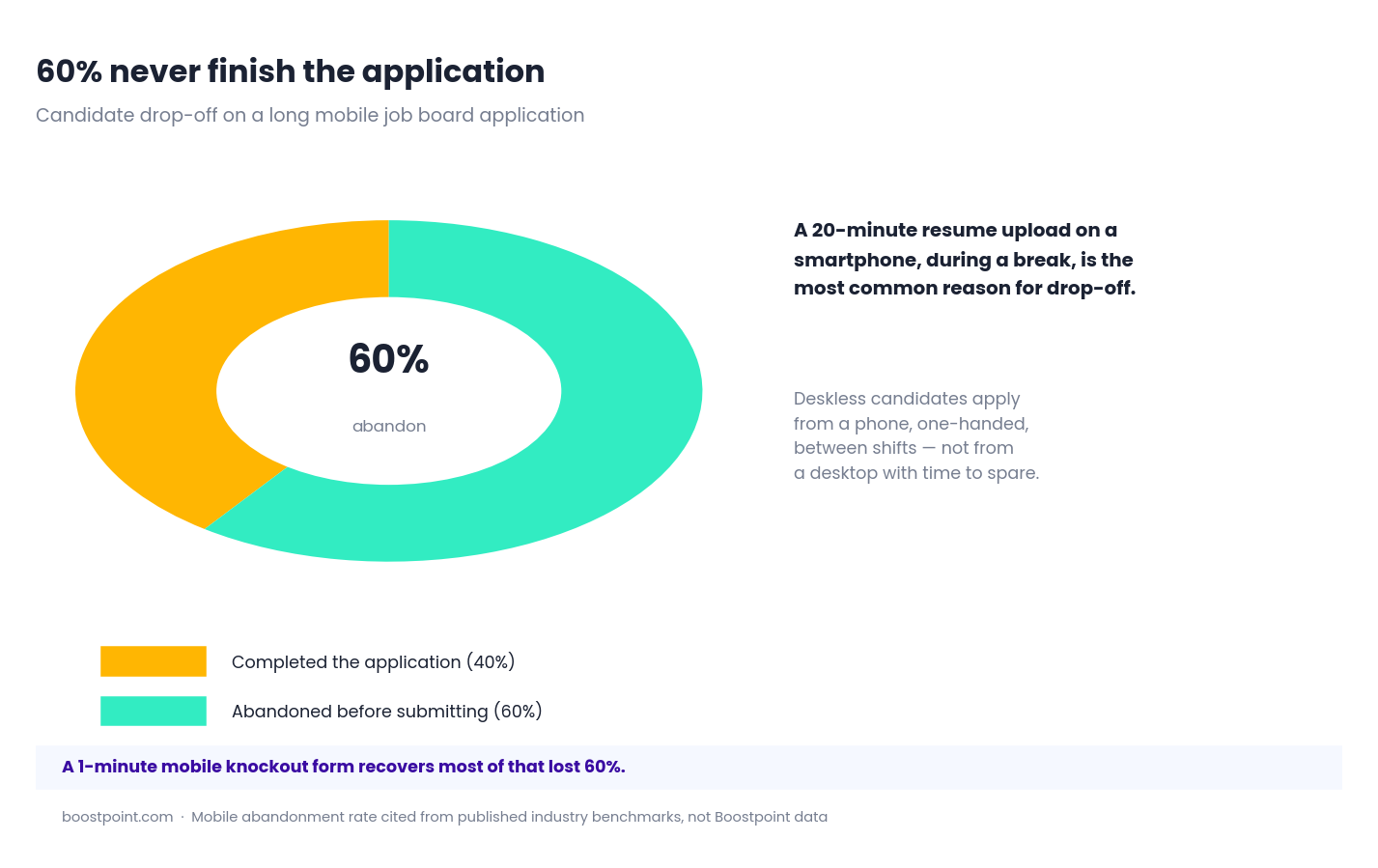
- The application friction is too high. Over 60% of candidates abandon applications because they are too long. Deskless workers apply from smartphones during breaks. If your job board redirects them to an Applicant Tracking System (ATS) that demands a 20-minute resume upload, you lose them instantly.
- Slow response times kill conversions. If a worker applies on a job board on a Friday, and your team sorts resumes on Monday, that candidate has already moved on. Speed is the ultimate currency in hourly hiring.
The passive sourcing alternative (and the 2026 benchmarks)
Social advertising inverts the traditional model. Instead of waiting for a worker to search for you, your job opportunity becomes an engaging video ad placed directly in their social media feed.
Because the blue-collar workforce is highly active on social media platforms, targeting passive candidates drives acquisition costs down significantly.
Across thousands of Boostpoint-managed frontline campaigns in 2026, targeted social recruitment yielded the following applicant acquisition costs — the full breakdown across every industry we track is in our published 2026 Frontline Benchmark Report:
| Blue collar industry category | Median cost per applicant (CPA) |
|---|---|
| Warehouse & Light Industrial | $2.14 |
| Retail & FOH Hospitality | $4.98 |
| Manufacturing (Blended Average) | $5.56 |
| Healthcare & Senior Living | $11.54 |
| Transportation (CDL Drivers) | $13.57 |
| Skilled Trades & Construction | $15.80 |
Source: Boostpoint campaign data — 1,070 managed frontline recruitment campaigns conducted in 2025–2026 across manufacturing, transportation, healthcare, and retail sectors nationwide.
Data based on the 2026 Boostpoint Frontline Benchmark Report spanning North America.
Calculating direct ad cost per hire across screening ratios
Advertising budget generates applicants, not onboarded employees. Because blue-collar roles require background checks, drug screening, MVR checks, and skills testing, you must account for candidate drop-off.
Here is the direct advertising cost per hire across three candidate screening scenarios, based on the $5.56 median CPA for manufacturing and industrial roles:
| Frontline role | Cost per applicant (CPA) | 1 in 10 hire rate (10% — high touch) | 1 in 30 hire rate (3.3% — realistic standard) | 1 in 50 hire rate (2% — strict vetting) |
|---|---|---|---|---|
| Industrial / Manufacturing Associate | $5.56 | $55.60 | $166.80 | $278.00 |
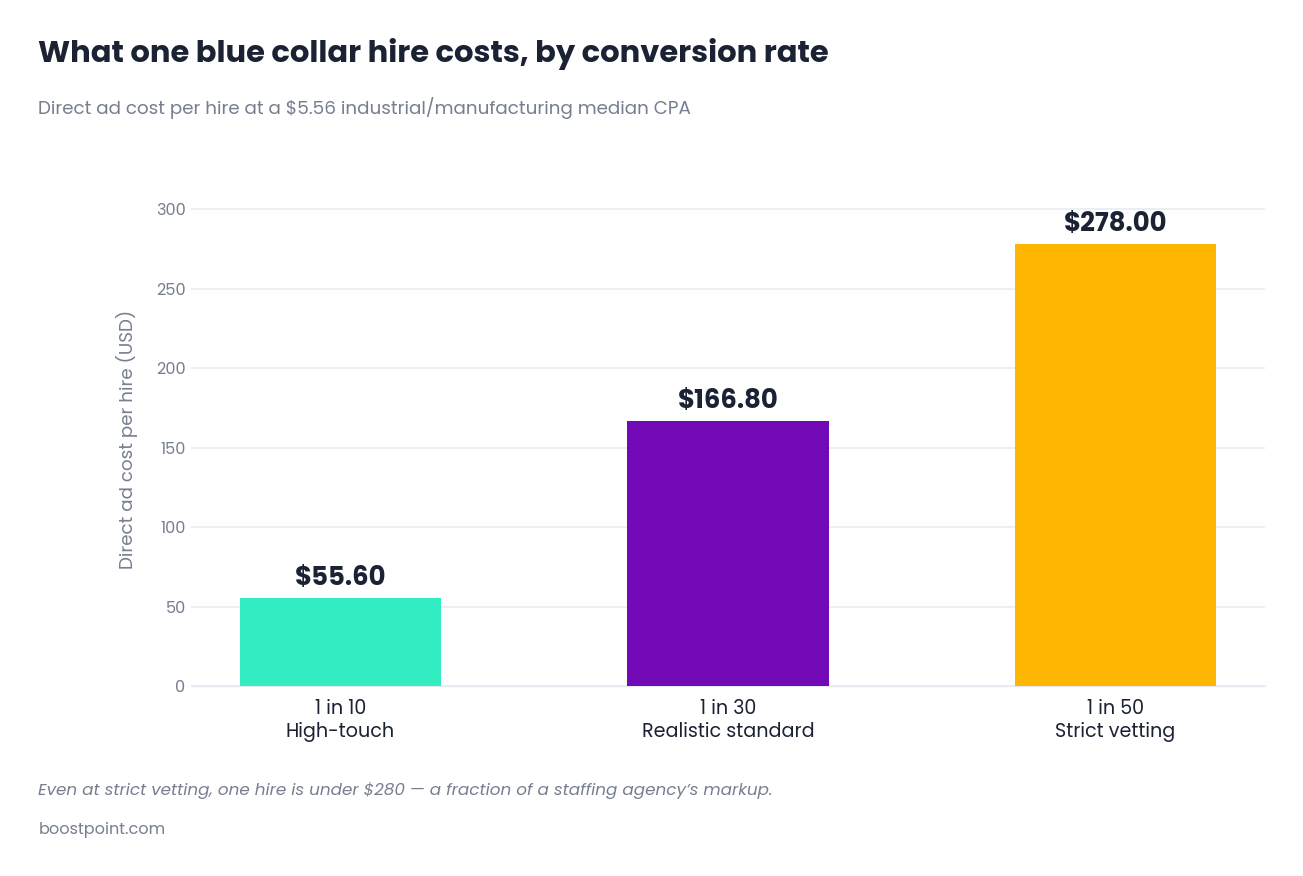
Even under a strict 1 out of 50 hire rate, generating a dedicated industrial worker directly costs just $278.00. This is a fraction of the cost of placing standard job board ads or paying staffing agency markups.
4 best practices for a modern blue collar recruiting strategy
To build a reliable talent pipeline for hourly workers, you must optimize your process for speed and mobile accessibility:
- Deploy 1-minute mobile knockout forms. Eliminate the resume requirement. Use a "Quick Apply" process with 3-4 custom knockout questions (e.g., Can you work second shift? Do you have forklift experience?) to instantly pre-screen candidates.
- Automate SMS engagement. Email is dead in frontline hiring. Use automated SMS to text candidates the moment they hit "apply." Texting has a 90% open rate and allows you to double your interview scheduling rate instantly.
- Use authentic video ads. Ditch the stock photos. Run 15-second smartphone video ads showing your actual plant floor, the equipment, and the team. Transparency builds trust.
- Recruit where they spend their time. Leverage hyper-targeted ads on Facebook, Instagram, and TikTok to reach workers in your exact geographic radius without paying per-click premiums on search engines.
The honest summary
Stop posting jobs and hoping. Start installing a hiring system.
If your company is spending thousands of dollars a month on job boards just to collect resumes that don't convert, your blue collar recruiting strategy needs an overhaul.
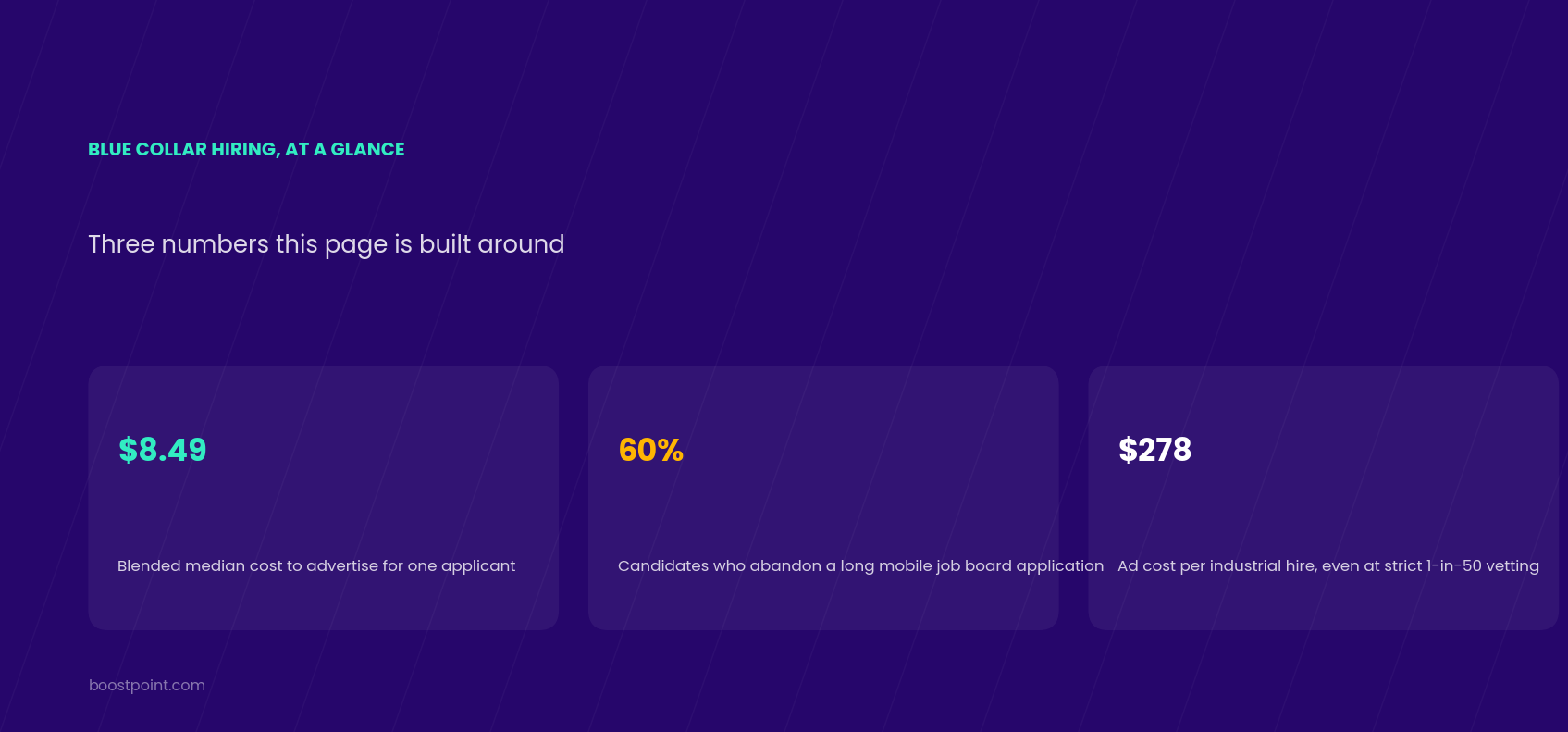
By shifting your budget to targeted social media campaigns, you can reach passive, employed workers, automate your SMS follow-ups, and drive your cost-per-applicant down to a blended average of $8.49.
The calculation worth running this quarter
Talent Acquisition leaders should evaluate these metrics immediately:
- Calculate your true job board cost-per-hire. Divide your total monthly job board spend (Indeed, ZipRecruiter) by the number of actual seated hires.
- Audit your application abandonment rate. Do you know how many people click your job ad but fail to apply? If your completion rate is under 15%, your ATS form is too long.
- Measure your speed-to-contact. How long does it take for your recruiters to text a new applicant? If it is longer than 5 minutes, you are losing top talent to faster competitors.
Frequently asked questions
How to hire blue collar workers effectively?
The most effective way to hire blue collar workers is to shift away from active job boards and use targeted social media advertising. This allows you to reach passive candidates who are currently employed but open to better opportunities. Combine this with a 1-minute mobile application and automated SMS follow-ups to maximize conversions.
Why is blue collar recruiting so difficult right now?
The market is facing a systemic skills shortage, not just a headcount shortage. Millions of experienced manufacturing and trades workers are retiring, and traditional job boards fail to reach the limited pool of employed, highly skilled workers who remain.
What is the average cost to recruit an hourly worker?
Using targeted social media recruitment, the median cost per applicant (CPA) for frontline and blue-collar roles is $8.49. Specific costs range from $2.14 for warehouse workers to $15.80 for skilled tradespeople.
Are job boards still useful for hiring hourly workers?
Job boards can still capture active job seekers, but they are highly saturated and commoditize your job postings. Social media advertising reaches a much broader talent pool (the 70% of the workforce that is passive) and typically yields a lower cost per hire.
How quickly do I need to contact a blue collar applicant?
Instantly. Top blue collar talent is hired within days, not weeks. Using automated SMS text messaging to engage a candidate the second they apply ensures you don't lose them to a competitor.
How do you recruit blue collar workers?
Advertise the job to people who are working, not only to people who are searching. Put the hourly rate, shift and location in the first line of a social job ad, ask two to four knockout questions in a mobile form instead of asking for a resume, and text every applicant within minutes. Keep a job board posting for the few who are actively looking. In Boostpoint's 2026 Social Job Advertising Benchmark, warehouse and production roles ran a median $9.83 per applicant.
What does blue collar hiring cost per applicant, by role?
It depends heavily on the role. In Boostpoint's 2026 Social Job Advertising Benchmark of 891 Meta campaigns, median cost per applicant was $9.83 for warehouse and production roles, $13.41 for technicians and mechanics, $14.14 for skilled trades and $26.86 for CDL truck drivers, against $13.88 across all roles. The figures include campaign management. Cost per applicant is not cost per hire: divide by your own applicant-to-hire rate.
Why do blue collar workers click my job ad but not apply?
Usually because the application is too long for a phone. In Boostpoint's 2026 Social Job Advertising Benchmark, what happened after the click explained 70% of the difference in cost per applicant between campaigns. Apply rates were 20% for warehouse roles, 15% for skilled trades and 8% for CDL drivers. Cut the resume upload and account creation, keep the form under a minute, and put the pay in the ad so the people who click already like the number.
Where do you find blue collar workers?
Mostly at their current jobs, which is why a posting that waits for searchers misses them. Reach them with Facebook and Instagram job ads scoped to commuting distance, ask your own crew for referrals, recruit from adjacent roles (a forklift operator can become a machine operator, a helper can become an apprentice), and work with trade schools and apprenticeship programs for entry-level roles. Keep a job board listing for the smaller group actively searching. Our guide to where to find skilled trades workers ranks the channels role by role.
How do you attract blue collar workers?
Lead with what they compare first: the hourly rate, the shift, the location and how soon they can start. Show the actual work site and equipment rather than stock photos, name overtime and shift differentials if you pay them, and make the application a short mobile form with no resume or account. In Boostpoint's 2026 Social Job Advertising Benchmark, the apply experience explained 70% of the cost variation between campaigns, more than click-through rate (30%) or ad delivery cost (18%).
What is the best blue collar hiring platform?
It depends on which part of hiring you need a platform for. Job boards and hourly job apps reach people who are searching this week. Social job advertising, such as Boostpoint Attract on Facebook and Instagram, reaches the larger group who are working somewhere else and not searching. An applicant tracking system organizes the people who apply. Whichever you choose, check three things: the application finishes on a phone in about a minute with no resume or account, every applicant gets a text within minutes, and the platform reports cost per completed application with all fees included. In Boostpoint's 2026 Social Job Advertising Benchmark, the apply experience explained 70% of the difference in cost per applicant between campaigns.
See what it costs to build a blue collar talent pipeline
Book a 30-minute strategy call with our recruitment marketing team. We'll analyze your local labor market, review cost-per-applicant benchmarks for your specific industry, and demonstrate how to build a direct hiring pipeline using automated social ads.
Book a Demo →Boostpoint figures are derived from 1,070 managed frontline recruitment campaigns conducted in 2025–2026 across manufacturing, transportation, healthcare, and retail sectors nationwide. Cost-per-applicant metrics reflect what advertisers paid for advertising. Labor statistics are sourced from the U.S. Bureau of Labor Statistics (BLS).