
How to Hire Installers and Specialty Technicians: Fire Sprinkler, Fire Alarm, Low-Voltage, Solar — the Trades With No Recruiting Page
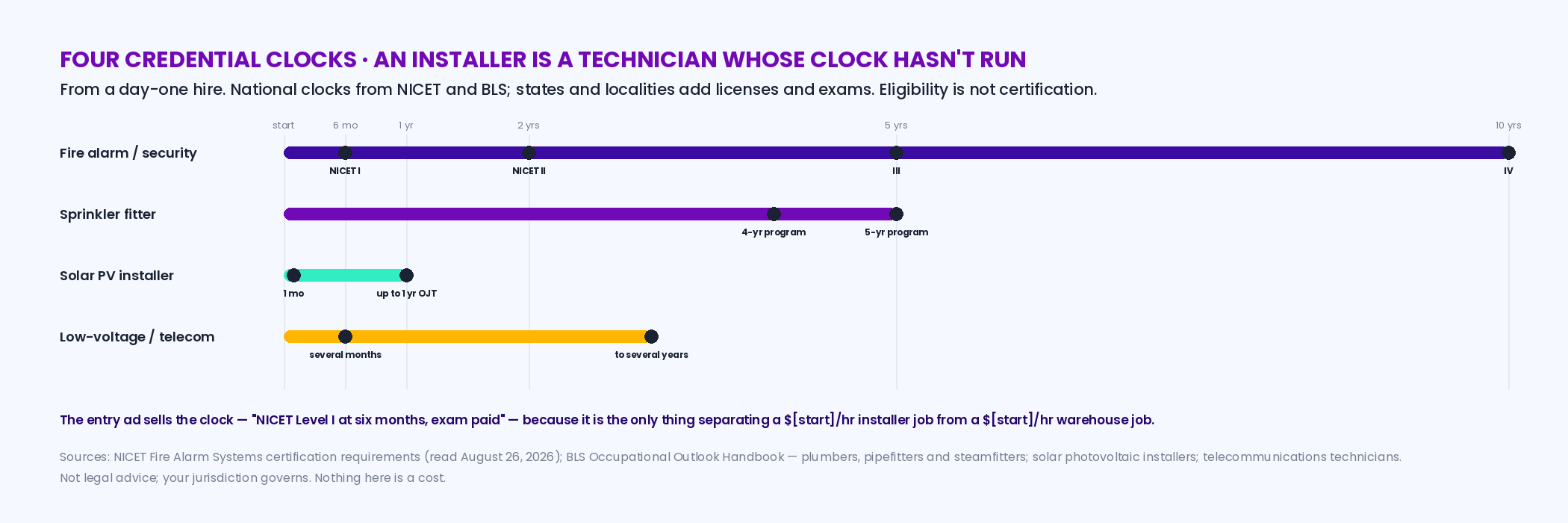
The specialty trades share one structure: an installer is a technician whose clock hasn't run yet. Fire alarm certification starts at 6 months of documented experience and reaches Level II at 2 years; a sprinkler fitter comes out of a 4- or 5-year apprenticeship at 2,000 hours a year; a solar installer is trained in one to twelve months; a telecom technician in months to years. So every one of these trades is two ads — an entry installer ad written for someone with a license and a ladder, and a credentialed technician ad written for someone whose clock has run at a competitor — and the ad that names the clock is the one that fills. Our trades data says the rest: cheap clicks, the lowest click-to-apply of any vertical, and a form that decides everything.
A note on who's writing this
Boostpoint runs social media job ads for contractors, and the specialty trades on this page — fire protection, low-voltage, solar, telecom — are among them, so the ad sections describe what we sell. We publish no cost per applicant for any of these trades and won't estimate one: 69% of applications in our trades data sit in campaigns whose names don't identify the role, so a specialty-by-specialty figure would be invented. The figures here are the skilled trades and technician rows of our benchmark, labeled as the nearest published rows, plus BLS and NICET. Licensing for these trades is set by states and localities and varies more than for almost any other trade; the credential clocks below are the national ones (BLS, NICET) and your jurisdiction governs. No contractor is named. Every figure of ours is a cost per applicant, never a cost per hire.
The specialty pools, by the numbers
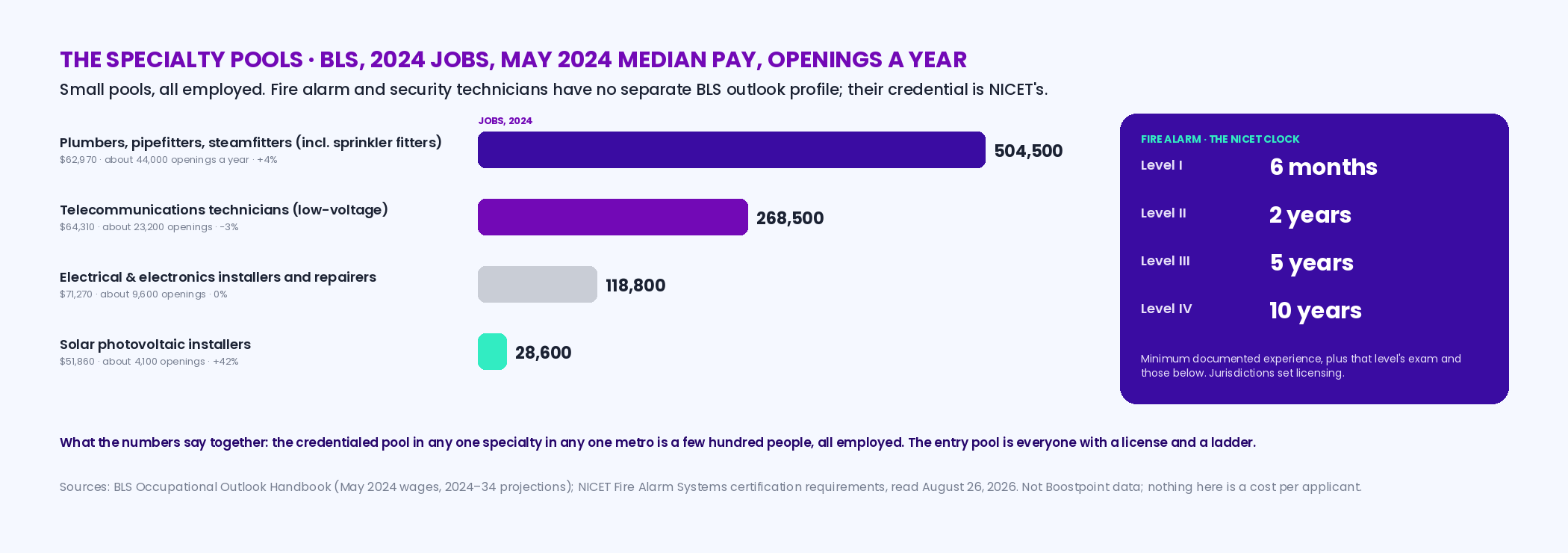
None of these trades is large, which is the first fact about recruiting them. Sprinkler fitters sit inside BLS's plumbers, pipefitters and steamfitters — 504,500 jobs at a median $62,970, about 44,000 openings a year — with BLS noting that "employment of sprinklerfitters is expected to increase because of building codes in all states that require the use of fire suppression systems"; most learn "through a 4- or 5-year apprenticeship" with 2,000 hours of paid on-the-job training a year, and most states require licensing. Telecommunications technicians, the low-voltage pool, are 268,500 jobs at a median $64,310 — $73,140 in telecommunications and $55,000 with specialty trade contractors — declining 3% but still producing about 23,200 openings a year, with employers preferring a certificate or associate's degree and on-the-job training "from several months to several years." Solar photovoltaic installers are the smallest and fastest-growing: 28,600 jobs at a median $51,860, projected to grow 42% with about 4,100 openings a year, trained on the job "between 1 month and 1 year," licensed in some states. Electrical and electronics installers and repairers — the industrial and commercial equipment side — are 118,800 jobs at a median $71,270 with about 9,600 openings a year. Fire alarm and security technicians have no separate BLS outlook profile; their credential is NICET's, and it is a clock: Level I after a minimum of 6 months of experience with fire detection and signaling systems, Level II after 2 years including at least 12 months on fire alarm systems, Level III after 5 years, Level IV after 10, each with its exam and the ones below it. What the numbers say together: the credentialed pool in any one specialty in any one metro is a few hundred people, all employed, and the entry pool is everyone with a driver's license and a ladder. Recruiting the first is poaching; recruiting the second is the grow track, and the clock is what you're selling.
The credential clock is the recruiting plan
Read the credentials as clocks and the two-ad structure falls out. A fire alarm installer hired today with no experience reaches NICET Level I eligibility in six months and Level II in two years; the contractor who hires him is buying two years of a technician's future at an installer's wage, and the installer who reads the ad is buying a credential he can't get anywhere except on a job. A sprinkler apprentice is on a 4- or 5-year clock of 2,000 hours a year; a solar installer's clock is one to twelve months; a telecom technician's is months to years plus a certificate. In every case the ad for the entry role has to say the clock out loud — "NICET Level I eligible at six months, Level II at two years, exam fees paid" — because that sentence is the reason to take a $[start]/hr installer job over a $[start]/hr warehouse job, and no competitor's ad says it. The technician ad is the opposite person: someone whose clock has run, who holds the level or the license, and who reads the ad for the rate, the truck, the on-call rotation and whether the company does service or new construction. The apprenticeship and trade school page has the cohort arithmetic for running the entry track as a program; the electrician and HVAC technician pages are the licensed-trade versions of the technician ad.
Interactive
Credential clock — pick a specialty and a start date, and see when an installer becomes a technician on paper
Nothing is stored or sent — this runs in your browser. National clocks from BLS and NICET; your state or locality may require a license, a longer clock or an exam of its own, and the exam itself has to be passed.
Sources: NICET Fire Alarm Systems certification requirements (Level I minimum 6 months' experience; Level II minimum 2 years including at least 12 months on fire alarm systems; Level III 5 years; Level IV 10 years; each level's exam plus those below), read August 26, 2026; BLS Occupational Outlook Handbook (sprinkler fitters: 4- or 5-year apprenticeship at 2,000 hours a year; telecom: OJT several months to several years, certificate or associate's preferred; solar: OJT 1 month to 1 year, some states license). Dates are calendar arithmetic on your start date; eligibility is not certification, and your jurisdiction governs. Nothing here is a cost.
Two ads, two people
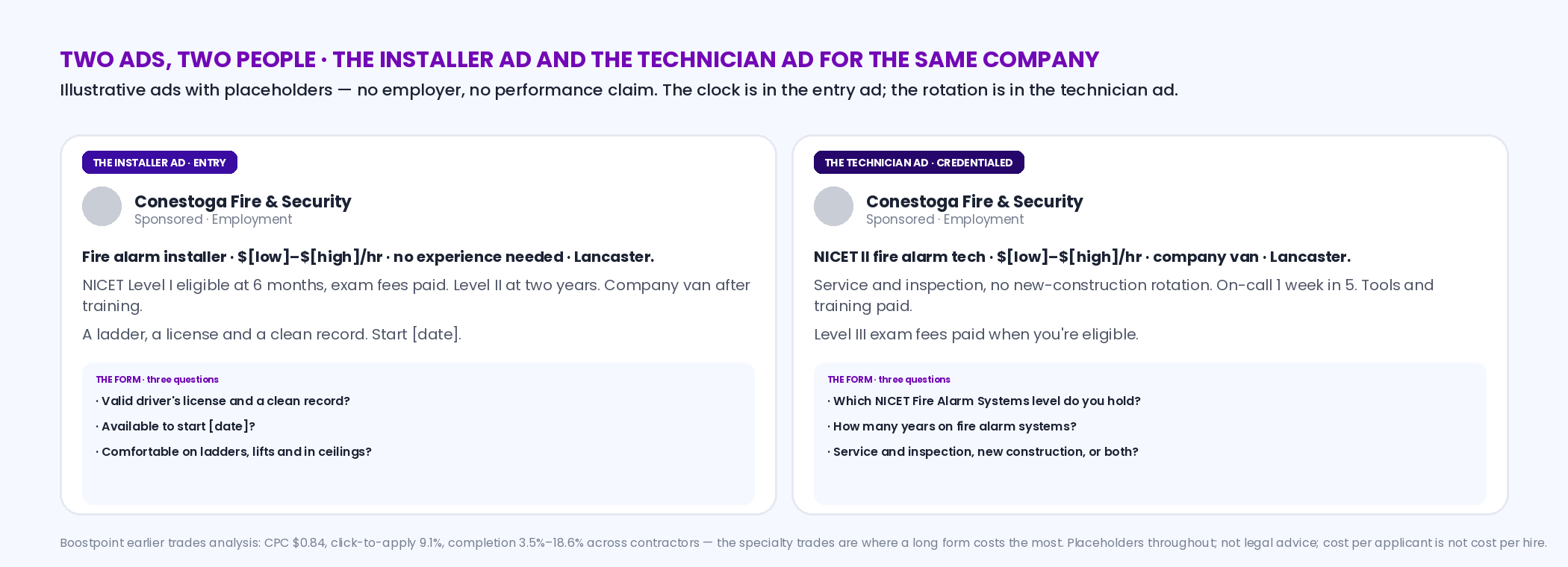
The entry ad is for a person with a driver's license, a clean record and no fear of heights or crawlspaces, and it competes with warehouse and delivery ads at the same rate. Its first line names the specialty in plain words, the rate, the clock and the credential at the end: "Fire alarm installer · $[low]–$[high]/hr · no experience needed · NICET Level I at 6 months, exam paid · [City]." The technician ad is for a person whose clock has run at a competitor, and it competes with the competitor's next raise. Its first line names the level or license, the rate, the truck, the work type and the on-call rotation: "NICET II fire alarm tech · $[low]–$[high]/hr · company van · service, no new-construction rotation · on-call 1 week in 5 · [City]." On Meta both run in the Special Ad Category — no age, gender or ZIP targeting, rules on Meta Special Ad Category, explained — so the words do the selecting, and "NICET II" in the first line is the targeting. The form asks three things for the entry ad (license, available for the start date, comfortable on ladders and lifts) and three for the technician ad (level or license held, years on the specialty, service or install preference), and nothing else before the call; our earlier trades analysis found the cheapest clicks of any vertical at $0.84, the lowest click-to-apply at 9.1%, and completion from 3.5% to 18.6% across contractors on the same channel — the specialty trades are where a long form costs the most. The nearest published rows for what these campaigns cost per applicant are the 2026 benchmark's skilled trades at a median $14.14 (15% apply rate, 35 campaigns) and technician and mechanic at $13.41 (16%, 145); we have no specialty figure and don't print one. A dated shop open house with the trucks in the lot, the lead technician present and offers made on the spot is the event-driven structure that ran a median $8.02 per applicant in the benchmark, mechanics on open house hiring events; the construction-site version of the same playbook is on how to recruit construction workers, and the posting for the solar role starts from the solar photovoltaic installer job description.
Interactive
Two-ad builder — the installer ad and the technician ad for the same specialty, with the clock written in
Nothing is stored or sent — this runs in your browser. Pick the specialty, the work type and the city; the builder writes both first lines and both sets of knockout questions. Rates are placeholders — yours.
Boostpoint practice, assembled from your choices; the credential clocks are NICET's and BLS's national figures and your jurisdiction governs. No age or gender words — the ADEA and Meta's policy reach them. Where a pay-transparency law applies, the range must be the one you pay. Nothing here is a cost.
| Specialty | The clock | BLS pool and median pay | Entry ad, first line | Technician ad, first line |
|---|---|---|---|---|
| Fire alarm / security systems | NICET Level I at 6 months' experience, Level II at 2 years (12 months on fire alarm), Level III at 5, Level IV at 10; exams at each level | No separate BLS outlook profile; jurisdictions set licensing | "Fire alarm installer · $[low]–$[high]/hr · no experience needed · NICET I at 6 months, exam paid · [City]" | "NICET II fire alarm tech · $[low]–$[high]/hr · company van · service · on-call [X] · [City]" |
| Fire sprinkler fitter | 4- or 5-year apprenticeship, 2,000 hours a year plus technical instruction; most states license | Inside plumbers, pipefitters and steamfitters: 504,500 jobs, $62,970, about 44,000 openings a year | "Sprinkler fitter apprentice · $[start]/hr rising to $[journeyman]/hr · 2,000 paid hours a year · starts [date] · [City]" | "Journeyman sprinkler fitter · $[low]–$[high]/hr · [license] · commercial · truck · [City]" |
| Low-voltage / telecom technician | Several months to several years on the job; certificate or associate's preferred; driver's license | 268,500 jobs, $64,310; $55,000 with specialty trade contractors; about 23,200 openings a year | "Low-voltage installer · $[low]–$[high]/hr · no experience needed · we train to [cert] · [City]" | "Low-voltage tech · [cert] · $[low]–$[high]/hr · structured cabling / access control · van · [City]" |
| Solar PV installer | 1 month to 1 year on the job; some states license; driver's license | 28,600 jobs, $51,860, +42%; $61,140 with plumbing/HVAC contractors, $59,130 with electrical contractors | "Solar installer · $[low]–$[high]/hr · no experience needed · roof work, training paid · [City]" | "Lead solar installer · $[low]–$[high]/hr · [license/cert] · crew lead · [City]" |
An installer is a technician whose clock hasn't run. Put the clock in the entry ad and the rotation in the technician ad — and ask three questions, because the specialty trades are where a long form costs the most.
How to recruit low-voltage technicians
Low-voltage work sits across several BLS occupations, which is why the pool looks small on any one table. Security and fire alarm systems installers are 86,300 jobs (2025) at a median $60,070 a year (May 2025), with about 8,500 openings a year through 2035; telecommunications equipment installers and repairers (other than line installers) are 143,100 jobs at $63,890, projected to decline 3.3%. Structured cabling, access control, CCTV, AV and fire alarm technicians are spread through both, and through electrical contractors.
The practical consequence is that you recruit low-voltage technicians from the adjacent trades as much as from competitors. Cable and satellite installers already pull wire, work in customers' buildings and drive a van; AV installers, electrician helpers and IT support staff who like hardware all cross over with training. The ad for this person names the systems in plain words ("structured cabling and access control, commercial buildings"), the rate, the van and "we train you on the systems and pay for your certification," then asks three questions: which systems they have worked on (a list, not a knockout), a valid driver's license, and comfort on ladders and lifts. The experienced-technician ad is the one on this page with the level or license in the first line; licensing for low-voltage work is set by states and localities and varies widely, so name only what your jurisdiction requires. The role is set out on our low-voltage technician job description, and the cable-installer pool on how to recruit cable installers.
How to recruit solar photovoltaic installers
Solar PV installers are the smallest pool on this page and the fastest-growing. In the newer BLS edition they are 31,100 jobs (2025), projected to reach 42,400 by 2035 (36.5% growth), with about 4,200 openings a year and a median of $53,140 (May 2025); training is on the job and short. The person who fills the job is usually not a solar installer yet. Recruit from the people who already work on roofs and with tools: roofers and roofing helpers, construction laborers, electrician helpers and warehouse workers who want to learn a trade.
The entry ad sells the trade: "Solar installer · $[low]–$[high]/hr · no experience needed · roof work, training paid · [City]." It has to be honest about the roof, the heat and the lifting, because a new installer who finds out on the first day leaves on the second. For utility-scale and commercial work, say whether the job travels and whether per diem or lodging is paid. Ask three questions: comfortable working on roofs or at heights, a valid driver's license, and the start date. Where your state licenses PV installation or requires an electrician on the job, say so and recruit the electrician separately. Then keep the new installer: pair each one with a lead for the first weeks and state in the offer when the pay step after training arrives, since an installer who learns the trade on your crew is the one your competitors will recruit next. The posting itself is on our solar photovoltaic installer job description.
Solar company recruiting: installers, electricians and sales under one roof
A solar company hires three different people, and each is recruited against a different competitor. Installers are recruited against roofing and construction crews. Electricians are recruited against every electrical contractor in the area, and the ad reads like an electrician ad: license, rate, truck, and the fact that the work is solar. Sales representatives, site surveyors and project coordinators are recruited against every other commissioned sales job. For reference, Boostpoint's 2026 Social Job Advertising Benchmark put the Sales family at a median $11.61 per applicant (21% apply rate) and the Skilled trades family at $14.14 (15%); neither is a solar-specific figure.
Recruiting in 2026 also has to be honest about demand. The IRS says the residential clean energy credit "is not available for any property placed in service after December 31, 2025" (IRS), which changes the residential market that many installers and sales reps worked in. Experienced candidates know this, and the question they bring to the interview is whether the work will last. An ad that names the work mix (residential, commercial, utility-scale, service and repair), the schedule and how pay works for sales (base, commission, draw) answers it before the call and attracts the people who still want the job. A company that has shifted toward commercial or service work should lead with that, and one still hiring for residential installs should say what keeps its pipeline full. The electrician side of the hire is covered on electrician recruiting.
Frequently asked questions
How do you hire installers?
As the entry rung of a credential clock: an ad written for someone with a driver's license and no experience that names the specialty in plain words, the rate, the clock — "NICET Level I at six months, exam paid" — and the credential at the end, with a three-question form behind it. Run it beside a separate technician ad for the credentialed person, and hold a dated shop open house with the trucks in the lot.
How do you recruit fire sprinkler technicians?
Two ways at once: journeymen from competitors, with an ad that names the license, the rate, commercial or residential, and the truck; and apprentices into a 4- or 5-year program at 2,000 paid hours a year, with an ad that quotes the wage schedule. BLS counts sprinkler fitters inside 504,500 plumbers, pipefitters and steamfitters at a median $62,970, and expects their employment to grow because all states' building codes require fire suppression systems.
What does NICET certification require?
For Fire Alarm Systems: Level I requires a minimum of 6 months' experience with fire detection and signaling systems and the Level I exam; Level II a minimum of 2 years including at least 12 months on fire alarm systems and the Level I and II exams; Level III 5 years; Level IV 10 years, each with the exams below it. Whether a jurisdiction requires a NICET level for a license or a permit varies by state and locality.
How do you hire low-voltage technicians?
From the entry pool with a "no experience, we train to [certification]" ad, and from the credentialed pool with an ad that names the certification, the work — structured cabling, access control, CCTV — and the van. BLS puts telecommunications technicians at 268,500 jobs and a median $64,310, with employers preferring a certificate or associate's degree and on-the-job training running from several months to several years.
What does it cost to recruit installers and specialty technicians?
We publish no specialty figure and won't estimate one, since 69% of applications in our trades data sit in campaigns whose names don't identify the role. The nearest rows in our 2026 benchmark are skilled trades at a median $14.14 per applicant (15% apply rate, 35 campaigns) and technician and mechanic at $13.41 (16%, 145). Cost per applicant is not cost per hire.
Why should the installer ad mention the certification clock?
Because it is the only thing that separates a $[start]/hr installer job from a $[start]/hr warehouse job in the applicant's feed, and no competitor's ad says it. "NICET Level I eligible at six months, exam fees paid" turns an entry job into a credential the person can't get anywhere except on a job. The clock is the grow track's product; the ad has to sell it.
What should the technician ad say?
The level or license, the rate range, the truck, the work type — service and inspection or new construction — and the on-call rotation, in the first line; the person reading it has the credential and is comparing the rotation and the truck against his current employer's. Three form questions: level held, years on the specialty, service or install preference. The license check comes after the call.
Do solar installers need a license?
BLS says "some states require a license for PV installers" and that some states require certification for installers on projects that qualify for solar subsidies; employers typically require a driver's license. Training is on the job, between one month and one year. BLS counts 28,600 solar PV installers at a median $51,860, projected to grow 42% to 2034 — the fastest-growing trade on this page and the smallest.
How do you recruit low-voltage technicians who already have experience?
Name the systems and the upgrade. Experienced low-voltage technicians compare the systems they will work on (structured cabling, access control, CCTV, fire alarm), the rate, the van, the on-call rotation and certification support, so those go in the first lines, with the certification or license you require. Recruit from competitors and from adjacent pools such as cable, satellite and AV installers. The BLS counts 86,300 security and fire alarm systems installers at a median $60,070 a year (May 2025).
How do you recruit solar photovoltaic installers?
Mostly by recruiting people who are not installers yet: roofers, roofing helpers, construction laborers and electrician helpers. Run an entry ad that says "no experience needed, training paid," the rate and the realities of roof work, plus travel and per diem for utility-scale jobs, with three questions behind it (heights, driver's license, start date). The BLS projects solar PV installers to grow 36.5% from 2025 to 2035, to 42,400 jobs, at a median $53,140 a year (May 2025).
How should solar company recruiting change after the residential tax credit ended?
Be explicit about the work that remains. The IRS says the residential clean energy credit is not available for property placed in service after December 31, 2025, and experienced installers and sales reps will ask whether the work will last. Name your work mix (residential, commercial, utility-scale, service), the schedule, and for sales roles how base, commission and draw work, so the ad attracts people who want the job as it is now.
Run the installer ad and the technician ad together
We'll write both first lines for your specialty with the clock in one and the rotation in the other, put a three-question form behind each, run them where installers and technicians scroll, and show you the contractor campaigns closest to yours.
Book a DemoBoostpoint figures come from the 2026 Social Job Advertising Benchmark — 891 campaigns and 1,334 campaign-months: skilled trades median cost per applicant $14.14, middle 50% $7.58–$21.49, 15% apply rate, 35 campaigns; technician / mechanic $13.41, $7.40–$23.58, 16%, 145 (the nearest published rows, not specialty figures); event-driven $8.02, 21%, 78 campaigns. Earlier campaign-level trades analysis (different methodology): 45 field campaigns, 10 clients, blended $9.28, typical range $6–$17, CPC $0.84, click-to-apply 9.1%, application completion 3.5% to 18.6% across contractors. No fire protection, low-voltage, solar or installer-specific figure is published, because 69% of trades applications are in campaigns whose names don't identify the role. Third-party figures — BLS Occupational Outlook Handbook (May 2024 wages, 2024–34 projections) for plumbers, pipefitters and steamfitters; telecommunications technicians; solar photovoltaic installers; electrical and electronics installers and repairers; NICET Fire Alarm Systems certification requirements — are theirs, read August 26, 2026, and attributed in place; licensing is set by states and localities and this page is not legal advice. No customer is named. The clock and ad builders are calendar arithmetic and Boostpoint practice, not measured results. Cost per applicant is not cost per hire; we do not track hires and publish no cost-per-hire figure. A sample of Boostpoint campaigns, not an industry-wide study.
Three more free templates for route and installation trades: pest control technician, which covers how to write the licensing requirement without shrinking your applicant pool; auto body technician, including the federal spray certification most collision adverts omit; and insulation installer, which explains why the two insulation occupations pay $9,000 apart.