
HVAC Technician Recruiting: Overcoming High CPCs and Agency Markups
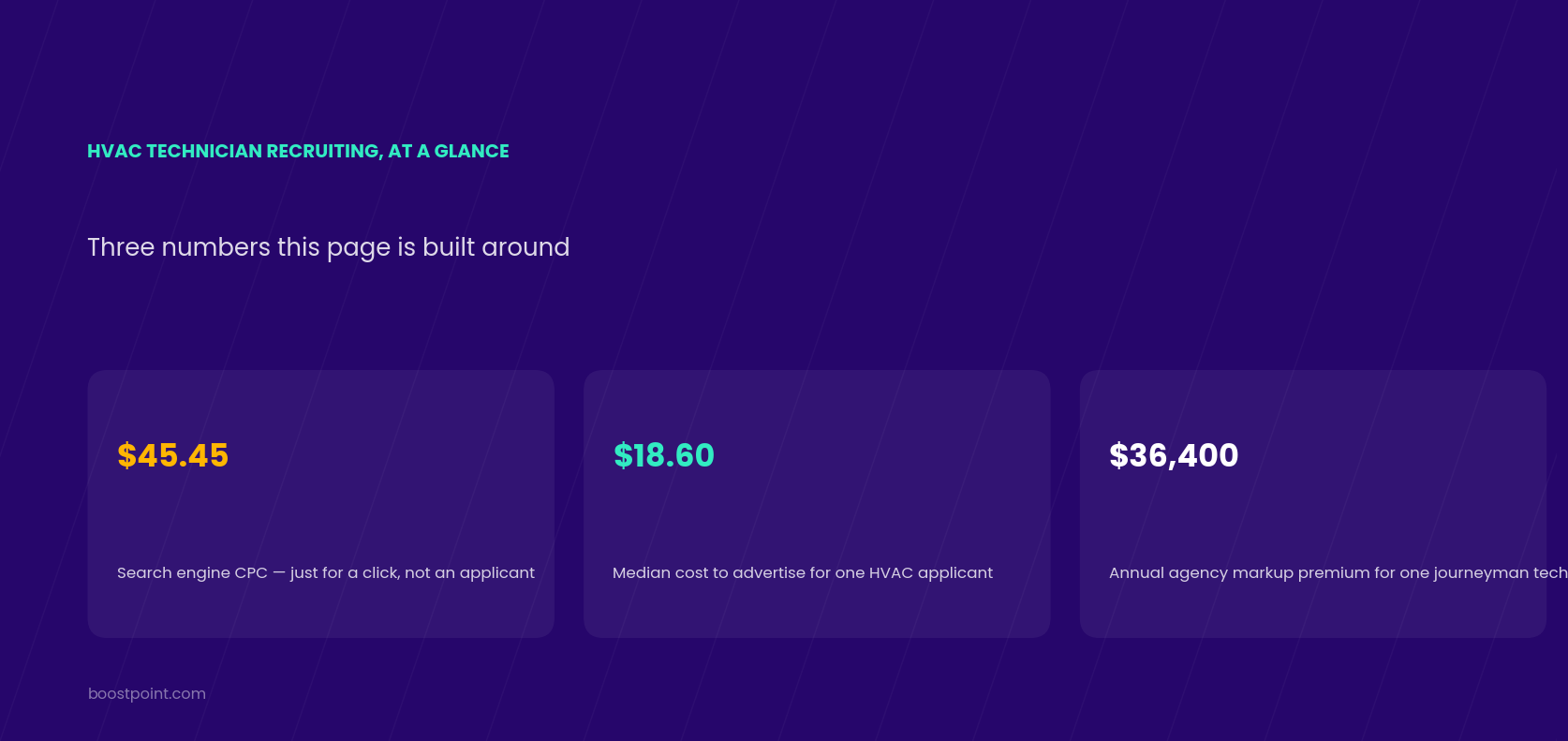
HVAC recruiting is fiercely competitive, with search engine pay-per-click (CPC) rates reaching $45.45 just to get a candidate to click a job link. Meanwhile, HVAC staffing agencies typically charge a 45% to 60% markup on a technician's hourly wage, draining $30,000+ in annual project margins per worker. By pivoting to passive social media sourcing, contractors can bypass high search costs and — in Boostpoint's 2025–2026 campaign data — generate HVAC technician applicants for an average of $18.60 each.
Source: Boostpoint campaign data — managed construction, skilled trades, and MEP recruitment campaigns conducted in 2025–2026 across contractors nationwide.
A note on who's writing this
Most guides on HVAC recruiting are written by job boards that want you to buy more sponsored listings, or by specialized staffing agencies that want to rent you their technicians at a steep markup. Their content frames high acquisition costs as an unavoidable reality of the skilled trades shortage.
Boostpoint is not a staffing agency or a job board. We build recruitment advertising software that helps commercial mechanical contractors and residential HVAC companies generate their own direct applicants through targeted social media campaigns.
We are pulling back the curtain on the actual economics of HVAC recruiting. We are providing the hard 2026 financial benchmarks that show why traditional search channels are draining your budget, and what passive social sourcing costs by comparison.
The extreme cost of active HVAC recruiting
If you feel like you are spending thousands of dollars on job boards and getting zero qualified HVAC technicians in return, you are experiencing the active sourcing bottleneck.
The $45.45 CPC problem
Great HVAC technicians are already employed. Because the pool of active job seekers is incredibly small, commercial mechanical contractors and staffing agencies are trapped in a bidding war on search engines (like Google and Indeed).
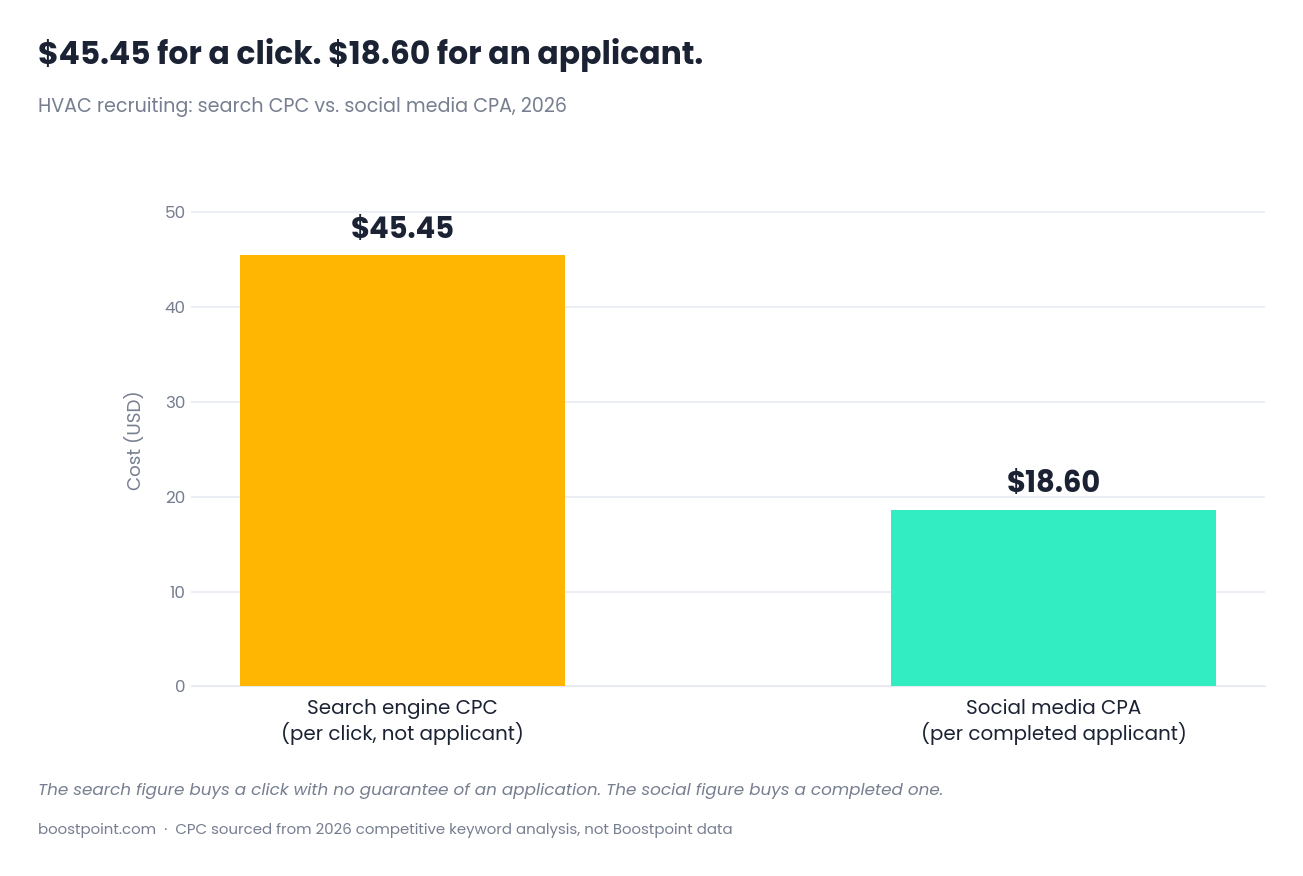
In 2026, the keyword "HVAC recruiting" commands an astronomical Cost-Per-Click (CPC) of $45.45. That means an employer pays $45.45 just for someone to click on their careers page — with absolutely zero guarantee that the visitor actually fills out an application. If your application conversion rate is 10%, you are paying $454 for a single applicant.
The agency markup penalty
When contractors get frustrated with job boards, they turn to HVAC staffing agencies. These agencies supply the talent and carry the workers' comp liability, but they charge a massive premium.
Consider a Journeyman HVAC Technician:
| HVAC role | Base wage | 50% agency markup bill rate | Annual markup premium per tech |
|---|---|---|---|
| Apprentice / Helper | $22.00/hr | $33.00/hr | $22,880 |
| Journeyman HVAC Tech | $35.00/hr | $52.50/hr | $36,400 |
| Master Commercial Tech | $45.00/hr | $67.50/hr | $46,800 |
If you rely on an agency to staff just three Journeyman technicians year-round, you are forfeiting over $109,000 annually to pure agency overhead and profit.
The passive sourcing alternative (and what it costs)
To stop paying $45 per click and $36,000 per agency seat, contractors must shift from active sourcing (job boards) to passive sourcing (social media advertising).
By placing engaging video ads directly into the Facebook and Instagram feeds of employed tradespeople, you capture their attention during off-hours, entirely bypassing the search engine bidding war.
Across Boostpoint-managed skilled trades campaigns in 2026 — the full breakdown across every trade we track is in our published 2026 Frontline Benchmark Report:
| Skilled trade category | Median cost per applicant (CPA) |
|---|---|
| General Skilled Labor | $9.40 |
| Electrical, HVAC & Plumbing (MEP) | $18.60 |
Source: Boostpoint campaign data — managed construction, skilled trades, and MEP recruitment campaigns conducted in 2025–2026 across contractors nationwide.
By leveraging social media, you can generate a completed HVAC application for $18.60 — less than half the cost of a single click on a traditional search engine.
From applicants to hires
Advertising buys applicants, not finished hires. How many applicants it takes to make one HVAC hire depends on what happens inside your own process — EPA certification checks, driving-record screening, technical interviews, and how quickly a recruiter calls back. That ratio varies enormously between contractors, and our campaign data measures advertising rather than hiring outcomes, so we don't publish a cost per hire. Take the cost per applicant above, apply your own applicant-to-hire ratio once you have measured it over a few months, and compare the result against what an agency placement costs you. If you want the demand side of the same picture — how many HVAC openings there are each year, how few of them are new posts, and why the scramble always lands in June — see the HVAC technician shortage.
Where to find HVAC technicians
The Bureau of Labor Statistics counted 425,200 heating, air conditioning and refrigeration mechanics and installers in 2024, at a median $59,810 a year, with about 40,100 openings a year projected through 2034 (BLS Occupational Outlook Handbook, May 2024 wages, read August 2026). Anyone who handles refrigerant needs an EPA Section 608 card, which is why the card, not the résumé, is the first thing a good ad asks for. The question of where to find HVAC technicians has two answers, and they are not the same size. The active pool is the few percent of those 425,200 who are looking this week: on the boards, on the placement list at an HVACR program, on an agency's bench. The passive pool is everyone else, employed and on a phone, standing in line at the distributor counter at 7 a.m. Every channel below belongs to one pool or the other. Commercial refrigeration is a narrower pool; see how to recruit refrigeration technicians.
| Channel | Pool | Who is actually there | How to work it |
|---|---|---|---|
| HVACR programs at trade schools and community colleges | Active | The entry pool, on a graduation schedule; often no 608 card yet | Ask the instructor for the placement contact, offer a paid ride-along, and be there the month before the cohort finishes |
| The distributor counter and its training classes | Passive | Employed techs from every shop in the county, weekly, for parts and manufacturer training | Know the counter staff by name; ask who is good and who is unhappy; leave a card with the rate on it |
| Manufacturer and rep-firm contacts | Passive | Reps who visit every shop and know who installs their equipment well | Tell your rep you are hiring and what you pay; the introduction is warm |
| Your own technicians | Passive | Every tech knows the techs at three other shops, and which ones want out | A referral bonus paid at ninety days, said out loud in the shop meeting, and the ad texted to the crew to forward |
| Union locals (UA pipefitters and HVACR service, SMART sheet metal) in commercial markets | Active | The out-of-work list in union markets; nowhere else | Call the hall's dispatcher; a signatory contractor gets the list, a non-signatory does not |
| Job boards | Active | The between-jobs few, and everyone else's ad next to yours | Post, but do not budget on it; the click you pay for is bid up by every contractor and agency in the market |
| The feed (Meta, Special Ad Category) | Passive | Employed techs on a phone at lunch and in the truck; no age, gender or ZIP targeting, so the trade, the card and the rate in the first line do the selecting | Name the credential and the rate in the first sentence; a form of three questions; a call back the same day |
| A dated open house at the shop | Passive | The passive pool in a room at once, with the trucks in the lot | Event-driven campaigns ran a median $8.02 per applicant across 78 campaigns in our 2026 benchmark, 21% apply rate; the mechanics are on our open house hiring event page |
Two trades numbers of ours belong here, both from an earlier analysis of 45 field campaigns for 10 contractors (a different methodology from the benchmark): a click on a trades ad cost $0.84, the cheapest of any vertical we run, and only 9.1% of those clicks became an application, the lowest of any vertical. Reaching the passive pool is cheap; the form is where it leaks. That is a form problem, not a sourcing problem, and the fixes are in the best practices below. Cost per applicant is not cost per hire; we do not track hires. The trade-by-trade version of this map, with every other trade's pool and its pages, is on where to find skilled trades workers.
Interactive
Sourcing channel picker — where the HVAC technician you need is, by the work you do
Nothing is stored or sent — this runs in your browser. Channel order and ad lines are Boostpoint practice, not measured results; which ones matter in your market is yours to judge.
4 best practices for recruiting HVAC technicians directly
To build a reliable talent pipeline and convert passive tradespeople, your recruitment mechanics must be optimized for deskless workers:
- Ask for EPA certs, not resumes. Do not force an HVAC tech to upload a PDF resume from their phone. Use a 1-minute mobile application with 3 knockout questions: Do you have an active EPA Universal Certification? Do you have 3+ years of commercial service experience? Do you have a clean driving record?
- Promote the vehicle and dispatch model. Experienced techs care deeply about logistics. In your ad copy, explicitly state if they are dispatched from home, if they take the company van home, and the quality of the fleet.
- Showcase the equipment. Run a 15-second smartphone video showing your organized service vans, your tool allowances, and the specific brands you service. Transparency builds instant credibility.
- Automate the follow-up. When a qualified tech submits an application, automate an SMS text message to them immediately so they can reply while grabbing lunch between service calls.
Nobody is applying: a 14-day plan for HVAC technician recruiting
When an HVAC ad gets no applicants, the problem is almost never that no technicians saw it: in Boostpoint's 2025–2026 campaigns, electrical, HVAC and plumbing roles produced completed applications at a median $18.60 each, and in our 2026 benchmark technician and mechanic campaigns converted 16% of clickers into applicants. Zero applicants usually means the ad hid the pay, the application sent people to a long careers-site form, or the ad only reached the few technicians searching this week. The plan below fixes those in order, in two weeks.
Days 1–2: fix the ad. Put the hourly rate in the first line; for context, BLS's May 2025 national figures for HVAC mechanics and installers are $23.25 at the 25th percentile, $29.33 at the median and $37.05 at the 75th, and a service tech ad below your local median has to say what it offers instead. Name the truck, the schedule, the on-call rotation and whether the work is residential or commercial. Ask for the EPA 608 card in the ad, not the résumé.
Days 2–3: cut the application to under five minutes, ideally under one. Name, phone, the 608 card and one question about the schedule. No account, no résumé upload. A technician applying from a truck between calls will not finish a twelve-page ATS form, and in our benchmark what happens after the click explained 70% of the difference in cost per applicant between campaigns.
Days 3–5: open three funnels, each with its own ad. Experienced technicians, with the rate and the truck. Apprentices and helpers, with the training and the path to a card. And adjacent trades whose skills transfer: electricians and electrician's helpers, refrigeration and appliance repair techs, building maintenance and facilities techs, automotive technicians who already diagnose systems, and veterans trained in HVAC or refrigeration in the service. The adjacent-trades ad sells the switch: "Already work on equipment? We train you on HVAC and pay you while we do."
Days 5–7: stage the referral bonus. Split it into payments tied to the new hire staying, such as a first payment at 30 days, a second at 90 and a third at six months, and announce it in the shop meeting with the ad texted to every tech to forward. A staged bonus costs nothing for referrals who leave in the first month, and it keeps the referring tech invested in the new hire's first six months.
Days 7–10: go where employed techs already are. The distributor counter, the manufacturer training classes and the local HVACR program's placement contact, as the table above describes, while the social ad reaches the technicians who are not looking at job boards at all.
Every day: contact applicants the same day. A text within minutes, a call the same afternoon, a ride-along or interview booked on the call. A technician who applied on Tuesday and hears back on Friday has usually taken another interview.
Day 14: measure cost per qualified interview, not cost per applicant. Total ad spend for the two weeks divided by the number of interviews held with technicians who had the card and fit the schedule. That is the number to compare against an agency's markup, and it tells you which of the three funnels to keep funding.
The honest summary
Stop bidding against yourself on saturated job boards.
If you need a specialized chiller technician for a massive 3-week commercial retro-fit, paying a 55% agency markup is a logical operational expense. But if you are trying to staff your permanent residential or commercial service routes using high-CPC search terms and staffing agencies, you are destroying your profit margins.
By shifting your budget to targeted social media recruitment, mechanical contractors can bypass the $45.45 search clicks, engage experienced HVAC techs directly, and pay per applicant instead of per click or per agency seat. What that comes to per hire depends on your own applicant-to-hire ratio, which you measure and we don't publish.
The calculation worth running this quarter
Service Managers and HR leaders should calculate these three metrics together:
- Calculate total annual agency markup spend. Take total agency invoicing for HVAC techs over the past 12 months and subtract direct wages paid. That difference is your preventable markup premium.
- Calculate your true cost-per-click (CPC). Audit your job board spend. If you are paying $40+ per click on active search channels, measure how many of those clicks actually convert into completed applications.
- Compare direct acquisition against agency premium. Track what you actually spend on advertising per technician hired over a full quarter, then compare that against the markup an agency charges for the same seat.
When the applicants start arriving, our HVAC interview questions page covers what to ask, how to ask about the Section 608 certification type properly, and what to do about A2L experience.
Frequently asked questions
How to recruit HVAC technicians effectively?
To overcome the skilled trades shortage, contractors must shift from active job boards to passive social media advertising. Running targeted ads on platforms like Facebook and Instagram reaches currently employed HVAC technicians. Pair this with a fast, mobile-friendly application process that removes resume requirements.
What do I do when nobody applies to my HVAC job ad?
Fix the ad and the application before you spend more. Put the hourly rate in the first line, ask for the EPA 608 card instead of a résumé, cut the application to under five minutes with no account or upload, and contact every applicant the same day. Then run separate ads for experienced techs, apprentices and adjacent trades such as electricians, refrigeration and appliance techs, facilities maintenance and veterans. In Boostpoint's 2025–2026 campaigns, electrical, HVAC and plumbing applicants cost a median $18.60 each.
How much does an HVAC staffing agency charge?
HVAC staffing agencies typically charge a 45% to 60% markup over the technician's base hourly wage. For a Journeyman tech earning $35.00/hour, the agency bill rate ranges from $50.75 to $56.00 per hour, costing the employer over $30,000 in annual markup premiums.
Why is HVAC recruiting so expensive on search engines?
The competition for active job seekers is fierce. Because the pool of unemployed HVAC techs is incredibly small, contractors and agencies bid aggressively on keywords like "HVAC recruiting," driving the Cost-Per-Click (CPC) as high as $45.45 just for a single website visit.
What is the average cost to recruit an HVAC technician directly?
Based on Boostpoint 2026 benchmark data, targeted social media recruitment campaigns generate mechanical, electrical, and plumbing (MEP) applicants for an average of $18.60 each.
Is direct hiring cheaper than using an HVAC temp agency?
For permanent, baseline service routes, the comparison is ad spend per applicant against the agency's annual markup on the same seat. Direct advertising is priced per applicant, not per technician-year; how many applicants your process needs for one hire is a number you measure, not one we publish, so multiply the per-applicant figure above by your own ratio and set the result against an annual markup premium of $30,000 or more on the same technician. Cost per applicant is not cost per hire.
Where can I find HVAC technicians who aren't looking for a job?
In the places employed technicians already are: the distributor counter and its training classes, the manufacturer's rep who visits every shop, your own crew's phones, and the social feed at lunch. BLS counts 425,200 HVACR mechanics and installers, and the few percent searching this week are the only ones a job board reaches. A referral bonus paid at ninety days, a rate-and-credential first line in a Special Ad Category campaign, and a dated open house with the vans in the lot are the three ways to reach the rest.
Do job boards work for finding HVAC technicians?
For the between-jobs few, yes, and every contractor and agency in the market is bidding on the same handful, which is why the click costs what it does. Post the job, but budget on the channels that reach employed technicians. Our earlier trades analysis (45 field campaigns, 10 contractors) put a click on a trades ad at $0.84 and click-to-apply at 9.1%; reach is cheap, the form is where it leaks.
What should an HVAC recruiting ad say to reach employed technicians?
The credential, the rate and the thing he is comparing against his current shop, in the first sentence: EPA 608 Universal, the hourly rate, whether the van goes home, the on-call rotation, the equipment he will work on. Under Meta's Special Ad Category there is no age, gender or ZIP targeting, so the first line does the selecting. Then a form of three questions and a call back the same day, which is Boostpoint practice, not a measured statistic.
How do I find HVAC technicians?
Look in two places, because the pool splits in two. The small active pool, technicians between jobs, is on job boards, an agency's bench and the placement list at local HVACR programs. The much larger passive pool is employed and is found at the distributor counter, through your own techs' referrals and in the social feed. In Boostpoint's 2026 Social Job Advertising Benchmark, technician and mechanic campaigns ran a median $13.41 per applicant with a 16% apply rate. Budget most of your effort on the passive pool.
How do I hire HVAC technicians?
Make the first line and the first day fast. Put the hourly rate, the EPA 608 card, the van and the on-call rotation in the ad; ask three questions in a mobile form instead of asking for a résumé; text within minutes and call the same day; and book a ride-along on that call. Check the 608 card and driving record before the offer, and make the offer quickly, because employed technicians are usually weighing more than one shop.
See what it costs to build your own HVAC pipeline
Book a 30-minute strategy call with our skilled trades recruiting team. We'll analyze your local trade market, review cost-per-applicant benchmarks for your region, and demonstrate how to build a direct hiring pipeline using automated social ads.
Book a Demo →Boostpoint figures are derived from managed construction, skilled trades, and MEP recruitment campaigns conducted in 2025–2026 across contractors nationwide. Cost-per-applicant metrics reflect what advertisers paid for advertising. Search engine CPC benchmarks are sourced from 2026 competitive keyword analysis. Staffing agency markups are compiled from published industry financial audits and third-party staffing benchmarks.
HVAC competes for the same route technicians as two other trades. Our free pest control technician job description and auto body technician job description templates cover duties, pay and the certification rules for each.