
Hiring event flyer: what has to be on it
A hiring event flyer is read in about two seconds, from four feet away, usually on a wall or a phone screenshot someone else sent. That constraint decides the design more than anything else. Six things have to be legible at that distance, and everything else is decoration.
- The roles — named, not "multiple positions available". A CNA does not read an ad for "team members".
- The pay — a number or a range. It is the reason the flyer works or does not.
- The date and the window — day of the week, date, start and end time. "Thursday, October 9, 2–6pm" beats "next Thursday".
- The address — the street address, plus which door and where to park. More people bail in the parking lot than anyone realizes.
- What to bring — usually a photo ID and nothing else. Saying "no resume needed" measurably increases walk-ins for hourly roles.
- One instruction — walk in, or text this number, or scan this code. Not all three.
Two production notes. Make one version tall and one square: the tall one for print and for doors, the square one for a phone feed, because a flyer designed for paper loses its edges when it is cropped for social. And put a short human sentence somewhere on it — "come see the building before you decide" — which is the line that most often converts a maybe.
Hiring event checklist
Ten days out is the point at which an open house is either going to be full or empty; nothing you do in the last 48 hours changes the attendance much. Work backwards from the door.
| When | Do |
|---|---|
| 14 days out | Fix the date, the roles and the pay range. Book the room and the interviewers. Decide whether you can make offers on the spot and get that approved now, not on the day. |
| 10 days out | Flyer and social creative finished. Advertising live. This is the single most important deadline on the list — attendance is bought in this window. |
| 7 days out | Text and email everyone who applied in the last 90 days and was not hired. This is the cheapest attendance you will get all campaign. |
| 5 days out | Flyers to the places your candidates actually are: the break rooms you have access to, the laundromat, the church noticeboard, the community college, the parts counter. Ask permission; it is usually given. |
| 3 days out | Confirm the five stations — greeting, application, interview, tour, offer — and who is standing at each one. Print more applications than you think. |
| 1 day out | Reminder text to everyone who said they were coming. Signage from the road to the door. Check the parking. |
| On the day | Someone greeting people within ten seconds of the door. Water and something to eat. A clock on the wall and a named person whose job is to stop anyone waiting more than fifteen minutes. |
| Within 24 hours | Every attendee gets a text: offer, next step, or a clear no. This is the step that decides whether your next event is full. |
How to promote a hiring event or job fair
Promotion for an event is different from promotion for a job, in one specific way: the event has a deadline, so the advertising has to concentrate rather than run flat. Ten days of spend at a real frequency beats a month of spend at a trickle, and the reason is in the numbers — once the same person has seen an ad more than three times in a month the median cost per applicant roughly doubles, from $7.85 to $26.78 in our benchmark data. An event campaign wants high frequency in a short window, then to stop.
In rough order of return for a frontline open house:
- Your own past applicants. People who applied in the last 90 days and were not hired already know you and already wanted a job. Text them.
- Paid social in a tight radius. Five to fifteen miles, depending on the role and whether there is public transport. Run it for ten days, not thirty.
- Your own employees. Give them the square flyer image and a referral bonus that vests on the referred person’s first completed shift, not on their hire.
- Physical placement. Ten flyers in the right ten places outperform a hundred anywhere else. Think about where someone in that job already stands still for two minutes.
- Local groups and partners. Workforce boards, community colleges, veterans’ organizations, church noticeboards, ESL programs. Slow to set up, and durable once it is.
The paid social piece has its own rules on Facebook and Instagram, including a 15-mile minimum radius for employment ads. Our guide on how to promote a hiring event on social media covers the ad, the targeting limits and the organic channels.
Recruiting event ideas that are not a folding table
The generic open house works, and there are four variations that work better for specific problems.
Hire-on-the-spot day. Advertise it as such and mean it — conditional offers before the person leaves the building. It changes who turns up: people who need work now rather than people browsing. It requires the offer authority to be in the room.
Shift-shadow hour. Instead of interviewing, let candidates walk the floor for an hour during a real shift with someone doing the job. Slower, and it produces the best 90-day retention of anything on this list, because the surprises happen before the hire rather than after.
Bring-a-friend night. Open the event to your own staff and whoever they bring, with food and the referral bonus explained in person. Referral hires arrive pre-sold on the employer.
Second-shift event. Hold it between 6pm and 9pm, or at 6am for the crews that finish at 2. Almost every hiring event in the country runs during business hours, which is precisely when the people you want are at work.
Open House Hiring Events: How to Fill the Room and Leave With Hires
An open house hiring event works when the building does the selling and the day is run as five stations — check-in, tour, screen, interview, offer — each with a named owner. The room is filled the same way every dated event is: in Boostpoint's 2026 Social Job Advertising Benchmark, event-driven campaigns ran an $8.02 median cost per applicant with a 21% apply rate, against $14.45 for single-role always-on ads. Plan backwards from hires, staff the interview station by arithmetic, and make offers before people reach the parking lot.
A note on who's writing this
Boostpoint sells the social ad campaigns that fill hiring events, so the bias here is plain: we think the invitation is where an open house is won or lost, and we sell the invitation. We don't sell event software, catering, or staffing, and the parts of this page about running the room are what our clients have taught us, not a product. The advertising figures come from the campaign-structure cut of our 2026 Social Job Advertising Benchmark; they cover every dated event type in the sample, not open houses alone, and the methodology note says so. This page sits with our frontline recruiting pages, next to on-the-spot hiring and walk-in interviews — the any-time drop-in model — and mass hiring, the multi-site surge. Which of those you actually need is the first question below.
Which event is this? Open house vs walk-in vs virtual
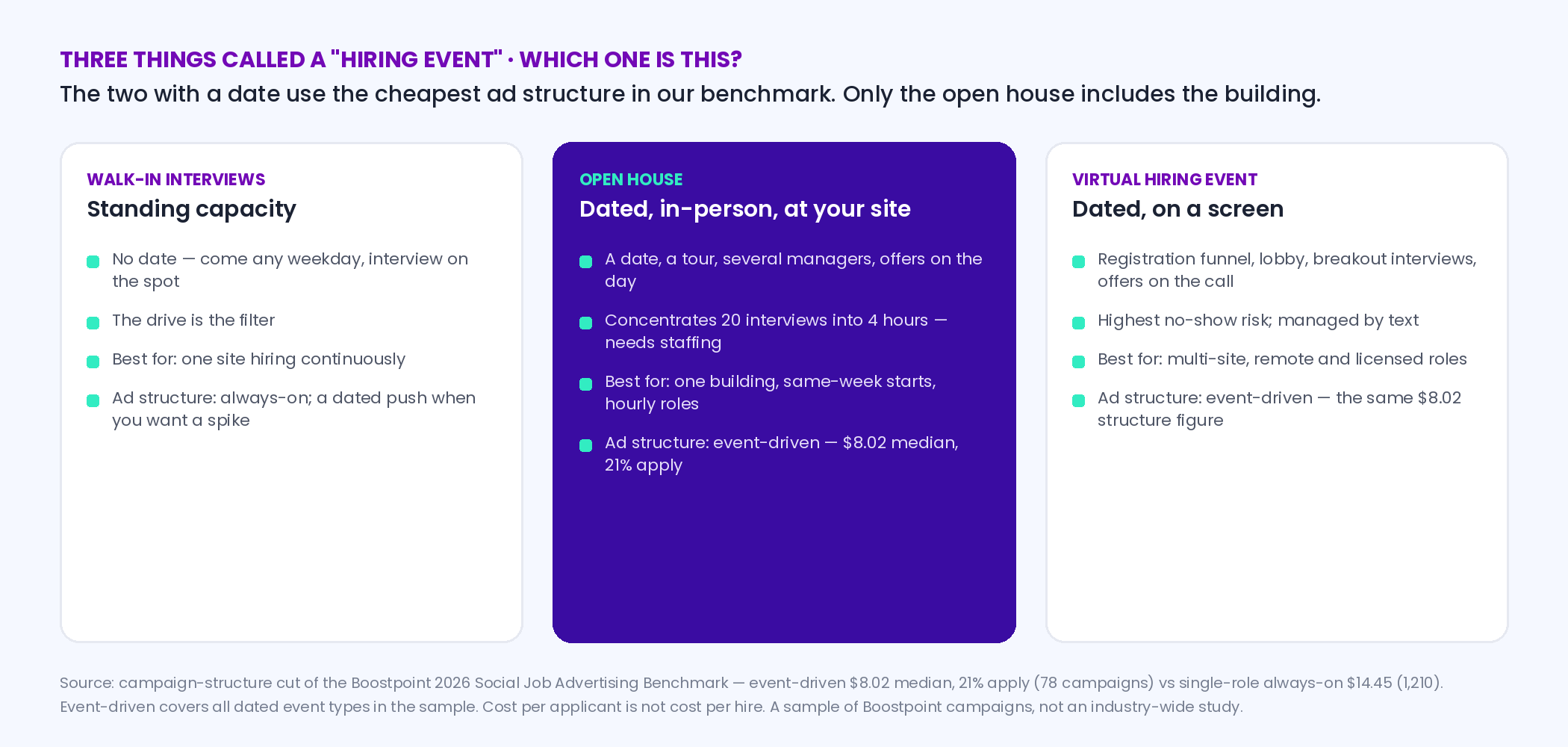
Three things get called a "hiring event," and they fail for different reasons. A walk-in model is standing capacity: come any weekday 9–4, interview on the spot. It needs no date, and its strength is that the drive is the filter — someone who shows up unannounced is serious. An open house is a dated event at your site: a Saturday morning, a Tuesday evening, with a tour, several managers, and the intention of making offers that day. Its strength is concentration — twenty interviews in four hours instead of twenty across three weeks — and its risk is that concentration needs staffing. A virtual hiring event is the same dated funnel on a screen, for roles and regions where nobody can come to the building. The dated formats share the benchmark's cheapest ad structure; only the open house lets a candidate see the floor, the break room, and the person they'd work for.
| Structure | Median cost per applicant | Blended average | Apply rate | Click-through rate | Campaigns |
|---|---|---|---|---|---|
| Event-driven (dated event, orientation, class start) | $8.02 | $5.93 | 21% | 1.53% | 78 |
| Multi-role / always-on | $9.83 | $14.16 | 12% | 1.10% | 46 |
| Single-role, always-on | $14.45 | $7.82 | 18% | 1.36% | 1,210 |
| All 891 campaigns | $13.88 | $8.02 | — | — | 891 |
The reason a date is cheap is not mysterious. "Register for Saturday" is a smaller decision than "apply for this job," so more of the people who click finish; and an event campaign runs for ten days, not forever, so the audience sees it while it is still news. In an event campaign the registrant is the applicant — a name, a mobile number, two knockout questions, and a time slot — which is the shortest post-click path there is, and post-click conversion explains 70% of cost variation across the benchmark.
The five stations, and how each one fails
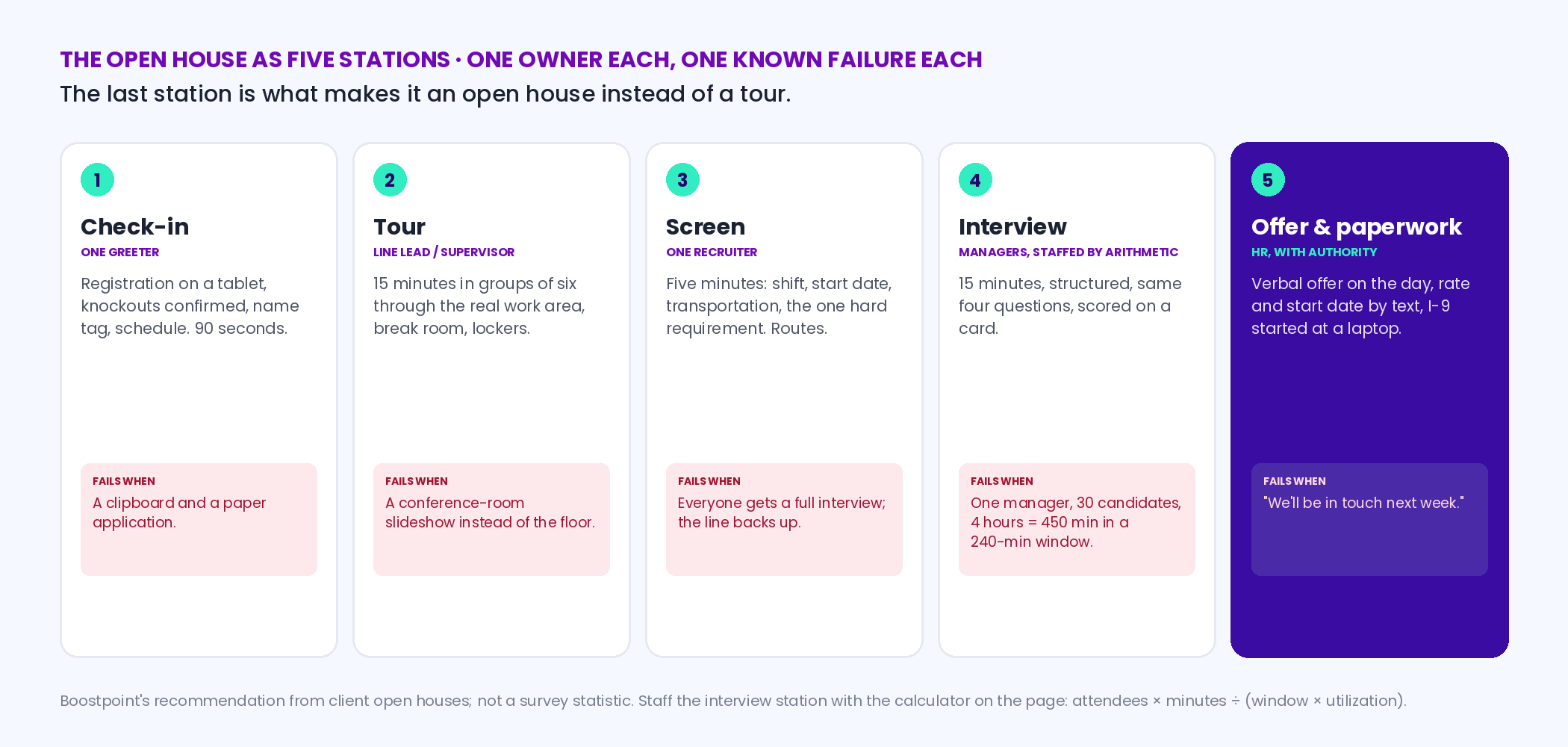
An open house is a small production. The candidates who come are giving up a Saturday morning; the ones who leave without an answer tell their friends. Run it as five stations with one named owner each, and know in advance what each station's failure looks like — because every one of them has a standard failure, and all five are avoidable.
Pull up the registration on a tablet, confirm the knockouts, hand over a name tag and a one-page schedule. Ninety seconds.
Fails when: a clipboard and a paper application. You paid for the registration already; don't make them fill it in again.
Fifteen minutes, in groups of six, through the actual work area, break room, and lockers. The person who'd be their supervisor talks; HR doesn't.
Fails when: the tour skips the floor. People came to see the job; a conference-room slideshow tells them it's worse than it looks.
Five minutes: shift, start date, transportation, the one hard requirement. Routes each candidate to the right interviewer — or to a polite "not today" with a next event date.
Fails when: everyone gets a full interview. The interview station backs up, the last hour is a waiting room, and the best candidates leave.
Fifteen minutes, structured, the same four questions for everyone, scored on a card. The calculator below says how many interviewers you need.
Fails when: one manager, thirty candidates, four hours. That is 450 minutes of interviews in a 240-minute window.
Verbal offer on the day, rate and start date in writing by text before they leave, background check and I-9 started at a laptop station.
Fails when: "we'll be in touch next week." Then it wasn't an open house; it was a job fair with a tour.
The case for a job fair or a staffing agency instead, made fairly
Two alternatives deserve a fair hearing. A multi-employer job fair — a workforce board's, a chamber's, a community college's — costs a table fee and a morning, brings foot traffic you didn't have to generate, and puts you in front of people who came to compare employers. For a brand nobody knows in a market you're entering, that is a cheap way to be seen, and the organizer does the promotion. Its weakness is the same as its strength: the traffic isn't yours, the candidates are comparison-shopping in real time, and you can't tour them through a building that's across town. A staffing agency solves the other problem an open house can't — people on the floor this week with no event at all — at a temp markup that our staffing agency markup page works through with third-party fee ranges. If you have no pipeline and a line down, the agency is the honest answer for this week and the open house is the answer for next month.
Staffing the interview station by arithmetic
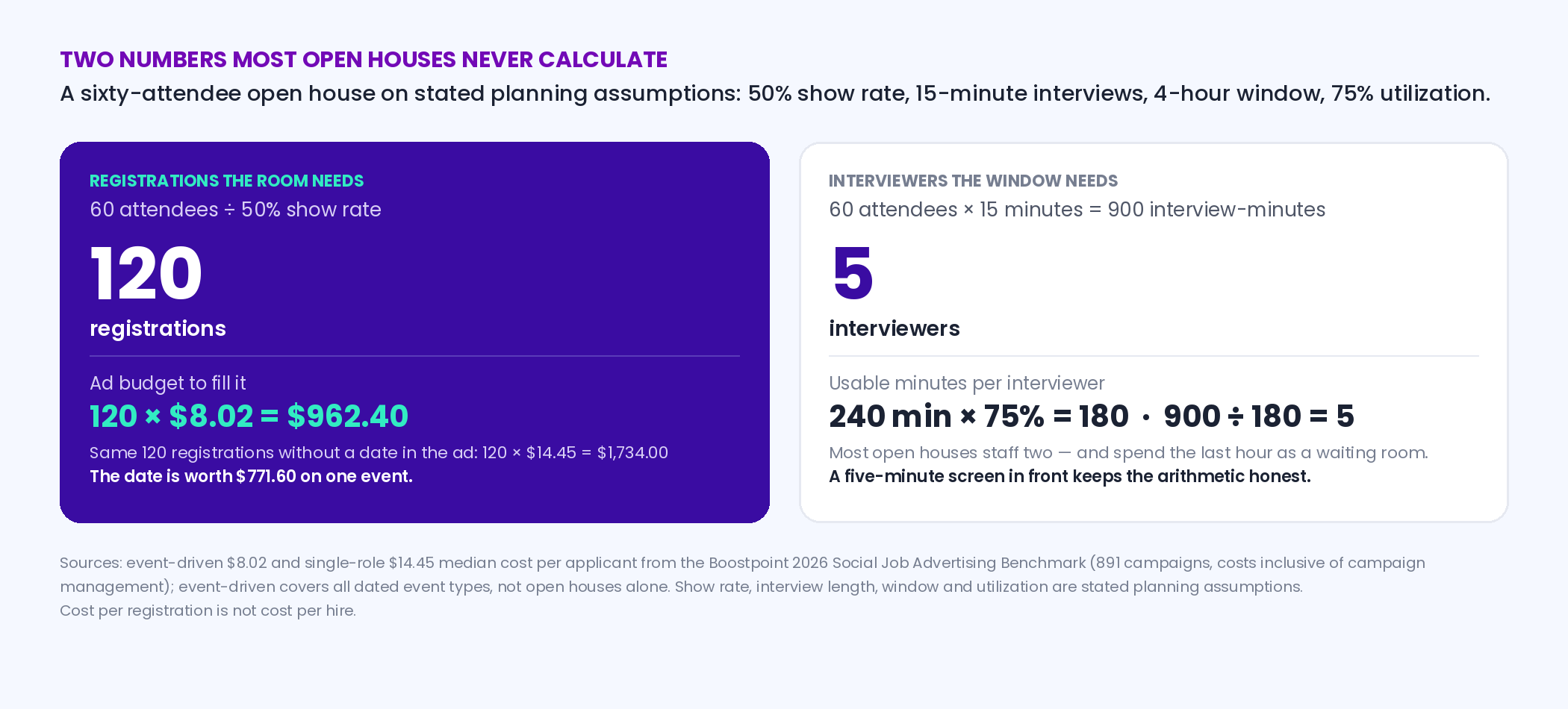
The interview station is where open houses fail, and it fails on a number nobody calculated. Interviewers needed = attendees × minutes per interview ÷ (window minutes × the share of the window an interviewer is actually interviewing). Sixty attendees at fifteen minutes each is 900 interview-minutes; in a four-hour window at 75% utilization — breaks, no-shows, the candidate still on the tour — that is 180 usable minutes per interviewer, so you need five. Most open houses staff two.
Nothing is stored or sent — this runs in your browser. Interviewers = attendees × minutes per interview ÷ (window minutes × utilization), rounded up.
900 interview-minutes ÷ 180 usable minutes each
60 attendees ÷ 50% show rate
120 × $8.02
Illustrative arithmetic from stated inputs. Utilization and show rate are planning assumptions to replace after your first event; $8.02 is the benchmark's event-driven median cost per applicant across all dated event types, not an open-house figure. Cost per registration is not cost per hire.
Filling the room: the ten days before
- Day −10: launch the dated ad. First line: "Saturday, Oct 4 · 9 a.m.–1 p.m. · 200 Mill Rd · forklift, packers, 2nd shift · $19–$21/hr · tour, interviews and offers on the day · register in 60 seconds." Registration is the application: name, mobile, two knockouts, a time slot.
- Day −10 to −1: watch frequency, not just registrations. A short campaign hits the same local audience fast. Benchmark-wide, cost per applicant rises from $11.48 at a frequency of 1.5–2.0 to $26.78 above 4.0; check it every other day and widen the radius or refresh the creative when it passes 2.5.
- Day −3: text every registrant the address, the slot, and a photo of the door they'll walk in. Parking, the entrance, and "ask for Maria" remove the three reasons people drive past.
- Day −1: text again, with one question: "Still coming at 10?" The reply is your real show rate for the morning; the non-replies get a second slot offered.
- Day 0, 30 minutes out: the last text. Then run the five stations, and put the next event's date on the thank-you screen for everyone who didn't get an offer.
- Day +1: text the no-shows the next date. Two open houses a month sharing one funnel out-hire one a quarter that starts from zero.
The math for a sixty-attendee open house
Say you plan for 60 attendees and a 50% show rate — a stated planning assumption; use your own after the first event — so you need 120 registrations. At the benchmark's event-driven median, 120 × $8.02 = $962.40 in ad spend to fill the room. The same 120 registrations at the single-role median — reaching the same people with an ad that has no date in it — would be 120 × $14.45 = $1,734.00; the date is worth $771.60 on one event. On the day, 60 attendees at 15 minutes each is 900 interview-minutes, which in a 240-minute window at 75% utilization needs 5 interviewers. Cost per registration is not cost per hire: how many of the 60 leave with an offer depends on your screen, your interviewers, and whether station five has authority.
An open house is the building making the pitch — filled by a dated ad, run as five stations, and finished by someone who can say yes before the candidate reaches the parking lot.
If you would rather assess in one scheduled session than in five stations, the same room runs as a group interview, and that page has the seventy-five-minute structure and the scoring sheet.
Frequently asked questions
What is an open house hiring event?
A scheduled, in-person event at your own site — a Saturday morning or a weekday evening — where registered candidates check in, tour the actual work area with a supervisor, are screened in five minutes, interview for fifteen, and receive verbal offers on the day. It differs from walk-in interviews, which are standing any-time capacity, and from a virtual hiring event, which runs the same dated funnel on a screen. The date is what makes it cheap to fill: in our 2026 benchmark, event-driven campaigns ran an $8.02 median cost per applicant against $14.45 for single-role always-on ads.
How do you get people to come to a hiring open house?
Run a dated ad for ten days with the date, time, address, roles, pay range, and "tour, interviews and offers on the day" in the first line, and make registration the application — name, mobile, two knockouts, and a time slot, in-platform, under a minute. Then manage the show rate: text the address, slot, and a photo of the door three days out, ask "still coming?" the day before, text 30 minutes out, and offer a second slot to anyone who doesn't reply. Plan on a stated 50% show rate until you have measured your own.
How many interviewers do we need for an open house?
Attendees × minutes per interview ÷ (window minutes × utilization), rounded up. Sixty attendees at fifteen minutes is 900 interview-minutes; a four-hour window at 75% utilization gives each interviewer about 180 usable minutes, so you need five. Most open houses staff two and spend the last hour as a waiting room. A five-minute screening station in front of the interviewers keeps the arithmetic honest by routing only eligible candidates through.
What's the difference between an open house and walk-in interviews?
A walk-in model is standing capacity — come any weekday, interview on the spot — with no date and no campaign spike; its filter is the drive itself. An open house is a dated event with a registration funnel, a tour, several managers, and the intention of making offers that morning; it concentrates twenty interviews into four hours and needs staffing to match. Both are covered by the benchmark's event-driven structure when advertised with a date; the on-the-spot page has the walk-in model's worked example.
Should we make offers on the day?
Yes — that is the difference between an open house and a job fair with a tour. Station five is HR with authority: a verbal offer, the rate and start date by text before the candidate leaves, and background check and I-9 started at a laptop station. Candidates who leave with "we'll be in touch next week" go to the next employer's event; the ones who leave with a start date tell their friends. If your process can't produce an offer on the day, fix the process before you run the event.
How much does an open house hiring event cost?
Three lines: the room and refreshments (yours), staff time on the day (a greeter, a tour lead, a screener, interviewers by arithmetic, HR), and the campaign that fills it. Only the last has public benchmark data: event-driven campaigns ran an $8.02 median cost per applicant across 78 campaigns in our 2026 benchmark, so a 60-attendee event needing 120 registrations on a stated 50% show rate costs $962.40 in ad spend. We publish no cost per hire; the hires depend on your screen, your interviewers, and your offers.
Should I use a multi-employer job fair instead?
For a brand nobody knows in a new market, a workforce-board or chamber job fair is a cheap way to be seen: a table fee, a morning, and foot traffic the organizer generated. Its limits are that the traffic isn't yours, candidates are comparing employers in real time, and you can't tour them through a building across town. Many employers do both — the job fair to be seen, then an open house at the site two weeks later for the people they met — and the second event is where the offers happen.
How often should we run open houses?
Twice a month sharing one funnel beats once a quarter starting from zero. Every registrant who didn't show and every attendee who didn't get an offer receives the next date by text, so the second event opens with a warm list; the ad campaign runs ten days each time and stays under the frequency level where cost climbs. For sites that hire continuously, a standing walk-in window between open houses catches the people who can't wait two weeks.
What should be on a hiring event flyer?
Six things legible from four feet: the named roles, the pay or pay range, the day and time window, the street address with which door and where to park, what to bring (usually a photo ID and nothing else), and one instruction. Make a tall version for print and a square version for phone feeds.
Do hiring events hire on the spot?
Many do, and the ones that advertise it change who turns up — people who need work now rather than people browsing. It requires offer authority in the room and any background check or drug screen to be named as a contingency in the offer. Decide this two weeks out, not on the day.
How do I run a hiring event that people show up to?
Give it a date, an address and a reason to come that day, then manage attendance like a funnel. Run a dated ad for about ten days naming the roles, pay range, address and "interviews and offers on the day," and make registration a one-minute form with a time slot. Text the address three days out, ask "still coming?" the day before, and text again 30 minutes out. Plan on a 50% show rate until you have measured your own, and staff interviewers for the people who come.
How do you promote a hiring event?
Concentrate rather than spread: text your own applicants from the last 90 days first, run paid social in a tight radius for about ten days at real frequency, give your employees a square flyer image and a referral bonus that vests on the first completed shift, and place physical flyers where your candidates already stand still.
How far in advance should you promote a job fair?
Advertising should be live ten days out. That window is where attendance is actually bought; nothing done in the final 48 hours moves it much beyond a reminder text to people who already said they were coming.
What are good recruiting event ideas?
A hire-on-the-spot day, a shift-shadow hour where candidates walk the floor during a real shift, a bring-a-friend night built around your own staff and referral bonuses, and a second-shift event held in the evening or early morning — because almost every hiring event runs during the hours your candidates are already at work.
Fill your next open house
We'll show you what event-driven campaigns cost across 891 real campaigns — and build the dated ad and 60-second registration that put people at your door.
Book a DemoAdvertising figures come from the campaign-structure and frequency cuts of the 2026 Social Job Advertising Benchmark — 891 campaigns and 1,334 campaign-months overall: event-driven $8.02 median cost per applicant, $5.93 blended (volume-weighted) average, 21% apply rate, 1.53% click-through rate, 78 campaigns; multi-role always-on $9.83 median, $14.16 blended, 12% apply rate, 1.10% click-through rate, 46 campaigns; single-role always-on $14.45 median, $7.82 blended, 18% apply rate, 1.36% click-through rate, 1,210 campaigns; benchmark-wide $13.88 median and $8.02 blended; frequency bands $11.48 (1.5–2.0) and $26.78 (over 4.0); post-click conversion explaining 70% of cost variation. Event-driven figures cover all dated event types in the sample, not open houses alone. The sixty-attendee example and the calculator use stated planning assumptions — 50% show rate, 15-minute interviews, a 240-minute window, 75% interviewer utilization, $8.02 per registration — to be replaced with your own measured figures; 60 ÷ 0.5 = 120 registrations; $962.40 and $1,734.00 resolve exactly from 120 × $8.02 and 120 × $14.45, and $771.60 is their difference; 60 × 15 = 900 interview-minutes ÷ (240 × 0.75 = 180) = 5 interviewers. Cost per registration (applicant) is not cost per hire; we do not track hires and publish no cost-per-hire figure. No third-party statistics are used on this page; the station model and the ten-day sequence are Boostpoint's recommendations. This is a sample of Boostpoint campaigns, not an industry-wide study.