
Virtual Hiring Events That Fill Roles — and the Ads That Fill the Event
A virtual hiring event fills roles when three things are true: the registration funnel is fed by ads with a date in them, the no-show rate is managed like a metric rather than mourned like weather, and offers happen on the call. The evidence for the first is in Boostpoint's 2026 Social Job Advertising Benchmark: event-driven campaigns ran an $8.02 median cost per applicant against $14.45 for single-role always-on campaigns, with a 21% apply rate. The platform is the least important decision on this page.
A note on who's writing this
Boostpoint sells the social ad campaigns that fill hiring events, so this page has an obvious bias: we think the registration funnel is where virtual events are won or lost, and we sell the funnel. We do not sell an event platform, we don't take referral fees from any, and the vendor section below says which ones publish pricing (none of the three we checked) and what each is genuinely best at. The advertising figures come from the campaign-structure cut of our 2026 Social Job Advertising Benchmark; the attendance trends are the National Association of Colleges and Employers' (NACE), cited where used. This page sits with our frontline recruiting pages. If your event is in a building, our on-the-spot hiring and walk-in interviews page covers that model; if it is a surge across sites, mass hiring does. This one is about the screen.
Start with the uncomfortable trend
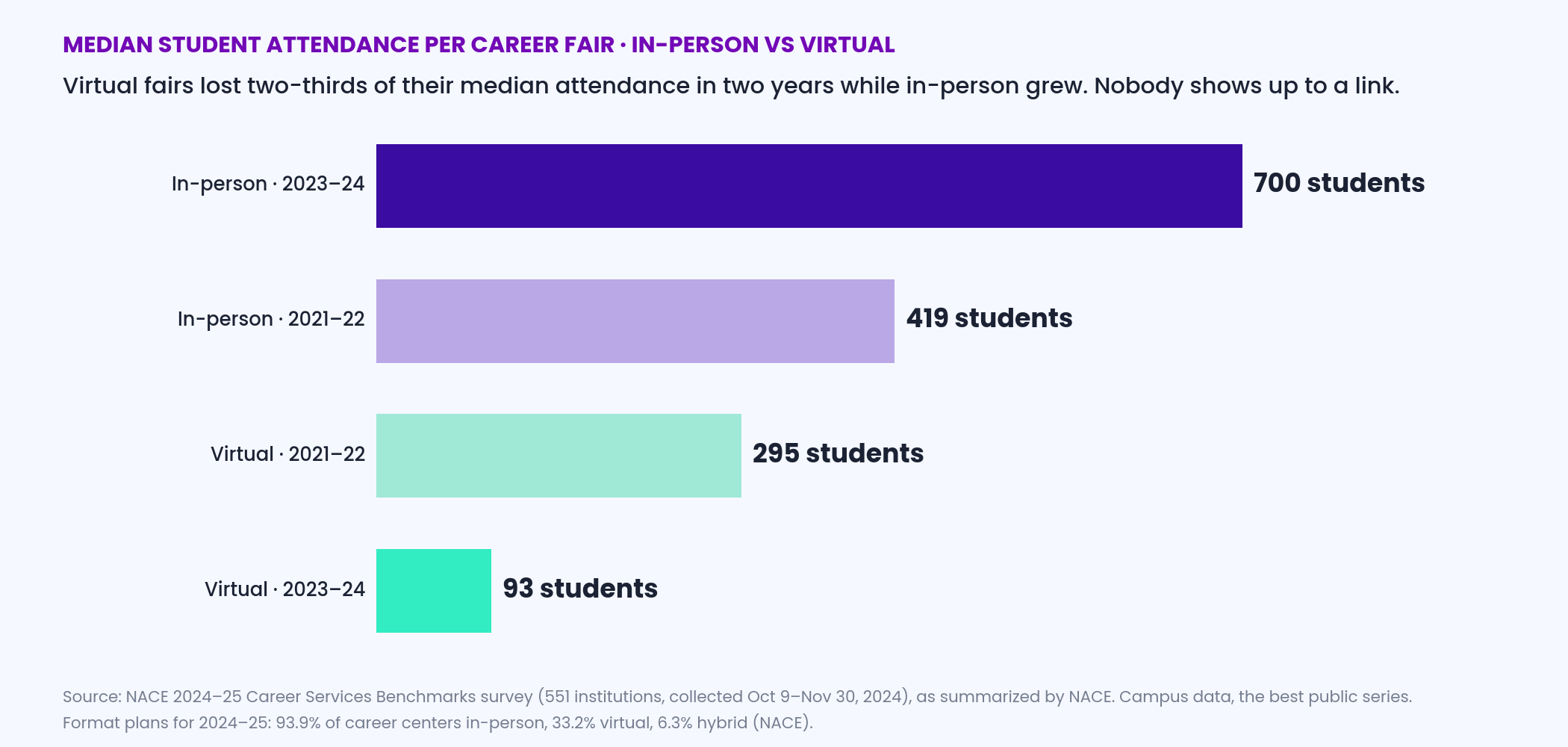
Virtual career fairs peaked in 2021 and have been shrinking since. NACE's 2024–25 Career Services Benchmarks survey (551 institutions, collected October–November 2024) found 93.9% of career centers planned in-person fairs for the year, 33.2% planned virtual ones, and 6.3% hybrid. Median student attendance at in-person fairs rose from 419 in 2021–22 to 700 in 2023–24; at virtual fairs it fell from 295 to 93. Employer attendance moved the same way. NACE's summary: "both groups prefer to attend career fairs in person." That is campus recruiting, not frontline hiring — but it is the best public attendance data there is, and the lesson transfers: a virtual event does not draw a crowd by existing. People come because something reached them with a date, a role, and a reason. That is a funnel, and it can be built.
Why events are the cheapest thing we run
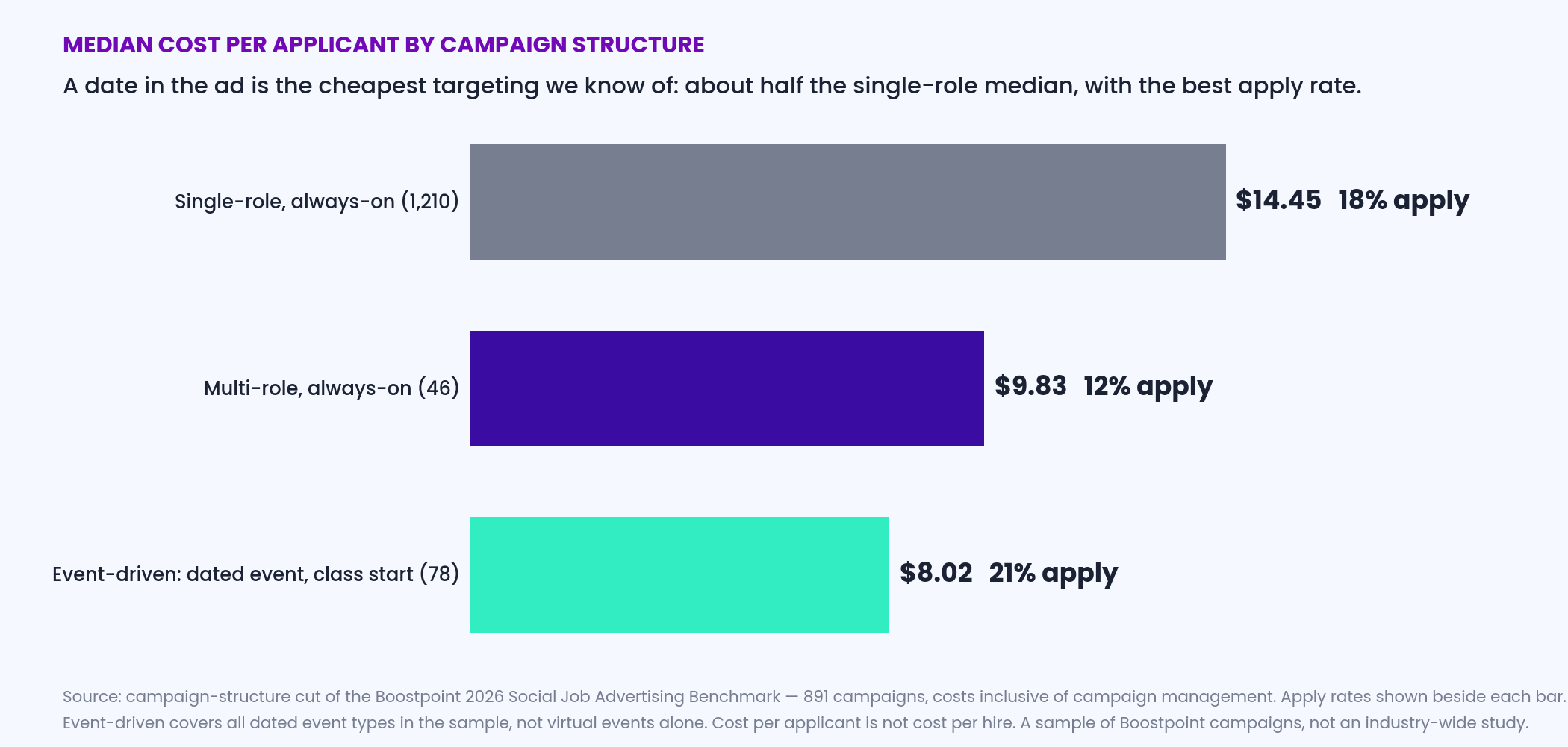
Across the 891 campaigns in our benchmark, the structure of a campaign predicts its cost better than most targeting choices. Always-on single-role campaigns — one job, running indefinitely — are the default and the most common (1,210 campaign-months), and they ran a $14.45 median cost per applicant with an 18% apply rate. Event-driven campaigns — a dated hiring event, an orientation, an open house, a class start — ran an $8.02 median with a 21% apply rate and a 1.53% click-through rate, the best of any structure. The blended averages tell the same story from the other direction: $5.93 event-driven against $7.82 single-role.
| Structure | Median cost per applicant | Blended average | Apply rate | Click-through rate | Campaigns |
|---|---|---|---|---|---|
| Event-driven (dated event, orientation, class start) | $8.02 | $5.93 | 21% | 1.53% | 78 |
| Multi-role / always-on | $9.83 | $14.16 | 12% | 1.10% | 46 |
| Single-role, always-on | $14.45 | $7.82 | 18% | 1.36% | 1,210 |
| All 891 campaigns | $13.88 | $8.02 | — | — | 891 |
Why does a date work? Because it converts a vague intention ("I should look for something") into a decision with a deadline, and because "register for Thursday" is a smaller ask than "apply for this job." In an event campaign the applicant is the registrant: a name, a mobile number, and two or three knockout answers, collected in the platform in under a minute. Benchmark-wide, what happens after the click explains 70% of cost variation, and a registration form is the shortest post-click path there is. The virtual part changes nothing about that arithmetic — it changes what you have to do to make sure the registrant shows up on a screen instead of at a door.
Which format for which hire
Virtual is not the default event; it is one of four ways to compress a hiring timeline, each with a job it does well. The matrix is our read, with the on-the-spot and mass-hiring pages holding the detail for the in-person columns. The dated in-person version has its own playbook: open house hiring events.
The case for a platform vendor, made fairly
A dedicated virtual hiring event platform earns its fee in three situations. When you are running many employers or many booths — a workforce agency, a health system with twelve facilities, a campus fair — scheduling, queueing, and branded booths are real engineering, and a video-call link doesn't scale to it. When you need screening before the conversation — chat-based pre-qualification so recruiters only talk to eligible candidates — the platforms built for that save recruiter hours you can count. And when you want reporting that shows which registrant came from which source, talked to whom, and got what outcome, a platform's dashboard beats a spreadsheet stitched from three tools. Those are honest reasons to pay.
Where the case weakens is the single-employer, single-evening event that most frontline hiring actually is: eight roles, one region, a 90-minute window, and a hiring manager who can say yes. That event runs on a scheduling link, a video tool you already pay for, and a campaign that fills it — and the platform's monthly fee becomes the largest line in the budget without adding a single registrant. The vendors below are graded on what they are best at; none of the three we checked publishes pricing, and we won't invent it.
| Platform | Genuinely best at | Pricing | What the vendor says (their claim) |
|---|---|---|---|
| Radancy (formerly Brazen) | Enterprise hiring events inside a wider recruitment-marketing suite; Brazen was acquired by Radancy in October 2023. | Not published in the public materials we could reach | Radancy describes the deal as adding "award-winning hiring event capabilities" to its talent acquisition cloud (Radancy, Oct 2023). |
| Premier Virtual | Workforce agencies and multi-employer job fairs; booths, 1-on-1 video, hybrid events via QR codes. | Not published — "Request pricing" | Calls itself "the leading virtual and hybrid job fair platform trusted by workforce agencies, employers, and educational institutions" (Premier Virtual). |
| vFairs | Large branded virtual fairs with many sessions and booths; add-ons for accessibility, managed services, and extra attendees. | Not published — quote-based; "you pay only for what your events actually need" | Lists virtual career fairs and job fairs as event formats; makes no performance claims on its pricing page (vFairs). |
| Your existing video tool + a scheduling link | Single-employer events under a few hundred registrants; the 90-minute regional event with offers on the call. | Whatever you already pay; check your plan's webinar and breakout limits | No claims — it's a video call. The registration funnel and the reminders are the product. |
The registration planner
Work backwards from the hires. Every virtual event has four conversion steps — registrations to attendees, attendees to offers, offers to accepts — and each is a number you can measure after one event and plan with before it. The defaults are stated planning assumptions, not benchmarks; the cost per registration default is the benchmark's event-driven median, because in an event campaign the registrant is the applicant.
Nothing is stored or sent — this runs in your browser. Registrations = hires ÷ (show rate × offer rate × accept rate), rounded up.
84 registrations × $8.02
84 × $14.45 — what the same registrations cost without a date in the ad
Illustrative arithmetic from stated inputs. Show, offer, and accept rates are planning assumptions you should replace after your first event; the $8.02 default is the benchmark's event-driven median cost per applicant across all event types, not a virtual-event figure. Cost per registration is not cost per hire.
The playbook, in order of impact
- 1. Put the date, the roles, and "offers on the call" in the ad's first line. "Thursday 6–7:30 p.m. · RNs, LPNs, CNAs · video interviews · offers on the call · register in 60 seconds." The date is the cheapest targeting in our benchmark; the offer promise is the reason to keep the date.
- 2. Make registration the application. Name, mobile, two knockouts, a time slot — in-platform, under a minute. Don't send registrants to a portal to "complete their profile"; you will lose the 21% apply rate that event campaigns earn.
- 3. Run the campaign for 10–14 days and watch frequency. A short, dated campaign hits the same people fast. In our benchmark, cost per applicant climbs from $11.48 at a frequency of 1.5–2.0 to $26.78 above 4.0; check weekly and refresh creative or widen the audience when it passes 2.5.
- 4. Treat the no-show rate as the metric it is. Text at registration, the day before, and 30 minutes out; send a calendar invite with the link inside; keep the window to 90 minutes; offer two time slots so "I'm working" isn't a reason. Then measure show rate and put the real number in the planner.
- 5. Screen in the lobby, decide in the room. One host greets and routes; a screener confirms the knockouts in two minutes; the hiring manager interviews in a breakout with authority to extend a verbal offer and a link to start paperwork. Without the last part, it's a webinar.
- 6. Use the platform you already have unless you're running booths. Multi-employer or multi-site fairs justify a vendor; a single-employer regional event usually doesn't. Spend the difference on the campaign that fills it.
- 7. Put the next event date in the follow-up. Every registrant who didn't show, and every attendee who didn't get an offer, gets a text with the next date. Two events a month with a shared funnel beat one event a quarter with a fresh one.
For the promotion itself, including Meta's employment-ad targeting rules, event ad copy and the organic channels worth adding, see how to promote a hiring event on social media.
The math for a ten-hire event
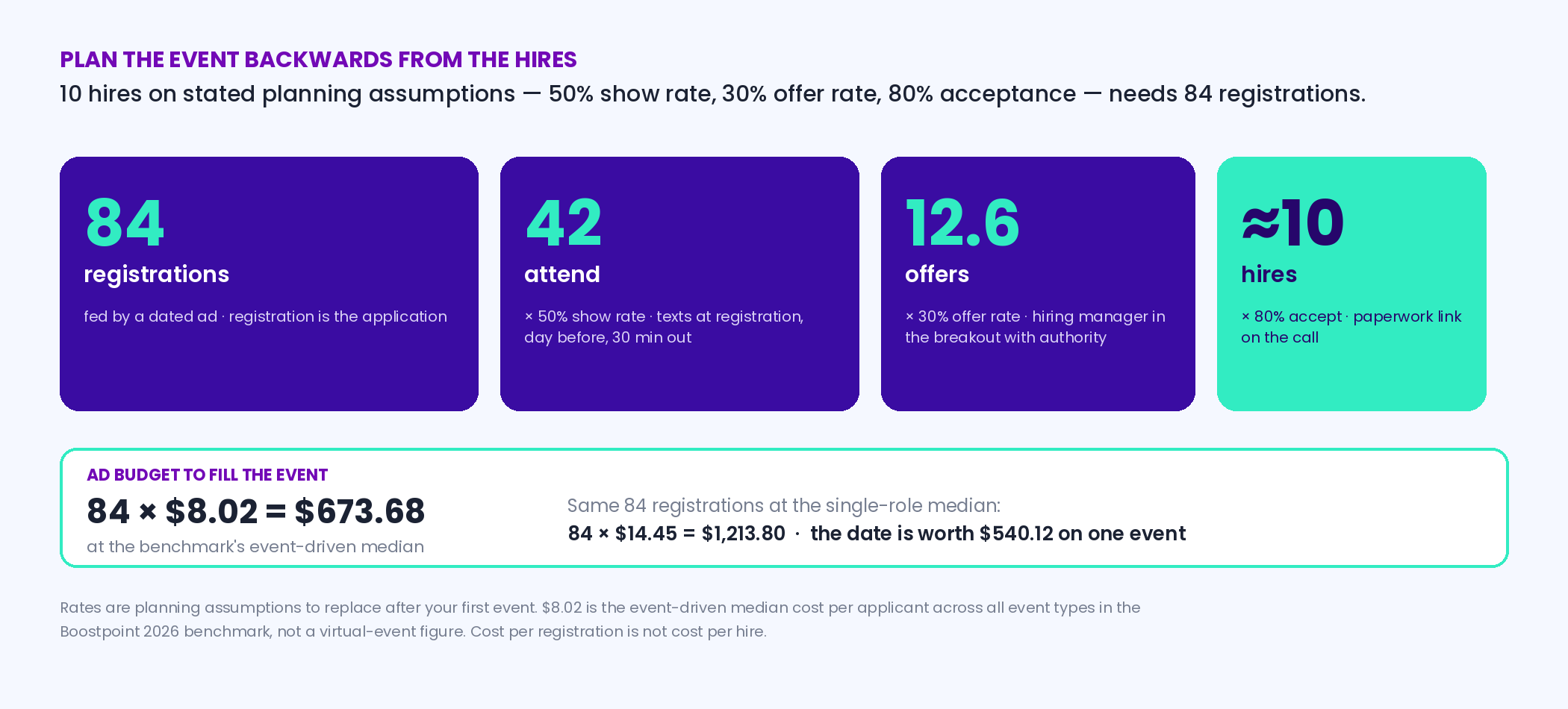
Say you need 10 hires from one virtual event and plan on a 50% show rate, a 30% offer rate, and 80% acceptance — stated assumptions to be replaced with your own after the first event. That is 10 ÷ (0.5 × 0.3 × 0.8) = 83.3, so 84 registrations: 42 attend, 12.6 get offers, about 10 accept. At the benchmark's event-driven median, 84 × $8.02 = $673.68 in ad spend to fill the event. The same 84 registrations at the single-role median — the cost of reaching the same people with an ad that has no date in it — would be 84 × $14.45 = $1,213.80. The difference, $540.12, is what a date is worth on a single event, before counting the recruiter hours a 90-minute block saves against a fortnight of phone screens. Cost per registration is not cost per hire; the hires depend on the three rates you will measure on the night.
The platform is the least important choice. A virtual hiring event is a funnel with a date on it — fed by an ad that names the roles and the offer, drained by no-shows you can text, and closed by a manager who can say yes on the call.
Frequently asked questions
What is a virtual hiring event?
A scheduled, time-boxed online event — usually 60 to 120 minutes on video — where candidates register in advance, are screened in a lobby, interview in breakout rooms, and, when it is run well, receive verbal offers on the call. It differs from a virtual career fair, which is typically multi-employer and informational, and from an always-on job ad, which has no date. The date is what makes it work: in our 2026 benchmark, event-driven campaigns ran an $8.02 median cost per applicant against $14.45 for single-role always-on campaigns.
How do you get people to attend a virtual hiring event?
Fill the registration funnel with dated ads and then manage the show rate. The ad's first line carries the date, the roles, "offers on the call," and a 60-second registration; registration is the application, in-platform, with a time slot. Then text at registration, the day before, and 30 minutes out, send a calendar invite with the link inside, keep the window to 90 minutes, and offer two slots. Measure the show rate afterwards and plan the next event with it — the planner on this page uses a stated 50% assumption until you have your own.
How many registrations do you need per hire?
Registrations = hires ÷ (show rate × offer rate × accept rate). On stated planning assumptions of 50% show, 30% offer, and 80% accept, one hire needs about 8.3 registrations, so 10 hires needs 84. Those three rates are the whole answer, and they are yours to measure: after one event you will know all three and can replace the assumptions. At the benchmark's $8.02 event-driven median cost per applicant, 84 registrations is $673.68 in ad spend; cost per registration is not cost per hire.
Are virtual hiring events better than in-person ones?
Neither is better; they fit different hires. NACE's 2024–25 survey shows the market voting with its feet on campus — 93.9% of career centers planned in-person fairs versus 33.2% virtual, and median virtual attendance fell from 295 to 93 students while in-person rose from 419 to 700. Virtual wins for multi-site and remote roles, licensed roles where a video screen is the interview, and employed candidates who can't visit mid-afternoon; in-person wins for one building, same-week starts, and hourly roles closed by a handshake and a walkthrough. Both are event-driven campaigns in our data, and both beat an undated ad on cost.
What platform should I use for a virtual hiring event?
For a single-employer event under a few hundred registrants, the video tool you already pay for plus a scheduling link is usually enough — the registration funnel and the reminders are the product. Dedicated platforms earn their fee for multi-employer or multi-site fairs with booths and queues, chat-based pre-screening, and source-to-outcome reporting. Radancy (which acquired Brazen in October 2023), Premier Virtual, and vFairs are established options; none of the three published pricing when we checked in August 2026, so budget from a quote, not from a blog post.
How much does a virtual hiring event cost?
Three lines: the platform (from zero on a tool you already have to a quote-based vendor fee that none of the major platforms publish), staff time on the night (one host, a screener per breakout, a hiring manager), and the ad campaign that fills it. Only the last has public benchmark data: event-driven campaigns ran an $8.02 median cost per applicant across 78 campaigns in our 2026 benchmark, so a ten-hire event needing 84 registrations on stated assumptions costs $673.68 in ad spend. We publish no cost per hire; the hires depend on your show, offer, and accept rates.
How do you reduce no-shows for a virtual hiring event?
Treat the show rate as a metric and work each cause. Confirm by text at registration, the day before, and 30 minutes out; put the link inside a calendar invite so it is one tap; keep the event to 90 minutes and offer two slots so shift work isn't an excuse; state "offers on the call" so attending has a payoff; and ask one commitment question at registration ("Which slot will you join?"). Then text everyone who didn't show the next date — a shared funnel across two events a month recovers more people than a longer reminder sequence for one.
Do virtual hiring events work for hourly and frontline roles?
Yes, with two conditions: the roles are clear enough to screen with two or three knockout questions, and someone on the call can extend a verbal offer. They suit multi-site employers hiring the same role across a region — home care agencies, healthcare systems, distribution networks, carriers — where an in-person open house would mean six buildings. For a single warehouse or plant filling a shift this week, a walk-in event usually converts faster; the on-the-spot page has that model. Either way, the ad structure that fills the event is the cheapest one we run.
What is a virtual hiring fair?
A virtual hiring fair is an online job fair where several employers each hold a virtual booth and candidates move between them, usually through a dedicated event platform, chatting or joining short video calls with recruiters. Colleges, workforce agencies and industry groups often organize them. It differs from a single-employer virtual hiring event, where one employer runs a dated session with screening and interviews for its own roles, and often makes offers on the call. Fairs are better for reach and employer visibility; single-employer events are better for filling specific roles quickly.
How do you stand out at a virtual hiring fair?
Treat your booth like a short job ad. Put the roles, the pay, the shifts and the locations at the top, not the company history. Staff it with someone who can screen on the spot and book the next step, collect a mobile number from every candidate you speak to, and text them the same day with an interview time or the date of your own hiring event. At a multi-employer fair the candidate may talk to several other employers the same afternoon, so the employer that follows up first has the advantage.
Fill your next virtual hiring event
We'll show you what event-driven campaigns cost across 891 real campaigns — and build the dated ad and 60-second registration that put people on the call.
Book a DemoAdvertising figures come from the campaign-structure and frequency cuts of the 2026 Social Job Advertising Benchmark — 891 campaigns and 1,334 campaign-months overall: event-driven $8.02 median cost per applicant, $5.93 blended (volume-weighted) average, 21% apply rate, 1.53% click-through rate, 78 campaigns; multi-role always-on $9.83 median, $14.16 blended, 12% apply rate, 1.10% click-through rate, 46 campaigns; single-role always-on $14.45 median, $7.82 blended, 18% apply rate, 1.36% click-through rate, 1,210 campaigns; benchmark-wide $13.88 median and $8.02 blended; frequency bands $11.48 (1.5–2.0) and $26.78 (over 4.0); post-click conversion explaining 70% of cost variation. Event-driven figures cover all dated event types in the sample, not virtual events alone. The ten-hire example and the planner use stated planning assumptions — 50% show rate, 30% offer rate, 80% accept rate, $8.02 per registration — to be replaced with your own measured rates; 10 ÷ (0.5 × 0.3 × 0.8) = 83.3, rounded up to 84 registrations; $673.68 and $1,213.80 resolve exactly from 84 × $8.02 and 84 × $14.45, and $540.12 is their difference. Cost per registration (applicant) is not cost per hire; we do not track hires and publish no cost-per-hire figure. Third-party figures: career-fair format shares (93.9% in-person, 33.2% virtual, 6.3% hybrid) and median attendance (in-person 419 → 700 students, virtual 295 → 93; employer medians 98.5 → 109 in-person, virtual down 37) from NACE's 2024–25 Career Services Benchmarks survey (551 respondents, collected October 9–November 30, 2024), as summarized by NACE; Brazen's acquisition by Radancy from Radancy's October 24, 2023 announcement; vendor descriptions and pricing status from Premier Virtual and vFairs websites, checked August 25, 2026 (Radancy's virtual-events product page could not be reached; its pricing status is stated as unverified). Vendor claims are the vendors' own. This is a sample of Boostpoint campaigns, not an industry-wide study.