
Staffing Agency Markup and Fees, Explained: What Recruiters Actually Charge
Staffing agency cost comes in four forms: temp markups of 25–100% on the worker's hourly wage depending on industry, direct hire fees of 15–30% of first-year salary, temp-to-hire conversion fees of 11–21%, and retained arrangements for executive searches. The alternative is recruiting directly: in Boostpoint's 2026 Social Job Advertising Benchmark, the median campaign cost $13.88 per applicant — applicants, not hires, so your team still screens and hires. This page decodes each fee — what it means in dollars, what it pays for, and how to compare it against recruiting the role yourself.
A note on who's writing this
Boostpoint is not a staffing agency — we run recruitment advertising, which competes with agencies for the same hiring budget, so read our framing accordingly. What we've tried to do here is the opposite of a hit piece: the fee ranges below come from staffing firms' own published rates and industry sources, cited in-table, and the "what the markup pays for" section takes the agency's side of the ledger seriously. If you're deep in one industry, the vertical breakdowns go further: how staffing agencies make money covers the business model itself. The advertising alternative we sell is managed social job advertising, priced as a fee on ad spend rather than a markup on wages.
The four ways staffing agencies charge
Temp markup
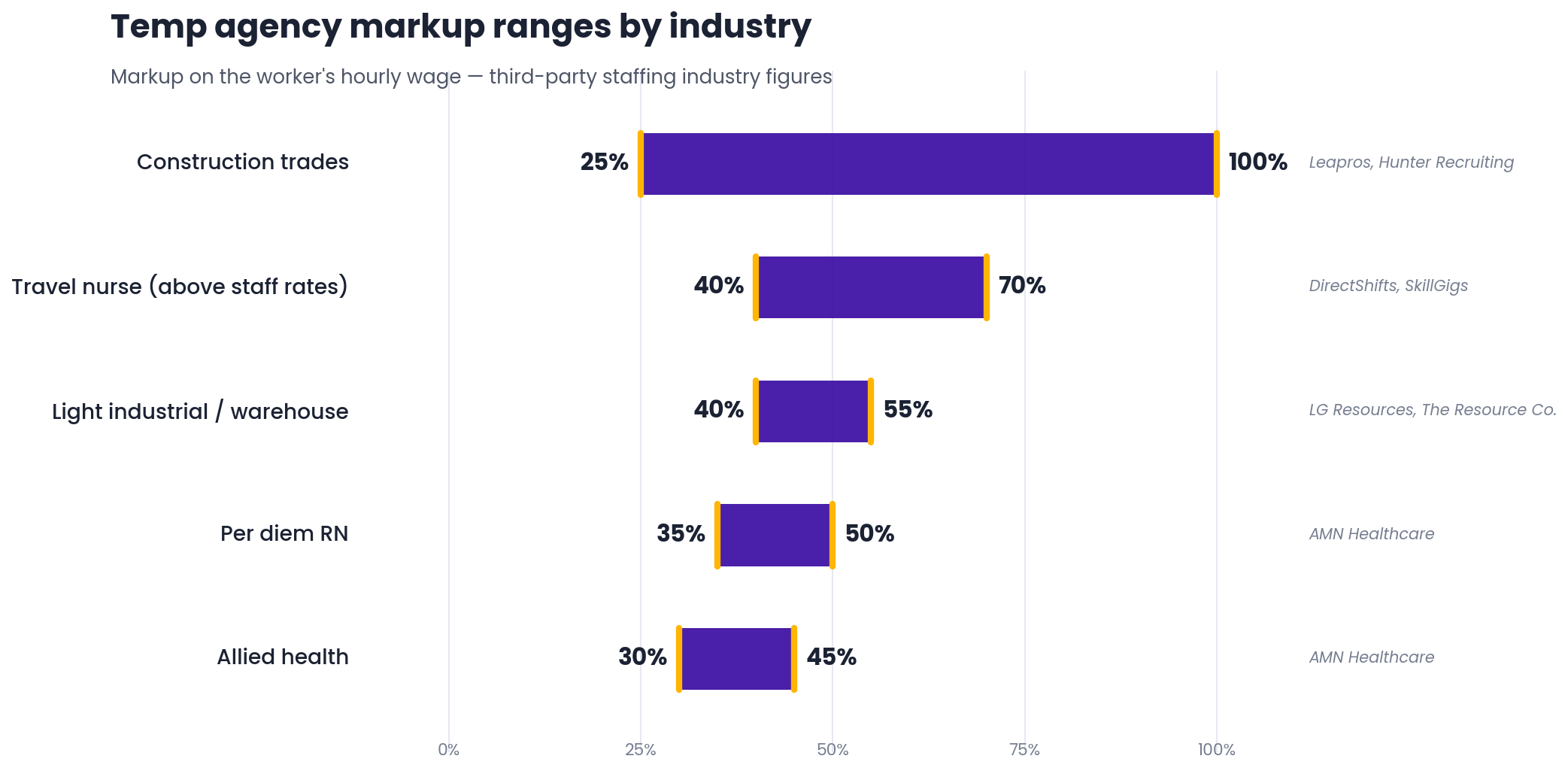
The agency employs the worker and bills you wage × (1 + markup). The range is wide because industries differ: light industrial runs 40–55%, construction 25–100%.
Direct hire fee
The recruiter sources, screens, and delivers a candidate you employ directly. Healthcare typically runs 18–25%; specialized searches push toward the top of the range.
Temp-to-hire conversion fee
Charged when a temp joins your payroll. Many contracts scale it down the longer the assignment ran — always check the schedule before converting.
Retained search
Used for executive and hard-to-fill leadership roles. Priced as a project rather than a contingency — outside the scope of most frontline hiring, so this page focuses on the other three.
Temp agency markup by industry
The markup is the number that matters for ongoing staffing, and it varies more by industry than most buyers expect. These are third-party figures from staffing firms and industry sources:
| Industry | Typical markup | Source |
|---|---|---|
| Light industrial / warehouse | 40–55% | LG Resources, The Resource Company |
| Construction trades | 25–100% | Leapros, Hunter Recruiting |
| Healthcare — per diem RN | 35–50% | AMN Healthcare |
| Healthcare — allied health | 30–45% | AMN Healthcare |
| Healthcare — travel nurse | 40–70% above staff rates | DirectShifts, SkillGigs |
Decode any markup into dollars
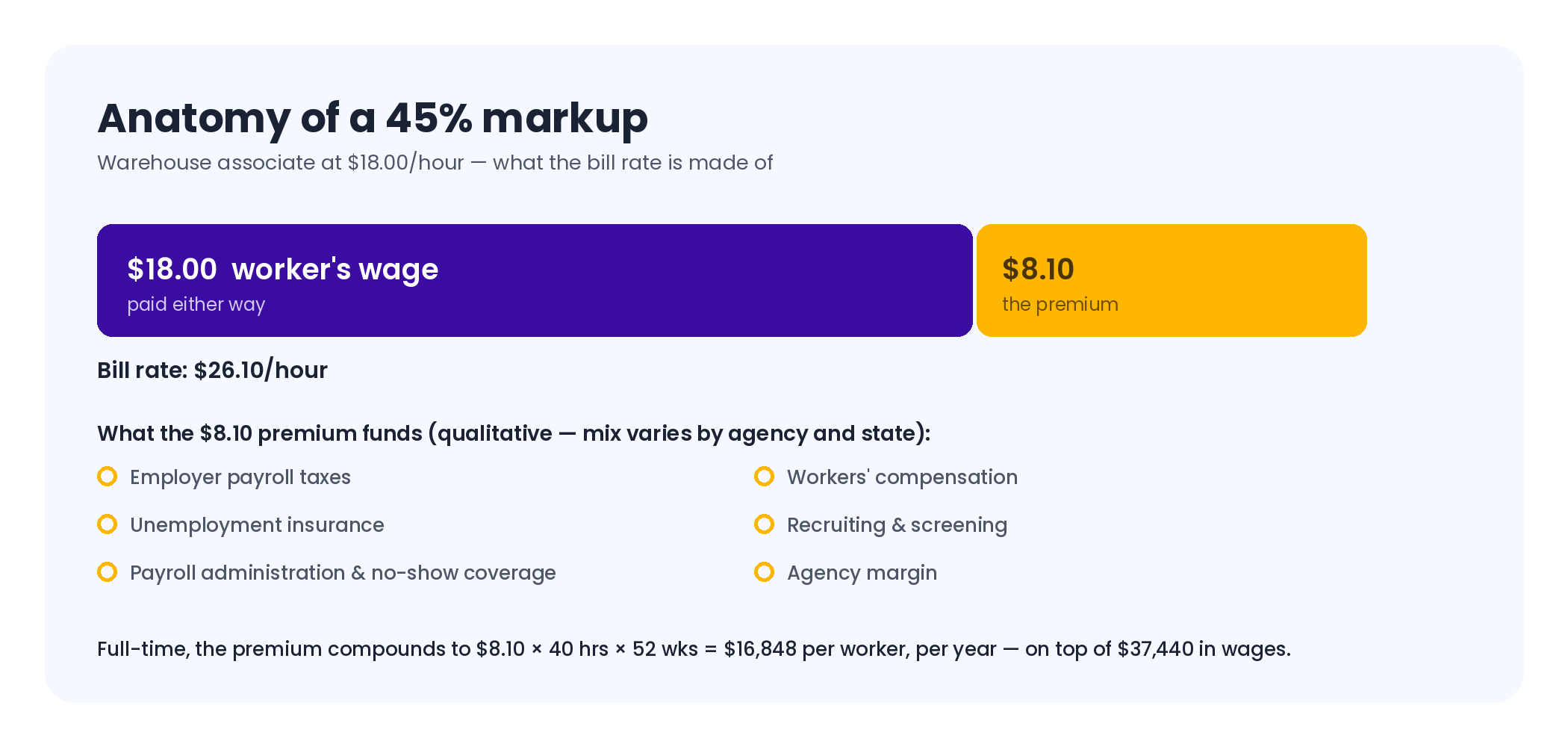
A percentage hides the annual number. Worked example first: a warehouse associate at $18.00/hour with a 45% markup bills at $26.10/hour — a premium of $8.10 every hour. Full-time, that's $8.10 × 40 hours × 52 weeks = $16,848 per year, per worker, on top of the $37,440 in wages. Ten temps at those numbers carry $168,480 in annual markup. Now run your own:
Temp agency markup calculator
What the markup actually pays for
The premium isn't padding, and pretending it is makes for bad decisions. On a temp arrangement the agency is the employer of record, so the markup carries real costs before any agency margin: employer payroll taxes, workers' compensation coverage (a serious line item in industrial and construction work), unemployment insurance, recruiting and screening, payroll administration, and replacing the no-shows. The honest question is never "why is there a markup" — it's "does this role need everything the markup buys, for as long as we'll be paying it?" A two-week census spike: probably yes. The same "temporary" workers on the floor for their second year: that markup has become the most expensive payroll tax you pay. If you're working through that question for a whole department rather than one role, staffing agency vs in-house recruiting walks it as a decision tree.
Direct hire fees: the salary math
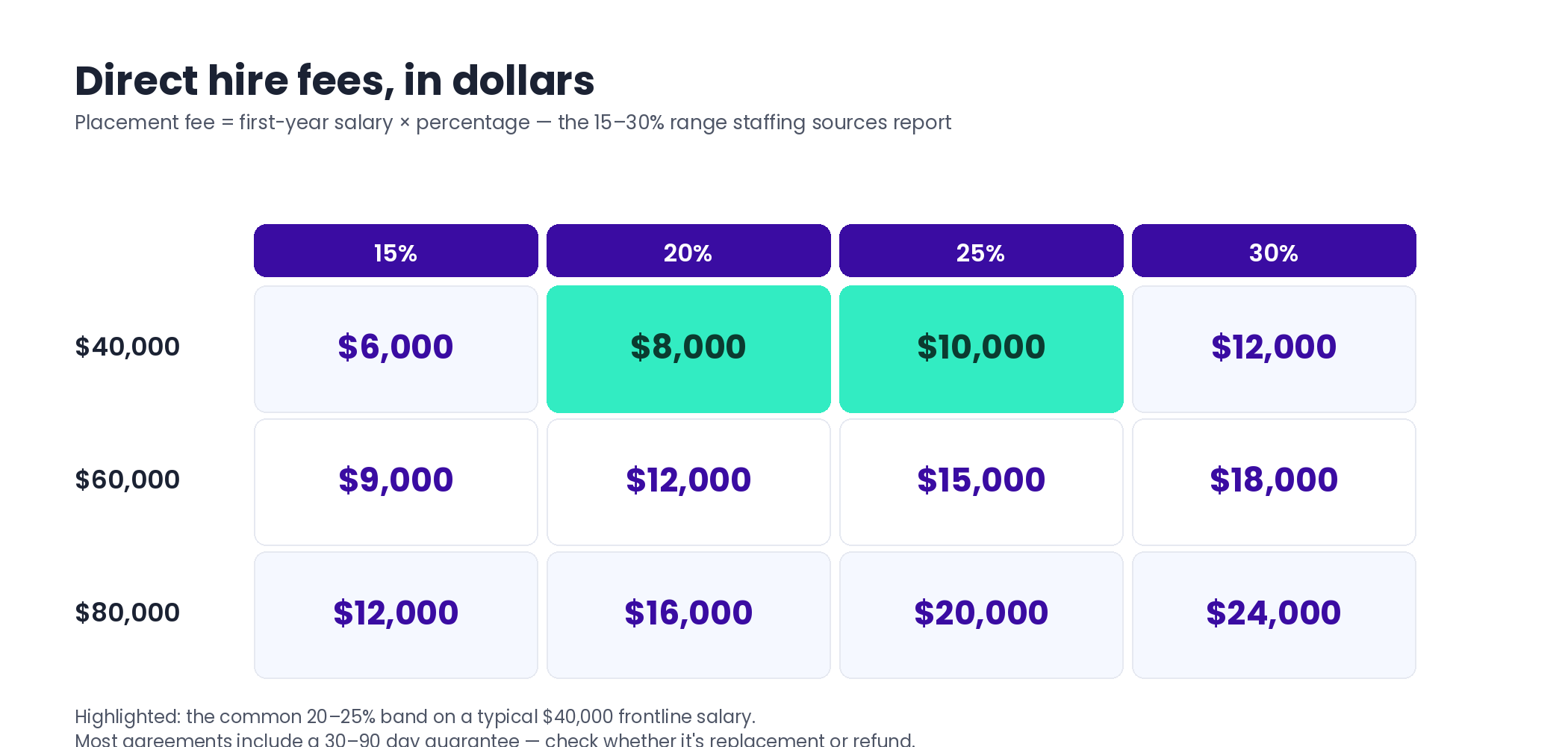
For permanent placements, the fee is a percentage of first-year salary — typically 15–30% across industries per staffing-industry sources (Instawork, Davis Companies, Frontline Source Group), with healthcare direct hires commonly quoted at 18–25% (AMN Healthcare). In dollars:
| First-year salary | 15% | 20% | 25% | 30% |
|---|---|---|---|---|
| $40,000 | $6,000 | $8,000 | $10,000 | $12,000 |
| $60,000 | $9,000 | $12,000 | $15,000 | $18,000 |
| $80,000 | $12,000 | $16,000 | $20,000 | $24,000 |
Three things worth knowing before you sign: fees are frequently negotiable, especially for multiple placements; most agreements include a guarantee period (30–90 days is common) with a replacement or refund if the hire leaves — read which one, because they are not equivalent; and the fee prices the whole service, sourcing through offer. If your team does the interviewing and closing anyway, you're paying placement-fee rates for a resume feed. And if the proposal is to hand over the whole recruiting function rather than fill single roles, that's priced differently — see RPO cost. For contingency, retained, flat-fee and fractional recruiter pricing side by side, see how much a recruiter costs.
And where the question is administration rather than supply, a PEO is the instrument: PEO cost sets out the percentage-of-payroll and per-employee-per-month models and the pass-through lines that make a headline percentage misleading.
Temp-to-hire conversion fees
The conversion fee — typically 11–21% of projected first-year salary — is what agencies charge when a temp joins your payroll. It exists for a fair reason: without it, employers would use every temp assignment as a free trial and convert on day 30. Two mechanics decide what you'll actually pay: most contracts scale the fee down as billed hours accumulate (converting after 90 days costs more than after 520 hours; some reach zero after a defined period), and the "projected salary" base is defined in the agreement, not at conversion time. On a $50,000 role, the range spans $5,500 to $10,500 — enough to make the timing worth planning rather than discovering.
Temp-to-perm conversion fees
A temp-to-perm conversion fee is the same thing as the temp-to-hire fee above, and the cheapest way to pay it is to plan the conversion date before the assignment starts. “Temp to perm” is simply the older name for the arrangement: the worker starts on the agency's payroll at a bill rate, and if you both want to keep going, you hire them onto yours and the agency is paid once for the placement it made.
The fee and the markup are two sides of one decision. Every week you wait to convert, you keep paying the markup; every week you wait may also shrink the conversion fee. Using this page's worked example, an $18.00 wage at a 45% markup carries an $8.10 premium per hour, or $324 a week at 40 hours. On a $40,000 role, a conversion fee in the 11–21% range is $4,400 to $8,400. If your contract drops the fee to zero after another eight weeks on assignment, those eight weeks cost $2,592 in markup, so waiting is cheaper than paying a $4,400 fee today. If the fee stays flat, converting sooner wins, because every extra week adds markup on top of the same fee. Run it with your own schedule; the numbers here are illustrative.
Five clauses to read before the first temp starts
- The fee basis. Is it a percentage of projected first-year salary, a flat amount, or a number of billed hours? “Projected salary” is defined in the agreement, so check whether it includes overtime or shift differentials.
- The step-down schedule. How does the fee fall as billed hours accumulate, and is there a point where conversion is free? Write that date in the assignment record.
- The tail period. Many agreements charge the fee if you hire the worker within a set time after the assignment ends, including through another agency. Know how long it runs.
- Buyout vs conversion. Some contracts price an early buyout differently from a conversion at the end of a minimum assignment. Ask for both numbers in writing.
- Who else counts. Check whether the fee applies to candidates the agency only submitted, or only to people who actually worked an assignment for you.
Temp-to-perm is worth its price when you genuinely need to see someone work before committing. For roles you fill every month, a direct pipeline removes both the markup and the conversion fee; see temp-to-hire in our glossary and staffing agency vs in-house recruiting for the decision itself.
So how much do recruiters charge, all-in?
Pulling it together — the answer to "how much do recruiters charge" is always one of these three structures, and the real comparison is against the role's duration:
- Short-term coverage: the temp markup (25–100% by industry) is the whole cost, and for genuinely short needs it's usually the cheapest professional option available.
- One permanent role: the direct hire fee (15–30% of salary) prices a full-service search — $8,000–$12,000 on a typical $40,000 frontline salary.
- Temp who worked out: the conversion fee (11–21%), shrinking with assignment length.
What the alternative costs
The other way to fill the same roles is generating your own applicants. Across the 891 campaigns in our 2026 Social Job Advertising Benchmark, the volume-weighted average was $8.02 per applicant (median campaign $13.88) — applicants, not placements, so your team still screens and hires. The comparison only resolves with your own applicants-per-hire ratio, but the scale of the gap is why this page exists: a $10,000 placement fee funds roughly 1,247 applicants at $8.02. The vertical pages run this math against real agency rates in each industry:
- Truck driver recruiting agency costs and construction staffing agency costs
- Caregiver staffing agency costs and healthcare staffing costs across roles
- Warehouse, manufacturing, and hospitality staffing agency costs
When agency fees are worth paying
- Speed you can't build. A staffed bench can cover shifts this week; no recruiting channel can. For coverage emergencies, the markup is the price of time.
- Employer-of-record burden you don't want. Payroll taxes, workers' comp, and no-show replacement are real work. For fluctuating headcount, renting that infrastructure can beat building it.
- Scarce, credentialed searches. Roles where the candidate pool is small and passive — a placement fee for a specialist a recruiter already knows is often cheaper than months of advertising into a thin market.
- A trial you genuinely need. Temp-to-hire prices the option to evaluate before committing, and for some roles that option is worth its fee.
When they're not
- Recurring frontline hiring. Roles you fill every month, all year, are annuity revenue for an agency and an owned pipeline waiting to happen for you.
- "Temporary" workers who never leave. Every month past the genuine need converts the markup from a service fee into a standing tax — at 45% on $18.00/hour, $1,404 per worker per month.
- Paying full fees for partial service. If your team screens, interviews, and closes, a full placement fee is buying sourcing alone — price it that way.
- Converting temps without checking the schedule. The difference between converting at 60 days and at the fee-free threshold is thousands of dollars per person. Read the contract before the handshake.
Markups and fees aren't tricks — they're prices for speed, employment infrastructure, and search. Pay them when you're buying those things. The expensive mistake is paying them for recurring roles a pipeline you own would fill — every month, without a fee.
Headhunter and recruiter fees: contingency, retained, flat and hourly
"Staffing agency", "recruiting agency" and "headhunter" get used interchangeably, but the work is paid for in four distinguishable ways, and which one you are quoted decides both what you pay and when you pay it.
| Model | How it is charged | Reported range | When you pay |
|---|---|---|---|
| Contingency search | A percentage of the hire's first-year salary | 15–25% of annual salary, with 20% the most commonly quoted single figure; entry-level roles nearer 10–15% and executive-level contingency reaching 25–30% | Only if a hire starts |
| Retained search | A percentage of first-year or total compensation, invoiced in installments | 25–40% of salary, commonly split into three equal parts — engagement, shortlist, placement | Partly up front, whether or not you hire |
| Flat or fixed fee | One price per hire, independent of salary | $5,000 to $30,000 depending on seniority and how hard the search is | On placement, or at agreed milestones |
| Hourly or embedded recruiter | An hourly rate for recruiting work rather than for an outcome | $75 to $250 an hour | As the hours are worked |
| Contract placement | A multiplier applied to the worker's hourly wage | Usually quoted as a multiple — a 1.5× multiplier on a $30.00 wage is a $45.00 bill rate | Every hour the worker is on assignment |
What a placement fee is, and when you get it back
A placement fee is the one-time charge for a permanent hire — the contingency or retained percentage converted into dollars at the moment the candidate accepts. It is not a markup and it does not recur: you pay once, and the person is your employee from the first day. Two clauses decide what it is really worth.
- The salary basis. Fees are normally calculated on first-year base salary, with bonus, commission, equity and benefits excluded unless the engagement agreement expressly says otherwise. On a role with a large variable component, that one line moves the fee by thousands.
- The guarantee. Most contingency agreements carry a replacement window — commonly 60 to 90 days, and longer on retained work — in which a departure is replaced at no further fee. Check whether what you have is a free replacement or a refund, because they are not the same thing, and a replacement guarantee is worth very little on a role you only ever needed filled once.
The practical question is what each model is actually selling. Contingency sells sourcing at no risk to you, but without exclusivity, so the recruiter rations effort toward whichever search is likeliest to close. A retainer buys attention, which is why it appears where the pool is small and passive. An hourly or embedded recruiter buys capacity without buying an outcome. A flat fee is the only one of the four that does not get more expensive because the salary did.
Bill rate vs pay rate
Three numbers describe every temporary assignment, and quotes get compared wrongly because two of them sound alike.
- Pay rate — what the worker receives per hour.
- Bill rate — what you are invoiced per hour: the pay rate plus the markup.
- Markup — the spread between them, as a percentage of the pay rate.
- Gross margin — the same spread, as a percentage of the bill rate. Always the smaller number, and the one quoted when the figure is meant to sound modest.
In numbers: a $30.00 pay rate at a 50% markup is a $15.00 spread and a $45.00 bill rate. That identical spread is a 33.3% gross margin, because $15.00 is a third of $45.00 rather than half of $30.00. The conversion is margin = markup ÷ (1 + markup), so a quoted 35% margin is a 53.8% markup and a quoted 50% markup is a 33.3% margin. Whenever a quote hands you two of the three numbers, solve for the third before you compare it with anything.
Bill rate solver
Direct hire vs temp-to-hire fees
Both routes end with the person on your payroll. What differs is when you pay, and how much of the bill is markup rather than a fee. A direct hire is one fee of 15–30% of first-year salary, paid once the person starts, usually with a 30 to 90 day guarantee. Temp-to-hire charges the markup on every hour of the assignment, then a conversion fee of 11–21% of projected first-year salary unless your step-down schedule has run it to zero.
| Using this page's worked example, $40,000 role | Direct hire | Temp-to-hire, converted after 12 weeks |
|---|---|---|
| During the trial | No trial; wages only once they start | $324 a week in markup ($18.00 wage, 45% markup, 40 hours): $3,888 over 12 weeks |
| Fee at hire or conversion | 15–30%: $6,000 to $12,000 | 11–21%: $4,400 to $8,400 |
| Total paid to the agency | $6,000 to $12,000 | $8,288 to $12,288 |
| If it does not work out | Replacement or refund inside the guarantee period | End the assignment; no conversion fee |
Read the table the right way round. Temp-to-hire is not a cheaper route to the same hire; at 12 weeks it costs at least as much as the low end of a direct hire fee. What it buys is the option to walk away having seen the work, and that option is worth paying for when you genuinely cannot judge the role from an interview. If you already know you want the person, the markup weeks are the most expensive part of the arrangement. And if the contract drops the conversion fee to zero after a set number of hours, the only cost is the markup, so plan the conversion date before the first shift.
For roles you fill every month, the comparison that matters is against neither: staffing agency vs in-house recruiting walks the decision, and the temp-to-hire glossary entry covers the mechanics. For the wider picture of temps, contractors and on-call workers, see contingent workforce.
Frequently asked questions
What is a typical staffing agency markup?
Between 25% and 100% on the worker's hourly wage, depending on industry: light industrial commonly runs 40–55%, construction 25–100%, healthcare per diem RNs 35–50%, and travel nurses bill 40–70% above staff rates. The markup covers the agency's employer-of-record costs — payroll taxes, workers' comp, screening — plus its margin.
How much do recruiters charge for a direct hire?
Typically 15–30% of the candidate's first-year salary, paid once at hire — $8,000 to $12,000 on a $40,000 salary at the common 20–30% range. Healthcare direct hires are commonly quoted at 18–25%. Fees are frequently negotiable, especially across multiple placements, and most include a 30–90 day guarantee period.
How much does it cost to hire a recruiting agency?
Most recruiting agencies charge 15% to 30% of the hire's first-year salary for a permanent placement, paid once when the person starts; on a $40,000 frontline salary that is $6,000 to $12,000. Retained searches run 25% to 40% of salary with part paid up front, flat-fee recruiters charge $5,000 to $30,000 per hire, and hourly recruiters $75 to $250 an hour. For temporary staff you pay a markup of 25% to 100% on the worker's hourly wage instead.
How much do recruiting agencies charge per hire?
Usually 15% to 30% of the new hire's first-year base salary, with 20% the figure quoted most often for contingency search. On a $40,000 salary that is $6,000 to $12,000; on $60,000 it is $9,000 to $18,000. Flat-fee recruiters charge $5,000 to $30,000 per hire regardless of salary. The fee is paid once, usually after the person starts, and most agreements include a 30 to 90 day replacement or refund guarantee.
What is a temp-to-hire conversion fee?
A one-time fee — typically 11–21% of projected first-year salary — charged when you hire a temp onto your own payroll. Most contracts scale it down as billed hours accumulate, sometimes to zero after a defined period, so conversion timing materially changes the cost. On a $50,000 role the range spans $5,500 to $10,500.
How do I convert a markup percentage into an annual cost?
Wage × markup = premium per hour; premium × hours per week × weeks = annual premium. At $18.00/hour with a 45% markup, that's $8.10 per hour and $16,848 per year for a full-time schedule — per worker, on top of wages. The premium is the number to compare against alternatives, since the wage exists either way.
What does the staffing markup actually pay for?
On temp arrangements the agency is the employer of record, so the markup funds employer payroll taxes, workers' compensation, unemployment insurance, recruiting and screening, payroll administration, and no-show replacement — plus the agency's margin. The premium buys real services; the question is whether your specific role needs them, for as long as you'll pay them.
Are staffing agency fees negotiable?
Often, yes — especially direct hire percentages when you're placing multiple roles, markup rates at volume, and conversion fee schedules. The guarantee period is also worth negotiating: a replacement guarantee and a refund guarantee are very different protections. Get the conversion schedule and guarantee terms in writing before the first placement, not after.
Is it cheaper to use a staffing agency or recruit directly?
It depends on duration and volume. For short-term coverage and scarce specialist searches, agency fees are often the cheapest real option. For recurring frontline hiring, direct recruiting usually wins: across our 2026 benchmark, applicants averaged $8.02 (volume-weighted), so a single $10,000 placement fee funds roughly 1,247 applicants — the comparison then depends on your own applicants-per-hire ratio, which only your ATS knows.
Why do markups vary so much between industries?
Because the agency's underlying costs vary. Workers' compensation premiums in construction dwarf those in an office, healthcare staffing carries credentialing and liability overhead, and scarce-skill markets let agencies price search value into the markup. That's why construction spans 25–100% while light industrial clusters at 40–55% — the range reflects risk and scarcity, not just margin.
How much does a headhunter cost?
Between 15% and 30% of the hire's first-year salary in most contingency arrangements, with 20% the figure quoted most often; entry-level searches sit nearer 10–15% and executive work at the top of the range. Retained search, where part of the fee is paid before anyone is hired, is reported at 25–40%. On a $70,000 salary a 20% contingency fee is $14,000, payable once the person starts.
What is a placement fee?
The one-time fee an agency charges when a permanent hire accepts — the contingency or retained percentage converted into dollars. It is normally calculated on first-year base salary, with bonus, commission and equity excluded unless the engagement agreement says otherwise, and it usually carries a replacement guarantee of 60 to 90 days. Unlike a temp markup it does not recur: the person is your employee from the first day.
How much do recruiters charge?
It depends which of four models you are buying. Contingency search is priced at 15–25% of first-year salary and retained search at 25–40%, invoiced in installments. Flat-fee recruiting runs $5,000 to $30,000 per hire regardless of salary. An hourly or embedded recruiter charges $75 to $250 an hour for the work rather than the outcome. Contract placement is charged as a markup on the worker's hourly wage, for every hour worked.
What percentage do staffing agencies take?
On temporary assignments the agency takes the markup, commonly 25% to 100% of the pay rate depending on industry — light industrial around 40–55%, construction 25–100%, healthcare per diem 35–50%. Read the basis carefully: a 50% markup is a 33.3% gross margin on the bill rate, so one spread can be quoted two ways. On permanent placements the agency takes a fee of 15–30% of first-year salary instead, paid once.
What is bill rate vs pay rate?
The pay rate is what the worker receives per hour; the bill rate is what you are invoiced per hour. The gap between them is the agency's spread. Measured against the pay rate that gap is called markup; measured against the bill rate it is called gross margin, and it is always the smaller number. A $30.00 pay rate at a 50% markup gives a $45.00 bill rate, a $15.00 spread and a 33.3% gross margin.
What is the average temp agency markup?
There is no single published average, because agencies quote markups by industry. The typical ranges staffing firms and industry sources publish run from 25% to 100% on the worker's hourly wage: light industrial and warehouse 40–55%, construction 25–100%, per diem RNs 35–50%, and allied health 30–45%. Put your own quote into the markup calculator above to see it in dollars per hour and per year.
How much does it cost to hire a temp?
The temp's hourly wage plus the agency's markup on it, which varies by industry. A temp paid $18 an hour at a 40% markup bills at $25.20 an hour, and the $7.20 markup comes to $14,976 a year full-time on top of the $37,440 wage. The markup covers the agency's payroll taxes, workers' compensation, recruiting and margin, so it is not all profit; light industrial and warehouse markups typically run 40% to 55%, per diem RNs 35% to 50% and construction 25% to 100%.
Is a 50% staffing markup normal?
It sits inside the published ranges for light industrial and warehouse work (40–55%) and construction (25–100%), and at the top of the per diem RN range (35–50%). Before comparing it with another quote, check which basis each uses: a 50% markup on the pay rate is the same spread as a 33.3% gross margin on the bill rate.
How much does it cost to convert a temp to permanent?
Typically 11% to 21% of the worker's projected first-year salary, charged once when you move the temp onto your payroll. On a $40,000 role that is $4,400 to $8,400. Many contracts reduce the fee as billed hours accumulate, sometimes to zero, so the conversion date you pick can matter as much as the percentage.
Can I hire a temp without paying the agency a fee?
Usually only after the conversion schedule in your contract says the fee has run to zero, or after any tail period following the assignment has ended. Hiring the worker directly before then, or through another agency, typically still triggers the fee. Read the step-down schedule and the tail clause before the assignment starts, and put the fee-free date in writing.
How much does a job agency charge?
It depends on what you are buying. For a temporary worker, the agency bills the worker's hourly wage plus a markup, typically 25% to 100% depending on industry. For a permanent direct hire, it charges a one-time fee of typically 15% to 30% of first-year salary, which is $6,000 to $12,000 on a $40,000 role. If you later hire a temp onto your own payroll, a conversion fee of 11% to 21% of projected first-year salary usually applies. Retained executive searches are priced separately, with part of the fee paid up front.
See the math on your own roles
We'll show you what applicants cost for roles like yours across 891 real campaigns — so you can compare every fee against a number you own.
Book a Demo




Agency fee and markup ranges are third-party figures from staffing firms and industry sources cited in-table and in-text (LG Resources, The Resource Company, Leapros, Hunter Recruiting, AMN Healthcare, DirectShifts, SkillGigs, Instawork, Davis Companies, Frontline Source Group); individual agencies price above and below these ranges, and contracts control. Worked examples use stated assumptions and resolve exactly. Boostpoint advertising figures ($8.02 volume-weighted average, $13.88 median cost per applicant) come from the 2026 Social Job Advertising Benchmark — 891 campaigns and 1,334 campaign-months. Cost per applicant is not cost per hire; applicants still require screening and hiring. This page is general information, not legal or financial advice for specific contracts.