
Warehouse Staffing Agency Costs: What You Pay Per Worker, Per Hour
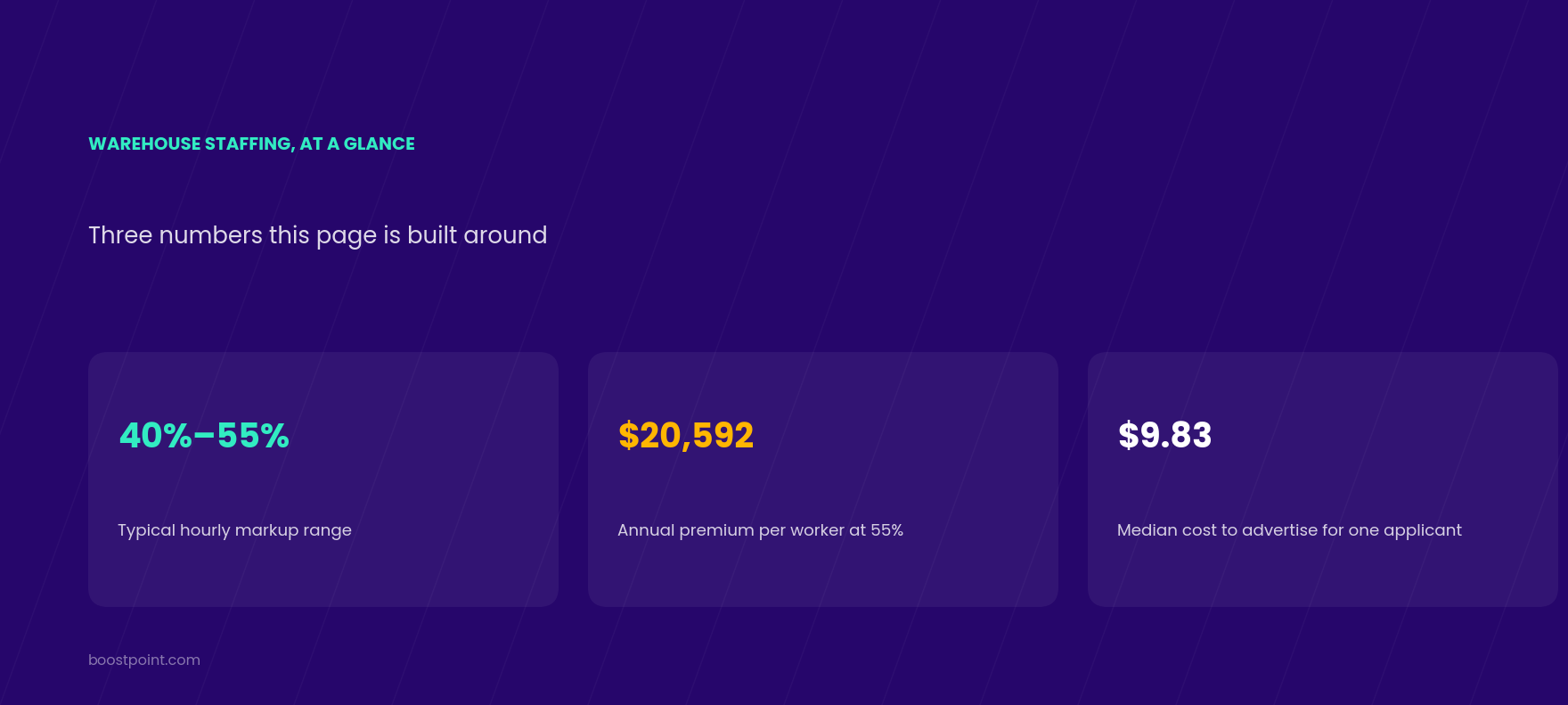
Warehouse and light industrial staffing agencies typically charge a 40% to 55% markup on the worker's hourly wage. On an $18/hour associate, that's a bill rate of $25.20 to $27.90 — a premium of $14,976 to $20,592 per worker per year. Across twenty positions, the markup alone runs $300,000 to $412,000 annually.
A note on who's writing this
Nearly every article about staffing agency costs is written by a staffing agency. That's not a criticism — they know the numbers, and most of what they publish is accurate. But the framing is consistent: fees get presented as reasonable, and the alternative is rarely priced with the same care.
We're not a staffing agency. Boostpoint runs recruitment advertising — we help operations generate their own applicants rather than placing workers. So apply the same skepticism to our framing that you would to theirs.
What we can add is the half of the comparison agency articles leave out: what it costs to fill a warehouse position when you advertise for it yourself, from actual campaign data. Both numbers are below.
What warehouse and light industrial staffing costs
Most warehouse staffing runs on hourly markup rather than placement fees. The agency employs the worker, carries the payroll burden, and bills you above their wage. Where warehouse markups sit against other industries is in staffing agency markup and fees.
Published ranges for light industrial and warehouse work specifically:
| Source | Light industrial / warehouse markup |
|---|---|
| LG Resources | 40%–55% |
| The Resource Company | 40%–55% |
| getproductiv | 45%–55% |
| Hunter Recruiting | 35%–60% |
| Freelance Pricing | 35%–55% |
| USA Staffing Services | 25%–40% |
| Instawork | 25%–50% for W2; over 40% is uncommon in warehouse |
Most sources cluster at 40% to 55%, and there's a specific reason light industrial sits above IT, engineering and clerical despite lower underlying pay: workers' compensation rates for physical production environments are substantially higher, and the agency carries that cost. It runs a similar structure to what construction staffing agencies charge, though the underlying cost driver differs.
What that means per worker
Take a warehouse associate at $18 an hour, full time:
| Markup | Bill rate | Annual premium over wage |
|---|---|---|
| 25% | $22.50/hr | $9,360 |
| 40% | $25.20/hr | $14,976 |
| 55% | $27.90/hr | $20,592 |
The worker earns $37,440. At a 55% markup you're paying $58,032 for the same labor.
The number most operations never total up
Here's what makes warehouse different from almost every other staffing category.
The markup applies to every hour of every worker, and warehouse operations run headcount, not headcounts of one.
| Positions on temp | Annual markup cost at 40%–55% |
|---|---|
| 10 workers | $149,760 – $205,920 |
| 20 workers | $299,520 – $411,840 |
| 50 workers | $748,800 – $1,029,600 |
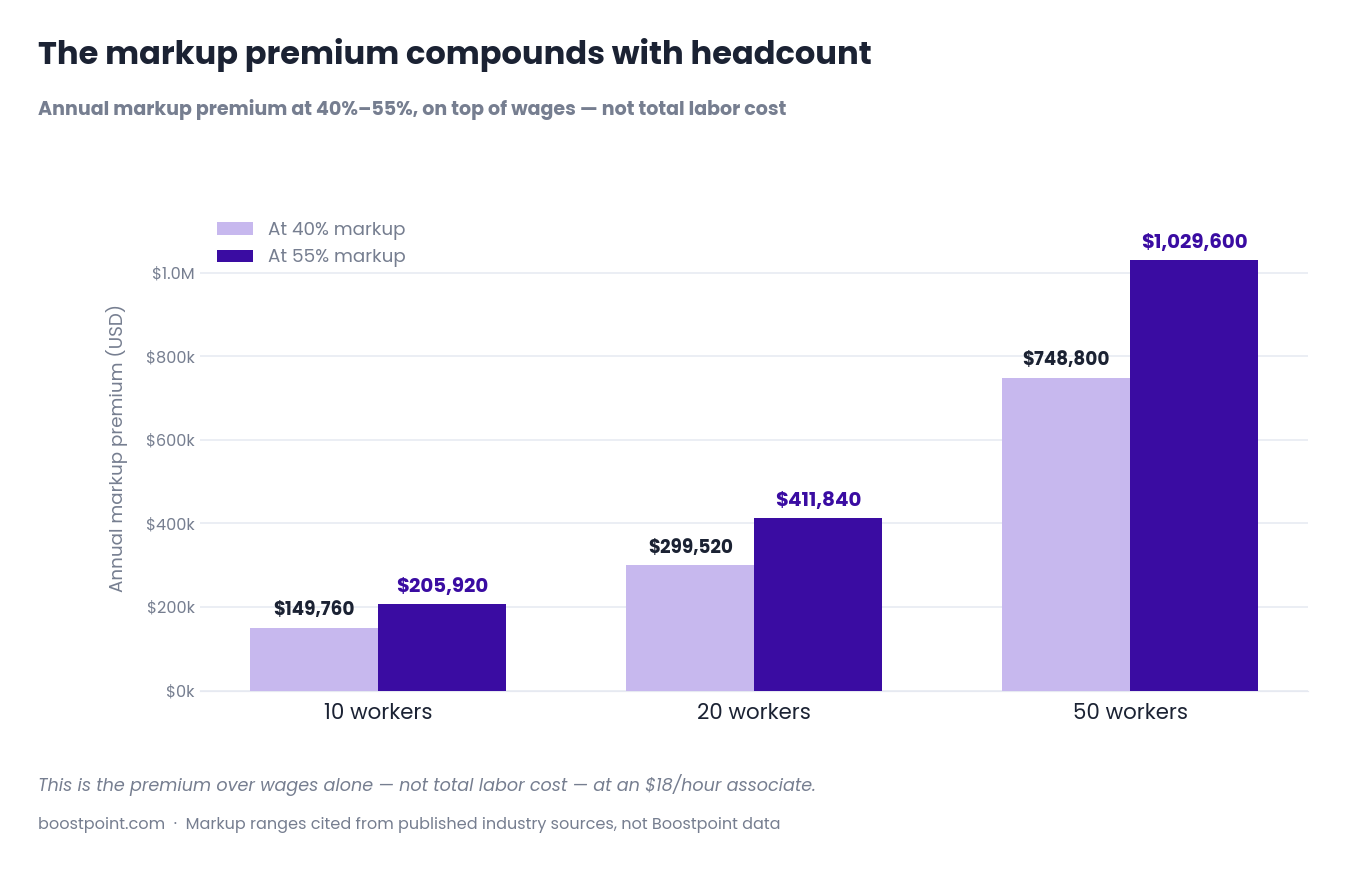
That's the premium alone, not the wages. A fifty-person temp floor can carry a seven-figure markup.
Then turnover multiplies it. Annual warehouse turnover is commonly estimated between 30% and 60% depending on the facility and role. Every replacement is a new placement, billed at the same markup, with a fresh onboarding and training ramp behind it.
One staffing analysis puts the compounding plainly: operations running very high turnover on temp labor often end up paying more per productive hour than a direct-hire workforce at half that turnover would cost. The bill rate looks like the cost. The effective cost per productive hour is the real number, and almost nobody calculates it.
A caveat worth stating: the markup is not the agency's profit. It covers employer payroll taxes, workers' compensation at physical-labor classifications, unemployment insurance, recruiting, onboarding and administration. A 55% markup is closer to a 33% gross margin, and net margins in staffing typically run 8% to 15%. If you bring the same workers in-house you carry most of those costs yourself — just without the agency's margin on top.
What the same position costs to advertise
Here's the other half of the comparison.
Across Boostpoint-managed campaigns for warehouse and production roles — 82 campaigns in 2026, part of our published benchmark data — how warehouse costs compare to agency markup is laid out in full there:
| Metric | Warehouse & production |
|---|---|
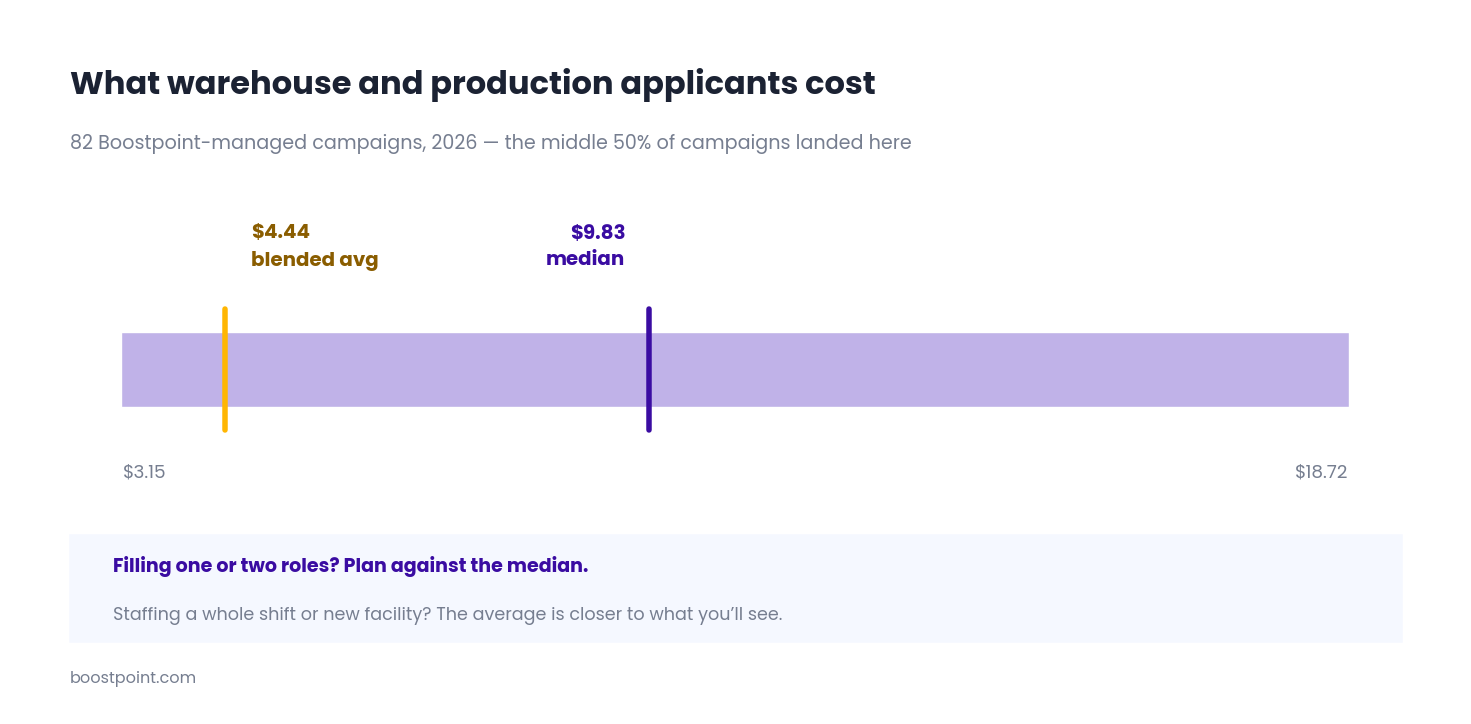
| Median cost per applicant | $9.83 |
| Middle 50% of campaigns | $3.15 – $18.72 |
| Volume-weighted average | $4.44 |
| Application completion rate | 20% |
| Click-through rate | 1.67% |
Source: Boostpoint 2026 Social Job Advertising Benchmark — 891 Boostpoint-managed campaigns on Meta (1,334 campaign-months), 2026; costs are what advertisers paid for advertising only.
Costs are what advertisers paid. An applicant is a completed application, not a click.
Why the average is so much lower than the median
The blended average of $4.44 sits at less than half the median of $9.83, and that gap is bigger than in any other role family we measure. You can see where warehouse sits against every other deskless role in our frontline hiring benchmarks.
The reason is volume. Warehouse and production campaigns include some very high-throughput hiring — facilities filling dozens of positions at once — and those campaigns convert at exceptional rates, pulling the average down.
Practically: if you're filling one or two roles, plan against the median. If you're staffing a whole shift or a new facility, the average is closer to what you'll see.
Turning that into a cost per hire
The two numbers aren't directly comparable, and it matters.
A markup buys you a working body with the payroll burden handled. An advertising budget buys you applicants. You still screen, interview, onboard, and carry the employment relationship yourself.
To compare, you need your own applicant-to-hire ratio. Filling twenty positions:
| If you hire | Applicants needed | Advertising cost |
|---|---|---|
| 1 in every 20 | 400 | ~$3,932 |
| 1 in every 50 | 1,000 | ~$9,830 |
Against $299,520 to $411,840 in annual markup for those same twenty positions.
But that arithmetic assumes two things, and both are real constraints: that you have someone to work the applications, and that you're prepared to carry payroll, workers' comp and unemployment yourself. The markup isn't only buying you workers. It's buying you the recruiting function and the employer-of-record relationship.
When a staffing agency is the right call
We sell advertising, so treat this as the section we had least incentive to write. For warehouse operations specifically, the case for agencies is stronger than in most verticals.
Use an agency when:
- You have genuine peaks. Q4 fulfillment, seasonal ramps, a large customer onboarding. Hiring permanent staff for a ten-week surge and laying them off in January is worse for everyone than paying a markup. This is what temp labor exists for.
- Volume is unpredictable. If your headcount need swings 40% month to month, variable labor cost is a feature, not a premium.
- You need people this week. A shift short for Monday is a staffing problem. Advertising produces applicants in days and hires in weeks.
- You don't want the workers' comp exposure. On physical-labor classifications this is a meaningful cost and a meaningful risk, and having the agency carry it has real value.
- You have no capacity to work applications. If nobody can call forty applicants a week, the agency is supplying a recruiting function that advertising doesn't replace.
- You want to try before you hire. Temp-to-hire genuinely reduces the risk of a bad permanent hire in a role where fit is hard to assess on paper. Just price the conversion fee in — commonly 11% to 21% of first-year salary.
When advertising makes more sense
Advertise when:
- The positions are permanent. If a role will exist for years, paying a markup on every hour indefinitely is an expensive way to fill it.
- You're running a permanent temp floor. Some operations have run a fixed share of headcount on temp labor for years because they never solved the hiring problem. That's the most expensive version of this — you're paying surge pricing for baseline staffing.
- Turnover is your actual problem. Replacing the same seats repeatedly through an agency means paying the markup again each time. More applicant flow lets you hire for fit rather than availability.
- You're opening a new facility. Standing up a site is a known, plannable hiring event. Advertising can run months ahead at a fraction of surge staffing cost.
- You already have someone working applications. If a supervisor or HR coordinator can call a list same-day, you have the piece the agency would otherwise supply.
The honest summary
Agencies solve variability. Advertising solves baseline.
If your headcount need genuinely swings — peak season, project work, unpredictable volume — the markup is the price of flexibility and it's often worth paying. If you're running a stable floor and using temp labor because you never solved recruiting, you're paying surge pricing for permanent staffing.
Most operations we work with end up using both: advertising for the baseline headcount they'll need all year, agencies for peak and surge. That mix is usually cheaper than either alone, and it's a more honest recommendation than telling you to fire your staffing partner.
The calculation worth running this quarter
Four numbers. Most operations have never put them side by side.
- What is your all-in markup cost for the last twelve months? Total agency invoices minus the wages that flowed to workers. That's the premium you paid.
- How many of those positions were filled for more than six months? Those are baseline roles, not surge, and they're the ones where the arithmetic works against you.
- What is your effective cost per productive hour? Bill rate is not the answer. Include the hours lost to turnover, ramp-up and unfilled shifts. This is the number that reveals whether high turnover is quietly eating the flexibility you're paying for.
- What would it cost to generate applicants for the baseline roles? Median cost per applicant times your applicant-to-hire ratio times the headcount.
If steps two and four come back large and small respectively, you've found a real budget line.
Frequently asked questions
How much does a warehouse staffing agency charge?
Most warehouse and light industrial staffing runs on hourly markup, typically 40% to 55% over the worker's wage. On an $18/hour associate that's a bill rate of $25.20 to $27.90. Some sources cite ranges as low as 25% to 40%, so quotes vary considerably by agency, region and volume.
Why is light industrial markup higher than IT or clerical?
Workers' compensation. Physical production environments carry substantially higher comp classifications than office work, and the agency absorbs that cost. Higher turnover in the category also means more recruiting and onboarding overhead per placed hour.
Is the markup the agency's profit?
No. It covers employer payroll taxes, workers' compensation, unemployment insurance, recruiting, onboarding and administration, plus margin. A 55% markup is roughly a 33% gross margin, and net margins in staffing typically run 8% to 15%.
What does it cost to advertise for warehouse workers?
In our 2026 campaigns, warehouse and production applicants cost a median of $9.83, with the middle 50% of campaigns between $3.15 and $18.72. The volume-weighted average is $4.44, reflecting high-throughput campaigns filling many positions at once.
Is it cheaper to advertise than use a staffing agency?
For permanent, baseline positions, usually by a wide margin — filling twenty roles might cost $4,000 to $10,000 in advertising against $300,000 or more in annual markup. But advertising delivers applicants, not employees, and you carry the payroll and workers' comp burden yourself. For genuine peaks and surges, the agency markup is often the better trade.
What's a conversion fee?
If you want to hire a temp worker permanently, most agencies charge a fee — commonly 11% to 21% of projected first-year salary, often decreasing with assignment length. It's the cost most operations forget when planning a temp-to-hire route.
How does turnover affect what we pay?
Directly and heavily. Warehouse turnover is commonly estimated at 30% to 60% annually, and every replacement is billed at the same markup with a fresh onboarding ramp. The metric worth tracking is effective cost per productive hour, not bill rate — high turnover on temp labor can end up costing more per productive hour than a direct workforce at lower turnover.
When should we use an agency for warehouse staffing?
Genuine peaks and seasonal surges, unpredictable volume swings, when you need people this week, when you don't want the workers' comp exposure, or when nobody in-house can work applications. Those are real problems that advertising doesn't solve.
See what it costs to fill warehouse roles directly
Book a 30-minute call and we'll walk through cost per applicant for the roles, shifts and facilities you're staffing — and tell you honestly if advertising isn't the right fit.
Book a Demo →




Boostpoint figures come from 82 managed campaigns for warehouse and production roles run in 2026, drawn from a wider dataset of 891 campaigns and 1,334 campaign-months. Costs are what advertisers paid for advertising only. Staffing agency markup ranges, conversion fee figures and turnover estimates are cited from published industry sources and are not Boostpoint data; markups vary considerably by agency, region, role and volume. Cost comparisons use illustrative conversion assumptions and are not drawn from attributed hire data.