
Construction Staffing Agency Costs: What Contractors Actually Pay
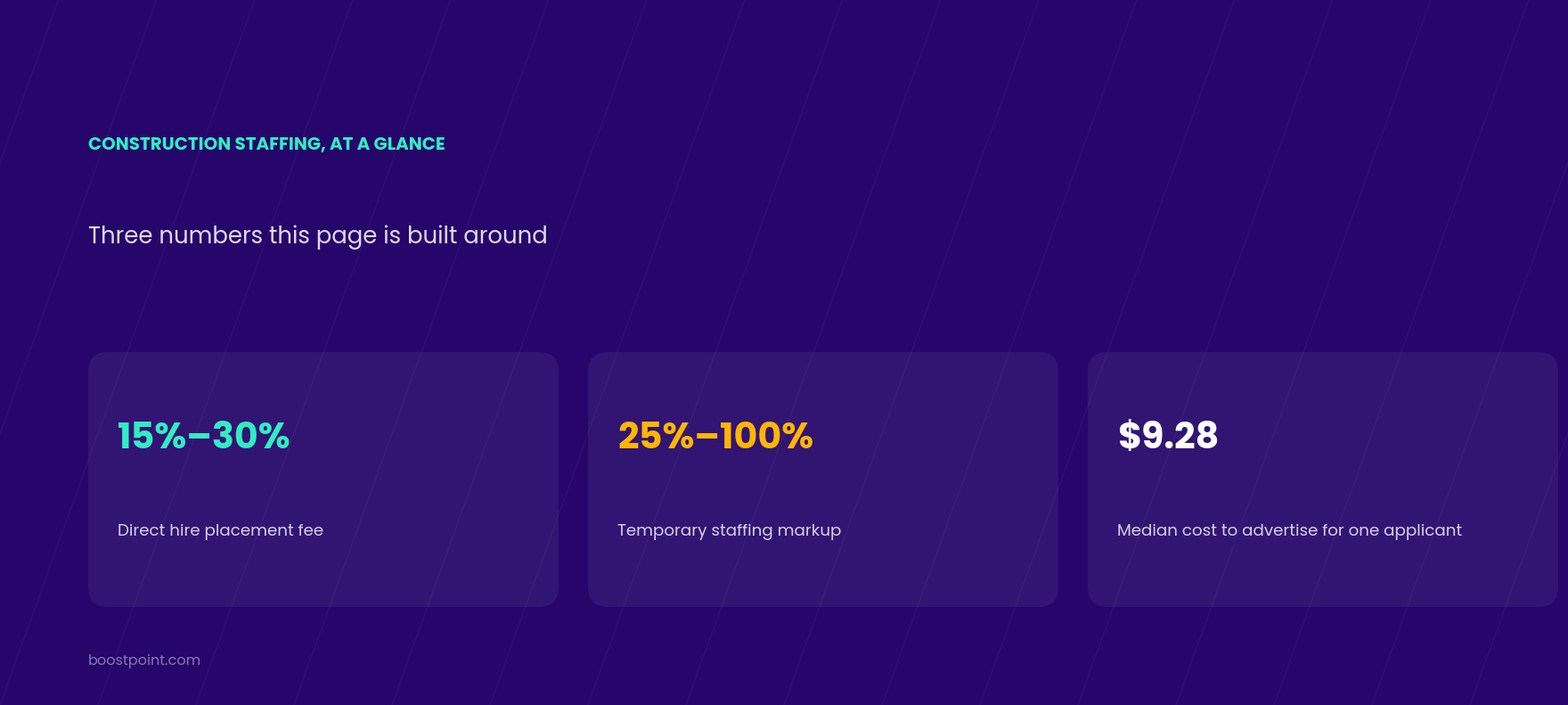
Construction staffing agencies typically charge 15% to 30% of first-year salary for direct placements, or a 25% to 100% markup on hourly wages for temporary workers. Construction sits at the high end of both ranges because the work is classified as hazardous. On a $22/hour laborer, that markup means a bill rate of $27.50 to $44.00 an hour.
A note on who's writing this
Almost every article you'll find about staffing agency costs is written by a staffing agency.
That's not a conspiracy — they're the ones who know the numbers, and most of what they publish is accurate. But it does mean the framing is consistent: fees are presented as reasonable, the value is emphasized, and the alternative is rarely priced out with the same care.
We're not a staffing agency. Boostpoint runs recruitment advertising — we help contractors generate their own applicants rather than placing workers. So take our framing with the same skepticism you'd apply to theirs.
What we can offer that the agency articles can't is the other half of the comparison: what it costs to fill a crew position when you advertise for it yourself, from actual skilled trades recruiting campaign data. Both numbers are below.
How construction staffing agencies charge
Three models, and most agencies offer all three.
1. Direct hire placement fee
The agency finds a permanent employee and you pay a percentage of that person's first-year salary.
Published ranges across the industry:
| Source | Direct hire fee |
|---|---|
| Instawork | 15%–25% of first-year salary |
| Davis Companies | 15%–30%, by role complexity and seniority |
| ExpectLLC | 15%–30% |
| BDA Recruitment | 15%–35% |
| Frontline Source Group | 20%–30% |
| Advance Partners | 10%–20% of gross annual salary |
The consensus lands around 15% to 30%.
What that means in construction terms. A journeyman electrician at $65,000 costs $9,750 to $19,500 to place. A superintendent at $110,000 costs $16,500 to $33,000.
Most agencies attach a guarantee — commonly 90 days, occasionally longer. If the placement leaves inside that window they replace them, though prorated credits are more common than full refunds. That guarantee is real value and belongs in the comparison.
2. Temporary and contract markup
The agency employs the worker, carries the payroll burden, and bills you an hourly rate above their wage.
| Source | Temp markup |
|---|---|
| Leapros (construction-specific) | 25%–100% of wages |
| Hunter Recruiting | 25%–100% |
| Advance Partners | 20%–75% |
| Second Talent | 20%–71%, by role complexity |
| getproductiv (manufacturing/fulfillment) | 45%–55% |
| Instawork | 25%–50% for W2 workers |
| ExpectLLC | 40%–45% over hourly rate |
Construction sits at the top of these ranges, and there's a specific reason.
3. Conversion fees
If you want to hire a temp worker permanently, most agencies charge a conversion fee — commonly 11% to 21% of projected first-year salary, often decreasing the longer the worker has been on assignment.
This is the cost contractors most often forget to factor in. If your plan is "try them out on temp, then bring them on," the conversion fee is part of the price of that plan.
Why construction pays more than other industries
Three factors push construction to the high end of every published range.
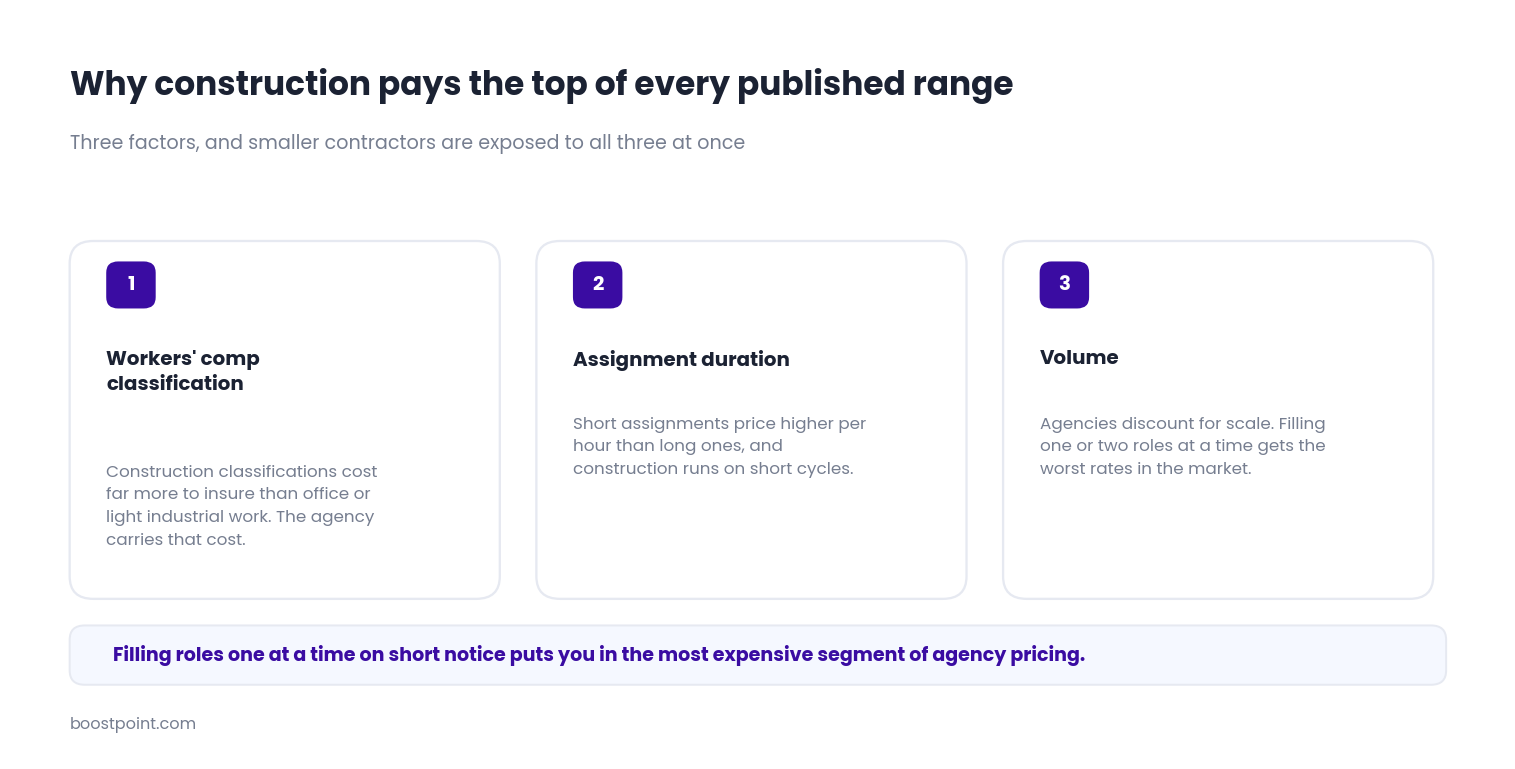
Workers' compensation classification. This is the biggest one. Comp rates for commercial construction classifications run dramatically higher than for office or light industrial work, and the agency carries that cost. As one staffing firm puts it plainly, agencies charge a higher service fee to place a worker in a hazardous job than a safe one. That's not gouging — it's the actual cost of the employment relationship.
Assignment duration. Short assignments cost more per hour than long ones. A crew needed for a two-week pour is priced differently than a six-month placement, and construction runs on short cycles more than most industries.
Volume. Agencies discount for scale. Requesting thirty workers gets a lower per-worker rate than requesting one. Contractors filling one or two positions at a time pay the worst rates in the market.
The practical implication: if you're a smaller contractor filling roles one at a time on short notice, you are structurally in the most expensive segment of agency pricing. The published averages understate what you'll actually be quoted.
What that looks like on a real crew position
Take a construction laborer at $22 an hour — roughly $45,760 a year.
| Approach | What you pay | What you get |
|---|---|---|
| Direct hire agency | $6,864 – $13,728 | A placed worker, plus a guarantee period |
| Temp at 25% markup | $27.50/hr bill rate — $11,440/yr above wage | A working body, no payroll burden |
| Temp at 100% markup | $44.00/hr bill rate — $45,760/yr above wage | Same, at the high end of construction pricing |
| Temp, then convert | Above, plus 11–21% of salary to convert | Try-before-you-hire |
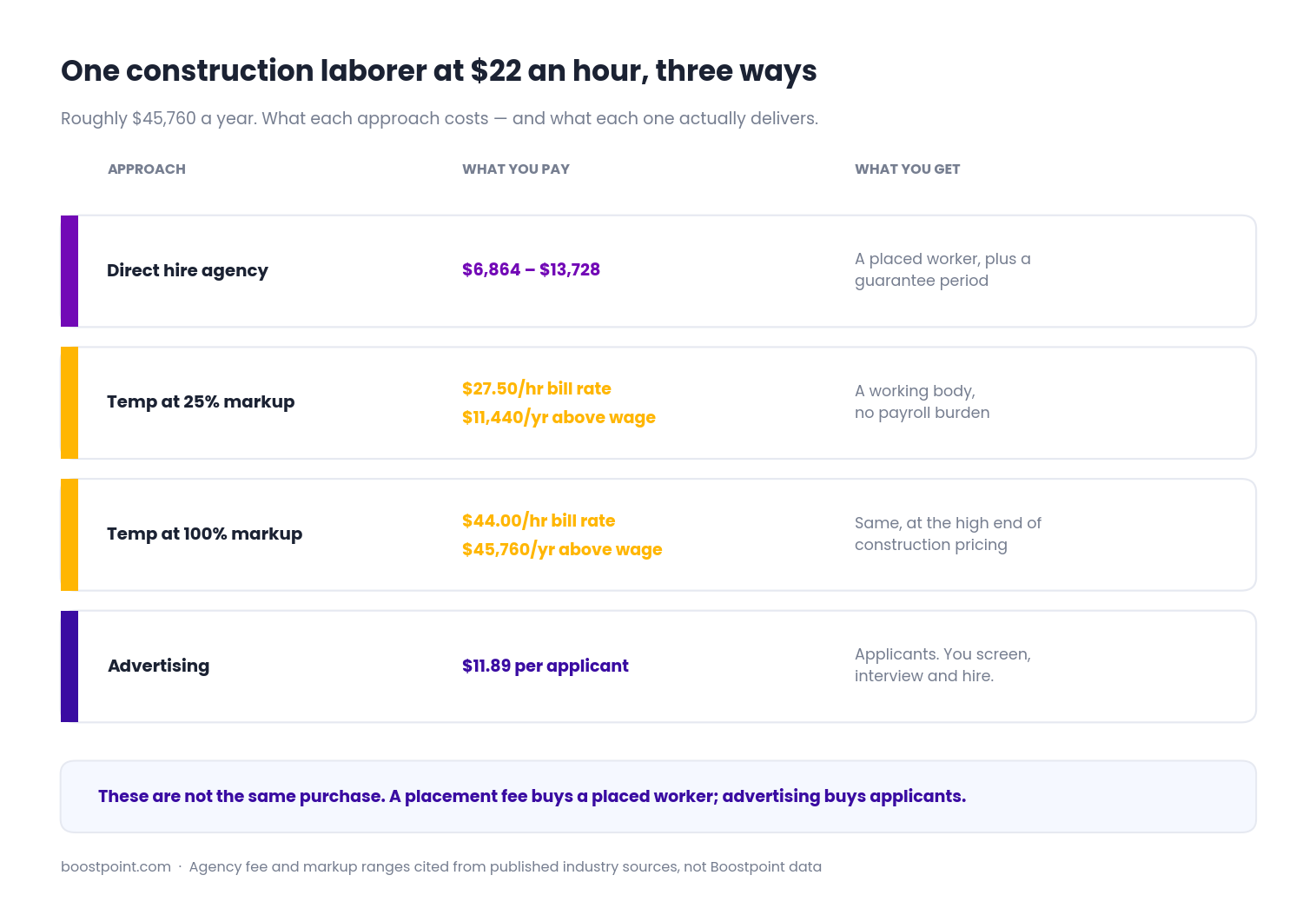
At the top of the construction markup range, a full year of temp labor costs roughly as much again as the worker's entire wage. To see where construction sits against other industries' markups, see staffing agency markup and fees.
That's not necessarily wrong — you're buying flexibility, payroll administration, workers' comp coverage and the ability to end an assignment without a termination. For a six-week job, that's often exactly the right trade. For a position you'll need filled for years, it's an expensive way to staff.
What the same position costs to advertise
Here's the other half of the comparison, and it's the number the agency articles don't include.
Across Boostpoint-managed skilled trades campaigns — 35 campaigns in 2026, part of our published benchmark data:
| Metric | Skilled trades |
|---|---|
| Median cost per applicant | $14.14 |
| Middle 50% of campaigns | $7.58 – $21.49 |
| Campaigns | 35 |
Source: Boostpoint 2026 Social Job Advertising Benchmark — 891 Boostpoint-managed campaigns on Meta (1,334 campaign-months), 2026; costs are what advertisers paid for advertising only.
Costs are what advertisers paid. An applicant is a completed application, not a click.
Turning that into a cost per hire
This is where honesty matters, because the two numbers aren't directly comparable.
A placement fee buys you a placed worker. An advertising budget buys you applicants. You still have to screen, interview, check references, run the drug test and onboard. Your foreman still spends time on it.
To compare them you need your own applicant-to-hire ratio:
| If you hire | Advertising cost per hire |
|---|---|
| 1 in every 10 applicants | ~$141 |
| 1 in every 20 | ~$283 |
| 1 in every 50 | ~$707 |
| 1 in every 100 | ~$1,414 |
Even at a pessimistic one-in-a-hundred, advertising costs a fraction of a $6,864 minimum placement fee.
But that arithmetic assumes something significant: that you have someone to work the applications. A hundred applicants and nobody to call them is worth nothing. What a placement fee is really buying is the recruiting function you don't have in-house.
When a staffing agency is the right call
We sell advertising, so treat this as the section we had least incentive to write. It's also the most useful part of the page.
Use an agency when:
- You have nobody to work applications. If your office manager is already doing payroll, permits and scheduling, adding forty applicant calls a week isn't a plan. The agency is buying you capacity, and capacity is the actual constraint.
- You need bodies this week. A crew short for a Monday start is a staffing problem, not a recruiting problem. Advertising produces applicants in days and hires in weeks.
- The work is short-duration. A six-week job doesn't justify permanent hires. Temp labor exists for exactly this, and the markup is a fair price for the flexibility.
- You want to try before you hire. Temp-to-hire genuinely reduces the risk of a bad permanent hire, and for some contractors that's worth the conversion fee.
- You don't want the workers' comp exposure. On high-risk classifications, having the agency carry the employment relationship has real value beyond convenience.
- You're filling one specialized role. A superintendent or a specialized technician is a search problem. The qualified population is too small for broad-reach advertising.
When advertising makes more sense
Advertise when:
- You're hiring continuously. Steady crew turnover or seasonal ramps mean paying placement fees repeatedly for the same roles. That's where the economics diverge fastest.
- Someone can call applicants the same day. If a foreman or office manager can work a list, you already have the piece the agency would otherwise supply.
- You want a bench, not a slot. Advertising produces more applicants than you need, which lets you hire for fit rather than availability.
- You're expanding into a new market. Adding a geography is a campaign setting. Agencies charge the same fee per placement whether they know your market or not.
- You want the relationship to be yours. People hired directly are your employees from day one, with no conversion fee between you and a permanent hire.
The honest summary
Agencies solve a capacity problem. Advertising solves a reach problem.
If your crews are short because nobody qualified is applying, advertising addresses that directly and at a fraction of a placement fee. If your crews are short because nobody at your company has time to recruit, advertising will generate applicants you never call — and you'll conclude it doesn't work when what actually happened is you bought the wrong thing.
Most contractors we work with end up using both. Advertising for the roles they hire repeatedly, agencies for surge work and the occasional specialized search. That combination is usually cheaper than either alone, and it's a more honest recommendation than telling you to fire your staffing partner.
Questions to ask before you sign
If you do go the agency route, these five questions surface most of what a quote leaves out:
- Is the markup on base wage or on total cost? The difference is substantial and not always volunteered.
- What's the guarantee period, and is it a replacement or a refund? Prorated credits are more common than money back.
- What's the conversion fee, and does it decrease over time? Ask for the schedule in writing.
- What's the rate at higher volume? If you'll need ten workers next quarter, price that now rather than per-worker.
- Who carries the workers' comp, and at what classification? On construction classifications this is a meaningful share of what you're paying for, and you should know it's actually being covered.
Frequently asked questions
How much does a construction staffing agency cost?
Direct hire placements typically run 15% to 30% of first-year salary — $9,750 to $19,500 for a journeyman electrician at $65,000. Temporary staffing runs on an hourly markup, and construction sits at the high end of published ranges at 25% to 100% over the worker's wage. On a $22/hour laborer that means a bill rate between $27.50 and $44.00.
Why do construction staffing agencies charge more than other industries?
Three reasons. Workers' compensation classifications for construction are far more expensive than office or light industrial, and the agency carries that cost. Construction assignments tend to be shorter, and short assignments price higher per hour. And smaller volume requests get worse rates than bulk ones.
What is a staffing agency markup actually covering?
Employer payroll taxes, workers' compensation at construction classification rates, general liability, administrative overhead, and the agency's margin. On a hazardous classification the insurance component alone is substantial. A 50% markup is not a 50% profit margin.
What's a conversion fee?
If you want to hire a temp worker permanently, most agencies charge a fee — commonly 11% to 21% of projected first-year salary, often decreasing the longer the worker has been on assignment. It's the cost contractors most often forget to include when planning a temp-to-hire route.
Is it cheaper to advertise for construction workers than use an agency?
Per hire, usually yes. Skilled trades applicants cost a median of $14.14 in our 2026 campaign data, which works out to roughly $283 per hire at a one-in-twenty conversion rate — against a $6,864 minimum placement fee on a laborer. But advertising delivers applicants, not placed workers, and assumes you have someone to screen and call them.
When should a contractor use a staffing agency instead of advertising?
When you have no capacity to work applications, when you need people this week, for short-duration or surge work, when you want to try before hiring, when you don't want the workers' comp exposure, or for a single specialized search.
Can we do both?
Most contractors we work with do. Advertising for the roles they hire repeatedly, agencies for surge work and specialized searches. That mix is usually cheaper than committing entirely to either.
How much does it cost to advertise a construction job?
In our 2026 campaigns, skilled trades roles had a median cost of $14.14 per applicant, with the middle 50% of campaigns falling between $7.58 and $21.49. That covers advertising only — not screening, drug testing, onboarding or your team's time.
See what it costs to fill your crews directly
Book a 30-minute call and we'll walk through cost per applicant for the trades, markets and shifts you're hiring for — and tell you honestly if advertising isn't the right fit.
Book a Demo →




Boostpoint figures come from the 35 managed skilled trades campaigns in the Boostpoint 2026 Social Job Advertising Benchmark, a dataset of 891 campaigns and 1,334 campaign-months. Costs are what advertisers paid for advertising only. Staffing agency fee ranges, markup percentages and conversion fee figures are cited from published industry sources and are not Boostpoint data; they vary considerably by agency, region, role and contract terms. Cost-per-hire calculations use illustrative conversion assumptions and are not drawn from attributed hire data.