
Hospitality and Restaurant Staffing Agency Costs: Markups, Bill Rates, and Direct Alternatives
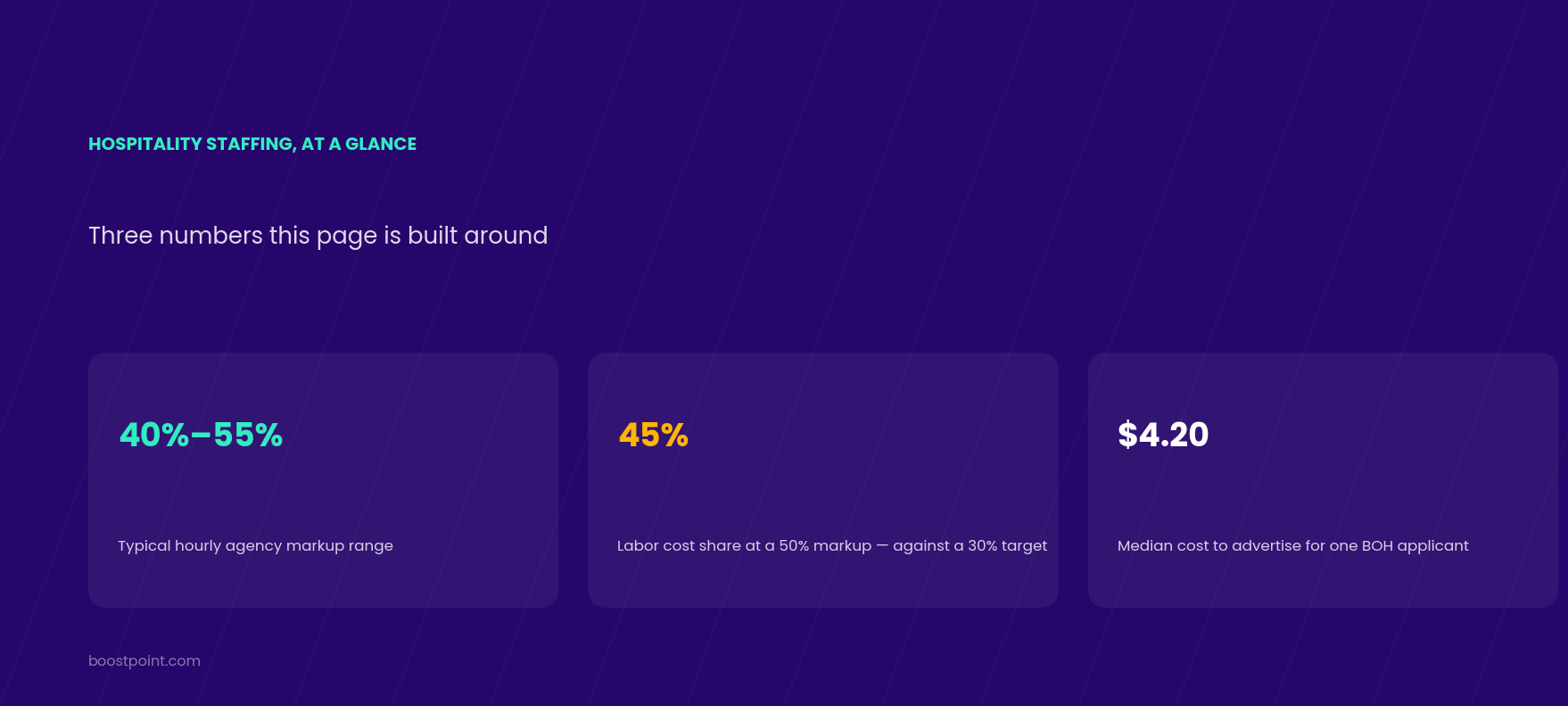
Hospitality and restaurant staffing agencies typically charge a 40% to 55% markup on hourly worker wages for back-of-house and front-of-house staff. For a line cook earning $18.00/hour, the agency bill rate sits between $25.20 and $27.90 per hour. In an industry where net profit margins average 3% to 5%, paying a 55% labor premium destroys operational profitability. By comparison, Boostpoint-managed recruitment advertising yields restaurant applicants at a median cost of $4.85 each.
Source: Boostpoint campaign data — managed hospitality and restaurant recruitment campaigns conducted in 2025–2026 across food service and hotel operations nationwide.
A note on who's writing this
Most guides on hospitality staffing agency costs are written by event staffing firms or gig-work platforms. Because their business model relies on taking a percentage of every hour worked, their content frames high markups as the normal price of dealing with the restaurant industry's chronic turnover.
Boostpoint is not a staffing agency. We build recruitment advertising software that helps restaurant groups, hotel chains, and food service operators generate their own direct applicants through targeted social media campaigns.
We aren't going to claim staffing agencies have no place in hospitality — for 500-person catering events or sudden holiday banquets, contingent labor is essential. But we can provide the financial clarity agency guides leave out: what it actually costs to build a direct pipeline of hospitality workers using targeted advertising, backed by 2026 campaign data across the food service industry.
What a restaurant or hospitality staffing agency actually charges
Hospitality staffing agencies supply temporary workers for back-of-house (BOH) roles like line cooks, prep cooks, and dishwashers, as well as front-of-house (FOH) roles like servers, hosts, and bartenders. Because the agency acts as the employer of record, they cover payroll taxes and workers' compensation while billing your restaurant an hourly rate above the worker's base wage.
Published markup ranges across hospitality segments:
| Hospitality segment | Typical agency markup range |
|---|---|
| Back-of-House (Cooks, Dishwashers) | 40% – 55% |
| Front-of-House (Servers, Hosts) | 40% – 50% |
| Banquet & Event Staffing | 45% – 60% |
| Hotel Housekeeping & Janitorial | 45% – 55% |
| Last-Minute Gig / Shift Apps | 40% – 60%+ |
Most standard restaurant contracts cluster between 40% and 55%. Gig-work apps that fill single shifts often charge varying flat fees that equate to a 50%+ hourly markup when broken down. For a cross-industry view of markups and what's negotiable, see staffing agency markup and fees.
What that markup means per hour and per worker
Consider standard hourly wage rates across common hospitality roles working full-time (2,080 hours per year):
| Restaurant role | Base wage | 40% markup bill rate | 55% markup bill rate | Annual agency markup premium per worker | Total annual cost per seat |
|---|---|---|---|---|---|
| Dishwasher / Prep Cook | $16.00/hr | $22.40/hr | $24.80/hr | $13,312 – $18,304 | $46,592 – $51,584 |
| Line Cook | $18.00/hr | $25.20/hr | $27.90/hr | $14,976 – $20,592 | $52,416 – $58,032 |
| Banquet Server | $15.00/hr | $21.00/hr | $23.25/hr | $12,480 – $17,160 | $43,680 – $48,360 |
| Sous Chef / Kitchen Mgr | $24.00/hr | $33.60/hr | $37.20/hr | $19,968 – $27,456 | $69,888 – $77,376 |
At a 55% markup on an $18/hour line cook, a restaurant pays $58,032 annually for labor where the cook receives $37,440 in direct wages.
The margin arithmetic restaurant groups rarely add up
In commercial manufacturing or tech, a 50% labor markup is painful but absorbable. In restaurants, it breaks the fundamental business model.
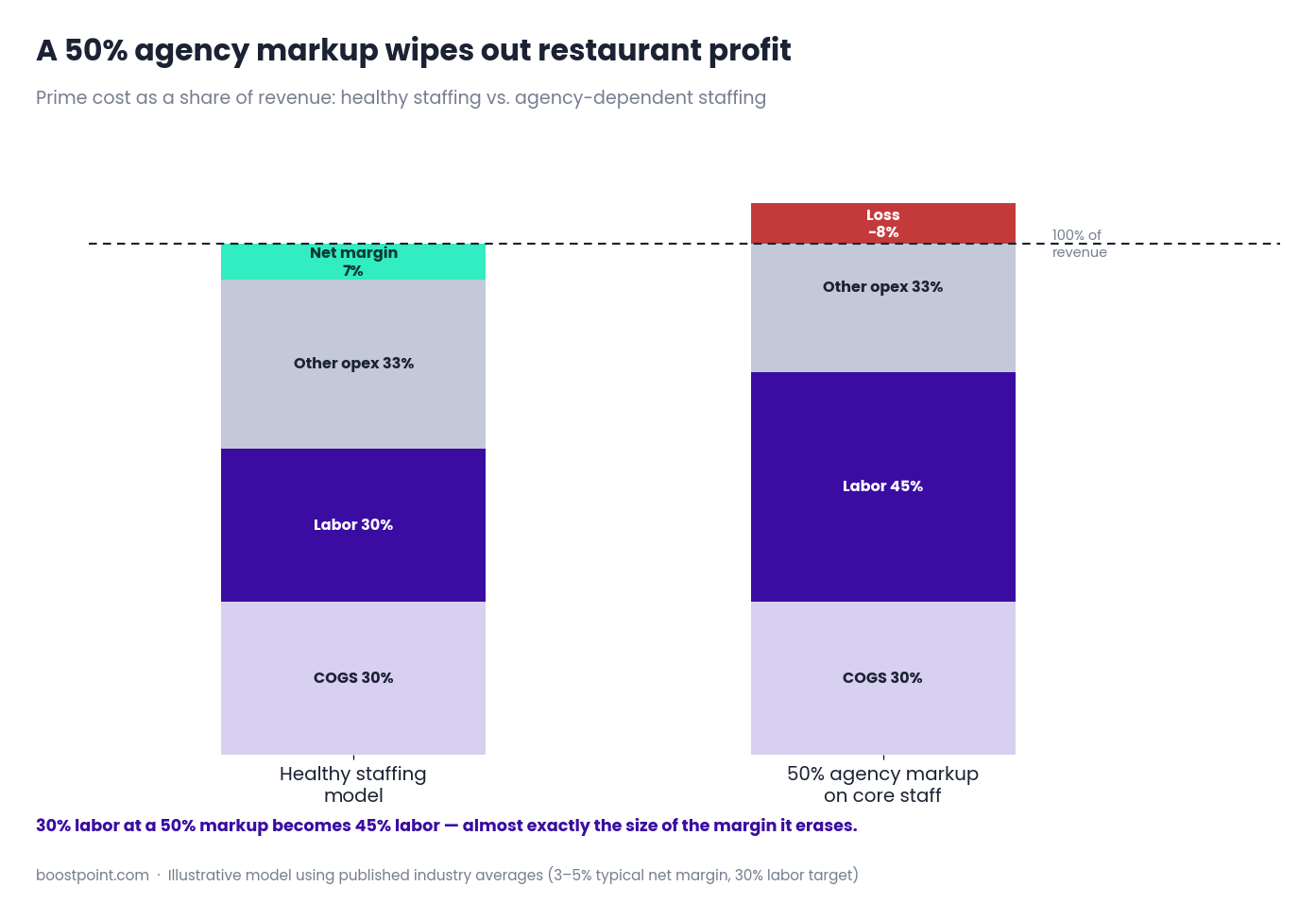
A healthy restaurant aims for a prime cost (Cost of Goods Sold + Labor) of 60% to 65%, with labor accounting for roughly 30% of total revenue. If you rely heavily on agency labor at a 50% markup, your labor cost instantly spikes to 45% of revenue, entirely wiping out the industry's average 3% to 5% net profit margin.
| Headcount on temp labor | Annual markup premium (at 40%–55%) |
|---|---|
| 5 BOH staff members | $74,880 – $102,960 |
| 10 BOH/FOH staff | $149,760 – $205,920 |
| 20 hotel/event staff | $299,520 – $411,840 |
Figures reflect pure agency markup paid above worker base pay for $18/hr roles.
How hospitality turnover multiplies the agency tax
The hospitality industry suffers the highest turnover rate in the private sector, often exceeding 75% to 80% annually. When a temp line cook quits after three weeks, the restaurant does not stop paying the markup. The agency simply sends a replacement, and the restaurant pays the exact same 40%–55% markup on the new worker, absorbing the chaos of an untrained cook on a busy Friday night.
Net agency margin context: the 40%–55% markup is not pure profit for the staffing agency. It covers employer FICA, FUTA/SUTA, workers' compensation insurance, recruiting, and administrative overhead. Net profit margins for hospitality staffing agencies typically run 8% to 15%. Transitioning core staff in-house means absorbing standard payroll taxes directly — while completely eliminating the agency's net profit margin.
What hospitality roles cost to recruit directly
To evaluate whether direct recruiting makes financial sense, restaurant operators and hotel HR directors need real candidate acquisition benchmarks.
Traditional job boards struggle with frontline hospitality recruiting because active job seekers are bombarded with hundreds of identical listings. However, targeted passive candidate campaigns on social platforms (Facebook, Instagram, TikTok) reach working local industry talent during their off-hours — the full pattern across every industry we track is in our published 2026 campaign data.
Across Boostpoint-managed hospitality and restaurant campaigns in 2026:
| Hospitality role category | Cost per applicant (CPA) | Application completion rate |
|---|---|---|
| Front-of-House (Servers / Hosts) | $3.15 | 24.2% |
| Back-of-House (Line Cooks / Prep) | $4.20 | 21.5% |
| Banquet & Event Staff | $5.10 | 19.8% |
| Hotel Housekeeping | $4.65 | 20.1% |
| Hospitality Management | $12.45 | 14.5% |
Source: Boostpoint campaign data — managed hospitality and restaurant recruitment campaigns conducted in 2025–2026 across food service and hotel operations nationwide.
Data based on the 2026 Boostpoint Frontline Benchmark Report covering restaurant, hotel, and food service recruitment campaigns.
From applicants to hires on the floor
Advertising budget produces applicants, not finished hires. How many applicants it takes to fill one seat depends on your own vetting standards, background checks, interview no-show rate and how fast a manager calls people back — all of which sit inside your operation, not in the ad account. Our campaign data measures advertising, not hiring outcomes, so we don't publish a cost per hire. Take the cost per applicant above, track your own applicant-to-hire ratio for a quarter, and compare the result with the markup an agency charges for the same shift.
When a hospitality staffing agency is the right call
Direct advertising is not a total replacement for contingent labor. Agencies serve valuable operational needs during extreme volume volatility.
Use a hospitality staffing agency when:
- You host massive, irregular catering events. If you need 40 servers for a one-night wedding banquet, hiring permanent employees only to let them go the next day is impossible. Agencies are designed for this exact scenario.
- Extreme seasonal spikes. Resort towns that do 80% of their revenue in a 12-week summer window often rely on agency labor to supplement core staff without carrying winter payroll.
- Emergency shift triage. If three cooks call out sick on Mother's Day weekend, an on-demand gig app or temp agency is your fastest operational patch.
- Opening a massive new venue. When a 500-room hotel opens, using agency temp staff can safely buffer the schedule while your permanent direct-hire pipelines mature.
When direct advertising makes more sense
Recruit directly when:
- Roles represent core, baseline schedule headcount. If a line cook position is scheduled 6 days a week year-round, paying a 45% markup indefinitely destroys your prime cost ratio.
- Ending "permanent temp" reliance. If 20% of your kitchen has been staffed by agency temps for over two months, you are paying surge pricing for permanent staffing.
- Improving guest experience and consistency. Direct hires show better menu knowledge, higher cultural buy-in, and stronger reliability than rotating temporary workers.
- Combating high turnover. Direct recruitment campaigns build a database of local hospitality workers who recognize your restaurant's brand, allowing you to quickly re-engage them via SMS when a seat opens up.
The honest summary
Agencies manage event volatility. Direct recruitment advertising builds profitable core teams.
If your event schedule swings wildly, agency markups are a reasonable fee for flexibility. But if you rely on staffing agencies to maintain your core Tuesday-night kitchen crew because job boards stopped generating applicants, you are paying permanent surge pricing for a fixable recruiting problem.
Leading restaurant groups and hotel operators adopt a strategic hybrid model: direct recruitment advertising to maintain 90% of baseline roster capacity, while reserving agency labor exclusively for banquets and true emergencies.
The calculation worth running this quarter
Four metrics restaurant operators and HR leaders should calculate together:
- Calculate total annual markup premium. Take total agency invoicing over the last 12 months and subtract direct wages paid to workers. That difference is your agency markup tax.
- Audit long-tenure temp staff. Count how many temporary workers have been on your roster longer than 60 days. These represent baseline core roles.
- Run cost-per-hire math against screening ratios. Compare your annual agency markup against direct advertising costs across realistic 1:30 or 1:50 conversion ratios.
- Evaluate mobile application friction. Hospitality workers apply on their phones during shift breaks. Switching from a multi-page ATS application to a 1-minute mobile knockout form dramatically increases applicant conversion.
Frequently asked questions
How much does a restaurant staffing agency charge?
Hospitality and restaurant staffing agencies typically charge a 40% to 55% markup over base hourly wages. For a line cook earning $18.00/hour, the agency bill rate ranges from $25.20 to $27.90 per hour.
Why is it bad for restaurants to use staffing agencies for core roles?
Restaurants operate on razor-thin net profit margins (3% to 5%). A healthy labor cost is 30% of revenue. Paying a 50% agency markup on core labor pushes labor costs to 45%+, entirely wiping out the restaurant's profitability.
What is the average cost per applicant for restaurant roles on social media?
Based on Boostpoint 2026 benchmark data, front-of-house applicants cost $3.15 each, back-of-house line cooks average $4.20, hotel housekeeping averages $4.65, and hospitality management averages $12.45 per applicant.
Is direct hiring cheaper than using a gig-work shift app?
Yes. While gig apps offer convenience for emergency call-outs, they often charge effective markups of 40% to 60%. Direct advertising generates a permanent candidate pipeline at a cost you control and can measure, eliminating recurring shift fees.
What is a standard temp-to-hire conversion fee in hospitality?
If a restaurant converts an agency temp worker into a permanent employee before fulfilling the contract period (usually 90 days), agencies charge a conversion fee ranging from 10% to 20% of the worker's annualized salary.
See what it costs to fill your restaurant roles directly
Book a 30-minute strategy call with our hospitality recruiting team. We'll analyze your local labor market, review cost-per-applicant benchmarks for your specific FOH and BOH roles, and show you how to build a direct hiring pipeline.
Book a Demo →Boostpoint figures are derived from managed hospitality and restaurant recruitment campaigns conducted in 2025–2026 across food service and hotel operations nationwide. Cost-per-applicant metrics reflect what advertisers paid for advertising. Staffing agency markups and conversion fee figures are compiled from published hospitality financial audits, SIA reports, and third-party event staffing benchmark data.