
Healthcare Staffing: What Agencies Charge, What Advertising Costs, and When Each Makes Sense
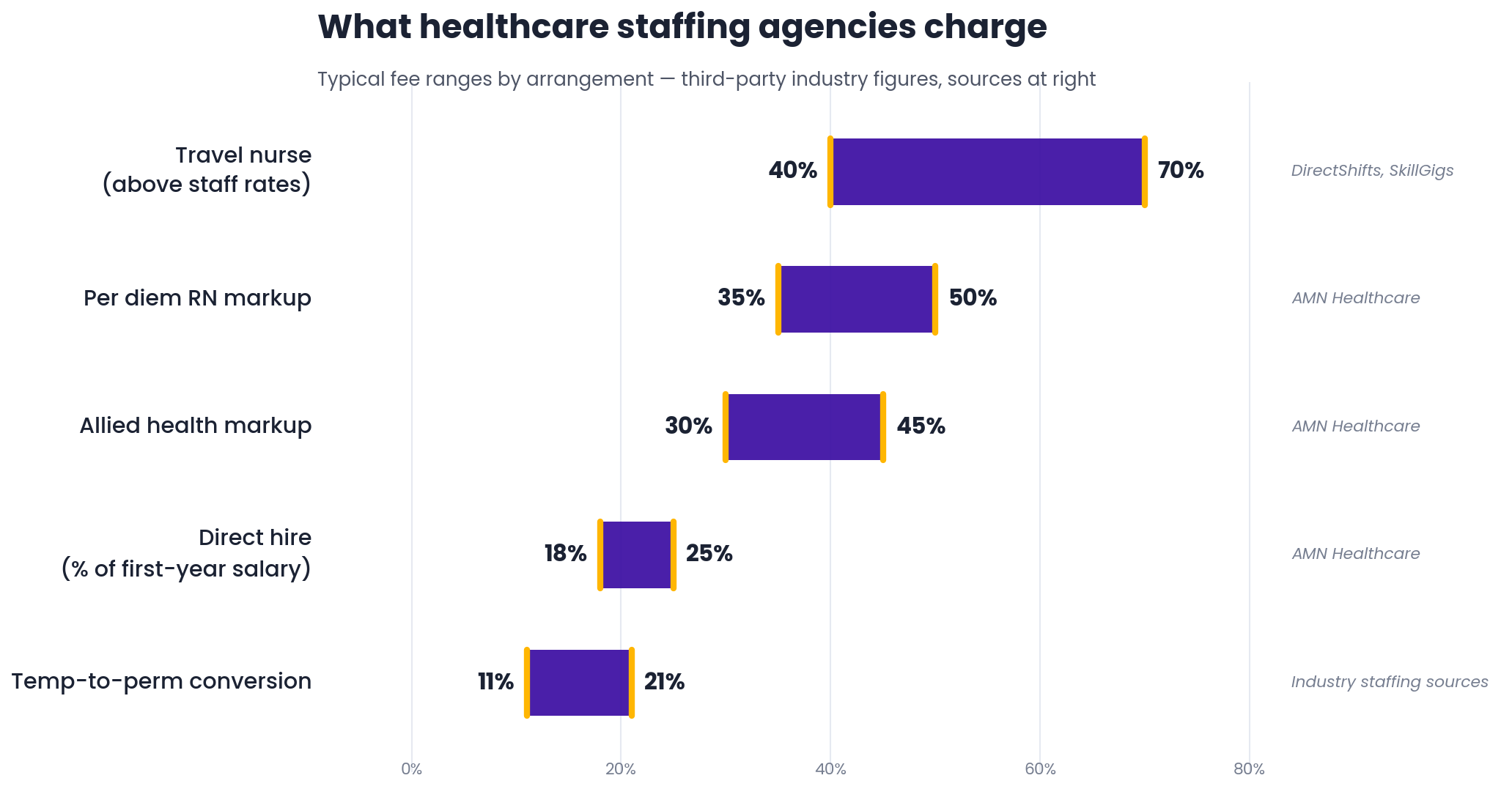
Healthcare staffing agencies typically charge 18–25% of first-year salary for direct-hire placements and bill travel nurses at 40–70% above staff rates. Recruiting the same roles directly through social job advertising produced a median cost per applicant of $15.42 across the 553 healthcare campaigns in Boostpoint's 2026 Social Job Advertising Benchmark. Which one is cheaper depends on how many applicants you need to make one hire — and this page shows you how to run that math for your own roles.
Source: Boostpoint 2026 Social Job Advertising Benchmark — 891 Boostpoint-managed campaigns on Meta (1,334 campaign-months), 2026; costs are what advertisers paid for advertising only.
A note on who's writing this
Boostpoint is not a healthcare staffing agency, and if you searched for one — or for a healthcare recruiting agency — we're not going to pretend to be neutral. We run job advertising campaigns on Facebook and Instagram for healthcare employers, which means we compete with staffing agencies for the same budget. You should discount our framing accordingly.
What we can offer that most pages on this topic can't: real cost data from 553 healthcare and senior living campaigns, published with the methodology attached, plus honestly-sourced agency fee figures from the agencies' own industry. There are situations where an agency is clearly the right call — including one entire category of clinical roles where our own data shows advertising performs worst. We'll name it.
What healthcare staffing agencies cost
Agency pricing in healthcare follows a few standard structures. These figures are third-party, drawn from staffing industry sources — not our data.
| Arrangement | Typical fee | How it's charged | Source |
|---|---|---|---|
| Direct hire (permanent placement) | 18–25% of first-year salary | One-time fee per placement | AMN Healthcare |
| Per diem RN | 35–50% markup | On top of the hourly wage, per shift | AMN Healthcare |
| Allied health | 30–45% markup | On top of the hourly wage | AMN Healthcare |
| Travel nurse | 40–70% above staff rates | Weekly bill rate for the contract | DirectShifts, SkillGigs |
| Temp-to-perm conversion | 11–21% of projected first-year salary | When you hire the temp permanently | Industry staffing sources |
The scale of this spend is easy to underestimate. US hospitals spend more than $1.2 billion annually on contingent nursing staff alone. None of these fees are wrong or hidden — agencies carry recruiting, credentialing, payroll, and often liability, and the markup is what funds that. The question is never whether the fee is legitimate. It's whether your specific role needs everything the fee pays for.
A worked example: one RN position, three ways
Take a registered nurse role at a $80,000 salary — a plain assumption you should replace with your own number.
| Route | The math | What you pay |
|---|---|---|
| Agency direct hire, low end | $80,000 × 18% | $14,400 one-time |
| Agency direct hire, high end | $80,000 × 25% | $20,000 one-time |
| Travel nurse, 13-week contract | $45.00/hr staff rate + 40–70% = $63.00–$76.50/hr × 468 hrs (36 hrs/wk × 13 wks) | $29,484–$35,802 for the contract |
That travel contract covers the shifts — it doesn't fill the position. The same 468 hours at the $45.00 staff rate would cost $21,060 in wages, so the agency premium on one 13-week contract runs $8,424 to $14,742. Facilities that bridge a vacancy with travelers for two or three consecutive contracts often spend more on the premium alone than a permanent placement fee would have cost. The RN-specific version of this arithmetic, including the states that cap agency rates, is on nurse staffing agency costs.
What recruiting healthcare workers directly costs
The other route is generating your own applicants. The figures below come from our 2026 Social Job Advertising Benchmark — 553 healthcare and senior living campaign-months of Meta advertising, reported as what advertisers actually paid.
Which of those levers to pull depends on the role: our healthcare recruiting strategies playbook sets the approach for each role family against its own cost band and apply rate.
| Measure | Value |
|---|---|
| Median cost per applicant | $15.42 |
| Middle 50% of campaigns | $7.89 – $39.61 |
| Volume-weighted average | $11.47 |
| Click-to-application rate | 16% |
| Cost per 1,000 impressions | $25.18 |
| Campaign-months in sample | 553 |
Source: Boostpoint 2026 Social Job Advertising Benchmark — 891 Boostpoint-managed campaigns on Meta (1,334 campaign-months), 2026; costs are what advertisers paid for advertising only.
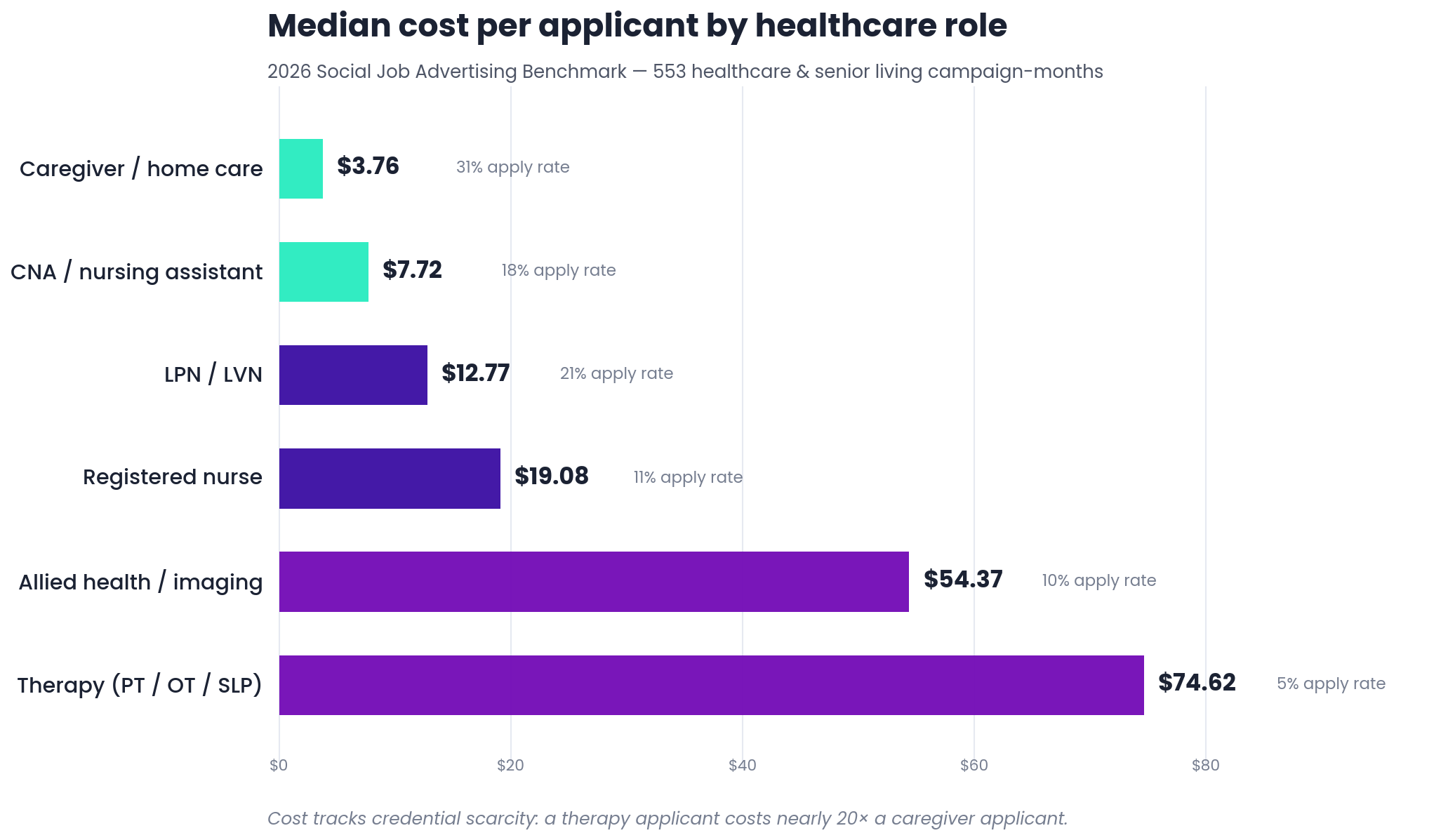
The sector median hides enormous spread by role, and the spread follows credentials, not effort:
| Role | Median | Middle 50% | Apply rate | Campaigns |
|---|---|---|---|---|
| Caregiver / home care | $3.76 | $2.99 – $5.83 | 31% | 34 |
| CNA / nursing assistant | $7.72 | $6.18 – $12.06 | 18% | 32 |
| LPN / LVN | $12.77 | $7.53 – $21.46 | 21% | 57 |
| Registered nurse | $19.08 | $12.76 – $34.84 | 11% | 173 |
| Allied health / imaging | $54.37 | $10.27 – $106.51 | 10% | 23 |
| Therapy (PT / OT / SLP) | $74.62 | $44.85 – $171.40 | 5% | 39 |
Source: Boostpoint 2026 Social Job Advertising Benchmark — 891 Boostpoint-managed campaigns on Meta (1,334 campaign-months), 2026; costs are what advertisers paid for advertising only.
A caregiver applicant costs a fifth of an RN applicant. A therapy applicant costs nearly twenty times a caregiver. Read that bottom row carefully, because it's the honest part: for PT, OT, and SLP roles, advertising is expensive and conversion is poor. Only 5% of clicks become applications. This is exactly the credential tier where staffing agencies earn their fees, and we'd rather tell you that than have you find out with your own budget. We cover the cost mechanics of individual roles in more depth on our RN, LPN and CNA recruiting cost page. We go deeper on when an agency is the right call for those roles in therapy staffing costs.
The setting matters as much as the role
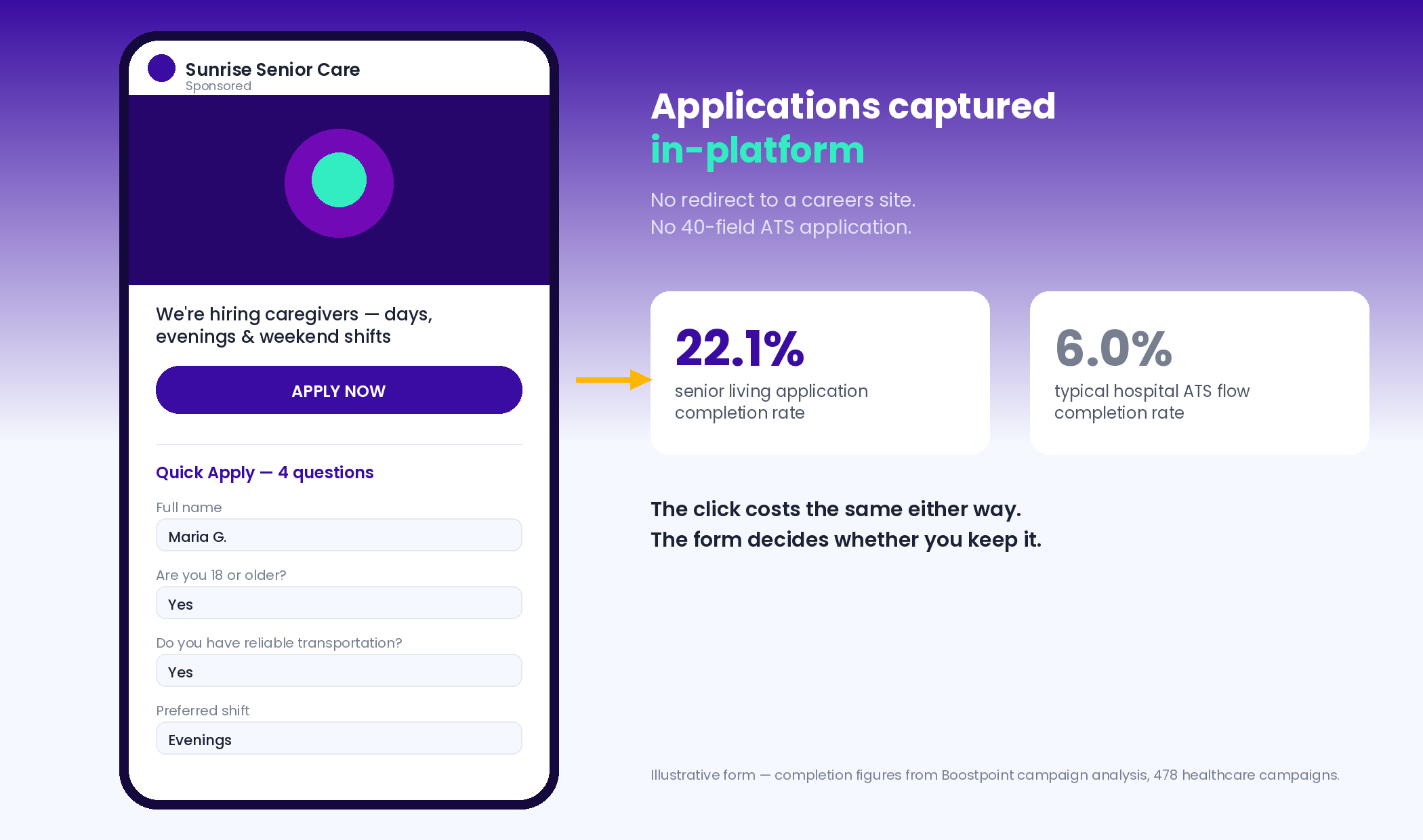
In an earlier campaign-level analysis of 478 healthcare campaigns across 30 employers, the same advertising produced very different results depending on where the job was: senior living roles averaged $6.11 per applicant, home care $8.40, and hospitals $17.82. The driver wasn't the ads — it was the application. Senior living applications were completed at 22.1% and home care at 21.6%, while hospital application flows converted at just 6.0%. Hospitals largely route candidates into long ATS applications; the click was purchased either way.
Agency vs. advertising, side by side
One caution before the table: this is not an apples-to-apples comparison. An agency fee buys a placement — a person who starts. Advertising buys applicants — people you still have to screen, interview, and hire. The comparison only becomes meaningful when you divide by your own applicants-per-hire ratio, which is why the calculation section below matters more than this table.
| Staffing agency | Direct advertising | |
|---|---|---|
| What you buy | A placement or covered shifts | Applicant flow you own |
| Typical cost | 18–25% of salary, or 35–70% wage markups | $15.42 median per applicant, healthcare and senior living sector (Boostpoint 2026 Social Job Advertising Benchmark) |
| Speed | Days — the roster already exists | Campaigns produce applicants in days; hires take your process time |
| Who does the screening | The agency | You (or qualifying questions in the ad flow) |
| Credentialing & compliance | Included | Yours |
| What you keep afterward | Nothing — next role starts at zero | The audience, the creative, the applicant pipeline |
When a healthcare staffing agency is the right call
There are real situations where the markup is the cheapest option on the table:
- You need coverage tomorrow. If shifts are going unfilled this week, no recruiting channel beats a roster of credentialed people who can start. Census spikes, sudden departures, and leave coverage are what per diem staffing exists for — though if you're using it constantly, our PRN and per diem staffing costs page covers the float-pool alternative.
- The role is a credentialed specialty. Our own data says therapy applicants cost $74.62 at a 5% apply rate, and allied health runs $54.37 with wide variance. Phlebotomy sits at the entry end of that family rather than the imaging end, which is why our phlebotomist job description plans against the sector line instead. For a single PT or imaging tech opening, an agency's specialist network will often beat advertising on both speed and total cost.
- You have no one to work the applicants. Advertising produces applicants, and applicants who wait two days go cold. If nobody on your team can call the same day, paying an agency to do the screening is buying a real service, not wasting money.
- Compliance and credentialing are the bottleneck. License verification, background checks, and health screenings across states is genuine work. Agencies amortize it across hundreds of placements; you'd be building it for a handful.
- It's one hard role, once. Advertising economics reward repetition — audiences, creative, and process improve over campaigns. A single hire for a role you'll never fill again is the weakest case for building that machine.
When advertising makes more sense
- You hire the same frontline roles all year. Caregivers at $3.76 and CNAs at $7.72 per applicant, hired continuously, is where the math runs away from any percentage-of-salary fee. This is the core of what caregiver recruitment costs across our book.
- Turnover means the position never stays filled. With CNA turnover at 42.3% in skilled nursing (AHCA) and caregiver turnover near 75% industry-wide, a placement fee buys you an average tenure, not a solved problem. A pipeline you own re-fills the role without re-paying the fee.
- You're staffing multiple locations. Campaign structures repeat across markets at marginal cost. Agency fees don't.
- Your application is fixable. The 6.0% hospital completion rate isn't destiny — it's a form problem. Employers who take applications in-platform instead of routing to a long ATS flow capture the conversion the click already paid for.
- You want to own the asset. Every campaign builds audience data and creative you keep. Every agency placement leaves you exactly where you started.
Agencies solve speed and credentialing. Advertising solves volume and cost. Most healthcare employers over a few hundred employees genuinely need both — the expensive mistake is paying agency markups for the recurring frontline roles advertising fills for single-digit dollars per applicant.
Run the numbers for your own role
Here's the calculation, with the honest caveat first: we cannot tell you your cost per hire from advertising data. Our campaigns track applicants, not hires — hire attribution lives in your ATS, not in the ad platform, and any vendor quoting you a cost-per-hire from ad data alone is extrapolating. You, however, can compute it, because you know your own applicants-per-hire ratio.
- Agency route: salary × fee percentage. Example: $55,000 LPN × 20% = $11,000 per placement.
- Advertising route: cost per applicant × the number of applicants your team needs to make one hire. Example: $12.77 per LPN applicant × 15 applicants per hire = $191.55. At a much worse 40 applicants per hire, $510.80.
- The crossover: $11,000 ÷ $12.77 = 861 applicants. That's how many LPN applicants one placement fee funds. If you can hire one LPN out of 861 applicants, the routes break even.
The gap looks extreme because the products differ — the agency does the screening, interviewing, and closing inside that $11,000. But the gap is also the point: it prices exactly what that work costs you to do in-house, and for high-volume frontline roles the answer is rarely anywhere near the fee.
Frequently asked questions
How much do healthcare staffing agencies charge?
Typical healthcare staffing agency costs: 18–25% of first-year salary for direct-hire placements, 35–50% markups on per diem RN wages, 30–45% for allied health, and travel nurse bill rates 40–70% above staff rates. Temp-to-perm conversions add 11–21% of projected first-year salary. These are third-party industry figures, not our data.
What does a travel nurse cost compared to a staff nurse?
At a $45.00/hour staff rate, a 40–70% agency premium puts the travel bill rate at $63.00–$76.50/hour. Over a 13-week, 36-hour-per-week contract (468 hours), that's $29,484–$35,802 — a premium of $8,424–$14,742 over the $21,060 the same hours would cost at the staff rate.
What does it cost to recruit healthcare workers with social advertising?
Across 553 healthcare and senior living campaign-months in our 2026 benchmark, the median cost per applicant was $15.42, with the middle 50% of campaigns falling between $7.89 and $39.61. By role: caregivers $3.76, CNAs $7.72, LPNs $12.77, RNs $19.08, allied health $54.37, and therapy roles $74.62.
Why do RN applicants cost five times more than caregivers?
Credential scarcity, not effort. Caregiver roles convert 31% of clicks into applications; RN roles convert 11%. Fewer eligible people see each ad, and those who click complete applications less often. The same pattern continues up the credential ladder — therapy roles convert at just 5%.
Is Boostpoint a healthcare staffing agency?
No. Boostpoint runs recruitment advertising campaigns on Facebook and Instagram for healthcare employers — we generate applicants that go into your process and your ATS. We don't employ, credential, or place workers, and this page tells you plainly when an actual staffing agency is the better tool.
When is a staffing agency worth the markup?
When you need credentialed coverage immediately, when the role is a specialty our own data shows is expensive to advertise (therapy at $74.62 per applicant, allied health at $54.37), when nobody on your team can work applicants the same day, or when it's a single hard role you'll fill once. The markup funds real work — the question is whether your role needs that work.
Why do hospital roles cost more to advertise than senior living roles?
In our earlier campaign-level analysis, hospital campaigns averaged $17.82 per applicant against $6.11 in senior living — and the gap was mostly the application, not the ad. Senior living applications completed at 22.1% versus 6.0% for hospital flows that route candidates into long external ATS applications.
Can you tell me my cost per hire from advertising data?
No — and be skeptical of anyone who says yes. Ad platforms track applicants; hires happen in your ATS. Published healthcare cost-per-hire figures are extrapolations. You can compute your own by multiplying cost per applicant by your applicants-per-hire ratio, which only you know.
What does healthcare staffing cost?
Through an agency, typically 18–25% of first-year salary for a direct hire, 35–50% markups on per diem RN wages and travel nurse bill rates 40–70% above staff rates, according to AMN Healthcare and DirectShifts. Recruiting directly costs a different kind of number: in Boostpoint's 2026 Social Job Advertising Benchmark, the median healthcare and senior living applicant cost $15.42, with role medians of $3.76 for caregivers and $19.08 for registered nurses. An agency fee buys a placement; advertising buys applicants you still screen and hire.
See what your roles would cost
We'll show you real campaign data for roles like yours — including the ones where we'd tell you to use an agency instead.
Book a Demo



Boostpoint advertising figures come from the 2026 Social Job Advertising Benchmark: 553 healthcare and senior living campaign-months from 891 campaigns run in 2026, reported as medians and quartiles of what advertisers paid. Campaigns run with click objectives rather than lead objectives are excluded. Setting-level figures ($6.11 senior living, $8.40 home care, $17.82 hospital) come from an earlier campaign-level analysis of 478 campaigns across 30 employers, 2025 through mid-2026, using a different unit of analysis; where the two disagree, the benchmark is canonical. Agency fee ranges are third-party figures from AMN Healthcare, DirectShifts, and SkillGigs, cited in-table. Cost-per-applicant is not cost-per-hire; we track applications, not hires. Full methodology at boostpoint.com/benchmarks/. This is a sample of Boostpoint campaigns, not an industry-wide study.